

Open-Source Grammarly Alternatives That Keep Your Writing on Your Own Device
Grammarly is the default writing assistant for many founders, but every sentence you check goes to its servers, and the strongest features sit in a paid plan. Grammarly itself has changed: on 29 October 2025 its parent company renamed itself Superhuman, and grammarly.com now says Grammarly is part of Superhuman, next to an AI assistant called Superhuman Go. Open-source tools take a different route. Some are full grammar checkers you can run locally, some are style linters that enforce your own writing rules, and some only check spelling. The 2025 version of this list mixed all of these with free web tools that were never open source. We checked the licence, latest release and setup of every project below on its official website or repository in October 2026.
Quick answer: for a Grammarly-style checker in your browser that never sends text anywhere, install Harper (Apache-2.0, English only). For many languages, run the open-source LanguageTool server on your own machine and point its browser add-on at it. Writers in VS Code, LaTeX or Markdown should use LTeX+; teams with a style guide should use Vale. For French, use Grammalecte.
Boost Your SEO by Getting Featured in Our Blogs and get a backlink.
We publish content about startups, education, tech, funding, etc. that ranks well not only in Google but also in Perplexity, ChatGPT, Grok and other AI tools.
👉 Get featured now!
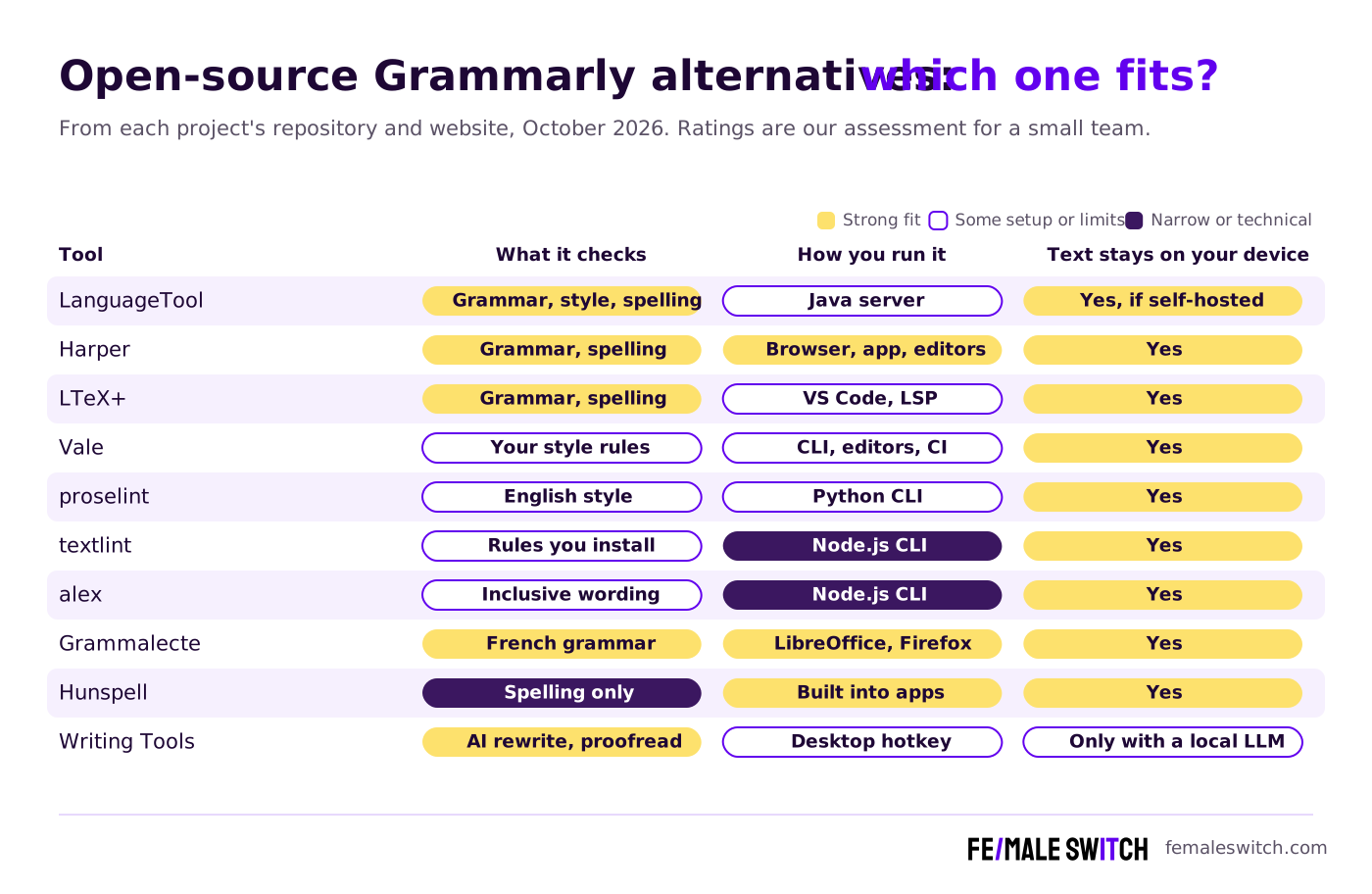
Open-Source Grammarly Alternatives Compared
Sources: each project's official website, GitHub repository, releases and npm or PyPI page, checked 28 October 2026.
Grammar Checker, Style Linter or Spell Checker?
Grammarly does three jobs at once, and open-source tools usually do one. Knowing which job you need saves a lot of trial and error:
- Grammar checkers (LanguageTool, Harper, LTeX+, Grammalecte) find wrong verb forms, missing articles, repeated words and agreement errors, much like Grammarly's free plan.
- Style linters (Vale, proselint, textlint, alex) check your text against rules: weasel words, passive voice, clichés, banned terms or your own brand names. They suit docs, blogs and teams with a style guide.
- Spell checkers (Hunspell, Nuspell) only check spelling, and they already run inside LibreOffice, Firefox and Thunderbird.
- AI rewriters (Writing Tools) send text to a large language model to proofread or rephrase it. They are only private if that model runs on your own machine.
The 10 Best Open-Source Grammarly Alternatives in 2027
1. LanguageTool: the open-source core you can host yourself
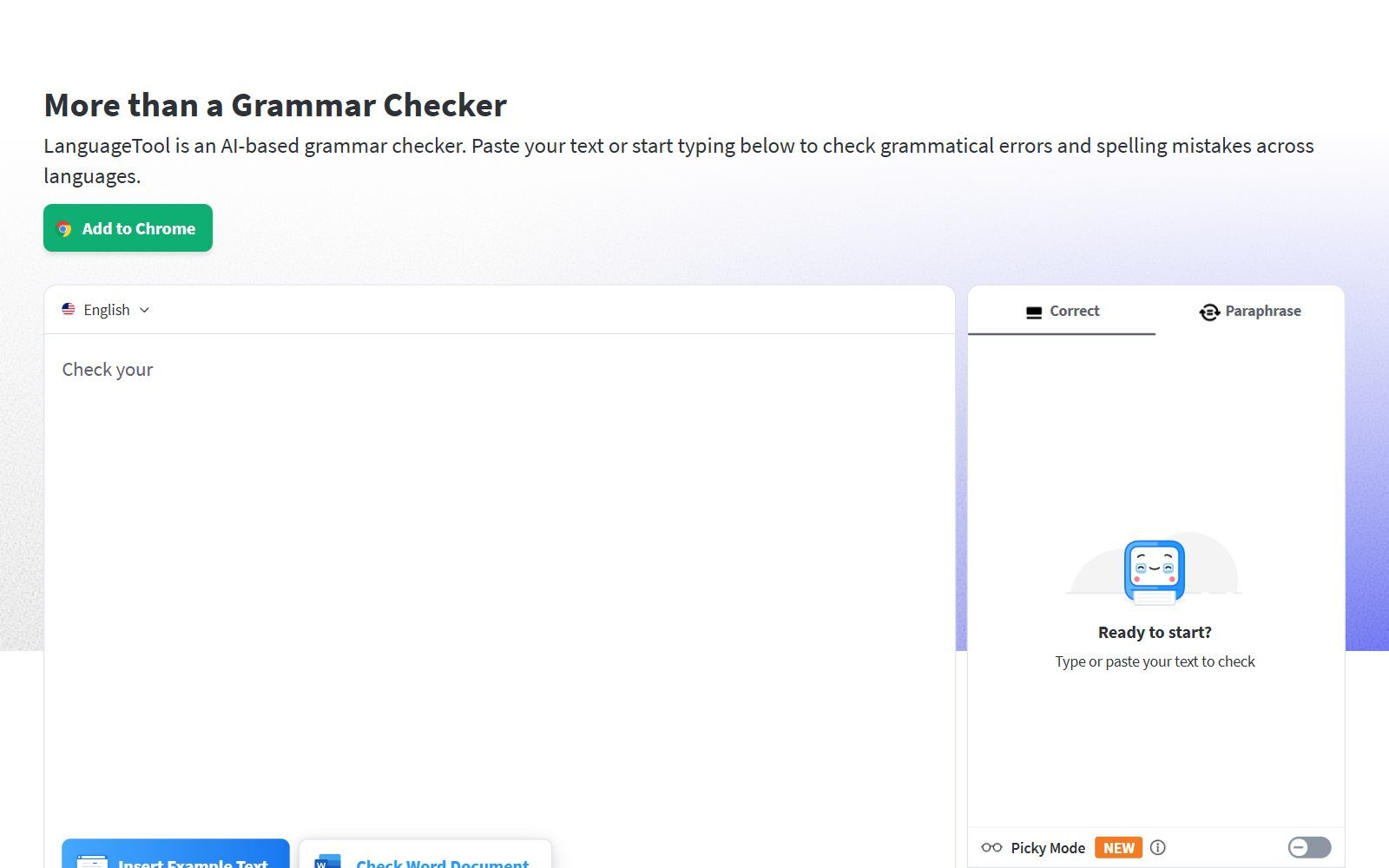
LanguageTool needs a clear label, because the name covers two things. The core engine is open source under LGPL-2.1 on GitHub and checks grammar, style and spelling; its repository describes it as a style and grammar checker for 25+ languages. The hosted service at languagetool.org, with its browser add-ons, is a freemium product: a free Basic plan and a paid Premium plan that adds longer texts, more than 20,000 extra checks, a style guide and unlimited AI paraphrasing. Its website now calls it an AI-based grammar checker.
To use the open-source part, you run LanguageTool as a local HTTP server with Java, following the official server guide, and then choose "Local server" in the browser add-on's experimental settings. The guide is clear about what you lose: the local server has no AI-based rules, which are cloud-only, and no synonyms. Version 6.8 came out on 5 May 2026.
2. Harper: a private grammar checker for English
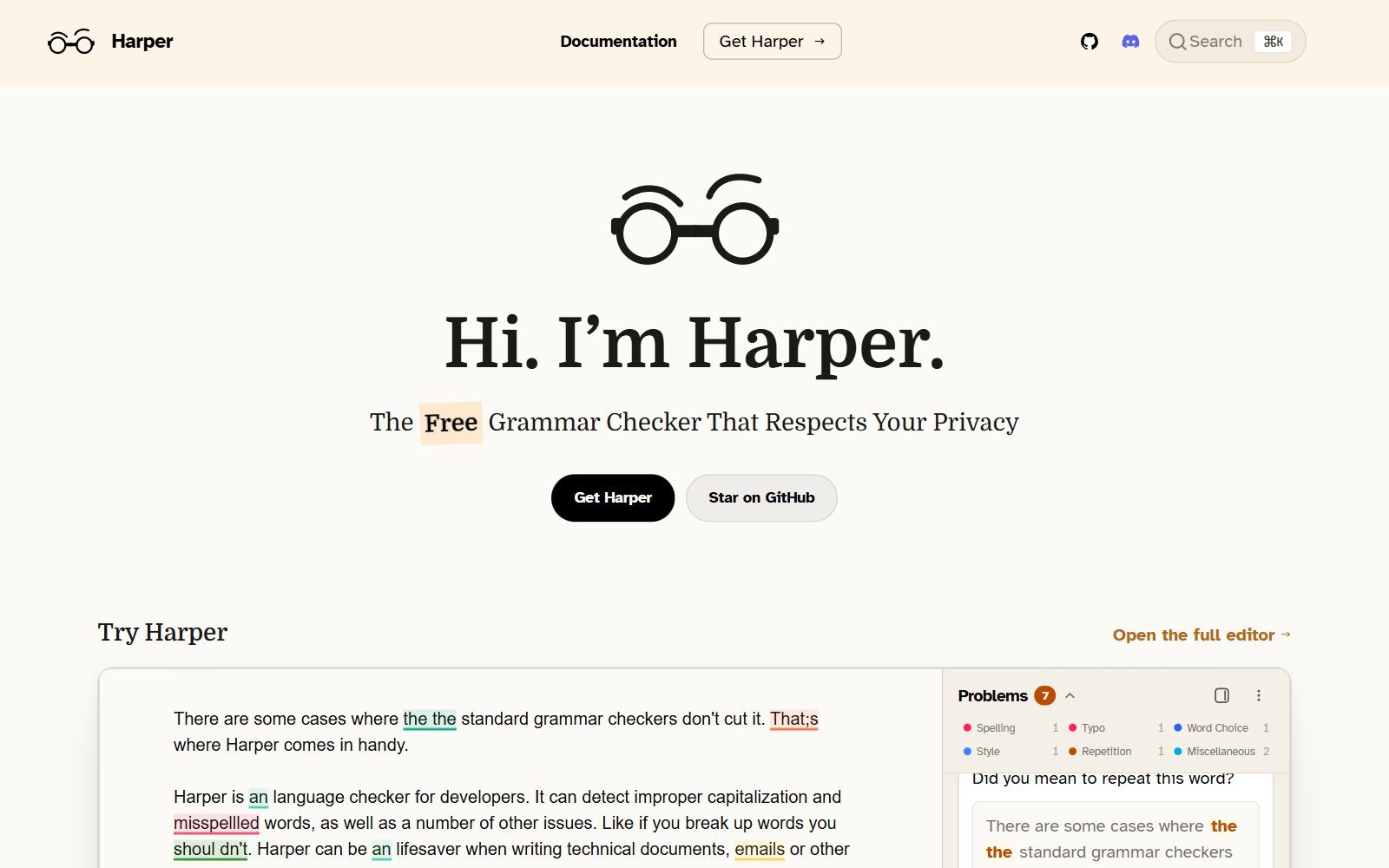
Harper is the closest open-source match for Grammarly's free plan. It calls itself "the private alternative to Grammarly": every check runs on your device, with no cloud round-trip, no telemetry and no LLM, and it catches spelling mistakes, wrong capitalisation, awkward phrasing and broken grammar. The project is Apache-2.0 and lives in Automattic's GitHub organisation; version 3.0.0 came out on 27 October 2026.
It runs almost everywhere: extensions for Chrome, Edge and Firefox, a macOS desktop app for every text field, VS Code, Obsidian, Neovim, a WordPress block-editor plugin and Zed, plus documented setups for Helix, Emacs and Sublime Text. The limit is language: Harper checks English only (American, British, Canadian, Australian and Indian dialects), and its site says other languages are "on the horizon".
3. LTeX+: LanguageTool for LaTeX, Markdown and VS Code
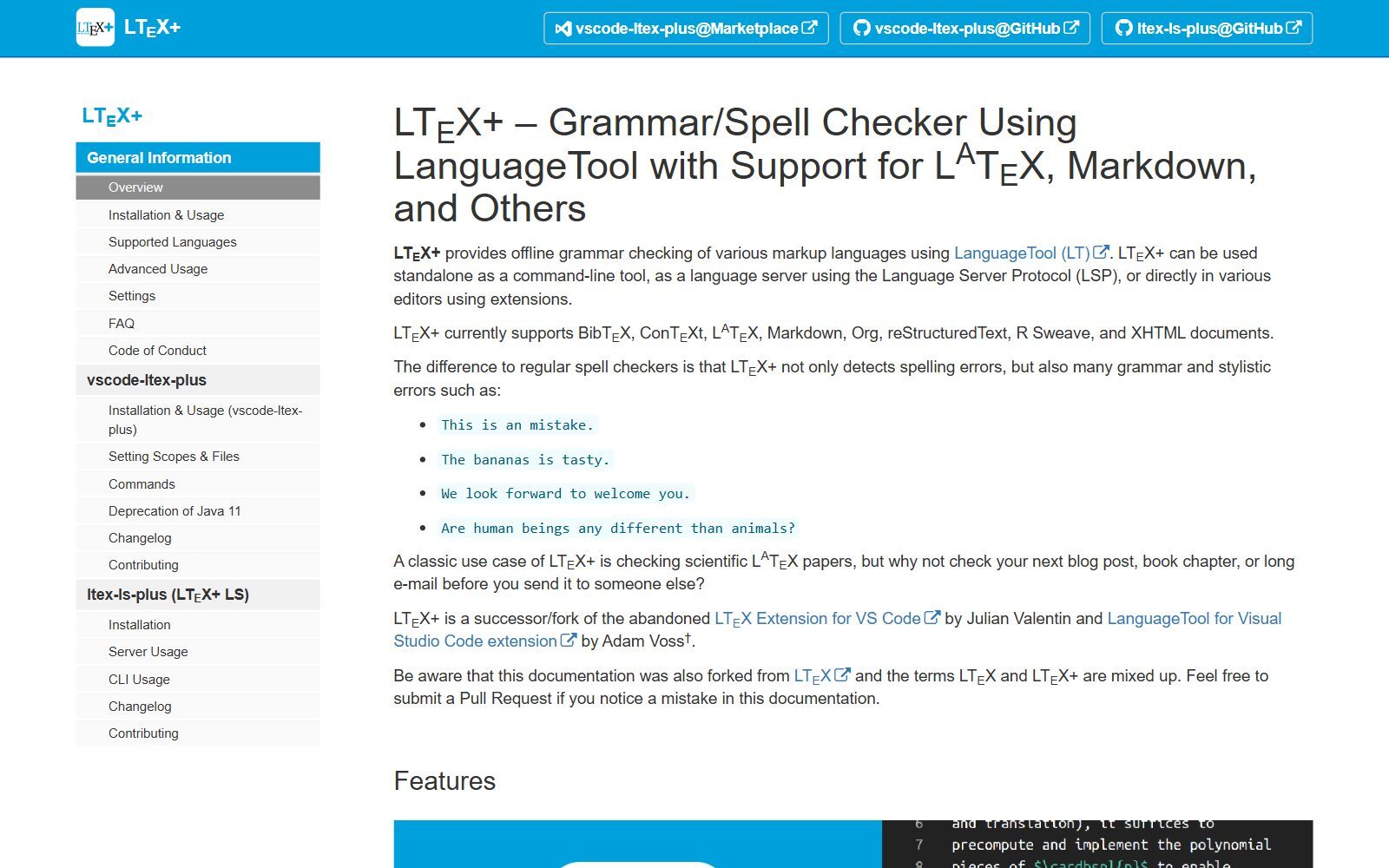
LTeX+ brings LanguageTool's grammar and spell checking into your editor, offline. It ships with LanguageTool bundled, so you do not install Java or a server, and it understands markup: BibTeX, ConTeXt, LaTeX, Markdown, Org, reStructuredText, R Sweave and XHTML, in more than 20 languages. You use it as a VS Code extension, a Language Server Protocol server for other editors, or a command-line tool. LTeX+ is the maintained fork of the original LTeX extension, which is now archived. The language server ltex-ls-plus is MPL-2.0, and version 18.7.0 came out on 13 June 2026.
4. Vale: a style linter that enforces your own writing rules
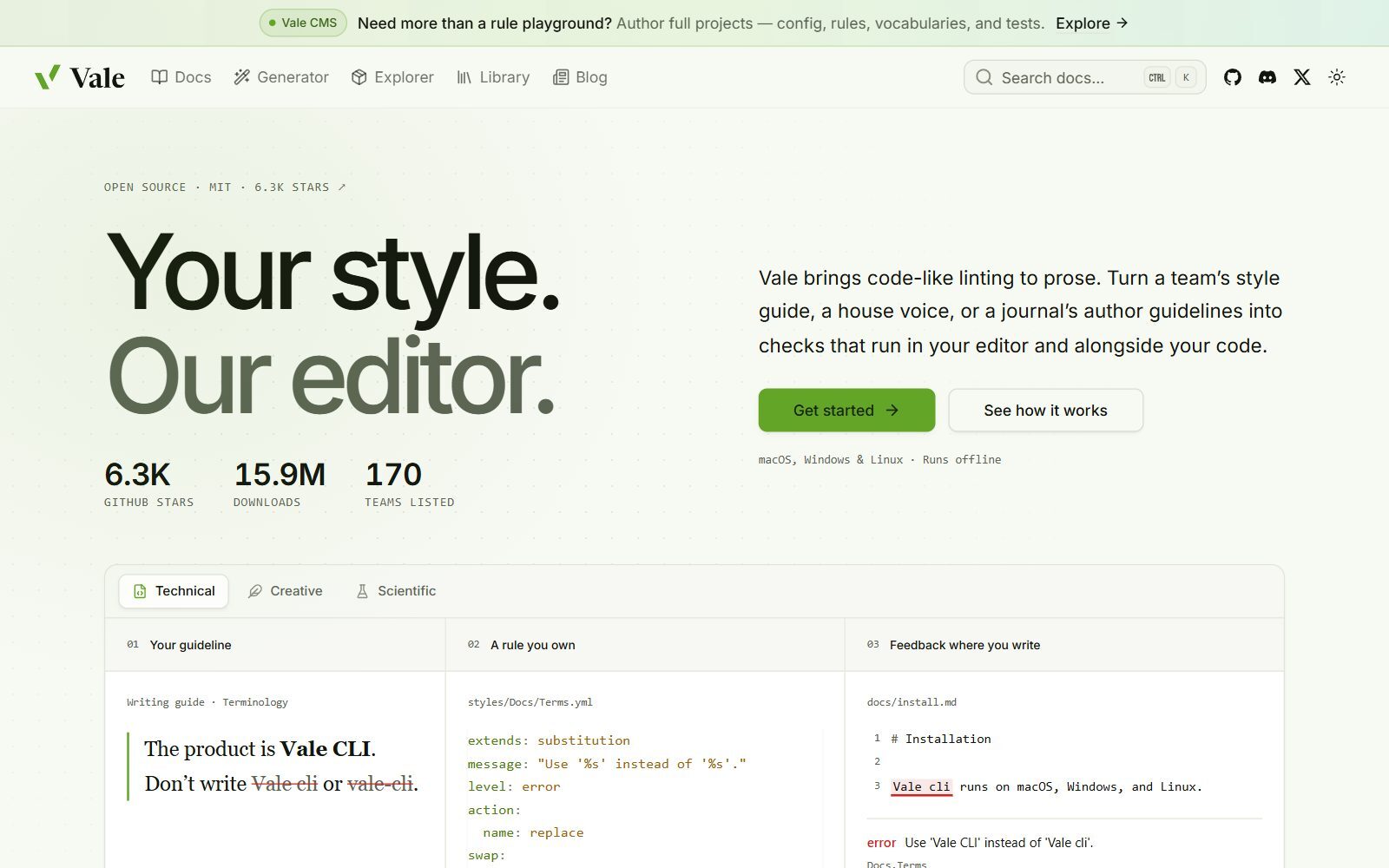
Vale is not a grammar checker; it is a linter that turns a style guide into checks, the way code linters work. You write rules in YAML (for example, "write Vale CLI, not vale-cli") or install ready-made styles; its package explorer lists Microsoft, Google, Red Hat, write-good, proselint, alex, Joblint and Readability. Vale understands markup, so it skips code blocks and URLs in Markdown, AsciiDoc, reStructuredText, HTML and other formats. It is an MIT-licensed single binary for macOS, Windows and Linux that runs offline, with plugins for VS Code, JetBrains IDEs, Neovim, Emacs, Sublime Text, Zed and Obsidian, and it runs in GitHub Actions. Version 3.25.1 came out on 22 October 2026.
5. proselint: an English prose linter built on editors' advice
proselint (BSD-3-Clause) checks English text for style problems such as clichés, jargon and redundancy, based on advice from writers and editors. You install it with pip install proselint and run proselint check text.md, or use it inside Vim, Emacs, Neovim or a pre-commit hook. Version 0.16.0 came out in November 2025, and the project now develops on Codeberg, with GitHub as a mirror. Several older editor plugins, including the VS Code one, are listed as archived or unmaintained.
Validate your startup idea with the unique borrowed authority approach: we publish articles about your product in our blog and you get traffic and testers for your MVP
- Prove Market Demand: See real organic traffic and waitlist conversions
- Unlock High-Potential Keywords: Receive a curated list of top-performing keywords directly from Google Search Console data.
- Estimate Customer Acquisition Cost (CAC): Gain financial foresight with an estimated CAC based on real keyword performance data.
🔗 Start validating your startup now
6. textlint: a pluggable linter for natural language
textlint (MIT) is a JavaScript framework for checking text: it supports Markdown and plain text by default, HTML and other formats through plugins, and you add every check yourself as an npm rule package. Its README is explicit that "textlint has no default rules", so expect to spend time picking rules from the community collection. It suits developer teams that already use Node.js and want writing checks in CI. Version 15.8.0 came out on 1 August 2026.
7. alex: catch insensitive or exclusive wording
alex has one narrow job: it flags gender-favouring, polarising, race-related or other unequal phrasing and suggests alternatives, for example "their" instead of "his". It reads plain text, HTML, MDX and Markdown, installs with npm and is MIT-licensed. Use it as a second check next to a grammar tool, for job ads, product copy and docs. Development is quiet: the latest npm release, 11.0.1, dates from August 2023. Vale offers an alex style, so you can also run its rules there.
8. Grammalecte: open-source grammar checking for French
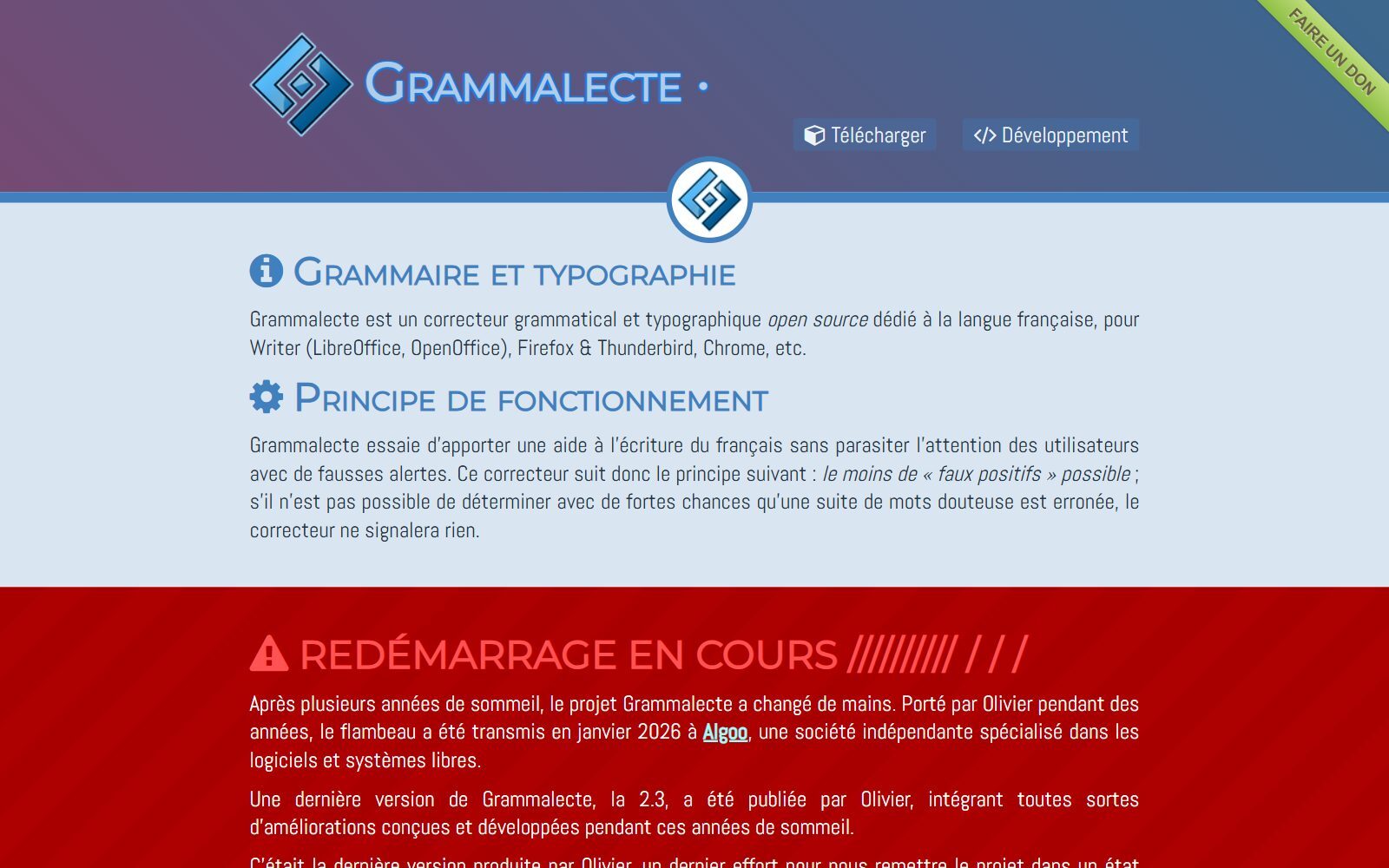
Grammalecte is a GPL-3.0 grammar and typography checker for French, built on a simple principle: as few false alarms as possible. It runs in LibreOffice and OpenOffice Writer, Firefox and Thunderbird, and as a command-line tool, server or Python package; its site says a Chrome version for the new extension system is not ready yet. The project changed hands: in January 2026 its original developer passed it to Algoo, an independent free-software company, after releasing a final version 2.3.0 on 15 December 2025.
9. Hunspell and Nuspell: the spell checkers inside your apps
Hunspell is the spell checker behind LibreOffice, OpenOffice, Firefox, Thunderbird and Google Chrome, and it is also used in macOS and several commercial tools. It is tri-licensed GPL/LGPL/MPL, handles complex morphology and compound words, and has dictionaries for many languages; version 1.7.6 came out on 26 October 2026. Nuspell (LGPL-3.0 or later) is a newer C++ spell checker that reads the same Hunspell dictionaries. Neither checks grammar, so treat them as the base layer: if you write in LibreOffice or Thunderbird, you already have open-source spell checking, and you can add LanguageTool or Grammalecte for grammar.
10. Writing Tools: AI proofreading with the model you choose
Writing Tools is a GPL-3.0 desktop app for Windows, Linux (work in progress) and macOS: select text anywhere, press a hotkey (Ctrl+Space by default), and it proofreads, rewrites, changes the tone, summarises or translates it with a large language model. On Windows and Linux you can use the free Gemini API, Ollama or any OpenAI-compatible endpoint, including local servers such as llama.cpp and vLLM; the macOS version adds Anthropic, Mistral, OpenRouter and on-device MLX. It is the open-source answer to Grammarly's AI rewriting rather than its grammar checks. Your text stays private only if you use a local model. The latest release, from 10 May 2026, is Windows v9 and macOS v6.1.
Join ElonaHunt (like ProductHunt but for women) and explore the coolest women-focused startups out there!
Discover your next big inspiration and connect with like-minded female entrepreneurs!
👉 Join the Hunt Here
Grammarly Alternatives That Are Discontinued or Not Open Source
Several tools from older lists, including the 2025 version of this one, are no longer a good choice:
- After the Deadline: its website says it is no longer actively maintained and the hosted service has been shut down. The source code can still be downloaded to run your own server.
- LTeX (original): the LTeX language server is archived, with a last release in March 2023. Use its successor LTeX+.
- CorrectLy: a small Python research project with no licence on GitHub and a last commit in December 2022.
- UniJump: unijump.app now hosts an unrelated service, and the extension repository we found was last updated in July 2023.
- write-good: the MIT-licensed English linter's latest npm release dates from February 2021. Its checks live on as a Vale style.
- Slick Write and Scribbr Grammar Checker: free online checkers, but not open source.
- Flyspell: still part of Emacs, but an on-the-fly spell checker only. For grammar in Emacs, use Harper, LTeX+ or proselint.
Which Open-Source Grammarly Alternative Should You Choose?
- You want Grammarly-style underlines in the browser, privately: Harper (English).
- You write in several languages: a self-hosted LanguageTool server with the browser add-on, or LTeX+ in your editor.
- You write in Markdown, LaTeX or docs-as-code: LTeX+ for grammar, Vale for your style guide.
- Your team needs consistent wording and product names: Vale, with alex for inclusive language.
- You write in French: Grammalecte.
- You want AI rewriting without a subscription: Writing Tools with a local model through Ollama.
Still deciding about paid tools too? Our tips for Grammarly's AI writer and the list of free AI writing tools cover the hosted options, and our guide to copywriting tools goes beyond grammar.
How Founders Use Open-Source Writing Tools
For a small startup, clean writing shows up everywhere: the landing page, investor emails, help docs and every post that brings in search traffic. A practical setup is Harper or a local LanguageTool server for daily emails and documents, plus Vale in the repository that holds your website copy and docs, so product names and tone stay consistent whoever writes. Pitch decks, grant applications and contracts often contain confidential details, which is the strongest reason to keep checks on your own machine.
Open source works for the rest of the stack too. See our guides to open-source Notion AI alternatives for notes and docs, open-source GitHub Copilot alternatives for coding, open-source Scribe alternatives for step-by-step guides, free Canva Pro alternatives for visuals and free Looker alternatives for dashboards. When your writing is ready to rank, our AI SEO tool helps you plan the articles.
FAQ About Open-Source Grammarly Alternatives
What is the best open-source alternative to Grammarly?
For English in the browser, Harper: it is Apache-2.0, free and runs entirely on your device. For many languages, a self-hosted LanguageTool server with its browser add-on. For editors and Markdown, LTeX+.
Is LanguageTool open source?
The core engine is, under LGPL-2.1 on GitHub, and you can run it as your own server. The hosted service at languagetool.org with Premium plans and AI-based rules is a commercial product; the local server has no AI-based rules or synonyms.
Is there an open-source grammar checker that works offline?
Yes. Harper, LTeX+ and a self-hosted LanguageTool server all check grammar without sending text to the cloud. Vale, proselint, alex and textlint also run offline, but they check style rather than grammar.
Is Harper as good as Grammarly?
Harper covers spelling, capitalisation, awkward phrasing and grammar in English, fast and privately, but it has no AI rewriting and no other languages yet. Many writers use it for everyday checks and a separate tool for rewriting.
Is Grammarly now called Superhuman?
The company is. Grammarly's parent company renamed itself Superhuman on 29 October 2025, and Grammarly is now a product within Superhuman, next to Superhuman Mail, Docs and the AI assistant Superhuman Go.
Is Grammarly free?
Grammarly has a free plan; its plans page lists Free at €0 and a paid Pro plan (€12 in the euro view), plus Enterprise. Your text is processed on Grammarly's servers.
What is the difference between Vale and a grammar checker?
A grammar checker finds language errors. Vale checks your text against style rules you choose, such as banned words, product names or passive voice, and is ideal for docs and team style guides.
Is there an open-source grammar checker for French?
Yes. Grammalecte is a GPL-3.0 French grammar and typography checker for LibreOffice, Firefox and Thunderbird. LanguageTool and LTeX+ also support French.
Can I use an open-source AI to rewrite my text like Grammarly?
Yes. Writing Tools (GPL-3.0) proofreads and rewrites selected text with a hotkey, using the Gemini API, an OpenAI-compatible service or a local model through Ollama.
How can I get my startup featured in articles like this one?
We publish articles about startups and tools that rank in Google and in AI answers. Our marketing services page explains how to get featured and earn a backlink.
About the Author
Violetta Bonenkamp, also known as MeanCEO, is an experienced startup founder with an impressive educational background including an MBA and four other higher education degrees. She has over 20 years of work experience across multiple countries, including 5 years as a solopreneur and serial entrepreneur. Throughout her startup experience she has applied for multiple startup grants at the EU level, in the Netherlands and Malta, and her startups received quite a few of those. She’s been living, studying and working in many countries around the globe and her extensive multicultural experience has influenced her immensely.

