

Hong Kong Tech Startups in 2027: Verified Companies in AI, Robotics, Insurtech, Fintech and Logistics
Hong Kong is a small city with two large public innovation campuses, Hong Kong Science Park and Cyberport, a stock exchange that lists young biotech and tech companies, and the Chinese mainland across the border. That mix shows in its tech companies: AI drug discovery and surgical robots grow out of the universities and the Science Park, while virtual insurers, digital asset firms and delivery apps grow out of the finance and trading economy. The 2026 version of this article listed ten startups, but when we checked them, several turned out to be different companies from the ones described, one had been taken over and one could not be found at all. For this 2027 edition we started again: in October 2026 we checked every company on its own website, that it still operates, that it has a Hong Kong base, what it sells and what it publishes about its funding. Where a company publishes no funding figure, we cite none. The old names and what happened to them are listed near the end.
Quick answer: the Hong Kong tech startups and scale-ups to watch in 2027 are Insilico Medicine (AI drug discovery, listed in Hong Kong since December 2025), Agilis Robotics (flexible surgical robots), Hanson Robotics (the maker of the humanoid robot Sophia), Rice Robotics (delivery and service robots), Bowtie and OneDegree (virtual insurers), Hex Trust (digital asset custody), Lalamove (on-demand delivery) and Epago (fuel cell and electrolyser parts). For support, look at the Cyberport Incubation Programme (up to HK$500,000) and the HKSTP Incubation Programme (up to HK$1.29 million).
Are you getting customers from ChatGPT yet?
More and more traffic is coming from Perplexity, ChatGPT, Grok and other AI tools.
👉 Rank on ChatGPT
Why Hong Kong Matters for Tech Founders in 2027
Three things make Hong Kong different from other Asian startup cities. The first is public infrastructure for startups: Hong Kong Science and Technology Parks (HKSTP) runs the Science Park and several InnoParks, and Cyberport runs a digital tech campus; both offer incubation with funding, and many of the companies below started in one of them. The second is finance: Hong Kong was early with virtual insurance licences and has its own rules for trust companies that hold digital assets, which is why insurtech and digital asset firms cluster here. The third is the capital market: Insilico Medicine listed on the Hong Kong Stock Exchange in December 2025, and our list of China startups to watch shows several mainland AI and robotics companies preparing Hong Kong listings.
For the wider region, compare our guides to startup incubators in Asia, early-stage VCs in Asia and the best countries for AI startups.
Hong Kong Tech Startups in 2027 Compared
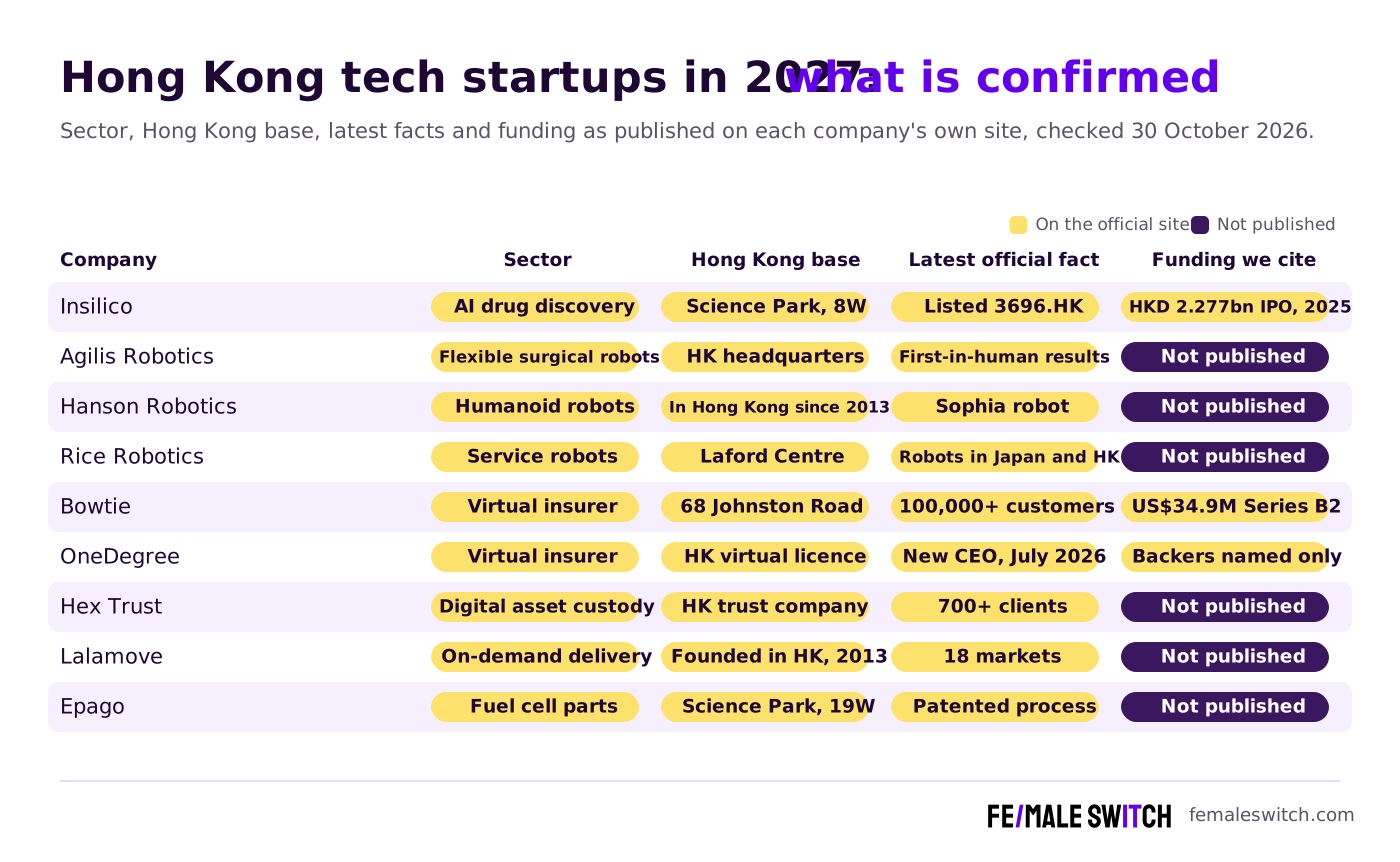
Sources: each company's official website, news page or press release, checked 30 October 2026. Amounts are in the currency of the announcement.
The Hong Kong Tech Startups to Watch in 2027
1. Insilico Medicine: AI drug discovery from the Science Park
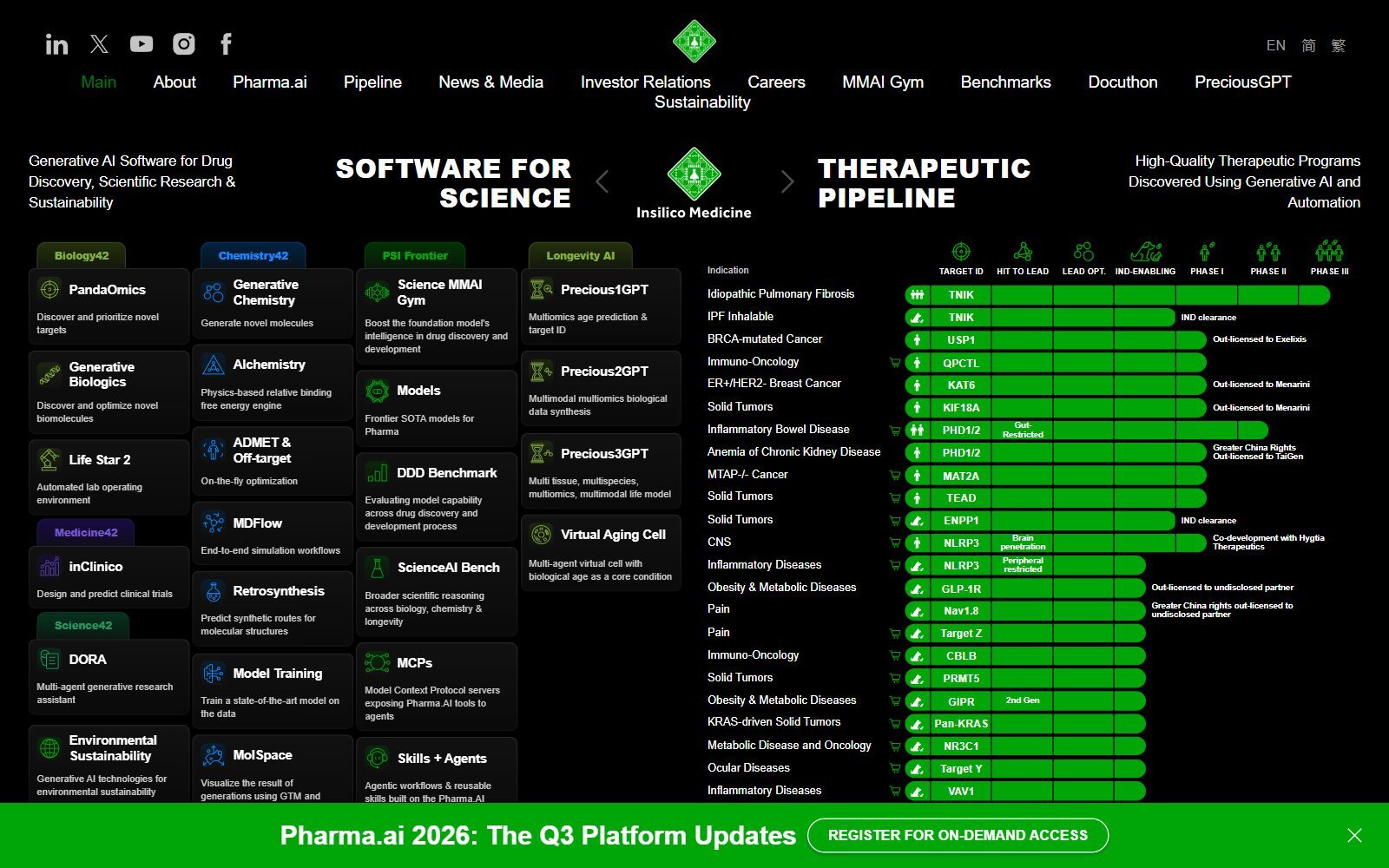
Insilico Medicine sells Pharma.AI, a set of generative AI tools for drug discovery (PandaOmics for finding targets, Chemistry42 for designing molecules, inClinico for predicting trials and more), and uses them to build its own drug pipeline. Its Hong Kong office is in Building 8W of Hong Kong Science Park, next to offices in Cambridge (Massachusetts), Abu Dhabi and Shanghai. According to the company, it was founded in the United States in 2014 by Alex Zhavoronkov, and on 30 December 2025 it listed on the Main Board of the Hong Kong Stock Exchange under the stock code 3696, raising HKD 2.277 billion with 15 cornerstone investors including Lilly, Tencent, Temasek and Schroders. Its most advanced drug, rentosertib for idiopathic pulmonary fibrosis, completed a Phase IIa trial in China in 2024, with results published in Nature Medicine in May 2025. It is still an experimental medicine.
Lesson for founders: Insilico sells software and develops drugs with it at the same time. Licensing deals for its own drug candidates bring in money long before any drug reaches patients.
Best for: founders in AI for science, biotech and health tech who want to see how a research-heavy company reaches a public listing in Hong Kong.
2. Agilis Robotics: surgery without external cuts
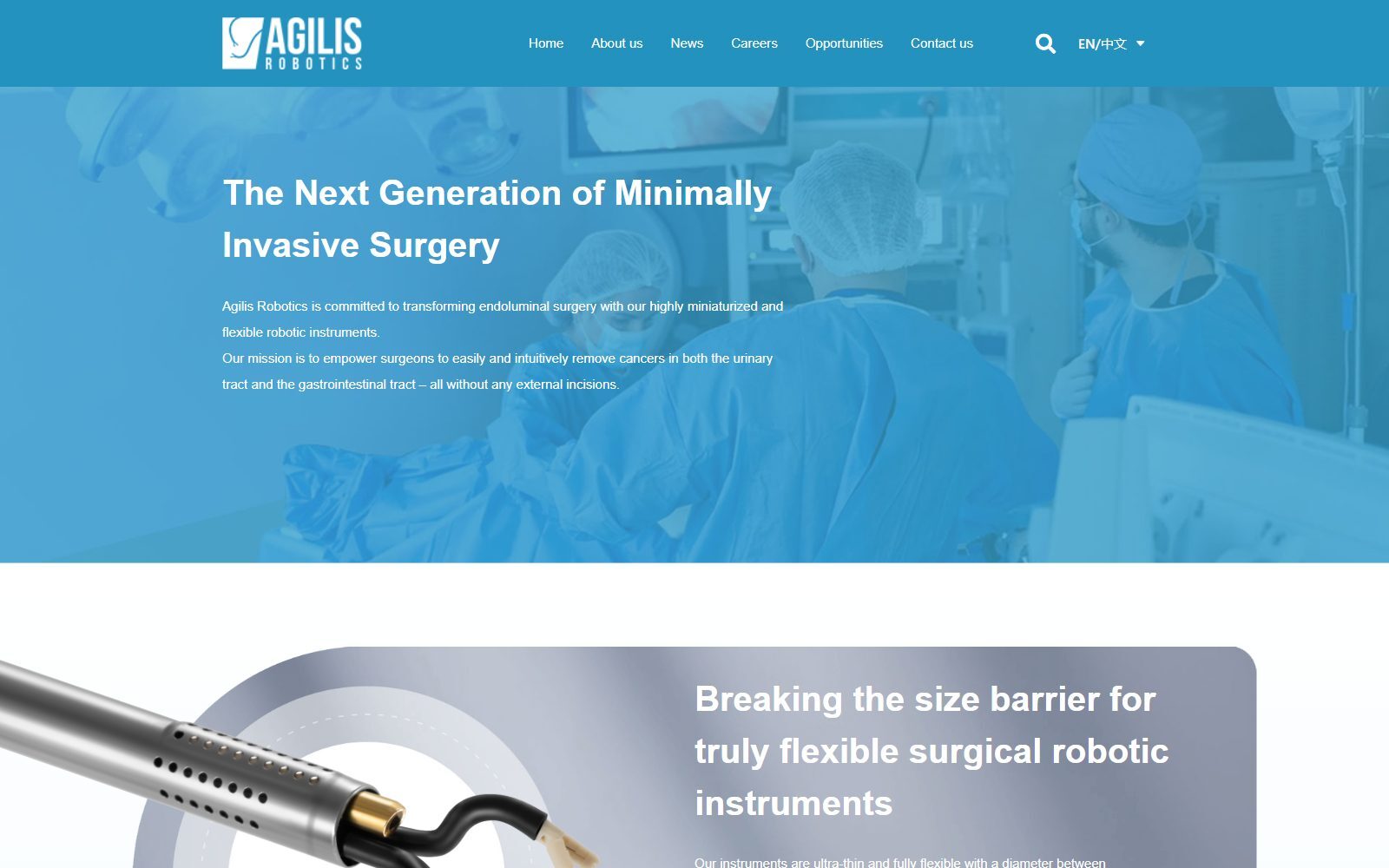
Agilis Robotics builds miniaturised, fully flexible robotic instruments, 2.8 to 3.5 mm in diameter, that let surgeons remove cancers in the urinary and digestive tracts from the inside, without external incisions. It has its headquarters in Hong Kong, a company in Guangzhou and a US company in Boston; its co-founders include Ka-Wai Kwok and the surgeon Jason Y.K. Chan. In September 2026 it announced that the first-in-human results of its Intilume system, used to remove bladder tumours in one piece through the urethra, were published in European Urology, with no bladder perforation during surgery; it thanks the team at the Chinese University of Hong Kong. Its site lists HKSTP, Annoland Technology, a Hong Kong single family office and a US-listed multinational as investors, but no amounts, and it says the device is not yet approved or cleared for sale.
Lesson for founders: in medical devices, clinical evidence published in a top journal is the milestone that opens doors to regulators, hospitals and later-stage investors.
Best for: founders in medtech and robotics, especially those spinning out of a university lab with clinicians on the founding team.
Boost Your SEO by Getting Featured in Our Blogs and get a backlink.
We publish content about startups, education, tech, funding, etc. that ranks well not only in Google but also in Perplexity, ChatGPT, Grok and other AI tools.
👉 Get featured now!
3. Hanson Robotics: the maker of Sophia
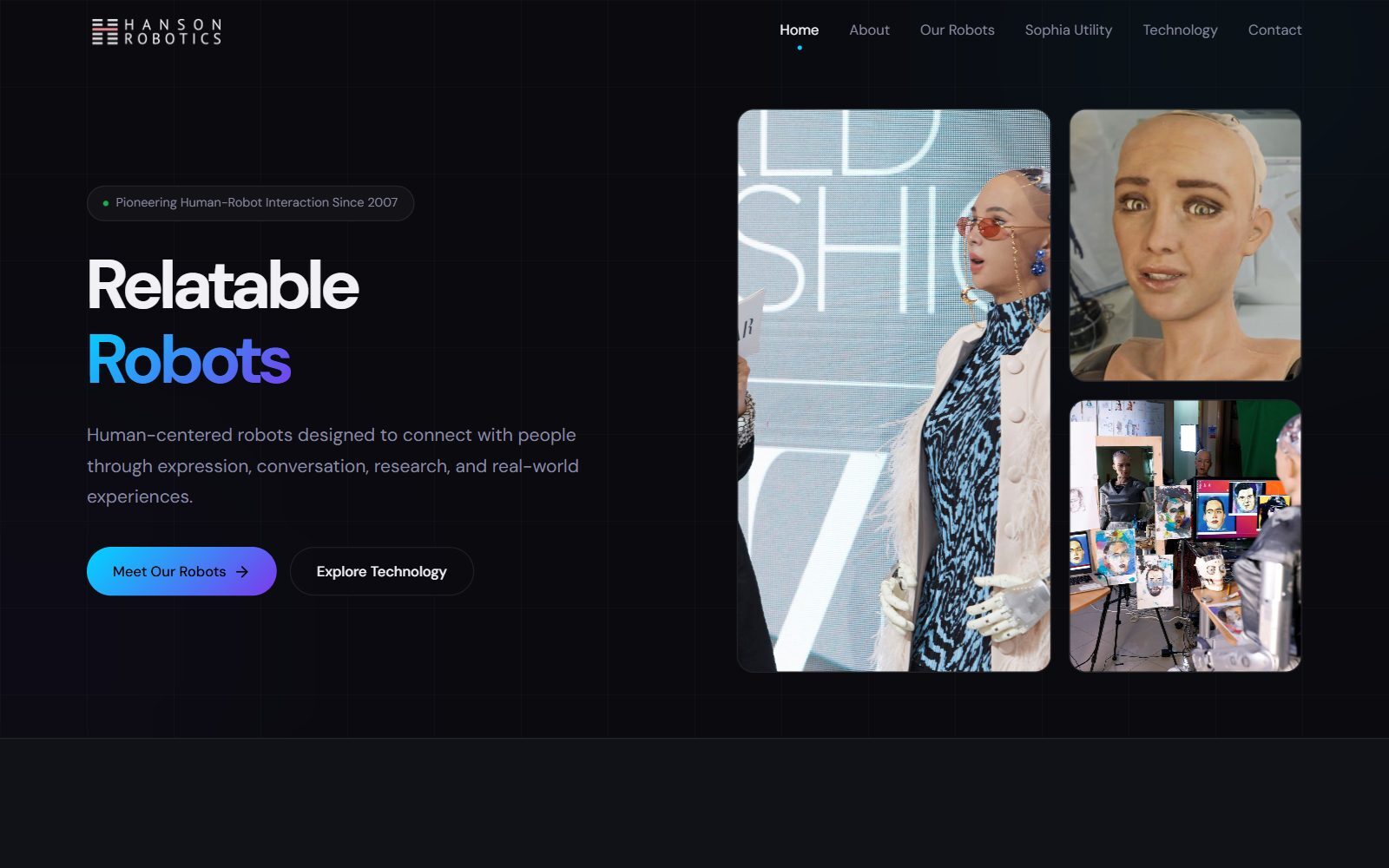
Hanson Robotics describes itself as a Hong Kong-based AI and robotics company that builds socially intelligent, human-like robots. David Hanson founded it in 2007 in Dallas, Texas, and moved it to Hong Kong in 2013. Its best-known robot, Sophia, was activated in 2016; the company followed with Little Sophia for STEM education in 2019 and a Sophia Beta with an SDK for researchers and developers in 2020. It does not publish funding figures, so we cite none.
Lesson for founders: Hanson turned one robot into a global brand. A memorable product that people talk about can do more for awareness than any marketing budget, but you still need a business model behind it.
Best for: founders in robotics, human-robot interaction and AI for education or entertainment.
4. Rice Robotics: service robots for buildings in Hong Kong and Japan
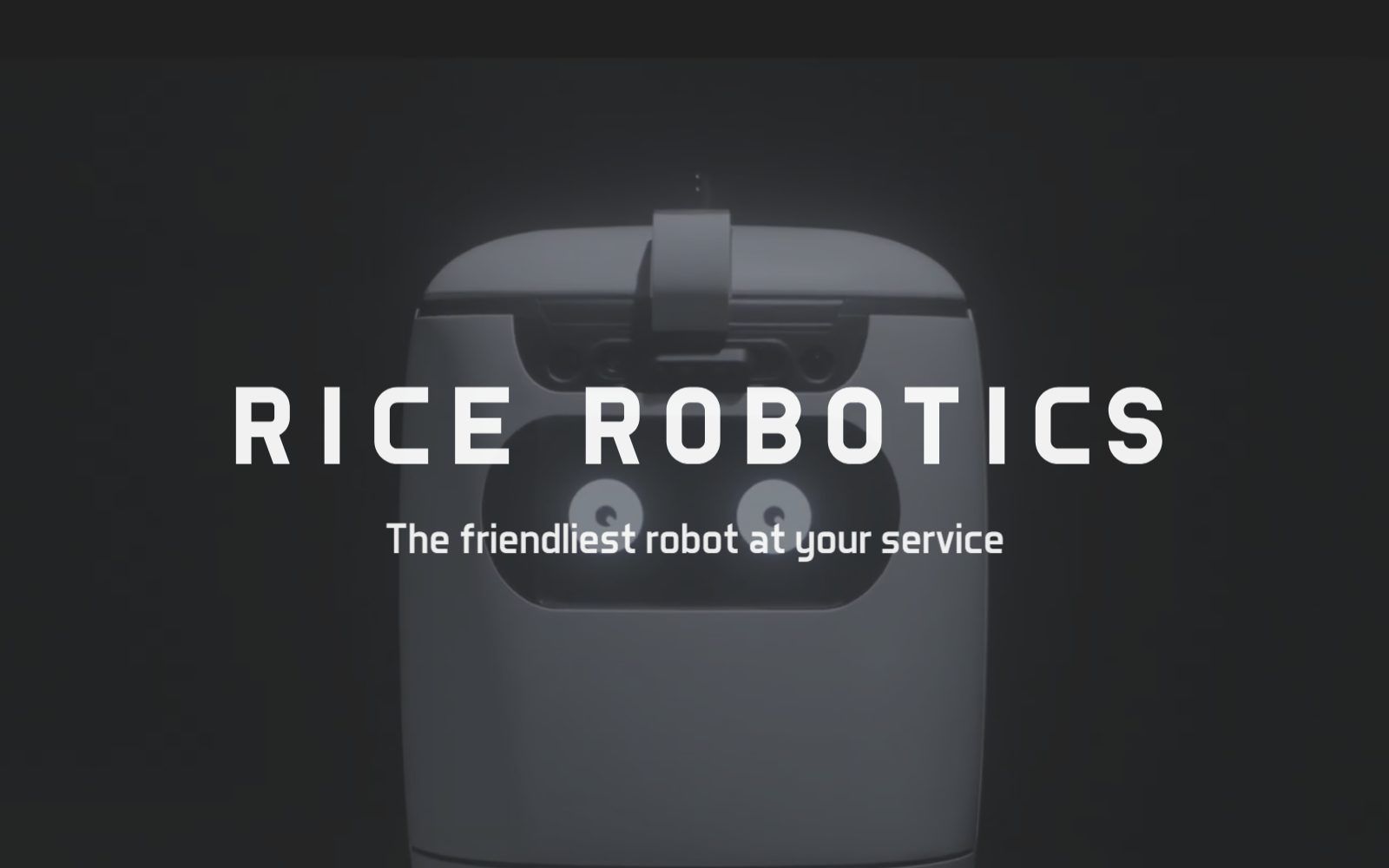
Rice Robotics makes small service robots for delivery, disinfection, security patrols and AI chat, managed through its RiceCore cloud platform, which shows the location, battery level and status of each robot in a fleet. Its Hong Kong office is at the Laford Centre in Cheung Sha Wan, and it has a second office in Tokyo. According to its blog, its delivery robot RICE has been bringing 7-Eleven products to employees at SoftBank's Tokyo headquarters since January 2021, and it lists clients such as Japan Post, Mitsui Fudosan, Sino Group and K11 Musea. Cyberport lists it among the former incubatees of its incubation programme. It does not publish funding figures.
Lesson for founders: Rice Robotics found its biggest showcase outside Hong Kong. For hardware startups from a small home market, an early reference customer abroad can matter more than local scale.
Best for: founders in robotics, proptech and retail tech who want to sell to building owners and large chains.
5. Bowtie: Hong Kong's first virtual insurer
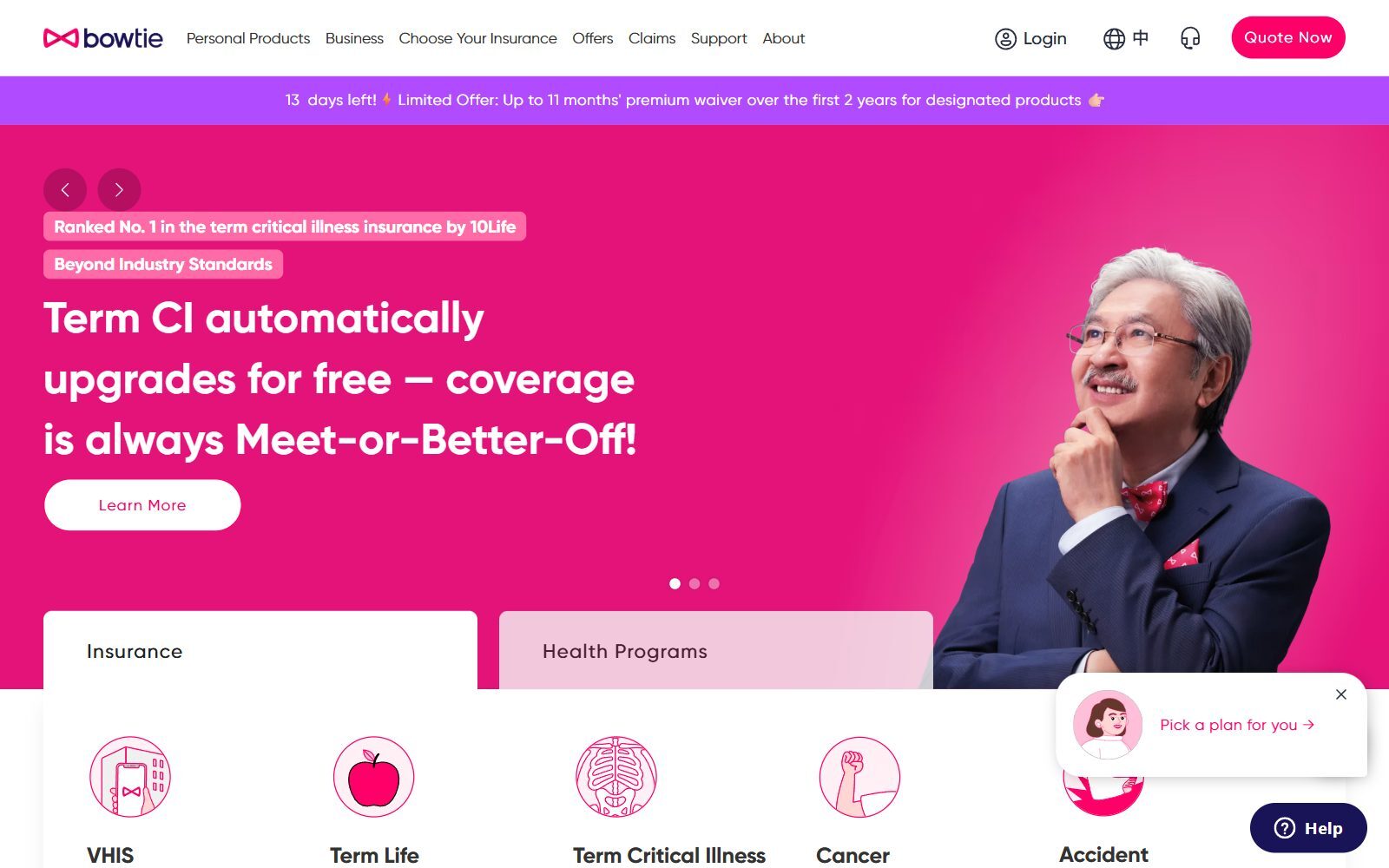
Bowtie sells health and life insurance online without agents: hospital cover under Hong Kong's Voluntary Health Insurance Scheme, term life, critical illness, cancer, accident and group medical plans. According to its press release of 14 September 2023, it was the first company authorised by Hong Kong's Insurance Authority under its Fast Track Pilot Scheme, and it raised a US$34.9 million Series B2 led by Sun Life Hong Kong with Mitsui & Co., taking its total funding to more than HK$680 million. Its site says it is trusted by over 100,000 customers, and its office is in the Bowtie Life Insurance Tower at 68 Johnston Road, Wan Chai. It is also a former Cyberport incubatee.
Lesson for founders: in a regulated market, a new licence can be the opening. Bowtie was ready with a product when the regulator created a fast track for online insurers.
Best for: founders in insurtech, health tech and any regulated consumer business.
Boost Your SEO by Publishing Your Startup Press Release with us.
We publish content about startups, education, tech, funding, etc. that ranks well not only in Google but also in Perplexity, ChatGPT, Grok and other AI tools.
👉 Publish Press Release
6. OneDegree: a virtual insurer that grew through pet cover
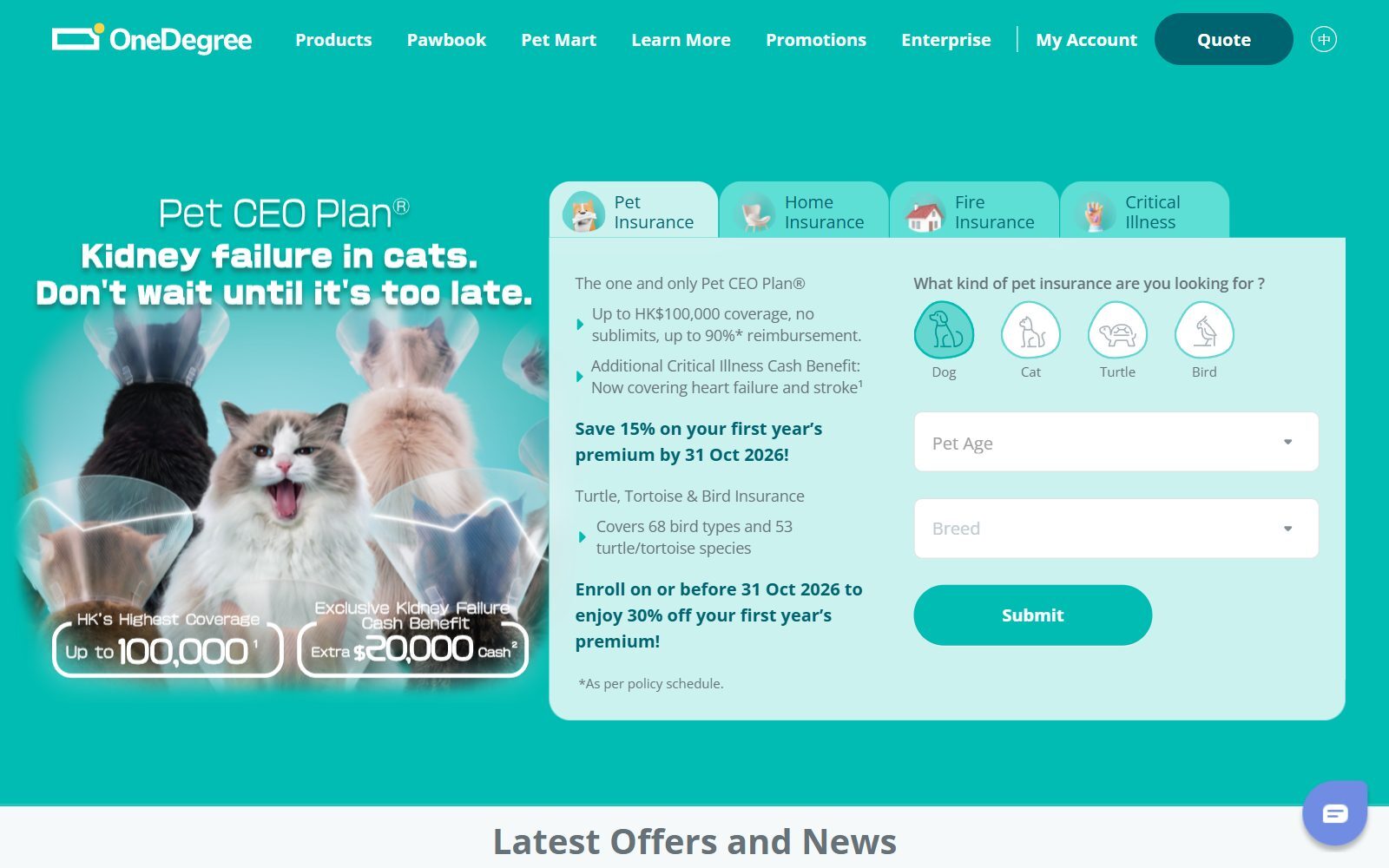
OneDegree was founded in 2016 and says it was one of the first companies in Hong Kong to receive a virtual insurance licence from the Insurance Authority. It sells pet, home, home appliance warranty, fire and critical illness insurance, runs the Pawbook pet health app, and offers cyber and digital asset insurance to businesses through separate sites. Its pet insurance launched in April 2020, and its Pet CEO Plan offers up to HK$100,000 of cover. OneDegree is a Cyberport incubation alum and names BitRock Capital and Cathay Venture among its backers, without amounts. On 13 July 2026 it promoted Emily Chow to Chief Executive, in a release that credits her four years at the company with more than sixfold revenue growth and full-year profitability.
Lesson for founders: OneDegree won a niche, pets, that larger insurers served poorly, and built an app around it. A focused niche can carry a young company to profitability.
Best for: founders in insurtech, pet tech and consumer apps for a clearly defined audience.
7. Hex Trust: custody for digital assets
Hex Trust was founded in 2018 and provides regulated custody, trading, lending, staking and payment services for digital assets to foundations, financial institutions and wealthy individuals. Its trust centre lists a trust company registration under Hong Kong's Trust Ordinance and a Trust or Company Service Provider licence, plus a Major Payment Institution licence from the Monetary Authority of Singapore and registrations in Dubai. The site states more than 700 clients and $5 billion in assets under custody. It does not publish funding figures.
Lesson for founders: in a young, risky market, licences and security certifications are the product. Hex Trust leads with them on its own site.
Best for: founders in fintech, Web3 and other businesses where trust and regulation decide who wins.
8. Lalamove: a Hong Kong delivery app that went global
Lalamove was founded in Hong Kong in 2013 as an on-demand delivery platform: individuals, small businesses and companies book a van, truck or motorcycle with a professional driver partner in an app. It now says it operates in 18 markets across Asia, Latin America and Europe, the Middle East and Africa. It is no longer an early-stage startup, but it shows how far a Hong Kong consumer app can travel. It does not publish funding figures on its site.
Lesson for founders: Lalamove solved a simple, daily problem in a dense city and then repeated the model city by city. Dense home markets are good test labs for logistics ideas.
Best for: founders in logistics, marketplaces and gig-economy platforms.
Is your startup on ChatGPT?
More and more traffic is coming from Perplexity, ChatGPT, Grok and other AI tools.
👉 Rank on ChatGPT
9. Epago: parts for fuel cells and electrolysers
Epago makes membrane electrode assemblies, the core part of PEM fuel cells and electrolysers, and electrochemical dehumidification for wind turbines, gas streams and buildings. It cites more than 10 years of experience in electrochemistry and catalysis and a patented process for controlling metal nanoparticles, and its contact page gives an address in Building 19W of Hong Kong Science Park. It is a small company and publishes no funding, team or customer figures, so we only report what its site says.
Lesson for founders: deep tech hardware startups can sell components to larger hydrogen projects long before they build a full system of their own.
Best for: founders in hydrogen, materials and climate hardware.
Where Hong Kong Tech Startups Get Support
- Cyberport Incubation Programme: for digital tech companies limited by shares, incorporated in Hong Kong less than 7 years before the deadline (or being incorporated), with founders holding at least 51%. Over 24 months, incubatees receive up to HK$500,000 in financial assistance, a HK$200,000 on-site rental subsidy, rent-free workspace on site and access to Cyberport's investor and mentor networks. Its timeline lists 1 December 2026 as the deadline for the February 2027 intake, but the page also says the programme is being enhanced and that the next intake will open soon, so check the page before you apply. Teams that are not incorporated yet can start with the Cyberport Creative Micro Fund. Klook, GOGOX, Snapask, Bowtie, OneDegree and Rice Robotics are among its former incubatees.
- HKSTP Incubation Programme: a 3-year, on-site programme at Hong Kong Science Park for tech startups with an MVP or prototype in ICT, electronics, green technology or precision engineering, with up to HK$1.29 million for technology and business development, labs, mentors and a rental subsidy. Applications are open all year, rejected teams can re-apply after three months, and overseas founders first need a Hong Kong business registration. Biotech teams have a separate Incu-Bio programme.
- StartmeupHK: an initiative of InvestHK, the government's investment promotion agency, that helps founders from overseas set up in Hong Kong, lists funding schemes, incubators and investor networks, and runs the StartmeupHK festival together with Hong Kong FinTech Week.
- Universities: Agilis Robotics works with clinicians from the Chinese University of Hong Kong, and HKUST's entrepreneurship centre incubates companies such as Allegrow Biotech. If you study or research in Hong Kong, start with your university's technology transfer office.
Hong Kong Companies From the Old List That Changed or Could Not Be Verified
The 2026 version of this article listed ten companies, several with descriptions that did not match the real company. Agilis Robotics, Epago, OneDegree and Hanson Robotics are still operating in Hong Kong and are in the list above. Here is what we found for the others:
- dumbChat.ai: a real WhatsApp CRM and chatbot tool for small businesses that says it is "Proudly made in Hong Kong", but its copyright line names a company in Shenzhen's Qianhai zone and it publishes no funding. We removed the old claim that it is a leader in AI communication.
- QickGenerate: its site now presents "QuickGenerate Tech", AI 3D scanning and digital twins, with no address or company details, so we could not verify the old 4D construction scheduling description.
- Allegrow: not an agritech company. According to HKUST, Allegrow Biotech works on cell manufacturing for cell therapy and was incubated at the HKUST Entrepreneurship Center.
- Stellerus: not a blockchain fintech. According to HKUST, Stellerus Technology is building the Feilian satellite constellation to measure 3D wind data and won the Platinum Award at the HKUST-SINO One Million Dollar Entrepreneurship Competition 2025.
- ASA Robotics: according to announcements by the US company ModuLink, ModuLink completed the purchase of a 60% stake in this Hong Kong robotics company on 23 April 2026.
- Forge: we found no Hong Kong AI finance company under this name, so we removed it.
We also removed the old article's unsourced claims, such as companies being "leaders" or gaining "massive traction", and its generic marketing sections.
Which Hong Kong Startup Should You Learn From?
- You build AI for science or health: study Insilico Medicine, which combines software sales with its own drug pipeline.
- You spin out of a university or hospital: study Agilis Robotics and its path from clinical study to publication.
- You build hardware for buildings or retail: study Rice Robotics and its reference customers in Japan.
- You want to enter a regulated market: study Bowtie and OneDegree, which used Hong Kong's virtual insurance licences.
- You build in fintech or Web3: study Hex Trust and how it puts its licences first.
- You build a marketplace or logistics app: study Lalamove, which grew from one dense city to 18 markets.
- You build climate hardware: look at Epago, and at HKSTP's labs and green technology focus.
How Founders Use Hong Kong's Startup Scene
Notice where these companies started: Bowtie, OneDegree and Rice Robotics came through Cyberport, Insilico and Epago sit in the Science Park, and HKSTP is among Agilis Robotics' investors. If you build technology in Hong Kong, apply to these programmes early, and compare them with the incubators, accelerators and investors in our guides to accelerators for AI startups, VCs for AI startups, deep tech VCs in Asia and angel investors for AI startups. Non-dilutive money helps too: see our lists of grants for early-stage startups, which also covers Cyberport, and grants for women entrepreneurs in Asia.
To meet founders and investors in person, check the startup events in Hong Kong and in Singapore. Comparing cities? See our lists of startups in Shenzhen, startups in Singapore, Abu Dhabi startups to watch, Rotterdam startups to watch, Beirut startups to watch and Honolulu startups to watch.
Before you copy any of these business models, validate your startup idea with real customers. Tech founders often leave marketing until a funding round depends on it, so start early: list your startup in the F/MS marketing directories, publish your startup press release, and write about your product with the F/MS AI SEO Tool or the AI SEO Blog so customers, investors and AI assistants can find you.
FAQ About Hong Kong Tech Startups in 2027
Which Hong Kong tech startups should I watch in 2027?
Our verified list: Insilico Medicine, Agilis Robotics, Hanson Robotics, Rice Robotics, Bowtie, OneDegree, Hex Trust, Lalamove and Epago. Each still operates and shows a Hong Kong base on its official site, checked in October 2026.
Which Hong Kong tech company raised the most money recently?
Among the companies we checked, Insilico Medicine, which raised HKD 2.277 billion when it listed on the Hong Kong Stock Exchange on 30 December 2025, according to the company.
Is Insilico Medicine still a startup?
It is now a listed company (stock code 3696), but it still invests heavily in research and has no approved drug yet. Its lead candidate, rentosertib, is still experimental.
Which Hong Kong startups work in robotics?
Agilis Robotics (flexible surgical robots, not yet approved for sale), Hanson Robotics (humanoid robots such as Sophia) and Rice Robotics (delivery, disinfection and patrol robots used in Hong Kong and Japan).
What is a virtual insurer in Hong Kong?
An insurer licensed by the Insurance Authority to sell directly online without agents. Bowtie says it was the first company authorised under the Authority's Fast Track Pilot Scheme, and OneDegree says it was one of the first to receive a virtual insurance licence.
How much funding does the Cyberport Incubation Programme give?
Up to HK$500,000 in financial assistance over 24 months, plus a HK$200,000 on-site rental subsidy, for Hong Kong digital tech companies under 7 years old. Cyberport says the programme is being enhanced, so check its page for the next intake.
How much funding does the HKSTP Incubation Programme give?
Up to HK$1.29 million over a 3-year, on-site programme at Hong Kong Science Park, for tech startups with an MVP or prototype. Applications are open all year.
Can foreign founders start a tech company in Hong Kong?
Yes. HKSTP accepts applications from abroad once you have a Hong Kong business registration, Cyberport requires a Hong Kong-incorporated company, and InvestHK's StartmeupHK helps overseas founders set up.
What happened to the companies from the old list?
Agilis Robotics, Epago, OneDegree and Hanson Robotics are still here. Allegrow and Stellerus turned out to be different companies from the ones described, ASA Robotics is now majority-owned by ModuLink, and we could not verify QickGenerate or find Forge.
Where can I get a backlink by writing about my startup?
You can publish a guest post in one of the Fe/male Switch startup blogs, which rank in Google and in AI tools. Get a quality backlink.
About the Author
Violetta Bonenkamp, also known as MeanCEO, is an experienced startup founder with an impressive educational background including an MBA and four other higher education degrees. She has over 20 years of work experience across multiple countries, including 5 years as a solopreneur and serial entrepreneur. Throughout her startup experience she has applied for multiple startup grants at the EU level, in the Netherlands and Malta, and her startups received quite a few of those. She’s been living, studying and working in many countries around the globe and her extensive multicultural experience has influenced her immensely.

