

Tucson Startups to Watch in 2027: 7 Verified Tucson Companies in Diagnostics, Biotech, Radar, Space and Semiconductor Tools
Tucson's young tech companies grow out of one place more than any other: the University of Arizona. Its optical sciences, medicine and cancer research labs produce the technology, Tech Launch Arizona turns it into licences and companies, and the UA Tech Park on Rita Road gives many of them their first office. The 2026 version of this article listed ten names, but most did not hold up: one was bought by Workday, one left autonomous trucking and changed its name, several are not based in Tucson, and for four we found no official website at all. For this 2027 edition we started again and checked every company on its own website, or in a University of Arizona release, in November 2026: that it still operates, that it gives Tucson as its headquarters or office, what it builds and what it publishes about its funding. What happened to the old names is listed near the end.
Quick answer: the Tucson startups to watch in 2027 are Precision Epigenomics (a multi-cancer early detection blood test), NuvOx Therapeutics (an oxygen therapeutic for stroke and brain cancer), ProxyBio (organoids and AI to predict cancer drug response), Aqualung Therapeutics (an antibody for lung inflammation and fibrosis), Lunewave (lens-based radar for cars), Paramium Technologies (satellite ground stations as a service) and Fringe Metrology (surface measurement for telescopes and chip wafers). ProxyBio's $3.5 million investment in May 2026 is the latest round on this list with a published amount. For support, start with Tech Launch Arizona, the University of Arizona Center for Innovation and Startup Tucson.
Are you getting customers from ChatGPT yet?
More and more traffic is coming from Perplexity, ChatGPT, Grok and other AI tools.
👉 Rank on ChatGPT
Why Tucson Matters for Founders in 2027
Five of the seven companies below are built on University of Arizona research or were founded by its scientists, and Paramium works from the UA Tech Park on Rita Road. According to Tech Launch Arizona, the university's commercialization office, its innovators filed 372 invention disclosures in fiscal year 2026 (July 2025 to June 2026), the office completed 87 licences and options and helped launch 11 startups, and it has launched more than 160 companies in total, 71% of which are still active or have been acquired. That pipeline explains the list: many Tucson startups sell to hospitals, drug developers, car makers and chip makers, and most of them need years of research and grants before their first sale.
We removed the old article's claims that Tucson is a leading hub for healthcare, agriculture, aerospace and renewable energy startups, because it gave no source. For the wider picture, compare our guides to the best startup cities in North America and our city lists for El Paso, San Diego, Oklahoma City and Omaha.
Tucson Startups to Watch in 2027 Compared
Sources: each company's official website and news page, and Tech Launch Arizona releases, checked 1 November 2026.
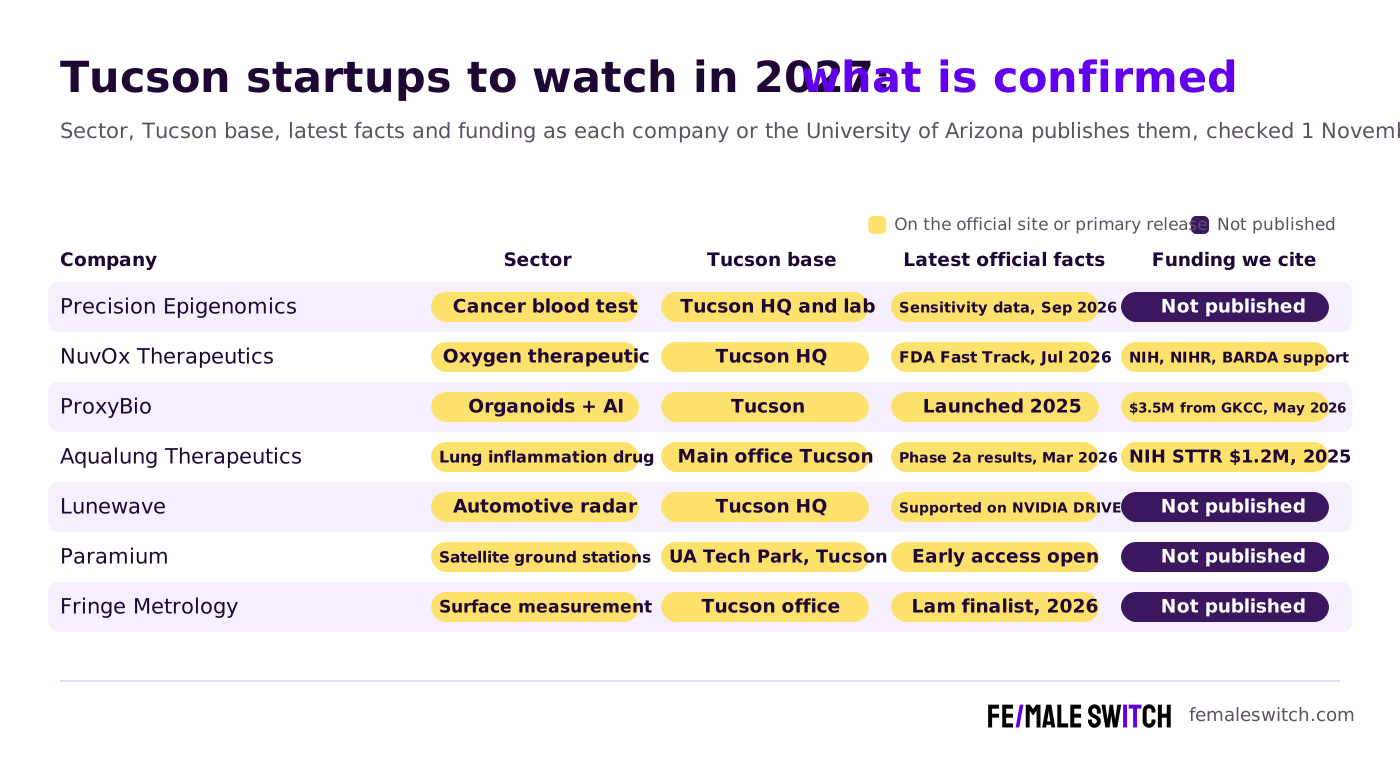
The Tucson Startups to Watch in 2027
1. Precision Epigenomics: a multi-cancer early detection blood test
Precision Epigenomics sells EPISEEK, a multi-cancer early detection test that looks for DNA changes linked to more than 80 types of cancer in a simple blood draw. Samples go to the company's CAP-accredited, CLIA-certified lab, and results come back in 7 to 10 days; its homepage lists the test at $699 and says it is meant to be used alongside, not instead of, routine cancer screening. Its cofounder and CEO, Mark Nelson, PhD, is a professor of pathology at the University of Arizona, and the company gives an address on North Alvernon Way in Tucson. The university named it Startup of the Year in October 2025, it signed a partnership with Front Line Mobile Health in December 2025 to bring the test to firefighters and other first responders in Texas, Colorado and Georgia, and in September 2026 it published new early-stage sensitivity data. According to Tech Launch Arizona, it also received a Fast Lane recognition at the 2026 AZBio Awards.
Lesson for founders: Precision Epigenomics aims its test at groups with a higher cancer risk, such as firefighters, and reaches them through a partner that already serves them. A clear first customer group makes a new medical test easier to sell.
Best for: founders in diagnostics, health tech and university spinouts.

2. NuvOx Therapeutics: oxygen delivery for stroke and brain cancer
NuvOx Therapeutics is a clinical-stage drug company, headquartered in Tucson, that develops NanO2, a drug designed to improve the flow of oxygen from the lungs to the blood and from the blood to oxygen-starved tissue. Its site says it is enrolling 87 glioblastoma patients in a placebo-controlled Phase IIb trial, where NanO2 is given with standard chemoradiation, that the UK's National Institute for Health and Care Research supports a Phase IIb stroke trial of about 150 patients, and that the US Biomedical Advanced Research and Development Authority (BARDA) partly sponsors a trial in respiratory distress. In July 2026 the FDA granted NanO2 Fast Track designation for acute ischemic stroke, and in October 2026 an independent data safety monitoring board recommended continuing the stroke trial without changes. NanO2 is still under investigation and not approved for general medical use.
Lesson for founders: NuvOx runs its stroke trial with partners in the UK and funds parts of its work with government grants. Partners and public money can carry a small drug company through expensive trials.
Best for: founders in biotech, drug development and medical research.
Boost Your SEO by Getting Featured in Our Blogs and get a backlink.
We publish content about startups, education, tech, funding, etc. that ranks well not only in Google but also in Perplexity, ChatGPT, Grok and other AI tools.
👉 Get featured now!
3. ProxyBio: organoids and AI to predict cancer drug response
ProxyBio grows patient-derived organoids, small living models of human tissue, and analyses them with AI to predict how a patient or a drug candidate will respond to cancer treatment. Its site gives Tucson as its location. According to a Tech Launch Arizona release from May 2026, it launched in 2025 out of the university's BIO5 Institute, the College of Medicine - Tucson and the UA Cancer Center, and received a $3.5 million investment from GKCC to build out its products. Its CLARITY AI platform powers three of them: ProxyDISCOVERY for drug screening at pharmaceutical companies, ProxyTOX for preclinical safety testing and ProxyPATIENT for patient profiling.
Lesson for founders: ProxyBio sells to drug developers first and to patients later. Earning revenue from companies while a clinical product matures is a common path for a lab-born startup.
Best for: founders in biotech, AI for science and cancer research.

4. Aqualung Therapeutics: an antibody for lung inflammation and fibrosis
Aqualung Therapeutics is a clinical-stage company developing ALT-100, a humanized monoclonal antibody that neutralizes eNAMPT, a protein the company describes as a key driver of runaway inflammation, vascular leak and fibrosis. It was founded by its CEO, Joe G.N. "Skip" Garcia, MD, a pulmonary physician-scientist, and its contact page gives its main office in Tucson and a satellite office in Florida. Its news page lists a $1.2 million NIH STTR grant for progressive pulmonary fibrosis in September 2025, FDA clearance for a Phase 2a lung fibrosis study in December 2025, and early Phase 2a results in acute respiratory distress syndrome (ARDS) published in March 2026.
Lesson for founders: Aqualung uses one antibody for several lung diseases. A platform with more than one target market gives investors more than one way to win.
Best for: founders in biotech, pulmonary medicine and grant-funded research companies.
Boost Your SEO by Publishing Your Startup Press Release with us.
We publish content about startups, education, tech, funding, etc. that ranks well not only in Google but also in Perplexity, ChatGPT, Grok and other AI tools.
👉 Publish Press Release
5. Lunewave: lens-based radar for cars, drones and robots
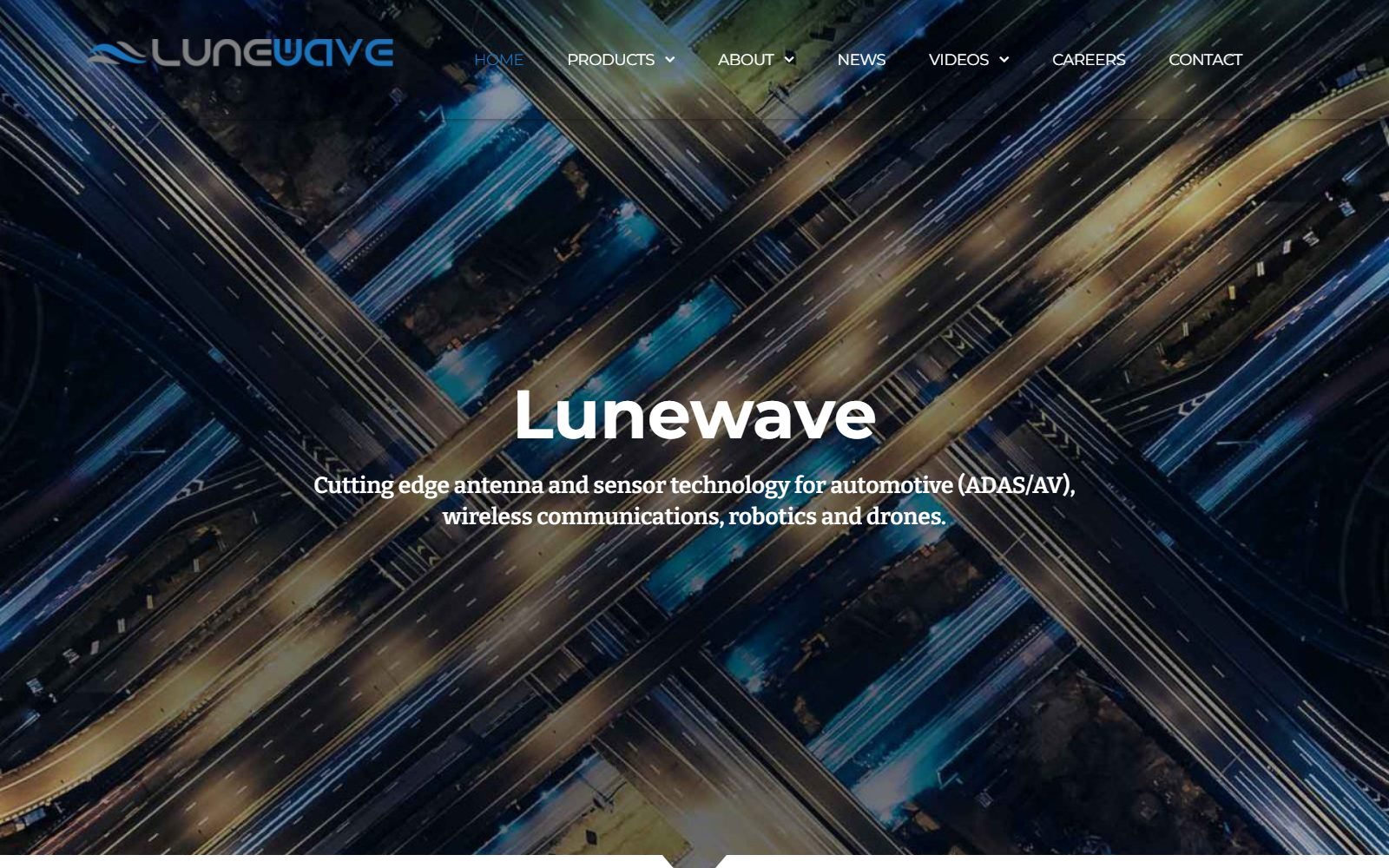
Lunewave builds antennas and radar sensors based on the Luneburg lens, made with additive manufacturing. Its site says the technology was invented by its technical founders at the University of Arizona and that the company was founded in 2017 with support from the National Science Foundation's SBIR/STTR programme. Its automotive radar works in the 76-81 GHz band, with a detection range of more than 300 metres and up to a 360-degree field of view, and the company says its imaging radar is supported on NVIDIA DRIVE. It also sells custom lens antennas for satellite communications and 5G. Its site lists Tucson as its headquarters, with offices in Silicon Valley and Boston. It does not publish funding amounts, so we do not quote any.
Lesson for founders: Lunewave sells custom antennas while its car radar goes through long automotive development cycles. A second, faster product line can keep a hardware startup alive.
Best for: founders in automotive tech, radar, drones and hardware.
6. Paramium Technologies: satellite ground stations as a service
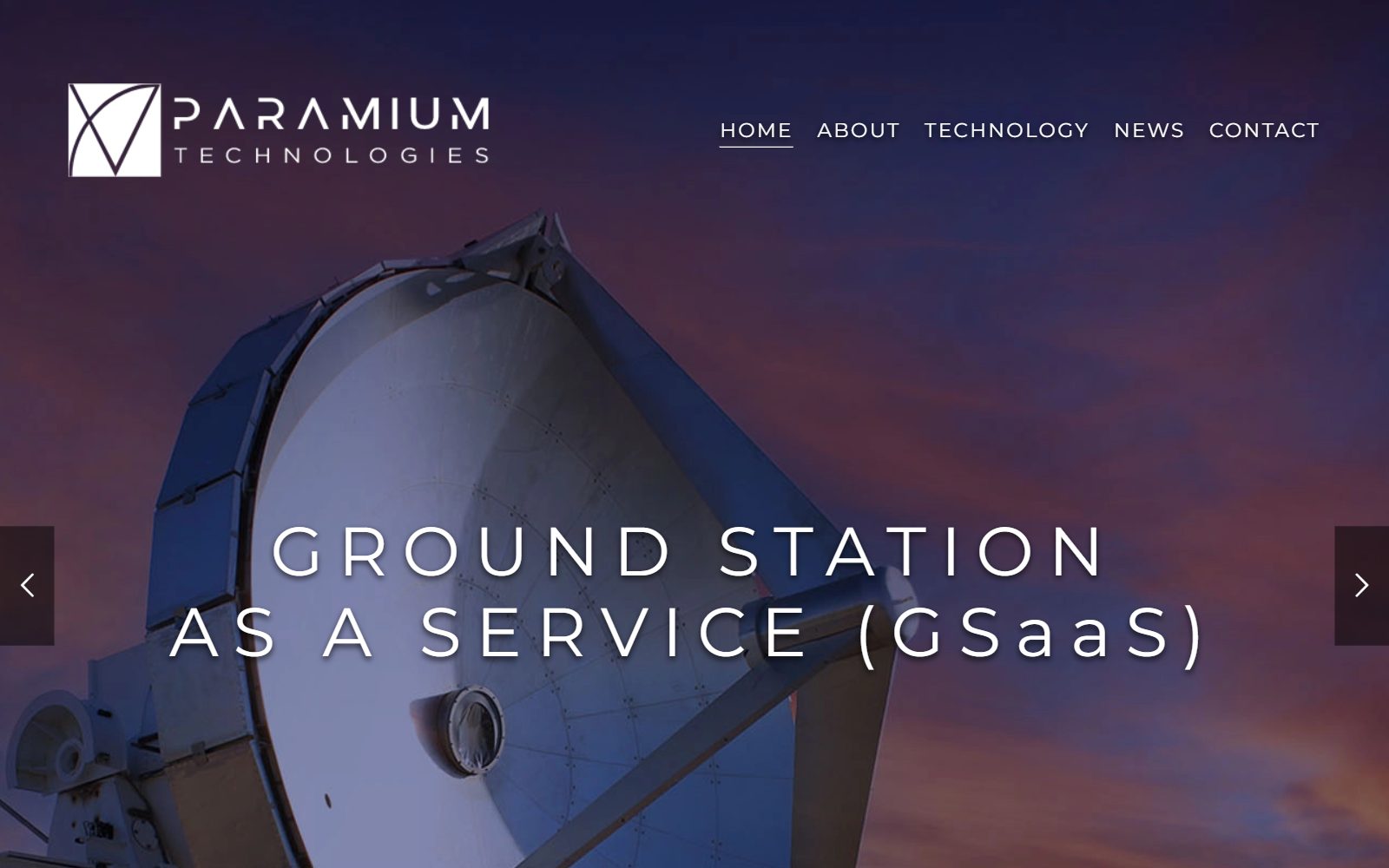
Paramium Technologies is building a network of ground stations, using its own Magnum antenna, that satellite operators can book through a web-based scheduler to download data from their satellites to their servers. It calls this Ground Station as a Service (GSaaS) and currently offers early access by application. It is based at the UA Tech Park on South Rita Road in Tucson, and its founder and CEO, Justin Hyatt, holds a PhD in optical sciences from the University of Arizona. The company does not publish funding amounts.
Lesson for founders: Paramium turns expensive infrastructure into a self-serve booking service. Selling access by the hour lets small satellite companies become customers without large contracts.
Best for: founders in space tech, satellite data and infrastructure as a service.
7. Fringe Metrology: measuring telescopes and silicon wafers
Fringe Metrology makes measurement systems for surfaces that are hard to measure. FringeScan measures large objects of up to 2.5 metres with micron-level accuracy, and its Structured Light Autocollimator measures wafers and other small surfaces at the nanometre level. Its about page says the idea came in 2021 from work on telescope manufacturing, its founder and president is Joel Berkson, PhD, and its contact page gives an office on South Research Loop in Tucson. According to Tech Launch Arizona, it was one of 10 finalists, out of about 250 applicants, in the 2026 Lam Capital Venture Competition for semiconductor technologies. The same article says it was not yet selling its product and was pursuing a Phase II SBIR grant.
Lesson for founders: Fringe Metrology built a tool for telescope makers and then pointed it at a much larger market, chip manufacturing. Ask which bigger industry has the same problem as your first customer.
Best for: founders in optics, semiconductors and deep tech hardware.
Where Tucson Startups Get Support
- Tech Launch Arizona (TLA): the University of Arizona's commercialization office. It licenses university inventions, helps researchers form startups, started an incubation service for university-affiliated ventures in fiscal year 2026, and lists the Wildcat Seed Fund, the Wildcat Investor Network and a new Venture Catalyst Program, which matches experienced entrepreneurs with university technologies. According to TLA, university startups have raised more than $1.1 billion since 2015.
- University of Arizona Center for Innovation (UACI): an incubator for early-stage technology companies with nearly two decades of history and locations at the UA Tech Park, Oro Valley, Biosphere 2, Sahuarita and Vail. It is run by Tech Parks Arizona, which also manages the UA Tech Park at Rita Road and the UA Tech Park at The Bridges.
- Startup Tucson: a nonprofit founded in 2012 after Tucson's first Startup Weekend. It runs Startup 101 for people testing an idea, BUILD for business fundamentals and an invitation-based GROW programme for founders who are already building, plus mentoring and community events. It hosts the TENWEST festival, which returns from 30 March to 2 April 2027. According to BizTucson, Startup Tucson and UACI co-lead the IdeaFunding pitch competition, whose 2026 edition gave two flagship awards of $10,000 each.
- Arizona Innovation Challenge (AIC): run by the Arizona Commerce Authority. Awardees receive $100,000 of non-dilutive funding and three months of customized support. The Fall 2026 round focused on SaaS startups incorporated after August 2023 with $5,000 to $50,000 in monthly recurring revenue; applications ran from 14 to 28 September 2026 and are closed, and awardees are due to be announced on 4 November 2026. Watch the page for the next round.
- Federal grants: several companies on this list used SBIR or STTR grants (Lunewave, Aqualung, Fringe Metrology) or other federal research money (NuvOx). See our list of deep tech grants in North America.
Tucson Companies From the Old List That Changed or Were Removed
The 2026 version of this article listed ten companies. Here is what we found when we checked each one in November 2026:
- Paradox: the conversational hiring software company was acquired by Workday, which completed the deal on 1 October 2025, according to Workday's newsroom. It is no longer an independent startup.
- TuSimple: according to TechCrunch and Reuters reports, it left US autonomous trucking and renamed itself CreateAI in December 2024 to work on AI for games and animation. Its old website no longer loads.
- Getlabs: a real at-home lab testing service, but its about page describes a nationwide company and gives no Tucson base.
- CAE Parc Aviation: part of CAE, a large international aviation training group, not a Tucson startup.
- Sigma Technologies: a real Tucson company that makes thin-film and vacuum coating products, but it was founded in 1992, so we moved it to the note below on established companies.
- MG: the old article gave no full name. It may have meant Merchant's Garden, a Tucson aquaponics farm whose site still lists delivery and pickup hours but shows no dated news, so we could not confirm recent activity.
- NextMed, Aventas Home Care, Simple Solar and Biosphere Ventures: we found no official website confirming a Tucson company with these names and the activities the old article described, so we removed them.
Established Tucson tech companies worth knowing: Sigma Technologies (thin films, founded 1992 by Dr. Angelo Yializis) and Paragon Space Development Corporation (life support and thermal control for spaceflight) both give Tucson as their headquarters. They are not startups, but they hire engineers and buy from local suppliers.
We also removed the old article's links to third-party startup lists (Built In, Wellfound, Nucamp and a fundraising blog) and its unsourced claims about Tucson's industries.
Which Tucson Startup Should You Learn From?
- You build a medical test or device: study Precision Epigenomics, which picked first responders as an early market.
- You build a drug: study NuvOx and Aqualung, which combined government grants, partners and FDA designations to move through trials.
- You build AI for science: study ProxyBio, which pairs lab models with an AI platform and sells to drug developers.
- You build hardware: study Lunewave's second product line and Fringe Metrology's move from telescopes to semiconductors.
- You build infrastructure: study Paramium, which sells satellite ground station time as a self-serve service.
- You are just starting: join Startup 101 at Startup Tucson, talk to Tech Launch Arizona if your idea comes from university research, and watch the next Arizona Innovation Challenge round.
How Founders Use the Tucson Startup Scene
The pattern on this list is clear: university research first, federal grants second (SBIR, STTR, NIH), and private investors once there is data, as with ProxyBio's $3.5 million round. Plan for all three. Compare investors in our guides to angel investors in North America and early-stage VC firms, and test your pitch in one of the startup competitions in North America or an AI accelerator in North America.
Many Tucson startups sell to specialists, so meet them where they gather: see our calendars of biotech startup events and space tech startup events, and compare with founders in Corpus Christi.
Research-heavy startups often forget marketing until late. Start early: publish your startup press release, and write about your work with the F/MS AI SEO Tool or the AI SEO Blog so customers, investors and AI assistants can find you.
Is your startup on ChatGPT?
More and more traffic is coming from Perplexity, ChatGPT, Grok and other AI tools.
👉 Rank on ChatGPT
FAQ About Tucson Startups in 2027
Which Tucson startups should I watch in 2027?
Our verified list: Precision Epigenomics, NuvOx Therapeutics, ProxyBio, Aqualung Therapeutics, Lunewave, Paramium Technologies and Fringe Metrology. Each still operates and gives Tucson as its headquarters, main office or office on its own website, checked in November 2026.
Which Tucson startup raised the most recent published round?
ProxyBio received a $3.5 million investment from GKCC in May 2026, according to Tech Launch Arizona. The other companies on our list either publish grants rather than equity rounds or publish no amounts.
Are there health tech and biotech startups in Tucson?
Yes, most of our list. Precision Epigenomics sells a multi-cancer early detection blood test, NuvOx develops an oxygen therapeutic, ProxyBio predicts cancer drug response with organoids and AI, and Aqualung develops an antibody for lung inflammation and fibrosis.
Are there hardware and space startups in Tucson?
Lunewave builds lens-based radar and antennas, Paramium Technologies runs satellite ground stations as a service from the UA Tech Park, and Fringe Metrology builds measurement systems for large optics and silicon wafers.
What is Tech Launch Arizona?
The University of Arizona's commercialization office. It licenses university inventions and helps form startups; in fiscal year 2026 it helped launch 11 startups, and it says it has launched more than 160 companies in total.
What does the University of Arizona Center for Innovation offer?
Incubation for early-stage technology companies, with locations at the UA Tech Park, Oro Valley, Biosphere 2, Sahuarita and Vail. It is run by Tech Parks Arizona.
How much does the Arizona Innovation Challenge pay?
Awardees receive $100,000 of non-dilutive funding and three months of customized support. The Fall 2026 round, for SaaS startups, closed on 28 September 2026.
What does Startup Tucson do?
It is a nonprofit that runs Startup 101, BUILD and the invitation-based GROW programme for founders, offers mentoring and hosts the TENWEST festival, next held from 30 March to 2 April 2027.
What happened to the companies on the old list?
Paradox was acquired by Workday, TuSimple became CreateAI and left autonomous trucking, Getlabs and CAE are not Tucson startups, Sigma Technologies is an established company founded in 1992, and we could not confirm MG, NextMed, Aventas Home Care, Simple Solar or Biosphere Ventures.
Where can I get a backlink by writing about my startup?
You can publish a guest post in one of the Fe/male Switch startup blogs, which rank in Google and in AI tools. Get a quality backlink.
About the Author
Violetta Bonenkamp, also known as MeanCEO, is an experienced startup founder with an impressive educational background including an MBA and four other higher education degrees. She has over 20 years of work experience across multiple countries, including 5 years as a solopreneur and serial entrepreneur. Throughout her startup experience she has applied for multiple startup grants at the EU level, in the Netherlands and Malta, and her startups received quite a few of those. She’s been living, studying and working in many countries around the globe and her extensive multicultural experience has influenced her immensely.

