

Deep Tech Grants in North America: SBIR/STTR After the 2026 Reauthorization, NSF, NIH, DOE, NASA, DoD, Activate, IRAP and SR&ED Checked for 2027
Deep tech startups spend years in the lab before they sell anything, so non-dilutive money matters more for them than for software companies. In the United States, most of it comes from the federal SBIR and STTR programmes, which 11 agencies run under one law, plus fellowships such as Activate and state matching funds. In Canada, the main sources are NRC IRAP, the SR&ED tax credit and Mitacs. This guide was rebuilt from scratch in October 2026: every programme below was checked on its official page, including the six-month SBIR/STTR lapse and its reauthorization, and the 2025 list's European, Indian and invented entries were removed (see the end). For South America, read our guide to deep tech grants in South America.
Quick answer: SBIR and STTR are back. Their authority expired on 30 September 2025, and the President signed the reauthorization on 13 April 2026, so the programmes now run until 30 September 2031. For most US deep tech founders, the first stop is NSF SBIR/STTR (up to $305,000 in Phase I and $1.25 million in Phase II, no equity; next deadline 4 November 2026), then the agency that matches your field: NIH for health, DOE for energy, NASA for space and DoD for defence and dual-use technology. Hardware founders can also apply to the Activate fellowship. In Canada, start with an NRC IRAP advisor and claim SR&ED, a refundable 35% tax credit for most small Canadian-controlled companies.
Write FREE SEO-optimized Blog Articles! Our Article Writer ensures your blog is loved by both Google and your readers, turning those clicks into customers.
👉 Write your article here
SBIR and STTR in 2027: the Lapse and the Reauthorization
The Small Business Innovation Research (SBIR) and Small Business Technology Transfer (STTR) programmes are the largest source of early non-dilutive money for US deep tech. According to SBIR.gov, 11 federal agencies fund small businesses through them, usually in a Phase I (proof of concept) and a Phase II (technology development). STTR works the same way but requires a partner research institution, such as a university.
Their legal authority ran out on 30 September 2025, and new SBIR and STTR calls were paused across agencies. On 13 April 2026 the President signed S. 3971, the Small Business Innovation and Economic Security Act; the White House statement says it authorizes the programmes through fiscal year 2031. The text of Public Law 119-83 replaces the old 30 September 2025 end date with 30 September 2031 and adds strategic breakthrough awards of up to $30 million for companies that have finished Phase II. According to the Congress.gov summary of the act, agencies must also check applicants for foreign security risks, and from fiscal year 2027 each agency caps the number of Phase I and Phase II proposals one company may submit per year. Agencies restarted their calls from April 2026, with new formats and new award sizes, so older guides (including the 2025 version of this one) quote outdated numbers.
Deep Tech Grants in North America Compared
Sources: each programme's official website, solicitation or rules, checked 30 October 2026. Amounts are maximums; rules change between rounds, so read the current call before you apply.
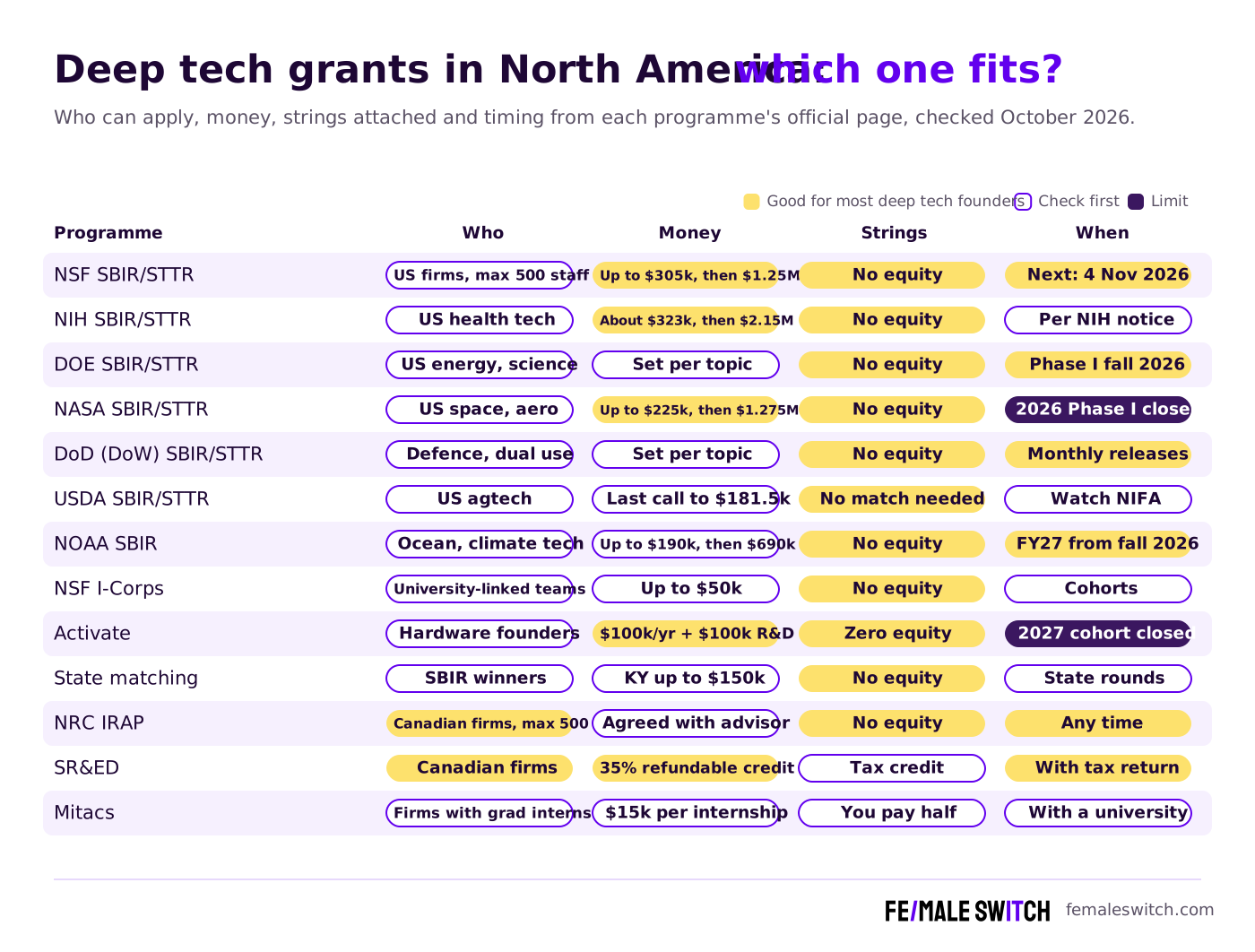
United States: Federal SBIR and STTR Programmes
1. NSF SBIR/STTR (America's Seed Fund): the deep tech starting point
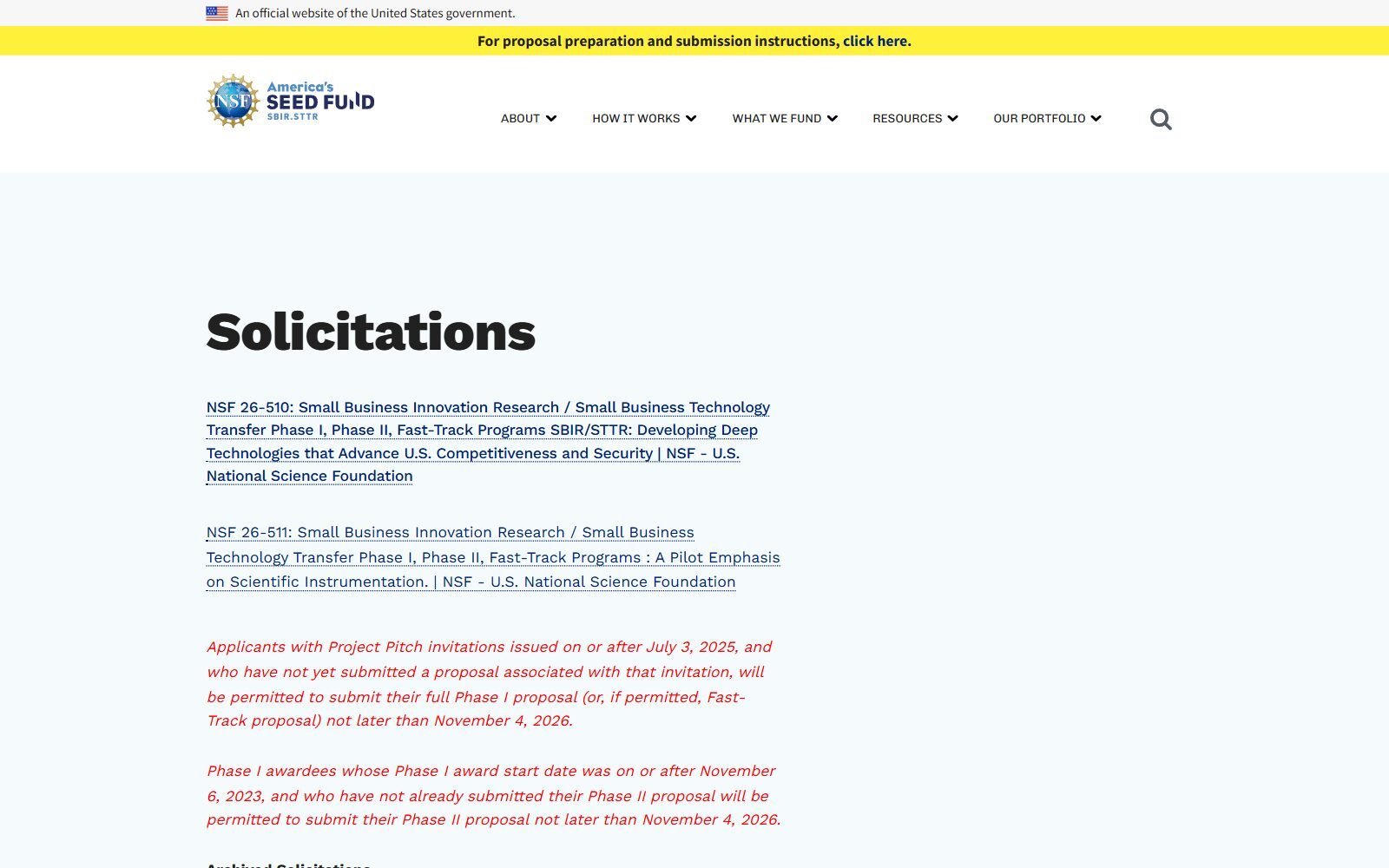
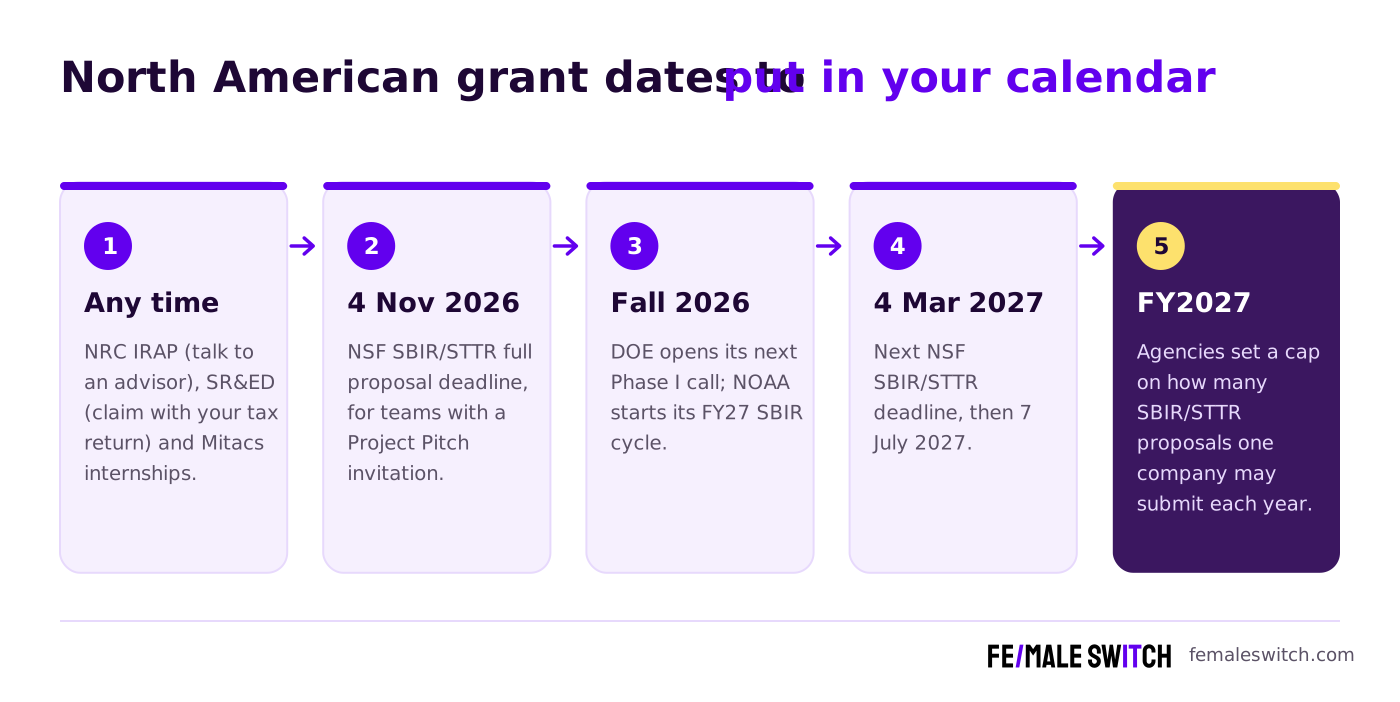
The National Science Foundation calls its SBIR and STTR programmes America's Seed Fund. The 2025 version of this article listed it twice; it is one programme. Its current call, NSF 26-510, is titled "Developing Deep Technologies that Advance U.S. Competitiveness and Security" and funds almost every technology area. Phase I pays up to $305,000 for 6 to 18 months, including the optional I-Corps training; Phase II pays up to $1,250,000, usually over 24 months, and only Phase I awardees can apply. Each company can receive up to $2 million for R&D, and NSF takes no equity. Your company must have no more than 500 employees, including affiliates. You start with a short Project Pitch; NSF reopened new pitches on 2 June 2026, and only invited teams can submit a full proposal. The next full proposal deadlines are 4 November 2026, 4 March 2027 and 7 July 2027. Phase II companies can also be invited to submit a Strategic Breakthrough proposal of up to $30 million.
2. NIH SBIR/STTR: health, biotech and medical devices
The National Institutes of Health fund health, biotech and medical device startups through SBIR and STTR, split across their institutes and centres. According to the NINDS small business application page, total funding normally may not exceed $323,090 for Phase I and $2,153,927 for Phase II, and NIH has an SBA waiver that allows larger budgets for some topics, so talk to a programme officer before asking for more. Several institutes publish their own priorities and limits, so read the notice you apply to. NIH announced that its small business programme was back after the April 2026 reauthorization.
3. DOE SBIR/STTR and ARPA-E: energy, materials, quantum and AI for science
The Department of Energy's SBIR/STTR programmes are now managed by its Office of Technology Commercialization and were reauthorized effective 13 April 2026. On 22 July 2026 DOE opened a $10 million Phase I call for its Genesis Mission, with about 40 awards in four topics: biotechnology, quantum systems, materials with predictable functionality and AI-driven autonomous labs. It also opened about $147 million in Phase II funding and said another Phase I opportunity will open in fall 2026. ARPA-E, DOE's agency for high-risk energy technology, runs its own SBIR/STTR calls on specific programmes; its recent calls closed in early 2026, and new ones appear on DOE's consolidated eXCHANGE portal.
4. NASA SBIR/STTR: space, aeronautics and Earth observation
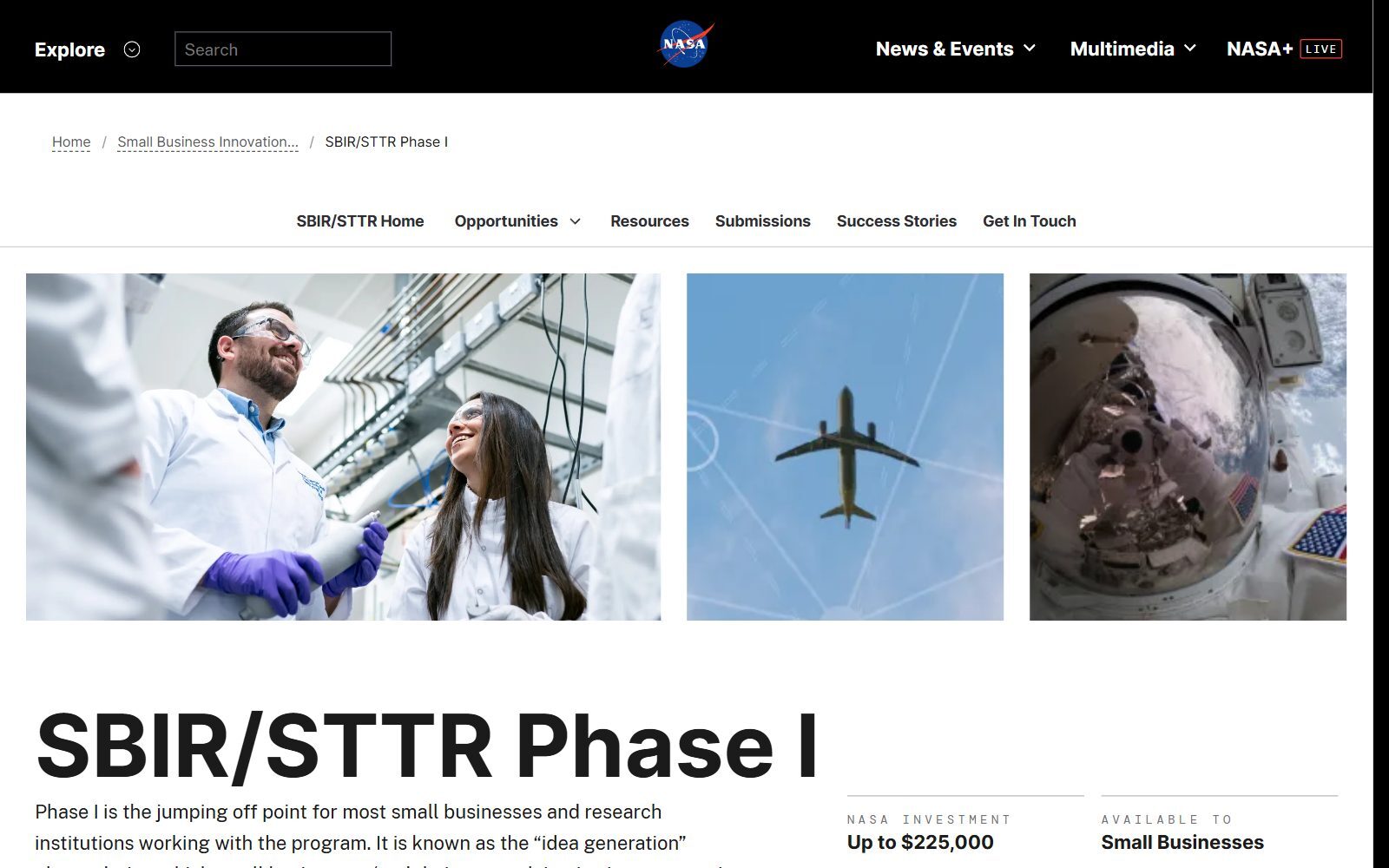
NASA raised its award sizes in 2026 and moved to a Broad Agency Announcement that releases topics in appendices during the year. Its Phase I page lists up to $225,000, for 6 months under SBIR or 13 months under STTR; Phase II pays up to $1,275,000 over 24 months. The 2026 Appendix A and Appendix B Phase I calls closed on 21 May, and NASA selected its winners in the summer, so prepare for the next appendix now. NASA also runs SBIR Ignite and follow-on funding for Phase II companies.
Boost Your SEO by listing your startup and get a FREE backlink.
Create a profile in the F/MS Startup Game, add the link to your website and submit.
👉 List your startup now!
5. DoD SBIR/STTR: defence and dual-use technology
The Department of Defense, which now also uses the name Department of War, funds SBIR and STTR projects through the Army, Navy, Air Force, DARPA and other components. Each component writes its own topics, so the amount depends on the topic. Since the reauthorization the department publishes its SBIR/STTR announcements monthly: an Air Force Research Laboratory briefing lists the first fiscal 2026 release from 13 April 2026 and new releases every month after that. The new law also lets agencies skip Phase I for qualifying STTR applicants (Direct to Phase II). Topics and deadlines are posted on the DoD SBIR/STTR Innovation Portal (dodsbirsttr.mil). Choose it if your technology has a defence customer as well as a civilian market.
6. USDA NIFA SBIR/STTR: agriculture and food tech
The US Department of Agriculture's NIFA SBIR/STTR programme funds research in 10 broad topic areas across agriculture and food. It does not make loans and does not fund the setting up of a business. The last Phase I call listed on NIFA's Phase I page paid $125,000 to $181,500 per project, required no matching funds and funded about 15% of applications. Sign up for Grants.gov alerts to catch the next call.
7. NOAA SBIR: ocean, weather and climate technology
The National Oceanic and Atmospheric Administration runs a smaller SBIR programme for technology that serves its mission: weather, oceans, fisheries and climate. Phase I awards are up to $190,000 for up to 6 months, and Phase II awards up to $690,000 for up to 24 months; only Phase I winners can apply for Phase II. NOAA says its fiscal 2027 funding cycle begins in fall 2026.
United States: Fellowships, Training Grants and State Money
8. NSF I-Corps Teams: $50,000 to test your market
Before you write an SBIR proposal, NSF I-Corps teaches research teams to find customers. A team of three to five people (a technical lead, an entrepreneurial lead and an industry mentor) interviews potential customers and partners, and accepted National Teams can receive up to $50,000. You qualify through an NSF research award active in the past five years, or by completing a regional I-Corps programme. NSF says more than 2,500 teams have taken part since 2012.
9. Activate Fellowship: two years of funding for science founders
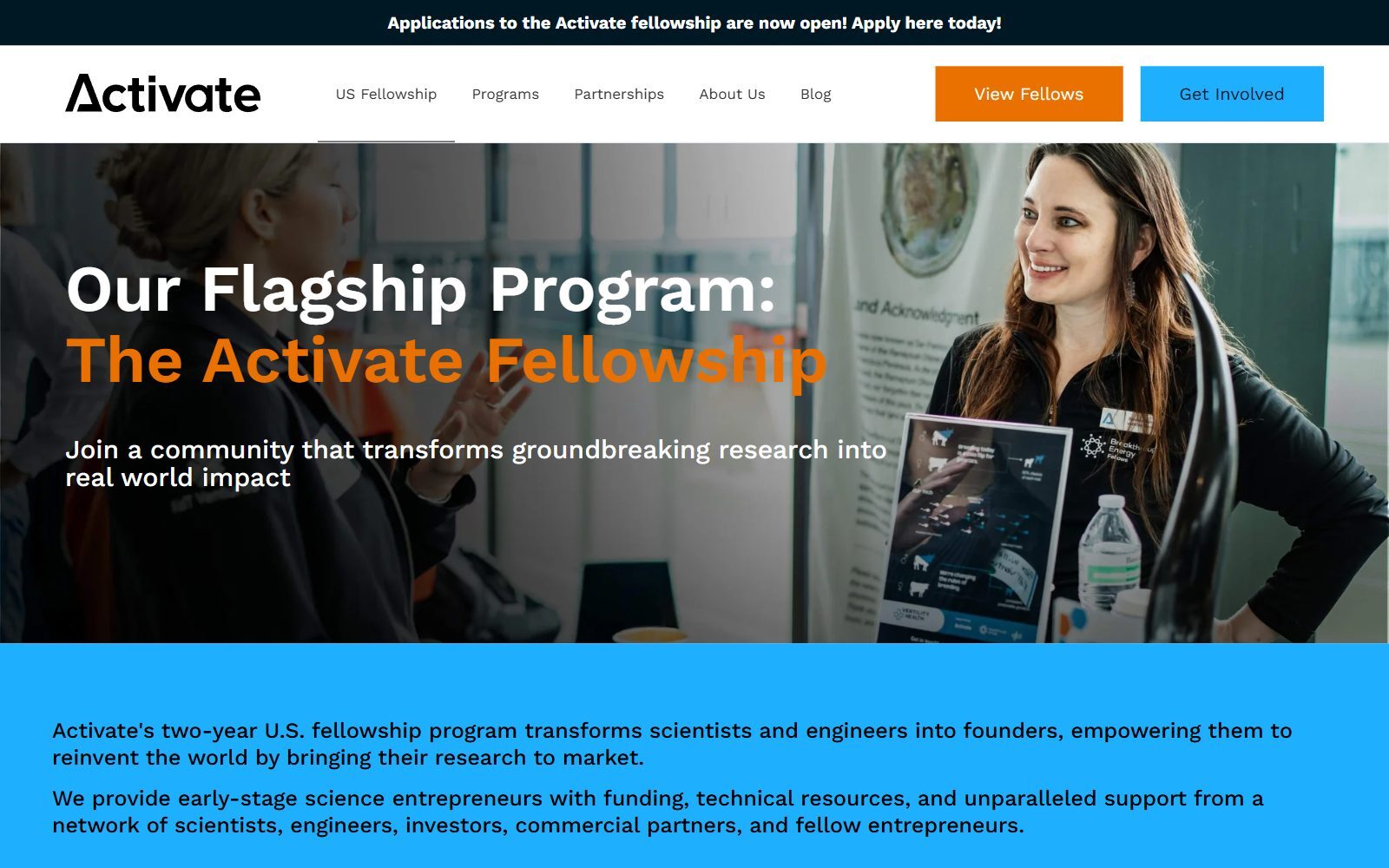
Activate is a two-year fellowship for scientists and engineers who lead the commercial development of a hardware technology for the first time, and it takes zero equity. According to its application guide, fellows get a $100,000 living stipend per year, $100,000 for R&D, $12,000 a year for travel and professional development, a health insurance stipend and a relocation allowance. You need a bachelor's degree and at least four years of research, engineering or technology development experience. Besides its in-residence communities, Activate Anywhere takes founders who live in the US at least 70 miles from one. Applications for the U.S. Cohort 2027 closed at noon Pacific time on 30 October 2026, so plan for the next round.
10. State SBIR/STTR matching funds
Many states add their own money once you win a federal SBIR or STTR award. Kentucky's SBIR/STTR Matching Funds programme is a competitive, reimbursable grant that matches up to $100,000 for a Phase I project and up to $150,000 for Phase II, for for-profit companies based in Kentucky or willing to move there. North Carolina's One NC Small Business Program gives matching funds to companies that have won a federal SBIR or STTR grant. Check your state's economic development agency, because rounds, amounts and budgets differ from state to state.
Boost Your SEO with 1,500+ Free Business Directories: increase your DA, get backlinks and traffic.
We've compiled an exclusive list of directories and websites where you can submit your business and start building high-quality backlinks to boost your website traffic and get your SEO snowball rolling.
👉 Submit your startup now!
Canada
11. NRC IRAP: funding and advice from an industrial technology advisor
The National Research Council's Industrial Research Assistance Program (IRAP) is Canada's main source of R&D money for small tech companies. According to NRC, your business must be incorporated, for-profit, operating in Canada and have no more than 500 full-time equivalent employees, and it must develop technology-driven products with economic benefits for Canada. There is no call: you contact IRAP, and if your project fits, an industrial technology advisor works out the support with you. IRAP does not pay day-to-day operating costs, purely commercial work or work done outside Canada. Since Sustainable Development Technology Canada (SDTC) was wound down, its cleantech funding moved to NRC: IRAP's clean technology support takes companies with a validated proof of concept and measurable environmental impact. IRAP also funds Canadian companies in international R&D projects such as Eurostars.
12. SR&ED: a refundable tax credit, not a grant
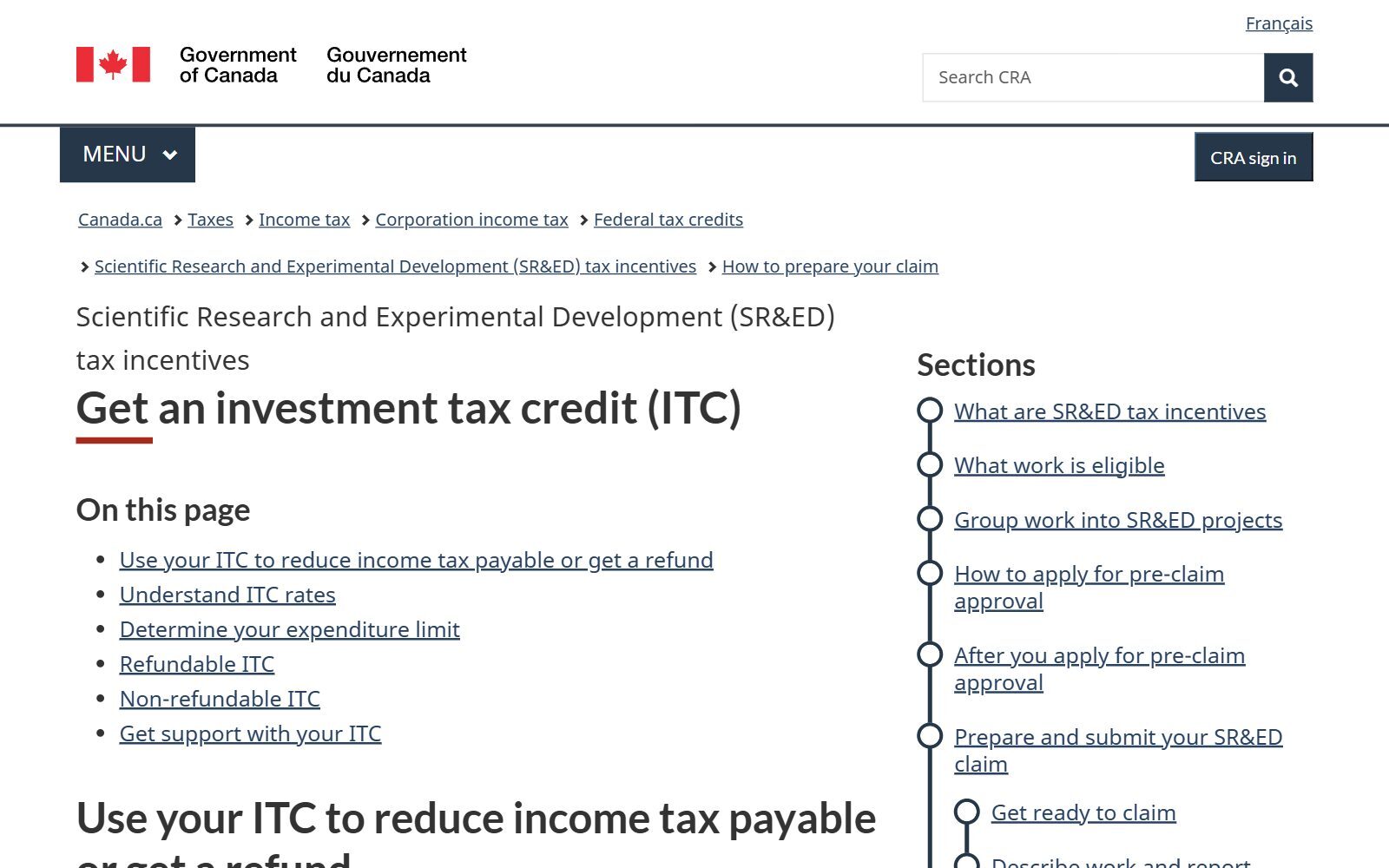
The Scientific Research and Experimental Development programme is a tax incentive: you claim it with your corporate tax return after you spend the money. According to the Canada Revenue Agency's SR&ED investment tax credit page, most Canadian-controlled private corporations (CCPCs) earn a 35% credit on qualified R&D spending up to an expenditure limit, and 15% above it. For tax years beginning after 15 December 2024 the limit is $6 million, up from $3 million. The 35% credit on current expenditures is fully refundable, so a startup without profits gets cash back. The limit shrinks when the previous year's taxable capital passes $15 million and disappears at $75 million. CRA also offers pre-claim approval if you want certainty before you file.
13. Mitacs: research interns paid half by the programme
Mitacs Accelerate pairs your company with graduate students or postdocs from a Canadian university. In the standard model the company contributes from $7,500 per four- or six-month internship and receives a $15,000 research award, of which the intern gets at least $10,000. Early-stage founders can also use Accelerate Entrepreneur, which supports student entrepreneurs working in their own incorporated startup.
14. Provincial programmes
Provinces add their own money, but programmes change often. Alberta Innovates, for example, stopped taking new applications for six startup and SME programmes on 29 May, including its Voucher Program (up to $100,000 for product commercialization, now marked inactive), while it redesigns them; health programmes such as AICE remain open. In other provinces, check your regional innovation agency (for example the Ontario Centre of Innovation, Innovate BC or Investissement Québec) before you plan around a grant.
Grant Dates for Your Calendar
These are the next fixed dates from the programmes above, plus the ones you can use at any time.
Boost Your SEO by Getting Featured in Our Blogs and get a backlink.
We publish content about startups, education, tech, funding, etc. that ranks well not only in Google but also in Perplexity, ChatGPT, Grok and other AI tools.
👉 Get featured now!
Programmes Removed or Changed
The 2025 version of this article listed 20 grants, but several were not North American, not grants or could not be found:
- NSF America's Seed Fund: listed separately next to NSF SBIR/STTR, but it is the same programme; merged above.
- EIT Health Deep Tech Venture Builder: a European programme for European teams. Read our guide to EIT Health funding for startups if you have a European entity.
- Lenovo Evolve Small grants: a general small-business grant from a corporation, cited from a third-party site, not a deep tech programme.
- Fund of Funds for Startups (FFS): an Indian government fund of funds that invests through venture funds; not North American and not a grant.
- "Public-Private Grant Initiatives (Future)", CIRI Technology Development Grant, Creative Economy Fund and Corporate Innovation Lab Grants: we found no official programme under these names, and the old links pointed to a markdown editor.
- Small Business Investment Company (SBIC) programme: SBA-licensed funds that lend to or invest in small businesses; it is investment, not a grant.
- NASDA research grants and EDA Regional Innovation Strategies: NASDA is an association of state agriculture departments, and EDA's grants go to organisations such as universities, non-profits and public bodies, not to startups.
- SDTC (Canada): wound down; its cleantech funding now runs through NRC IRAP (see above).
- The SBIR/STTR figures: the old numbers (for example $150,000 Phase I at NOAA or USDA's $100,000) are out of date; current maximums are in the table above.
Which Grant Should You Apply For?
- You have a lab-proven technology and a US company: send an NSF Project Pitch now; if your field matches an agency topic (NIH, DOE, NASA, DoD, USDA, NOAA), apply there too, but never for the same work twice.
- You are still at the research stage: NSF I-Corps first to test the market, then SBIR or STTR with your university as partner.
- You are a scientist starting a hardware company: the Activate fellowship for living costs and R&D money, alongside SBIR.
- You already won an SBIR award: ask your state about matching funds, and after Phase II ask about Strategic Breakthrough awards.
- You are in Canada: call NRC IRAP, claim SR&ED every year and hire research interns through Mitacs.
- You build clean technology in Canada: IRAP's clean technology stream, which took over SDTC's role.
How Founders Combine Grants With Other Funding
Grants pay for R&D, not for everything, and they take months to arrive, so most deep tech founders combine them with investors and accelerators. When you are ready to raise, compare deep tech VCs in North America and deep tech VCs in Europe, look at AI accelerators in North America and meet investors at deep tech startup events or climate tech events. If you are still choosing where to build, read our guides to startup cities in North America, the best cities for early-stage startups and the best countries for early-stage startups.
For grants outside North America, see our worldwide list of grants for early-stage startups, grants for early-stage startups in Europe and grants for female entrepreneurs. Grant-grants.com, our sister site, explains non-dilutive funding, lists research grants for deep tech, shows how to write a grant budget justification and what to do when you reapply after a rejection, which is common in SBIR.
Join F/MS: Startup Facilitator & Incubator and unlock your startup dreams today! Get your first customers, register you company in the Netherlands and get startup visas for the team.
FAQ About Deep Tech Grants in North America
Are SBIR and STTR still running in 2027?
Yes. Their authority expired on 30 September 2025 and new calls were paused, but the President signed the reauthorization (S. 3971, Public Law 119-83) on 13 April 2026. The programmes now run until 30 September 2031.
How much does NSF SBIR pay?
Under the current NSF 26-510 solicitation, Phase I pays up to $305,000 for 6 to 18 months and Phase II up to $1,250,000, usually over 24 months. Each company can receive up to $2 million for R&D, and NSF takes no equity.
When is the next NSF SBIR/STTR deadline?
The next full proposal deadlines are 4 November 2026, 4 March 2027 and 7 July 2027. You need an invitation from a Project Pitch before you can submit a full proposal.
Do SBIR grants take equity?
No. SBIR and STTR awards are grants or contracts, and the agencies take no equity. NSF, for example, says awardees keep full ownership of their company and intellectual property.
Can a Canadian startup apply for SBIR?
Not as a Canadian company. SBIR and STTR are for US small businesses with no more than 500 employees. Canadian founders usually start with NRC IRAP, SR&ED and Mitacs, or set up a qualifying US company.
Is SR&ED a grant?
No. It is a tax credit claimed with your tax return. Most Canadian-controlled private corporations earn 35% on qualified R&D spending up to $6 million a year, and that credit on current expenditures is fully refundable, so it works like cash for startups without profits.
What happened to SDTC?
Sustainable Development Technology Canada was wound down, and its cleantech funding moved to the National Research Council. Cleantech companies now apply through NRC IRAP's clean technology support.
What is the difference between SBIR and STTR?
STTR requires a formal partner research institution, such as a university, that does part of the work. SBIR lets the small business do the research on its own.
Which grant is best before I have a company?
NSF I-Corps (up to $50,000 for teams linked to university research) and the Activate fellowship help researchers test a market and start a company. Most other programmes need an incorporated business.
Where can I get a backlink by writing about my startup?
You can publish a guest post in one of the Fe/male Switch startup blogs, which rank in Google and in AI tools. Get a quality backlink.
About the Author
Violetta Bonenkamp, also known as MeanCEO, is an experienced startup founder with an impressive educational background including an MBA and four other higher education degrees. She has over 20 years of work experience across multiple countries, including 5 years as a solopreneur and serial entrepreneur. Throughout her startup experience she has applied for multiple startup grants at the EU level, in the Netherlands and Malta, and her startups received quite a few of those. She’s been living, studying and working in many countries around the globe and her extensive multicultural experience has influenced her immensely.
