

TL;DR: EIB venture debt is a long-term loan from the European Investment Bank for innovative SMEs and mid-caps that have already raised equity from professional investors. It typically ranges from €10 million to €50 million (more for scaleups valued above €500 million), is repaid in one go at the end, and pays the bank partly through a return linked to your company's value, often warrants. You apply directly to the EIB through a 10-step process that starts with your pitch deck. Below: a fit decision tree, a scored readiness worksheet, a pre-screening template, a dilution example and a 2026–2032 calendar.
EIB venture debt is the one piece of EU money a startup borrows straight from the EU's own bank, with no local bank or fund in between. Most pages that rank for it are either the EIB's short product page or provider reviews that list a few terms and stop. This guide explains what the EIB actually asks for, how its 10 steps work, and how to tell whether debt beats your next equity round.
All facts come from the European Investment Bank: its venture debt product page, its "Application and appraisal process for venture debt and scale-up financing" document, its pricing and other terms page, its project pages and its 2026 press releases, checked on 14 November 2026.
What EIB venture debt is

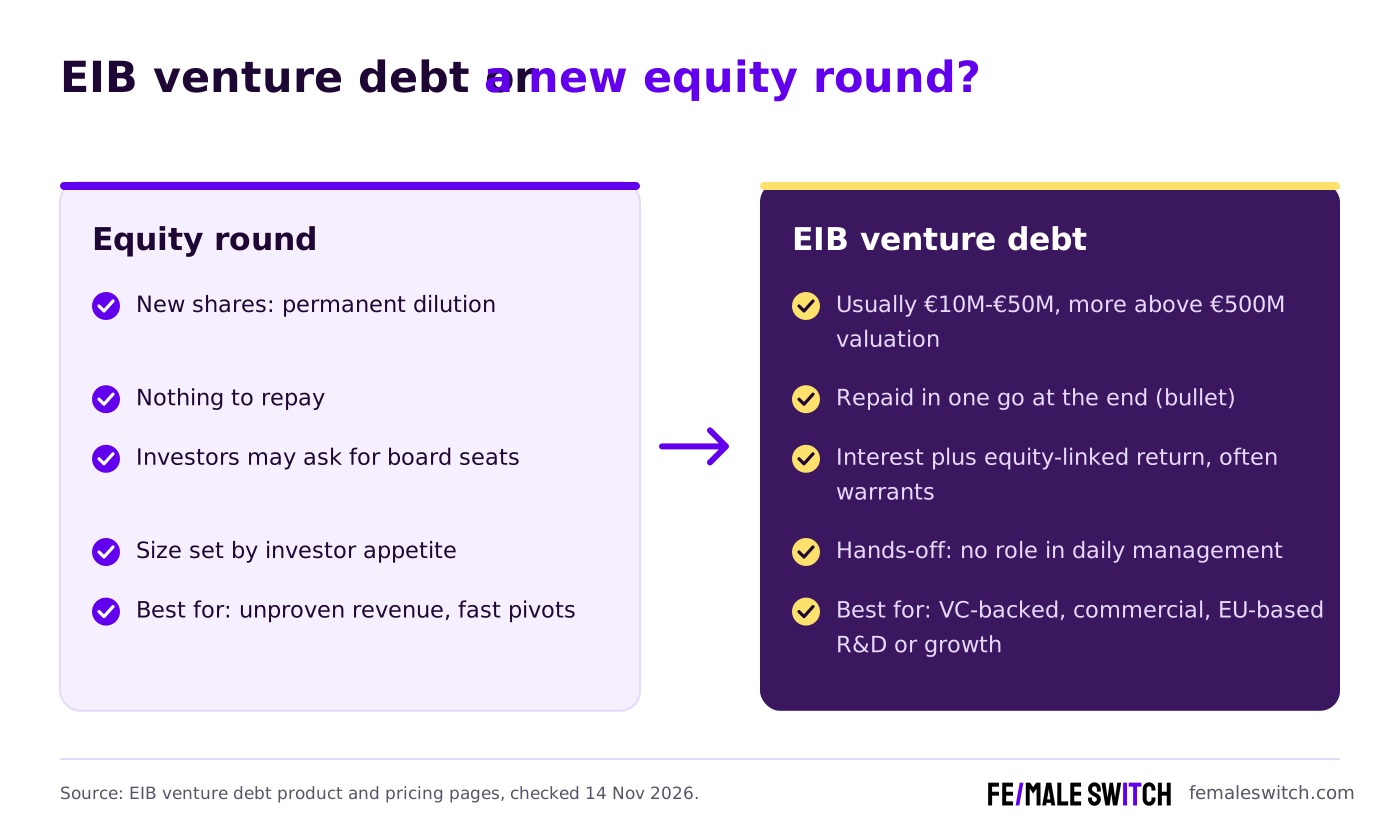
The EIB describes it as "long-term venture debt to address the unique needs of fast-growing companies". In practice that means three things:
- A bullet loan. You repay the principal at the end, not in monthly instalments, so the cash stays in the company while it grows.
- Equity-linked pay. Part of the bank's return is "linked to the equity risk of the investees". In EIB deals this is usually warrants, and the bank says entrepreneurs get call and put options so they can keep their stake.
- A hands-off lender. The EIB says it has "no direct involvement in daily management".
The EIB lists four benefits on its product page: limited dilution, bespoke financing (secured or unsecured, including contingent or participating loans), a hands-off approach and a signalling effect, because its money "is often seen as a mark of quality, helping attract additional investors".
Who it is for
Source: EIB venture debt product page. The EIB's pricing page adds that venture debt is "only available in the EU". One 2026 InvestEU envelope for green-transition venture debt also lists Norway and Iceland, so companies there should ask the EIB directly.
How it is priced
The EIB does not publish a rate card. Its pricing page says the interest rate "reflects the credit risk profile of the individual project", can be fixed or floating, and can be set at signature or at each disbursement. The bank may charge fees and expenses, including due-diligence costs.
What the 2026 deals show:
- Aiforia (Finland, July 2026): €20 million in three tranches, the first of €5 million. Each later tranche depends on hitting revenue and other targets set in the agreement. The return uses a "synthetic warrant arrangement", which the EIB says "does not cause immediate share dilution" for existing shareholders.
- Optics11 (Netherlands, signed December 2025, announced January 2026): €25 million for R&D on fibre-optic sensing for civilian and defence uses.
Both were supported under the European Commission's InvestEU programme. That is the link to our InvestEU guide: InvestEU is the EU guarantee behind much of this lending, and the EIB says projects that apply for financing under InvestEU are eligible for venture debt.
Where the money comes from in 2026
The EIB funds its venture debt through lending envelopes, several of them backed by InvestEU under the TechEU banner. Its project pages list three 2026 envelopes of €500 million each:
Source: EIB project pages 20250870, 20250871 and 20260038. The EIB calls these figures indicative until each operation is signed.
The EIB also started a pilot in May 2026, under the InvestEU Advisory Hub, that pays for first-time independent credit ratings for companies backed by its venture debt. It runs for 18 months.
The 10-step application process
You apply to the EIB itself. Its application document lists ten steps:
- Pre-screening: send your existing pitch deck and general company information through the EIB's online link.
- Intro call: if you fit, a video call about your technology and business.
- Application form: the EIB starts preparing its first investment committee.
- Initial investment committee (Go/No Go): decides whether to start full due diligence.
- Technical, financial and commercial due diligence.
- Indicative term sheet.
- Commercial alignment and structuring.
- Final approval.
- Legal due diligence, documentation and signing.
- Disbursement, often in tranches tied to milestones.
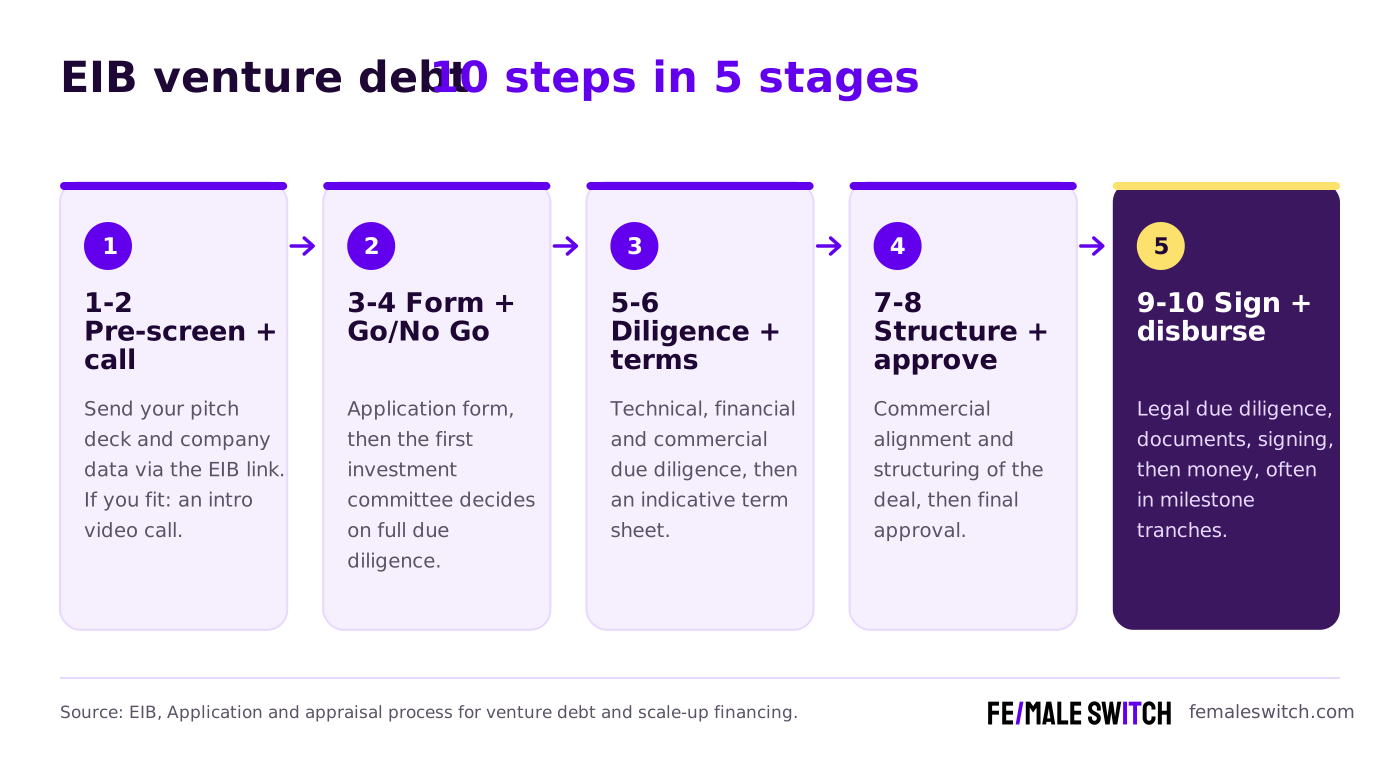
The EIB does not publish a standard duration. Plan for several months between pre-screening and the first euro, and do not count on EIB money to fix a cash gap in the next quarter.
Copyable template: pre-screening company summary
Send this with your deck so the venture debt team can judge fit at step 1.
Decision tree: debt, equity or a grant?
Readiness worksheet: score yourself
Give each line 0, 1 or 2 points.
12–16 points: pre-screen now. 8–11: fix the gaps first, mostly milestones and governance. Under 8: look at equity, grants or a guaranteed bank loan instead.
Worked example: a robotics company choosing between debt and equity
A generic example. A 90-person robotics company in Germany has raised €35 million from three VC funds, has €12 million in annual revenue and needs €20 million to build a second production line in the EU.
- Option A, equity: a new round at a €120 million pre-money valuation. €20 million of new shares means existing holders give up 20 / 140 = 14.3% of the company.
- Option B, EIB venture debt: €20 million in three tranches, the second and third released when revenue targets are met, repaid at maturity. The EIB is paid through interest and an equity-linked return, often warrants with call and put options. The exact terms are negotiated; in the Aiforia deal the warrant was synthetic and caused no immediate dilution.
- What decides it: whether the company can repay the bullet from cash flow or a later, larger round. If yes, debt keeps more ownership with founders and current investors. If the revenue targets are shaky, the later tranches may never be released, and equity is safer.
- The timing trap: because of the 10-step process, the company starts pre-screening at least two quarters before it needs the first tranche, and briefs its equity investors early, because the EIB looks at who has already invested and at the business plan they back.
EIB venture debt calendar 2026–2032
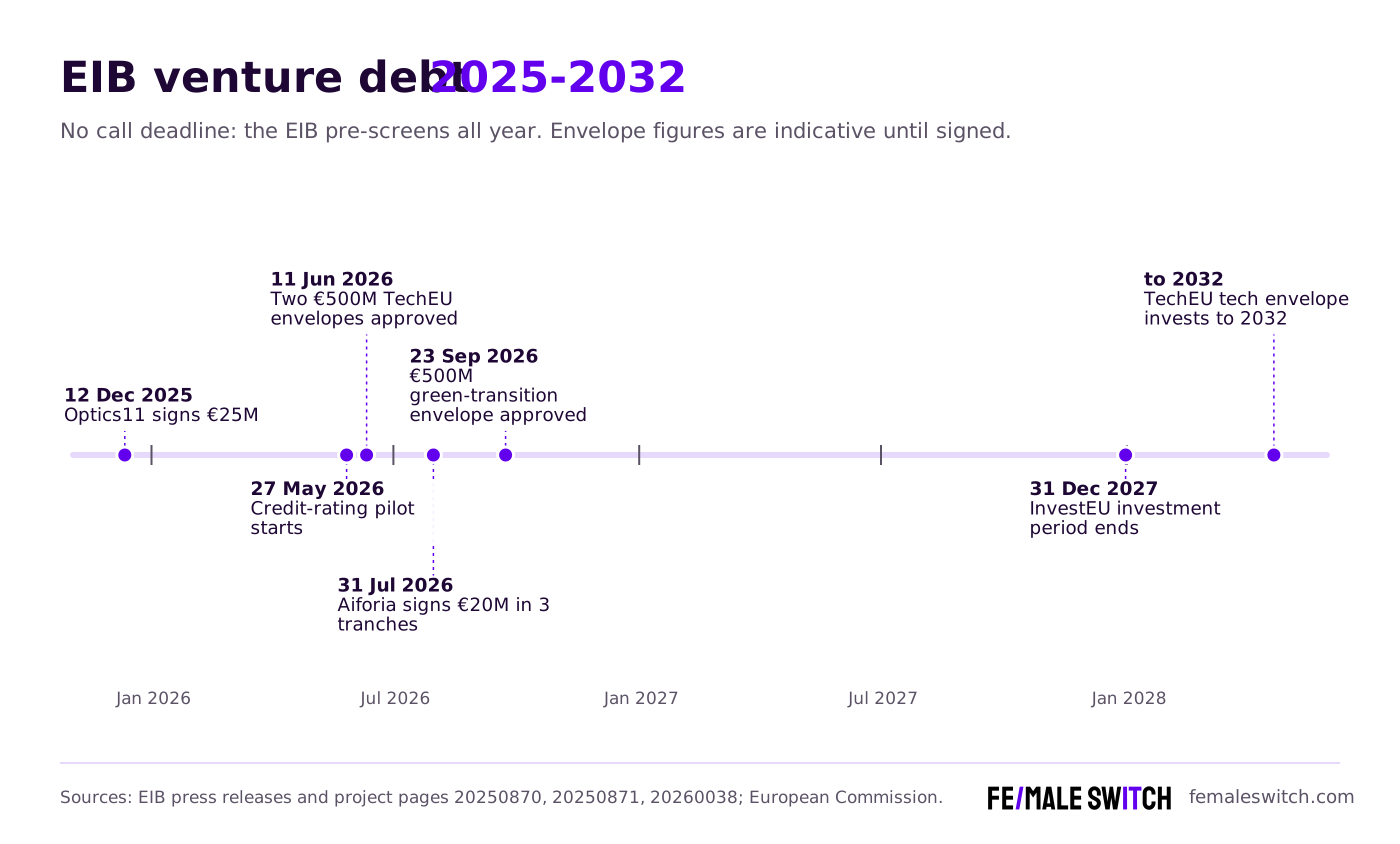
There is no call deadline: the EIB takes pre-screening requests all year. For monthly news on EU money, follow Mean CEO's EU Funding News on blog.mean.ceo.
Who should apply and who can skip it
Apply if you have VC backing, revenue or a strategic deep tech product, need €10 million or more for R&D or growth in the EU, and want to stretch your runway with less dilution than an equity round.
Skip it if you are pre-seed or seed, need less than €10 million, or have no professional investors yet. Start with the EIC Accelerator 2027, Eurostars or a guaranteed bank loan from our InvestEU guide. Check your basics with the EU funding readiness checklist, and if a grant is your next step, read our guide to writing an EU funding application.
Related EU funding guides
- EU grants for startups: programme map, deadlines and decision tree
- InvestEU for startups: how EU guarantees reach you through banks and funds
- Startup funding in Europe: where EU money fits next to angels and VCs
- European funds for startups: the map of EU grants, equity and loans
- EIT InnoEnergy for startups: investment and programmes
- The EU funding labyrinth: a critical analysis for startups
Want to rehearse the investor and lender conversations first? Play the Fe/male Switch startup game.
FAQ
What is EIB venture debt?
A long-term loan from the European Investment Bank for innovative SMEs and mid-caps that already have professional equity investors. It is repaid at the end of the term and the bank earns part of its return through warrants or a similar equity-linked element.
How much can a startup borrow from the EIB?
Typically €10 million to €50 million. Scaleups valued above €500 million may get more than €50 million.
Does EIB venture debt dilute founders?
Less than an equity round. The EIB usually takes warrants, with call and put options so entrepreneurs can keep their stake, and some deals use synthetic warrants that cause no immediate dilution.
Who is eligible for EIB venture debt?
Commercial-stage SMEs and mid-caps with highly innovative technology, professional equity investors, a sustainable business plan, solid governance and investment plans in the EU. Pre-commercial companies qualify only in areas of strategic importance to the EU.
How do I apply for EIB venture debt?
Send your pitch deck and company information through the EIB's pre-screening link. If you fit, an intro call, an application form, an investment committee, due diligence, a term sheet, approval, signing and disbursement follow.
Is EIB venture debt part of InvestEU?
Much of it is. The EIB says projects that apply under InvestEU are eligible, and its 2026 TechEU venture debt envelopes and the Aiforia and Optics11 deals are supported by InvestEU.
About the Author
Violetta Bonenkamp, also known as MeanCEO, is an experienced startup founder with an impressive educational background including an MBA and four other higher education degrees. She has over 20 years of work experience across multiple countries, including 5 years as a solopreneur and serial entrepreneur. Throughout her startup experience she has applied for multiple startup grants at the EU level, in the Netherlands and Malta, and her startups received quite a few of those. She’s been living, studying and working in many countries around the globe and her extensive multicultural experience has influenced her immensely.

