

TL;DR: European Prize for Women Innovators applications for the 2027 edition are open until 1 December 2026 at 17:00 Brussels time. The prize pays €420,000 across nine awards in three categories: Women Innovators (€100,000, €70,000, €50,000), Rising Innovators for women under 35 (€50,000, €30,000, €20,000) and EIT Women Leadership (€50,000, €30,000, €20,000). You apply as a person, not as a company: you must be a woman founder or co-founder, legally resident in the EU or a Horizon Europe associated country, and your company must have been registered before 1 January 2025. Below: the calendar, a category decision tree, a scoring worksheet, a three-week plan and a 90-second video script.
The European Prize for Women Innovators is a recognition prize, not a grant: there is no project, no budget and no reporting, just prize money paid after the ceremony to women who founded companies built on new technology. It is run by the European Innovation Council (EIC) with the European Institute of Innovation and Technology (EIT), managed by the European Innovation Council and SMEs Executive Agency (EISMEA). Every rule below comes from the official Rules of Contest for the 2027 edition (version 1.0, 2 September 2026), the EIC prize page and the EIT call page.
What the prize is and what it pays

The prize has run since 2011; the 2026 edition was the 12th. Since 2023 the EIC and the EIT have organised it together, with two EIC categories and one EIT category:
That is nine prizes and €420,000 in total. The money is yours as the winner: the rules attach no spending obligations to it, though they do ask winners to publicise the prize and show the EU emblem and a funding statement when they talk about it. The prize money is paid after the award ceremony, once you have sent every document the agency asks for. The Rules of Contest say nothing about tax, so check how your country treats prize income.
Who won last time? On 4 June 2026, at the EIC Summit in Brussels, the Commission named nine winners. According to the EIC's winners page, the three first prizes went to Katerina Spranger, founder and CEO of Oxford Heartbeat (Women Innovators), Marta Oliveira, co-founder of the space logistics company ATMOS Space Cargo, which develops return capabilities from orbit (Rising Innovators), and Ella Frances Cullen, co-founder of Minespider, a traceability platform that creates digital product and battery passports for minerals (EIT Women Leadership). The pattern is clear: deep tech and STEM companies with real customers and a founder who is visibly pushing for more women in the field.
Eligibility: the rules that knock applications out
You apply as a natural person, with a personal participant identification code (PIC). An application filed with your company's PIC is ineligible. To qualify, you must:
- be a woman (the rules include transgender women legally defined as women);
- be legally resident in an EU Member State (overseas countries and territories included) or a country associated to Horizon Europe;
- be the founder or co-founder of a company or organisation; self-employment does not count;
- have a company established in one of those countries and registered or incorporated before 1 January 2025;
- not have received an EU or Euratom prize for the same activities.
There is no turnover, funding or company-size threshold. Rising Innovators applicants must be born on or after 1 January 1991. EIT Women Leadership applicants need proof of a direct link to the EIT Community: support from one of the EIT's Knowledge and Innovation Communities (such as EIT Health, EIT Food or EIT RawMaterials), a signed agreement for EIT KIC financial support, or a diploma from an EIT Labelled educational programme.
Two more traps: you can enter only one category (if you file several, only the latest counts), and joint applications are rejected, so co-founders from the same company apply separately.
Decision tree: which category should you enter?
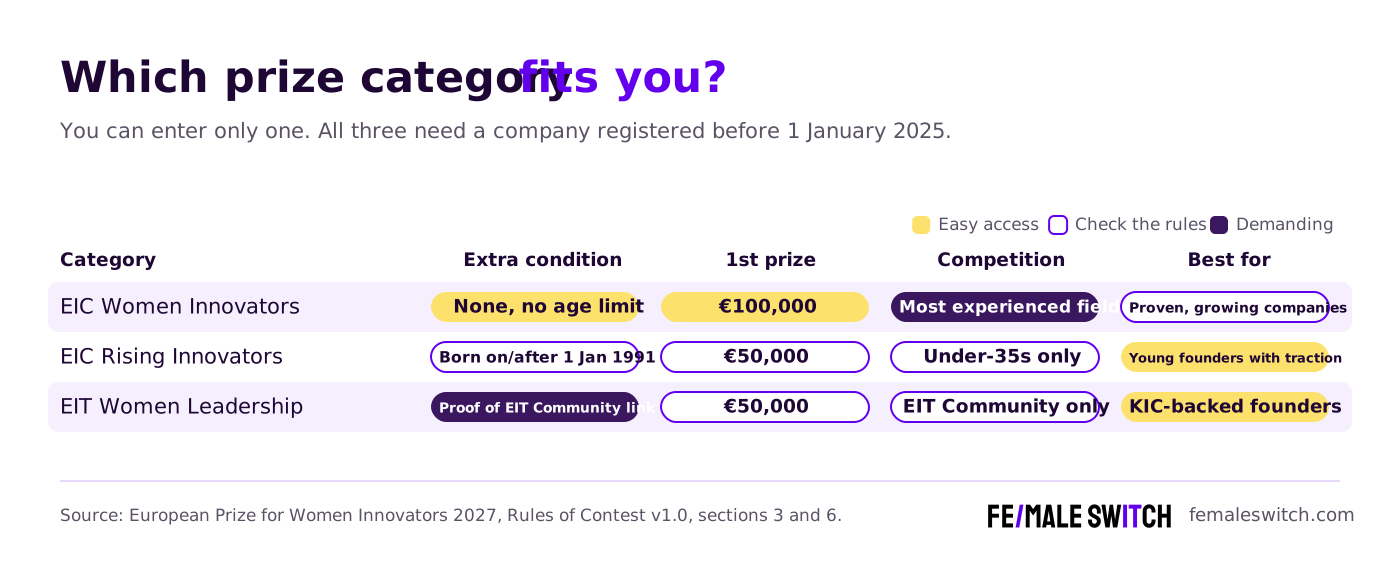
- Is your company registered before 1 January 2025 and are you a founder or co-founder? If no, you can't apply this round; look at Women TechEU, which funds younger women-led deep tech startups.
- Were you born on or after 1 January 1991? If yes, Rising Innovators is open to you, and you compete only with other under-35s for €50,000.
- Has your company had support from an EIT KIC, or do you hold an EIT Labelled degree? If yes, EIT Women Leadership is open to you.
- If both 2 and 3 apply, pick the category where your story is strongest: a young founder with early traction usually stands out more among Rising Innovators; a founder whose growth was built with a KIC fits EIT Women Leadership.
- Everyone else, or anyone with a large, proven company, enters Women Innovators, where the first prize is €100,000 but the field is the most experienced.
The 2027 calendar
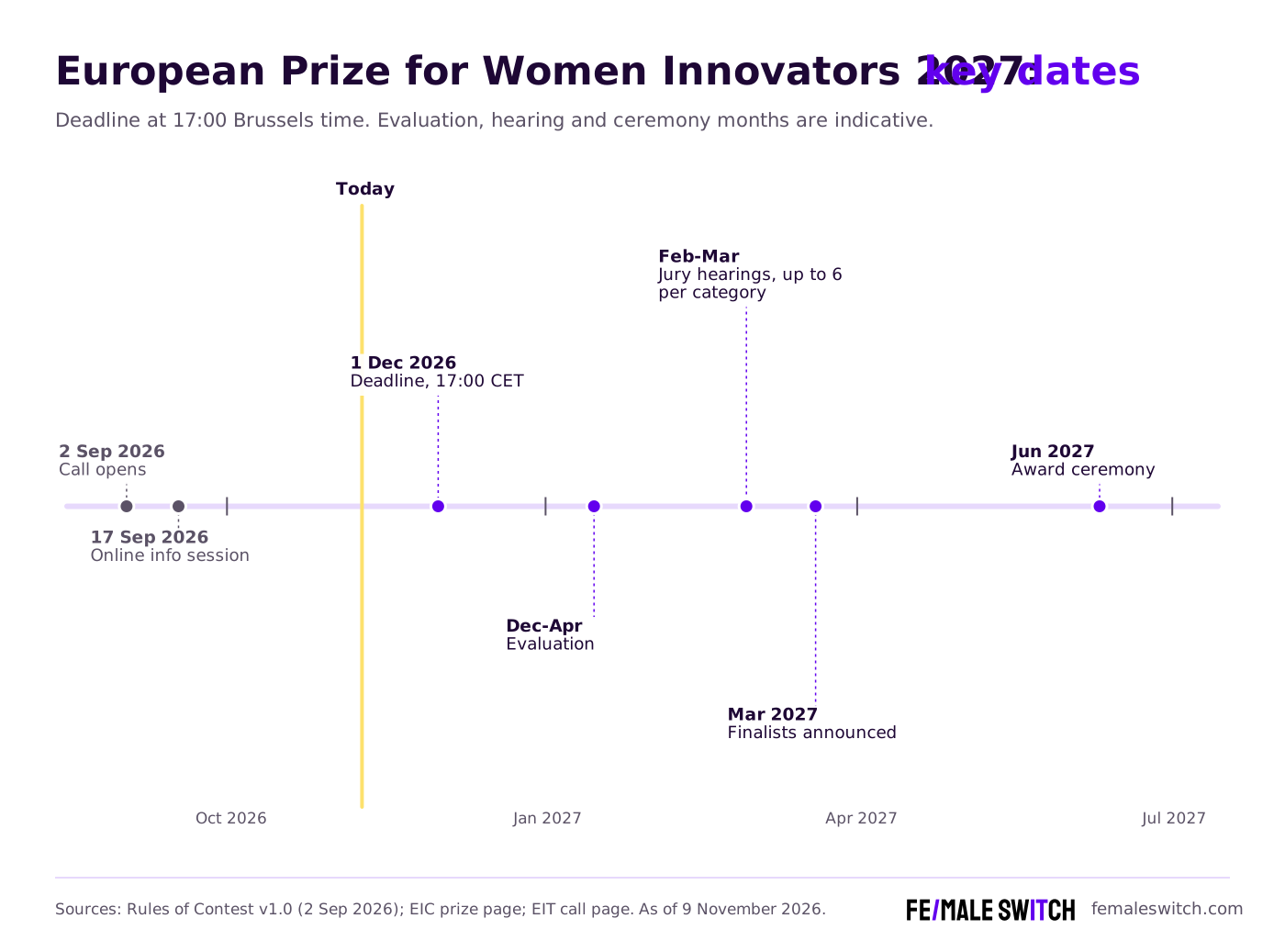
Missed it? The prize runs every year. The last three calls opened on 27 June 2024, 17 June 2025 and 2 September 2026, so expect the next one between June and September 2027; the date has not been announced. Our EU grant calendar 2027 lists the other deadlines to plan around.
How the jury scores you
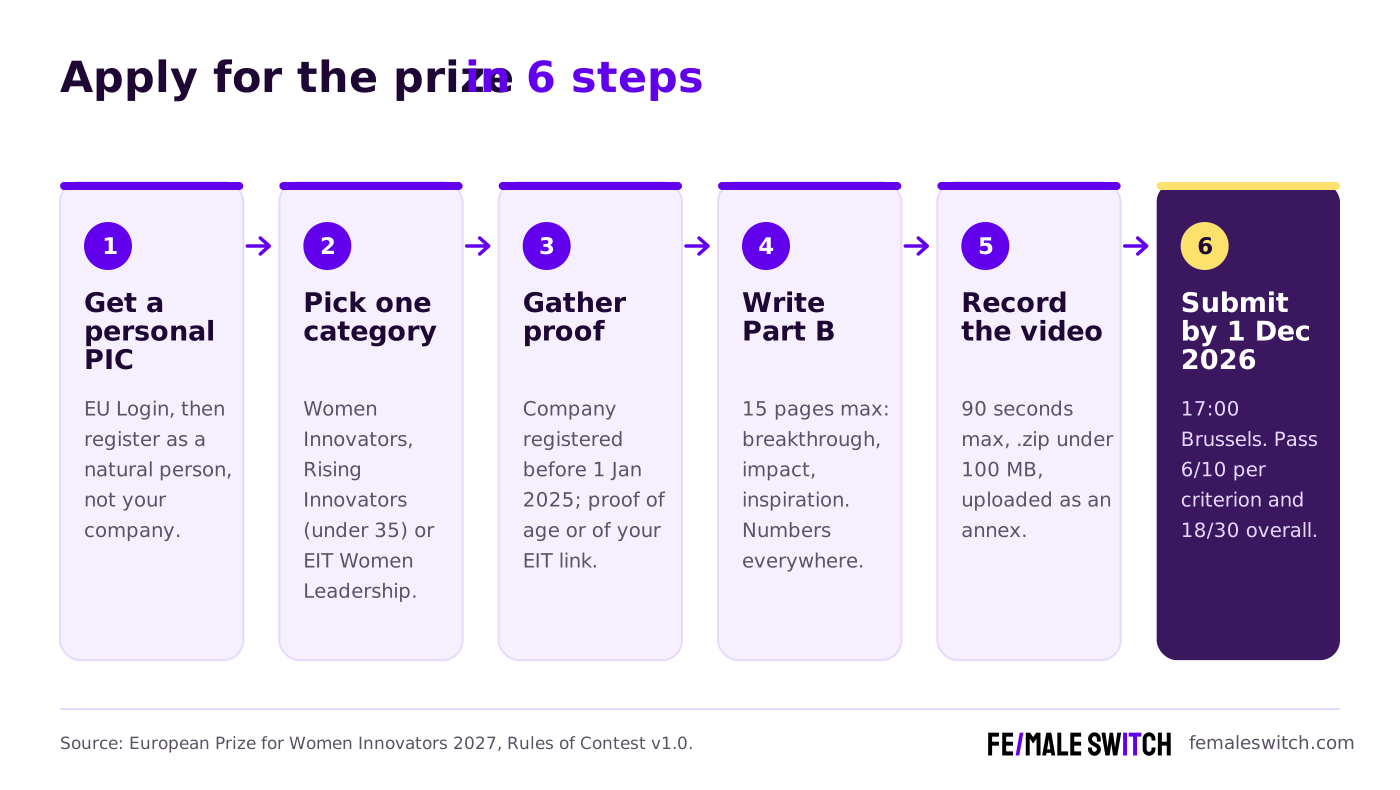
Your application has three parts: Part A (administrative details, filled in online), Part B (at most 15 pages on the official template; the jury ignores anything beyond that) and a video of no more than 90 seconds, uploaded as a .zip of up to 100 MB. Rising Innovators add proof of age; EIT applicants add proof of their EIT link.
The jury scores three criteria out of 10 each. You need at least 6 on every criterion and 18 overall:
Two details matter for strategy. Ties are broken by weighting Impact by 2 and Inspiration by 1.5, so those two criteria decide close calls. And Impact is about current performance: customers, revenue, jobs, measurable results. A brilliant prototype with no users scores weakly here.
Scoring worksheet: rate yourself before you write
Score each line 0–2 (0 = no evidence, 1 = a claim, 2 = a number or document):
- I can name the existing solutions and say in one sentence why mine is better.
- My technology is protected or hard to copy (patent, know-how, data, peer-reviewed results).
- I have paying customers, pilots or users, with numbers.
- I can quantify the benefit for people or the planet (lives, tonnes, hours, euros).
- The company has grown: revenue, team size or funding over the last two years.
- I can show decisions that only happened because of me (founding, a pivot, a deal that changed the company).
- I mentor, speak, teach or run programmes that bring more women into tech.
- My company has concrete gender-balance practices (hiring, pay, product design).
13–16: apply and aim for a hearing. 9–12: apply, but rewrite the weak lines with numbers first. Below 9: the Impact or Inspiration threshold is a real risk; consider building evidence for the next edition.
A worked example: choosing the category
A generic founder, 33, co-founded a battery-recycling startup in Portugal in 2022. The company has 14 staff, two industrial customers and went through an EIT KIC's business acceleration programme in 2024, which counts as EIT support.
- She is eligible for Rising Innovators (born after 1 January 1991) and EIT Women Leadership (EIT KIC support). She can enter only one.
- Her strongest evidence is impact (tonnes of material recovered) and inspiration (she runs a coding club for girls). Her breakthrough story is solid but not unique among battery startups.
- She enters Rising Innovators, where she competes with younger, earlier companies and her two customers make her Impact score stand out. Part B leads with tonnes recovered and contracts signed; the video ends on the coding club.
Your three-week plan to 1 December
Copyable 90-second video script
Film it in one take in a quiet room, look into the camera and show the product if you can. For writing tips that also apply to Part B, read our guide on writing an EU grant proposal.
Who should apply and who can skip it
Apply if you founded or co-founded a company registered before 2025 with deep tech or STEM at its core, you can show customers or measurable impact, and you are active in getting more women into innovation. The prize also brings EU visibility that helps with investors and with later applications to the EIC Accelerator.
Skip it if your company is younger than the cut-off, you are self-employed rather than a company founder, or you have no results yet; in that case Women TechEU or startup funding in Europe beyond grants fit better. Our guide on how to find open EU funding calls shows what is open now.
Related EU funding guides
- EU grants for startups: programme map, deadlines and decision tree
- Women TechEU: eligibility, timeline and how to apply
- EIC Accelerator 2027: cut-off dates, budget and how to apply
- EIT InnoEnergy for startups: investment, programmes and who fits
- Seal of Excellence: what the EU quality label is worth
- The EU funding labyrinth: a critical analysis for startups
For new EU calls and prizes every month, read Mean CEO's EU Funding News on blog.mean.ceo. To practise building a startup step by step, play the Fe/male Switch startup game.
FAQ
What is the European Prize for Women Innovators?
An annual EU recognition prize run by the EIC and the EIT for women who founded or co-founded companies built on new technology. It awards nine prizes worth €420,000 in three categories.
When is the deadline for the 2027 European Prize for Women Innovators?
1 December 2026 at 17:00 Brussels time, on the EU Funding & Tenders Portal. Finalists are expected in March 2027 and the ceremony in June 2027.
How much money do the winners get?
€100,000, €70,000 and €50,000 in the Women Innovators category; €50,000, €30,000 and €20,000 in both the Rising Innovators and EIT Women Leadership categories. It is paid after the award ceremony.
Who can apply for the European Prize for Women Innovators?
A woman who founded or co-founded a company registered before 1 January 2025 in the EU or a Horizon Europe associated country, and who is legally resident there. She applies as a natural person, in one category only.
What is the age limit for the Rising Innovators prize?
You must be under 35 at the start of the call year: born on or after 1 January 1991 for the 2027 edition. Women Innovators and EIT Women Leadership have no age limit.
Can I apply again if I didn't win?
Yes, the prize runs every year and the rules don't bar earlier applicants. Only an earlier EU or Euratom prize for the same activities rules you out.
About the Author
Violetta Bonenkamp, also known as MeanCEO, is an experienced startup founder with an impressive educational background including an MBA and four other higher education degrees. She has over 20 years of work experience across multiple countries, including 5 years as a solopreneur and serial entrepreneur. Throughout her startup experience she has applied for multiple startup grants at the EU level, in the Netherlands and Malta, and her startups received quite a few of those. She’s been living, studying and working in many countries around the globe and her extensive multicultural experience has influenced her immensely.

