

TL;DR: EIT Health is the EU-backed health innovation network that funds and accelerates health startups, but almost none of its money is for an idea on a slide. The call open right now is the Innovation Validation Call 2027: up to €850,000 (at most 50% of the budget) for consortia that validate a digital or AI-enabled medical device, with a deadline of 13 January 2027. The bigger single-company grant, the Transformative Healthcare Instrument, paid €300,000 to €500,000 in 2026 but closed on 16 September 2026, and Catapult is a competition with a cash prize of up to €30,000. Below: a fit matrix, a deadline timeline, a scored readiness check, a worked budget and a copyable email to a consortium partner.
Founders often picture EIT Health as one big grant scheme. In reality it is a menu: grant calls with strict maturity gates, acceleration programmes, matchmaking with pharma, and education. Which item fits depends on how close your product is to the market and how much you have already raised.
This guide sorts it for founders, using EIT Health's call pages and the EIT's call listing, checked on 29 October 2026.
What EIT Health is (and what it isn't)

EIT Health is one of the Knowledge and Innovation Communities of the European Institute of Innovation and Technology, an EU body funded under Horizon Europe. It brings together companies, universities and research centres in the health sector, and runs its activities through regional hubs across Europe: North, Central, East and South, according to its own site. Its site counts 139 innovations brought to market and €1.9 billion in investment attracted by the companies it has supported.
Three things to know first:
- It funds projects, not companies. Its grant calls pay for a defined project (a clinical validation, a market step), with a budget, milestones and co-funding.
- It wants something back. EIT Health is building its own income, so its startup grants come with a "financial sustainability" agreement. In the 2025 Transformative Health Instrument, that was a "grant to options to equity" model, explained in the call's FAQ. The 2026 pages name a Financial Sustainability Contribution Agreement without spelling out the terms on the page, so read the call documents before you apply.
- It is not for first-time ideas. Its startup grant calls set a minimum Innovation Maturity Level (IML). Without clinical or market evidence, start with its education and acceleration offer.
Which EIT Health programme fits your startup?
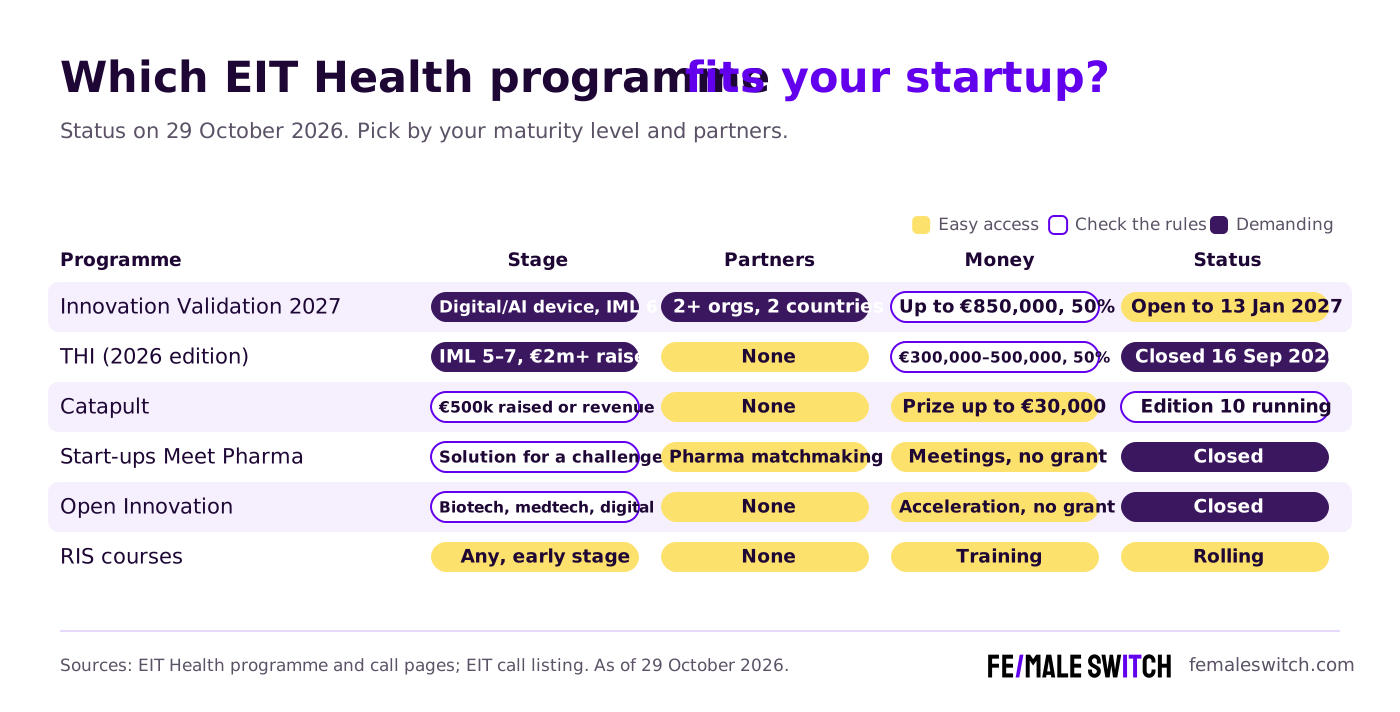
Sources: EIT Health programme and call pages; EIT call listing for THI 2026.
The EIT Regional Innovation Scheme (RIS) has run at EIT Health since 2015 in moderate-innovation regions, from the Baltics through Central Europe to Greece, Italy and Portugal. It mostly offers courses and local contacts, not startup grants.
The open call: Innovation Validation Call 2027
This is the one to act on now. According to EIT Health's call page:
- Dates: opened 14 October 2026, closes 13 January 2027. An online information session took place on 28 October 2026; an open Q&A follows on 1 December 2026 at 15:00 CET.
- Who: a consortium of at least two organisations from different countries, covering at least two sides of the "knowledge triangle" (industry, research, education). A commercialising company must lead.
- What: digital or AI-enabled medical devices under the EU medical device rules (MDR or IVDR), at IML 6, that will reach IML 7 by the end of the project.
- Money: EIT Health funds up to 50% of the total project budget, with a maximum grant of €850,000 per project.
- Strings: the commercialising company signs a Financial Sustainability Contribution Agreement. If it is a micro or small enterprise, it must receive €400,000 to €500,000 of the grant.
- Expected results: the solution should have the potential to reach 150,000 EU patients or citizens, and be on the market, generating at least €10,000 in revenue within 3 years after the funding period.
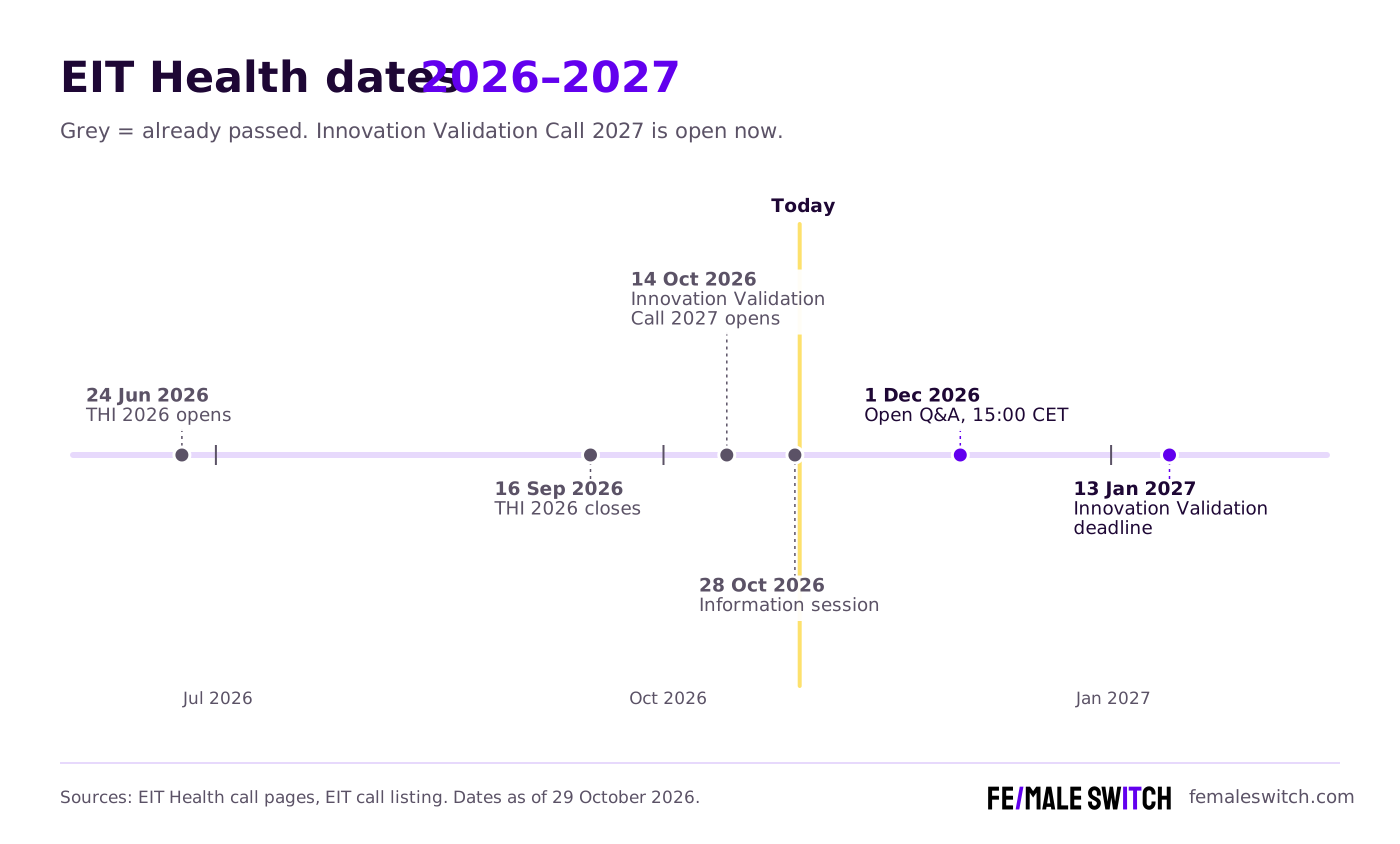
The 50% rule matters most. A project that asks for the full €850,000 needs a total budget of at least €1.7 million, so the consortium must find €850,000 or more from its own funds, investors or other sources.
The closed calls: THI and Catapult
Transformative Healthcare Instrument 2026. This was the single-company grant: €300,000 to €500,000, covering at most 50% of project costs. Applicants had to be SMEs with at least 4 full-time equivalent staff that had closed at least €2 million in equity investment within the previous 36 months, with at least one new investor. The minimum maturity was IML 5 for biotech (safety and toxicity studies), IML 6 for medtech (first clinical proof of concept) and IML 7 for digital health and diagnostics (market validation). The call ran from 24 June to 16 September 2026. The 2025 edition had other numbers (€400,000 to €500,000, at least 30% co-funding), so expect the terms to move if a 2027 round comes.
Catapult. A competition and training programme for life sciences and health tech startups. You need under 50 employees, incorporation in an EU or Horizon Europe associated country, at least €500,000 in private investment or last year's revenue, a plan to raise at least €2 million, and a company no older than 10 years. Winners get a cash prize of up to €30,000. The 10th edition picked 30 semifinalists in June 2026, with finals planned for late November or early December; applications are closed.
Readiness check: score yourself before you apply
Give yourself the points for each line that is true today:
16–20 points: apply to the Innovation Validation Call 2027 and start writing this week. 10–15: possible, but close the gaps in partners or co-funding first; 13 January leaves about 10 weeks. Under 10: skip this call, build evidence, and look at the programmes in our guide to European funds for startups.
Worked example: an AI cardiology startup
A generic case, not a real company. A 12-person startup sells AI software that flags heart-rhythm problems in ECG data. It is CE-marked for a first use and has a clinical proof of concept, so it sits at IML 6. It wants to run a validation study in two hospitals to reach market validation (IML 7).
Example figures, not official ones. The grant stays under the €850,000 cap, the startup's share falls inside the €400,000–€500,000 band, and the co-funding is money already in sight.
How to apply, step by step
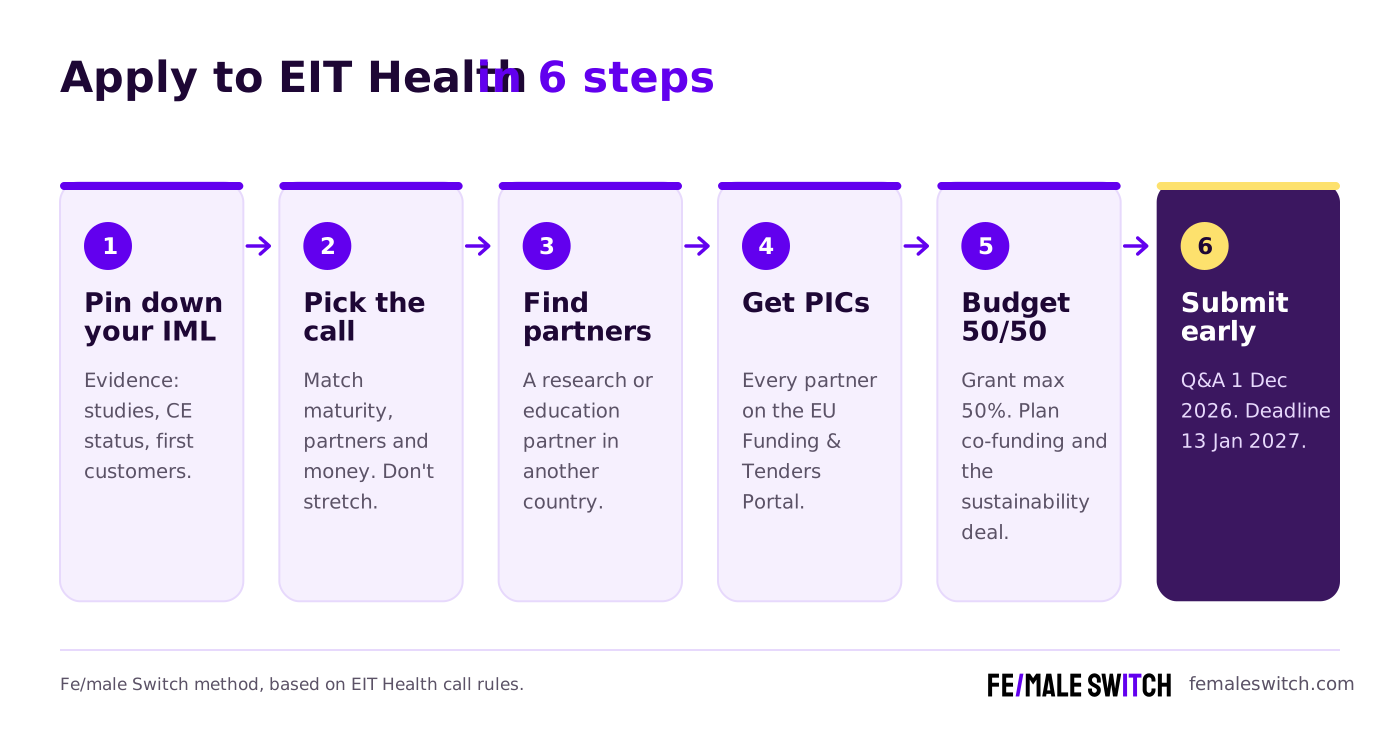
- Pin down your IML with evidence: study reports, CE status, first customers.
- Pick the call from the fit table. Don't stretch a product to fit.
- Find partners: research or education, in another country, with a clear role.
- Get a PIC (the nine-digit ID) for every partner on the EU Funding & Tenders Portal.
- Write the budget around the 50% co-funding and the sustainability agreement.
- Join the open Q&A on 1 December 2026, then submit well before 13 January 2027.
For the writing itself, use our guide to writing an EU funding application.
Copyable email to a consortium partner
Who should apply and who can skip it
Apply if you have a digital or AI medical device with clinical proof of concept, a partner in another country, and access to co-funding.
Skip it for now if you are pre-product, outside health, or can't match 50% of the budget. Personalised medicine teams should read our EP PerMed guide. R&D projects with a partner company may fit Eurostars better. Smaller, faster money often sits in cascade funding open calls.
Health innovation expert? EIT Health's Call for Experts is always open; see our call for evaluators guide.
Related EU funding guides
- EU grants for startups: programme map, deadlines and decision tree
- EU grant calendar 2027 for startups
- How to find open EU funding calls
- EIT RawMaterials funding calls: a startup guide
- EIT InnoEnergy for startups: investment, programmes and who fits
- EU funding readiness checklist for startups (2027)
- The EU funding labyrinth: a critical analysis for startups
For new EU calls every month, read Mean CEO's EU Funding News on blog.mean.ceo. And to test your business model before you write a grant, try the Fe/male Switch startup game.
FAQ
Does EIT Health fund startups?
Yes, through specific calls rather than open-ended grants. The Innovation Validation Call 2027 funds up to €850,000 (max 50% of the budget) for consortia led by a company, and the Transformative Healthcare Instrument paid €300,000 to €500,000 per startup project in 2026.
What is the EIT Health deadline for 2027?
The Innovation Validation Call 2027 closes on 13 January 2027. It opened on 14 October 2026, and an open Q&A session is set for 1 December 2026. Other 2027 calls had not been announced on 29 October 2026.
Does EIT Health take equity in startups?
Its startup grants come with a financial sustainability agreement. The 2025 Transformative Health Instrument used a "grant to options to equity" model, in which EIT Health is not a shareholder at signing. For 2026 and 2027 calls, check the terms in the call documents.
What is IML in EIT Health calls?
IML stands for Innovation Maturity Level, EIT Health's scale for how close a product is to market. The 2026 THI asked for IML 5 in biotech, IML 6 in medtech and IML 7 in digital health; the Innovation Validation Call 2027 wants IML 6 moving to IML 7.
Can a startup apply to EIT Health alone?
For the Innovation Validation Call 2027, no: you need at least two organisations from different countries. The THI was a single-company call in 2026, and Catapult accepts single startups.
Is EIT Health the same as the EIC?
No. EIT Health is a network under the European Institute of Innovation and Technology. The European Innovation Council (EIC) is a separate Horizon Europe funder with its own Accelerator, Pathfinder and Transition schemes.
About the Author
Violetta Bonenkamp, also known as MeanCEO, is an experienced startup founder with an impressive educational background including an MBA and four other higher education degrees. She has over 20 years of work experience across multiple countries, including 5 years as a solopreneur and serial entrepreneur. Throughout her startup experience she has applied for multiple startup grants at the EU level, in the Netherlands and Malta, and her startups received quite a few of those. She’s been living, studying and working in many countries around the globe and her extensive multicultural experience has influenced her immensely.

