

TL;DR: Women TechEU gives early-stage, women-led deep tech startups a €75,000 equity-free grant plus a six-month coaching and mentoring programme. The current round (2026–2028) funds 160 startups with €12 million through one open call with four deadlines: 16 September 2026, 14 January 2027, 1 April 2027 and 8 July 2027. You apply in two steps: a quick eligibility check first (weekly Tuesday cut-offs until 15 June 2027), then a full proposal. Below: the deadline calendar, a 10-point eligibility check, the scoring rules, the payment schedule, a copyable video outline and a worked founder example.
Women TechEU is one of the few EU grants written for women deep tech founders, and one of the easiest to fail on a technicality: the company is too old, women don't hold 25% of the shares, or the product is "tech-enabled" rather than deep tech.
This guide replaces our old post about the 2024 Call 3, which closed in March 2025. The facts below come from the official Women TechEU guidelines for applicants (September 2026 versions), the programme's info day material and the European Innovation Council and SMEs Executive Agency (EISMEA).
What Women TechEU is and who runs it

Women TechEU started in 2021 as a scheme managed directly by EISMEA. In 2024 a consortium took over, and the scheme is now a full cascade funding project: the European Commission funds a consortium, and the consortium passes the money on to startups through its own open call. The current project, Women TechEU 2 EIC, runs from 2026 to 2028 under the EIC part of Horizon Europe (Pillar III). EISMEA's call for the consortium (HORIZON-EIC-2025-WOMENTECH) closed on 2 September 2025.
What that means for you:
- You apply to the consortium, through the Sploro platform linked from the Women TechEU website, not the EU Funding & Tenders Portal.
- You sign a sub-grantee agreement and get a lump sum in three instalments.
- No detailed budget annex and no partners are needed.
If cascade funding is new to you, read our guide cascade funding explained first.
Women TechEU eligibility: the 10-point check
Run this check before you open the form. Every line is a pass or fail rule from the eligibility guidelines. One "no" means you can't apply this round.
The eligible associated countries listed in the guidelines are Albania, Armenia, Bosnia and Herzegovina, Egypt, the Faroe Islands, Georgia, Iceland, Israel, Kosovo, Moldova, Montenegro, North Macedonia, Norway, Serbia, Switzerland, Tunisia, Türkiye, Ukraine and the United Kingdom.
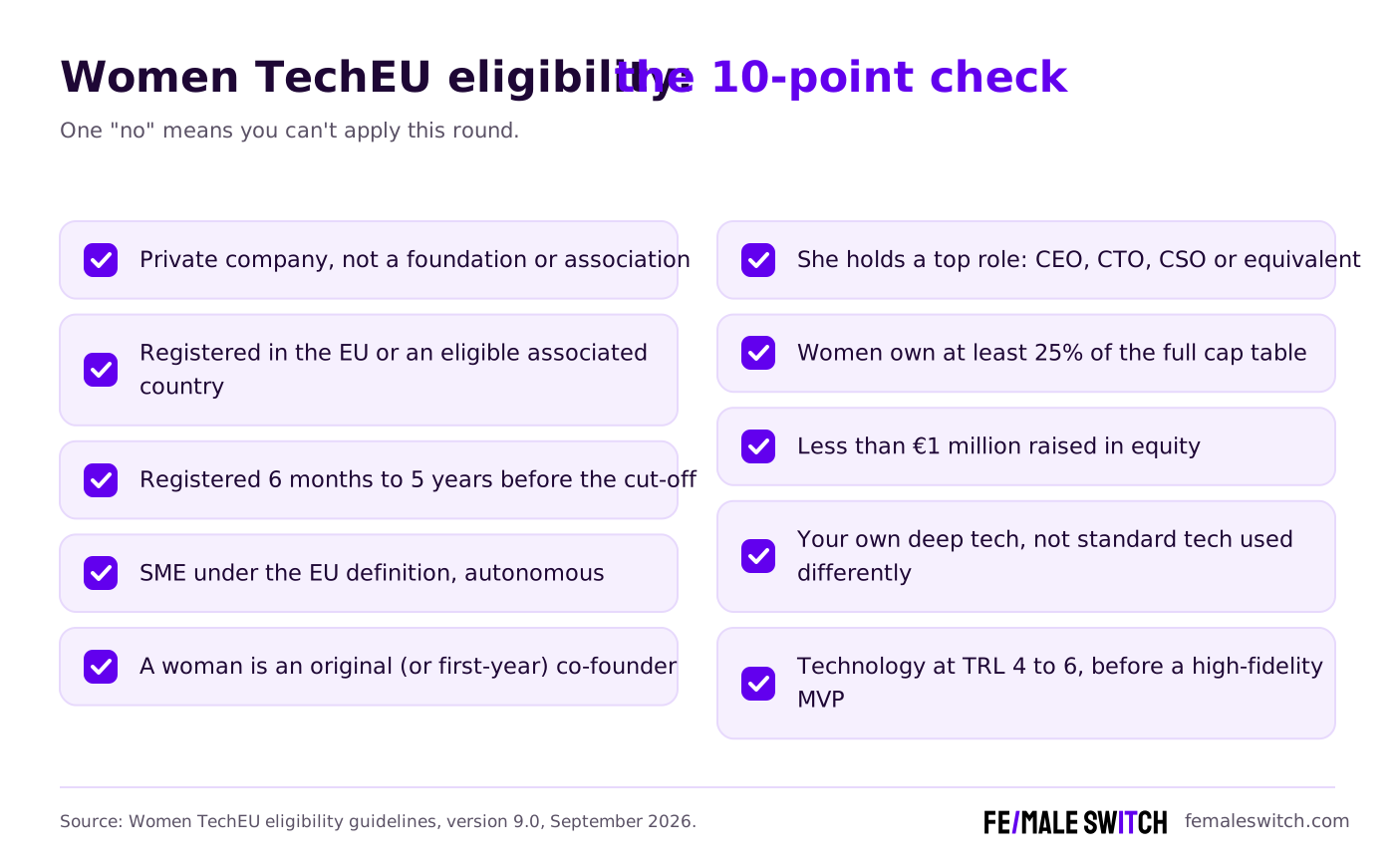
The two rules that trip people up most:
- Deep tech. The organisers name e-learning platforms, e-commerce apps with a new pricing model, games on standard engines and news portals as not deep tech. Using AI doesn't count either. The technology must be yours and push the state of the art.
- Company age. It counts from the date in the national company register, dormant periods and name changes included.
Non-dilutive grants and national subsidies don't count towards the €1 million equity limit. Earlier Women TechEU grants and EIC Accelerator funding are the exception, according to the programme's info day. And you can't win twice: €75,000 is the maximum per organisation across all deadlines.
Women TechEU timeline 2026–2027
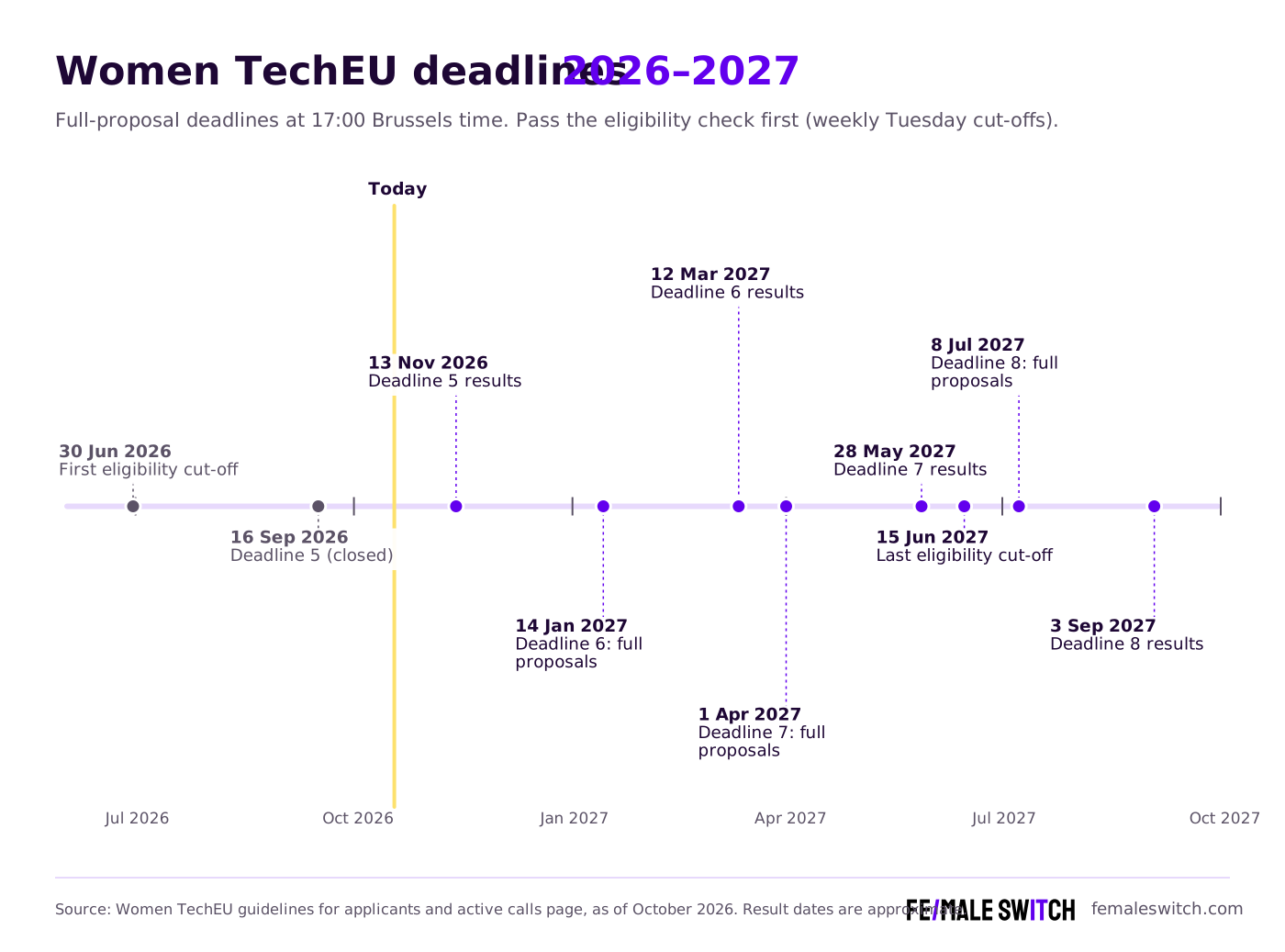
The call works in two strands. The eligibility strand opened on 1 June 2026 with weekly cut-offs every Tuesday at 17:00 Brussels time until 15 June 2027. Results come within one week, and you may resubmit up to three times. Once you are found eligible, you are invited to the full proposal strand, which opened on 15 July 2026.
All times are Brussels time. Some third-party sites still list 13 May and 12 August 2027; the dates above come from the official guidelines and active calls page, checked in October 2026.
The "what to do now" column is our advice, leaving room for one eligibility resubmission. Free online info days follow on 10 November 2026, 12 January 2027, 16 March 2027 and 4 May 2027.
How the full proposal is scored
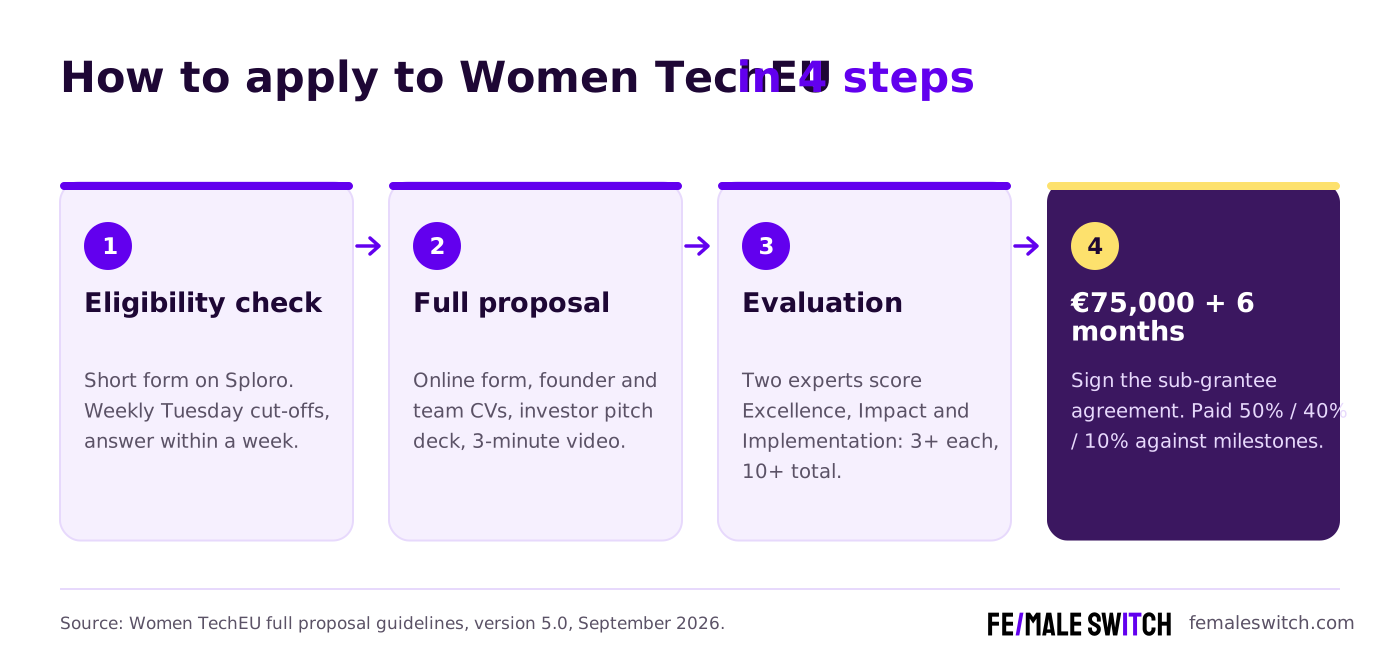
Two independent evaluators score each proposal on the same three criteria the EIC Accelerator uses. Each criterion gets 0 to 5 points.
- Excellence: use case, achievements, technology roadmap, how much the grant matters, fundraising record, how you will spend the €75,000, plans for the EIC Accelerator, novelty, technology and IP strategy.
- Impact: investor pitch, a realistic business plan with proof of demand, scale-up potential, five main competitors and a SWOT analysis.
- Implementation: work plan, women's positions in the team, team capability and risk mitigation.
Thresholds: at least 3 points on each criterion and 10 in total, or the proposal is rejected. Scores are normalised to correct for strict or generous evaluators, then ranked in two lists: widening areas and everyone else. Ties go to the higher Impact score.
What you upload: the online form, the CV of the woman founder and the team (PDF), an investor pitch deck (PDF) and a three-minute video on YouTube or Zoom, set to public. The form also asks which EIC challenge you address; an open challenge covers everything outside the five themed ones.
How the €75,000 is paid
You decide how to spend the grant, as long as evaluators agree it's what your company needs now. The money comes in three lump-sum payments tied to the six-month programme.
Payments follow up to 30 days after each report is reviewed. For the last deadline (8 July 2027), the guidelines warn the second and third payments may be delayed until the consortium receives its own funds.
A copyable outline for the three-minute video
The video is where many applications lose points. The organisers want the woman founder on screen, speaking in her own words. A smartphone recording is fine; a corporate film, an AI avatar or a slide show is not. Videos must be in English (English subtitles are accepted), at most three minutes long, and still online eight weeks after the deadline.
Open the link in a private browser window to check it plays without a login.
A worked founder example
Picture a materials scientist who co-founded a startup in Portugal in March 2023. She is CTO and owns 30%; a business angel owns 20% after investing €300,000. The team has a lab prototype of a coating that extends battery life, tested at TRL 5.
She runs the 10-point check: private company, Portugal (a widening country), registered 3 years and 9 months before a December 2026 cut-off, SME, original co-founder, top management, women own 30%, €300,000 in equity, own deep tech, TRL 5. Ten passes. She submits the eligibility form on a Tuesday in early December, gets her eligibility letter within a week and starts the full proposal for 14 January 2027.
She picks the EIC challenge on advanced materials for energy storage, budgets the €75,000 for a pilot with a battery maker and a freedom-to-operate search, and submits three days early. Coming from a widening country, she competes for one of the 16 places reserved for widening areas.
Mistakes that cost Women TechEU applicants the grant
- Submitting on the last day. The organisers say over 58% of applications in an earlier call arrived on the final day, and some missed the deadline through traffic problems. No exceptions are made.
- Counting only your own shares. The 25% is measured across the whole cap table, investors included.
- Calling a software platform deep tech. If your innovation is the content or the business model, this is the wrong grant.
- Missing the paperwork if you win. Winners must send an SME declaration, accounts for the last two closed years, the latest cap table and a PIC number from the EU Funding & Tenders Portal.
Who should apply and who can skip it
Apply if you are a woman co-founder in a top role, your company is between six months and five years old, your technology is your own and sits between TRL 4 and 6, and €75,000 plus six months of coaching would move you to your next milestone. It is a strong first step before the EIC Accelerator.
Skip it if your product already has a polished MVP, you have raised more than €1 million in equity, your innovation is a business model rather than technology, or you won Women TechEU before. Look at open EU funding calls or the wider map of European funds for startups instead.
Related EU funding guides
- EU grants for startups: programme map, deadlines and decision tree
- How to find open EU funding calls for startups (and not miss deadlines)
- Cascade funding explained: how startups win EU open calls
- European funds for startups: the 2027 map of EU grants, equity and loans
- Call for evaluators 2027: how to become a paid EU expert evaluator
- The EU funding labyrinth: a critical analysis for startups
- EU grant calendar 2027: deadlines for startups
- Eurostars for SMEs: is the consortium route worth it?
- EU grants: a guide to writing a funding application
For new calls every month, read Mean CEO's EU Funding News. Still shaping your idea? The Fe/male Switch startup game helps you build and test your startup step by step, so you arrive with the traction evaluators look for.
FAQ
Who is eligible for Women TechEU?
Private deep tech SMEs from the EU or an eligible associated country, six months to five years old, with under €1 million in equity and technology at TRL 4 to 6. A woman co-founder must hold a top role, and women must own at least 25% of the shares.
When is the next Women TechEU deadline?
The next full proposal deadline is 14 January 2027 at 17:00 Brussels time, followed by 1 April 2027 and 8 July 2027. You must pass the eligibility check first; it has weekly Tuesday cut-offs until 15 June 2027.
How much funding does Women TechEU give?
€75,000 per startup as an equity-free lump sum, paid in three instalments of €37,500, €30,000 and €7,500, plus a six-month business development programme with a mentor.
Is Women TechEU only for EU countries?
No. Eligible associated countries such as the United Kingdom, Switzerland, Norway, Israel, Ukraine and Türkiye can apply too, and 40% of the budget is reserved for widening areas.
Can I apply to Women TechEU if my startup uses AI?
Only if the AI technology itself is your own advance and goes beyond the state of the art. Using existing AI tools inside a product does not count as deep tech under the programme's rules.
Can I apply again if I was rejected?
Yes, within limits. You can submit a full proposal at most three times across the four deadlines (the first try plus two resubmissions), and the eligibility check can be resubmitted up to three times. Read the evaluation summary report before trying again. Each company can win only one grant.
About the Author
Violetta Bonenkamp, also known as MeanCEO, is an experienced startup founder with an impressive educational background including an MBA and four other higher education degrees. She has over 20 years of work experience across multiple countries, including 5 years as a solopreneur and serial entrepreneur. Throughout her startup experience she has applied for multiple startup grants at the EU level, in the Netherlands and Malta, and her startups received quite a few of those. She’s been living, studying and working in many countries around the globe and her extensive multicultural experience has influenced her immensely.

