

TL;DR: Screw It, Let's Do It summary in one paragraph: Richard Branson's short 2006 book collects the life lessons behind Virgin, from "just do it" and "have fun" to "be bold", "stand on your own feet" and "do some good", each told through a story from his own life. The useful part for founders is hiding in plain sight: Branson's boldest bets came with an exit, like the first Virgin Atlantic jumbo jet he could hand back if the airline failed. Below: the nine lessons in plain words, a copyable downside-check worksheet, a then-vs-now table, a decision checklist and a 30-day plan for a small startup.
Screw It, Let's Do It is the book that turned Richard Branson's favourite phrase into a title. He wrote it in 2006 for Quick Reads, a UK series of short books for adults who don't read much, launched on World Book Day that year. Virgin Books then published an expanded edition in 2007 with the subtitle "Lessons in Life and Business".
It is warm, quick to finish and reads more like a collection of stories than a business manual. Most summaries list the lessons and stop. This one asks a harder question for founders in 2026: how do you act on "screw it, let's do it" without a billionaire's safety net?
Screw It, Let's Do It summary in nine lessons

- Just do it. Believe things can be done, set goals, prepare well and don't give up. Branson ties this to a near-disaster in a hot-air balloon and to his mother's can-do attitude.
- Have fun. If work stops being fun, change something. He links the start of his airline to a holiday in the Caribbean, when a cancelled flight led him to charter a plane and sell seats to other stranded passengers.
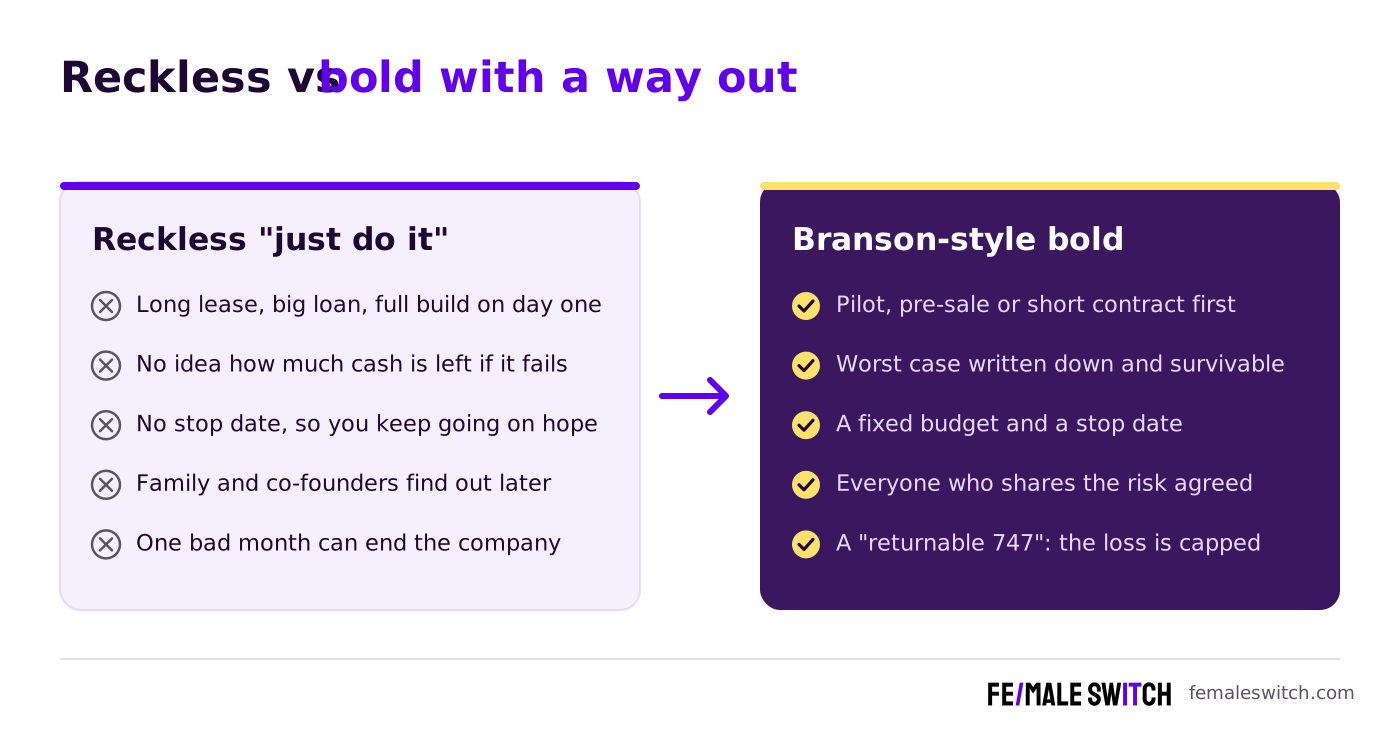
- Be bold. Take risks, but weigh them first. His key example: when he started Virgin Atlantic, he arranged to lease a Boeing 747 that he could give back after a year if the airline didn't work.
- Challenge yourself. Set goals that stretch you. He tells of learning to swim after a bet with an aunt, and of starting a magazine for students as a teenager despite dyslexia and poor school results.
- Stand on your own feet. Think for yourself and don't wait for others to hand you things. One example is taking Virgin public in the 1980s and then buying it back because life as a listed company didn't suit him.
- Live the moment. Don't dwell on regrets, keep time for family, and treat money as a means rather than the goal.
- Value family and friends. Loyalty runs both ways. Early on, relatives backed his music business with their own money.
- Have respect. Be honest and courteous. A brief brush with the law over his early record business taught him never to do business in a way he would be ashamed of.
- Do some good. Business should leave the world better. He points to Virgin's charity work, organised since the early 2000s through Virgin Unite.
📘 Free e-book: Startup Idea Validation the Right Way. Before you market or build anything, make sure people want it. Violetta Bonenkamp's free e-book shows first-time founders how to test demand with minimal resources, track the metrics that matter and reach their first customers without giving away equity, with downloadable templates and checklists. Read about the book and get your free copy →
The lesson most readers miss: bold, with a way out
The title sounds like permission to jump without looking. The stories say something else. Branson's famous "yes" moments usually came after he had limited the damage if things went wrong. The returnable jumbo jet is the clearest case: a big, public, risky bet, with the worst outcome capped in advance. He has repeated the idea for years in interviews as "protect the downside".
For a small startup, that is the whole lesson. Say yes quickly to the experiment, and say no to anything that could end the company if it fails. Boldness is about how fast you start. Survival is about how much you put at risk.
A downside-check worksheet before you say "let's do it"
Copy this into your notes before any big move: a new product, a hire, a launch, a loan, a big ad budget.
If question 3 or question 6 gets a "no", the answer is "go smaller", not "go".
What still holds and what aged (2006 vs 2026)
The book is twenty years old. Its values hold up, but the context has changed.
Some of Branson's own later bets show the limits of pure boldness. Virgin Atlantic needed rescue funding during the pandemic, and Virgin Orbit, the satellite launch company, filed for bankruptcy in 2023. Even the master of the capped downside couldn't cap everything. For a founder with one company and no group behind it, the downside check matters more, not less.
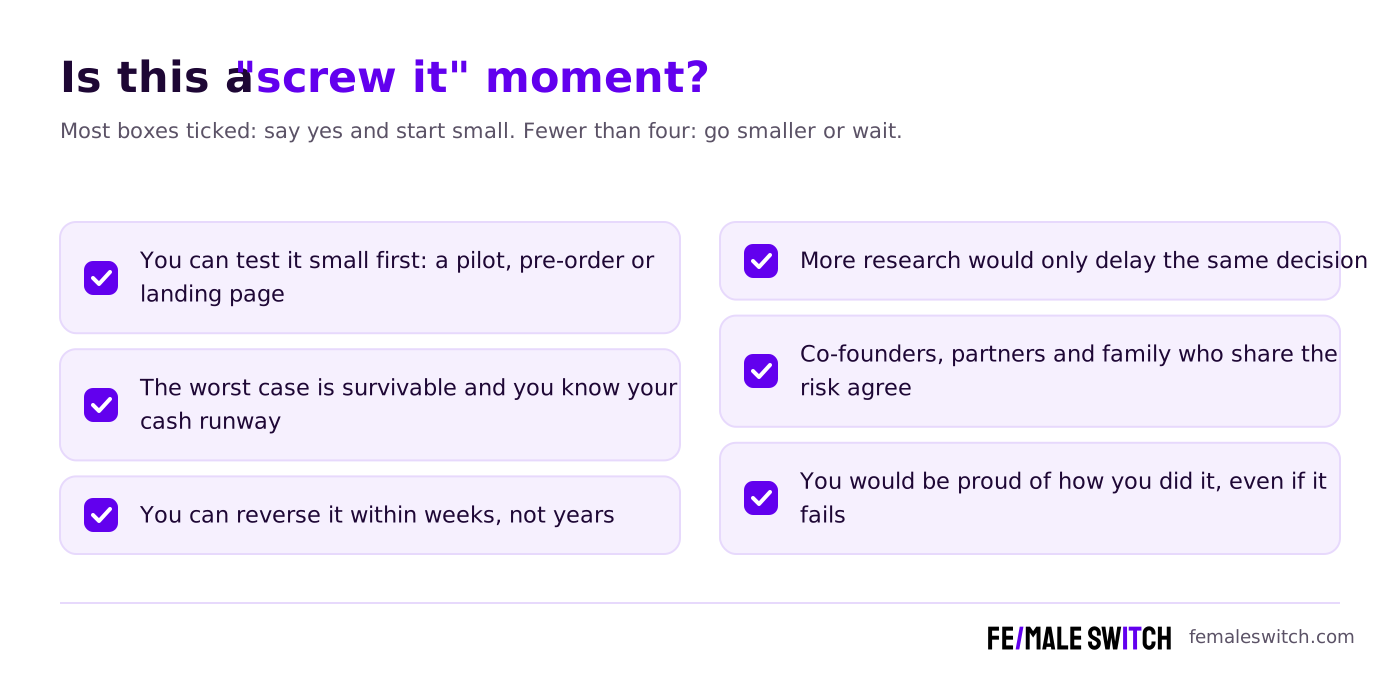
A decision checklist: is this a "screw it" moment?
Say "let's do it" when most of these are true:
- You can test it small first, with a pilot, a pre-order or a landing page.
- The worst case is survivable, and you know how many months of cash you'd have left.
- You can reverse it within weeks, not years.
- Waiting won't teach you more. More research would only delay the same decision.
- The people who share the risk agree. Co-founders, partners and family have said yes.
- You'd be proud of how you did it, even if the result is a failure.
A worked founder example: the weekend food stall
A founder wants to open a café serving dishes from her home region. The bold version is a five-year lease, a full fit-out and a bank loan. Her downside check says no: if the café fails, she loses her savings and owes money for years.
So she looks for her "returnable 747". She rents a stall at a weekend market for a month, with a short contract and no fit-out. She cooks three dishes, sells out twice, and builds an email list of regulars. A small online pre-order for holiday catering turns into a dozen paid orders.
After three months she knows which dishes sell, what people pay and where her customers live. She signs a short sublease in a shared kitchen instead of a full café. The move was still bold, and fun, but at no point could one bad month end the business.
A 30-day plan to act like Branson in a small startup
You can rehearse decisions like this with an AI co-founder in our startup game, where first-time founders test ideas and make choices with no real money at risk. If you are building on a tight budget, The Bootstrap AI Revolution shows how to do the "just do it" part with AI tools instead of a loan.
Who should read Screw It, Let's Do It (and who can skip it)
Read it if you keep postponing a decision, need a boost of energy, or want a short, friendly book to give a teenager or a reluctant reader who dreams of starting something. It takes an evening or less.
Skip it if you want a step-by-step business method or a deep look at how Virgin was built. The lessons are broad and the stories jump around. Branson's longer autobiography, Losing My Virginity, gives far more detail, and a structured book like The Lean Startup gives you a process to follow.
Related startup books for founders
- You Are a Badass: the self-belief side of "just do it", with less business and more mindset.
- Rework: start small, launch fast and keep the company calm, the practical twin of Branson's optimism.
- Lost and Founder: an honest counterweight, about what goes wrong behind the founder myths.
- Zero to One: how to make your bold idea a unique one instead of a louder copy.
FAQ
What is the main message of Screw It, Let's Do It?
Stop waiting and act on your ideas, enjoy what you do, be bold but weigh the risks, stay honest, and use business to do some good. Each lesson comes with a story from Richard Branson's life.
How many lessons are in Screw It, Let's Do It?
The book is built around nine lessons: just do it, have fun, be bold, challenge yourself, stand on your own feet, live the moment, value family and friends, have respect, and do some good.
When was Screw It, Let's Do It published?
The first version came out in 2006 as part of the UK's Quick Reads series. Virgin Books published an expanded edition, "Lessons in Life and Business", in 2007.
Is Screw It, Let's Do It worth reading for entrepreneurs?
Yes, as a quick motivational read. It won't teach you a business method, but its stories show how Branson took bold steps while limiting how much he could lose.
What does "screw it, let's do it" mean in business?
It means deciding to act instead of overthinking. In Branson's own stories it rarely means acting blindly: his biggest bets came with a plan to limit the downside.
What is the difference between Screw It, Let's Do It and Losing My Virginity?
Losing My Virginity is Branson's long autobiography with the full story of Virgin. Screw It, Let's Do It is a short book that pulls life lessons from that story.
About the Author
Violetta Bonenkamp, also known as MeanCEO, is an experienced startup founder with an impressive educational background including an MBA and four other higher education degrees. She has over 20 years of work experience across multiple countries, including 5 years as a solopreneur and serial entrepreneur. Throughout her startup experience she has applied for multiple startup grants at the EU level, in the Netherlands and Malta, and her startups received quite a few of those. She’s been living, studying and working in many countries around the globe and her extensive multicultural experience has influenced her immensely.

