

Keyword Revealer vs Google Keyword Planner: Which Keyword Research Tool Fits a Startup in 2027?
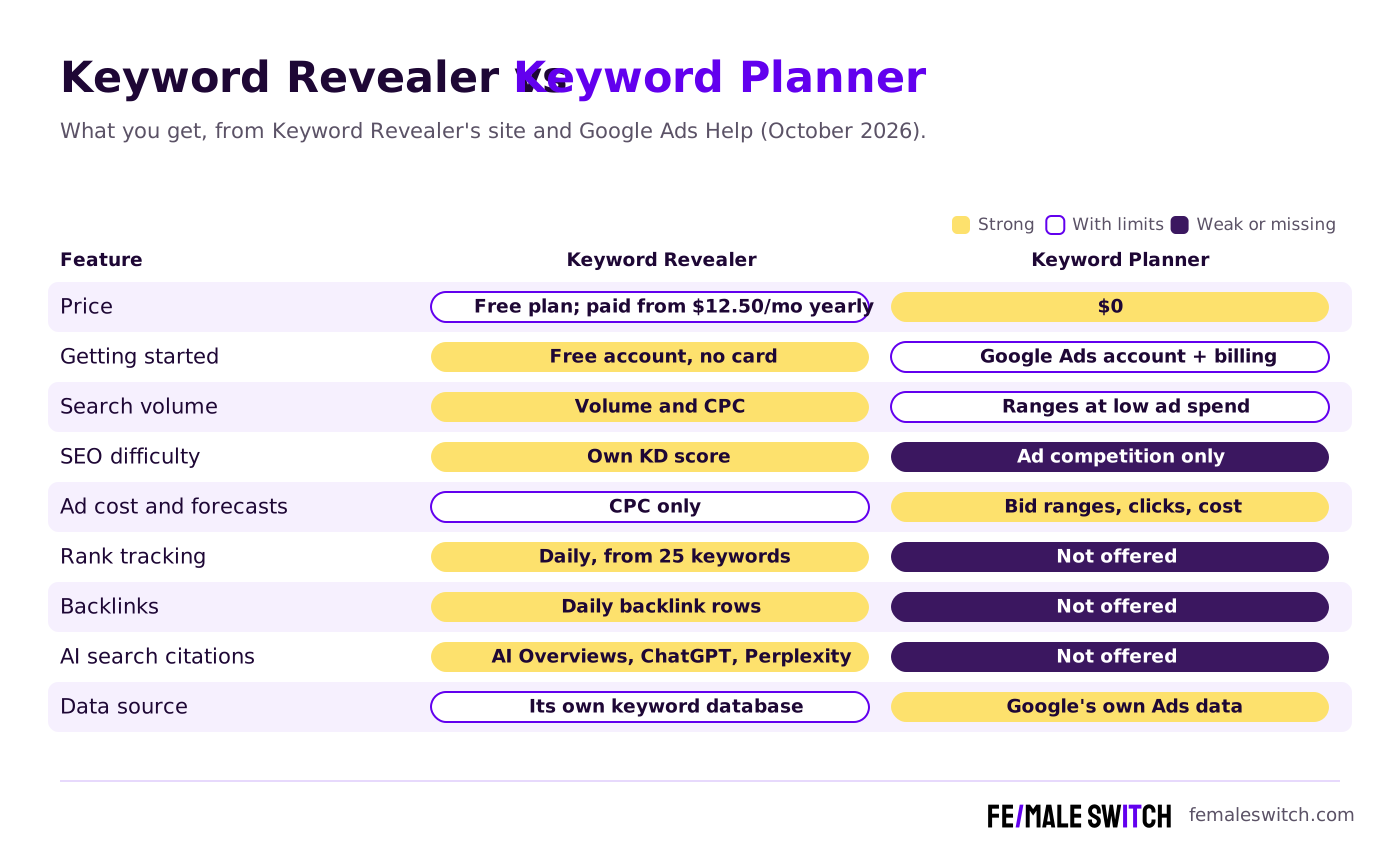
Keyword Revealer and Google Keyword Planner answer the same first question, what do people search for, but they come from opposite sides. Google Keyword Planner is Google's free advertising tool: its numbers come from Google itself, and it is built to tell you what a keyword costs in Google Ads. Keyword Revealer is a low-cost paid SEO tool that adds what Keyword Planner leaves out: a keyword difficulty score, rank tracking, backlink data and, since its relaunch, checks on whether Google's AI Overviews and ChatGPT cite your site. We checked both on their official pages in October 2026.
Quick answer: start with Google Keyword Planner. It is free once your Google Ads account has billing details, and it gives monthly searches, ad competition, bid ranges and forecasts from Google's own data. Add Keyword Revealer when you need to know which of those keywords you can actually rank for, and to track your positions and AI citations: it has a free plan, and paid plans start at $12.50 a month billed annually (Pro: $17.97 a month billed annually, or $1 for the first month and then $27.97 a month).
Are you getting customers from ChatGPT yet?
More and more traffic is coming from Perplexity, ChatGPT, Grok and other AI tools.
👉 Rank on ChatGPT
Keyword Revealer vs Keyword Planner at a Glance
Sources: keywordrevealer.com pricing (default annual view) and FAQ, Google Ads Help, checked 28 October 2026.
What Is Keyword Revealer?
Keyword Revealer started as a keyword research tool known for its keyword difficulty score and its Keyword Tree, which shows ideas as branches you can open one by one. It has since relaunched as an "AEO and GEO intelligence platform": the homepage now leads with checks on whether Google's AI Overviews and ChatGPT cite your site, and the keyword tools sit underneath. Keyword Revealer says it has more than 300,000 users and a database of 3.1 billion keywords.
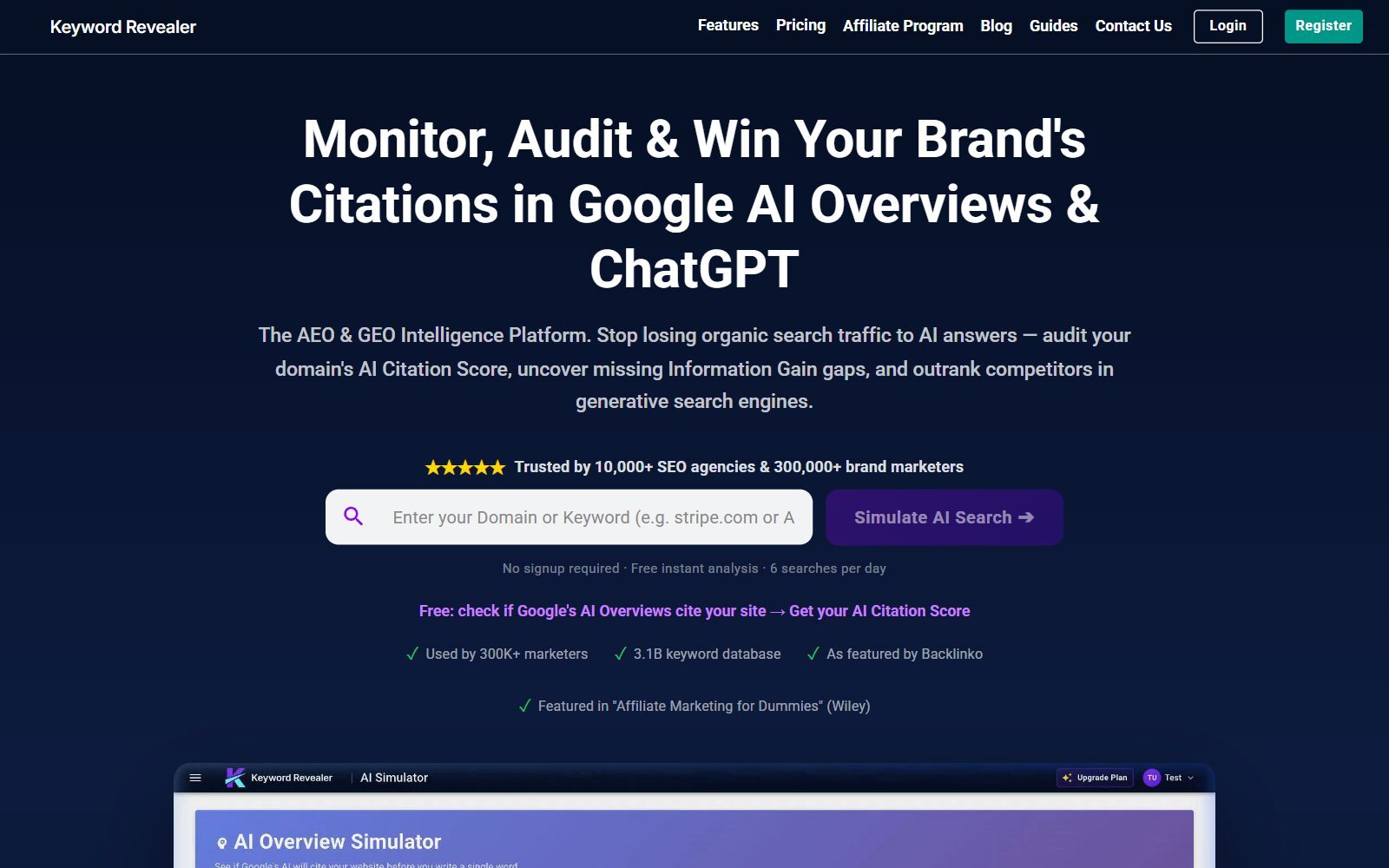
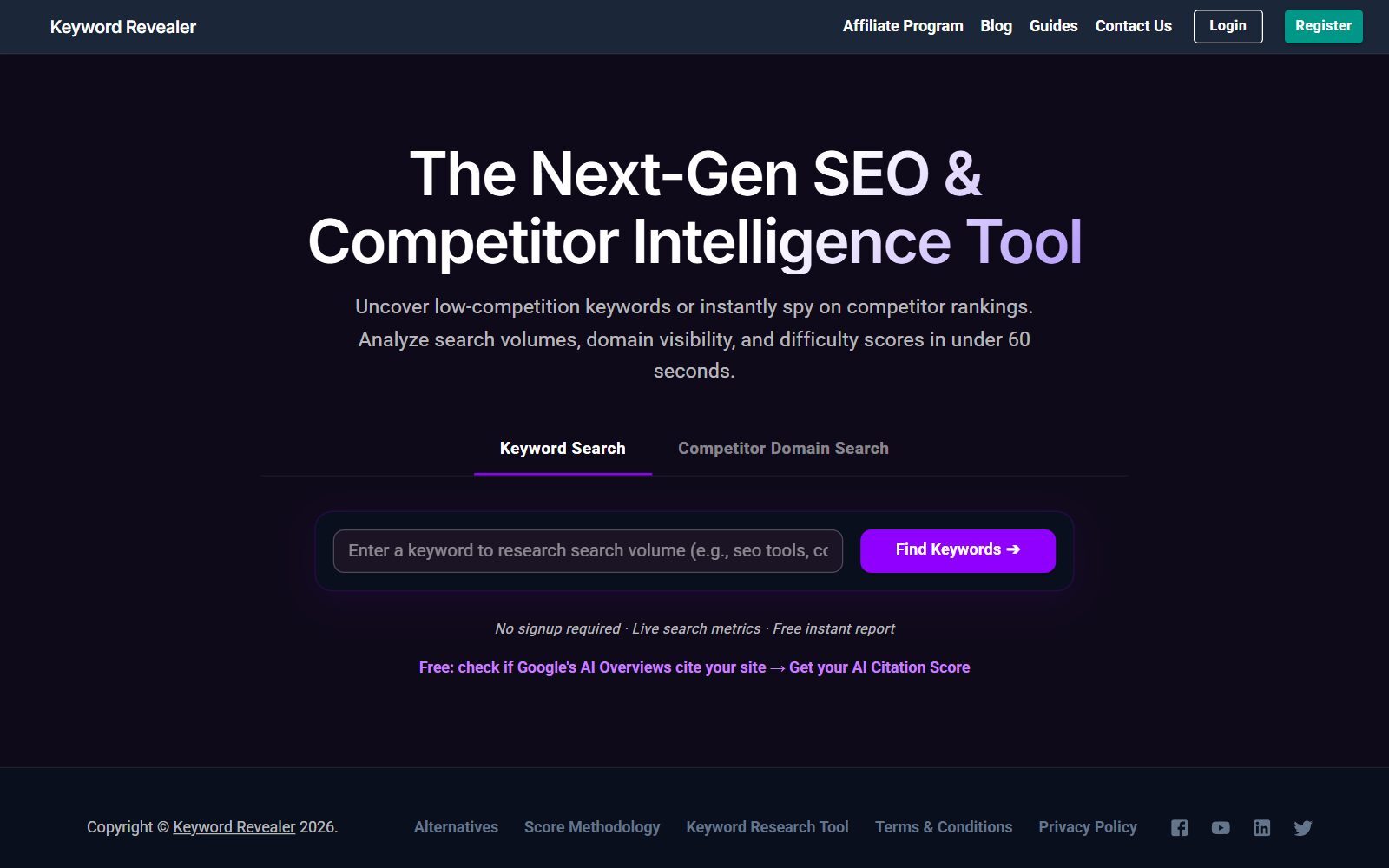
- Keyword research: monthly search volume, CPC and its own keyword difficulty (KD) score, plus the Keyword Tree for grouping ideas into topics. The keyword research tool also searches by competitor domain to show the keywords a site ranks for.
- Rank tracker and backlinks: daily position tracking with drop alerts, and backlink reports with Citation Flow and Trust Flow, the link metrics Majestic created.
- AI search tools: an AI Overview Simulator that gives a 0–100 AI Visibility Score, a citation monitor for Google AI, ChatGPT and Perplexity, and an AEO Page Generator that turns keyword clusters into pages with FAQ schema.
- Free use: the AI search simulation runs without signup (6 searches a day), and the Free plan needs no credit card.
Keyword Revealer pricing in 2027
On the pricing table we checked on 28 October 2026 (annual billing, the page's default view), the Free plan gives 50 keyword suggestions per search, 7 keyword evaluations a day, 3 AI visibility audits a day and one monitored citation keyword. Basic costs $12.50 a month ($150 a year) for 50 daily search credits, 100 keyword evaluations a day, 25 tracked keywords and 1,000 backlink rows a day. Pro costs $17.97 a month ($216 a year) for 300 daily search credits, 150 tracked keywords, 2,000 backlink rows and 150 AI prompt audits a day across Google AI, ChatGPT, Perplexity and Gemini, plus the AEO Page Generator (3 pages a day). Elite is $49 a month ($588 a year) with 800 search credits and 400 tracked keywords, and Agency is $41.58 a month ($499 a year) for 5 client domains with white-label reports. Paid monthly, Pro costs $27.97 a month, and a banner offers the first month for $1. Separate AI visibility plans for brands and agencies cost $79 to $399 a month billed annually.
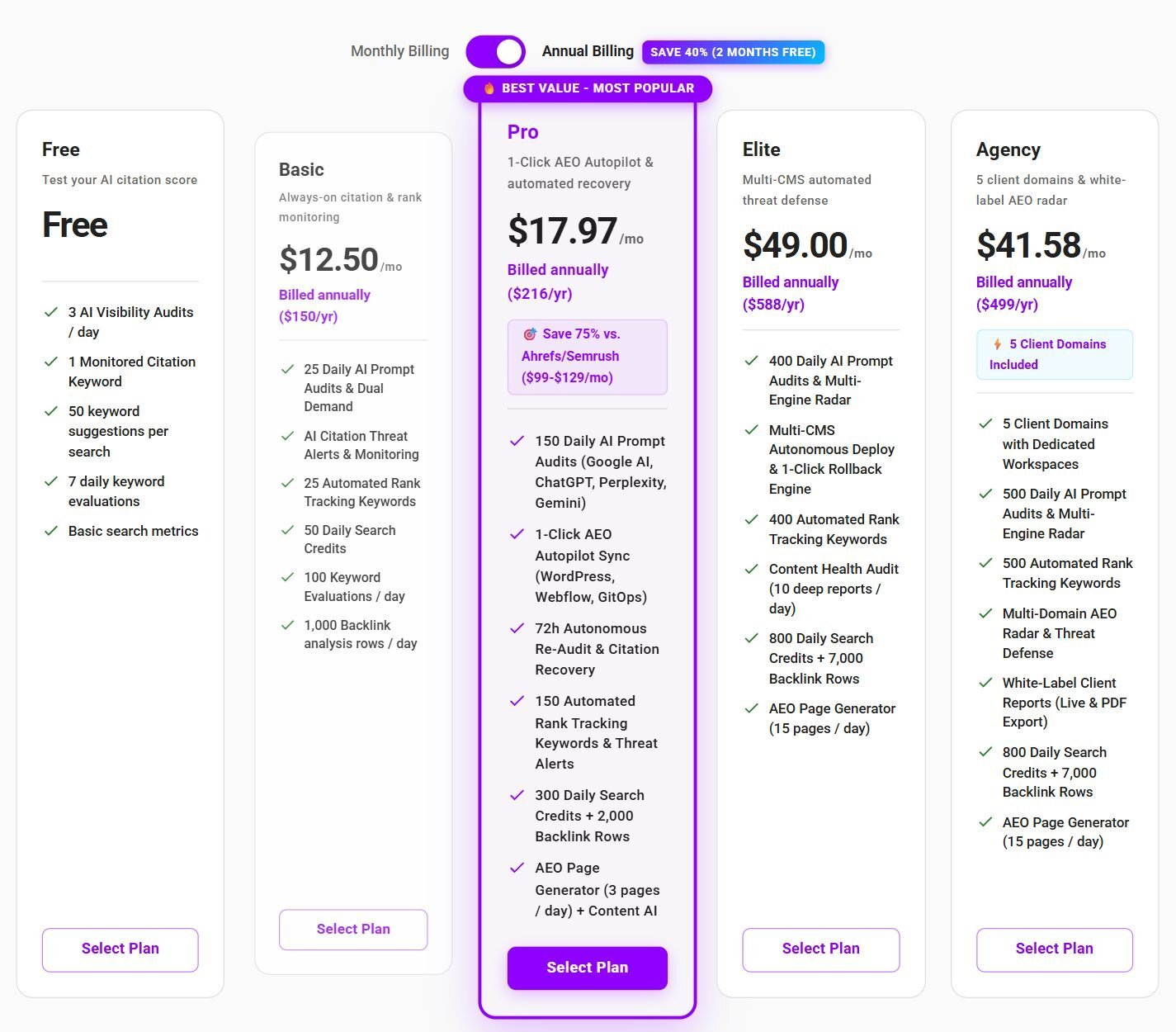
Keyword Revealer's FAQ says you can cancel any time and get a full refund within 7 days of signing up. Best for: founders who write their own content and need to find low-competition keywords, track rankings and see whether AI answers mention them, on a small budget.
Is your startup on ChatGPT?
More and more traffic is coming from Perplexity, ChatGPT, Grok and other AI tools.
👉 Rank on ChatGPT
What Is Google Keyword Planner?
Google Keyword Planner is the free keyword research tool inside Google Ads. It is built for advertisers, but SEO teams use it too because the data comes from Google. To use it you need a Google Ads account, and Google asks you to finish account setup by adding billing information before you get keyword ideas.
- Discover new keywords from words or from a website. If you enter your own domain, Google tries to leave out keywords that don't match what you offer.
- Get search volume and forecasts for a list you type or upload. Forecasts estimate clicks, impressions, cost and conversions for your budget; Google refreshes them daily from the last 7 to 10 days of data.
- Average monthly searches are averaged over 12 months by default and include close variants, for the locations and network you pick (Google's metric definitions).
- Competition (low, medium, high) shows how many advertisers appeared for a keyword compared with all keywords on Google. It is ad competition, not how hard the keyword is to rank for organically.
- Top-of-page bid ranges approximate the 20th and 80th percentile of what advertisers paid over the last 30 days.
- Filters and categories: filter by competition, impression share or keyword text, and refine ideas by brand or theme. Keywords with very low volume, or that Google treats as sensitive, are not shown.
The catch: Google's help pages don't list a spend threshold, but Search Engine Land reported in August 2016 that Google confirmed advertisers with lower monthly spend may see a limited data view, where search volumes appear as ranges such as 1K–10K instead of exact numbers. For a free account that means you can rank ideas against each other, but not read exact volumes.
Best for: checking real demand on Google, estimating ad costs and planning a first Google Ads test. Our step-by-step guide shows how to use Google Keyword Planner.
Boost Your SEO by Getting Featured in Our Blogs and get a backlink.
We publish content about startups, education, tech, funding, etc. that ranks well not only in Google but also in Perplexity, ChatGPT, Grok and other AI tools.
👉 Get featured now!
What Changed Since the 2026 Version of This Article
- Keyword Revealer relaunched: it now presents itself as an AI search (AEO and GEO) platform, with citation monitoring and an AI Overview Simulator next to its keyword, rank-tracking and backlink tools. Plans were renamed and repriced: Free, Basic, Pro, Elite and Agency, plus separate AI visibility plans.
- Keyword Planner's data is described more carefully: "accurate search volume" is replaced with what Google says the numbers are (12-month averages with close variants, ranges for many low-spend accounts).
- Removed links and filler: seven third-party review articles and a generic list of other SEO suites. Every fact above now comes from Keyword Revealer's own site or Google Ads Help.
Which One Should a Startup Choose?
- You have no budget: Keyword Planner for demand and costs, plus Keyword Revealer's Free plan for a few difficulty checks a day.
- You publish content to win organic traffic: Keyword Revealer, because Keyword Planner has no SEO difficulty score, rank tracking or backlink data.
- You plan to run Google Ads: Keyword Planner, for bid ranges and forecasts. Spending on ads also tends to unlock more precise volumes.
- You want to know if AI answers mention you: Keyword Revealer's free AI search simulation, then Pro if you need daily prompt audits.
- You need long-tail ideas on YouTube, Amazon or TikTok: neither; see our Keyword Tool vs Google Keyword Planner comparison.
- You need competitors' traffic, not only keywords: see Similarweb vs Google Keyword Planner.
Comparing link data and keyword clustering instead? Read Majestic vs Keyword Insights, Similarweb vs Keyword Insights and SpyFu vs Keyword Insights. For full SEO suites, see SE Ranking vs Mangools, Moz vs SE Ranking and Semrush vs Long Tail Pro; on a budget, start with our list of free Ahrefs alternatives.
How Founders Use Keyword Revealer and Keyword Planner Together
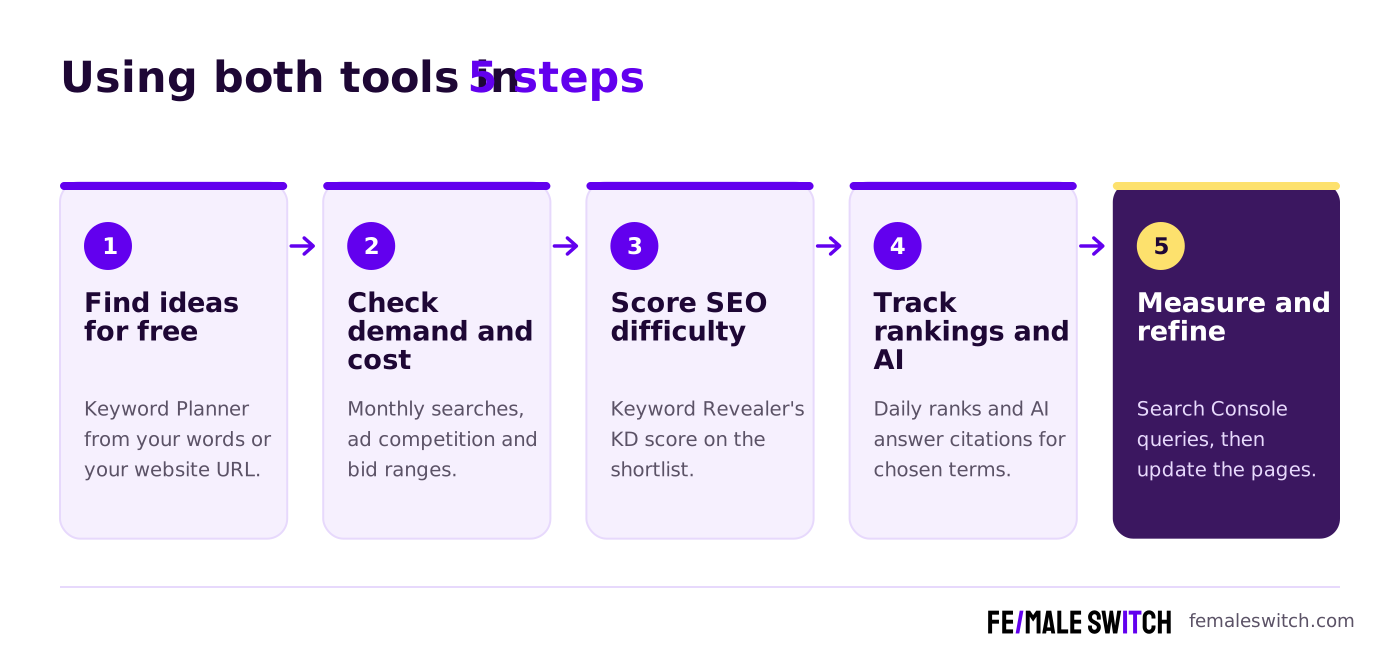
- Find ideas for free. Enter your product words or your website in Keyword Planner. Add how customers describe the problem; our guide to finding long-tail keywords shows where to look.
- Check demand and cost. Keep the keywords with real searches and note the bid ranges: a high bid often means buyers, not browsers.
- Score SEO difficulty. Run the shortlist through Keyword Revealer and keep the terms with a low KD score that match what you sell. Our guide to checking competitor keywords helps you see who ranks today.
- Track rankings and AI answers. After you publish, track the chosen keywords and check whether AI Overviews or ChatGPT cite your pages.
- Measure and refine. Use Google Search Console to see which queries bring impressions and clicks, then improve those pages.
Keyword research is also a cheap test of an idea: if nobody searches for the problem you solve, validate your startup idea before you build. To start with no budget at all, read how startups can do keyword research on a $0 budget and our roundup of free keyword planner tools.
Keywords only pay off once you publish. The F/MS AI SEO Tool turns a keyword into a full article written to rank on Google and to be cited by AI assistants such as ChatGPT and Perplexity, with human editors checking the result. For early links to a new site, F/MS Marketing Directories lists places where you can submit your startup.
Boost Your SEO by Publishing Your Startup Press Release with us.
We publish content about startups, education, tech, funding, etc. that ranks well not only in Google but also in Perplexity, ChatGPT, Grok and other AI tools.
👉 Publish Press Release
FAQ: Keyword Revealer vs Keyword Planner
What is the main difference between Keyword Revealer and Google Keyword Planner?
Keyword Planner gives Google's own advertising data for free: monthly searches, ad competition, bid ranges and forecasts. Keyword Revealer is a paid SEO tool with a free plan that adds keyword difficulty, rank tracking, backlinks and AI search citation checks.
Is Google Keyword Planner free?
Yes. You need a Google Ads account, and Google asks you to finish setup by adding billing information before you get keyword ideas. You don't have to spend money on ads to use it.
How much does Keyword Revealer cost in 2027?
When we checked in October 2026, Basic cost $12.50 a month, Pro $17.97, Elite $49 and Agency $41.58, all billed annually. Pro paid monthly costs $27.97, with the first month offered for $1. There is also a free plan.
Does Keyword Revealer have a free plan or a refund?
Yes. The Free plan needs no credit card and gives 50 keyword suggestions per search and 7 keyword evaluations a day. Paid plans can be cancelled any time, with a full refund within 7 days of signing up.
Where can I submit a guest post about my startup?
You can publish a guest post in one of the Fe/male Switch startup blogs, which rank in Google and in AI tools like ChatGPT and Perplexity. Get a quality backlink.
Why does Keyword Planner show ranges like 1K–10K?
According to Search Engine Land, Google confirmed in 2016 that advertisers with lower monthly spend may see a limited data view with search volume ranges. Google's help pages do not publish a threshold.
Does Keyword Planner show keyword difficulty?
No. Its competition column measures how many advertisers bid on a keyword, not how hard it is to rank organically. For SEO difficulty you need a tool such as Keyword Revealer.
Which tool is better for Google Ads?
Keyword Planner. It shows top-of-page bid ranges and forecasts clicks, impressions, cost and conversions for your budget, and you can add keywords straight to ad groups.
Can Keyword Revealer check if ChatGPT or Google's AI Overviews mention my site?
Yes. It has an AI Overview Simulator with a 0–100 visibility score and citation monitoring for Google AI, ChatGPT, Perplexity and Gemini. A free simulation runs without signup, 6 searches a day.
Can I use AI to write SEO articles from my keywords?
Yes. The F/MS AI SEO Tool writes articles from your keywords that are built to rank on Google and in AI assistants, with human editors reviewing them.
About the Author
Violetta Bonenkamp, also known as MeanCEO, is an experienced startup founder with an impressive educational background including an MBA and four other higher education degrees. She has over 20 years of work experience across multiple countries, including 5 years as a solopreneur and serial entrepreneur. Throughout her startup experience she has applied for multiple startup grants at the EU level, in the Netherlands and Malta, and her startups received quite a few of those. She’s been living, studying and working in many countries around the globe and her extensive multicultural experience has influenced her immensely.

