

Similarweb vs Keyword Insights: Market Traffic Intelligence or Keyword Clustering?
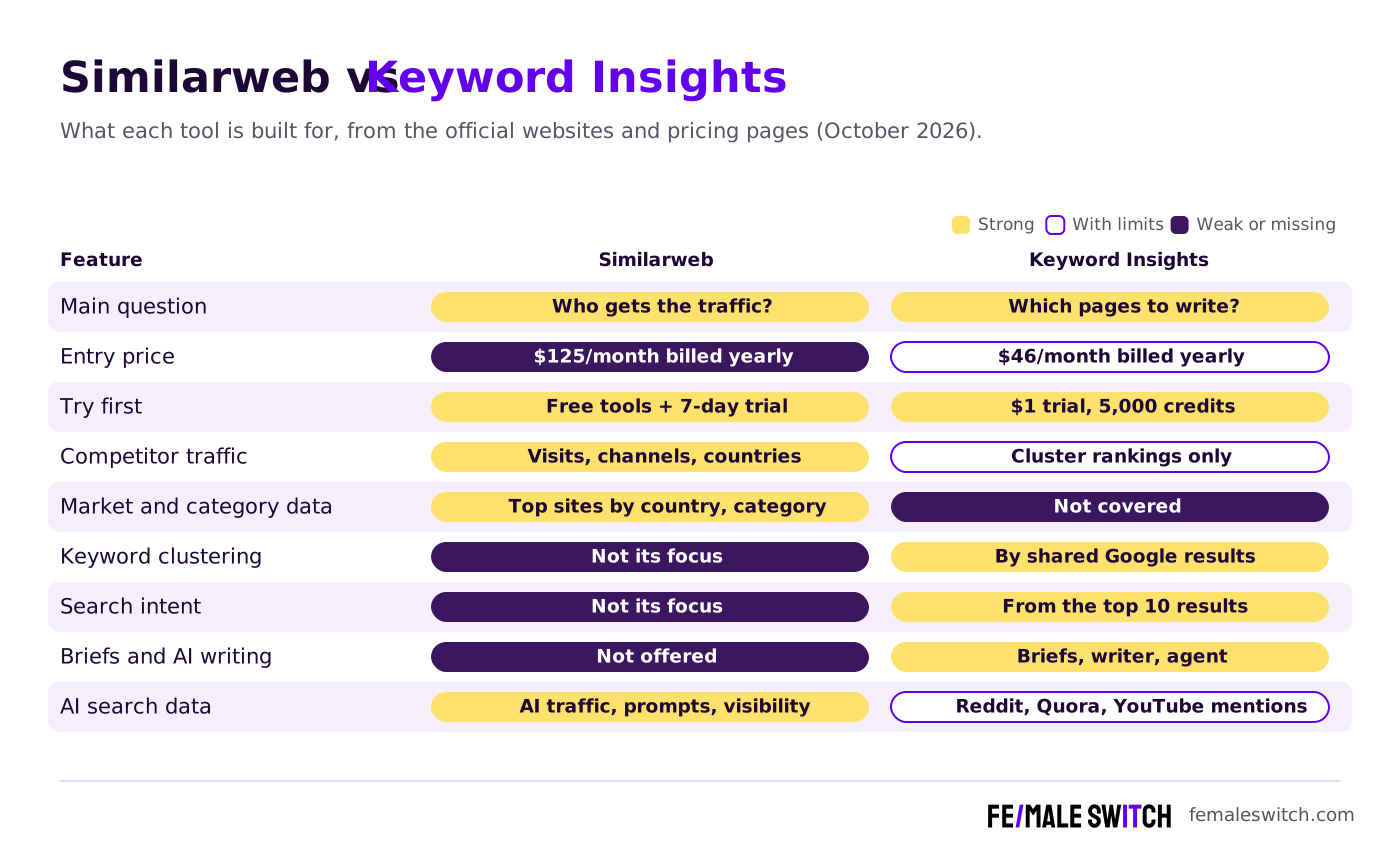
Similarweb and Keyword Insights are both sold as SEO tools, but they sit at opposite ends of the work. Similarweb tells you who wins the traffic in your market: how many visits competitors get, from which channels and countries, and how much now comes from AI chatbots. Keyword Insights starts after that: it takes a keyword list, groups the keywords that share the same Google results into clusters, adds search intent, and turns each cluster into a content brief and an AI draft. We checked both tools on their official websites and pricing pages in October 2026.
Quick answer: use Similarweb for market research and competitor benchmarking; its free website traffic checker and browser extension cover the basics, and paid self-service plans start at $125 a month billed annually ($199 month to month). Use Keyword Insights when you already know your market and need a content plan: SERP-based clusters, intent, briefs and AI writing from $58 a month, or $46 a month billed annually, with a $1 trial for 7 days. Most early-stage startups get the most from Similarweb's free tools plus a Keyword Insights subscription.
Are you getting customers from ChatGPT yet?
More and more traffic is coming from Perplexity, ChatGPT, Grok and other AI tools.
👉 Rank on ChatGPT
Similarweb vs Keyword Insights at a Glance
Sources: similarweb.com pricing, free tools and data pages, keywordinsights.ai pricing and feature pages, checked 27 October 2026.
What Is Similarweb?
Similarweb is a digital market intelligence platform. You type in any domain and it estimates the site's visits, engagement, traffic sources, top countries, the keywords that bring it search traffic and the sites that refer visitors to it. You don't need access to anyone's analytics, which is why founders use it to map a market, benchmark competitors and back up the market slide of an investor deck.
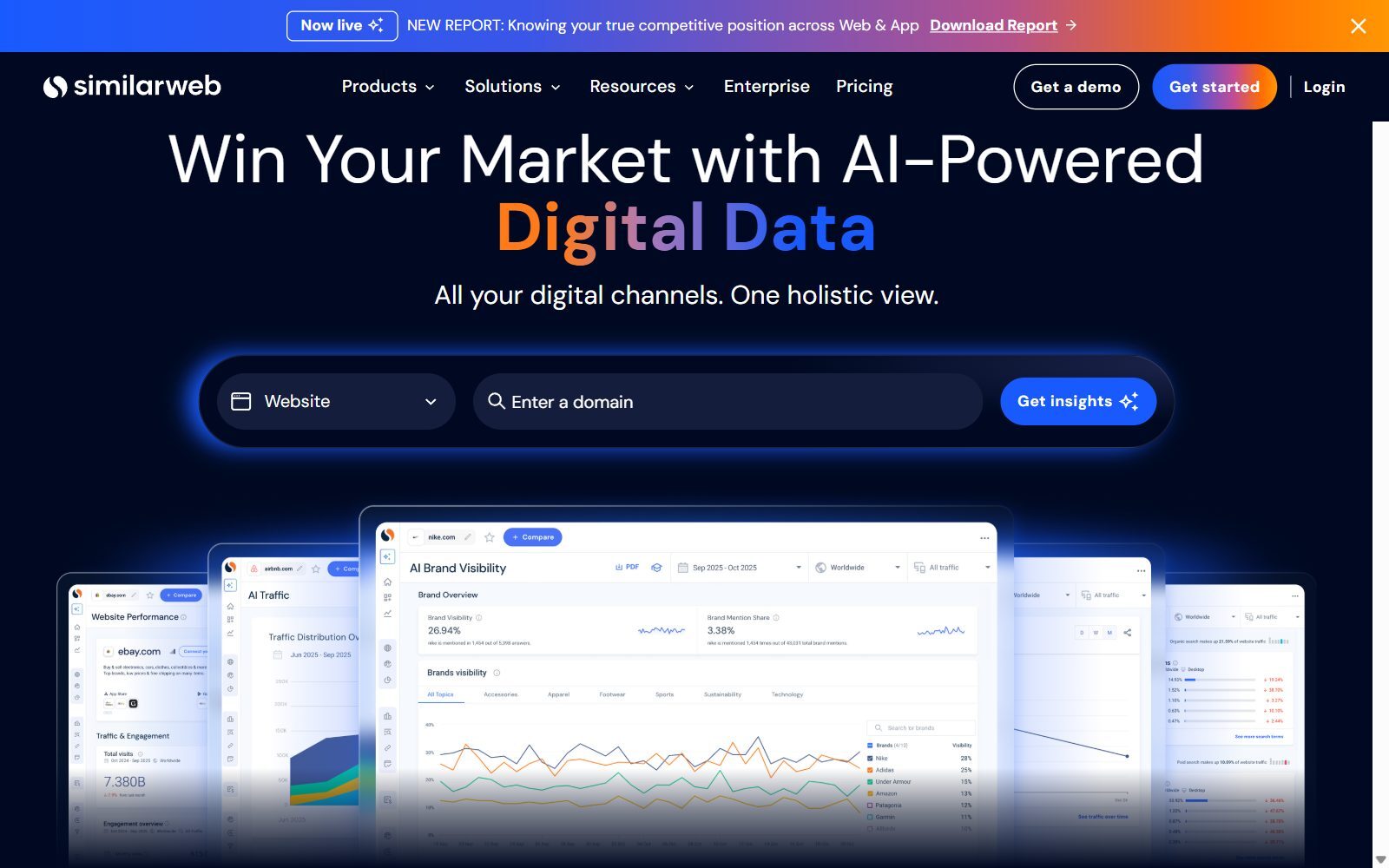
- Market maps: free rankings of the most visited websites in 50+ countries and 200+ categories show who leads your category before you look at any single competitor.
- Competitor traffic: the free website traffic checker shows traffic and engagement, rankings, SEO keywords with clicks and CPC, referring domains, search ads and technologies, and compares up to 5 competitors.
- AI search: the free browser extension shows how much of a site's traffic comes from ChatGPT, Gemini, Claude, Perplexity and other AI chatbots, plus the top prompts people ask AI about a brand.
- Where the numbers come from: Similarweb says it combines four data sources: first-party analytics from millions of websites and apps, an anonymous contributors network, public data and data partners such as ISPs and measurement companies. The figures are modelled estimates, best for comparing sites and spotting trends, not exact visit counts.
Similarweb pricing in 2027
On the Web Intelligence pricing page (checked 27 October 2026), the self-service plans for entrepreneurs each include one user: Competitive Intelligence at $125 a month billed annually or $199 monthly, with 3 months of history; Competitive Intel and SEO and AEO at $333 or $399, which adds keyword research, a rank tracker, site audit, backlinks and AI brand visibility with 150 tracked prompts, with 6 months of history; and the same plus ad intelligence at $542 or $649. Business and enterprise packages are quoted by sales and add up to 37 months of data, 100+ countries, the API, data feeds and an MCP server. There is a 7-day free trial, and Similarweb says its free data is only a high-level sample of the platform. For a full plan table, see our Similarweb vs Google Keyword Planner comparison.
Best for: sizing a market, finding out which channels work for competitors, spotting fast-growing rivals and checking whether AI assistants already send traffic in your category.
Is your startup on ChatGPT?
More and more traffic is coming from Perplexity, ChatGPT, Grok and other AI tools.
👉 Rank on ChatGPT
What Is Keyword Insights?
Keyword Insights is a UK tool (trading under Snippet Digital Ltd) built around topical authority: the idea that Google and AI assistants reward the brand that covers a whole topic, not one great page. It finds keywords, groups them into clusters that should share a page, shows the intent behind each cluster, and then writes briefs and drafts. Its Mentions feature looks beyond your own site, at the places AI answers draw on.

How Keyword Insights clusters keywords
Its keyword clustering tool checks the live, country-specific top 10 Google results for every keyword you upload. If two keywords share 30% or more of the same ranking URLs (you can change the threshold), they go into one cluster, which means one page should target both. You can choose between a centroid and an agglomerative algorithm, cluster up to 200,000 keywords at a time, and import keywords from Google Search Console. Each cluster report shows the ranking URL, average rank, search intent, traffic opportunity, difficulty and SERP features, and a competitor visibility map shows which rivals rank for each cluster.
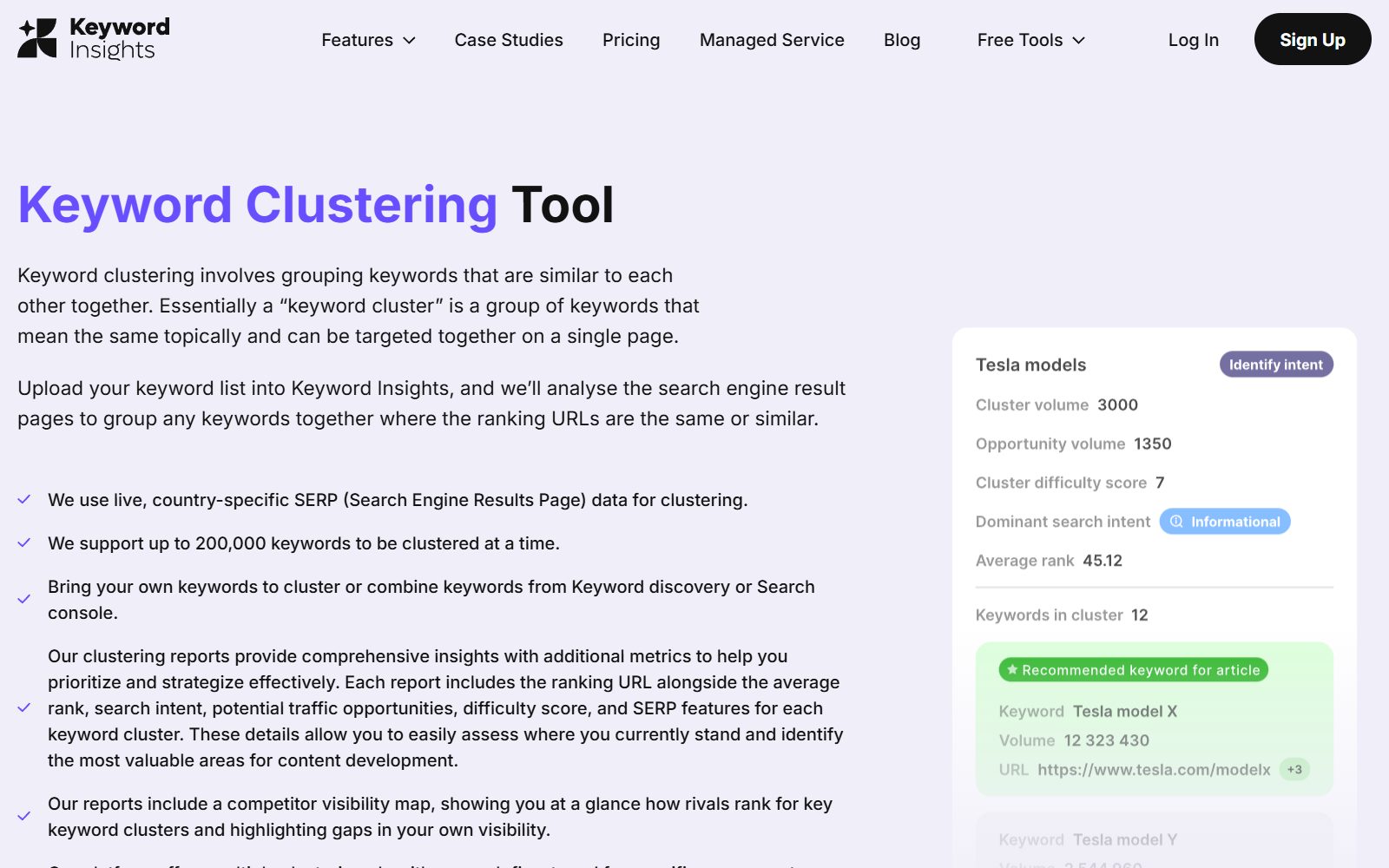
- Keyword Discovery: keyword ideas from Google Autocomplete, Reddit, Quora and People Also Ask, with search volume, keyword difficulty and CPC.
- Search intent: how many of the top 10 results are informational, commercial, transactional or other, so you pick the right page type.
- Topical clusters: NLP links related clusters into topics, which turns a flat keyword list into a site structure and a content calendar.
- Content briefs: outlines built from search results, Reddit, Quora and People Also Ask; Keyword Insights says it uses an Information Gain model to suggest a fresh angle.
- AI Writer Assistant and AI Writer Agent: an editor with grading and rewriting, and an agent that writes a full article for the page type and intent.
- Mentions: Reddit, Quora and YouTube conversations where your brand could contribute and be picked up in AI answers.
Keyword Insights pricing and credits
On the Keyword Insights pricing page (checked 27 October 2026), Basic costs $58 a month with 10,000 credits, one seat and 5 workspaces, and Professional $99 a month with 20,000 credits, three seats, 10 workspaces, team sharing and API access. Annual billing saves 20% ($552 and $948 a year). Every feature uses the same credits: clustering costs 1 credit per keyword, a Keyword Discovery search 1,000, a content brief 100, a Writing Assistant article 200 and an AI Writing Agent article 1,200. Unused credits reset at the end of each billing cycle. The $1 trial gives 7 days and 5,000 one-time credits, needs a card, and then moves you to pay as you go without charging you unless you subscribe; pay-as-you-go credits only work for clustering and expire after 30 days.
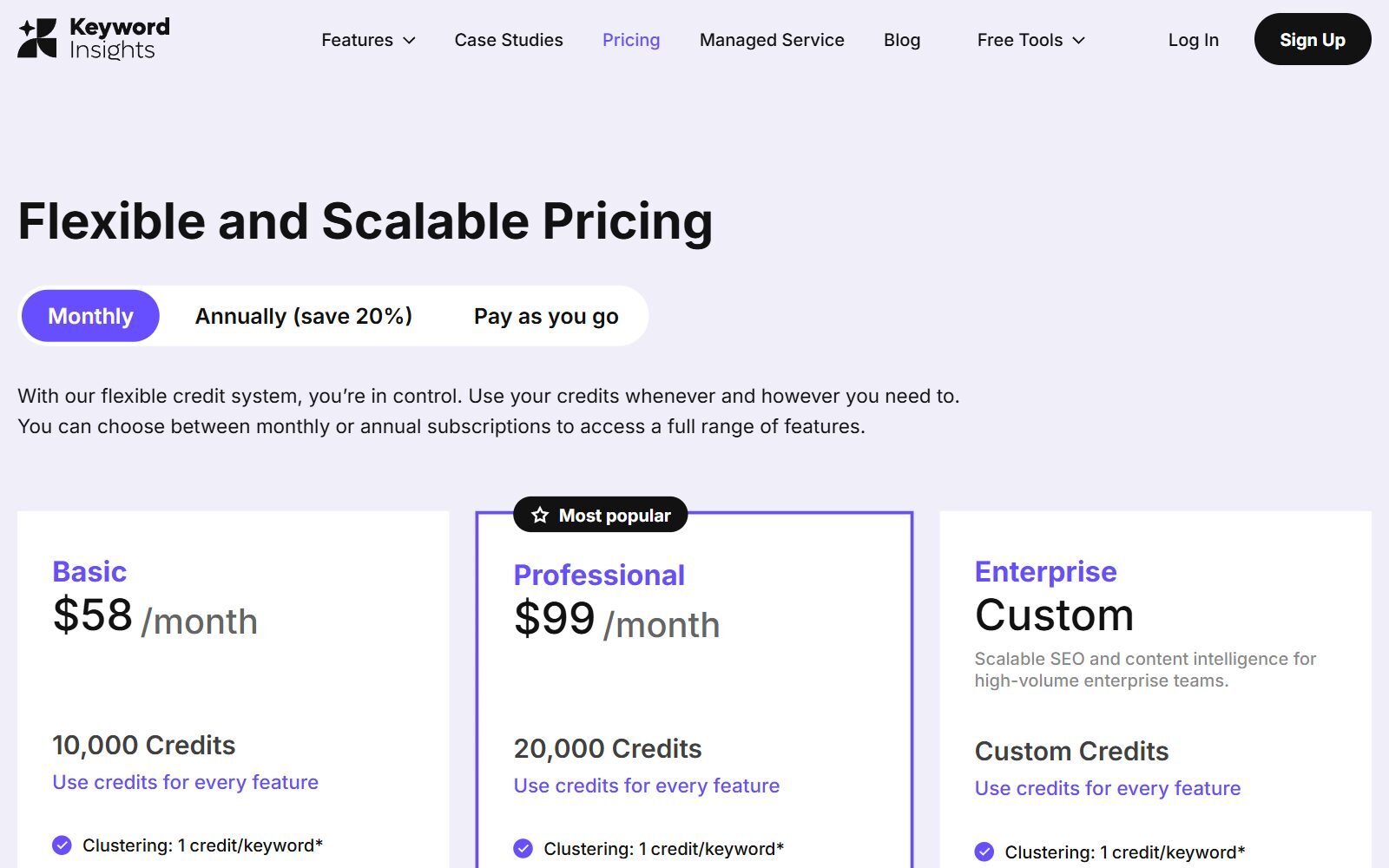
What 10,000 credits buy (our example): clustering a 2,000-keyword list (2,000 credits), 10 briefs (1,000) and 5 articles with the AI Writing Agent (6,000) use 9,000 credits, so the Basic plan covers a small startup's monthly content plan.
Best for: founders who publish regularly and need to turn a long keyword list into a clear site structure, without guessing which keywords belong on the same page. For other clustering tools, see our roundup of keyword clustering tools.
Boost Your SEO by Getting Featured in Our Blogs and get a backlink.
We publish content about startups, education, tech, funding, etc. that ranks well not only in Google but also in Perplexity, ChatGPT, Grok and other AI tools.
👉 Get featured now!
What Changed Since the 2026 Version of This Article
- Similarweb repackaged its plans: self-service plans are now Competitive Intelligence bundles that add SEO, AEO (AI search visibility) and ads, from $125 a month billed annually.
- Both tools moved into AI search: Similarweb now shows AI chatbot traffic and prompts; Keyword Insights now offers an AI Writer Agent and Mentions for AI answers.
- Removed claims: "real-time traffic data" (Similarweb's figures are modelled estimates), "trend prediction" and "localized keyword segmentation" for Keyword Insights, which neither vendor's pages describe, and vendor marketing percentages.
- Removed links: third-party reviews (MADX Digital, DemandSage, WordStream) and a vendor blog post. Every fact above now comes from the two tools' own pages.
Which One Should a Startup Choose?
- You are still validating the market: Similarweb. Its free market rankings and traffic checker show who leads your category and how they get visitors.
- You are preparing an investor deck: Similarweb, for competitor traffic and channel mix. Quote the figures as estimates.
- You have a keyword list and no content plan: Keyword Insights, to cluster it into pages and see the intent behind each one.
- You want briefs and AI drafts in the same tool: Keyword Insights.
- You want to know if AI assistants matter in your market: Similarweb's free extension for AI traffic, then Keyword Insights' Mentions to get your brand into the threads AI pulls from.
- Your budget is tight: Similarweb's free tools plus Keyword Insights Basic billed yearly ($46 a month). Test clustering first with the $1 trial on one real project.
If you mainly need competitors' keyword and Google Ads history, our SpyFu vs Keyword Insights comparison covers that pairing. For a wider SEO suite, see SE Ranking vs Mangools, Semrush vs BrightEdge, Moz vs SE Ranking, SpyFu vs SE Ranking and Wincher vs Keywords Everywhere. On a budget, start with our lists of free Ahrefs alternatives, open-source Ahrefs alternatives and cheaper Ahrefs alternatives.
How Founders Use Similarweb and Keyword Insights Together
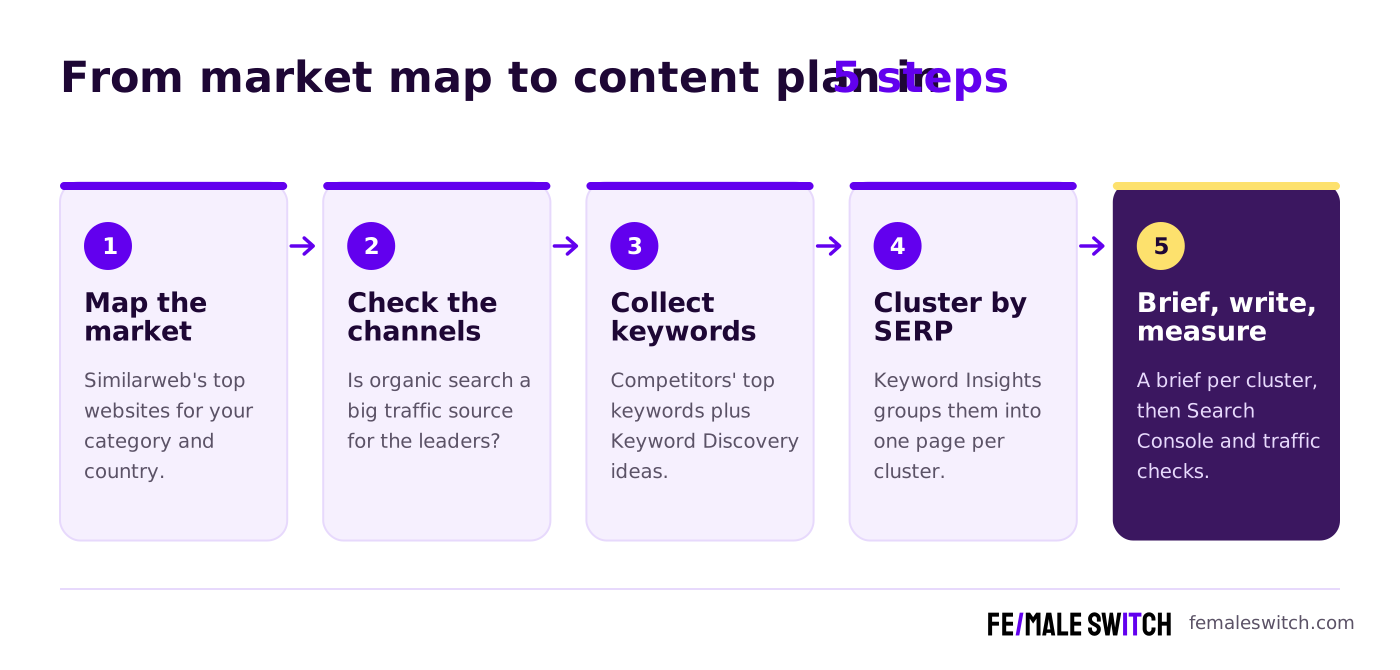
- Map the market. Open Similarweb's top websites for your category and country and list the five sites your customers would compare you with. For more ways to estimate traffic, see our traffic estimation tools.
- Check the channels. In the traffic checker or extension, see how much of each competitor's traffic comes from organic search. If search is a small channel in your market, put less of your budget into SEO.
- Collect keywords. Note the competitors' top keywords, add Keyword Discovery ideas, and use our guide to checking competitor keywords to fill the gaps.
- Cluster by SERP. Upload the list to Keyword Insights. Each cluster with its intent becomes one page, and the competitor visibility map shows where rivals are weak.
- Brief, write and measure. Write each page from its brief, yourself or with AI, then track queries in Google Search Console and re-check competitors' traffic every quarter.
This is also cheap market research: if competitors get little search traffic and nobody searches for the problem you solve, validate your startup idea before you build. To put numbers on the market, try these free market size calculators, compare more competitor analysis tools, or start free with our guide to keyword research on a $0 budget and our Keyword Tool vs Google Keyword Planner comparison.
Once your clusters are ready, the F/MS AI SEO Tool turns them into articles written to rank on Google and to be cited by AI assistants such as ChatGPT and Perplexity, with human editors checking the result. Comparing brief and content-grading tools too? See Frase vs Clearscope. For early links to a new site, F/MS Marketing Directories lists places where you can submit your startup.
Boost Your SEO by Publishing Your Startup Press Release with us.
We publish content about startups, education, tech, funding, etc. that ranks well not only in Google but also in Perplexity, ChatGPT, Grok and other AI tools.
👉 Publish Press Release
FAQ: Similarweb vs Keyword Insights
What is the main difference between Similarweb and Keyword Insights?
Similarweb estimates traffic for any website and shows where it comes from, so it is a market and competitor research tool. Keyword Insights is a content-planning tool: it clusters keywords by shared Google results and adds search intent, briefs and AI writing.
How much does Similarweb cost in 2027?
When we checked in October 2026, the self-service Competitive Intelligence plan cost $125 a month billed annually or $199 monthly, the plan with SEO and AEO $333 or $399, and the plan that adds ads $542 or $649. Business and enterprise packages are quoted by sales.
How much does Keyword Insights cost?
Basic costs $58 a month with 10,000 credits and Professional $99 a month with 20,000 credits; annual billing saves 20% ($552 and $948 a year). Enterprise pricing is custom, and a 7-day trial costs $1.
Is Similarweb free?
Partly. The website traffic checker, keyword tool and browser extension are free but show a high-level sample. Paid plans unlock more history, countries and drill-downs, and there is a 7-day free trial.
Where can I submit a guest post about my startup?
You can publish a guest post in one of the Fe/male Switch startup blogs, which rank in Google and in AI tools like ChatGPT and Perplexity. Get a quality backlink.
How does Keyword Insights decide which keywords belong together?
It checks the live top 10 Google results for each keyword. Keywords that share 30% or more of the same ranking URLs form one cluster; you can change that threshold and the clustering algorithm.
Does Similarweb cluster keywords or write content briefs?
Its pricing page does not list either. The SEO plans include keyword research, a rank tracker, site audit and backlinks, which is why Similarweb pairs well with a clustering and brief tool such as Keyword Insights.
How accurate is Similarweb traffic data?
It is a modelled estimate built from first-party analytics, a contributors network, public data and partners. Use it to compare sites and trends, not as a competitor's exact visit count.
Which tool helps more with AI search visibility?
They help in different ways. Similarweb shows how much traffic AI chatbots send to a site and which prompts people ask; Keyword Insights' Mentions finds Reddit, Quora and YouTube threads where your brand can be mentioned in sources AI answers draw on.
Can I use AI to write SEO articles from my keyword clusters?
Yes. Keyword Insights has its own AI writers, and the F/MS AI SEO Tool writes articles from your keywords that are built to rank on Google and in AI assistants, with human editors reviewing them.
About the Author
Violetta Bonenkamp, also known as MeanCEO, is an experienced startup founder with an impressive educational background including an MBA and four other higher education degrees. She has over 20 years of work experience across multiple countries, including 5 years as a solopreneur and serial entrepreneur. Throughout her startup experience she has applied for multiple startup grants at the EU level, in the Netherlands and Malta, and her startups received quite a few of those. She’s been living, studying and working in many countries around the globe and her extensive multicultural experience has influenced her immensely.

