

Mailchimp vs Pardot (Salesforce Marketing Cloud Account Engagement): Small-Business Email or B2B Marketing Automation?
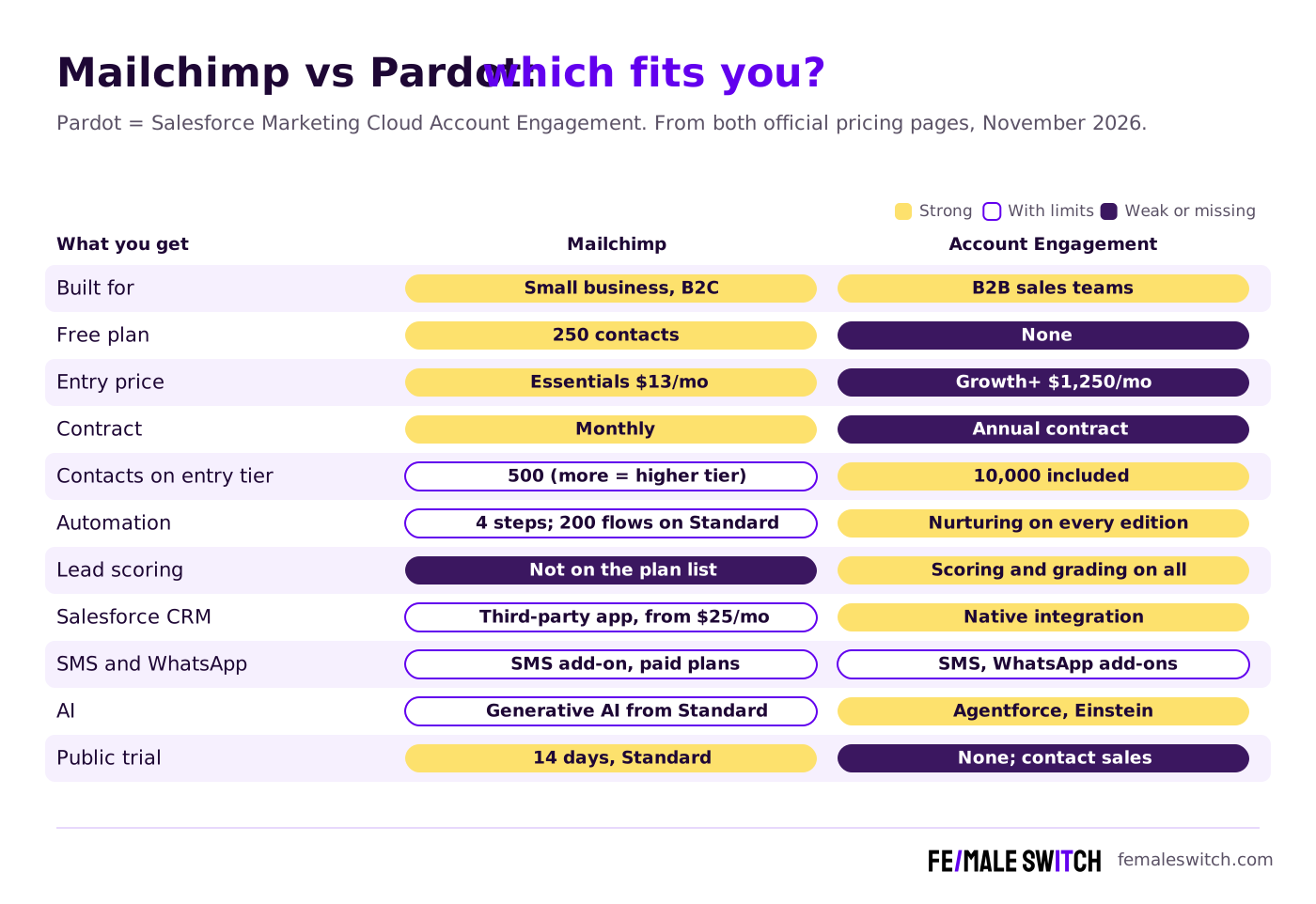
Pardot still has its old name in most searches, but Salesforce now sells it as Marketing Cloud Account Engagement: Salesforce introduced the new name in April 2022, describing Account Engagement as "formerly known as Pardot". So whether you searched for Mailchimp vs Pardot or Pardot vs Mailchimp, this guide compares the same two products under both names. Mailchimp, owned by Intuit, is an email and SMS marketing tool for small businesses, with a free plan and monthly prices that rise with your contact count. Pardot is Salesforce's B2B marketing automation for teams that already run their sales in Salesforce CRM: lead scoring, nurturing and hand-off to sales reps, sold per Salesforce org on an annual contract. We checked plans, prices and features on mailchimp.com and salesforce.com in November 2026.
Quick answer: pick Mailchimp if you are a startup or small business that sells to consumers or small customers, has no Salesforce CRM, and wants to start for free: under 250 contacts it costs nothing, and paid plans start at $13 a month. Pick Pardot (Account Engagement) only if you sell high-value B2B deals, your sales team already lives in Salesforce, and you need lead scoring and grading, account-based marketing and closed-loop reporting: editions start at $1,250 per org per month, billed annually, with 10,000 contacts included. Most early-stage founders are a Mailchimp case; Pardot becomes relevant once you have a sales team and a Salesforce admin.
Are you getting customers from ChatGPT yet?
More and more traffic is coming from Perplexity, ChatGPT, Grok and other AI tools.
👉 Rank on ChatGPT
Mailchimp vs Pardot Pricing and Features Compared
Sources: mailchimp.com/pricing/marketing (default view: euros from our location, 0-500 contacts; US dollars from the same page with the currency set to USD), salesforce.com Account Engagement pricing (default view, US dollars), checked 12 November 2026. Prices exclude VAT or sales tax.
The two products are not priced in the same league. Mailchimp's most expensive public plan, Premium at $350 a month, costs less than a third of Pardot's cheapest edition. In return, every Pardot edition includes 10,000 contacts and unlimited email sends, which is where a larger B2B database starts to make the price easier to justify.
Mailchimp: Email and SMS Marketing for Small Businesses
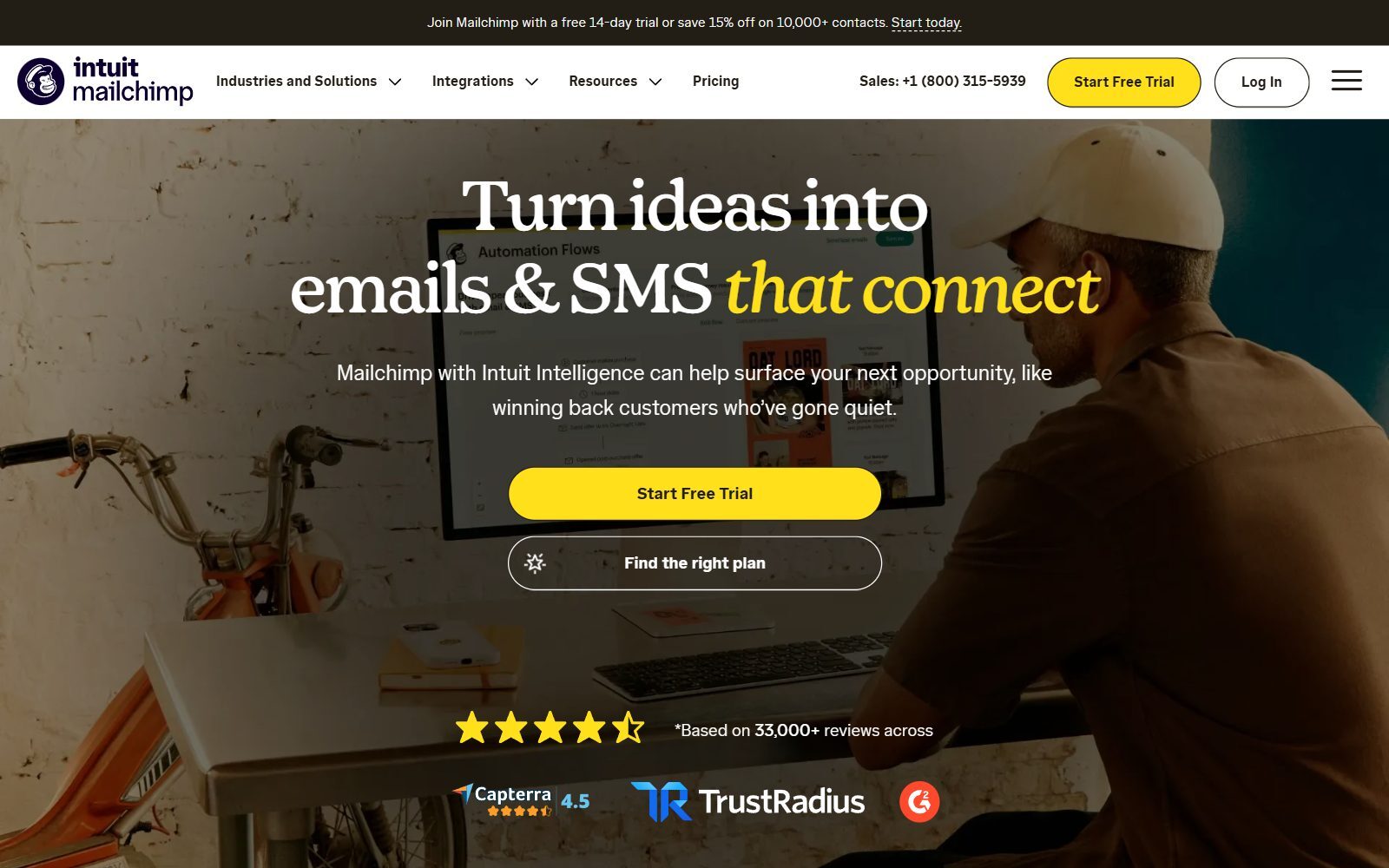
Mailchimp sells itself as a way to turn ideas into emails and SMS that connect, now with Intuit Intelligence, Intuit's AI assistant. Its about page says Mailchimp was acquired by Intuit in 2021, the company behind QuickBooks and TurboTax. You get a drag-and-drop email builder, templates, signup and popup forms, audience segments, automation flows, A/B testing and reports, and more than 300 integrations, including Shopify, WooCommerce, Canva, Stripe and Salesforce.
Plans (checked November 2026; prices for 0-500 contacts, monthly, US dollars with the euro default view in brackets):
- Free, $0: up to 250 contacts, at most 500 emails a month or 250 a day, 1 seat, 1 audience, limited templates and email support for the first 30 days. Automation flows and SMS are not included, and sending pauses when you hit a limit.
- Essentials, from $13 a month (EUR 11.73): sends 10 times your contact count, 3 seats, 3 audiences, automation flows of up to 4 steps, A/B testing, popup forms, no Mailchimp branding and 24/7 email and chat support.
- Standard, from $20 a month (EUR 18.04): up to 6,000 emails a month at this tier, 5 seats, up to 200 automation flows, generative AI at no extra cost, branded templates, custom reports, dynamic content and one onboarding session. Free for 14 days.
- Premium, from $350 a month (EUR 315.68): up to 150,000 emails a month, unlimited seats and audiences, phone and priority support, enterprise SSO and four onboarding sessions.
- Extras: SMS is a paid add-on in select countries; Pay As You Go email credits suit infrequent senders; nonprofits get 15% off; overages apply when a paid plan passes its contact or send limit.
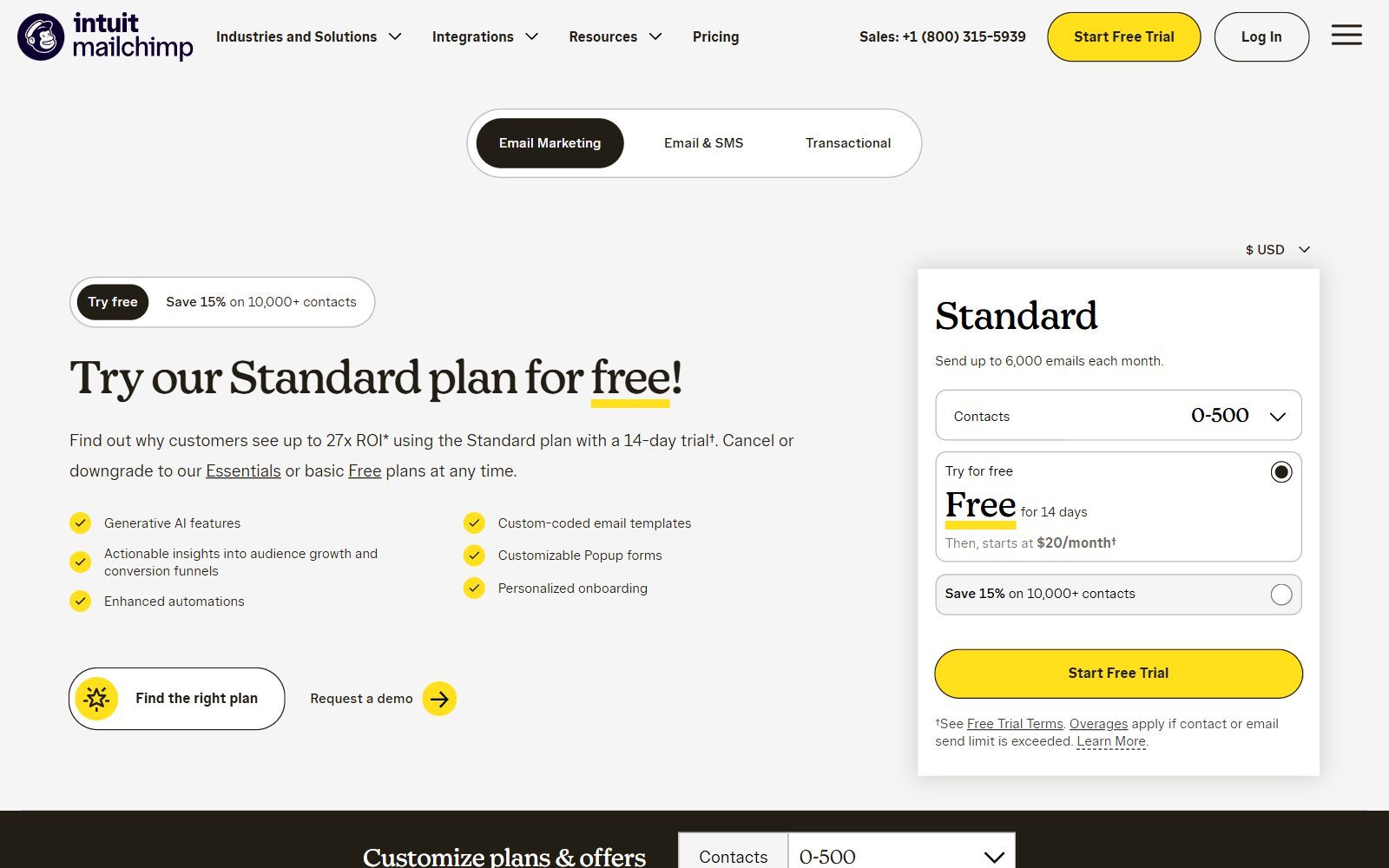
What the Mailchimp pricing page adds: the 14-day trial covers Standard or Essentials, and Mailchimp sends billing reminders before it ends. Annual plans exist only for Premium and for Standard from 10,000 contacts. For a Salesforce link, Mailchimp's integration directory lists a Salesforce integration built by Beaufort 12 with two-way sync, starting at $25 a month per Salesforce org.
Is your startup on ChatGPT?
More and more traffic is coming from Perplexity, ChatGPT, Grok and other AI tools.
👉 Rank on ChatGPT
Pardot (Marketing Cloud Account Engagement): B2B Automation on Salesforce
Marketing Cloud Account Engagement is Salesforce's B2B marketing automation. It captures leads with forms and landing pages, tracks what each prospect does, scores and grades them, nurtures them with engagement programs, and passes sales-ready leads to reps inside Salesforce CRM. Salesforce now pitches it with Agentforce AI agents and Marketing Cloud Next: every Account Engagement customer gets Account Engagement+, which unlocks Agentforce campaign creation, native SMS and WhatsApp journeys and Data 360 segments, paid for with usage credits. Salesforce's pricing FAQ also says there are no end-of-life or end-of-sale plans for Account Engagement, so the Pardot product is not being retired.
Editions (checked November 2026; US dollars per Salesforce org per month, billed annually, annual contract):
- Growth+, $1,250: 10,000 contacts, unlimited email marketing, 50 forms, 50 landing pages, lead scoring and grading, engagement programs, ROI reporting, Agentforce campaign creation and Einstein content creation, 25,000 API calls a day.
- Plus+, $2,750: adds unlimited forms and landing pages, multiple scoring categories, rule-based account scoring, multi-touch attribution, B2B Marketing Analytics (5 licences) and Google Ads integration; a dedicated IP is $500 a month extra.
- Advanced+, $4,400: adds Einstein lead scoring, behaviour scoring and campaign insights, 2 business units, 2 developer sandboxes, a dedicated IP and 100,000 API calls a day.
- Premium+, $15,000: 75,000 contacts, 5 business units, 5 sandboxes, B2B Marketing Analytics Plus and Premier Success support.
- Add-ons: extra contacts from $100 per 10,000 a month on Growth+ (up to $400 on Premium+), SMS credits from $10 per 1,000, WhatsApp credits, Sales Emails and Alerts at $50 per user a month.
What the Account Engagement pricing page adds: every edition has a "Contact us" button and no public free trial, and Salesforce notes the page is for information only, so the final quote comes from a sales rep. Marketing Cloud Next features run on consumption credits (Einstein Request, Messaging and Data 360 credits), which you may have to buy on top. The feature list also includes a native Olark chat integration, handy if your website already uses Olark live chat.
If you like Salesforce but the price is far out of reach, Salesforce's small-business suites are a different route: Starter Suite starts at $25 per user a month and includes email campaigns, dynamic email nurture campaigns and lead scoring inside the CRM, and Pro Suite starts at $100 per user a month, billed annually.
Boost Your SEO by Getting Featured in Our Blogs and get a backlink.
We publish content about startups, education, tech, funding, etc. that ranks well not only in Google but also in Perplexity, ChatGPT, Grok and other AI tools.
👉 Get featured now!
Pardot vs Mailchimp: Feature by Feature
Price and contract
Mailchimp starts free and bills monthly, so a founder can test email marketing for the cost of a lunch. Account Engagement starts at $1,250 a month, which is $15,000 a year on the cheapest edition, and requires an annual contract plus Salesforce licences for the people who use it.
Contacts and sending
Mailchimp prices by contact tier: the more contacts you keep, the more you pay, and each plan sends a multiple of your contacts. Account Engagement includes 10,000 contacts and unlimited email marketing on every edition, and sells extra contacts in blocks of 10,000.
Automation and lead scoring
Mailchimp's automation flows cover welcome series, abandoned carts and follow-ups, with up to 200 flows on Standard. Account Engagement is built around the B2B funnel: every prospect gets a score (how engaged they are) and a grade (how well they fit your ideal customer), and engagement programs nurture them until a rep should call. Einstein adds AI scoring on Advanced+ and Premium+.
CRM and sales alignment
This is the real dividing line. Account Engagement syncs natively with Salesforce CRM, so reps see every email open, form fill and page visit on the lead record. Mailchimp keeps its own audiences; you can connect Salesforce through a third-party app, but it is not a sales-alignment tool.
Ease of use
A founder can send a first Mailchimp campaign on the day they sign up. Account Engagement needs setup before the first send: tracking domains, the Salesforce connector, user sync, scoring rules and campaigns. Salesforce lists a setup assistant, and its pricing page points to Professional Services and certified partners for implementation.
What Changed Since the 2026 Version of This Comparison
- The name: the old text said Pardot was "acquired by Salesforce Account Engagement". Pardot was renamed: Salesforce has called it Marketing Cloud Account Engagement since April 2022.
- Pardot prices and editions: the four editions are now Growth+, Plus+, Advanced+ and Premium+, from $1,250 to $15,000 per org per month, billed annually, and include Marketing Cloud Next and Agentforce features.
- Mailchimp: part of Intuit since 2021, with Intuit Intelligence AI; the Free plan now covers 250 contacts and 500 emails a month.
- Removed: the unsourced "80% of SMEs report increased engagement" statistic, generic "common mistakes" filler and third-party review links.
Mailchimp or Pardot: Which Should You Choose?
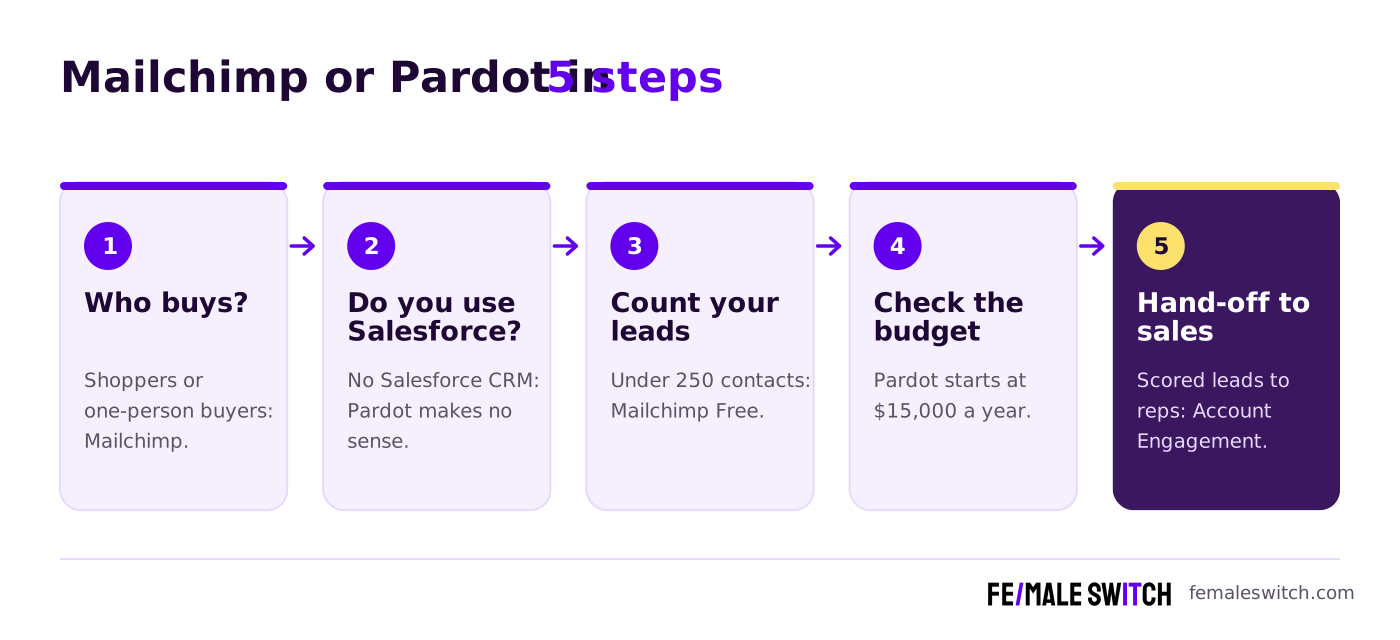
- You are pre-launch or have under 250 contacts: Mailchimp Free.
- You sell to consumers or run an online shop: Mailchimp, or compare Klaviyo vs Constant Contact and Omnisend vs Brevo.
- You sell B2B but have no sales team yet: Mailchimp Standard, or a CRM-first tool like HubSpot (see HubSpot vs ActiveCampaign).
- You already run Salesforce CRM and have reps chasing leads: Pardot (Account Engagement), starting with Growth+.
- You want Salesforce but cannot pay $15,000 a year: Salesforce Starter Suite at $25 per user a month, or Mailchimp with the Salesforce sync app.
- You need deep automation without Salesforce: see Mailchimp vs ActiveCampaign and Constant Contact vs ActiveCampaign.
Mailchimp and Pardot Alternatives
More Mailchimp comparisons: Mailchimp vs Constant Contact for small business, Mailchimp vs Mailgun, Klaviyo vs Mailchimp, HubSpot vs Mailchimp and Mailchimp vs Marketo. More Pardot comparisons: HubSpot vs Pardot, ActiveCampaign vs Pardot and Marketo vs Pardot; for Marketo itself, Marketo vs Omnisend. Other email head-to-heads: Brevo vs MailerLite, Constant Contact vs MailerLite, SendGrid vs Constant Contact, ActiveCampaign vs Brevo and Brevo vs SendGrid. For free tools see the free Mailchimp alternatives, to self-host the open-source Mailchimp alternatives, and for Salesforce's AI layer the open-source Salesforce Einstein alternatives.
How Founders Use Mailchimp or Pardot to Win Customers
Start email before the product is ready: collect signups on a landing page, send a short update every week or two, and ask readers to reply with their problems. Our email marketing tips for startups and the list of email marketing tools for startups cover the first steps, and before you spend on promotion, validate your startup idea. B2B founders who add live chat to catch leads can compare Olark vs Tidio; Olark is one of the chat tools Account Engagement integrates with.
Emails convert better when they point to useful articles. The F/MS AI SEO Tool writes articles from your keywords that are built to rank on Google and to be cited by ChatGPT and Perplexity; link them from your campaigns and nurture programs, and check which AI assistants mention you with the AI visibility tracking tools. F/MS Marketing Services help you get backlinks and guest posts that build your authority.
Boost Your SEO by Publishing Your Startup Press Release with us.
We publish content about startups, education, tech, funding, etc. that ranks well not only in Google but also in Perplexity, ChatGPT, Grok and other AI tools.
👉 Publish Press Release
FAQ: Mailchimp vs Pardot (Account Engagement)
Is Pardot still called Pardot?
No. Salesforce renamed it Marketing Cloud Account Engagement in April 2022, and its documentation still adds "formerly Pardot". Many people, and some screens inside the product, still use the old name. Salesforce's pricing FAQ says there are no end-of-life or end-of-sale plans for it.
Where can I submit a guest post about my startup?
You can publish a guest post in one of the Fe/male Switch startup blogs, which rank in Google and in AI tools like ChatGPT and Perplexity. Get a quality backlink.
How much does Pardot cost?
Account Engagement editions cost $1,250 (Growth+), $2,750 (Plus+), $4,400 (Advanced+) and $15,000 (Premium+) per Salesforce org per month, billed annually on an annual contract (checked November 2026). Growth+ to Advanced+ include 10,000 contacts; Premium+ includes 75,000.
How much does Mailchimp cost?
Mailchimp Free covers up to 250 contacts and 500 emails a month. For 0-500 contacts, Essentials starts at $13, Standard at $20 and Premium at $350 a month (in euros from Europe: 11.73, 18.04 and 315.68). Prices rise with your contact tier.
Does Pardot have a free plan or free trial?
Not on its pricing page. Every edition has a "Contact us" button, so pricing and any demo go through Salesforce sales. Mailchimp has a free plan and a 14-day trial of Standard or Essentials.
Do I need Salesforce CRM to use Pardot?
Account Engagement is built to work with Salesforce CRM: it is priced per Salesforce org and its value comes from the native sync with leads, contacts and opportunities. Without Salesforce CRM, a standalone tool such as Mailchimp, ActiveCampaign or HubSpot is usually the better fit.
Can Mailchimp connect to Salesforce?
Yes, through a third-party app listed in Mailchimp's integration directory: the Salesforce integration by Beaufort 12 offers two-way sync and starts at $25 a month per Salesforce org. It moves contacts and campaign activity, but it does not add Pardot-style lead scoring.
Which is better for B2B startups?
Early B2B startups without a sales team usually do fine with Mailchimp or a CRM-first tool. Account Engagement pays off when you have reps in Salesforce, a long sales cycle and enough leads that scoring and grading save time.
Which has better analytics?
Account Engagement, for B2B: ROI reporting, engagement history on lead records and, from Plus+, multi-touch attribution and B2B Marketing Analytics. Mailchimp's reports focus on campaign opens, clicks and revenue, with custom reports from Standard.
What other tools should I compare?
For B2B automation, HubSpot, Marketo and ActiveCampaign; for small-business newsletters, Constant Contact, Brevo or MailerLite; for online shops, Klaviyo and Omnisend; and for free or self-hosted options, our free and open-source Mailchimp alternatives lists.
About the Author
Violetta Bonenkamp, also known as MeanCEO, is an experienced startup founder with an impressive educational background including an MBA and four other higher education degrees. She has over 20 years of work experience across multiple countries, including 5 years as a solopreneur and serial entrepreneur. Throughout her startup experience she has applied for multiple startup grants at the EU level, in the Netherlands and Malta, and her startups received quite a few of those. She’s been living, studying and working in many countries around the globe and her extensive multicultural experience has influenced her immensely.

