

Mailchimp vs Mailgun: Marketing Campaigns or Developer Email Sending?
Mailchimp vs Mailgun (or Mailgun vs Mailchimp) is less a contest than a choice between two different jobs. Mailchimp, part of Intuit, is an email marketing platform: you build a list, design campaigns in an editor and run automated flows. Mailgun, owned by Sinch, is an email API and SMTP service: your developers send password resets, receipts and alerts from your app's code, and Mailgun delivers and tracks them. Mailchimp also sells its own transactional add-on, Mailchimp Transactional (formerly Mandrill), so we compare that with Mailgun too. Plans and prices below were checked on both official pricing pages in November 2026.
Quick answer: pick Mailchimp for newsletters, promotions and marketing automation run by non-developers: Free covers 250 contacts and 500 sends a month, Essentials starts at $13 and Standard at $20 a month. Pick Mailgun for emails your product sends by API or SMTP: Free allows 100 emails a day, Basic is $15 a month for 10,000 emails, and Foundation ($35, 50,000 emails) starts with a free month. Most software startups end up with both: a marketing tool for campaigns and a sending API for the app.
Are you getting customers from ChatGPT yet?
More and more traffic is coming from Perplexity, ChatGPT, Grok and other AI tools.
👉 Rank on ChatGPT
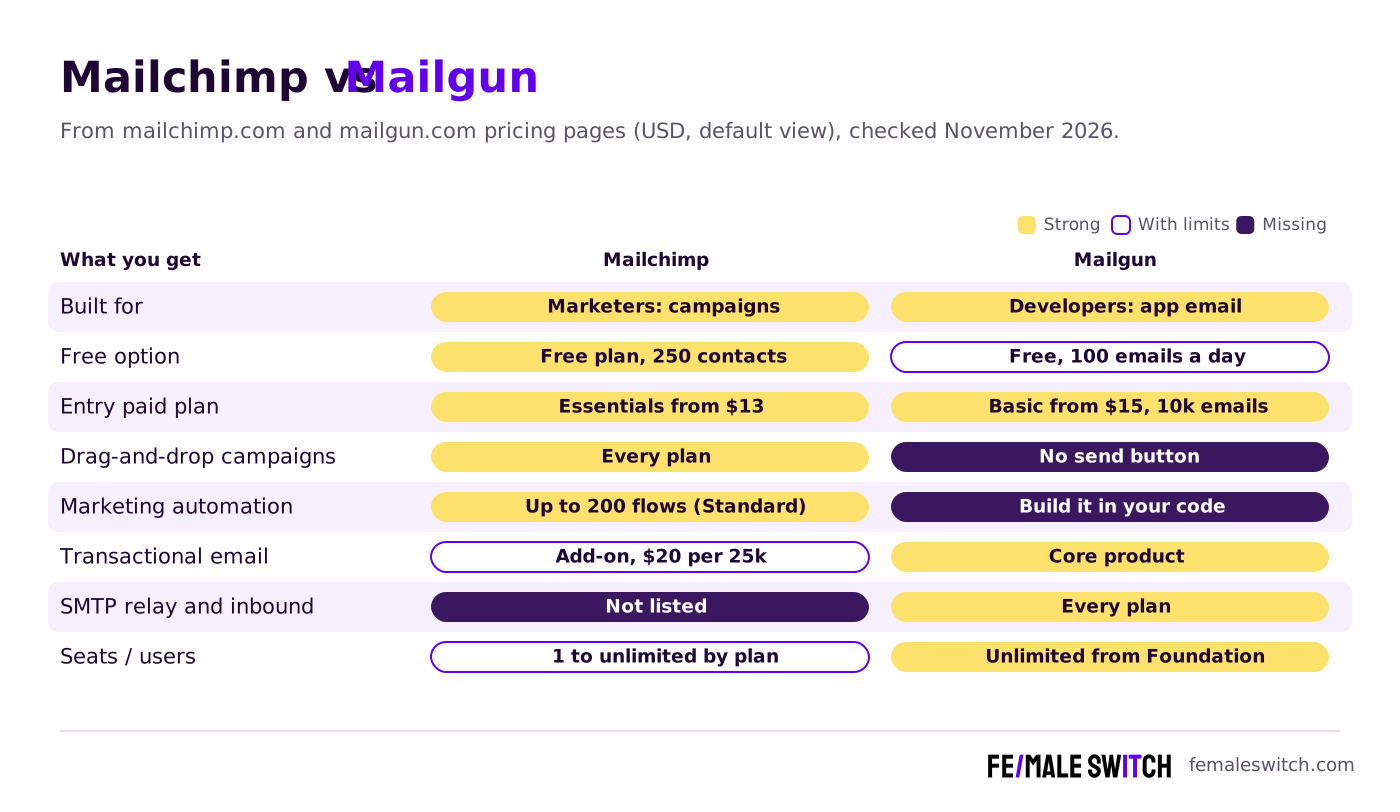
Mailchimp vs Mailgun at a Glance
Sources: mailchimp.com marketing and transactional pricing pages, mailgun.com pricing and about pages, checked 8 November 2026. Mailchimp's prices are for up to 500 contacts with monthly billing; Mailgun's are the Send plans in USD.
Mailchimp and Mailgun Explained
Mailchimp: email marketing for people who are not developers
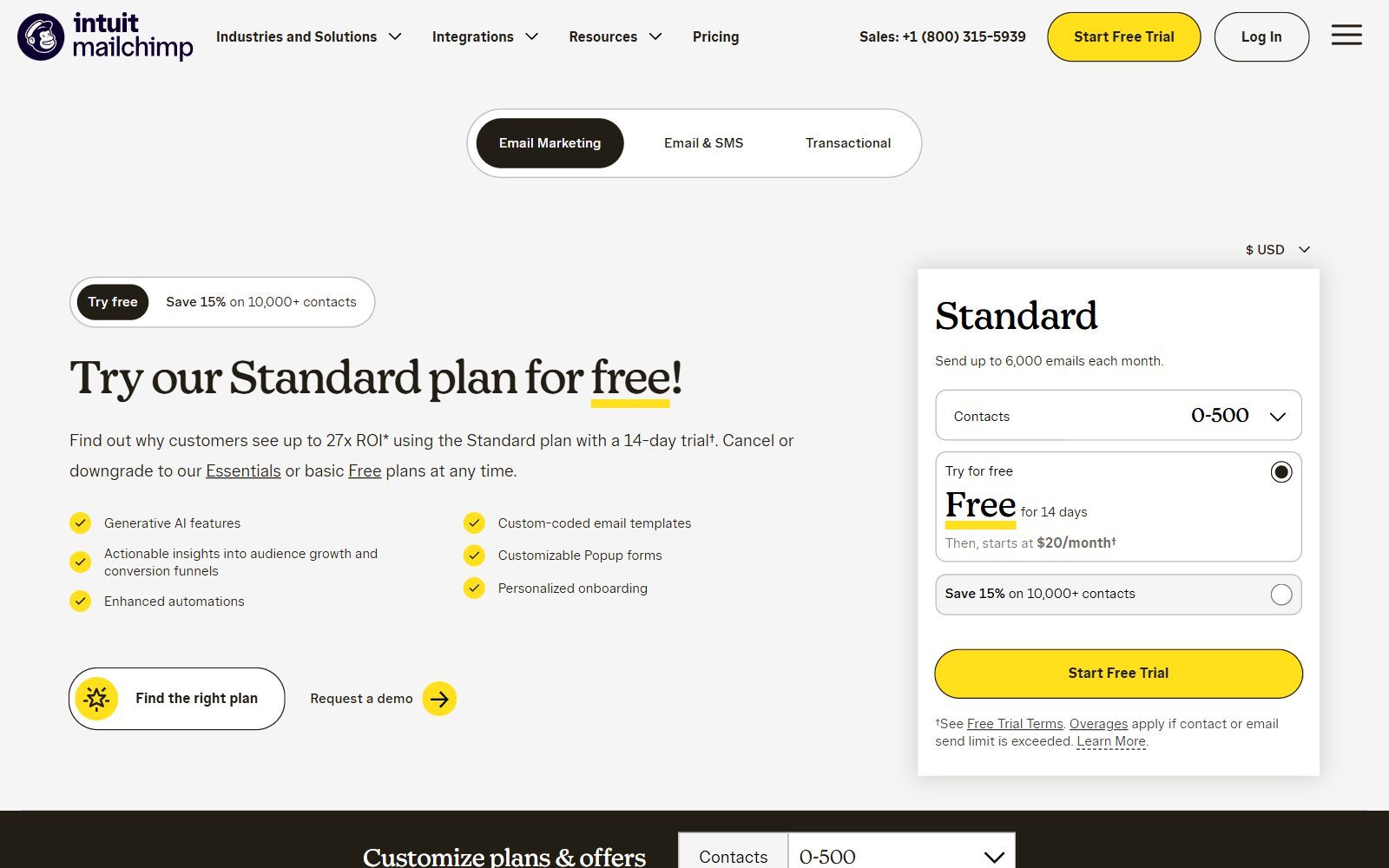
Mailchimp is built for sending campaigns to a list: templates, signup forms, segments, A/B testing and automated flows such as welcome or abandoned-cart emails, plus 300+ integrations with tools like Shopify, WooCommerce and Stripe. It belongs to Intuit, and its AI layer is called Mailchimp with Intuit Intelligence.
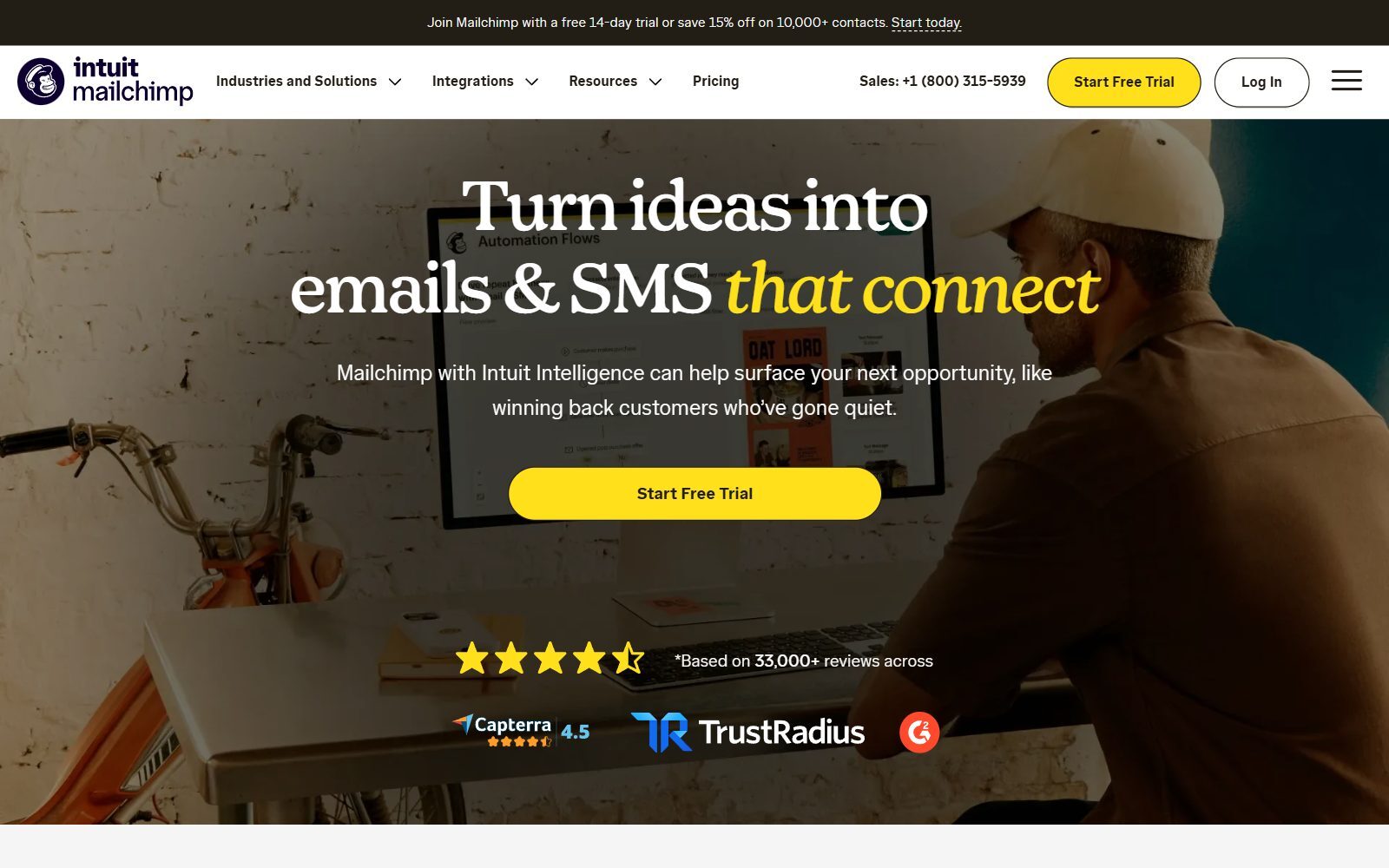
- Free, $0: up to 250 contacts, a maximum of 500 sends a month or 250 a day, 1 seat, no automation flows, and email support for the first 30 days only. Sending pauses when you hit a limit.
- Essentials, from $13 a month: 3 seats, automation flows of up to 4 steps, A/B testing and 24/7 email and chat support.
- Standard, from $20 a month: up to 6,000 sends a month at the 500-contact tier, 5 seats, up to 200 automation flows and generative AI features. It is also the cheapest plan that can add Mailchimp Transactional.
- Premium, from $350 a month: unlimited seats, phone and priority support, and more onboarding help.
How you pay: Mailchimp's pricing page prices plans by contact count with monthly billing, and charges overages if you pass a contact or send limit on a paid plan. New customers in selected countries get 14 days of Standard or Essentials free, with payment details entered at sign-up. From Europe the page shows euros by default; we quote the USD view.
Best for: founders and marketers who send newsletters, launches and promotions themselves and want automation without writing code.
Is your startup on ChatGPT?
More and more traffic is coming from Perplexity, ChatGPT, Grok and other AI tools.
👉 Rank on ChatGPT
Mailgun: an email API and SMTP relay for your product
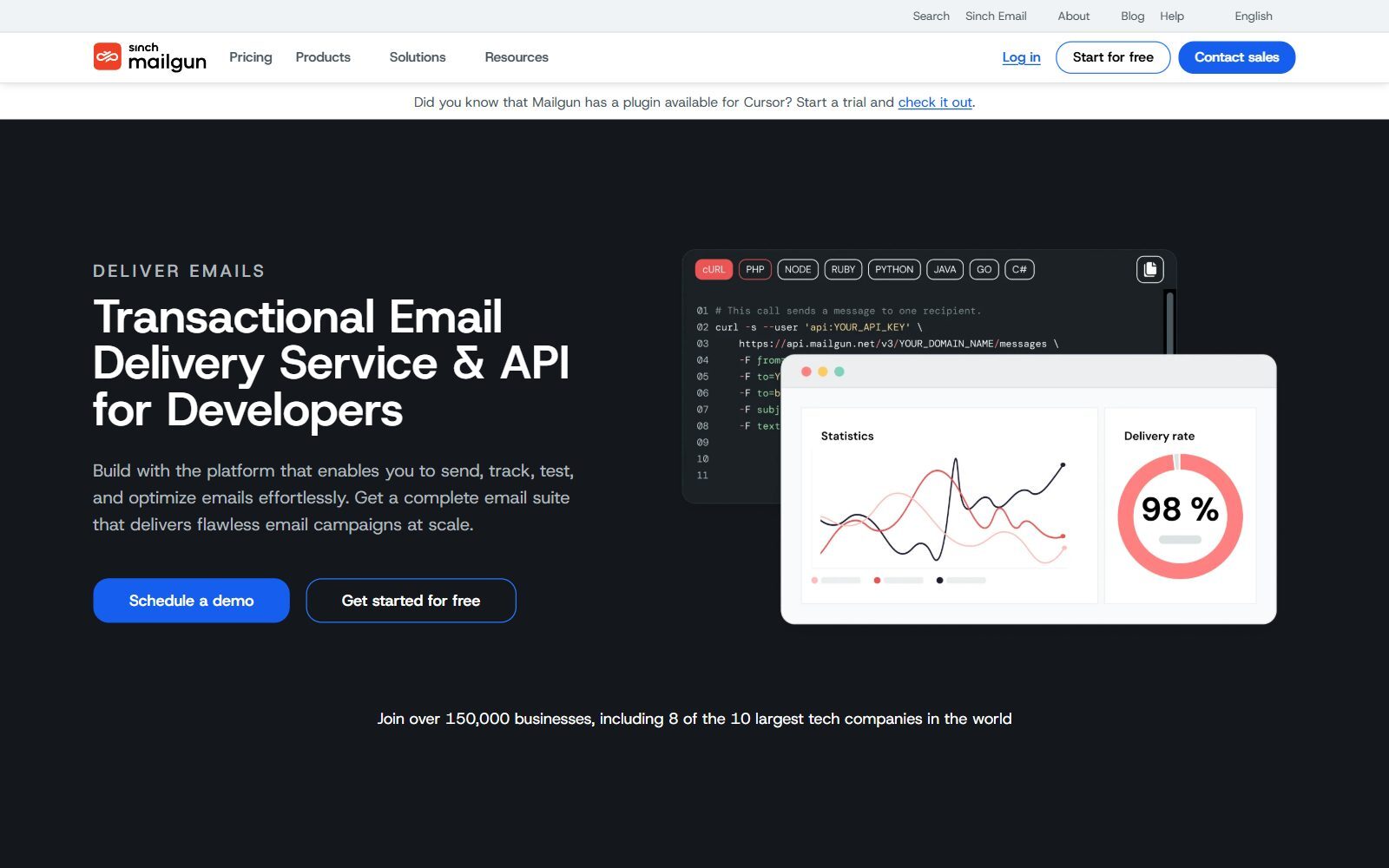
Mailgun is built for developers who need their application to send, receive and track email: a REST API and SMTP relay, webhooks for delivery events, inbound routing that turns incoming mail into data your app can use, email validation and US or EU data regions. It was founded in 2010 and, according to Mailgun's about page, acquired by Sinch in 2021; Sinch's email family also includes Mailjet and Email on Acid. Mailgun's own pricing FAQ says it has no send button, so there is no campaign editor for marketers.
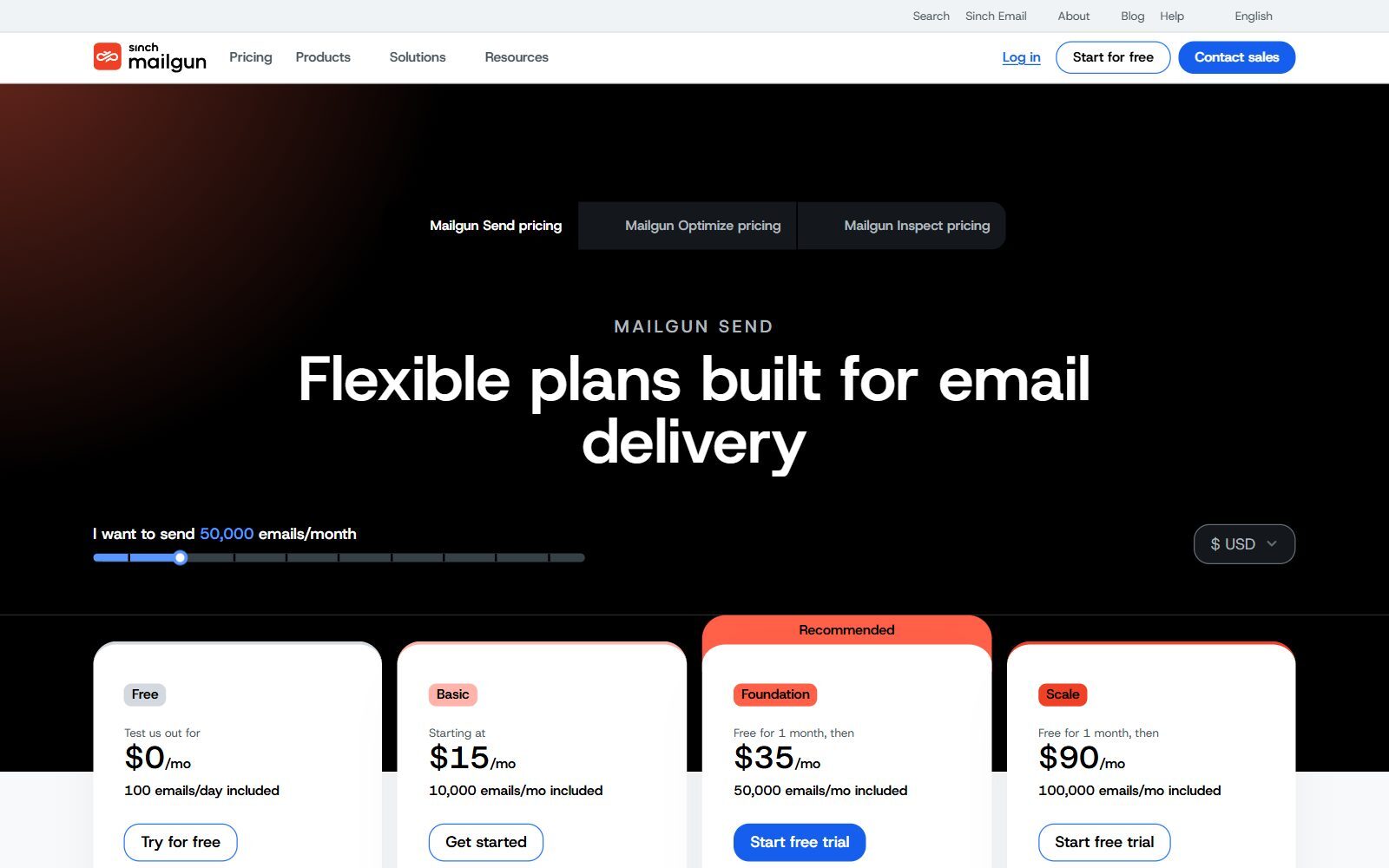
- Free, $0: 100 emails a day, REST API and SMTP relay, 1 custom sending domain, tracking, analytics and webhooks, 2 API keys, 1 day of logs, 1 inbound route, ticket support and 1 user.
- Basic, from $15 a month: 10,000 emails a month with no daily limit, extra emails from $1.80 per 1,000, 5 inbound routes and 1 day of logs.
- Foundation, $35 a month after a free first month: 50,000 emails, 1,000 sending domains, the email template builder and API, 5 days of logs, full inbound routing and unlimited users.
- Scale, $90 a month after a free first month: 100,000 emails, SAML SSO, 5,000 email validations, dedicated IP pools, send time optimization, 30 days of logs and live phone and chat support.
How you pay: Mailgun's pricing page prices by the number of emails you send each month, with overage per 1,000 extra emails that gets cheaper on bigger plans. Dedicated IPs become available at the 50,000 tier and are included from 100,000; extra IPs cost $59 per IP a month. Enterprise plans are quoted.
Best for: SaaS products, marketplaces and apps that send sign-up confirmations, password resets, receipts and notifications from their own code.
Boost Your SEO by Getting Featured in Our Blogs and get a backlink.
We publish content about startups, education, tech, funding, etc. that ranks well not only in Google but also in Perplexity, ChatGPT, Grok and other AI tools.
👉 Get featured now!
Mailchimp Transactional vs Mailgun
If the real question is which service should send your app's emails, compare Mailgun with Mailchimp Transactional. Mailchimp says Mandrill, its original transactional email service, was rebranded to Mailchimp Transactional in fall 2025. It is an add-on: you need a Standard or Premium marketing plan (Essentials is not eligible), and you buy blocks of 25,000 emails.
- Price: on Mailchimp's transactional pricing page, a block costs $20 for 1 to 20 blocks and falls to $10 a block above 4 million emails a month. Unused emails do not roll over, and sending stops when your blocks run out unless you set automatic top-ups. Mailgun charges a monthly plan with included emails and overage.
- Trying it: new Mailchimp Transactional users get up to 500 free sends to their verified domain. Mailgun's Free plan allows 100 emails a day with no end date, and its larger plans start with a free month.
- Who edits the emails: Mailchimp lets marketers edit transactional templates inside Mailchimp while developers keep the API integration; Mailgun gives developers a template builder and API from Foundation.
- Extras: Mailchimp adds transactional SMS (using SMS credits), webhooks and a first-party MCP server for AI coding assistants. Mailgun adds SMTP relay, inbound routing, email validation, US or EU data regions and dedicated IP pools.
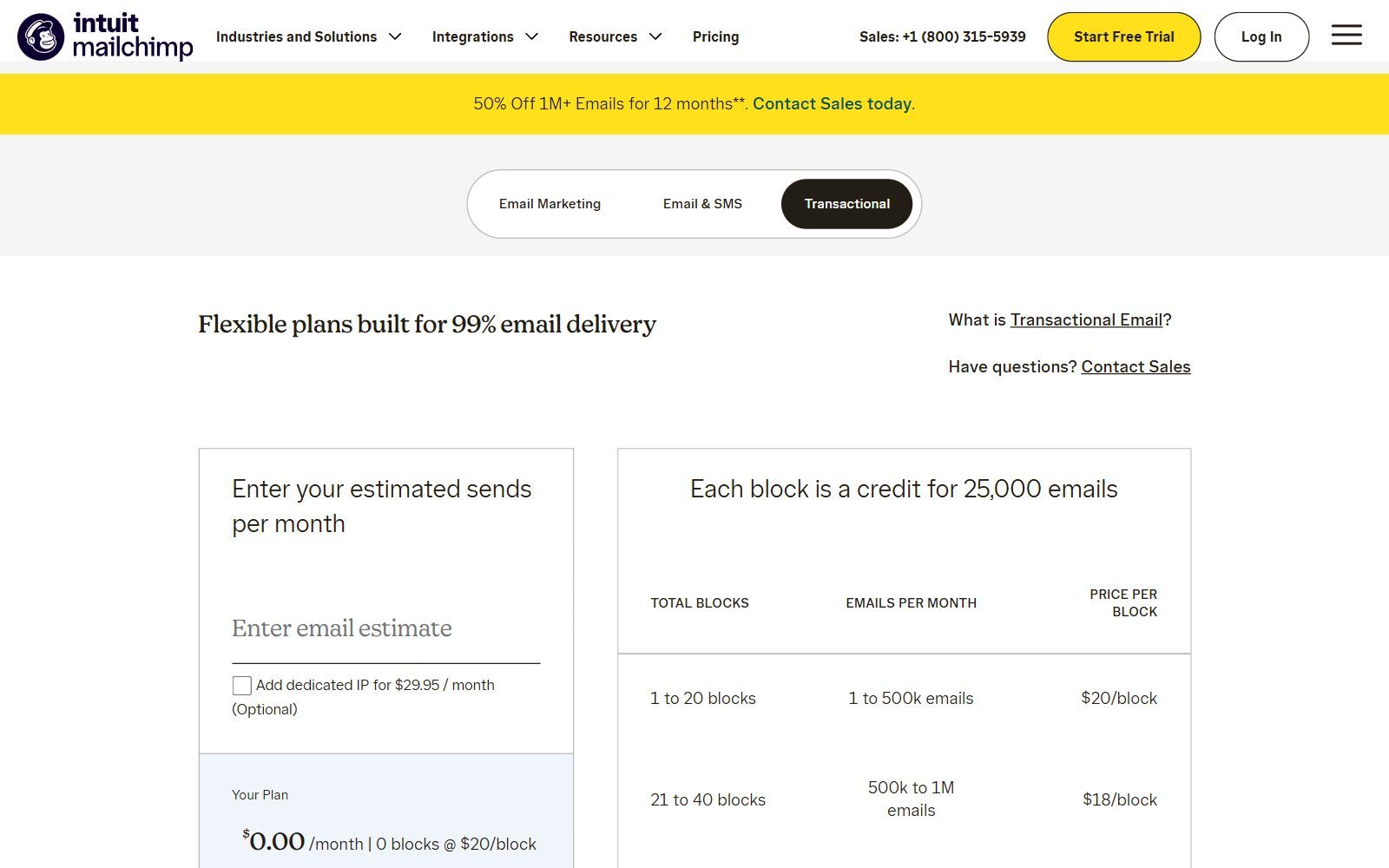
An example (our estimate, list prices): an app sending 20,000 transactional emails a month pays about $40 with Mailchimp (Standard from $20 plus one $20 block) or about $33 with Mailgun (Basic $15 plus 10,000 extra emails at $1.80 per 1,000). At 50,000 emails it is about $60 (Standard plus two blocks) against Mailgun Foundation at $35. If you already pay for Mailchimp Standard for marketing, the add-on only costs the blocks.
On deliverability: Mailchimp markets the transactional add-on as built for 99% email delivery; that is the vendor's own claim, and Mailgun publishes no comparable figure on its pricing page. Neither number is an independent test, so judge by the tools: authentication (SPF, DKIM, DMARC), dedicated IPs, logs and event webhooks, all of which both offer at some plan level.
Head-to-Head: Where Each Tool Wins
Ease of use
Mailchimp wins for non-technical teams: campaigns are built in an editor, and audiences, segments and reports sit in one dashboard. Mailgun needs a developer to connect your app by API or SMTP and to set up DNS records for your sending domain.
Marketing automation
Mailchimp wins. Its Marketing Automation Flows (formerly Customer Journey Builder, renamed in June 2025) run welcome, abandoned-cart and win-back sequences, with up to 200 flows on Standard. Mailgun has no flow builder: any sequence is logic in your own code that calls the API at the right moment.
Transactional and app email
Mailgun wins for developers: API and SMTP on every plan including Free, inbound routing, webhooks, logs and validation. Mailchimp Transactional is a solid option when your team already lives in Mailchimp Standard or Premium and wants marketers to own the templates.
Price for a small startup
For a small list, Mailchimp Free (250 contacts) costs nothing. For app emails, Mailgun Free (100 a day) costs nothing and Basic is $15. Mailchimp's transactional route starts at about $40 a month, because it needs Standard plus at least one block.
Mailchimp, Mailgun or Both: Which Should You Choose?
- You only send newsletters and promotions: Mailchimp. If 250 contacts is too tight on Free, compare our free Mailchimp alternatives.
- Your app sends receipts, resets and alerts: Mailgun, starting free at 100 emails a day.
- You need both and want one vendor: Mailchimp Standard plus Mailchimp Transactional blocks.
- You need both and want the cheapest app sending: a Mailchimp plan for campaigns and Mailgun for the product; send them from different subdomains so each keeps its own reputation.
- You want deeper marketing automation than Mailchimp: see Mailchimp vs ActiveCampaign.
- You want to self-host: neither; look at open-source Mailchimp alternatives.
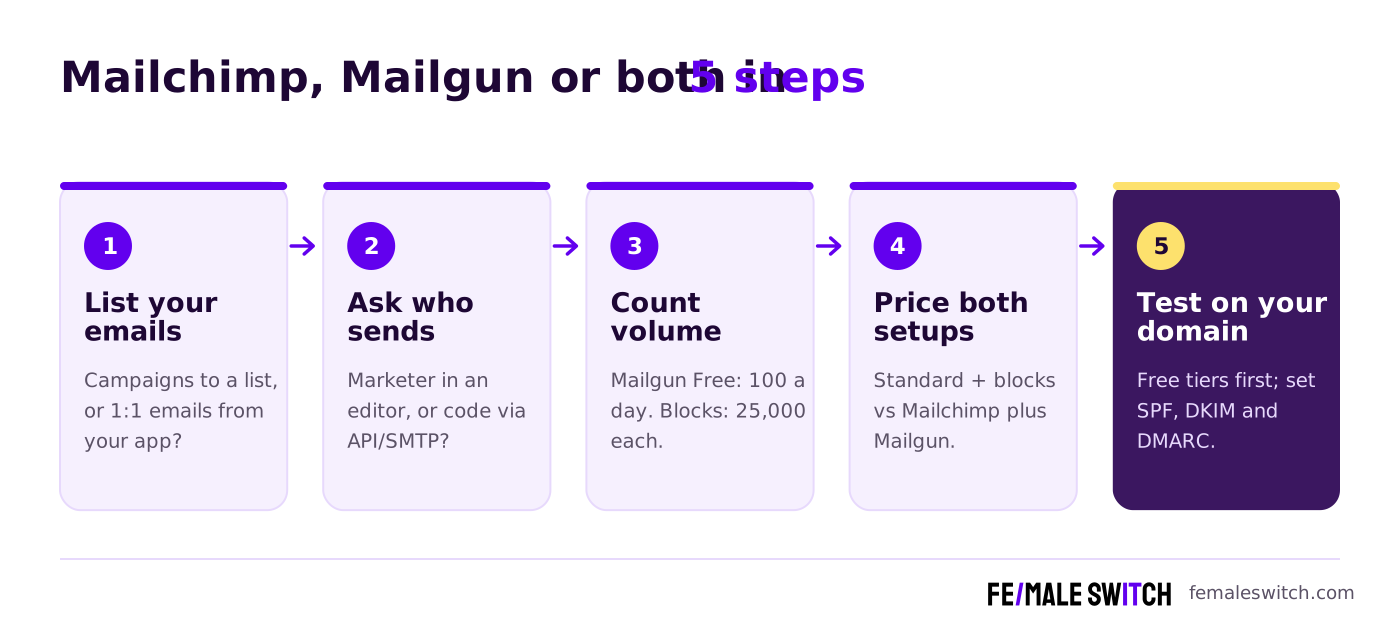
- List your emails. Split them into campaigns sent to a list and one-to-one emails your product triggers.
- Ask who sends them. A marketer in an editor points to Mailchimp; code calling an API or SMTP points to Mailgun or Mailchimp Transactional.
- Count the volume. Mailgun Free covers 100 emails a day; Basic covers 10,000 a month. Mailchimp Transactional sells 25,000 emails per block.
- Price both setups. Mailchimp Standard plus blocks against a Mailchimp plan plus Mailgun, at your real contact count and send volume.
- Test on your own domain. Use the free tiers, set up SPF, DKIM and DMARC, and watch the logs before you move real customers.
What Changed Since the Old Version of This Comparison
- Mandrill is now Mailchimp Transactional (rebranded in fall 2025), sold as an add-on to Standard and Premium in blocks of 25,000 emails.
- Mailchimp's Free plan covers 250 contacts, not the 500 the old FAQ said, with 500 sends a month.
- Mailgun's plans are now Free, Basic, Foundation, Scale and Enterprise, and Mailgun belongs to Sinch.
- Removed: the 99.99% uptime figure, which Mailgun's pricing page no longer states, broad claims that one tool "outshines others in deliverability", and links to third-party comparison blogs. Every number above comes from Mailchimp's and Mailgun's own pages.
How Founders Use Mailchimp, Mailgun and the Rest of Their Email Stack
A typical early-stage stack has a sending API wired into the product for sign-ups and receipts, and a marketing tool for the newsletter and onboarding sequence. Our mean.ceo guides explain how to build an email list, how to automate email marketing in a startup and which startup newsletters are worth reading for ideas.
Comparing other email tools? SendGrid vs Constant Contact and Omnisend vs SendGrid cover another developer email API, Mailchimp vs Constant Contact covers small-business newsletters, and Omnisend vs Brevo, Marketo vs Omnisend, Constant Contact vs MailerLite and Autopilot (now Ortto) vs MailerLite cover ecommerce and automation tools. If you need a CRM next to email, read HubSpot vs ActiveCampaign.
Connect your forms, app and email tools with open-source Zapier alternatives or free Make alternatives, give your emails a landing page with one of the free Carrd alternatives, and plan what you spend with the marketing budget calculator. For social media scheduling, see Later vs Sendible and Sprout Social vs Later. The F/MS AI SEO Tool writes articles from your keywords that your emails can link to, and the AI SEO blog explains how they rank on Google and in AI assistants.
Boost Your SEO by Publishing Your Startup Press Release with us.
We publish content about startups, education, tech, funding, etc. that ranks well not only in Google but also in Perplexity, ChatGPT, Grok and other AI tools.
👉 Publish Press Release
FAQ: Mailchimp vs Mailgun
Is Mailgun the same as Mailchimp?
No. Mailchimp, owned by Intuit, is an email marketing platform for campaigns and automated flows. Mailgun, owned by Sinch, is an email API and SMTP service that developers use to send emails from their own apps. They are separate companies.
What is the main difference between Mailchimp and Mailgun?
Who sends the email. In Mailchimp, a marketer designs and sends campaigns to a list in an editor. In Mailgun, your application sends one-to-one emails such as receipts and password resets by API or SMTP; Mailgun says it has no send button.
Can I use Mailgun for email marketing?
Mailgun can deliver bulk email your code sends, but it has no campaign editor or marketing automation builder. For newsletters and promotions, a marketing tool such as Mailchimp is easier; Sinch's own marketing tool is Mailjet.
How does Mailchimp Transactional compare to Mailgun?
Mailchimp Transactional (formerly Mandrill) is an add-on to Mailchimp Standard or Premium, sold in blocks of 25,000 emails from $20 a block. Mailgun is a standalone service with a free plan of 100 emails a day and paid plans from $15 a month for 10,000 emails, plus SMTP relay and inbound routing.
Why would a startup switch from Mailgun to Mailchimp Transactional?
Mainly to keep marketing and transactional email with one vendor and let marketers edit transactional templates inside Mailchimp. It requires a Standard or Premium plan; plan the move by recreating templates, updating API calls and authenticating your sending domain before switching traffic.
Which is cheaper for a startup?
For a small list, Mailchimp Free (250 contacts, 500 sends a month) costs nothing. For app emails, Mailgun Free (100 a day) costs nothing and Basic is $15 a month for 10,000 emails, while Mailchimp's transactional route needs Standard (from $20) plus blocks.
Do Mailchimp and Mailgun publish deliverability rates or an SLA?
Mailchimp markets its transactional add-on as built for 99% email delivery, which is its own claim. Mailgun's pricing page lists a guaranteed uptime SLA as a feature but no figure in its plan table. Neither is an independent deliverability test.
Do Mailchimp and Mailgun have free plans?
Yes. Mailchimp Free covers 250 contacts and 500 sends a month with 1 seat. Mailgun Free allows 100 emails a day with 1 sending domain and 1 user, and its Foundation and Scale plans start with a free month.
Where can I submit a guest post about my startup?
You can publish a guest post in one of the Fe/male Switch startup blogs, which rank in Google and in AI tools like ChatGPT and Perplexity. Get a quality backlink.
Can I use AI to write SEO articles that my emails can link to?
Yes. The F/MS AI SEO Tool writes articles from your keywords that are built to rank on Google and in AI assistants, with human editors reviewing them.
About the Author
Violetta Bonenkamp, also known as MeanCEO, is an experienced startup founder with an impressive educational background including an MBA and four other higher education degrees. She has over 20 years of work experience across multiple countries, including 5 years as a solopreneur and serial entrepreneur. Throughout her startup experience she has applied for multiple startup grants at the EU level, in the Netherlands and Malta, and her startups received quite a few of those. She’s been living, studying and working in many countries around the globe and her extensive multicultural experience has influenced her immensely.

