

Mailchimp vs ActiveCampaign: Which Email Marketing Tool Should a Startup Pick?
Mailchimp and ActiveCampaign are two of the best-known email marketing tools, and on the surface they do the same job: build a list, send newsletters and run automated emails. They are built for different founders, though. Mailchimp (now Intuit Mailchimp) is the easy start: a free plan, cheap monthly plans with several seats, and a simple flow builder. ActiveCampaign is an automation tool first: no free plan, but deep, branching automations, a sales CRM you can add on, and a 90% startup discount. We checked plans, prices and limits on both official pricing pages in November 2026 and removed what we could no longer confirm. Also weighing a free trial against Mailchimp's free plan? Read our Mailchimp vs Constant Contact comparison.
Quick answer: start on Mailchimp if you have fewer than 250 contacts (Free) or want several people in the account for little money: Essentials starts at $13 and Standard, with up to 200 automation flows and generative AI, at $20 a month for 500 contacts. Choose ActiveCampaign when automated, behaviour-based emails are your main growth channel: Starter is $15 and Plus, with unlimited automation steps and landing pages, $49 a month billed yearly for 1,000 contacts, after a 14-day free trial without a credit card.
Are you getting customers from ChatGPT yet?
More and more traffic is coming from Perplexity, ChatGPT, Grok and other AI tools.
👉 Rank on ChatGPT
Mailchimp vs ActiveCampaign at a Glance
Sources: mailchimp.com marketing pricing and plan comparison, mailchimp.com AI tools page, activecampaign.com pricing and start-up pages, checked 6 November 2026. Mailchimp prices are for its smallest tier (up to 500 contacts); ActiveCampaign's are for its default 1,000 contacts. Both rise with your list size.
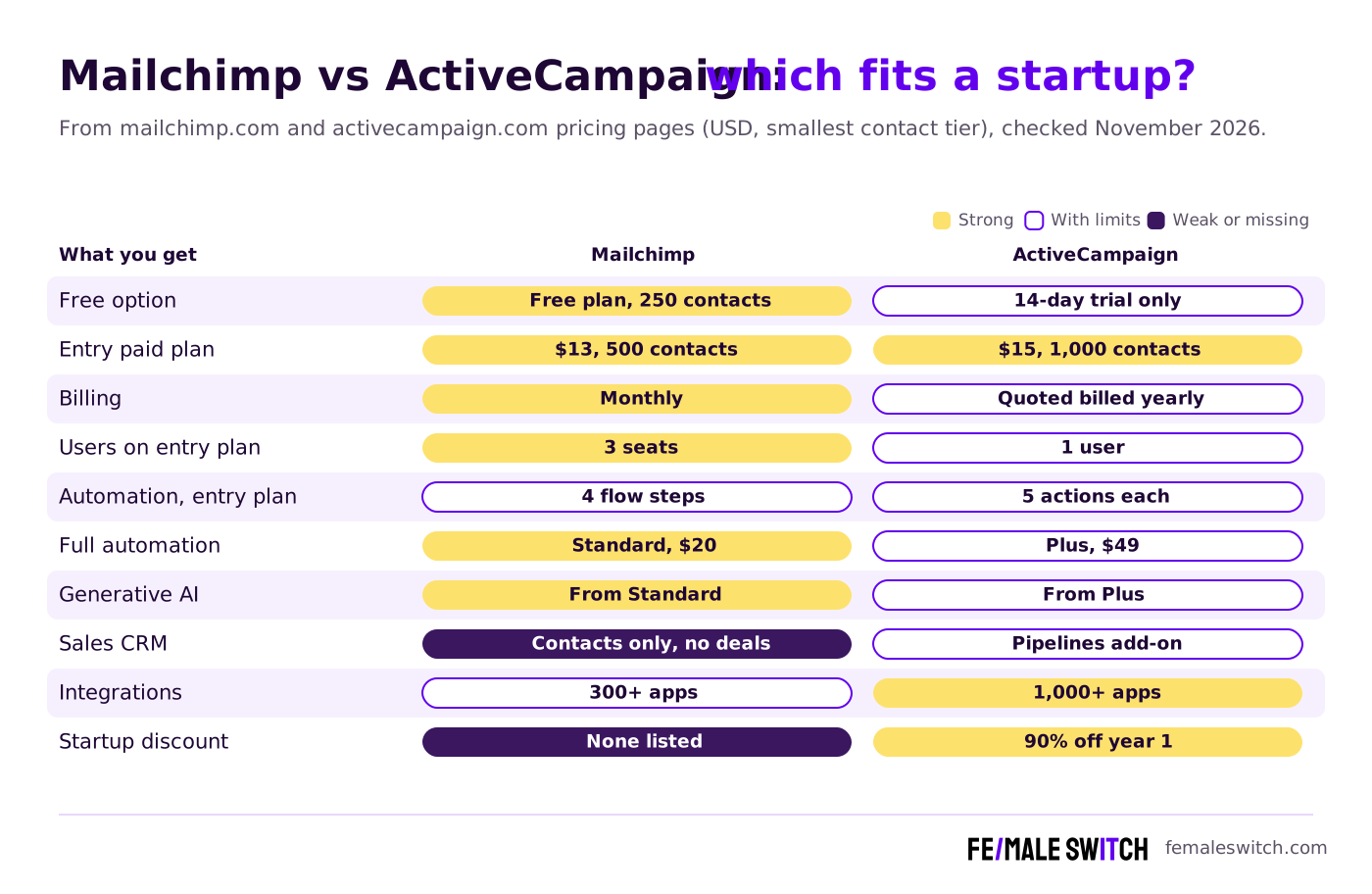
Mailchimp and ActiveCampaign Explained
Mailchimp: the easy start, with a free plan and cheap seats
Mailchimp is built for small businesses that want to send good-looking emails quickly: pre-built email templates, signup forms and landing pages on every plan, and 300+ integrations, with Shopify, WooCommerce, Square, Wix, Squarespace, Stripe and Canva among the most popular. It now belongs to Intuit, and its AI layer is called Mailchimp with Intuit Intelligence. SMS is a paid add-on in selected countries.
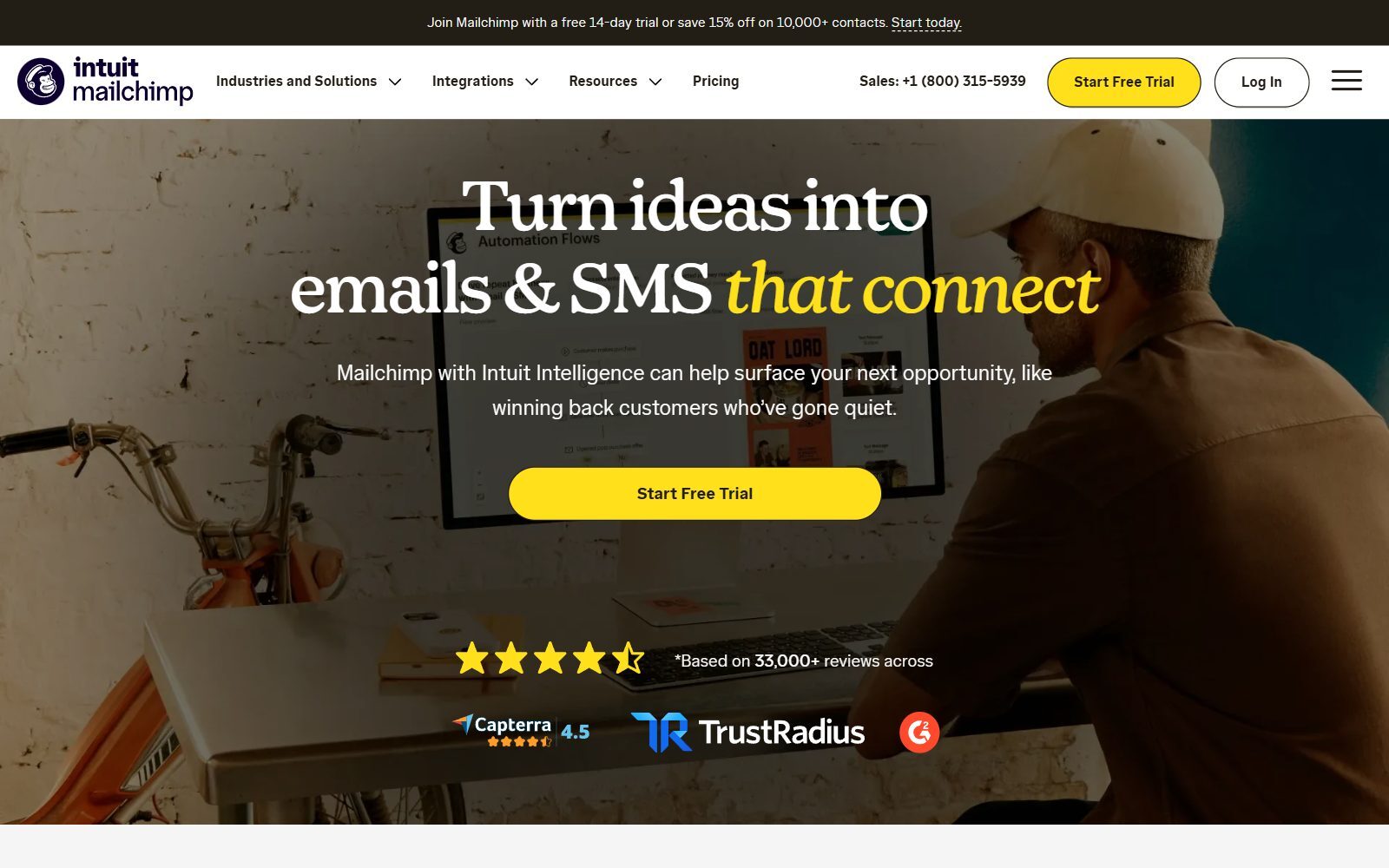
- Free, $0: up to 250 contacts, 500 sends a month with a maximum of 250 a day, 1 seat and 1 audience. There are no automation flows, Mailchimp branding stays in your emails, you cannot schedule campaigns, and email support lasts for the first 30 days. Sending pauses when you hit a limit.
- Essentials, from $13 a month: sends of 10 times your contacts, 3 seats, 3 audiences, automation flows of up to 4 steps, A/B testing, scheduling, no Mailchimp branding and 24/7 email and chat support. It goes up to 50,000 contacts.
- Standard, from $20 a month: 6,000 sends a month at the 500-contact tier (12 times your contacts), 5 seats, up to 200 automation flows, generative AI at no extra cost, send time optimization, delivery by time zone, predictive segmentation, custom reports and one personal onboarding session. It goes up to 100,000 contacts.
- Premium, from $350 a month: up to 150,000 sends a month at that price, unlimited seats and audiences, multivariate testing, phone and priority support and enterprise single sign-on.
How you pay: the prices on Mailchimp's pricing page are monthly; annual plans exist only for Premium and Standard at 10,000+ contacts through sales. Essentials and Standard come with a 14-day free trial for new customers in selected countries, but you enter payment details at sign-up. Infrequent senders can buy Pay As You Go email credits instead of a plan. If you go over your contact or send limit on a paid plan, Mailchimp bills overages.
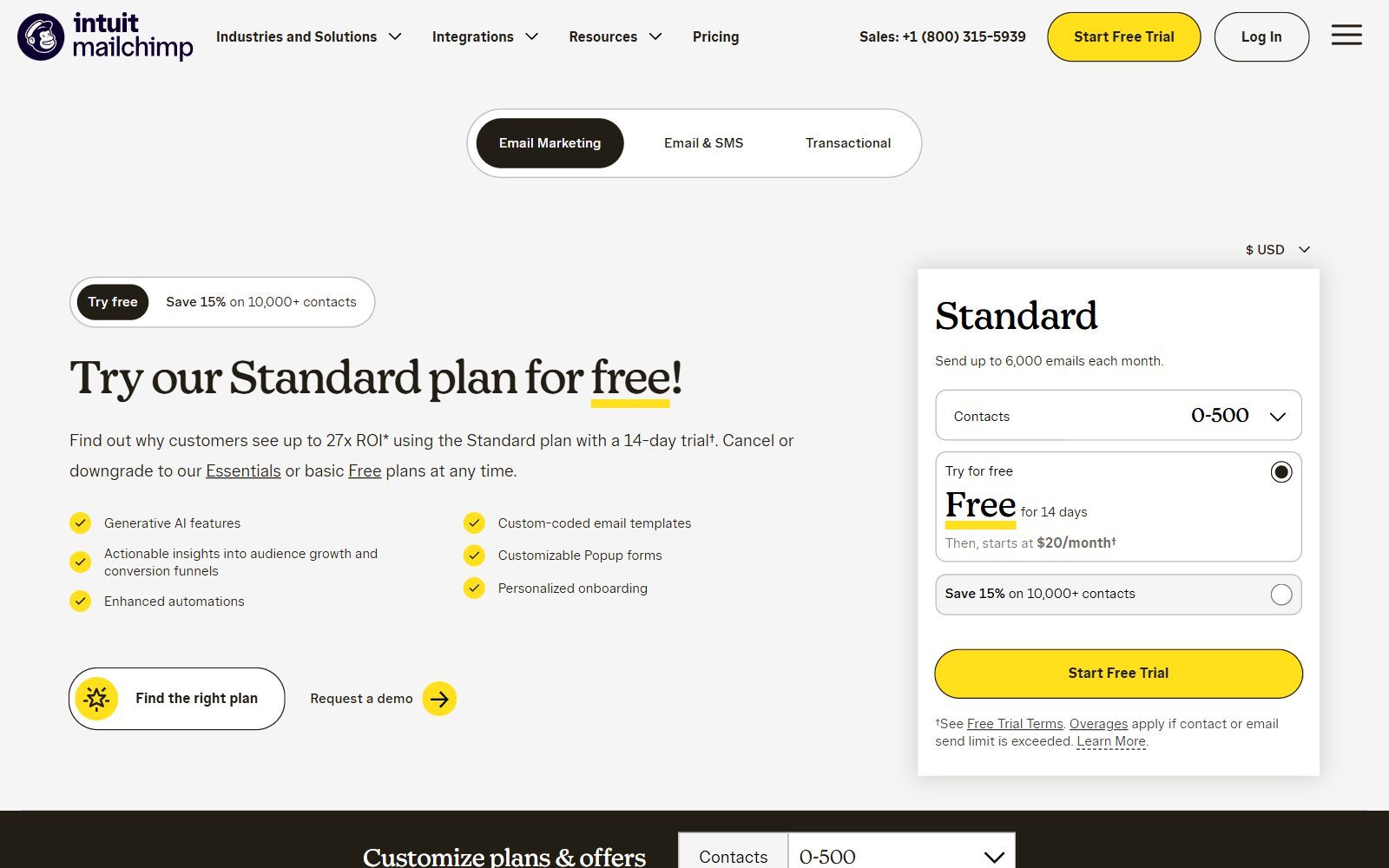
Note on currency: from Europe the same page showed us euros by default (Essentials €11.69, Standard €17.98 and Premium €314.63 a month), so the price you see depends on where you are.
Best for: founders with a small list who want to start free, small teams that need several logins on a cheap plan, and ecommerce shops that want ready-made integrations and simple product emails.
Is your startup on ChatGPT?
More and more traffic is coming from Perplexity, ChatGPT, Grok and other AI tools.
👉 Rank on ChatGPT
ActiveCampaign: automation first, priced by contacts
ActiveCampaign is built around automated customer journeys: a visual builder with 950+ automation recipes, multiple triggers, site and link tracking, segments and ecommerce automations such as abandoned cart on every plan. Its AI, Active Intelligence, comes with every plan and 500 AI credits; it drafts campaigns, automations and reports, and its core features keep working when the credits run out. SMS, WhatsApp and transactional email are add-ons.
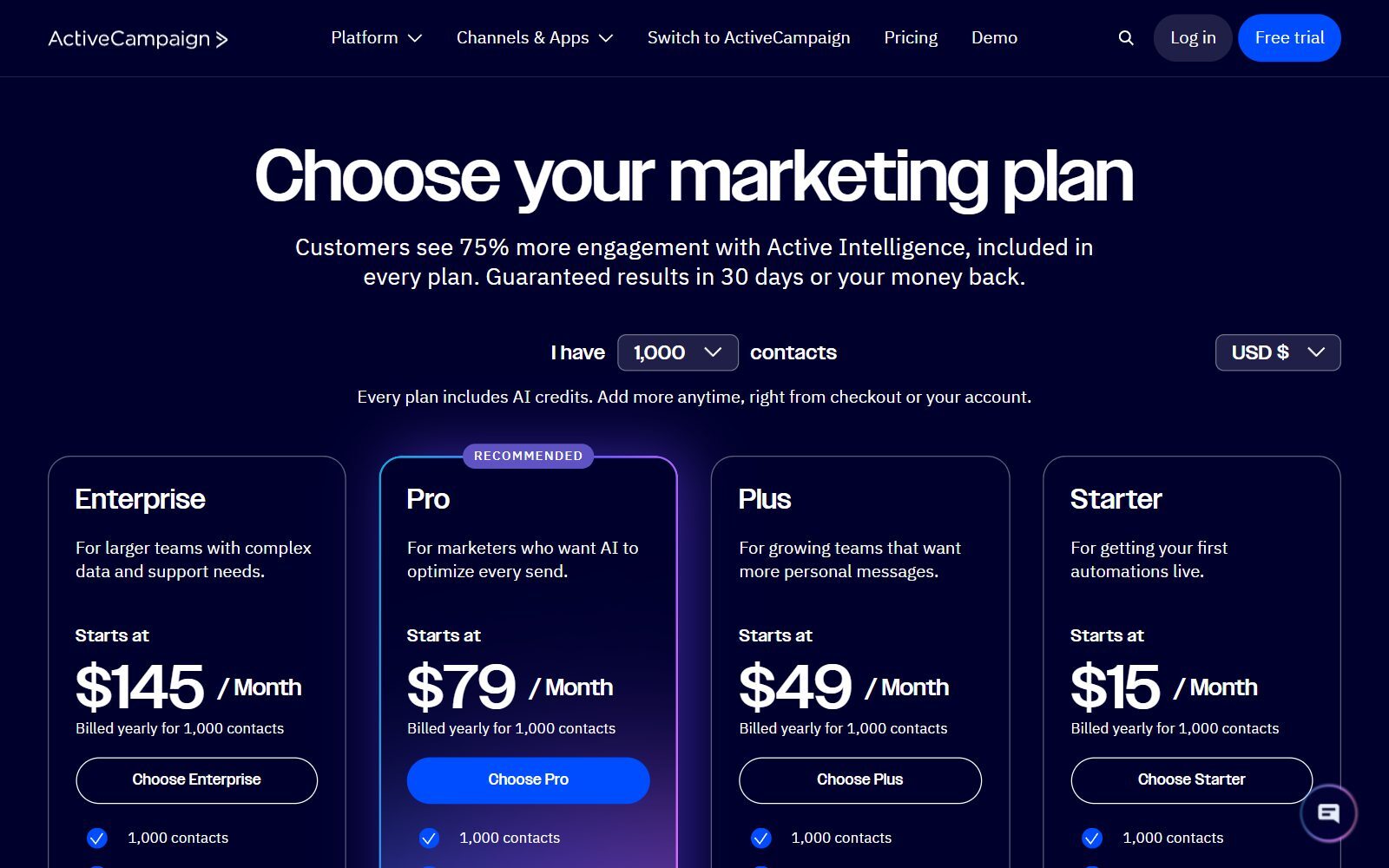
- Starter, $15 a month billed yearly for 1,000 contacts: 1 user, 10,000 sends a month, multi-step automation with up to 5 actions per automation (email only), up to 5 lists, standard and inline forms, 250+ templates. No landing pages and no generative AI.
- Plus, $49 a month: unlimited automation actions, cross-channel marketing, generative AI for text and images, landing pages and site messages, sales automation, and the option to add the Pipelines or Sales Engagement CRM. Still 1 user.
- Pro, $79 a month: 3 users, 12,000 sends, predictive sending at each contact's best time, conditional content, the automations map, advanced segmentation and attribution tracking.
- Enterprise, $145 a month: 5 users, 15,000 sends, single sign-on, HIPAA support, custom objects, Salesforce and Microsoft Dynamics integrations and a dedicated account team.
How you pay: the prices on ActiveCampaign's pricing page are billed yearly, and the monthly price scales with the size of your contact list. There are no setup fees, the 14-day trial needs no credit card, and a 30-day money-back guarantee applies.
Startup discount: the ActiveCampaign Incubator gives 90% off any annual plan for the first year to new customers that are under 2 years old, in an incubator now or an alum from the past 12 months, and have raised no more than $1 million. You pay full price from year two.
Best for: SaaS products with trial onboarding, course creators, ecommerce brands with behaviour-based flows, and B2B startups that want marketing automation and a simple sales pipeline in one tool.
Boost Your SEO by Getting Featured in Our Blogs and get a backlink.
We publish content about startups, education, tech, funding, etc. that ranks well not only in Google but also in Perplexity, ChatGPT, Grok and other AI tools.
👉 Get featured now!
Head-to-Head: Where Each Tool Wins
Price and free plan
Mailchimp wins at the very start. Its Free plan covers 250 contacts with no time limit, and Essentials ($13) and Standard ($20) are monthly plans you can cancel. ActiveCampaign has no free plan; after the trial you pay at least $15 a month on a yearly bill. As your list grows, compare the exact tier: both tools raise the price with every contact band, and Mailchimp's 500-contact starting tier is half of ActiveCampaign's 1,000.
Automation
ActiveCampaign wins on depth. Its Plus plan removes the limit on automation actions and adds cross-channel steps, and Pro adds predictive sending, conditional content and a map of all your automations. Mailchimp's Marketing Automation Flows (the feature formerly called Customer Journey Builder) are capped at 4 steps on Essentials; Standard allows up to 200 flows, which is enough for welcome, abandoned-cart and win-back sequences in most young companies.
CRM and sales
ActiveCampaign wins if anyone sells. Its Pipelines add-on brings deals, accounts and lead scoring, and Sales Engagement adds automated one-to-one emails and win probability, both from Plus. Mailchimp keeps contact profiles, tags, segments and surveys, but its plans list no deal pipeline; connect a separate CRM or compare HubSpot vs ActiveCampaign if you need one record for marketing and sales.
AI features
Both now sell AI as part of the plan. On Mailchimp, generative AI comes at no extra cost from Standard, and the Mailchimp AI tools page lists Write with AI in the email editor, Analytics AI, send time and send day optimization and predicted customer attributes; Intuit Intelligence is in beta, and connectors for ChatGPT, Claude and Perplexity are marked as coming soon. ActiveCampaign includes Active Intelligence and 500 AI credits on every plan, AI-built automations and campaigns even on Starter, generative content and images from Plus, and a connection to Claude and ChatGPT via MCP today.
Deliverability tools
Neither tool publishes inbox placement rates on its pricing page, so ignore third-party percentages you see quoted elsewhere. What you can compare is the tooling: ActiveCampaign runs a spam check on every plan, lets you send from a custom mailserver domain, includes 5 inbox previews a month on Plus and Pro (unlimited on Enterprise) and times sends per contact from Pro. Mailchimp adds send time optimization and delivery by time zone from Standard, and caps its Free plan at 250 sends a day.
Integrations and ecommerce
ActiveCampaign lists 1,000+ integrations, with Shopify, Square and WooCommerce as standard ecommerce connections and abandoned cart on every plan. Mailchimp lists 300+ integrations and puts Shopify, WooCommerce, Square, Stripe and website builders first. For a small online shop, either covers the basics; for a stack of SaaS tools, ActiveCampaign's longer list and automation app connections such as those in our open-source Zapier alternatives give you more room.
Mailchimp or ActiveCampaign: Which Should You Choose?
- Under 250 contacts and no budget: Mailchimp Free. If 250 contacts or 500 emails a month is too tight, our list of free Mailchimp alternatives compares bigger free plans.
- A newsletter and a simple welcome series: Mailchimp Essentials or Standard. Standard ($20) is the cheapest way here to get up to 200 automation flows and generative AI.
- Automation is your growth engine: ActiveCampaign Plus ($49 billed yearly) for unlimited automation steps, landing pages and cross-channel journeys.
- A small team of 3 to 5 people: Mailchimp includes 3 seats on Essentials and 5 on Standard; ActiveCampaign includes more than 1 user only from Pro ($79).
- Founders who also sell to businesses: ActiveCampaign with the Pipelines add-on, or a CRM-first suite; see open-source Apollo.io alternatives for prospecting tools.
- A young startup in an incubator: ActiveCampaign's 90% first-year discount can make an annual Plus or Pro plan cheaper than Mailchimp Standard for that year.
- You want to own your data and server: neither. Look at open-source Mailchimp alternatives you can self-host.
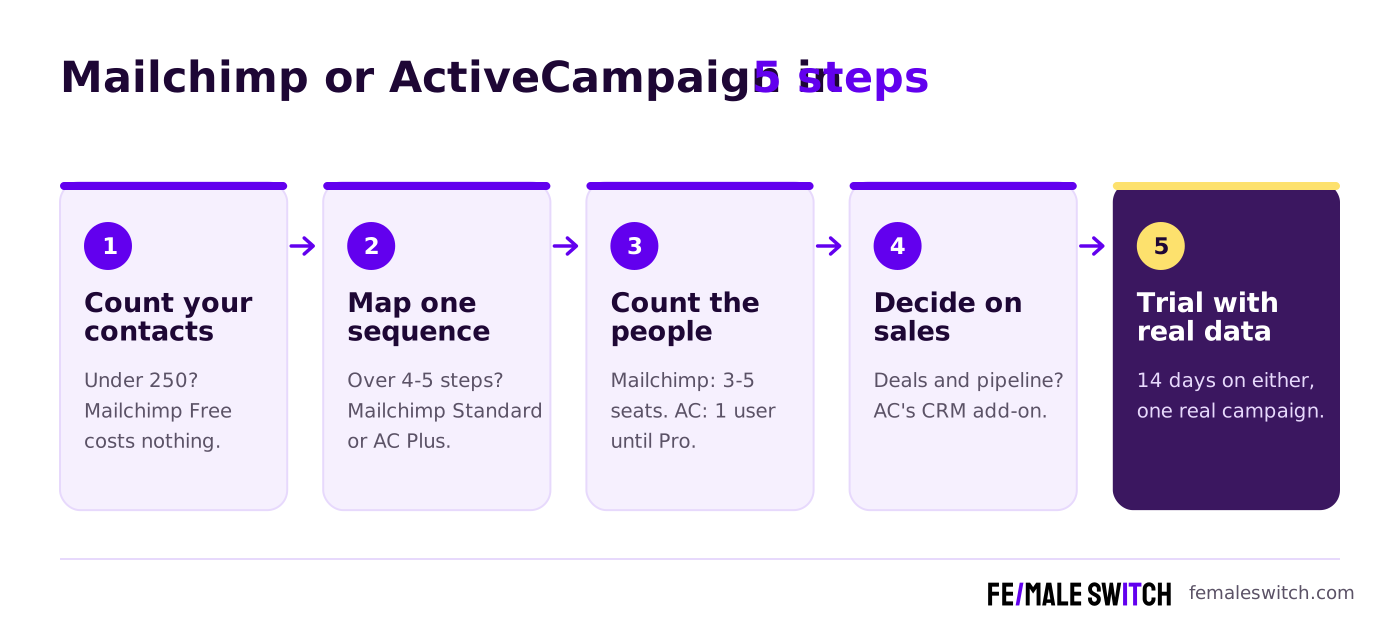
- Count your contacts. Under 250, Mailchimp Free costs nothing. Above that, price your real list size on both pricing pages, because both charge by contact band.
- Map one real sequence. Write down your welcome or trial-onboarding emails. More than 4 steps needs Mailchimp Standard; more than 5 actions needs ActiveCampaign Plus.
- Count the people. Mailchimp includes 3 seats on Essentials and 5 on Standard; ActiveCampaign includes 1 user until Pro.
- Decide whether you need sales tools. Deals, pipelines and lead scoring point to ActiveCampaign's CRM add-on; pure newsletters do not need them.
- Trial with real data. Both offer 14 days. Import a real segment, build one automation and send one campaign before you commit, especially to a yearly ActiveCampaign bill.
What Changed Since the Old Version of This Comparison
- Mailchimp renamed its automation builder. Customer Journey Builder became Marketing Automation Flows in June 2025, with limits by plan: none on Free, 4 steps on Essentials, up to 200 flows on Standard and Premium.
- Mailchimp's AI is now part of Intuit. The old post's "Content Optimizer" is not on Mailchimp's current AI page, so we no longer mention it; the tools now listed are Write with AI, Analytics AI, send time optimization and Intuit Intelligence (beta).
- ActiveCampaign's plans are Starter, Plus, Pro and Enterprise, each with 500 AI credits. The $15 entry price still holds, now billed yearly for 1,000 contacts. The automations map is a Pro and Enterprise feature.
- Removed: the general claim that email delivers "unmatched" return on investment, which had no source, and the links to third-party comparison blogs. Every number above comes from Mailchimp's and ActiveCampaign's own pages.
How Founders Use Mailchimp, ActiveCampaign and the Rest of Their Marketing Stack
Most early-stage startups need three emails before anything else: a welcome sequence for new sign-ups, a regular update or newsletter, and a reminder that brings trial users back. Our mean.ceo guides explain how to build an email list from zero, how to automate email marketing in a startup and which startup newsletters are worth reading for ideas.
Comparing more email tools? Read Constant Contact vs MailerLite and Autopilot (now Ortto) vs MailerLite. Your emails need somewhere to send people: our free Carrd alternatives cover simple landing pages, Olark vs Intercom covers live chat, and ManyChat vs Chatfuel covers Instagram and WhatsApp messaging. For social media, see Sprout Social vs Later; for AI-powered CRMs, our open-source Salesforce Einstein alternatives.
Email works best when it points to content people find on their own. The F/MS AI SEO Tool writes articles from your keywords that are built to rank on Google and to be cited by ChatGPT and Perplexity, the AI SEO blog explains how, and our guide to SEO and keyword research tools for startups helps you choose the topics.
Boost Your SEO by Publishing Your Startup Press Release with us.
We publish content about startups, education, tech, funding, etc. that ranks well not only in Google but also in Perplexity, ChatGPT, Grok and other AI tools.
👉 Publish Press Release
FAQ: Mailchimp vs ActiveCampaign
What is the main difference between Mailchimp and ActiveCampaign?
Mailchimp is an easy email and SMS marketing tool with a free plan and cheap monthly plans that include several seats. ActiveCampaign is an automation-first tool with no free plan, unlimited automation steps from its Plus plan and optional sales CRM add-ons.
Is Mailchimp cheaper than ActiveCampaign?
At the start, yes. Mailchimp has a Free plan for up to 250 contacts and paid plans from $13 (Essentials) and $20 (Standard) a month for 500 contacts. ActiveCampaign starts at $15 a month billed yearly for 1,000 contacts, and unlimited automation (Plus) costs $49.
Does ActiveCampaign have a free plan?
No. It offers a 14-day free trial with no credit card needed and a 30-day money-back guarantee. Mailchimp has a permanent Free plan with 250 contacts, 500 sends a month and 1 seat.
What are the limits of Mailchimp's Free plan?
Up to 250 contacts, 500 emails a month with a maximum of 250 a day, 1 seat and 1 audience, no automation flows, Mailchimp branding in your emails and email support only for the first 30 days.
Which tool has better marketing automation?
ActiveCampaign. Its Plus plan has unlimited automation actions and cross-channel steps, and Pro adds predictive sending and conditional content. Mailchimp allows 4 flow steps on Essentials and up to 200 flows on Standard and Premium.
Which one has a better CRM?
ActiveCampaign, if you need sales tools: its Pipelines and Sales Engagement add-ons bring deals, accounts, lead scoring and automated one-to-one emails from Plus. Mailchimp has contact profiles, tags and segments but no deal pipeline in its plans.
Is there a startup discount?
ActiveCampaign's Incubator gives 90% off any annual plan in year one to new customers under 2 years old, linked to an incubator and with no more than $1 million raised. Mailchimp lists a 15% discount for nonprofits and charities, not a startup programme.
Do Mailchimp and ActiveCampaign use AI?
Yes. Mailchimp includes generative AI at no extra cost from Standard, plus Analytics AI and Intuit Intelligence in beta. ActiveCampaign includes Active Intelligence with 500 AI credits on every plan, generative content from Plus and predictive sending from Pro.
Where can I submit a guest post about my startup?
You can publish a guest post in one of the Fe/male Switch startup blogs, which rank in Google and in AI tools like ChatGPT and Perplexity. Get a quality backlink.
Can I use AI to write SEO articles that my emails can link to?
Yes. The F/MS AI SEO Tool writes articles from your keywords that are built to rank on Google and in AI assistants, with human editors reviewing them.
About the Author
Violetta Bonenkamp, also known as MeanCEO, is an experienced startup founder with an impressive educational background including an MBA and four other higher education degrees. She has over 20 years of work experience across multiple countries, including 5 years as a solopreneur and serial entrepreneur. Throughout her startup experience she has applied for multiple startup grants at the EU level, in the Netherlands and Malta, and her startups received quite a few of those. She’s been living, studying and working in many countries around the globe and her extensive multicultural experience has influenced her immensely.

