

SendGrid vs Mailchimp: Developer Email Delivery or All-in-One Email Marketing?
SendGrid vs Mailchimp, or Mailchimp vs SendGrid, is really a question about what kind of email you need to send. Twilio SendGrid is email infrastructure for developers: an Email API and SMTP relay that your app calls to send receipts, password resets, login codes and alerts, with newsletters sold as a separate Marketing Campaigns product. Intuit Mailchimp is email marketing for small businesses: a drag-and-drop editor, audiences, automation flows, forms and reports, with its own developer add-on, Mailchimp Transactional (the service that used to be called Mandrill). Many startups end up using one of each. We checked plans, prices, free options and features on Twilio's SendGrid pricing pages and on mailchimp.com on 16 November 2026.
Quick answer: pick Mailchimp if a founder or marketer will write newsletters and set up welcome or abandoned-cart flows without a developer: the Free plan covers up to 250 contacts, Essentials starts at $13 a month and Standard, with up to 200 automation flows, at $20. Pick SendGrid if a developer is wiring email into your product and you care about volume, dedicated IPs, email validation and sending logs: the Email API has a 60-day free trial at 100 emails a day, then Essentials from $19.95 a month and Pro from $89.95. Use both when you need product emails and marketing emails from different teams: SendGrid for the app, Mailchimp for campaigns. If you want everything in one Mailchimp account, Mailchimp Transactional costs $20 per block of 25,000 emails on top of a Standard or Premium plan.
Are you getting customers from ChatGPT yet?
More and more traffic is coming from Perplexity, ChatGPT, Grok and other AI tools.
👉 Rank on ChatGPT
SendGrid vs Mailchimp Pricing and Features Compared
Sources: twilio.com SendGrid Email API and Marketing Campaigns pricing pages (default view, US dollars), mailchimp.com/pricing/marketing (US dollar view), mailchimp.com/pricing/transactional-email and Mailchimp's transactional email feature page, checked 16 November 2026. Prices exclude tax; overages may apply on both.
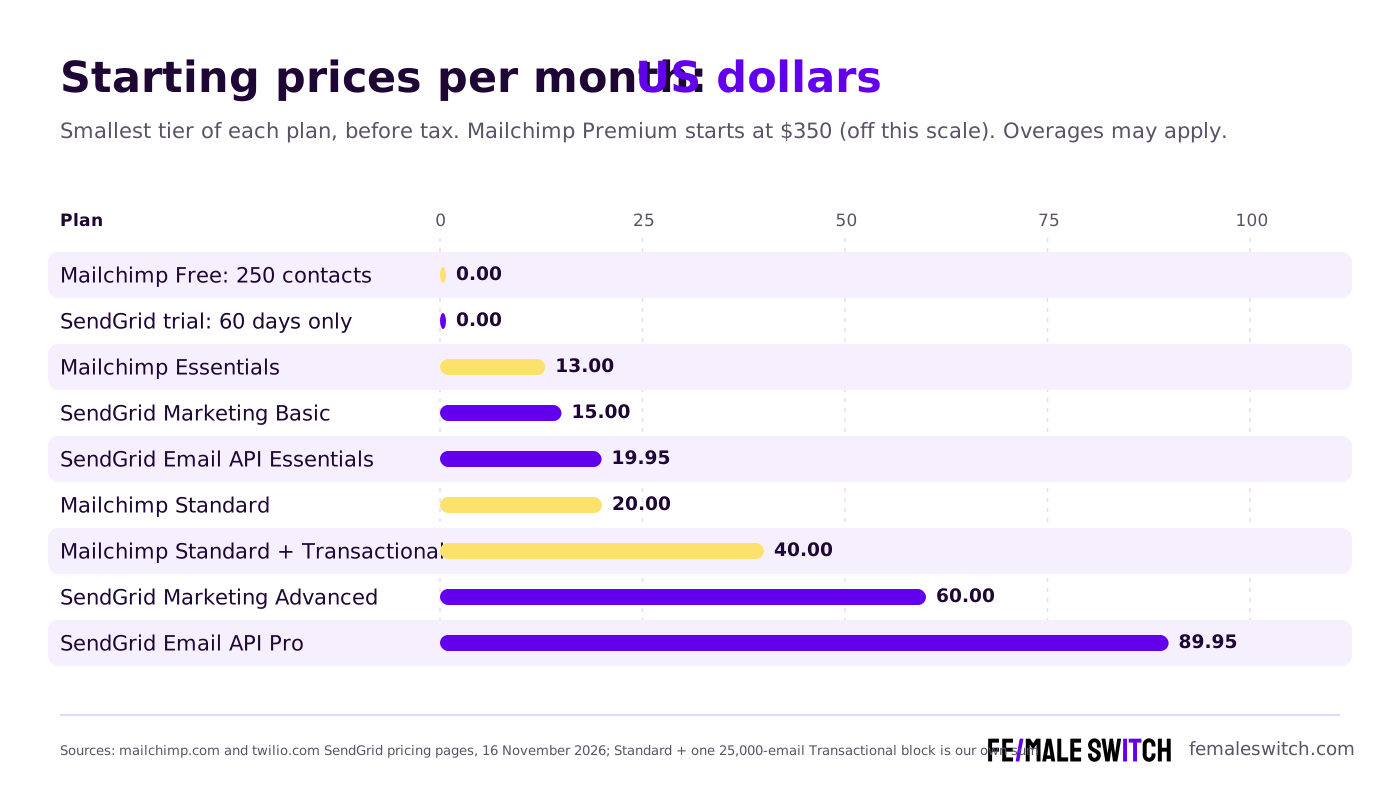
At the entry level the two cost about the same, but they buy different things. Mailchimp's $13 to $20 plans give you campaigns, forms and automations for up to 500 contacts; app emails cost extra and need Standard or Premium. SendGrid's $19.95 Essentials plan gives your product a sending engine for tens of thousands of emails a month, and its $15 Marketing Campaigns Basic plan has no automation. Both prices rise with your volume or list size, so set your own numbers on both pricing pages before you decide.
Twilio SendGrid: Email API and SMTP Relay for Developers
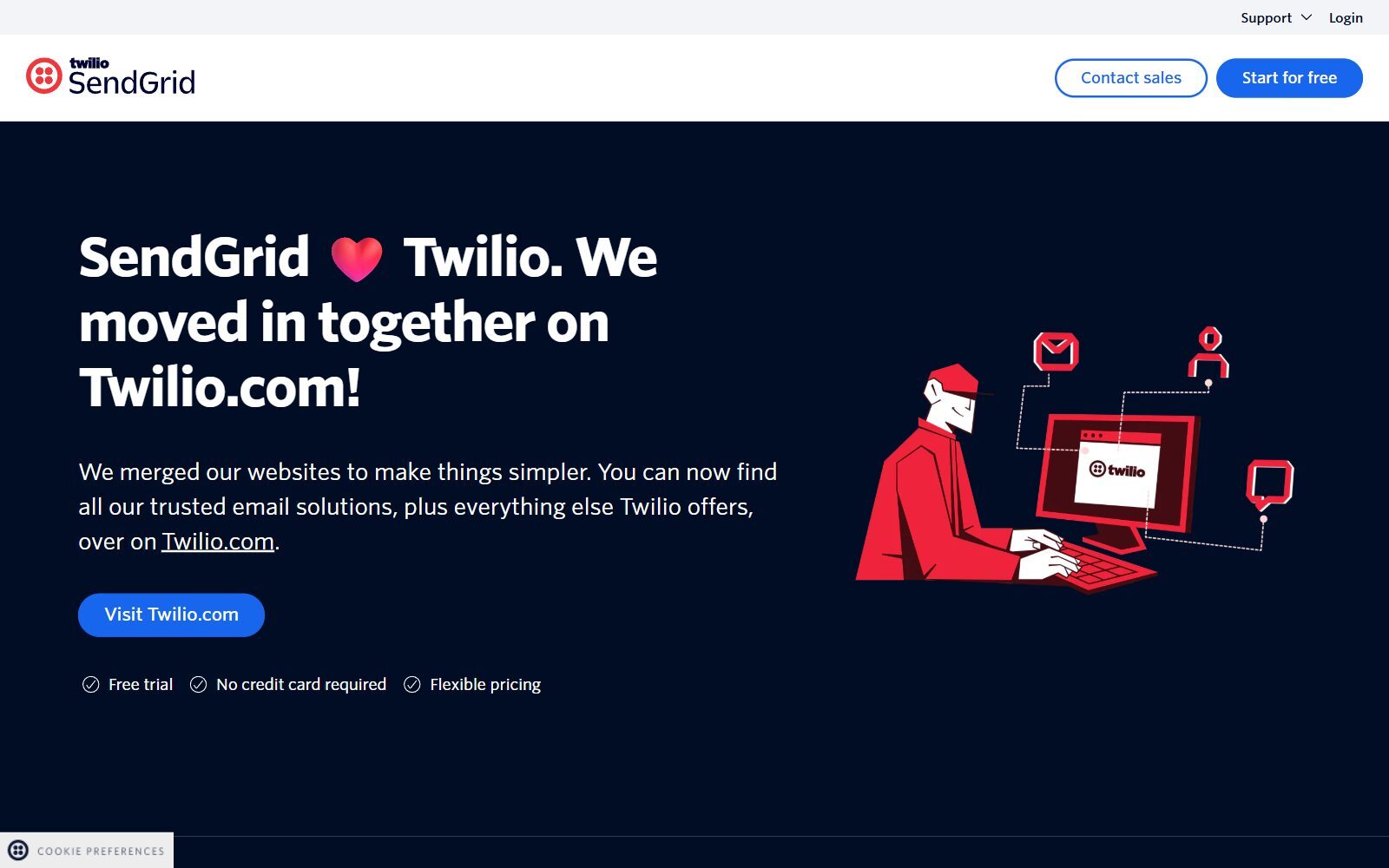
SendGrid is part of Twilio, and sendgrid.com now redirects to Twilio's site with the message that the two merged their websites. SendGrid is built to be called from code: your app hands each email to the API or the SMTP relay, and SendGrid handles authentication (SPF and DKIM), bounces, suppressions, event webhooks and sending statistics. It is the stronger choice when email is part of your product rather than a marketing channel.
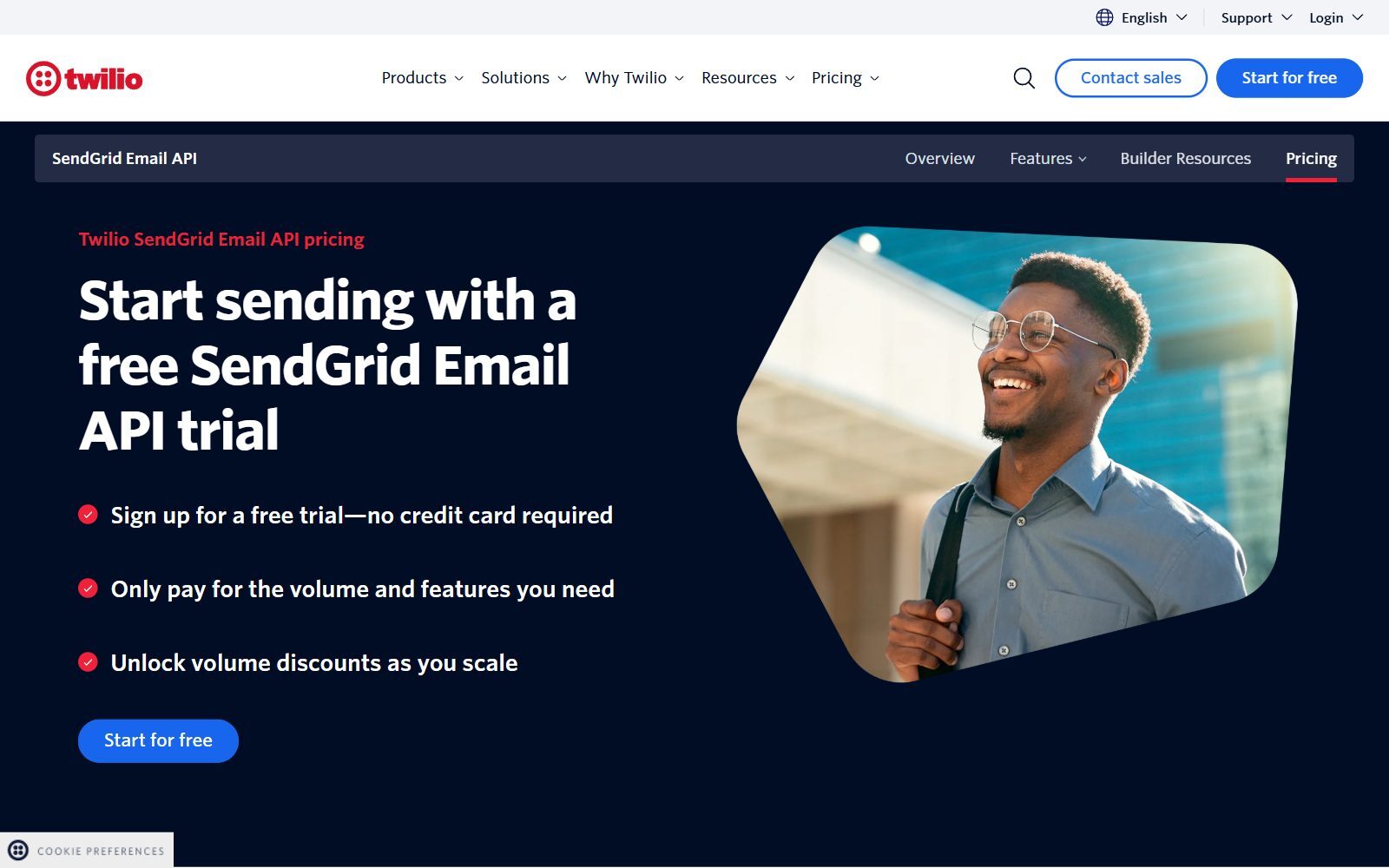
Email API plans (checked 16 November 2026; default view, US dollars):
- Free Trial, $0 for 60 days: 100 emails a day with no credit card, including analytics, deliverability optimisation and the dynamic template editor.
- Essentials, from $19.95 a month: core sending, tracking and deliverability tools; Twilio says Essentials fits senders of 50,000 to 100,000 emails a month.
- Pro, from $89.95 a month: dedicated IPs included (more can be bought), subuser management, single sign-on, 2,500 email validations and up to 1,000 teammates.
- Premier: custom pricing for custom volume, more email validations and expert program management.
Marketing Campaigns (bought separately): the Marketing Campaigns pricing page lists a 60-day Free Trial (100 contacts and 100 emails a day, which cannot be exceeded), Basic from $15 a month, Advanced from $60 a month and Custom. Automation, which answers the common search for "SendGrid marketing automation", is included on the trial and on Advanced, not on Basic. The Email API pricing page adds that exact pricing depends on send volume and features, and that taxes and overages may apply. One older FAQ answer on the Marketing Campaigns page still describes a free plan of 2,000 contacts and 6,000 emails a month; the plan table itself now shows the 60-day trial.
Is your startup on ChatGPT?
More and more traffic is coming from Perplexity, ChatGPT, Grok and other AI tools.
👉 Rank on ChatGPT
Intuit Mailchimp: Email Marketing for Small Businesses
Mailchimp was founded in Atlanta in 2001 and acquired by Intuit in 2021, and now presents itself as Intuit Mailchimp. It is built for people who write and send campaigns: a drag-and-drop editor and templates, audiences and segments, forms and popups, marketing automation flows (the feature once called Customer Journey Builder), reports, more than 300 integrations (Shopify, WooCommerce, Stripe and Zapier among those it lists), and SMS as a paid add-on in select countries.
Marketing plans (checked 16 November 2026; US dollar view, smallest contact tier):
- Free: up to 250 contacts and a maximum of 500 sends a month or 250 a day, 1 seat, 1 audience, no automation flows and email support for the first 30 days.
- Essentials, from $13 a month: sends of 10 times your contact tier, 3 seats, 3 audiences, automation flows of up to 4 steps, scheduling and 24/7 email and chat support.
- Standard, from $20 a month: up to 6,000 emails a month at the 500-contact tier, up to 200 automation flows, generative AI features at no extra cost, 5 seats and 1 onboarding session.
- Premium, from $350 a month: sends of 15 times your contacts, unlimited seats and audiences, enterprise SSO, phone and priority support and 4 onboarding sessions.
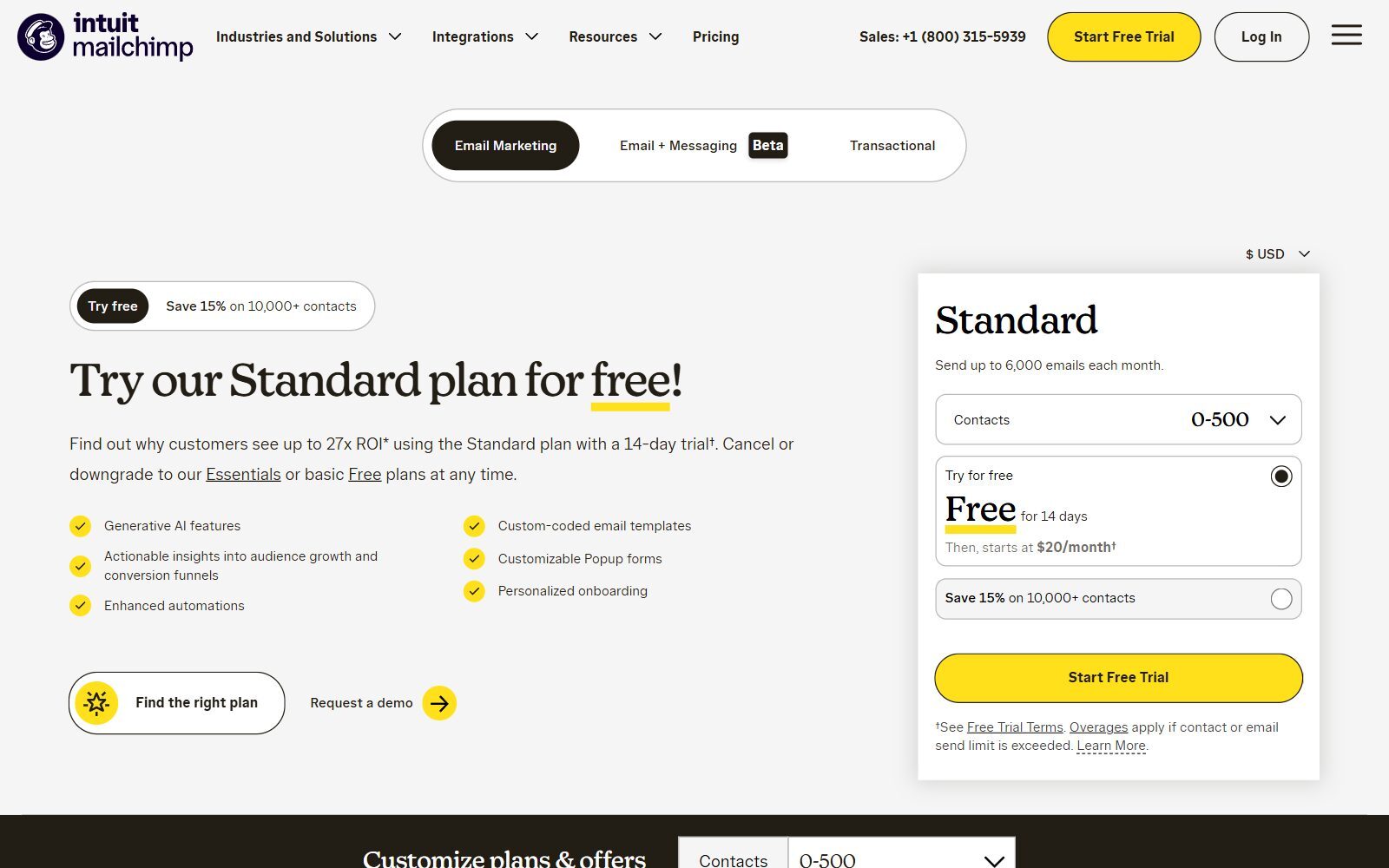
The Mailchimp pricing page offers a 14-day free trial of Essentials or Standard to new customers in select countries, with payment details required. From our location in Europe the same page showed euros by default (Essentials EUR 11.86, Standard EUR 18.24 and Premium EUR 319.23 a month), so the price you see depends on where you are. Nonprofits get 15% off, and a Pay As You Go option sells email credits for infrequent senders.
Boost Your SEO by Getting Featured in Our Blogs and get a backlink.
We publish content about startups, education, tech, funding, etc. that ranks well not only in Google but also in Perplexity, ChatGPT, Grok and other AI tools.
👉 Get featured now!
Mailchimp Transactional vs SendGrid for App Emails
Mailchimp has its own answer to SendGrid. Mailchimp Transactional is the service that was called Mandrill until it was renamed in fall 2025, and it sends one-to-one emails such as order confirmations, password resets and one-time codes through an API, SMTP and webhooks, with transactional SMS from the same API.
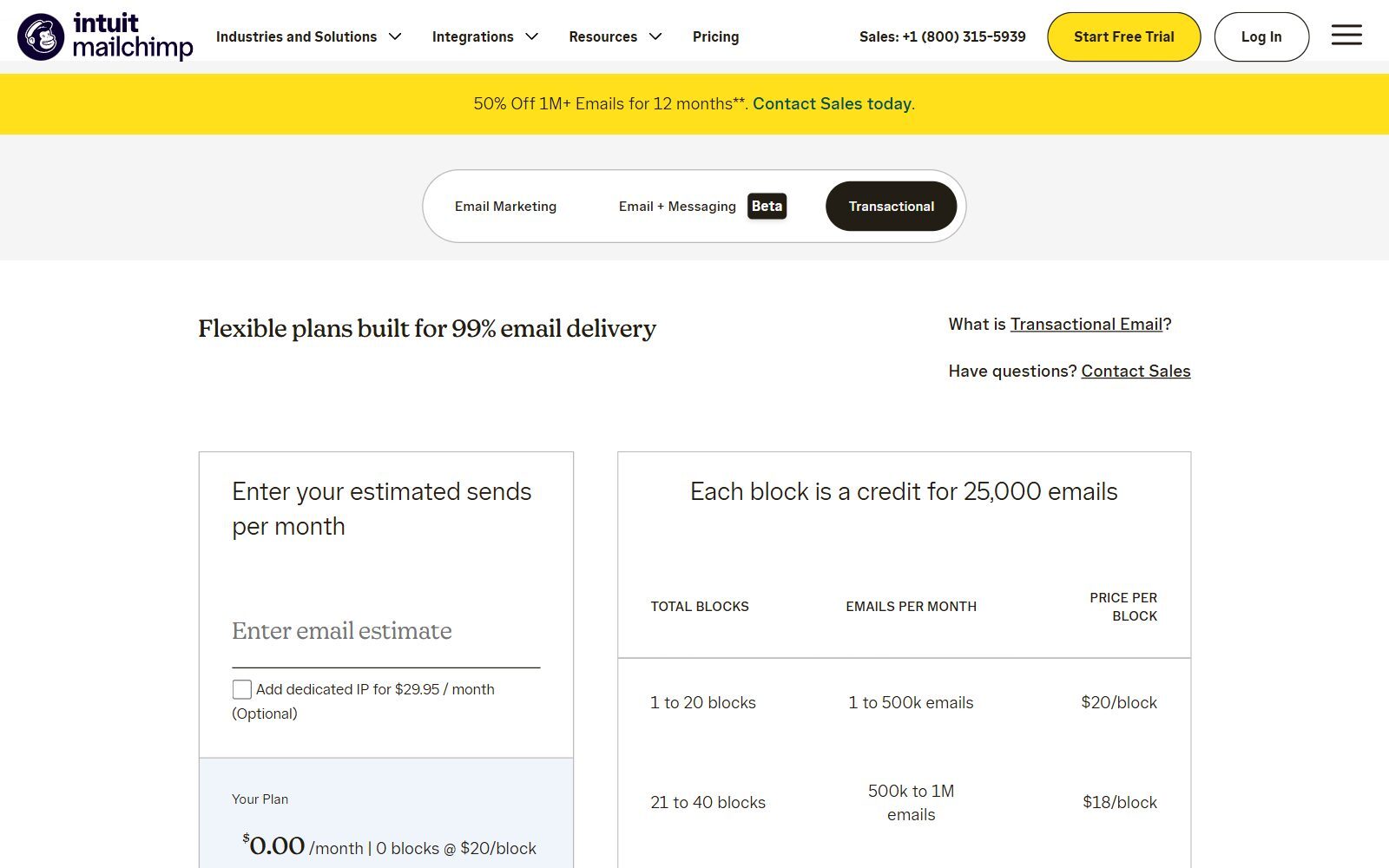
- Price: the Transactional pricing page sells blocks of 25,000 emails at $20 per block up to 500,000 emails a month, falling to $10 per block above 4 million; a dedicated IP is optional at $29.95 a month.
- Who can buy it: it is an add-on to Mailchimp Standard or Premium (or the legacy Monthly plan); Essentials is not eligible. New users get up to 500 free sends to their verified domain to test.
- How blocks work: unused emails do not roll over, and sending stops when your blocks run out unless you set automatic top-ups.
- Compared with SendGrid: at 25,000 app emails a month Mailchimp costs at least $40 (Standard plus one block, our own sum) and keeps marketing and app emails in one account, where marketers can edit templates. SendGrid Essentials starts at $19.95 for app emails alone, and its Pro plan adds dedicated IPs, subusers, SSO and email validation for larger senders.
For high-volume sending, check the volume tiers on both pages: Mailchimp lowers its price per block as you buy more, and SendGrid's price follows the monthly volume you pick on its slider.
SendGrid or Mailchimp: Feature by Feature
Free plan or free trial
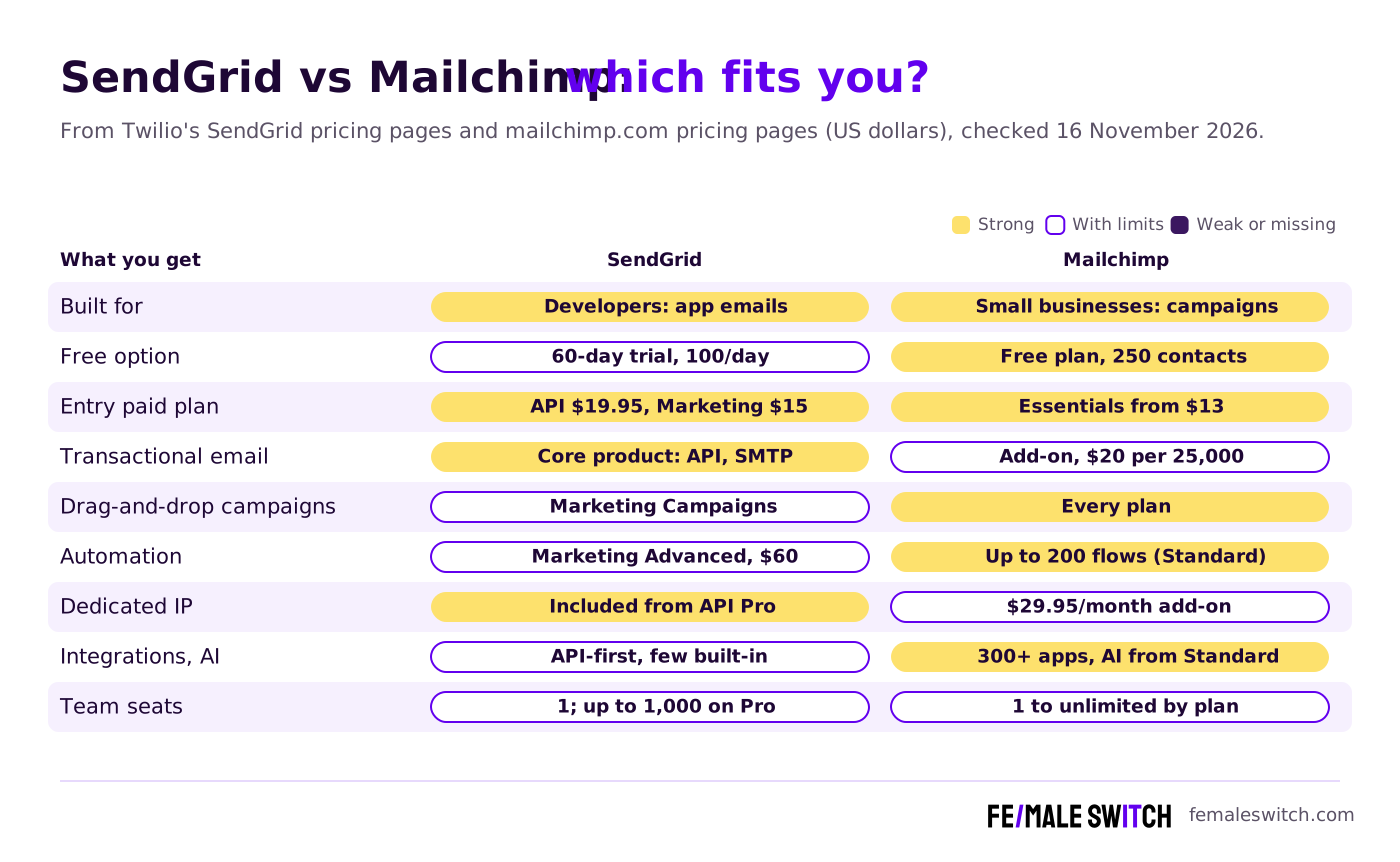
Mailchimp Free has no end date but stops at 250 contacts and 500 sends a month, with no automation. SendGrid's free option is a 60-day trial at 100 emails a day, for the Email API and for Marketing Campaigns separately. A pre-launch waitlist fits Mailchimp Free; a product in testing fits the SendGrid trial.
Email design and campaigns
Mailchimp is built around campaigns: templates, a drag-and-drop editor, audiences and segments, popup forms and reports. SendGrid's Marketing Campaigns lists design and code editors, segmentation and A/B testing too, but most SendGrid users design emails as dynamic templates that their code fills in.
Automation
Mailchimp's automation flows start on Essentials (up to 4 steps) and open up on Standard (up to 200 flows). SendGrid's automation sits on Marketing Campaigns Advanced at $60 a month; anything more complex is usually built in your own code on top of the Email API.
Deliverability and scale
SendGrid is built for volume, with dedicated IPs included from Pro, email validation and detailed event webhooks. Mailchimp's marketing plan table lists no dedicated IP; its pricing pages offer one only for Transactional, at $29.95 a month. Neither tool can promise your inbox rate: authenticate your domain (SPF, DKIM, DMARC) and keep your list clean on whichever you choose.
Using SendGrid and Mailchimp together
A common setup: your app sends sign-up confirmations and receipts through SendGrid, and the founder or marketer sends newsletters and onboarding flows from Mailchimp. We did not find a built-in connection between the two, so new users are usually added to Mailchimp by your own code through Mailchimp's Marketing API or through an integration tool. Use separate sending subdomains (for example mail. and news.) so a marketing complaint does not hurt your product emails.
What Changed Since the 2026 Version of This Comparison
- Free options: the old text promised Mailchimp Free for up to 500 contacts; it is now 250 contacts and 500 sends a month. SendGrid's free option is now a 60-day trial.
- Prices: the old text quoted SendGrid from $13 and Mailchimp from $20. SendGrid's Email API Essentials now starts at $19.95 and Marketing Campaigns Basic at $15; Mailchimp Essentials starts at $13 and Standard at $20.
- Names: Mandrill is now Mailchimp Transactional (renamed in fall 2025), Mailchimp's automation is called Marketing Automation Flows, and sendgrid.com redirects to twilio.com.
- Removed: the unsourced "$36 ROI for every $1" figure, the claim that SendGrid guarantees inbox placement, the "350 integrations" figure (Mailchimp says 300+), third-party review links and generic filler.
SendGrid or Mailchimp: Which Should You Choose?
- You have no developer and want newsletters and simple automations: Mailchimp (Free under 250 contacts, then Essentials or Standard).
- Your app needs receipts, password resets and alerts, and a developer will integrate it: SendGrid Email API.
- You want marketing and app emails in one account, edited by marketers: Mailchimp Standard plus Mailchimp Transactional.
- You send hundreds of thousands of app emails a month and want dedicated IPs and validation: SendGrid Pro.
- You need both and have a developer: SendGrid for the product, Mailchimp for campaigns.
- You want an all-in-one marketing tool with SMS and a free plan that sends more: read Brevo vs SendGrid.
- You run an online shop: compare Drip vs SendGrid and Omnisend vs SendGrid.
More SendGrid and Mailchimp Comparisons
More SendGrid comparisons: SendGrid vs HubSpot, SendGrid vs Constant Contact, SendGrid vs Mailgun, SendGrid vs MailerLite and SendGrid vs Klaviyo. More Mailchimp comparisons: Mailchimp vs Mailgun (Mailchimp Transactional against another developer API), Mailchimp vs ActiveCampaign, Mailchimp vs Pardot, Mailchimp vs Constant Contact for small businesses and Mailchimp vs MailerLite. Other head-to-heads: Brevo vs MailerLite and Klaviyo vs Constant Contact. Want to leave Mailchimp? See the free Mailchimp alternatives and, to run email on your own server, the open-source Mailchimp alternatives.
How Founders Use SendGrid or Mailchimp to Get Customers
Most early startups need two kinds of email: the ones a person writes (a launch announcement, a weekly update, a sales follow-up) and the ones the product sends on its own (a welcome email, a login code, a receipt). Mailchimp is built for the first kind and SendGrid for the second, which is why the question is often not which one, but which one first. Our email marketing tips for startups and the list of email marketing tools for startups cover the first steps. Before you spend on promotion, validate your startup idea.
Grow the list from social media with the schedulers in Loomly vs SocialPilot, and send those followers to a signup form. Newsletters are easier to fill when they point to good articles.The F/MS AI SEO Tool writes articles from your keywords that are built to rank on Google and to be cited by ChatGPT and Perplexity; link them from your Mailchimp campaigns. F/MS Marketing Services help you get backlinks and guest posts that build your authority.
Boost Your SEO by Publishing Your Startup Press Release with us.
We publish content about startups, education, tech, funding, etc. that ranks well not only in Google but also in Perplexity, ChatGPT, Grok and other AI tools.
👉 Publish Press Release
FAQ: SendGrid vs Mailchimp
Is SendGrid or Mailchimp better for a small business?
For a small business without a developer, Mailchimp: it has a free plan for up to 250 contacts, a drag-and-drop editor and automation flows from $13 to $20 a month. SendGrid suits small businesses whose product sends emails through code, such as a SaaS app or marketplace.
Where can I submit a guest post about my startup?
You can publish a guest post in one of the Fe/male Switch startup blogs, which rank in Google and in AI tools like ChatGPT and Perplexity. Get a quality backlink.
Does SendGrid still have a free plan?
Its pricing pages now show a 60-day Free Trial: 100 emails a day on the Email API, and 100 contacts and 100 emails a day on Marketing Campaigns, with no credit card (checked 16 November 2026). Mailchimp's Free plan has no time limit but covers only 250 contacts.
How does Mailchimp Transactional compare to SendGrid?
Both send app emails through an API or SMTP. Mailchimp Transactional (formerly Mandrill) is an add-on to Mailchimp Standard or Premium at $20 per 25,000 emails, which keeps marketing and app emails in one account. SendGrid's Email API is a standalone product from $19.95 a month, with dedicated IPs, subusers and email validation on Pro.
Which is better for high-volume transactional email?
Both scale: Mailchimp lowers its price per 25,000-email block from $20 to $10 as volume grows, and SendGrid prices by the monthly volume you pick, with dedicated IPs included from Pro. Compare both at your own volume on the official pricing pages.
Does SendGrid do marketing automation?
Yes, through Marketing Campaigns Advanced (from $60 a month) and the free trial; the Basic plan has no automation. Mailchimp includes automation flows from Essentials, with up to 200 flows on Standard.
Can I use SendGrid and Mailchimp together?
Yes. A common setup sends product emails through SendGrid and newsletters through Mailchimp. We found no built-in connection between the two, so contacts are usually synced by your own code through Mailchimp's Marketing API or an integration tool.
How do I move from SendGrid to Mailchimp Transactional?
You need a Mailchimp Standard or Premium plan, then add Transactional, verify your sending domain, rebuild your templates and switch your app's API or SMTP settings. New users can test with up to 500 free sends to their verified domain.
What is the difference between an email service provider and a marketing automation platform?
An email delivery service like SendGrid moves emails from your app to inboxes reliably. A marketing platform like Mailchimp adds the editor, audiences, segments, automation flows and reports that marketers use to plan campaigns. Some tools do both, with limits.
What other tools should I compare?
For an all-in-one marketing platform with SMS, Brevo; for another developer API, Mailgun; for ecommerce, Drip, Omnisend or Klaviyo; for automation with a CRM, ActiveCampaign or HubSpot; for free and self-hosted options, our free and open-source Mailchimp alternatives lists.
About the Author
Violetta Bonenkamp, also known as MeanCEO, is an experienced startup founder with an impressive educational background including an MBA and four other higher education degrees. She has over 20 years of work experience across multiple countries, including 5 years as a solopreneur and serial entrepreneur. Throughout her startup experience she has applied for multiple startup grants at the EU level, in the Netherlands and Malta, and her startups received quite a few of those. She’s been living, studying and working in many countries around the globe and her extensive multicultural experience has influenced her immensely.

