
The Best Countries for Female Entrepreneurs, Ranked by Data You Can Check
Where a woman starts her company decides how easy it is to borrow without a husband's or father's signature, how much public support she can get, and how many other women she will meet doing the same thing. This guide compares 10 countries using two primary sources only: the GEM 2025/2026 Women's Entrepreneurship Report for how many women actually start businesses, and the World Bank's Women, Business and the Law 2026 for how well laws and public systems back them. For each country we add one programme for women founders, checked on the government or agency page. We removed the growth percentages, decade-old index scores and blog sources the older lists repeat.
Quick answer: Canada is the strongest all-round country for women founders: almost one in four Canadian women is starting or running a new business, and Canada has the highest supportive frameworks score of all 190 economies in the World Bank's 2026 data. Spain has the most equal laws (97.9 out of 100) and France the second-best support systems. Chile and India are the places where women start businesses as often as men, and the United States and United Kingdom combine high startup rates with large women-focused funding and advice networks.
Write FREE SEO-optimized Blog Articles! Our Article Writer ensures your blog is loved by both Google and your readers, turning those clicks into customers.
👉 Write your article here
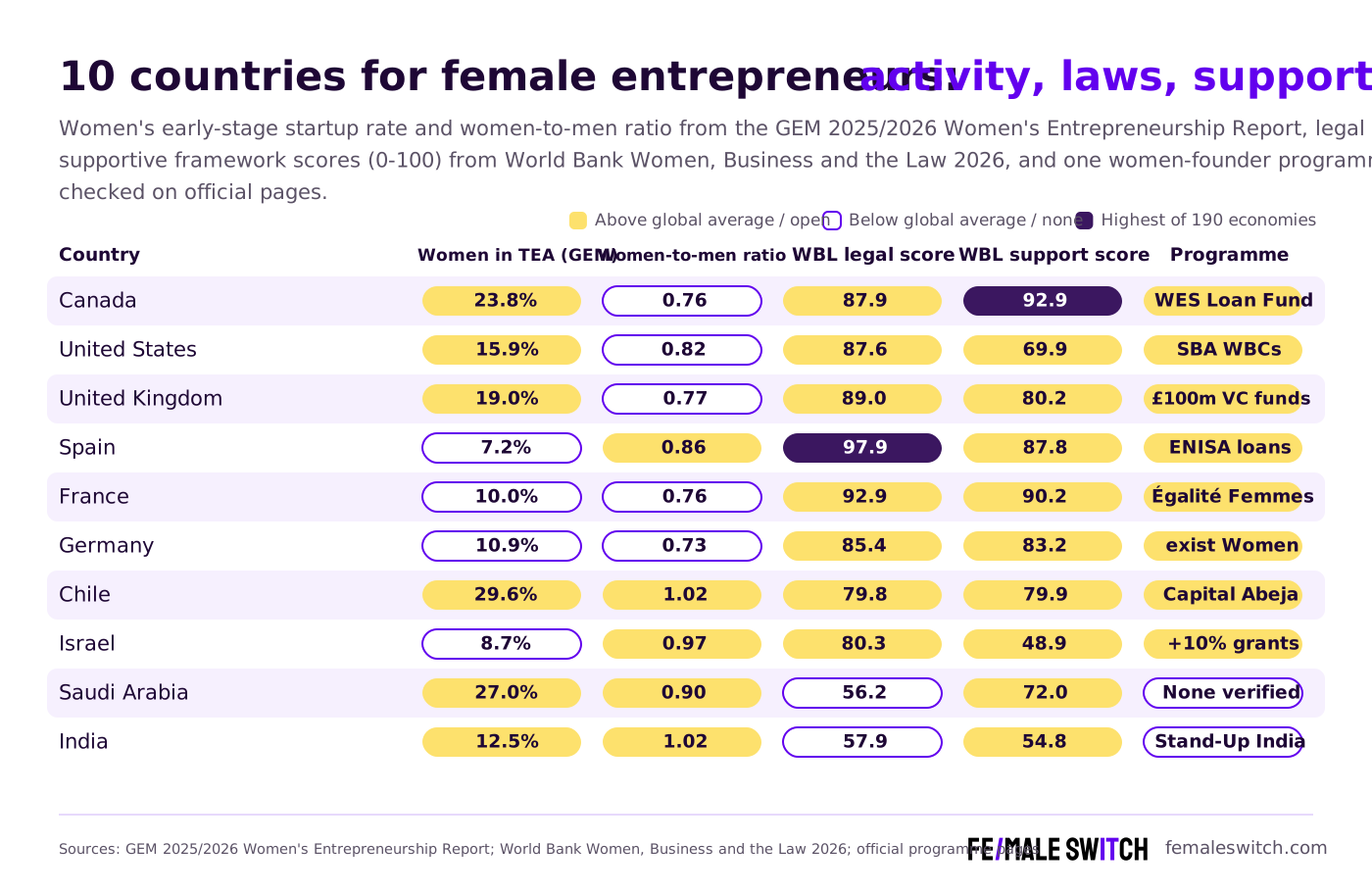
Female Entrepreneurship by Country at a Glance
Sources: women's and men's early-stage entrepreneurial activity (TEA) from Table A2.1 of the GEM 2025/2026 Women's Entrepreneurship Report (2025 survey); legal frameworks and supportive frameworks scores out of 100 from the World Bank's Women, Business and the Law 2026 data file; programmes from the official pages linked below, checked in November 2026.
How We Chose and Compared the Countries
GEM measures Total early-stage Entrepreneurial Activity (TEA): the share of adults aged 18 to 64 who are starting a business or running one less than about three and a half years old. Its 2025/2026 women's report, published on 8 October 2026, draws on the 2025 survey of 150,799 adults in 48 economies. On average 11.9% of women and 14.4% of men were in early-stage activity, a women-to-men ratio of 0.83. Europe had the widest gap (0.73), and the gap was largest of all at the established business stage (0.69), which GEM reads as a sign that structural barriers, not ambition, hold women back.
The World Bank's Women, Business and the Law 2026, released on 24 February 2026, scores 190 economies from 0 to 100 on three pillars: laws on the books (legal frameworks), the policies and institutions that put them into practice (supportive frameworks), and how experts see enforcement. The global averages are 67, 47 and 53, and only 4% of women live in economies close to full legal equality. Its data are current to 1 October 2025.
A high startup rate is not always good news: GEM's highest women's rates were in Angola (49.4%) and Ecuador (30.4%), where many women start businesses out of necessity. So a country made our list only if it appears in both datasets and either scores well above the world averages or stands out on women's activity, and we could check at least one programme on an official page. Our sister guides rank the best countries for early-stage startups and the best countries for AI startups for all founders.
The 10 Best Countries for Female Entrepreneurs in 2027
1. Canada
Canada is the only country here that scores high on everything at once. In GEM's 2025 survey 23.8% of Canadian women were in early-stage activity (31.3% of men), and the World Bank gives Canada the highest supportive frameworks score of all 190 economies (92.9) and a full 100 for supportive frameworks in entrepreneurship. Since 2018 the federal Women Entrepreneurship Strategy has grown to more than $7 billion in investments and commitments, according to Innovation, Science and Economic Development Canada. Its Women Entrepreneurship Loan Fund offers loans of up to C$50,000 through partner organisations, and the strategy reports more than 35,200 loans or non-repayable grants since 2018. For funding beyond loans, see our grants for female entrepreneurs in North America.
2. United States
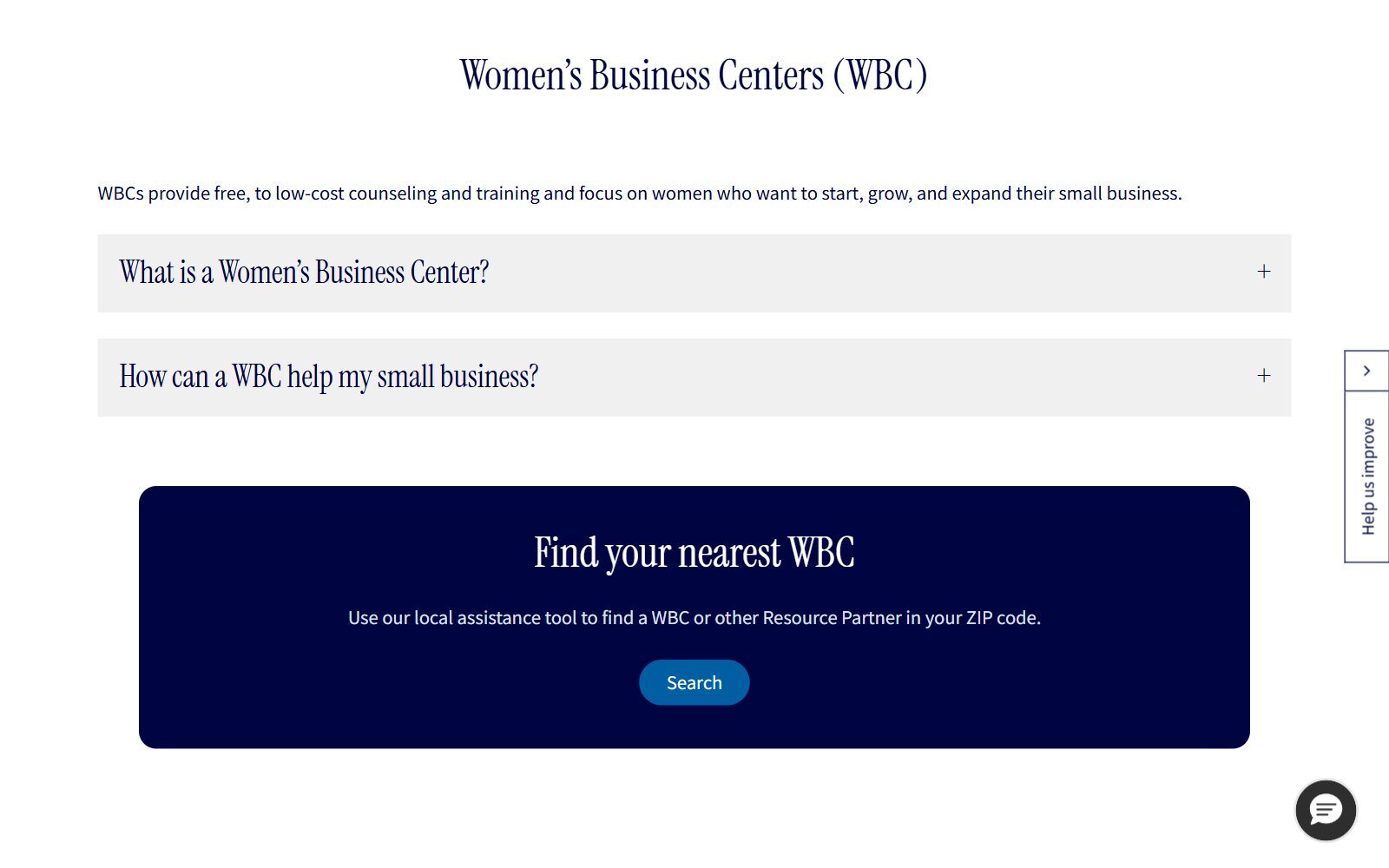
The US has the largest market and a dense support network. GEM's 2025 survey found 15.9% of American women in early-stage activity against 19.3% of men, and the World Bank scores the US 95 out of 100 on supportive frameworks for entrepreneurship, though its overall support score (69.9) is lower than Canada's or Western Europe's mainly because of low scores for parenthood (25) and work (50) support. The Small Business Administration's Women's Business Centers give women free to low-cost counselling and training to start and grow a small business, and you find the nearest one by ZIP code.
3. United Kingdom
The UK had the biggest jump in GEM's data: 19.0% of British women were in early-stage activity in the 2025 survey, up from 11.7% in the 2024 survey, against 24.8% of men. Its World Bank legal score is 89.0, held back by a 50 for entrepreneurship laws. On 10 July 2025 the government added £50 million for female-led venture capital funds, doubling the British Business Bank's commitment to £100 million in support of the Invest in Women Taskforce; the same release notes that only 2p of every £1 of UK venture capital goes to female-founded businesses. Read how the UK Budget 2026 affects women founders.
4. Spain
Spain has the highest legal frameworks score of all 190 economies in Women, Business and the Law 2026 (97.9), a perfect 100 on entrepreneurship laws and the third-highest enforcement score (86.3). Fewer people start businesses there: 7.2% of Spanish women and 8.5% of men, a ratio of 0.86. The Ministry for Digital Transformation's Emprendedoras Digitales line, run by the public lender ENISA, gives participative loans of €25,000 to €1.5 million to Spanish SMEs where women hold a leading role, with up to 9 years to repay, up to 7 years before repaying principal and no guarantees beyond the project; the ministry has set aside up to €51 million over three years.
5. France
France has the second-highest supportive frameworks score in the world (90.2, behind Canada) and a legal score of 92.9. In GEM's 2025 survey 10.0% of French women were in early-stage activity, against 13.2% of men. According to Bpifrance Création, the Garantie Égalité Femmes run by France Active guarantees up to 80% of a bank loan, up to €50,000, for women who create or take over a business less than three years old while job-seeking or in a precarious situation. It lasts up to 84 months, costs a one-off 2.5% of the guaranteed amount, and the bank cannot ask for a personal guarantee.
6. Germany
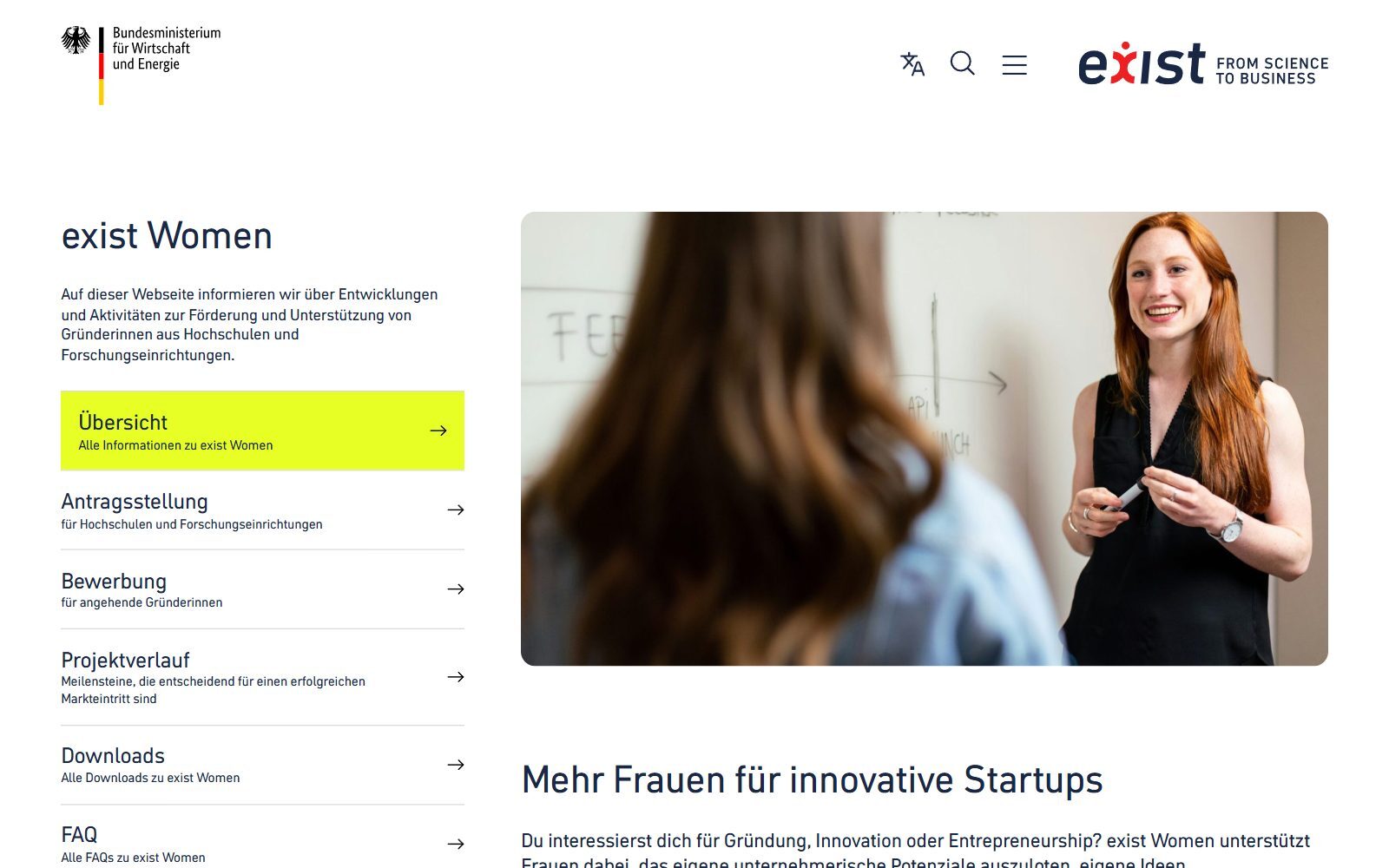
Germany scores 83.2 on supportive frameworks and 85.4 on laws, but its gender gap in startups is wide: 10.9% of women and 15.0% of men were in early-stage activity in 2025 (ratio 0.73). The economy ministry's exist Women programme targets women with a first business idea and a link to a university or research institute. It runs for 12 months with a mentor, €2,000 of material costs per participant and an optional 3-month stipend of €2,500 a month for graduates or €1,000 for students. Universities apply for each round; applications for the exist Women 2027 round were due between 1 and 30 September 2026. Our guide to grants for female entrepreneurs in Europe lists more European funding.
Boost Your SEO with 1,500+ Free Business Directories: increase your DA, get backlinks and traffic.
We've compiled an exclusive list of directories and websites where you can submit your business and start building high-quality backlinks to boost your website traffic and get your SEO snowball rolling.
👉 Submit your startup now!
7. Chile
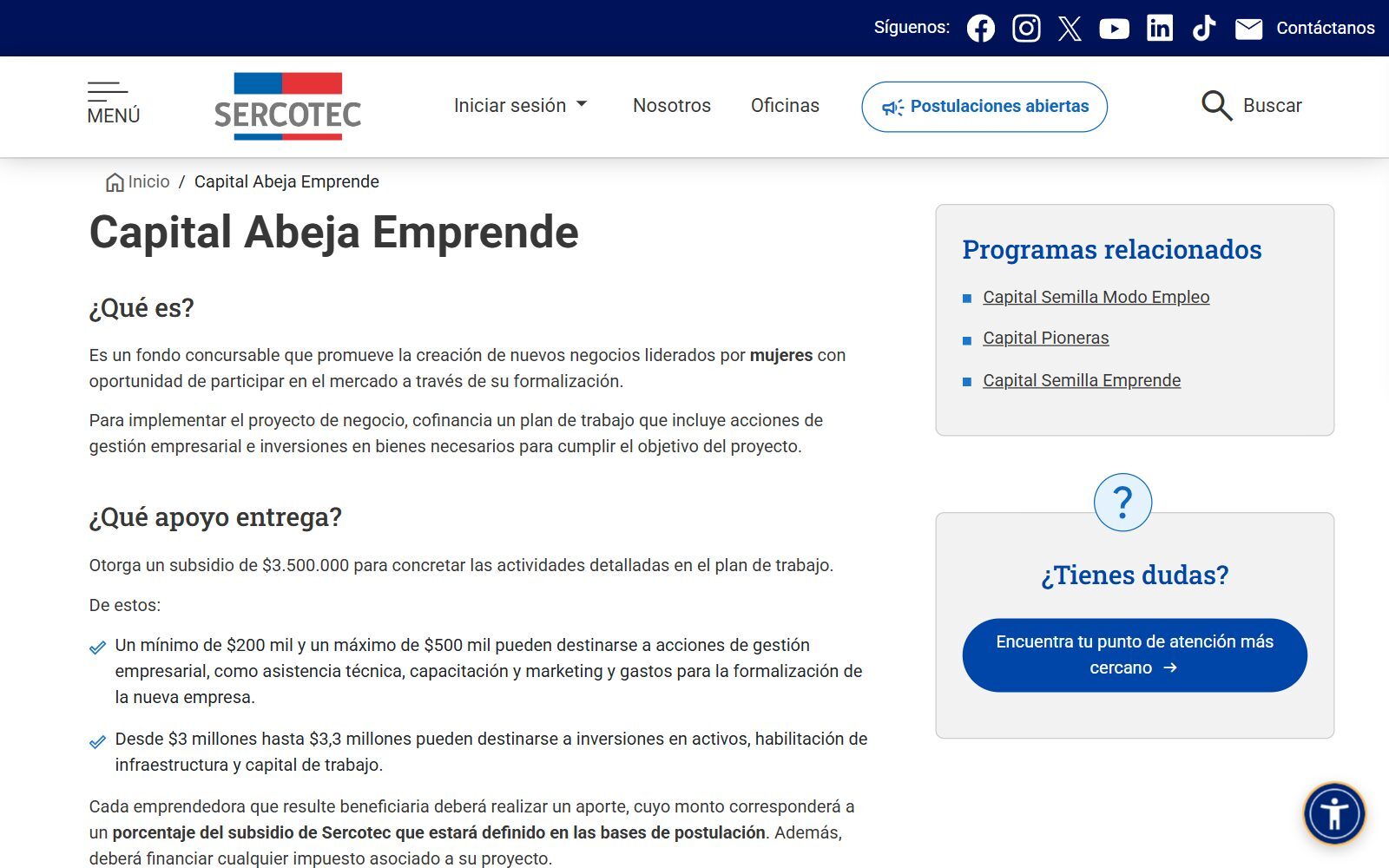
Chile has the highest women's startup rate in this list: 29.6% of Chilean women were in early-stage activity in 2025, slightly more than men (29.1%). GEM also found that about one in five Chilean women was involved in a high-potential startup (innovative, exporting or planning 20+ hires), the second-highest rate after Angola, and Chilean women outpaced men on that measure. The World Bank scores Chile 95 on supportive frameworks for entrepreneurship. The small-business agency Sercotec's Capital Abeja Emprende is a competitive fund for new businesses led by women: a subsidy of CLP 3.5 million, of which CLP 200,000 to 500,000 goes on business management and CLP 3 to 3.3 million on investments, with a co-payment set in each call. It opens once a year, and the 2026 call has closed.
8. Israel
Israeli women start businesses almost as often as men (8.7% against 9.0% in 2025), and they were more likely than men to run a high-potential startup (ratio 1.09). Israel scores 87.5 on entrepreneurship laws but only 48.9 on supportive frameworks overall. The Israel Innovation Authority's Women in High-Tech 2025 status report found that only 10.6% of startups founded from 2013 to 2024 had a woman CEO, and says the Authority adds a 10% grant increase for female-led startups in its Startup Fund.
9. Saudi Arabia
Saudi Arabia has one of the highest women's startup rates in GEM's data: 27.0% of Saudi women were in early-stage activity in 2025 (30.0% of men), and 44.0% of women said they intend to start a business. The legal picture lags: Saudi Arabia scores 56.2 on legal frameworks, well below the world average of 67, though 72.0 on supportive frameworks. We could not verify a national programme only for women founders on an official page, so check sector programmes before you move.
10. India
India is one of the few countries where women start businesses as often as men: 12.5% of women and 12.2% of men in 2025, and Indian women were 31% more likely than men to run a high-potential startup (ratio 1.31), the highest of the five economies where women led. Its World Bank scores are low (57.9 legal, 54.8 support). The Finance Ministry's Stand-Up India scheme gave bank loans of ₹10 lakh to ₹1 crore for new businesses of women and SC/ST entrepreneurs, about 1.99 lakh of them to women by 28 February 2025; it ran to 31 March 2025, and the ministry says a successor scheme with term loans of up to ₹2 crore for 5 lakh first-time women, SC and ST entrepreneurs was announced in the Budget. Our guide to grants for women entrepreneurs in Asia covers more of the region.
What Changed Since the Older List
The 2025 version of this article ranked 10 countries with figures it did not source or that were a decade old: a 114% growth rate and 42% ownership share for the US, venture figures from 2014, a C$1.4 billion Canadian pledge, Gender-GEDI scores for Sweden and Australia, a 2019 UK figure and a German target for 2025. Most links went to a 2015 World Economic Forum article and blogs. We removed all of it and used the two primary datasets above.
- Australia left the list: it scores 91.9 on laws, but it is not in GEM's 2025 survey, and its Boosting Female Founders grants ended after their third round; the programme pages on business.gov.au no longer load.
- Sweden left the list: strong laws and enforcement, but in GEM's 2025 survey only 6.1% of Swedish women were in early-stage activity against 12.9% of men, one of the widest gaps (0.48).
- New Zealand and Portugal score well on laws (90.0 and 91.1) but are not in GEM's 2025 survey, so we could not compare women's activity.
- Canada's goal to double majority women-owned businesses by 2025 has passed; the strategy page now reports results instead.
- Added: Spain, France, Chile, Saudi Arabia and India, each backed by GEM 2025 and World Bank 2026 data.
Which Country Should You Choose?
- You want the best all-round support: Canada, then France and Spain.
- You want the most equal laws: Spain, France and the UK lead our list on legal frameworks.
- You want the biggest market and advice network: the United States, through SBA Women's Business Centers.
- You are raising venture capital: the UK, where public money now backs female-led VC funds, or the US.
- You come from a university or lab: Germany's exist Women.
- You want a peer group of women founders: Chile, Saudi Arabia and Canada have the highest women's startup rates here.
- You are building a deep-tech startup: Israel, with its higher grants for female-led startups.
How Founders Use This List
Shortlist two or three countries where you can live and sell, then compare the money on offer: our guides to grants for female entrepreneurs, female founder grants and accelerators for female entrepreneurs list programmes by country. For the funding gap behind these numbers, see our female founder funding statistics; to meet investors and other founders, pick from the startup events for female entrepreneurs. If you are choosing within Europe, compare the best countries for startups in Europe on visas and national programmes.
FAQ About the Best Countries for Female Entrepreneurs
Which is the best country for female entrepreneurs in 2027?
Canada, on the latest data. 23.8% of Canadian women were in early-stage entrepreneurial activity in GEM's 2025 survey, and Canada has the highest supportive frameworks score of all 190 economies in the World Bank's Women, Business and the Law 2026.
Which country has the most equal laws for women in business?
Spain, with a legal frameworks score of 97.9 out of 100 in Women, Business and the Law 2026, followed by Croatia, Slovenia, France and Italy. The global average is 67.
In which countries do women start businesses as often as men?
In GEM's 2025 survey women's early-stage activity matched or beat men's in El Salvador, Costa Rica, Oman, Peru, Ecuador, Chile and India. The global average ratio was 0.83.
Which country has the highest rate of women entrepreneurs?
Angola, where 49.4% of women were in early-stage activity in GEM's 2025 survey, followed by Ecuador (30.4%) and Chile (29.6%). High rates often reflect necessity, so we also weighed laws and support.
What is the GEM Women's Entrepreneurship Report?
A report by the Global Entrepreneurship Monitor based on its yearly Adult Population Survey. The 2025/2026 edition, published on 8 October 2026, covers 150,799 adults in 48 economies and adds a high-potential index for innovation, exports and hiring.
What does Women, Business and the Law measure?
The World Bank scores 190 economies on women's legal rights at work and in business, the policies that put those rights into practice, and how experts rate enforcement. The 2026 edition was released on 24 February 2026.
Is the United States good for women founders?
It has a high startup rate (15.9% of women), a 95 out of 100 for supportive frameworks in entrepreneurship and free to low-cost help through SBA Women's Business Centers. Its overall support score (69.9) is lower than Canada's.
Which European country is best for female entrepreneurs?
Spain and France have the strongest laws and support systems, and the UK has the highest women's startup rate of the European countries GEM surveyed (19.0% in 2025). Germany's exist Women helps founders from universities. Our guide to startup grants for women in Europe lists funding.
Why did Australia and Sweden drop off the list?
Australia is not in GEM's 2025 survey and its Boosting Female Founders grants have ended. Sweden has strong laws, but its women-to-men startup ratio (0.48) is one of the widest gaps in GEM's data.
Where can women founders find grants?
Start with national programmes such as Canada's Women Entrepreneurship Loan Fund, Spain's Emprendedoras Digitales loans or Chile's Capital Abeja Emprende, then see our list of grants for female entrepreneurs.
About the Author
Violetta Bonenkamp, also known as MeanCEO, is an experienced startup founder with an impressive educational background including an MBA and four other higher education degrees. She has over 20 years of work experience across multiple countries, including 5 years as a solopreneur and serial entrepreneur. Throughout her startup experience she has applied for multiple startup grants at the EU level, in the Netherlands and Malta, and her startups received quite a few of those. She’s been living, studying and working in many countries around the globe and her extensive multicultural experience has influenced her immensely.
