

Deep Tech Incubators in North America: Lab Space and Hard Tech Incubators for Biotech, Climate and Hardware Startups in the US and Canada
A deep tech startup usually needs something a software startup does not: a wet lab, a fume hood, a BSL-2 room, a machine shop or a high-bay space for a prototype that weighs a tonne. That is what a deep tech incubator gives you, and it is why the best ones in North America are buildings first and programmes second. This guide lists incubators in the United States and Canada that run today and offer lab or hardware space to science founders, from LabCentral and Greentown Labs to the MaRS Incubator and Velocity. We checked each one on its official page on 15 November 2026: what it focuses on, what space it has, where it is and how to get in. The 2025 versions of this article mostly listed accelerators and investors; we explain where those went in a separate section.
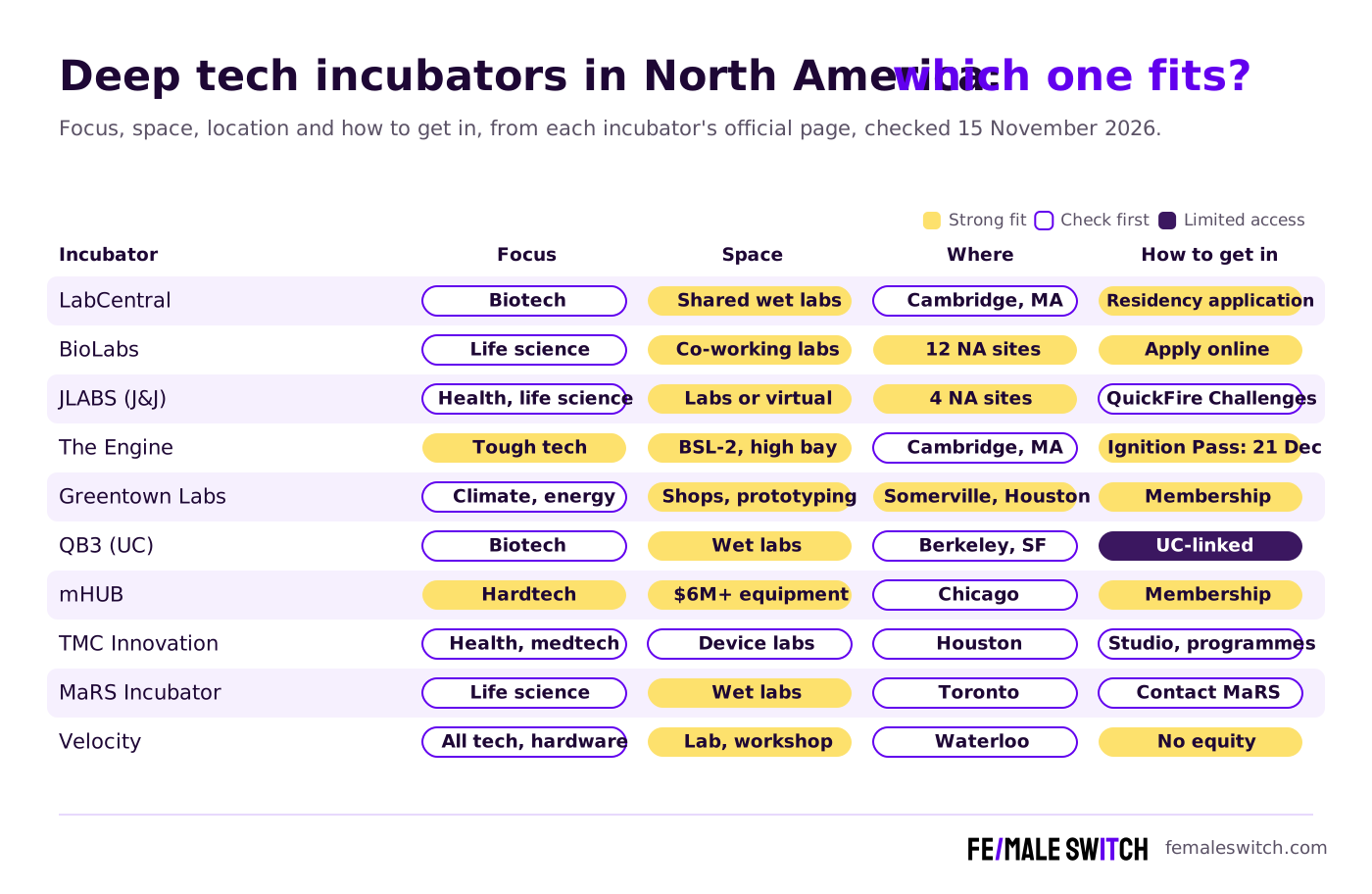
Quick answer: for biotech, start with LabCentral in Cambridge, the BioLabs network (12 North American sites) or JLABS by Johnson & Johnson. For climate and energy hardware, apply to Greentown Labs in Somerville or Houston; for tough tech that needs BSL-2 labs and high-bay space, The Engine in Cambridge (its Ignition Pass call closes on 21 December 2026). Hardware founders in the Midwest should look at mHUB in Chicago. In Canada, the MaRS Incubator in Toronto offers 30,000 square feet of wet labs, and Velocity in Waterloo takes no equity. If you want a fellowship or an accelerator rather than space, see our deep tech accelerators in North America.
Write FREE SEO-optimized Blog Articles! Our Article Writer ensures your blog is loved by both Google and your readers, turning those clicks into customers.
👉 Write your article here
Deep Tech Incubators in the US and Canada Compared
Sources: each incubator's official website, checked 15 November 2026. Prices for lab benches are not published on these pages, so ask each incubator for a quote.
Lab-Space Incubators in Boston and Cambridge
1. LabCentral (Cambridge, Massachusetts)
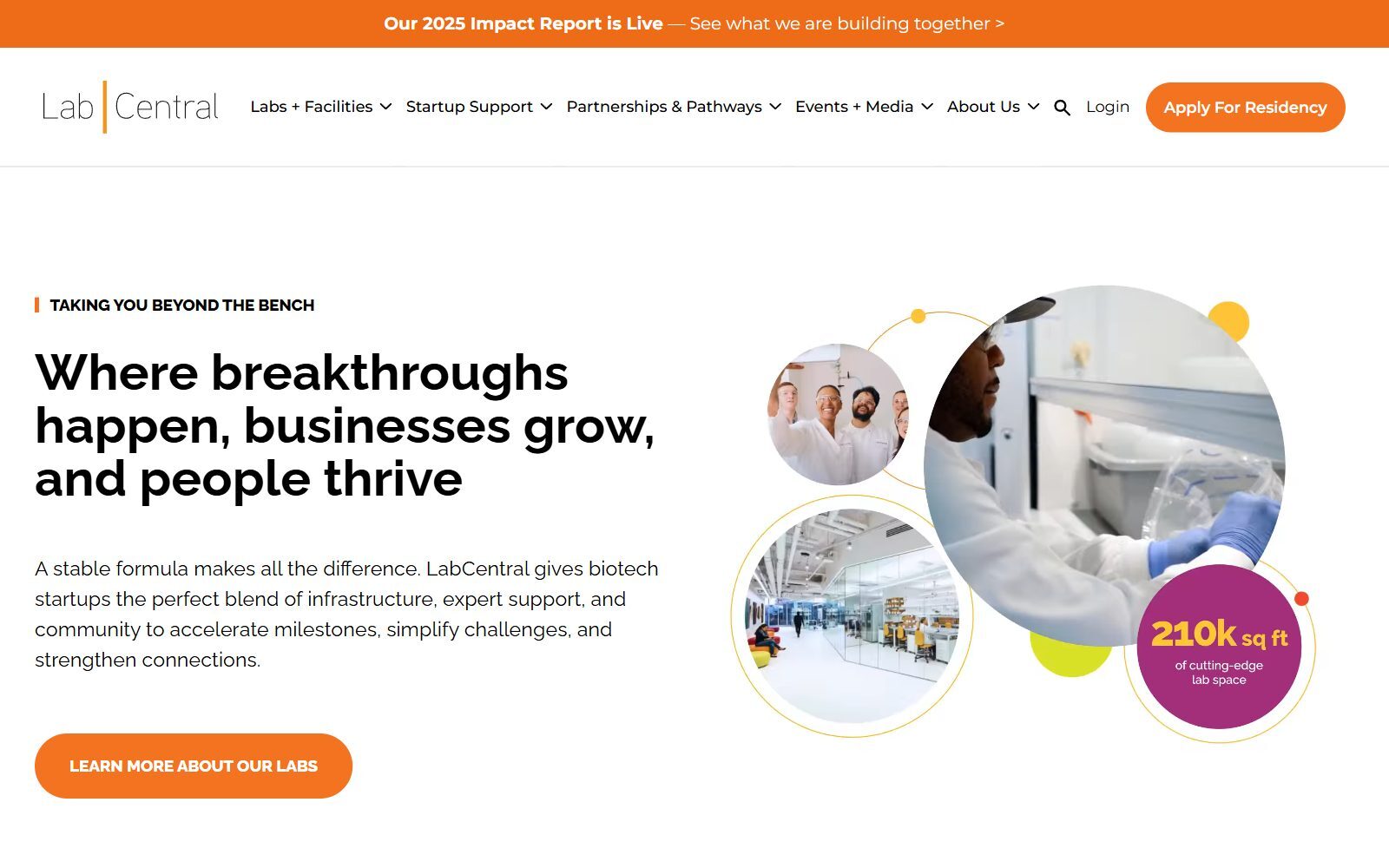
LabCentral is shared biotech lab space for early-stage startups in Cambridge, and its homepage puts its footprint at 210,000 square feet of lab space. Besides the main labs it runs a site for process development and scale-up, R&D space for Harvard-affiliated pre-seed and seed ventures, a network of core facilities, support for AI-biotech startups and a soft-landing programme for biotech companies from abroad. You get in by applying for residency; sponsors also fund Golden Tickets, which pay for a residency for selected startups. LabCentral does not publish bench prices on its homepage.
2. The Engine (Cambridge, Massachusetts)
The Engine is a nonprofit incubator for tough tech, and it runs its space as a residency. Residents get shared or private lab, engineering and office space, over 60,000 square feet of BSL-2 wet lab space for biology and chemistry, high-bay industrial space and rapid prototyping shops, with The Engine's team handling permits, safety reviews and hazardous waste. Its community counts over 100 teams and nearly 1,000 innovators in the Boston area, and the Engine Room programme connects residents with other facilities across New England. Next date: the Ignition Pass call funds a residency for up to five tough tech startups; apply by 21 December 2026. The Engine also runs Blueprint for graduate students, postdocs and researchers (the Fall 2026 cohort is closed; an interest form is open for Spring 2027), covered in our deep tech accelerators guide.
3. Greentown Labs (Somerville, Massachusetts and Houston, Texas)
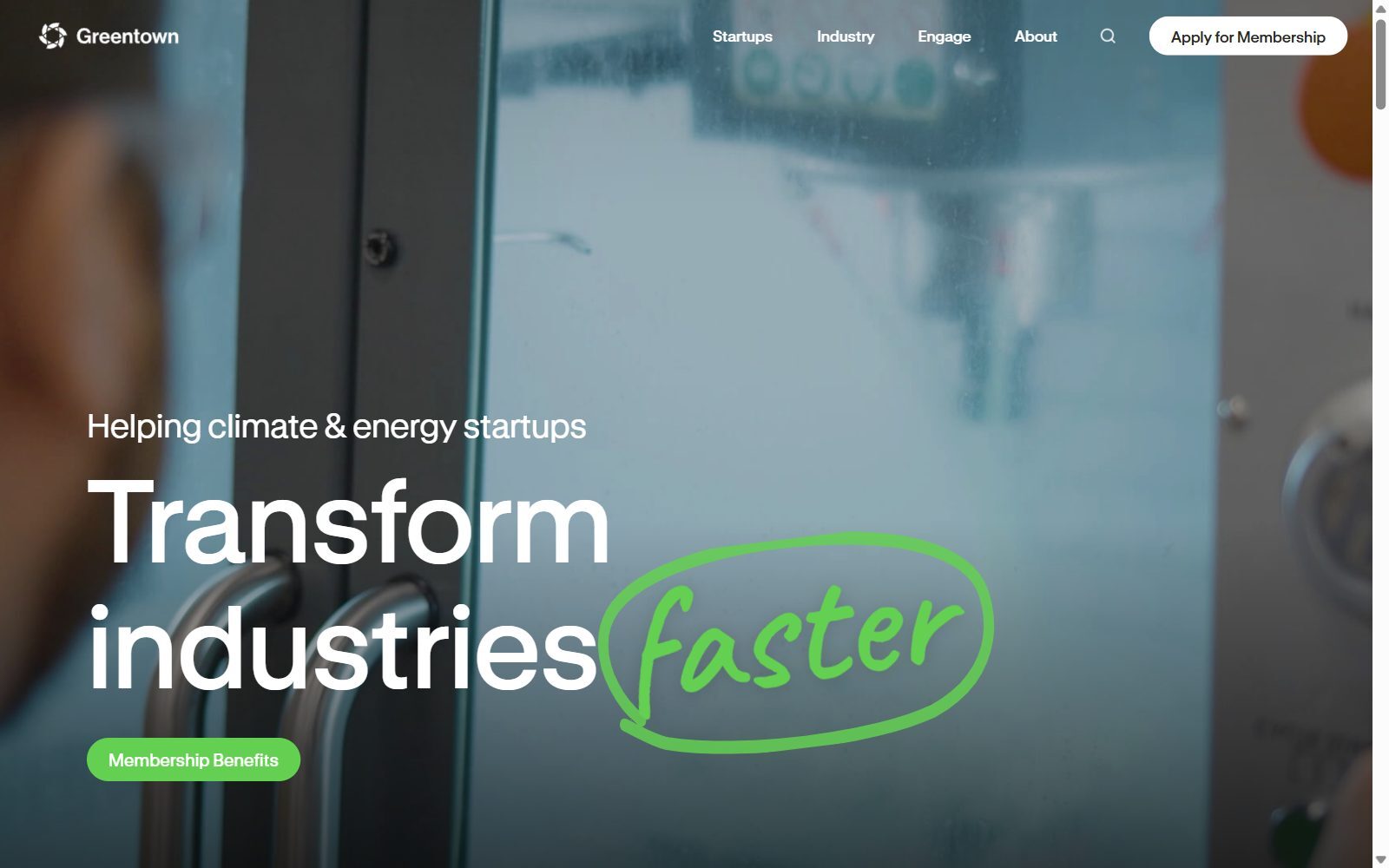
Greentown Labs is a 501(c)(3) nonprofit incubator for climate and energy startups, with one site in Somerville (444 Somerville Avenue) and one in Houston. Members get machine shops, prototyping labs and specialised equipment for fast R&D, plus help with customer discovery, field trials and pilots, investor introductions, pitch coaching and grant support. It describes itself as the world's largest community of climatetech and energy entrepreneurs. You join by applying for membership; fees are not published on the homepage.
Boost Your SEO by listing your startup and get a FREE backlink.
Create a profile in the F/MS Startup Game, add the link to your website and submit.
👉 List your startup now!
Life Science Incubator Networks
4. BioLabs (12 North American sites)
BioLabs runs co-working labs for life science startups, usually with a university or hospital partner. Its North American sites are Boston (Tufts Launchpad), Burlington, Vermont (University of Vermont), Los Angeles (Lundquist Institute), New Haven, New York (with NYU Langone, in Long Island City), Durham in North Carolina, Dallas (Pegasus Park), Philadelphia, Princeton, San Diego, Watertown and Toronto, where the University of Toronto and BioLabs opened what MaRS describes as the city's largest shared wet-lab incubator. A Rochester, Minnesota site with 16,000 square feet of labs was listed as coming in fall 2026. You apply online, and sponsors fund Golden Tickets for selected startups.
5. JLABS by Johnson & Johnson
JLABS is Johnson & Johnson's global incubator network for life science and health technology startups. It offers capital-efficient lab space as a physical residency, or a virtual membership if you do not need a bench, plus workshops, access to J&J experts and industry connections. In North America its sites include JLABS East North America, JLABS San Diego, JLABS San Francisco and JLABS @ LabCentral in Cambridge. Its QuickFire Challenges ask startups to solve a stated healthcare problem for awards that can include grant funding and a JLABS residency, a good way in if you cannot pay for a bench yet.
6. QB3 incubators (UC Berkeley and UCSF)
QB3, the University of California's hub for life science, energy and materials entrepreneurship, opened the QB3 Garage@UCSF in 2005 as the first startup incubator in the UC system. Its largest incubator today is Bakar Bio Labs at UC Berkeley, a full-service wet-lab incubator with space for 35 biotech companies; the smaller QB3 Garage@Berkeley in Stanley Hall has about 800 square feet of wet lab with eight stations. A new Bakar Labs for Energy and Materials is expected to open in the 2027-2028 academic year. QB3 also runs a mentoring programme, and it has given $100,000 QB3 mentoring awards to startups such as Invoke Bio and Immunectra. Its incubators are built around the UC system, so they suit founders who come out of a UC lab.
Boost Your SEO with 1,500+ Free Business Directories: increase your DA, get backlinks and traffic.
We've compiled an exclusive list of directories and websites where you can submit your business and start building high-quality backlinks to boost your website traffic and get your SEO snowball rolling.
👉 Submit your startup now!
Hardware and Medtech Incubators in the Midwest and Texas
7. mHUB (Chicago, Illinois)
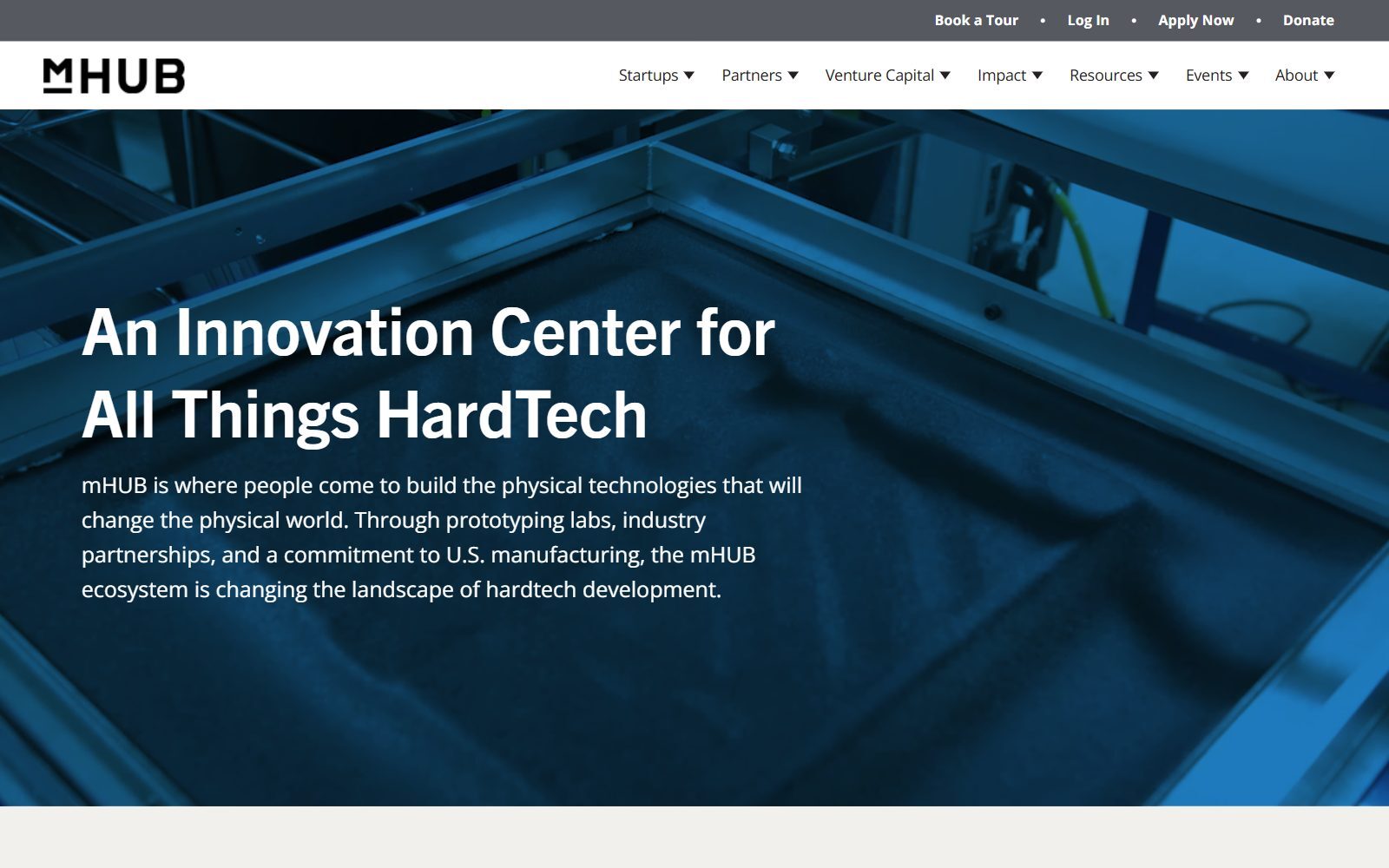
mHUB is a nonprofit innovation centre for physical products and hardtech. Members use a prototyping shop with more than $6 million in equipment and technical staff on site, a micro-factory for low-volume production runs, mentors, and introductions to Midwest manufacturers and suppliers. Besides membership, mHUB runs sector accelerators in energy tech, medtech and sustainable manufacturing. It suits founders building medical devices, energy hardware and smart manufacturing products.
8. TMC Innovation (Houston, Texas)
TMC Innovation is the innovation arm of the Texas Medical Center. It forms, fosters, recruits and funds healthcare companies, works with the Center's member institutions and corporate partners, and runs a venture studio and Medical Device Labs @ TMC for device founders. It is a fit for medtech and health startups that want clinical partners next door; Greentown's Houston site is the climate-tech option in the same city.
Deep Tech Incubators in Canada
9. MaRS Incubator (Toronto, Ontario)
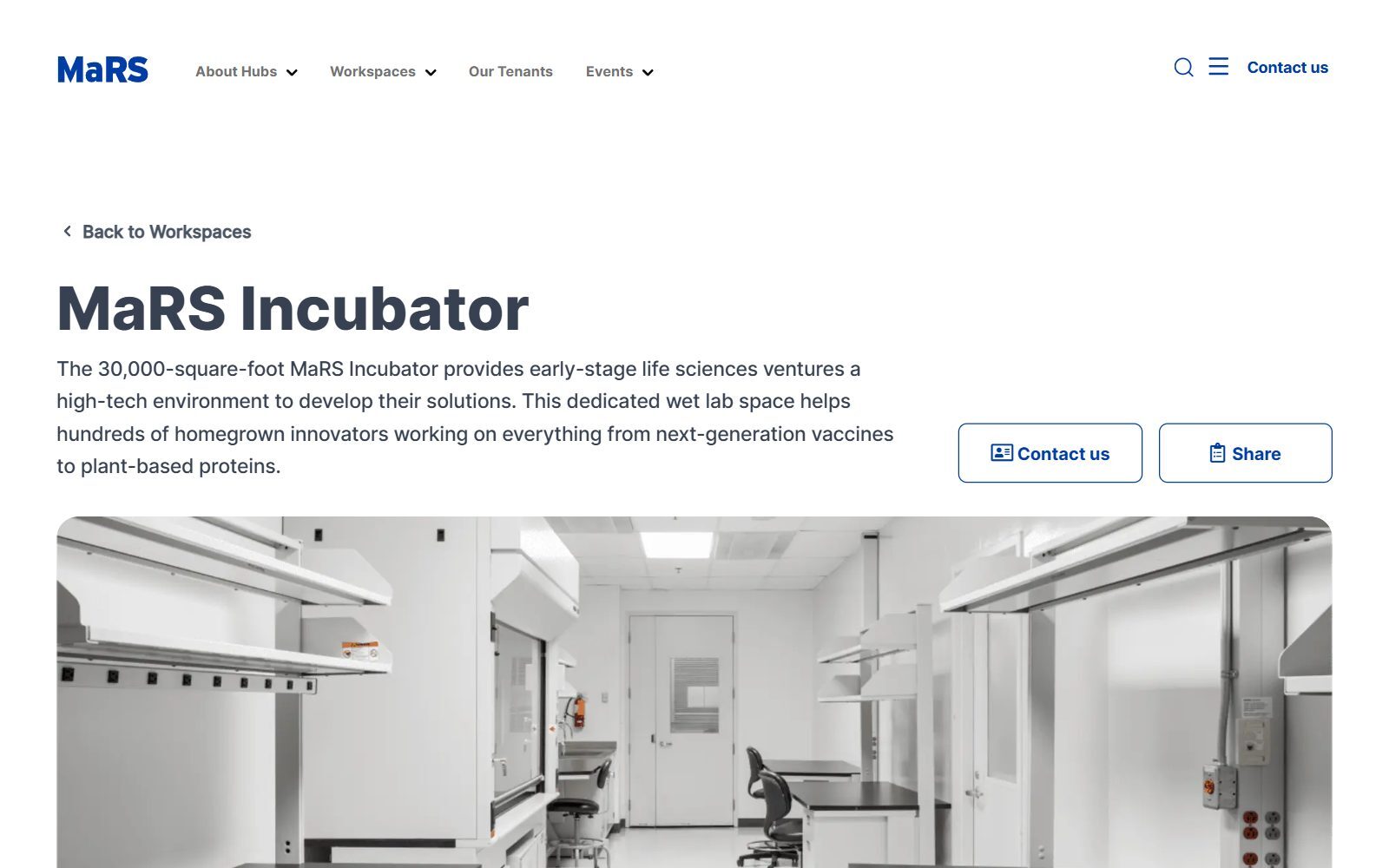
The MaRS Incubator is 30,000 square feet of wet lab space for early-stage life science ventures, with lab benches, waste handling partners and shared cold and warm rooms. Beyond it, the MaRS Centre has 700,000 square feet of larger scaling labs for companies that grow. MaRS itself is Canada's innovation hub in Toronto, with advisors, programmes and introductions to investors and customers. To rent incubator space, contact MaRS through the incubator page; prices are not published.
10. Velocity, University of Waterloo (Ontario)
Velocity is the University of Waterloo's incubator, and it says plainly that it takes no equity. Founders get 45,000 square feet of space, a hardware workshop with laser cutters, 3D printers and electronic test equipment, and a lab that you can book after safety training. Its sister organisation, the Velocity Fund, is a pre-seed fund in the same building. Velocity is open to all kinds of tech startups, but its lab and workshop make it one of the few free options for hardware and science founders in Canada.
Fellowships, Accelerators and Funding Programmes That Are Not Incubators
Some names in the old lists are good for deep tech founders but are not incubators. Our deep tech accelerators in North America guide covers them in detail; here is one line on each:
- Activate and Cyclotron Road: fellowships for scientist founders (Cyclotron Road is at Berkeley Lab); Cyclotron Road's Cohort 2027 applications closed on 30 October 2026, and Activate has an interest form for Cohort 2028.
- Creative Destruction Lab: an objectives-based programme with no fee and no equity, with sites across Canada and the US; not a space provider.
- Cleantech Open: an accelerator with regional and national competitions for clean tech; its site says the 2027 programme is coming soon.
- Berkeley SkyDeck: an accelerator; applications for Batch 24 open in January.
- DMZ (Toronto Metropolitan University): a general tech incubator, covered in our AI incubators in North America.
- Ascent Deep Tech Accelerator (CU Boulder): a four-month accelerator for research teams from the University of Colorado campuses.
- NRC IRAP (Canada) and SBIR/STTR (US): public funding and advice, not incubators; see our deep tech grants in North America.
Names From the Old Lists That Changed or Are Not Deep Tech Incubators
The 2025 versions of this article (Top 10, 15 and 25) listed many accelerators and investors as incubators. What we found when we checked them:
- Accelerators: Y Combinator, Techstars, 500 Global, AngelPad, Alchemist, ERA, gener8tor, Capital Factory, Plug and Play, MassChallenge and Google for Startups run accelerator programmes, not lab incubators; see our global deep tech accelerators guide.
- Investors: SOSV (with its HAX and former IndieBio programmes), Point72 Ventures, Alumni Ventures, DCVC, Mucker and The Yield Lab invest in startups; see our deep tech VCs in North America.
- Duality: the quantum accelerator in Chicago says its applications are closed and that it is now part of Alchemist Chicago.
- Fintech programmes: Fintech Innovation Lab, Revtech Labs and Nex Cubed are not deep tech incubators.
- NVIDIA Inception: a free programme for AI startups, not an incubator.
- HighTechXL: based in Eindhoven, the Netherlands; see our deep tech incubators in Europe.
- Launch Academy (Vancouver): its site now describes a founder community and an online course, with no incubator programme.
- Removed after checks: IBM Hyper Protect Accelerator (no current programme found), RocketSpace (its site did not answer), Tech Ranch (its domain is parked) and Polsky Deep Tech Ventures (the old page now leads to a 2024 news post).
- Not listed because we could not check them: Alexandria LaunchLabs and Harvard Innovation Labs blocked our checks, and NYU Tandon Future Labs' site did not answer.
Boost Your SEO by Getting Featured in Our Blogs and get a backlink.
We publish content about startups, education, tech, funding, etc. that ranks well not only in Google but also in Perplexity, ChatGPT, Grok and other AI tools.
👉 Get featured now!
Which Deep Tech Incubator Should You Choose?
- Biotech with wet-lab needs: LabCentral or JLABS in Cambridge, a BioLabs site near your university, QB3 in the Bay Area, or the MaRS Incubator in Toronto.
- Climate and energy hardware: Greentown Labs (Somerville or Houston) or The Engine if you need BSL-2 labs and high-bay space.
- Medical devices: TMC Innovation in Houston, mHUB's medtech accelerator in Chicago, or JLABS.
- Physical products and manufacturing: mHUB in Chicago or Velocity's workshop in Waterloo.
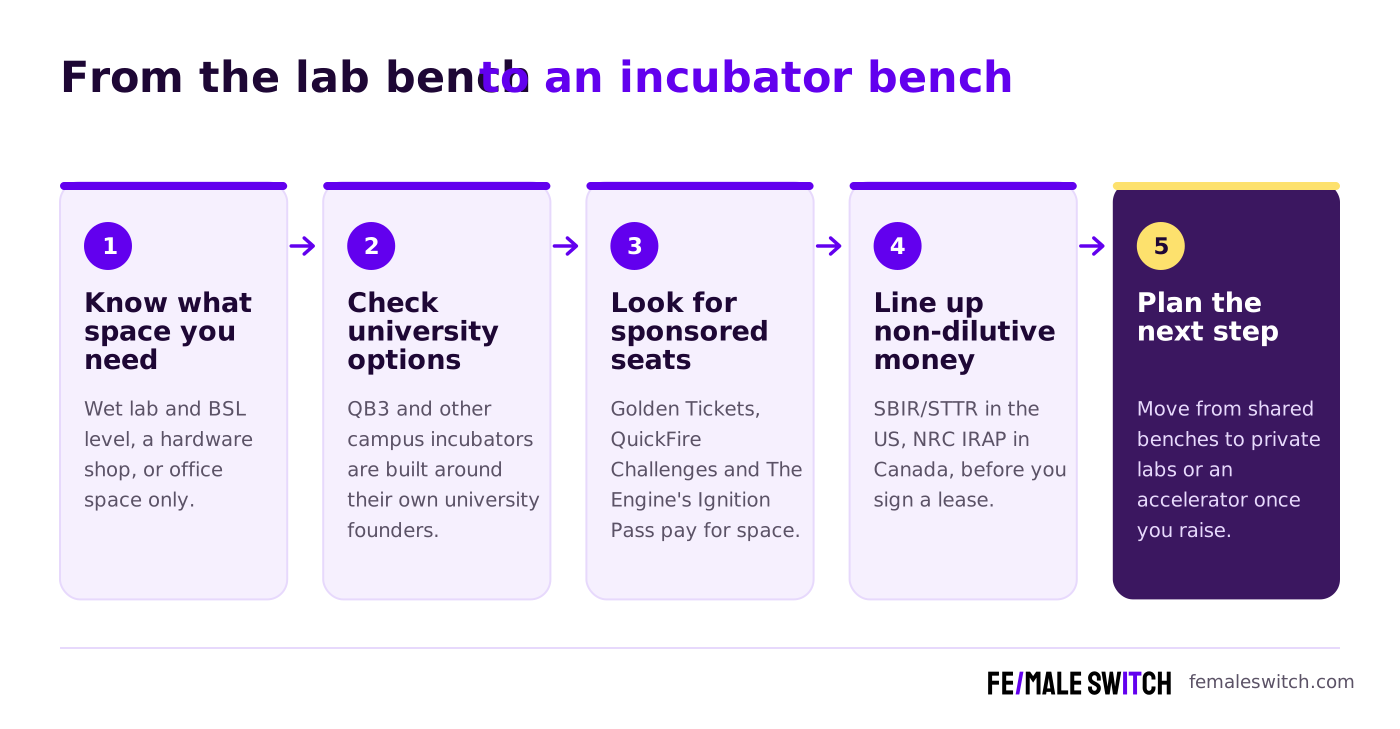
- No money for a bench yet: JLABS QuickFire Challenges, LabCentral and BioLabs Golden Tickets, and The Engine's Ignition Pass pay for space; Velocity takes no equity.
- You are still in a university lab: ask your tech transfer office first, then look at Activate, Cyclotron Road and Creative Destruction Lab.
How Deep Tech Founders Use Incubators
Lab space is expensive, so founders usually pair an incubator bench with non-dilutive money: our deep tech grants in North America guide covers SBIR/STTR and Canadian programmes, and Grant Grants explains equity-free funding. Use the time in the incubator to reach the milestones that deep tech VCs look for, and test your story at the deep tech startup competitions in North America. If AI is part of your product, the AI startup competitions in North America are worth a look too.
Compare options worldwide in our deep tech incubators guide, see which deep tech cities have the labs and talent you need, and read the deep tech trends investors are following. Women founders can also check the incubators for female entrepreneurs in North America, and if you are expanding to Asia, the deep tech accelerators in Asia.
Join F/MS: Startup Facilitator & Incubator and unlock your startup dreams today! Get your first customers, register you company in the Netherlands and get startup visas for the team.
FAQ About Deep Tech Incubators in North America
What is a deep tech incubator?
An incubator that gives science and engineering startups the space they cannot rent easily on their own: wet labs, BSL-2 rooms, machine shops or high-bay space, plus shared equipment, safety support and a community. Accelerators, by contrast, are short programmes that often invest for equity.
Which is the best biotech incubator in Boston?
LabCentral in Cambridge (210,000 square feet of lab space by its own count), JLABS @ LabCentral, The Engine for tough tech with BSL-2 labs, and BioLabs sites in Boston and Watertown. Which one is best depends on your lab needs and budget.
Do deep tech incubators take equity?
Most lab incubators charge rent or membership fees instead of taking equity. Velocity at the University of Waterloo says it takes no equity. The pages we checked for LabCentral, BioLabs and Greentown Labs do not publish fees, so ask each one for terms.
Is there a free deep tech incubator?
Velocity takes no equity and offers a lab and hardware workshop to its founders. Sponsor-funded seats such as LabCentral and BioLabs Golden Tickets, JLABS QuickFire Challenge awards and The Engine's Ignition Pass can also pay for space.
What is the best incubator for climate tech hardware?
Greentown Labs in Somerville and Houston, a nonprofit with machine shops and prototyping labs for climate and energy startups. The Engine in Cambridge suits tough tech that also needs wet labs or high-bay space.
Are there deep tech incubators in Canada?
Yes. The MaRS Incubator in Toronto has 30,000 square feet of wet labs, BioLabs runs a Toronto site with the University of Toronto, and Velocity in Waterloo offers space, a lab and a workshop with no equity. Creative Destruction Lab runs in several Canadian cities but is a programme, not a space.
Is Y Combinator a deep tech incubator?
No. Y Combinator, Techstars and similar programmes are accelerators that invest for equity and do not provide lab space. See our guide to deep tech accelerators in North America for their terms.
Where can hardware startups prototype in the Midwest?
mHUB in Chicago has a prototyping shop with more than $6 million in equipment, a micro-factory for low-volume runs and accelerators for energy tech, medtech and sustainable manufacturing.
When is The Engine's next call?
The Ignition Pass call, which funds a residency for up to five tough tech startups, takes applications until 21 December 2026.
How can my deep tech startup get in front of more investors?
Get covered where investors and AI assistants look: you can publish a guest post in the Fe/male Switch startup blogs. Get featured and earn a backlink.
About the Author
Violetta Bonenkamp, also known as MeanCEO, is an experienced startup founder with an impressive educational background including an MBA and four other higher education degrees. She has over 20 years of work experience across multiple countries, including 5 years as a solopreneur and serial entrepreneur. Throughout her startup experience she has applied for multiple startup grants at the EU level, in the Netherlands and Malta, and her startups received quite a few of those. She’s been living, studying and working in many countries around the globe and her extensive multicultural experience has influenced her immensely.
