

Deep Tech Accelerators in Asia (2027): 16 Programmes, Incubators and Fellowships for Science-Based Startups
Deep tech founders in Asia rarely fit a classic three-month software accelerator. They need lab space, equipment, engineers who understand manufacturing, and time to turn research into a company. This guide lists 16 programmes in Singapore, Hong Kong, Shenzhen, Japan, Korea, Taiwan and India that support science-based and hard tech startups and run in 2026 or 2027, market by market. Each one is labelled for what it really is (accelerator, incubator, fellowship, government programme or talent investor), with money, length and next intake only as stated on its own website, checked on 15 November 2026. The 2025 version of this list was mostly generalist accelerators with links to third-party list sites; what happened to them is explained at the end. For general programmes, see our guide to startup accelerators in Asia; for the rest of the world, deep tech accelerators worldwide.
Quick answer: university researchers in Singapore should look at National GRIP and the Activate Global - Singapore fellowship. Hard tech teams that need prototyping and manufacturing help can apply to HAX (SOSV), which works with teams in Shenzhen, Pune and Tokyo. In Hong Kong, HKSTP's Incubation Programme offers up to HKD 1.29 million over three years. In India, Social Alpha, C-CAMP, Venture Center and SINE IIT Bombay are the science-based options; in Korea, K-Startup Grand Challenge (for foreign startups) and TIPS; in Japan, Activate's BRIDGE Japan for researchers before incorporation.
Write FREE SEO-optimized Blog Articles! Our Article Writer ensures your blog is loved by both Google and your readers, turning those clicks into customers.
👉 Write your article here
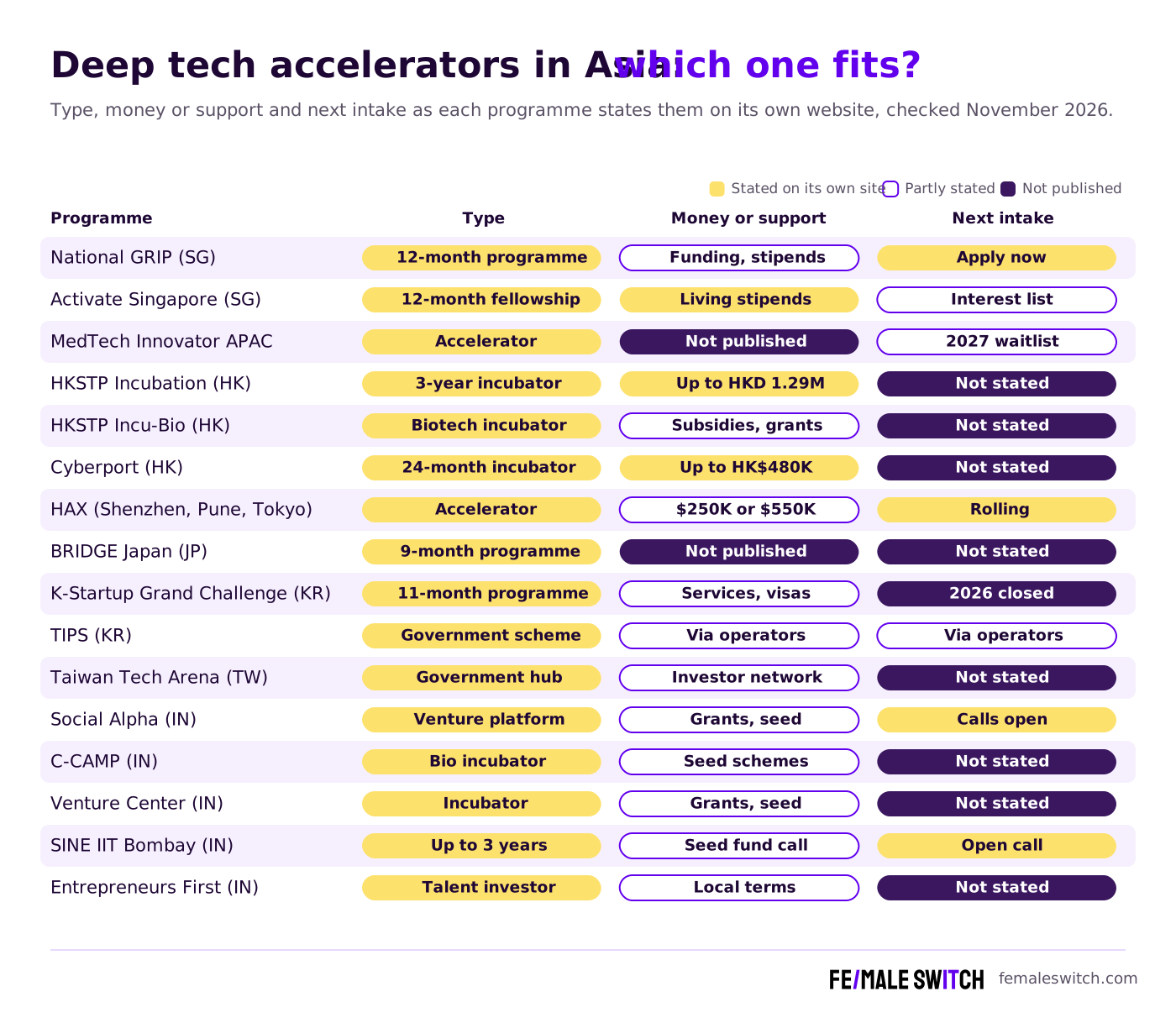
Deep Tech Accelerators in Asia Compared
Sources: each programme's own website, checked on 15 November 2026. "Not stated" means the site gives no figure or date.
Boost Your SEO by listing your startup and get a FREE backlink.
Create a profile in the F/MS Startup Game, add the link to your website and submit.
👉 List your startup now!
Singapore
1. National GRIP (commercialisation programme)
National GRIP (Graduate Research Innovation Programme) calls itself Singapore's national deep tech commercialisation platform. It was launched by the National Research Foundation and runs with NUS and NTU, for researchers, students and staff from the autonomous universities and research institutes, plus business people who want to build on their research. It lasts twelve months in three phases (discovery in months 1 to 2, venture creation in months 3 to 4, incubation in months 5 to 12) with founder matching, funding, grants and fellowships, founder stipends, NUS and NTU facilities, shared labs and engineers. It reports more than 600 teams incubated, more than 160 startups incorporated and more than $120 million in funding catalysed. Applications are open on its site.
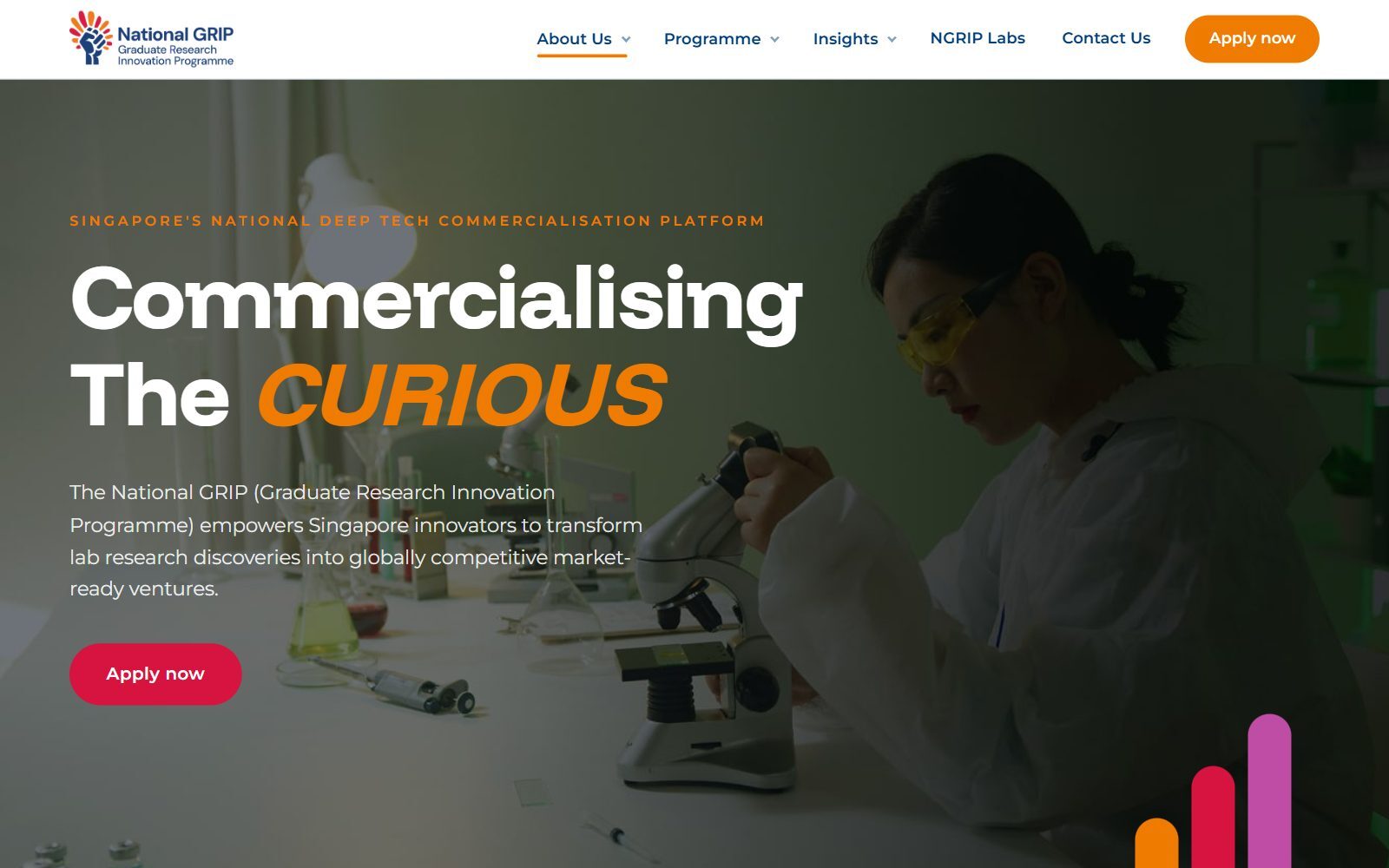
GRIP now runs inside NUSX: the National University of Singapore's site says NUS Enterprise has become NUSX, with NUS Overseas Colleges, BLOCK71 and GRIP as its operating layer and four deep tech tracks.
2. Activate Global - Singapore (fellowship)
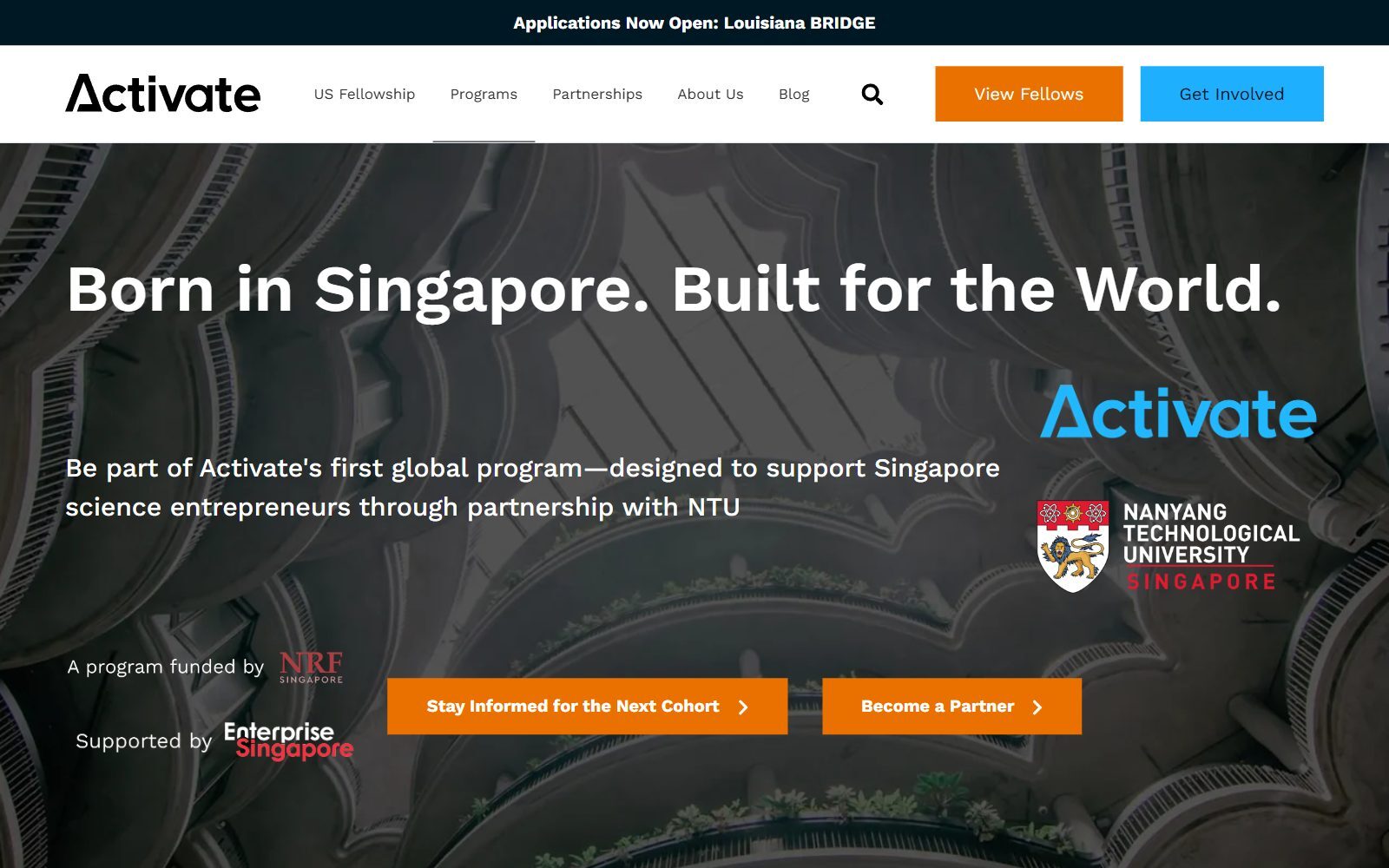
The Activate Global - Singapore Fellowship is Activate's first global programme, run with NTU, funded by Singapore's National Research Foundation and supported by Enterprise Singapore. It is a 12-month fellowship for Singapore-based scientists and engineers commercialising IP from a Singapore institute of higher learning, an autonomous university or A*STAR, with a bachelor's degree and at least four years of research or technology experience, who will set up their company in Singapore. Fellows receive funds for living stipends and flexible business expenses, mentoring, quarterly convenings in Singapore and two visits to the US. Its first Global Fellows are Cohort 2026; the site asks applicants to sign up for news of the next cohort.
3. MedTech Innovator Asia Pacific (accelerator, medtech)
MedTech Innovator Asia Pacific is the regional edition of what it calls the world's largest medtech accelerator, for medical device, diagnostic and digital health companies. Its yearly cycle runs from open applications (November to January) and a pitch RoadTour (March to May) to a summit in San Francisco in June, a programme from July to October and Grand Finals in Singapore in October. Applications for the 2026 programme have closed and the site offers a 2027 waitlist. It reports 166 Asia Pacific portfolio companies across 20 countries with more than USD 335 million in follow-on funding.
Boost Your SEO with 1,500+ Free Business Directories: increase your DA, get backlinks and traffic.
We've compiled an exclusive list of directories and websites where you can submit your business and start building high-quality backlinks to boost your website traffic and get your SEO snowball rolling.
👉 Submit your startup now!
Hong Kong and Shenzhen
4. HKSTP Incubation Programme and Incu-Bio (incubators)
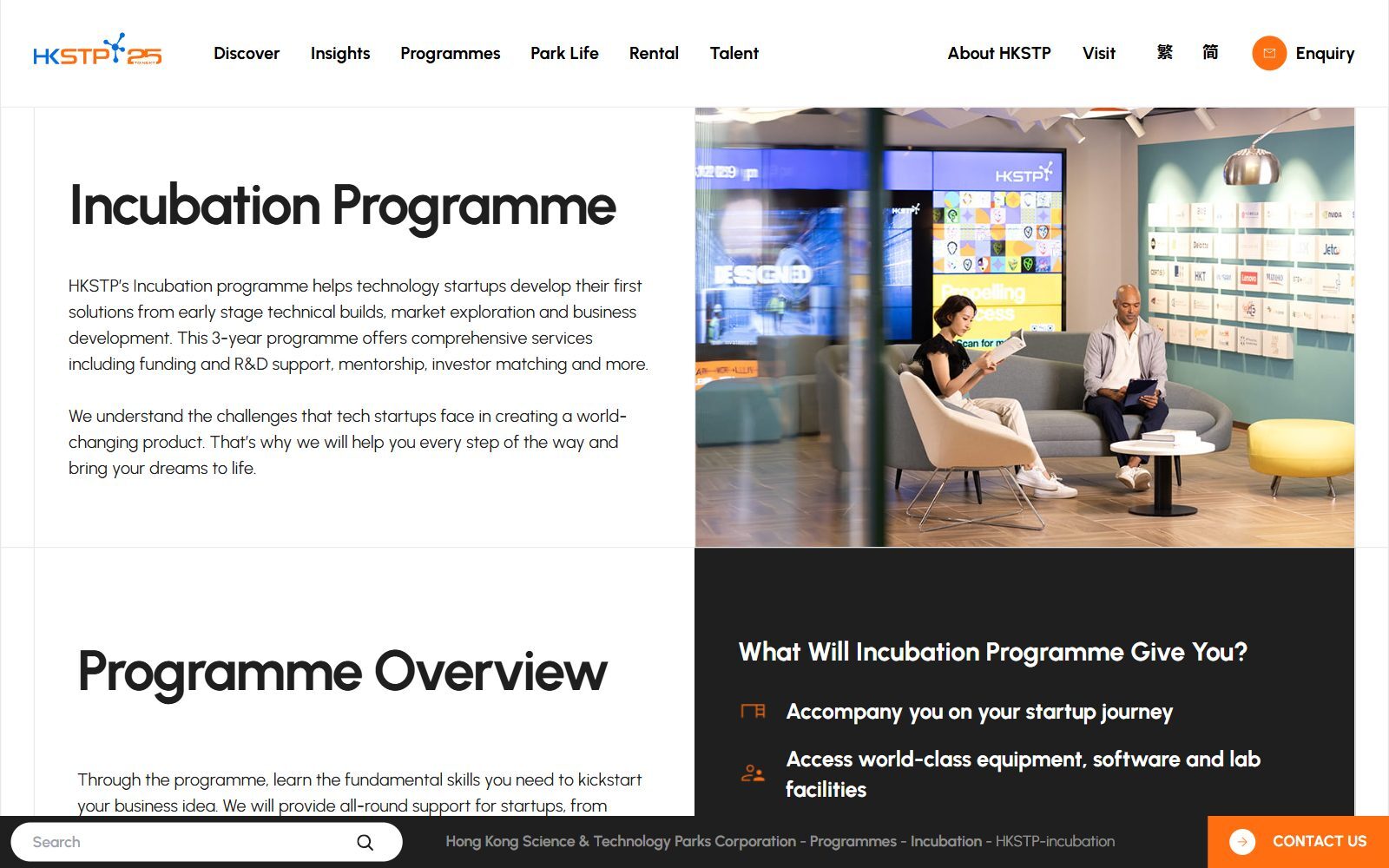
Hong Kong Science and Technology Parks runs an Incubation Programme for technology startups moving from early technical builds to market. It lasts three years and offers up to HKD 1.29 million for technology and business development, access to equipment, software and lab facilities, mentors and investor matching. Biotech and medtech teams can apply to the Incu-Bio Programme, a biotech incubator track with subsidies, grants and specialist facilities. HKSTP's focus areas are AI and robotics, green tech and new energy, life and health technology, and microelectronics and advanced manufacturing; it also runs Ideation, Co-Acceleration and Elite programmes.
5. Cyberport Incubation Programme (incubator, digital tech)
The Cyberport Incubation Programme is Cyberport's flagship programme, with a track for smart-living startups. Incubatees get up to 24 months of support, including financial assistance of up to HK$480,000, HK$20,000 in learning credits and HK$200,000 in on-site rental subsidies. It is aimed at digital technology rather than lab science, so it suits AI, fintech and smart-city teams better than hardware or biotech.
6. HAX by SOSV (accelerator, hard tech)
HAX, part of SOSV, backs pre-seed startups working at the intersection of science and engineering: energy, advanced compute, transport, health tech and manufacturing. Most teams work at its Newark, New Jersey headquarters, but every admitted team is introduced to HAX teams in Newark, Shenzhen, Pune and Tokyo: the Shenzhen and Pune teams handle engineering, design, manufacturing and sourcing, and the Tokyo office works mainly with teams in Japan. Its FAQ describes a first investment of $250,000 on a post-money SAFE, while its homepage lists $550K as the initial investment, so confirm current terms with HAX. It admits two to three teams a month on a rolling basis and works with startups for 6 to 18 months.
Boost Your SEO by Getting Featured in Our Blogs and get a backlink.
We publish content about startups, education, tech, funding, etc. that ranks well not only in Google but also in Perplexity, ChatGPT, Grok and other AI tools.
👉 Get featured now!
Japan
7. Activate BRIDGE Japan (pre-incorporation programme)
BRIDGE Japan is a nine-month programme for research scientists and engineers in Japan who have not yet incorporated, run with Tokyo IPC, Japan's Bureau of Science, Technology and Innovation and Hakuhodo as part of the Global Campus Startup initiative. Activate says plainly that it is not a generic accelerator: it covers techno-economic framing, fundraising readiness and founder habits, with monthly mentoring, peer pods, two in-person workshops in Tokyo and a trip to the US. It suits researchers deciding whether to start a company.
South Korea
8. K-Startup Grand Challenge (government programme for foreign startups)
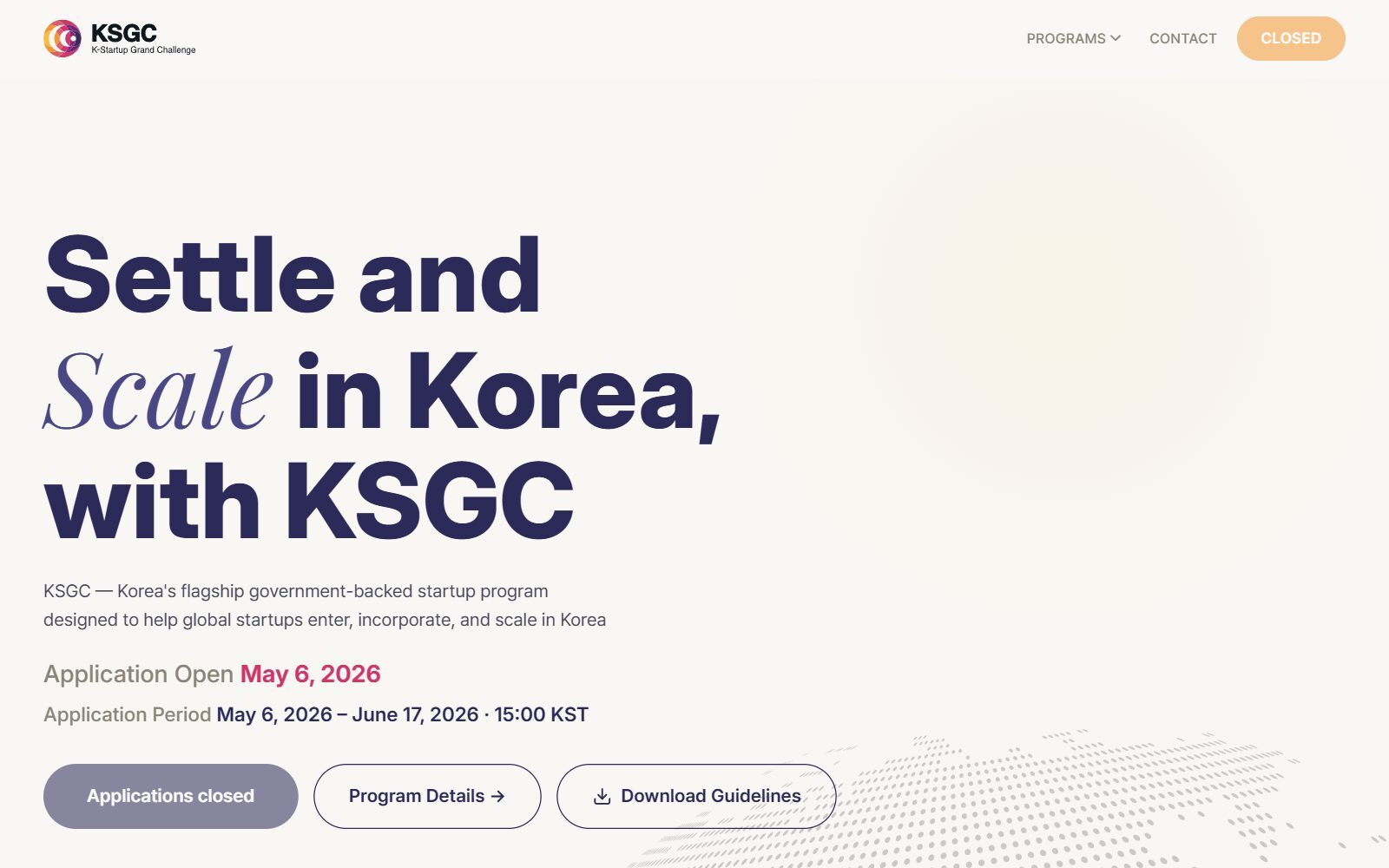
The K-Startup Grand Challenge is Korea's government-backed programme that helps global startups enter, incorporate and scale in Korea. It runs for 11 months in English: 80 teams in an online first phase, 40 in a second phase with legal, tax, HR and incorporation help and startup visa support (D-10-2), and 20 top teams in a third phase that requires a Korean entity and offers investor connections and D-8-4 visa support. Its 2026 priority sectors include mechanical design and materials, semiconductors, power systems and embedded systems. Applications for 2026 ran from 6 May to 17 June 2026 and are closed; the third phase runs from December 2026 to June 2027.
9. TIPS (government scheme with private operators)
TIPS (Tech Startup Incubator Program) is a Korean government startup programme in which private investors select promising technology-based startups, which then receive structured government support to grow into global companies. Founders enter through a TIPS operator (an accredited investor or accelerator) rather than applying directly; the site is in Korean.
Taiwan
10. Taiwan Tech Arena (government startup hub)
Taiwan Tech Arena (TTA) is Taiwan's flagship startup ecosystem programme, launched in 2018 by the National Science and Technology Council. It connects startups with partner accelerators, more than 100 local and overseas investors and corporate partners, and runs a southern hub (TTA South). It reports more than 200 alumni funded through its investor network. It is a hub rather than a single cohort programme, so check its programme page for current calls.
India
11. Social Alpha (deep tech venture platform)
Social Alpha backs science- and technology-led innovations that address social, economic and environmental challenges, from lab to market, in energy, resources, materials, food systems and health. Since 2016 it reports supporting more than 450 startups, with more than 100 seed investments and more than 400 catalytic grants, plus incubation labs and pilots. Its current calls include Techtonic programmes on sustainability and on agriculture and rural livelihoods.
12. C-CAMP (bio incubator)
C-CAMP (Centre for Cellular and Molecular Platforms) has been supported by India's Department of Biotechnology since 2009 and is part of the Bangalore Life Science Cluster. For founders it offers seed funding schemes, an entrepreneur mentorship programme, a bio-incubation facility and access to its research technology platforms. Its 2026 National Bio Entrepreneurship Competition named 15 startup winners.
13. Venture Center (incubator)
Venture Center in Pune is hosted by CSIR's National Chemical Laboratory and says it has aided more than 750 science-based startups since December 2006. It offers incubation, grants and seed funding, prototyping and analytical facilities, an Early Translation Accelerator and a Lab2Mkt track for academic spin-outs, and it has opened testing facilities for clean energy and green hydrogen startups.
14. SINE IIT Bombay (incubator)
SINE (Society for Innovation and Entrepreneurship) at IIT Bombay offers up to three years of incubation for technology startups across domains, physical or virtual, with lab facilities and mentors-in-residence. Its homepage currently shows a call for applications to the EXIM Bank-SINE Seed Fund.
15. Entrepreneurs First Bangalore (talent investor)
Entrepreneurs First backs individuals before they have a team or idea: it matches co-founders, then funds the strongest teams and gives them a bridge to Silicon Valley. Its FAQ says founders based in India apply to its Bangalore programmes, with local investment terms, and that it offers compute, lab access and hardware partners. It is a talent investor, not a deep tech specialist, but it suits technical founders without a co-founder.
Not sure yet? If none of these fit, two of our guides cover the gaps: startup incubators in Asia for university and government incubators, and deep tech grants in Asia for non-dilutive money that often comes with these programmes.
Join F/MS: Startup Facilitator & Incubator and unlock your startup dreams today! Get your first customers, register you company in the Netherlands and get startup visas for the team.
Changed or Not Carried Over From the 2025 Lists
The 2025 versions of this list (Top 20 and Top 25) were mostly generalist accelerators, with links to third-party list sites instead of official pages. Here is what we found:
- Brinc: its site now presents it as a private-markets firm that designs innovation programmes for corporates and governments, not as a deep tech accelerator.
- SGInnovate: invests in deep tech startups and builds talent and community, with no accelerator on its homepage; see deep tech VCs in Asia.
- BLOCK71: now part of NUSX, which replaced NUS Enterprise.
- Plug and Play Japan: runs industry programmes; its homepage shows no deep tech track. PIER71 (maritime): the latest Smart Port Challenge results on its homepage are from 2024, so we could not confirm a current call.
- Generalist programmes: 500 Startups (now 500 Global), Techstars, Antler, Y Combinator, Google's accelerator, Startupbootcamp, Surge, Accelerating Asia, Chinaccelerator, Plug and Play APAC, Axilor, JFDI.Asia, Orbit Startups, Alchemist, Tribe Accelerator, IncuVest, SAP.iO and T-Hub are not deep tech specific. The ones still running in Asia are in our startup accelerators in Asia guide.
- Investors, not accelerators: Jungle Ventures, Wavemaker Partners and Gobi Partners are venture capital firms.
- Not found: we could not find official pages for "Makerspace", "The Hive", "Moonshot Ventures", "OrangeFab", "Startup Factory", "Future Labs", "G.O.A.T. Startup Lab" or "iCube" as Asian deep tech accelerators, so they are removed.
Which Deep Tech Programme in Asia Should You Choose?
- Researcher at a Singapore university or A*STAR: National GRIP, or the Activate Global - Singapore fellowship if you want a stipend and US exposure.
- Researcher in Japan, not yet incorporated: Activate BRIDGE Japan.
- Hardware startup that needs manufacturing help: HAX, with its Shenzhen and Pune engineering teams.
- Company ready to build in Hong Kong: HKSTP's Incubation Programme (or Incu-Bio for biotech); Cyberport for digital tech.
- Medical device or diagnostics company: MedTech Innovator Asia Pacific (join the 2027 waitlist).
- Foreign startup entering Korea: K-Startup Grand Challenge; Korean technology startups go through TIPS operators.
- Indian science-based startup: C-CAMP for biotech, Venture Center for chemistry, materials and clean energy, SINE for IIT Bombay-linked teams, Social Alpha for impact-focused deep tech.
How Founders Use Deep Tech Accelerators in Asia
Deep tech founders who get the most from these programmes stack them: a university programme to form the company, an incubator for lab space, then investors. Pick a base with deep tech countries in Asia and deep tech cities in Asia, check what is being funded in deep tech trends in Asia, and add grants for deep tech startups. When you are ready to raise, read AI VCs in Asia and deep tech VCs worldwide, and consider deep tech angel investors. Competitions such as the deep tech startup competitions and startup competitions in Asia add prize money and visibility. To compare regions, see deep tech accelerators in Europe, deep tech accelerators in North America, deep tech incubators and deep tech incubators in North America.
FAQ About Deep Tech Accelerators in Asia
What are the best deep tech accelerators in Asia?
Programmes built for science-based startups include National GRIP and the Activate Global - Singapore fellowship in Singapore, HKSTP's Incubation Programme in Hong Kong, HAX (with teams in Shenzhen, Pune and Tokyo), Activate BRIDGE Japan, K-Startup Grand Challenge and TIPS in Korea, Taiwan Tech Arena, and Social Alpha, C-CAMP, Venture Center and SINE IIT Bombay in India.
Which deep tech programme in Asia gives the most money?
Among those that publish a figure, HKSTP's Incubation Programme offers up to HKD 1.29 million over three years, and HAX states a first investment of $250,000 in its FAQ ($550K on its homepage). Cyberport offers up to HK$480,000 for digital tech startups.
Is there an equity-free deep tech programme in Singapore?
The Activate Global - Singapore fellowship provides funds for living stipends and business expenses as a fellowship, and National GRIP offers grants, fellowships and founder stipends. Check each programme's terms on its site before applying.
Does HAX still operate in Shenzhen?
Yes, according to its FAQ: admitted teams work with HAX teams in Newark, Shenzhen, Pune and Tokyo, and the Shenzhen and Pune teams handle engineering, design, manufacturing and sourcing. Most teams are based at its Newark headquarters.
When does the K-Startup Grand Challenge open again?
The 2026 call ran from 6 May to 17 June 2026 and is closed. The site had not announced the next call when we checked; watch ksgc.global.
Is there a deep tech accelerator in Japan for researchers?
Activate BRIDGE Japan is a nine-month programme for researchers before incorporation, run with Tokyo IPC. HAX also has a Tokyo office that works mainly with Japanese teams.
Which incubators in India support science-based startups?
C-CAMP in Bengaluru (biotech), Venture Center in Pune (hosted by CSIR's National Chemical Laboratory), SINE at IIT Bombay and Social Alpha, which backs science- and technology-led innovation in energy, materials, food systems and health.
What happened to Brinc and BLOCK71?
Brinc now presents itself as a private-markets firm that designs innovation programmes for corporates and governments. BLOCK71 is now part of NUSX, which replaced NUS Enterprise.
Should deep tech founders apply to generalist accelerators?
Only if the programme gives you what you need. Most generalist accelerators do not offer labs, equipment or manufacturing help; see our guide to startup accelerators in Asia for the generalist options.
Where can I get a backlink by writing about my deep tech startup?
You can publish a guest post in one of the Fe/male Switch startup blogs, which rank in Google and in AI tools. Get a quality backlink.
About the Author
Violetta Bonenkamp, also known as MeanCEO, is an experienced startup founder with an impressive educational background including an MBA and four other higher education degrees. She has over 20 years of work experience across multiple countries, including 5 years as a solopreneur and serial entrepreneur. Throughout her startup experience she has applied for multiple startup grants at the EU level, in the Netherlands and Malta, and her startups received quite a few of those. She’s been living, studying and working in many countries around the globe and her extensive multicultural experience has influenced her immensely.
