

Deep Tech Incubators Worldwide: Lab Space, Venture Builders and Science-Founder Programmes for Biotech, Climate and Hard Tech
A deep tech startup cannot grow in a coworking space. It needs a wet lab, a machine shop or a clean room, time to get from a research result to a working prototype, and partners who understand long development cycles. That is what deep tech incubators sell: shared labs and equipment, residency in a community of science founders, and in some cases funding or a team. This guide covers incubators, lab-space providers, venture builders and fellowships around the world, with a focus on North America, Asia-Pacific and Latin America. For Europe, see our separate guide to deep tech incubators in Europe, and for shorter, cohort-based programmes with investment, our guide to deep tech accelerators. We checked every programme on its own website in November 2026 and took locations, costs, equity and dates from those pages only. For lab-space incubators in the US and Canada only, see our guide to deep tech incubators in North America.
Quick answer: for biotech lab space, look at LabCentral, BioLabs and Johnson & Johnson's JLABS. For hardware, climate and other "tough tech", look at The Engine and Greentown Labs. If you are a scientist who needs funding to leave the lab, look at the Activate fellowship and Breakthrough Energy Fellows. Outside the US, Cicada Innovations (Sydney), SINE at IIT Bombay and GRIDX (Buenos Aires) are strong options.
Write FREE SEO-optimized Blog Articles! Our Article Writer ensures your blog is loved by both Google and your readers, turning those clicks into customers.
👉 Write your article here
Incubator, Accelerator or Venture Builder?
The words get mixed up, so here is how we use them. The Engine's own website puts it simply: incubators provide the physical space, infrastructure and equipment that early-stage founders need to prove out and scale their technology, while accelerators provide education, mentorship and access to the ecosystem. A venture builder goes one step further and forms the company with you, often by matching a scientist with a business co-founder, and usually takes equity. A fellowship pays a scientist to work on their own technology for a year or two. Many deep tech founders use more than one: a fellowship to start, then a lab incubator, then an accelerator or investor.
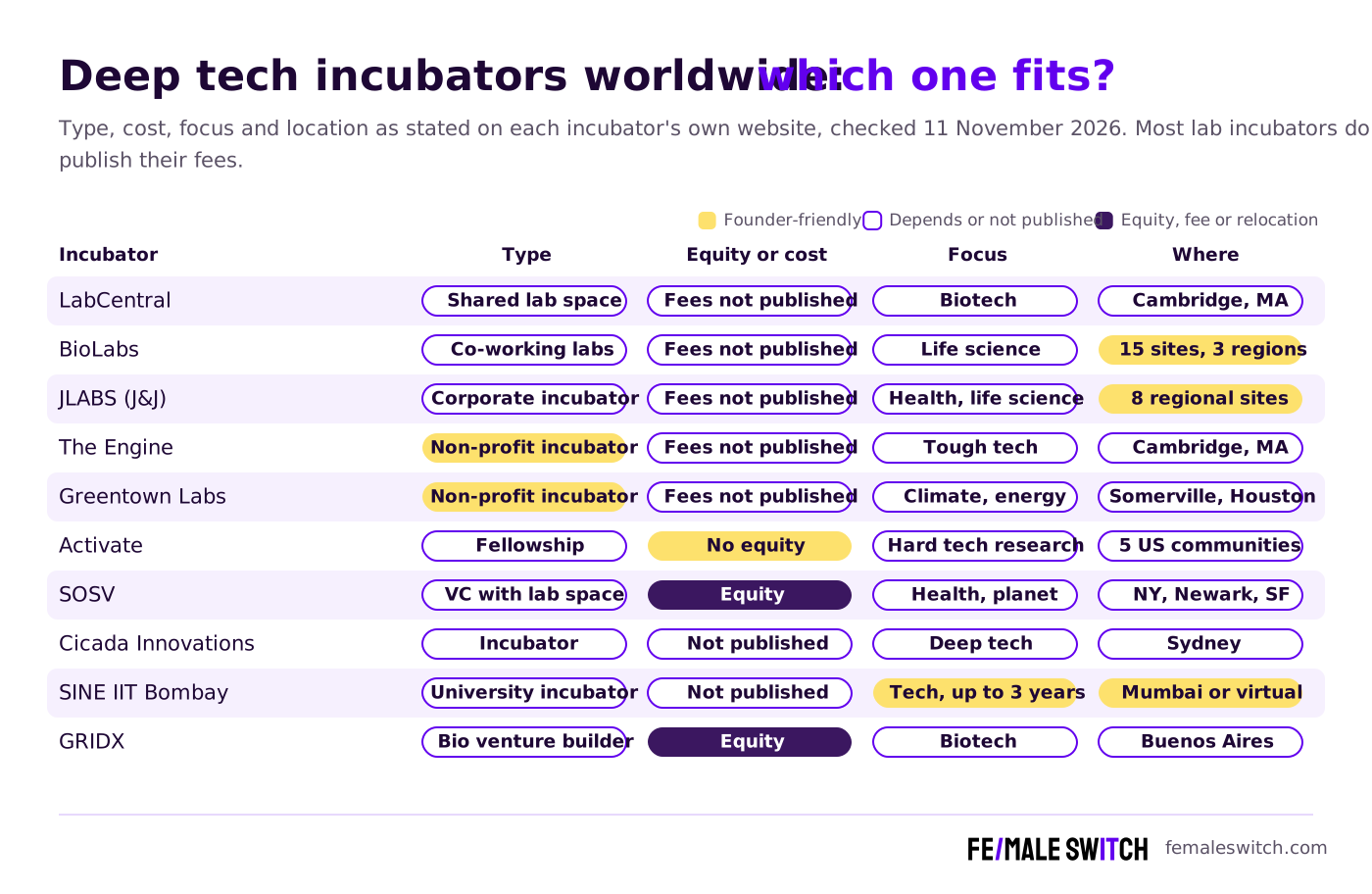
Deep Tech Incubators Compared
Source: each incubator's official website, checked 11 November 2026. Most lab incubators do not publish their residency or membership prices, so ask for current prices before you apply.
Lab-Space Incubators in North America
1. LabCentral (Cambridge, Massachusetts): shared biotech labs
LabCentral offers shared lab space for early-stage biotech and life science startups in Cambridge, Massachusetts, and its homepage gives a figure of 210,000 square feet of lab space. Its sites include the main LabCentral labs, LabCentral 238 for process development and scale-up, Bayer Co.Lab Cambridge, and two Harvard Life Labs for Harvard-affiliated ventures. Startups apply for residency; sponsors fund "Golden Tickets" that cover a residency, and it also runs an AI BioHub and The Loop, a soft-landing programme for biotech startups from abroad.
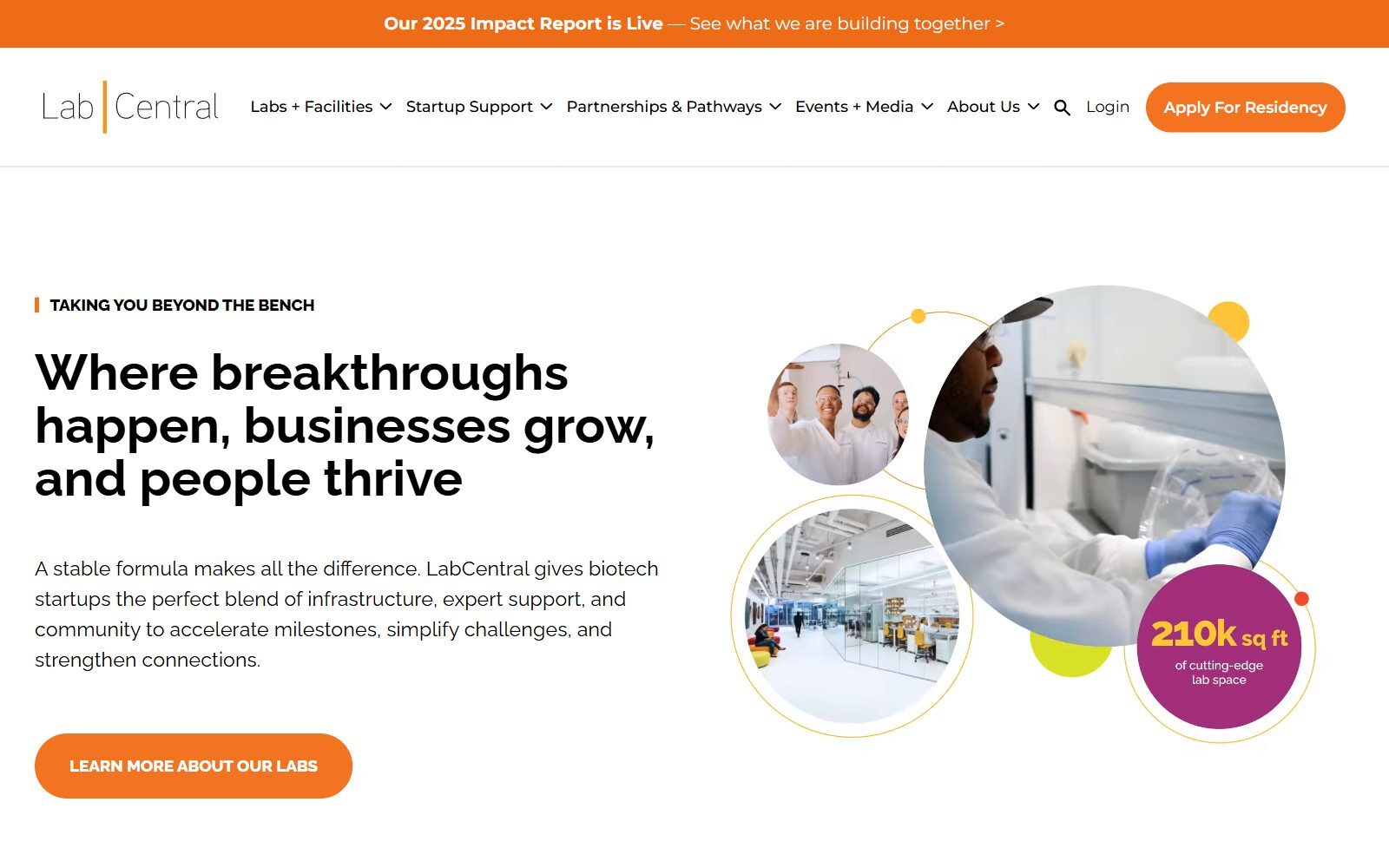
Best for: biotech teams that need a fully equipped wet lab in the Boston-Cambridge cluster without signing a long lease.
2. BioLabs (15 sites): co-working labs for life science
BioLabs runs co-working lab space for life science startups, with locations in Boston, Watertown, New York (NYU Langone), Princeton, Philadelphia, North Carolina, North Texas, San Diego, Los Angeles, Burlington (University of Vermont) and Toronto, plus Tokyo, Berlin, Heidelberg and the Wellcome Genome Campus near Cambridge, UK. Members get shared equipment such as PCR machines, plate readers, flow cytometry and sequencing, and BioLabs says it has supported more than 500 life science companies. Several sites are run with a university or research hospital, so check each site's own page for who it is for.
Best for: life science founders who want the same lab model in several cities, including Japan and Europe.
3. JLABS by Johnson & Johnson: a corporate incubator network
JLABS is Johnson & Johnson's global incubator network. It gives health and life science startups capital-efficient lab space, J&J experts, workshops and investor connections, either as a resident at a JLABS site or as a virtual member. Its sites cover EMEA, East North America, San Diego, San Francisco, Shanghai, Singapore, Korea and JLABS @ LabCentral in Cambridge. Its QuickFire Challenges award grant funding, residency and access to J&J experts to winners of specific healthcare challenges. JLABS does not publish its residency prices or terms online, so ask the site you apply to.
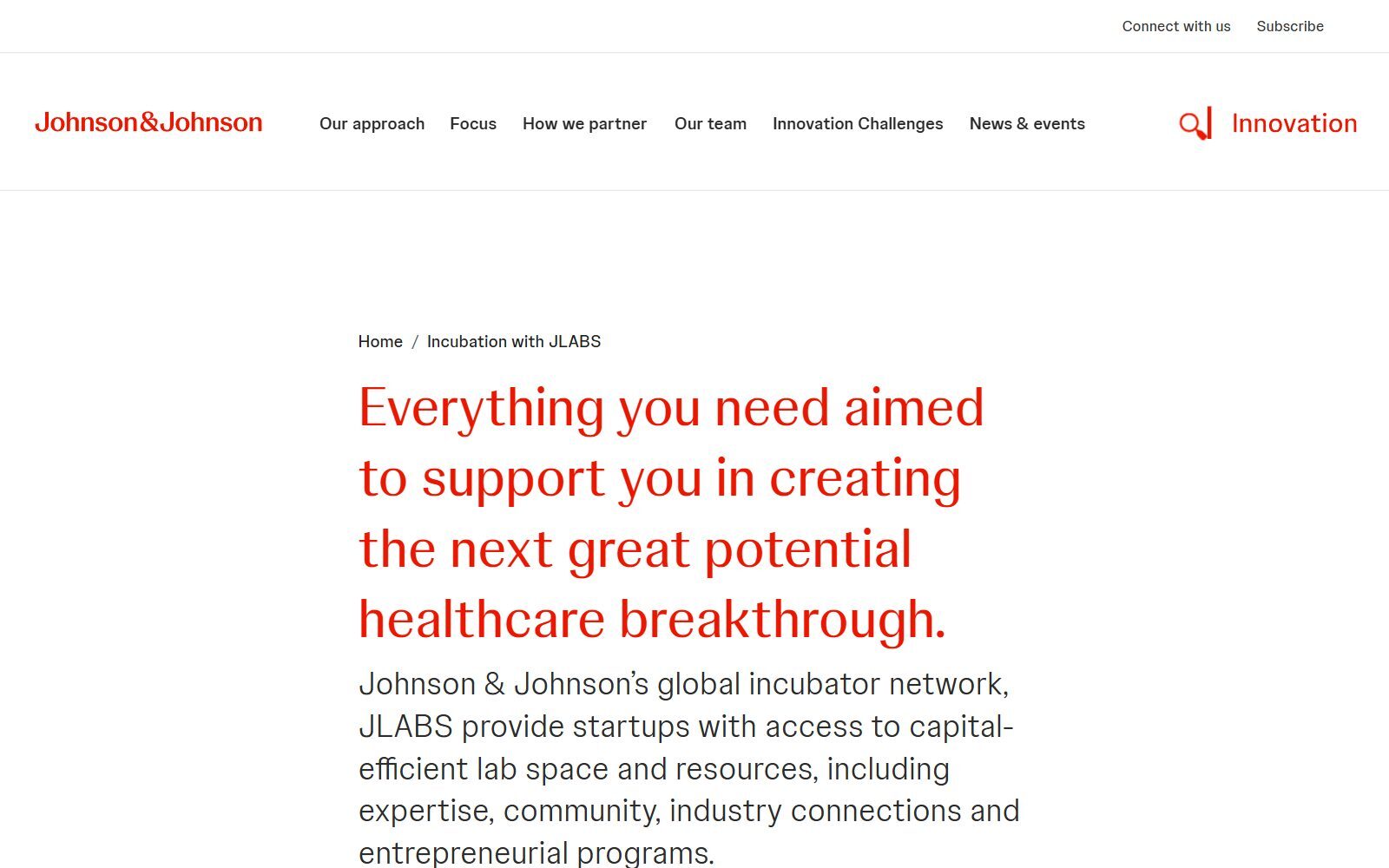
Best for: health and medtech founders who want a big pharma partner close by.
Boost Your SEO by listing your startup and get a FREE backlink.
Create a profile in the F/MS Startup Game, add the link to your website and submit.
👉 List your startup now!
4. The Engine (Cambridge, Massachusetts): the home for tough tech
The Engine is a non-profit incubator and accelerator for "tough tech": science and engineering companies in climate, biotech, space and other deep tech fields. Its residency at 750 Main Street in Cambridge offers more than 200,000 square feet of managed infrastructure, including over 60,000 square feet of BSL-2 wet labs, high-bay engineering space with prototyping shops, and offices, shared by more than 100 teams. It also runs Blueprint, a programme for researchers, which we cover in our accelerators guide.
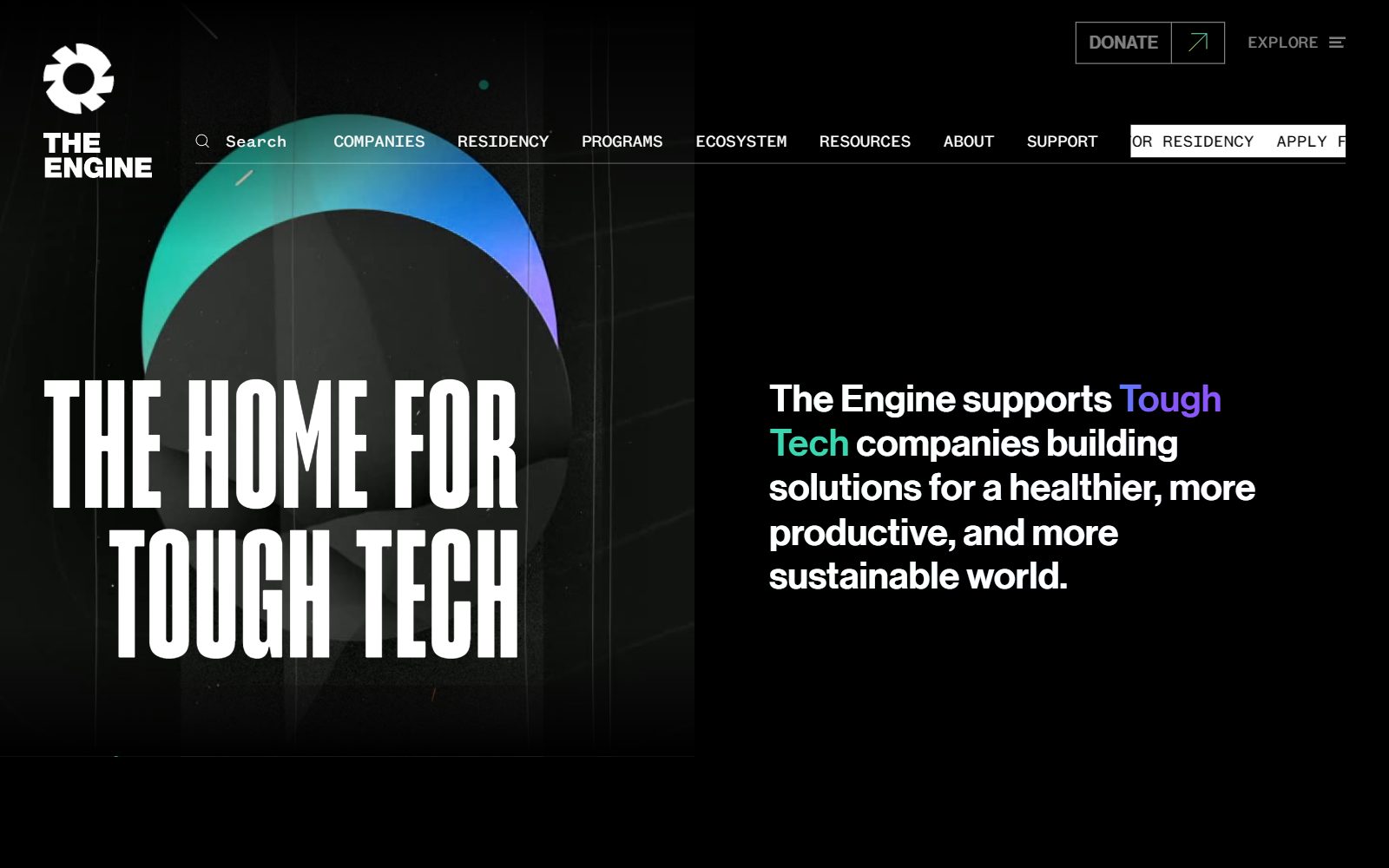
Best for: hardware, climate and biotech teams that need wet labs and engineering space in one building.
5. Greentown Labs (Somerville and Houston): the climate tech incubator
Greentown Labs is a non-profit incubator for climate and energy startups with two sites: Greentown Boston at 444 Somerville Avenue in Somerville, Massachusetts, and Greentown Houston at 4200 San Jacinto Street in Houston, Texas. Members get machine shops, prototyping labs and specialised equipment, help with customer discovery, pilots and field trials, investor introductions and grant support, and access to its corporate partners. Startups apply for membership.
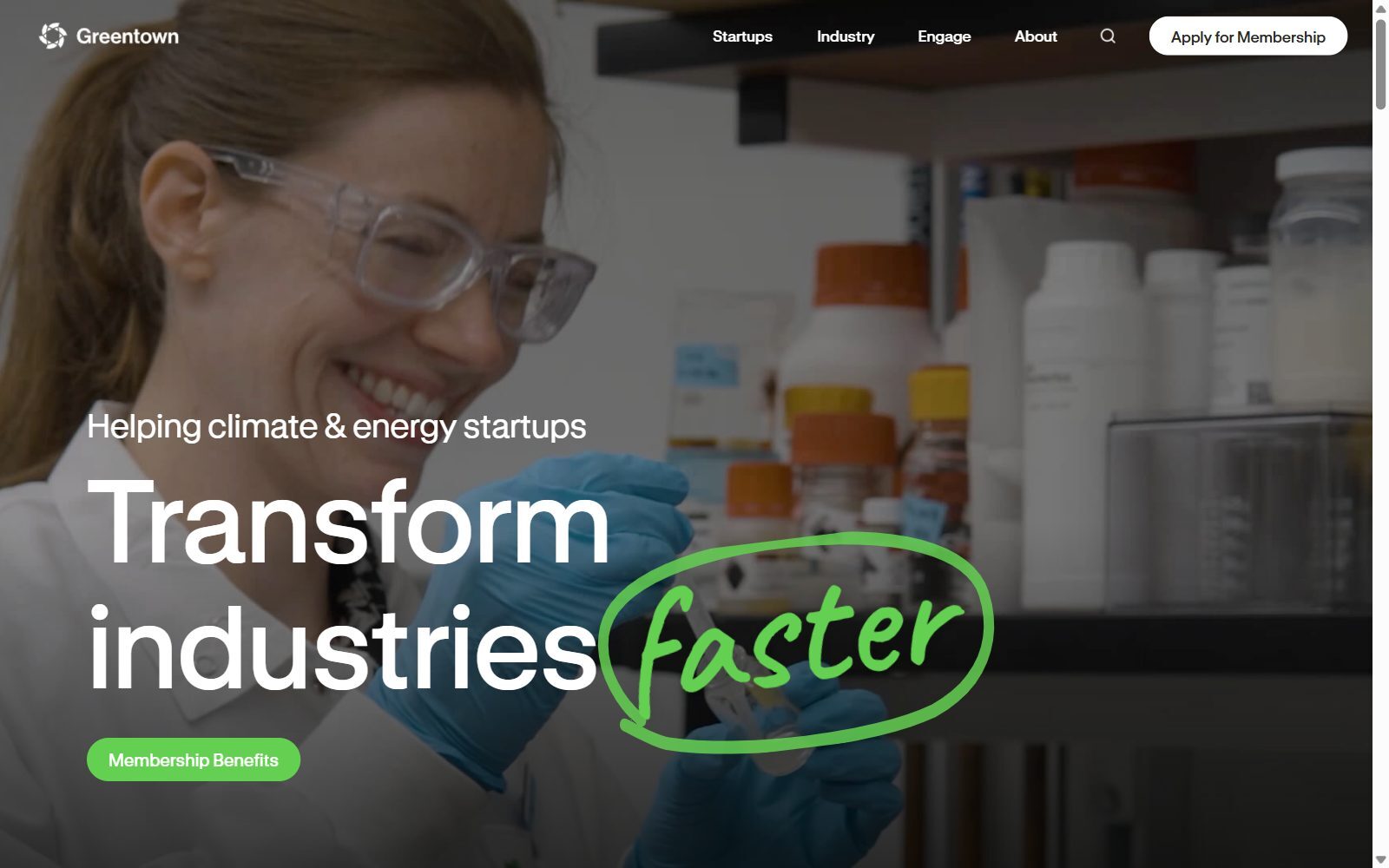
Best for: climate, energy and industrial tech founders who need workshop space and corporate pilots.
Boost Your SEO with 1,500+ Free Business Directories: increase your DA, get backlinks and traffic.
We've compiled an exclusive list of directories and websites where you can submit your business and start building high-quality backlinks to boost your website traffic and get your SEO snowball rolling.
👉 Submit your startup now!
Fellowships and Venture Programmes for Scientists
6. Activate (United States, with roots in Cyclotron Road): a fellowship with no equity
Activate runs a two-year fellowship in the United States that turns scientists and engineers into founders. It takes no equity and provides more than $300,000 over two years for a living stipend, R&D and other costs, plus mentoring and education. Fellows join one of five communities: Activate Anywhere (sponsored by the National Science Foundation), Activate Berkeley (with Cyclotron Road at Lawrence Berkeley National Laboratory), Boston, Houston and New York, and there is also Activate Global - Singapore. Activate began in 2015 alongside Cyclotron Road, a US Department of Energy lab-embedded entrepreneurship programme at Berkeley Lab, and says it has supported 353 scientists who started 281 companies.
Best for: researchers with a hardware or materials technology who need funded time to build a company.
7. Breakthrough Energy Fellows (global): funding to take climate tech from lab to market
Breakthrough Energy Fellows is part of Breakthrough Energy Discovery, the pre-venture arm of Breakthrough Energy. The programme gives climate technology innovators R&D funding, a curriculum, mentorship and access to a global network to take their ideas from the lab to the market. Its official page does not list the dates of the next call, so check it before you plan around a deadline.
Best for: climate tech founders at the research or prototype stage.
8. SOSV (New York, Newark, San Francisco): a VC firm with labs, not an incubator
SOSV is a venture capital firm that invests in deep tech for human and planetary health at pre-seed, with locations for founders in New York, Newark and San Francisco and, by its own count, 85,000 square feet of lab and office space. It invests in the companies it hosts, so it is not a neutral incubator: you give up equity. Its HAX location adds engineering, design and supply chain experts working with founders in equipped labs; we cover its programmes in our deep tech accelerators guide.
Best for: founders who want investment and lab space from the same partner.
Boost Your SEO by Getting Featured in Our Blogs and get a backlink.
We publish content about startups, education, tech, funding, etc. that ranks well not only in Google but also in Perplexity, ChatGPT, Grok and other AI tools.
👉 Get featured now!
9. Entrepreneurs First (London, Bangalore, San Francisco): a talent investor
Entrepreneurs First is not an incubator but a "talent investor": it recruits individuals before they have a team or an idea, matches co-founders in a 12-week FORM programme in its hubs in North America, Europe and Asia, and then runs a 12-week LAUNCH programme in San Francisco. Founders get an equity-free grant for living costs and up to $250,000 of equity investment if their team passes EF's investment committee.
Best for: technical people who want to start a company but have no co-founder yet.
Deep Tech Incubators in Asia-Pacific and Latin America
10. Cicada Innovations (Sydney, Australia)
Cicada Innovations calls itself Australia's leading deep tech incubator and has been developing ventures for more than 25 years. Its residents get custom labs and offices, specialist equipment and training at the National Innovation Centre in Eveleigh, Sydney. Its programmes Foundations, Elevate and Stride cover skills, scaling and traction; the NSW Defence and Aerospace Stride programme, supported by Investment NSW, had applications set to close on 22 November 2026. It also runs Cicada x Tech23, a yearly showcase of 23 deep tech startups.
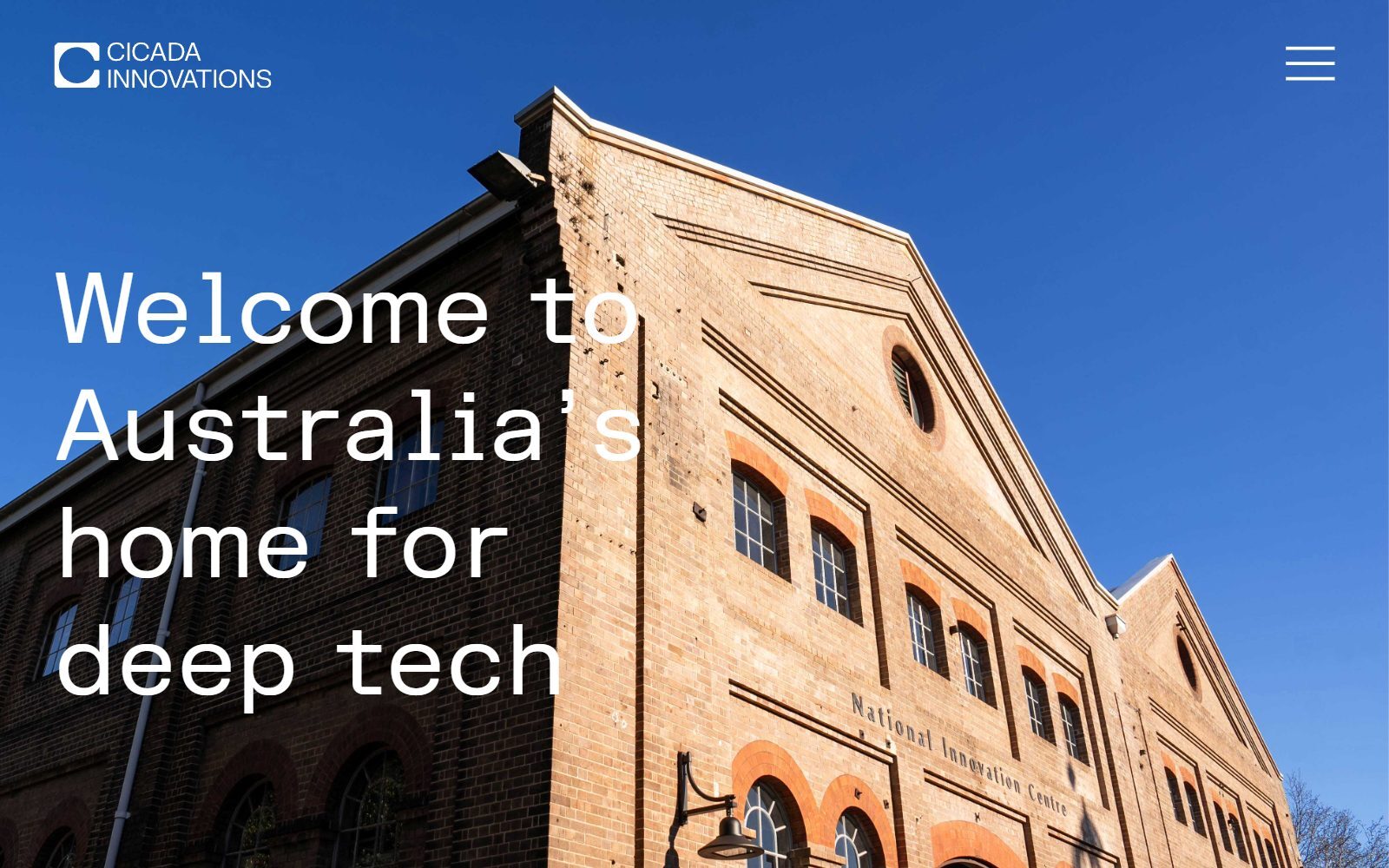
Best for: Australian deep tech founders who need lab space and a structured programme.
11. SINE at IIT Bombay (Mumbai, India)
SINE, the Society for Innovation and Entrepreneurship at IIT Bombay, has supported tech startups for more than two decades. It offers up to three years of incubation, physical or virtual, with offices, coworking, lab facilities and mentors, and it was taking applications for the EXIM Bank-SINE Seed Fund when we checked. For more programmes in the region, see our list of startup incubators in Asia.
Best for: Indian deep tech teams, especially those linked to IIT Bombay.
12. GRIDX (Buenos Aires, Argentina): a bio venture builder
GRIDX has built biotech companies in Latin America since 2015 from its base in Buenos Aires. Each year it screens more than 900 scientific projects and 300 business profiles and selects 24 scientific breakthroughs and 24 business co-founders, then helps them form a team, set the strategy and raise early money as an investor. Its open call, TRANSFORM 2027, takes applications from scientists and from entrepreneurs.
Best for: Latin American scientists in biotech, food, agriculture and bio-materials, and business founders who want to join one.
Deep Tech Incubators in Europe
Europe has its own strong set of deep tech incubators and venture builders, from Deep Science Ventures in the UK and HighTechXL in Eindhoven to the ESA Business Incubation Centres, and Station F in Paris, which calls itself the world's biggest startup campus and runs programmes in deep tech, AI and quantum. BioLabs (Berlin, Heidelberg, Cambridge UK) and JLABS (EMEA) also have European sites. We compare them all in our guide to deep tech incubators in Europe.
Networks and Platforms That Are Not Incubators
- Hello Tomorrow: a deep tech network founded in 2011 that runs events, a challenge, consulting and a VC fund. Its next summit is set for 2 to 3 June 2027 in Amsterdam. Use it to meet corporates and investors, not for lab space.
- Plug and Play: a corporate innovation platform that connects startups with corporations, governments and investors across more than 25 industries, including deep tech, with offices in Silicon Valley, Tokyo, New York, Stuttgart, Riyadh and more. It is a route to corporate pilots rather than a lab incubator.
- NVIDIA Inception: a free programme for AI startups with training, preferred pricing on NVIDIA hardware and software and exposure to investors. Useful for AI-heavy deep tech, but it is not an incubator.
- DMZ: a general tech incubator at Toronto Metropolitan University with an 18-month Incubator programme (next cohort spring 2027, applications ongoing). It takes deep tech startups but is not specialised in them.
Programmes From the Old List That Changed or Are Not Incubators
The 2025 version of this article listed 20 names, most of them accelerators or investors. Here is what we found when we checked them in November 2026:
- Accelerators, not incubators: Techstars, MassChallenge, Entrepreneurs Roundtable Accelerator, Startupbootcamp and StartupYard run accelerator programmes. AngelPad's application page now returns an error. See our deep tech accelerators guide and the deep tech accelerators in Europe list for those that run deep tech programmes.
- Investors, not incubators: Mucker Lab is now Mucker Capital, Alchemist now calls itself a venture firm for deeply technical founders, Hardware Club is now HCVC, and The VR Fund, Revolution and The Yield Lab are investment firms. See our lists of deep tech VCs for investors.
- HighTechXL: a deep tech venture builder in Eindhoven, covered in our Europe guide.
- TheBlueprint, CIV (The Creative Innovation Center) and Digital Factory: we found no official programme matching the old descriptions. Lighthouse Labs' website did not load.
We also removed the old article's unsourced figures (fund sizes, deal terms, exit counts and location counts) and its links to an AI search tool's redirect pages.
Which Deep Tech Incubator Should You Choose?
- You need a wet lab for biotech: LabCentral or BioLabs in the US, JLABS if a pharma partner matters, BioLabs Tokyo in Japan.
- You build hardware, energy or materials: The Engine for wet labs plus engineering space, Greentown Labs for climate and energy pilots.
- You are still a researcher: Activate or Breakthrough Energy Fellows for funded time, Entrepreneurs First if you have no co-founder.
- You want investment with the space: SOSV, or GRIDX in Latin America. Expect to give up equity.
- You are outside the US: Cicada Innovations in Australia, SINE in India, GRIDX in Argentina, and our Europe guide for European options.
Join F/MS: Startup Facilitator & Incubator and unlock your startup dreams today! Get your first customers, register you company in the Netherlands and get startup visas for the team.
How Deep Tech Founders Use Incubators
Most deep tech founders stack several kinds of support: a grant or fellowship to prove the science, a lab incubator to build the prototype, then an accelerator or investor to raise the first round. For money, see our guides to grants for deep tech startups, deep tech grants in North America, deep tech grants in Asia and deep tech grants in South America, and to investors in deep tech VCs in North America, deep tech VCs in Europe and deep tech angel investors in Europe. To test your pitch and win prizes, see deep tech startup competitions and deep tech competitions in North America. If you are choosing where to build, compare the best deep tech cities, deep tech cities in Asia, deep tech cities in Europe and the best countries for deep tech startups. Women founders can also look at incubators for female entrepreneurs in North America and AI incubators in North America.
FAQ About Deep Tech Incubators
What is a deep tech incubator?
An incubator that gives science and engineering startups the physical space, labs and equipment they need to prove out their technology, plus a community and expert support. Some also invest or help form the company.
What is the difference between a deep tech incubator and an accelerator?
Incubators mainly provide space, equipment and longer support, while accelerators run short cohort programmes with mentoring and often an investment. See our deep tech accelerators guide for the second kind.
Do deep tech incubators take equity?
Lab incubators such as LabCentral, BioLabs, The Engine and Greentown Labs work through residency or membership, while investors with labs such as SOSV and venture builders such as GRIDX take equity. Activate's fellowship takes no equity.
How much does lab space in an incubator cost?
Most lab incubators do not publish their prices online. Ask each one for current residency or membership fees, and look for sponsor-funded places such as LabCentral's and BioLabs' Golden Tickets or JLABS QuickFire Challenges.
Which incubator is best for biotech startups?
In the US, LabCentral, BioLabs and JLABS are built around shared wet labs. BioLabs and JLABS also have sites in Asia and Europe.
Which incubator is best for climate tech?
Greentown Labs in Somerville and Houston and The Engine in Cambridge, Massachusetts. Breakthrough Energy Fellows funds climate innovators at the research stage.
Are there deep tech incubators outside the US and Europe?
Yes. Cicada Innovations in Sydney, SINE at IIT Bombay in India and GRIDX in Buenos Aires are three examples; JLABS and BioLabs also have sites in Asia.
Is Station F a deep tech incubator?
Station F is a large startup campus in Paris that hosts more than 30 programmes, including deep tech, AI and quantum programmes. We cover it with other European options in our Europe guide.
Where can I get a backlink by writing about my startup?
You can publish a guest post in one of the Fe/male Switch startup blogs, which rank in Google and in AI tools. Get a quality backlink.
About the Author
Violetta Bonenkamp, also known as MeanCEO, is an experienced startup founder with an impressive educational background including an MBA and four other higher education degrees. She has over 20 years of work experience across multiple countries, including 5 years as a solopreneur and serial entrepreneur. Throughout her startup experience she has applied for multiple startup grants at the EU level, in the Netherlands and Malta, and her startups received quite a few of those. She’s been living, studying and working in many countries around the globe and her extensive multicultural experience has influenced her immensely.
