

EdTech Accelerators in North America: 12 US and Canadian Accelerators, Fellowships and Prizes for Education Startups
EdTech founders in the United States and Canada sell to some of the slowest buyers there are: school districts, universities and training departments. The programmes that help most are the ones that bring you pilots in real classrooms, learning-science feedback and investors who understand long sales cycles, and in North America many of them are fellowships, philanthropic funds and prizes rather than classic accelerators. We checked every North American programme from the old Top 10, 15, 20 and 25 lists, plus newer ones, on their own websites on 14 November 2026. Twelve still run with an education focus; the rest closed, changed or were never EdTech programmes, and you will find them in a short note near the end.
Quick answer: the classic EdTech accelerators in North America are LearnLaunch in Boston (for companies with at least $200K in annual recurring revenue; 2027 applications not open yet) and the USC EdTech Accelerator (virtual, no equity, no fees; its 2026-2027 cohort closed in September). Early-stage founders should watch the Camelback Fellowship ($40,000 per venture), 4.0 and Toronto's Siakam EdTech Engine. Open right now: nominations for the GSV Cup 50 at the ASU+GSV Summit (San Diego, April 4 to 7, 2027) and registration for XPRIZE Accelerate Learning ($6 million). Y Combinator, which absorbed Imagine K12 in 2016, is still the biggest general accelerator that backs EdTech.
Write FREE SEO-optimized Blog Articles! Our Article Writer ensures your blog is loved by both Google and your readers, turning those clicks into customers.
👉 Write your article here
EdTech Accelerators in the US and Canada Compared
Sources: each programme's official website, checked 14 November 2026. "Not stated" or "not published" means the programme's own site does not say it. Terms change between cohorts, so read the official page before you apply.
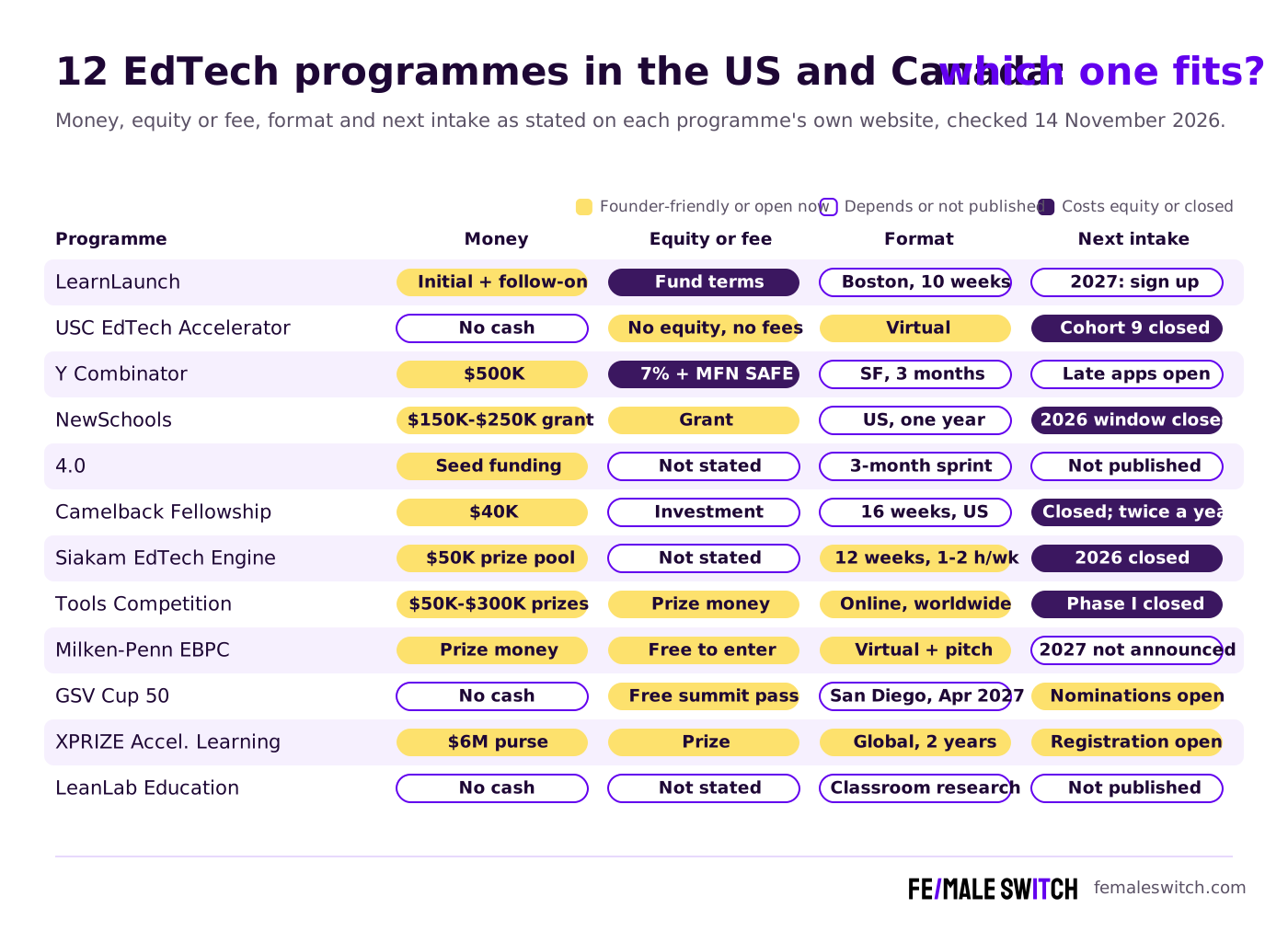
EdTech Accelerators
1. LearnLaunch Fund + Accelerator (Boston)
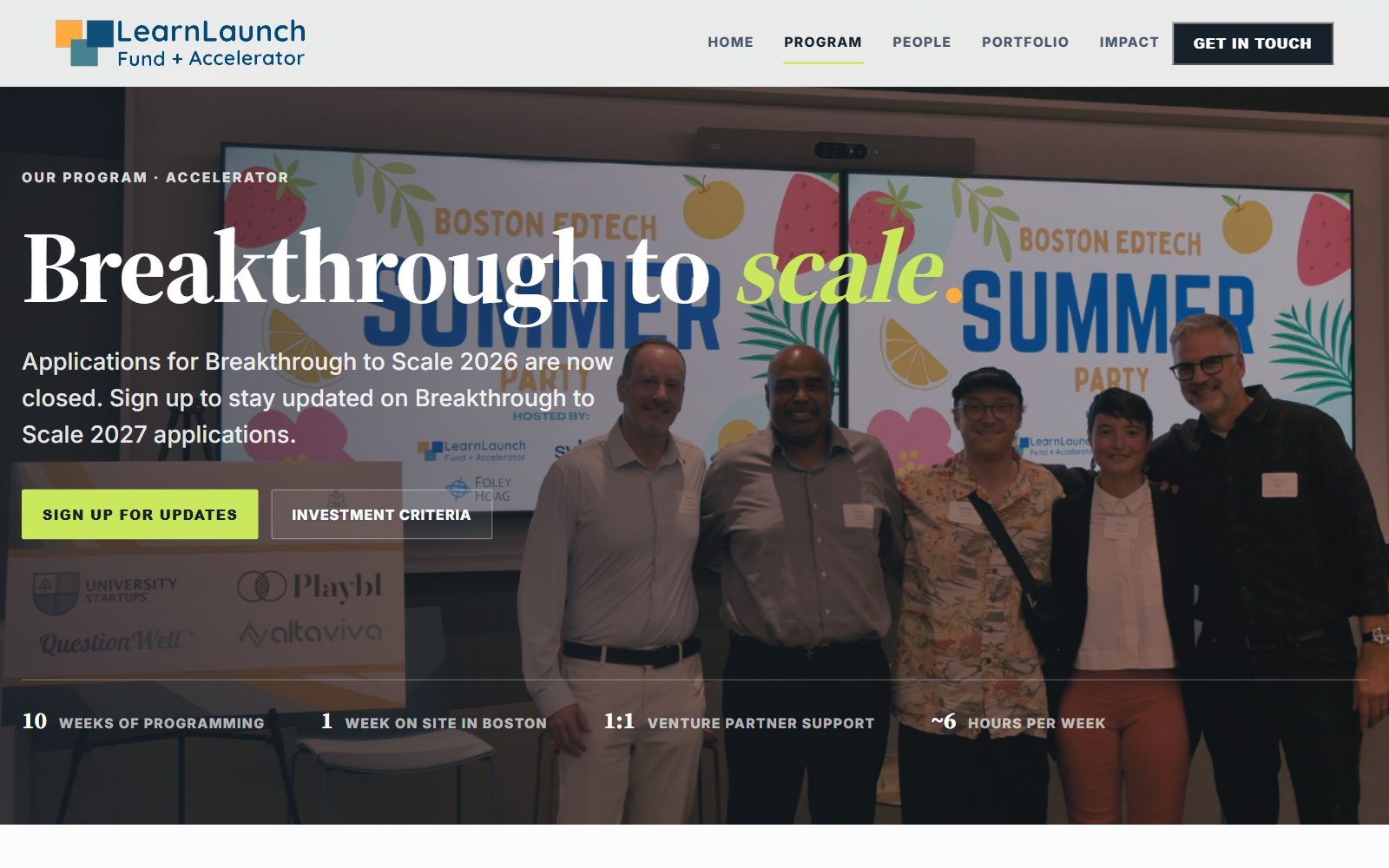
LearnLaunch is a Boston fund and accelerator that has backed more than 95 companies across three funds, with more than 220 mentors. Its accelerator, Breakthrough to Scale, is ten weeks of masterclasses with one week on site in Boston, a dedicated venture partner and about six hours a week of founder time. It invests on acceptance and adds milestone-based follow-on funding, evaluated six months after the programme. It is not for idea-stage teams: you need a product, revenue and market entry, with at least $200K in annual recurring revenue, in K-12, higher education, workforce or lifelong learning, and you cannot attend another accelerator at the same time. Next intake: 2026 applications are closed; you can sign up for news of the 2027 call. Best for: EdTech companies with revenue that want to scale.
2. USC EdTech Accelerator (Los Angeles, online)
The USC Education Technology Accelerator at the USC Rossier School of Education has always been virtual and does not ask startups to move. It takes no equity and charges no application fees, admission fees or tuition, and it adapts its curriculum to each cohort while covering product efficacy, product-market fit, go-to-market, sales, operations and financing. USC Rossier says TIME named it one of America's Best Incubators and Accelerators for 2026. Next intake: applications for its 9th cohort (2026-2027) ran from September 1 to 30, so watch its page for the next call. Best for: EdTech founders anywhere who want university expertise without giving up equity.
3. Y Combinator (San Francisco), home of Imagine K12
Imagine K12, launched in 2011 as the first EdTech accelerator, merged into Y Combinator in 2016 to form its education vertical, and its site now sends founders to YC. Y Combinator invests $500,000 in every company: $125,000 for a fixed 7% plus $375,000 on an uncapped SAFE with a most favoured nation clause. Next intake: the Winter 2027 batch runs from January to March in San Francisco; the on-time deadline was November 2, 2026, and YC still considers late applications and early applications for later batches. Best for: fast-growing EdTech software teams that want the biggest network.
Boost Your SEO by listing your startup and get a FREE backlink.
Create a profile in the F/MS Startup Game, add the link to your website and submit.
👉 List your startup now!
Fellowships and Seed Funds for Education Founders
4. NewSchools Venture Fund (US)
NewSchools Venture Fund is a nonprofit venture philanthropy based in Oakland; its homepage cites $500 million and more than 1,000 innovators since its founding. It gives one-year, unrestricted grants of $150,000 to $250,000, plus coaching and a peer community, to early-stage organisations and new initiatives in innovative public schools, K-8 reading and maths, teaching (including AI tools) and learning differences. Next intake: the 2026 funding window is closed, with final decisions by June; subscribe to its newsletter for the next call. Best for: founders building for US public schools.
5. 4.0 (US)
4.0 backs education ideas at day zero, from micro-schools to learning tools and alternative credentials, and says it has supported more than 2,000 people. Its main programme is a three-month sprint in which fellows refine their idea, write a pilot plan and launch, with coaching, seed funding and a small founder community; a two-day programme helps you test an idea first. Next intake: its page lists no dates. Best for: educators and first-time founders before they have a product.
6. Camelback Fellowship (US)
The Camelback Fellowship is a 16-week accelerator from Camelback Ventures for early-stage ventures in Education and Conscious Technology that address systemic inequities. Each fellow gets a 1:1 coach, a curriculum on strategy, pitching and hiring, and a $40,000 investment in the venture; Camelback has supported more than 220 entrepreneurs since 2015. Next intake: the application is closed; it opens twice a year, usually in mid-winter and late summer. Best for: underrepresented founders building education ventures.
7. Siakam EdTech Engine (DMZ, Toronto)
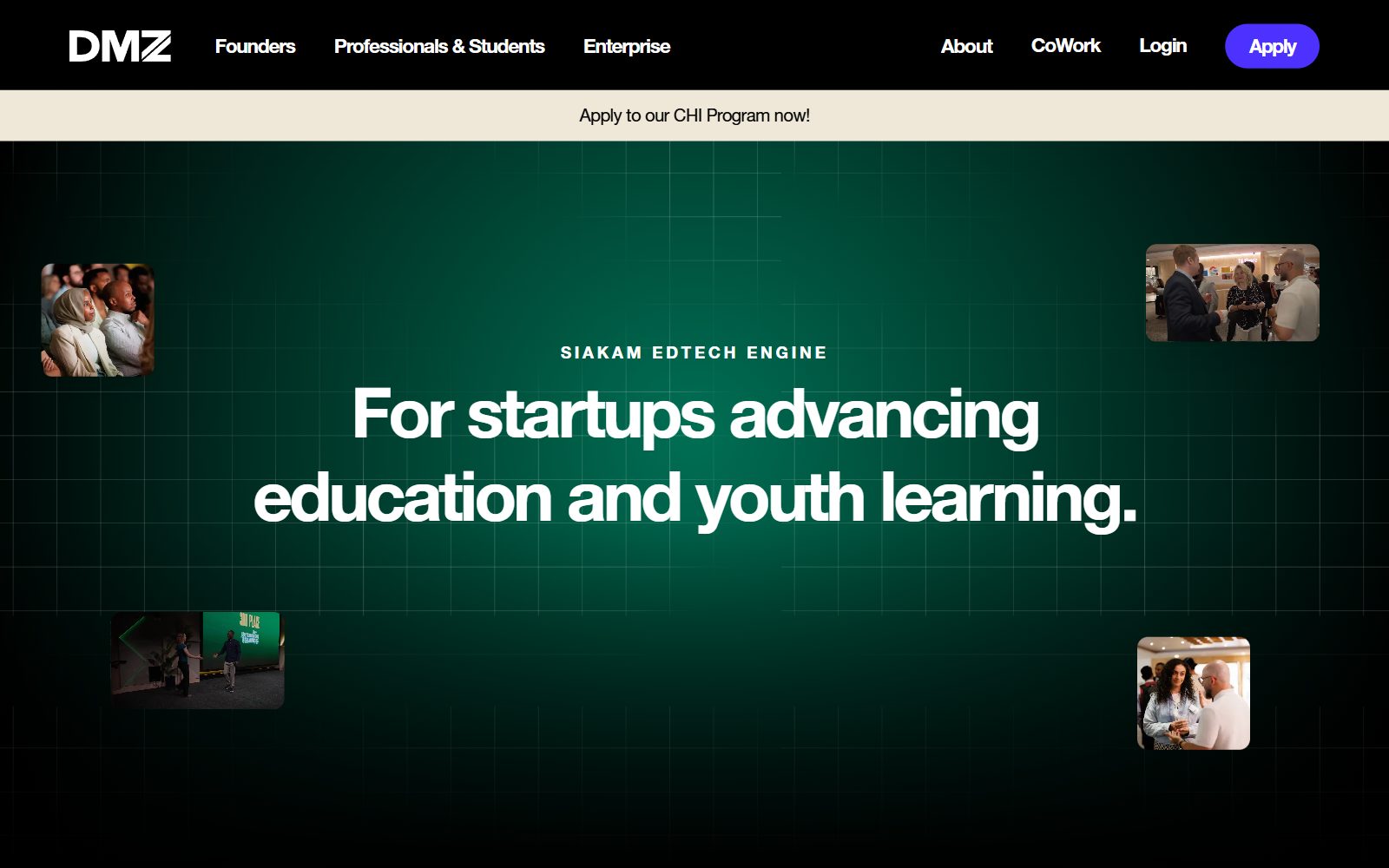
The Siakam EdTech Engine, co-founded by NBA champion Pascal Siakam with his PS43 foundation and DMZ at Toronto Metropolitan University, supports North American startups working on K-12 education and youth AI skills. It is 12 weeks with one to two hours a week, pilots with school boards and educators, and an in-person demo day with a $50,000 pool of grant prizes. You need a validated MVP with early traction, operational readiness in North America, a full-time founder and an in-house technical lead. Next intake: the 2026 cohort ran from April to July and applications are closed; no 2027 dates yet. Best for: Canadian and US K-12 startups that need school pilots.
Boost Your SEO with 1,500+ Free Business Directories: increase your DA, get backlinks and traffic.
We've compiled an exclusive list of directories and websites where you can submit your business and start building high-quality backlinks to boost your website traffic and get your SEO snowball rolling.
👉 Submit your startup now!
EdTech Competitions and Prizes
8. Tools Competition
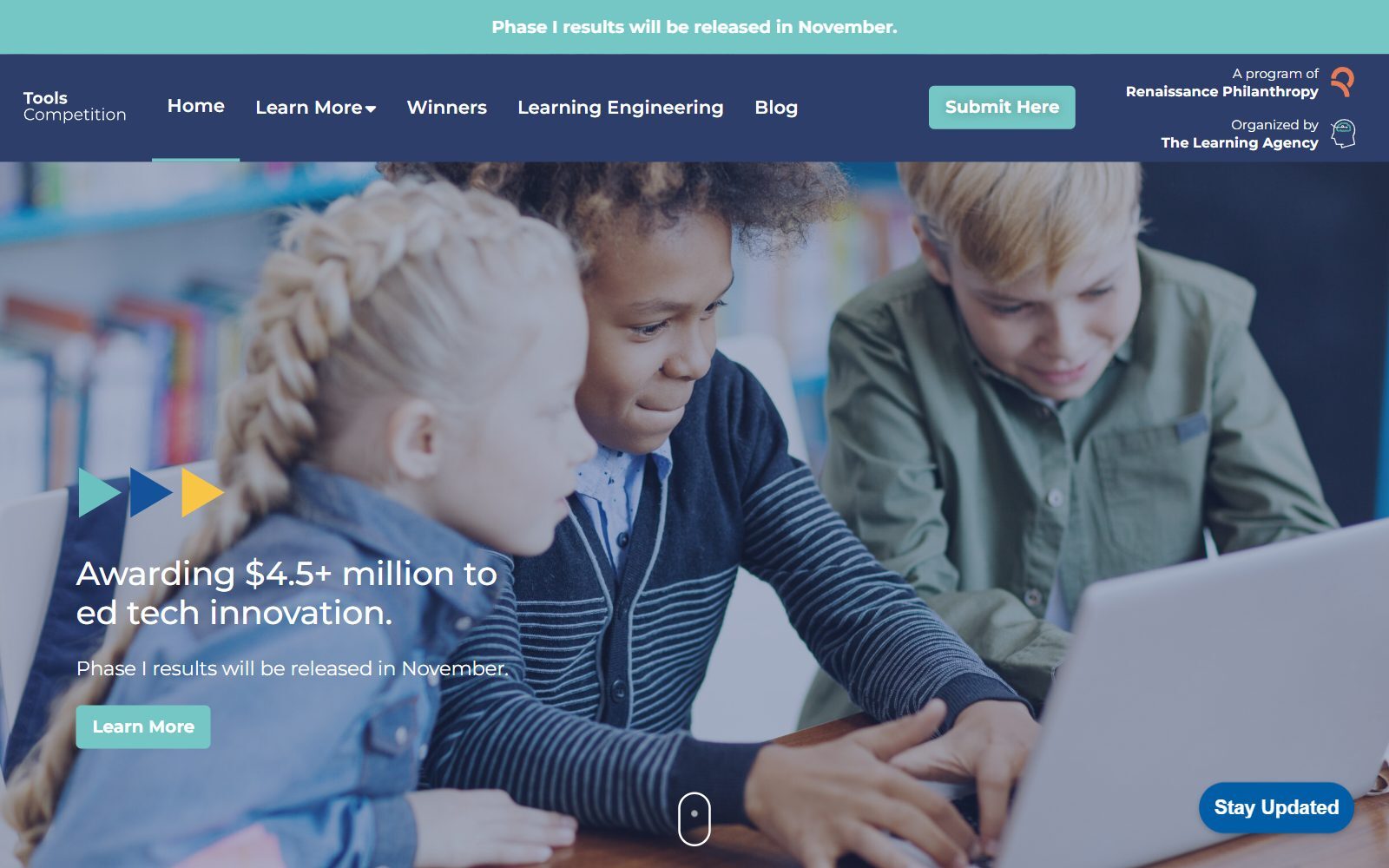
The Tools Competition, a programme of Renaissance Philanthropy organised by The Learning Agency, is awarding more than $4.5 million in its 2027 round to EdTech tools that use digital technology, data and learning science. It offers Catalyst prizes of $50,000, Growth prizes of $150,000 and Transform prizes of $300,000, across tracks for K-12 teaching, K-12 assessment, postsecondary learning and work, and datasets. Timeline: Phase I abstracts were due on October 13, 2026; invitations to Phase II were scheduled for November 24, 2026; Phase II proposals are due on January 21, 2027, pitches follow in April and winners are announced in June 2027. Best for: data-driven learning tools at any stage.
9. Milken-Penn GSE Education Business Plan Competition and Catapult
The Milken-Penn GSE Education Business Plan Competition (EBPC) at the University of Pennsylvania has awarded more than $2 million since 2010 and is open to education entrepreneurs worldwide. You apply through Catapult, the free virtual accelerator of Catalyst @ Penn GSE, and semifinalists get mentoring there before a live pitch event. Next intake: the 2026 round closed on February 11, 2026, with the final pitch event in fall 2026; 2027 dates are not announced yet. Best for: early ventures that want feedback and prize money without giving up equity.
10. GSV Cup 50 at the ASU+GSV Summit
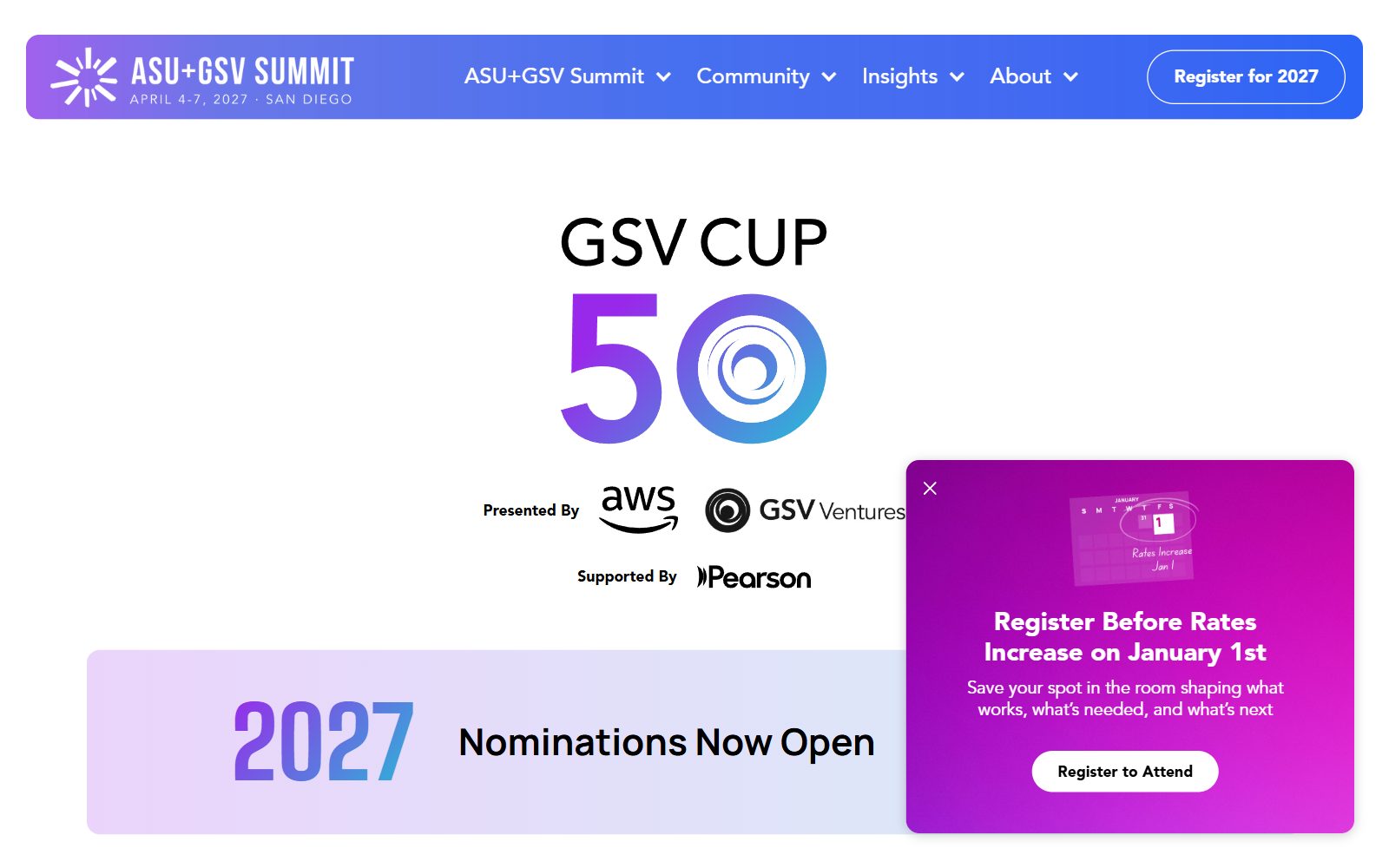
The GSV Cup 50 picks 50 early-stage EdTech startups from around the world each year and gives them free access to the ASU+GSV Summit, demo slots and visibility with investors, buyers and education leaders; GSV says the 2026 cohort was chosen from more than 3,000 nominations. The 2027 summit takes place in San Diego from April 4 to 7, 2027. Next intake: nominations for the 2027 GSV Cup 50 are open, and you can nominate your own company. Best for: EdTech startups ready to meet US buyers and investors.
11. XPRIZE Accelerate Learning
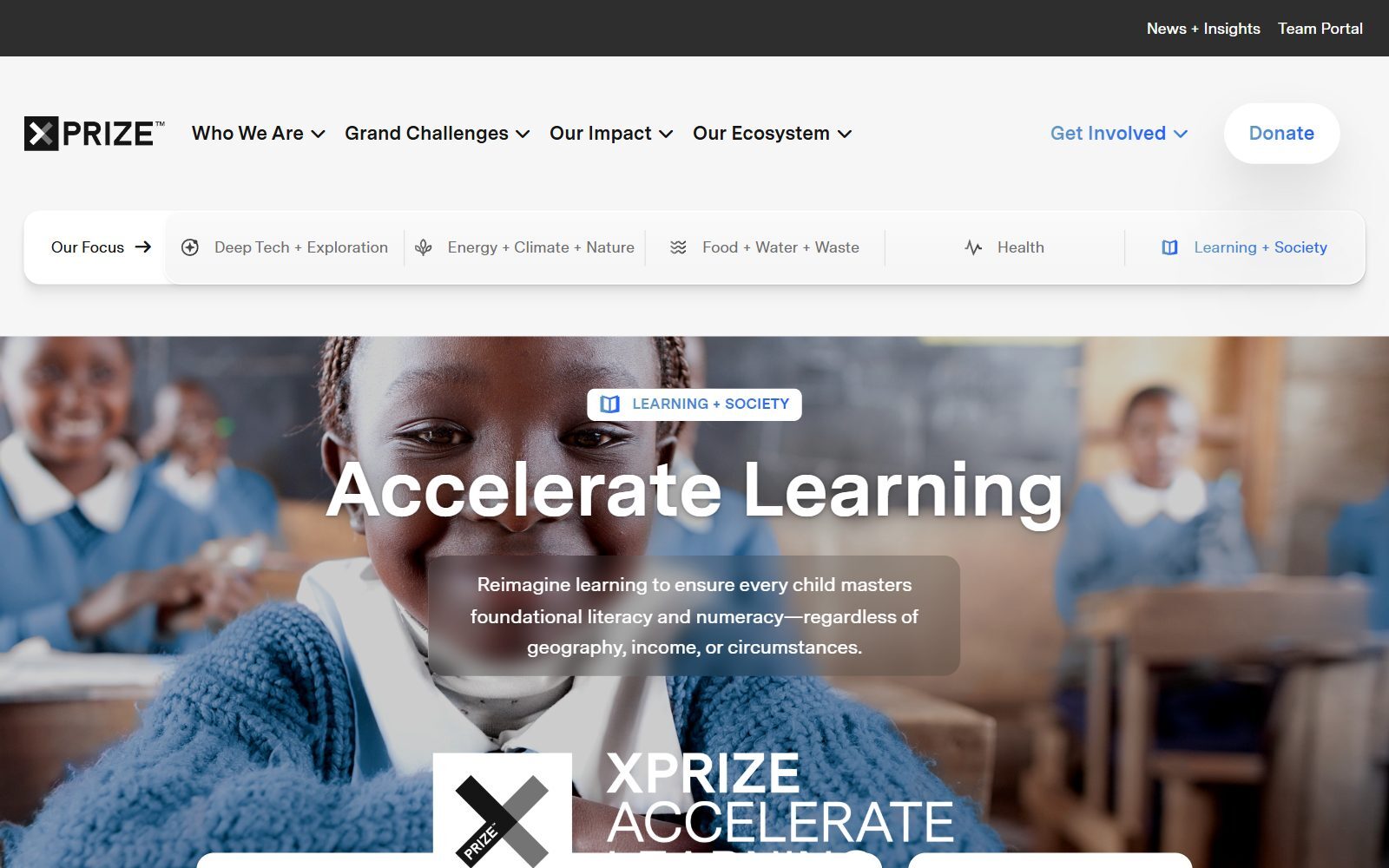
XPRIZE Accelerate Learning is a new $6 million, two-year competition, launched on November 10, 2026 and sponsored by the Gates Foundation, for solutions that help first-graders master literacy and numeracy at scale. Its Core Track asks for a gain of at least 25 percentage points for under $10 per child per year, and its Last Mile Moonshot Track a gain of at least 50 points for under $40 per child. Next intake: registration is open. Best for: foundational learning teams with evidence of impact.
Boost Your SEO by Getting Featured in Our Blogs and get a backlink.
We publish content about startups, education, tech, funding, etc. that ranks well not only in Google but also in Perplexity, ChatGPT, Grok and other AI tools.
👉 Get featured now!
Classroom Pilots and Research
12. LeanLab Education (Kansas City)
LeanLab Education is a nonprofit research organisation, not an accelerator. Through its Codesign Product Research it helps EdTech companies improve their products with direct feedback and research inside real classrooms, working with educators and partner districts and charter schools. Best for: EdTech companies that need evidence for district buyers. For non-dilutive research money such as federal SBIR awards for education, see our guide to EdTech grants in North America.
North American EdTech Accelerators That Closed or Changed
The 2025 versions of this article (Top 10, 15, 20 and 25) listed more than 50 names between them, many with terms copied from third-party blogs. Here is what happened to them:
- Imagine K12: merged into Y Combinator in 2016 (see above).
- BoomStartup: its old domain now redirects to an unrelated podcast site, so its old "up to $100,000" EdTech track is gone from this list.
- StartEd and AWS EdStart (AWS Education Accelerator): StartEd's site is a parked page, and the old AWS EdStart address redirects to the general AWS startups page.
- GSVlabs: became OneValley, which now describes itself as a platform for AI startups, not an EdTech programme.
- Techstars: no EdTech programme in its current accelerator list; the old "$120,000 for 6%" deal is now $220,000 for 5% plus an uncapped MFN SAFE. USC-affiliated founders in any industry can look at the USC and Techstars Accelerator, whose final deadline was set for November 18, 2026, with the programme starting on March 8, 2027.
- General accelerators, no EdTech track: 500 Global, Plug and Play (no education vertical in its industry list), MassChallenge, Google for Startups, Blue Startups, Brinc and Village Capital (current themes: climate, economic mobility and essential services). AngelPad's application page no longer exists and Alchemist no longer calls itself an accelerator.
- Investors, not accelerators: Learn Capital, Owl Ventures, Reach Capital, Indie.vc and The Venture Reality Fund; see our list of EdTech VC firms.
- Could not verify: AT&T Aspire Accelerator and Harvard Innovation Labs (their pages blocked our check), Real Industry (page not found), Iowa Startup Accelerator and Le Camp (sites did not answer). VentureWell still gives student E-Team grants of up to $25,000, but not for EdTech specifically.
- Outside North America: Go-Together, EduGrowth (Australia), xEdu (Finland), MindCET (Israel), UCL EdTech Labs and Startupbootcamp; see our guides to EdTech accelerators in Europe and EdTech accelerators in Asia.
- Left out: Imagine Worldwide (a nonprofit), Digital Media Accelerator, Cohort EdTech Accelerator, EdTech Impact Accelerator, Future of Learning Accelerator, Flathead Valley EdTech Accelerator, SVC2.0, EdTech Innovation Hub, Cohere Accelerator and "EdTech Accelerator Program" (no current official programme page found).
Which EdTech Accelerator in North America Should You Choose?
- You have revenue and want to scale: LearnLaunch (at least $200K in annual recurring revenue) or Y Combinator.
- You want support without giving up equity: the USC EdTech Accelerator, the Milken-Penn GSE competition and its Catapult accelerator, NewSchools grants, the Tools Competition and XPRIZE.
- You are an educator with an idea: 4.0's three-month sprint, then the Camelback Fellowship.
- You build for K-12 in Canada: the Siakam EdTech Engine in Toronto; for research funding, see our EdTech grants in North America.
- You need buyers and investors in one room: nominate yourself for the GSV Cup 50 and go to the ASU+GSV Summit in April 2027.
- You need evidence for districts: LeanLab Education's classroom research.
- You are a woman founder: compare these with our guides to accelerators for female entrepreneurs and incubators for female entrepreneurs in North America.
- You are outside North America: see our worldwide guide to EdTech accelerators.
Join F/MS: Startup Facilitator & Incubator and unlock your startup dreams today! Get your first customers, register you company in the Netherlands and get startup visas for the team.
How EdTech Founders in the US and Canada Use Accelerators
Treat an EdTech accelerator as a way to reach schools and evidence, not only money. Line up a pilot partner before you apply, and prove demand with our 30-day validation sprint. Stack non-dilutive money with it: our guides to EdTech grants in North America and EdTech startup grants cover federal, state and foundation programmes. When investors make offers, read our guide to term sheet negotiation and our lists of EdTech VC firms, early-stage VCs in North America and angel investors in North America. Pitch competitions and conferences are where many EdTech programmes recruit: see the startup competitions in North America and the EdTech startup events. If you plan to expand, compare the best countries for EdTech startups, the EdTech countries in Europe, the EdTech incubators in Europe and the EdTech trends in South America. If your product is AI-first or hardware, our sibling guides to AI accelerators in North America and deep tech accelerators in North America list programmes that are not EdTech-only, and our list of accelerators for early-stage startups covers general ones.
FAQ About EdTech Accelerators in North America
What is the best EdTech accelerator in North America in 2027?
For companies with revenue, LearnLaunch in Boston; for equity-free support from a school of education, the USC EdTech Accelerator. Early-stage founders should look at the Camelback Fellowship, 4.0 and, in Canada, the Siakam EdTech Engine. Y Combinator is the largest general accelerator that backs EdTech.
Is Imagine K12 still running?
Not on its own. Imagine K12, launched in 2011 as the first EdTech accelerator, merged into Y Combinator in 2016 to form YC's education vertical, and its website now sends founders to YC.
Which EdTech accelerators take no equity?
The USC EdTech Accelerator takes no equity and charges no fees. NewSchools gives grants, and the Tools Competition, XPRIZE Accelerate Learning, the Milken-Penn GSE competition and the Siakam EdTech Engine give prize money.
How much does LearnLaunch invest, and who can apply?
LearnLaunch makes an initial investment on acceptance and milestone-based follow-on investments six months after the programme; its site does not publish the amounts. You need a product, revenue and market entry with at least $200K in annual recurring revenue. 2026 applications are closed.
When does the USC EdTech Accelerator take applications?
Applications for its 9th cohort (2026-2027) ran from September 1 to 30 and have closed; watch its page for the next call. It is virtual, takes no equity and charges no fees.
Does Techstars have an EdTech accelerator?
Not now. Its current list of accelerators has no education programme. USC-affiliated founders in any industry can apply to the USC and Techstars Accelerator in Los Angeles.
What is the Tools Competition?
A competition run by The Learning Agency for Renaissance Philanthropy that is awarding more than $4.5 million to EdTech tools in its 2027 round, with prizes of $50,000, $150,000 or $300,000. Phase I closed on October 13, 2026, and winners are announced in June 2027.
Are there EdTech accelerators in Canada?
The Siakam EdTech Engine at DMZ in Toronto is the main EdTech-specific one, for K-12 and youth AI skills; its 2026 cohort is closed. Canadian founders can also apply to the virtual USC EdTech Accelerator, the Tools Competition and the GSV Cup.
How do I get into the GSV Cup 50?
Submit a nomination, for your own company or another, on the ASU+GSV Summit website; 2027 nominations are open. The 50 selected startups get free access to the summit in San Diego from April 4 to 7, 2027.
How can I get my EdTech startup in front of accelerators and investors?
Get covered where programme managers, school buyers and investors look: you can publish a guest post in the Fe/male Switch startup blogs and earn a backlink. See the featured-post offer in the box above.
About the Author
Violetta Bonenkamp, also known as MeanCEO, is an experienced startup founder with an impressive educational background including an MBA and four other higher education degrees. She has over 20 years of work experience across multiple countries, including 5 years as a solopreneur and serial entrepreneur. Throughout her startup experience she has applied for multiple startup grants at the EU level, in the Netherlands and Malta, and her startups received quite a few of those. She’s been living, studying and working in many countries around the globe and her extensive multicultural experience has influenced her immensely.
