

Open-Source Databricks Alternatives: Build the Lakehouse, Notebooks and MLOps Stack Yourself
Databricks is not one product but a bundle: a Spark engine, lakehouse tables, a catalog, SQL warehouses, notebooks, job scheduling, machine-learning tooling and dashboards behind one login and one bill. Much of it grew out of open source, and the Databricks open-source page lists Apache Spark, Delta Lake, Unity Catalog and MLflow among the projects its engineers created. That means you can rebuild most of Databricks from free, open-source parts and run them on your own servers. This guide maps each part of Databricks to the open-source project that replaces it. We checked every licence, maintainer and latest release on the official website and GitHub repository on 4 November 2026, and we flag the items from the 2025 version of this list that are not open source or no longer fit.
Quick answer: to run your existing Spark jobs without Databricks, use Apache Spark with Delta Lake or Apache Iceberg tables; add Unity Catalog OSS or Apache Polaris as the catalog and Trino for SQL; use JupyterHub for shared notebooks, Apache Airflow for jobs, MLflow for experiments, models and AI agents, Ray for distributed training and serving, and Apache Superset for dashboards. If your data fits on one machine, start with DuckDB or Polars and skip the cluster.
Boost Your SEO by Getting Featured in Our Blogs and get a backlink.
We publish content about startups, education, tech, funding, etc. that ranks well not only in Google but also in Perplexity, ChatGPT, Grok and other AI tools.
👉 Get featured now!
What You Replace When You Leave Databricks in 2027
The Databricks pricing page describes pay-as-you-go pricing with no up-front costs, charged at per-second granularity, with discounts for committed-use contracts; your cloud provider bills servers and storage separately. The Databricks Free Edition costs nothing, but its FAQ says it is for personal use only, not for production or commercial use, and limited to smaller compute and warehouse sizes. So a startup either pays for Databricks or runs the open-source pieces itself. With open source you pay nothing for the software, but you pay for servers and for the engineering time to install, upgrade and secure each part. If you would rather compare managed platforms such as Snowflake, BigQuery, Microsoft Fabric or SageMaker, read our Databricks alternatives guide instead.
Open-Source Databricks Alternatives Compared
Sources: each project's GitHub repository (licence file, latest release), PyPI and official website, checked 4 November 2026.
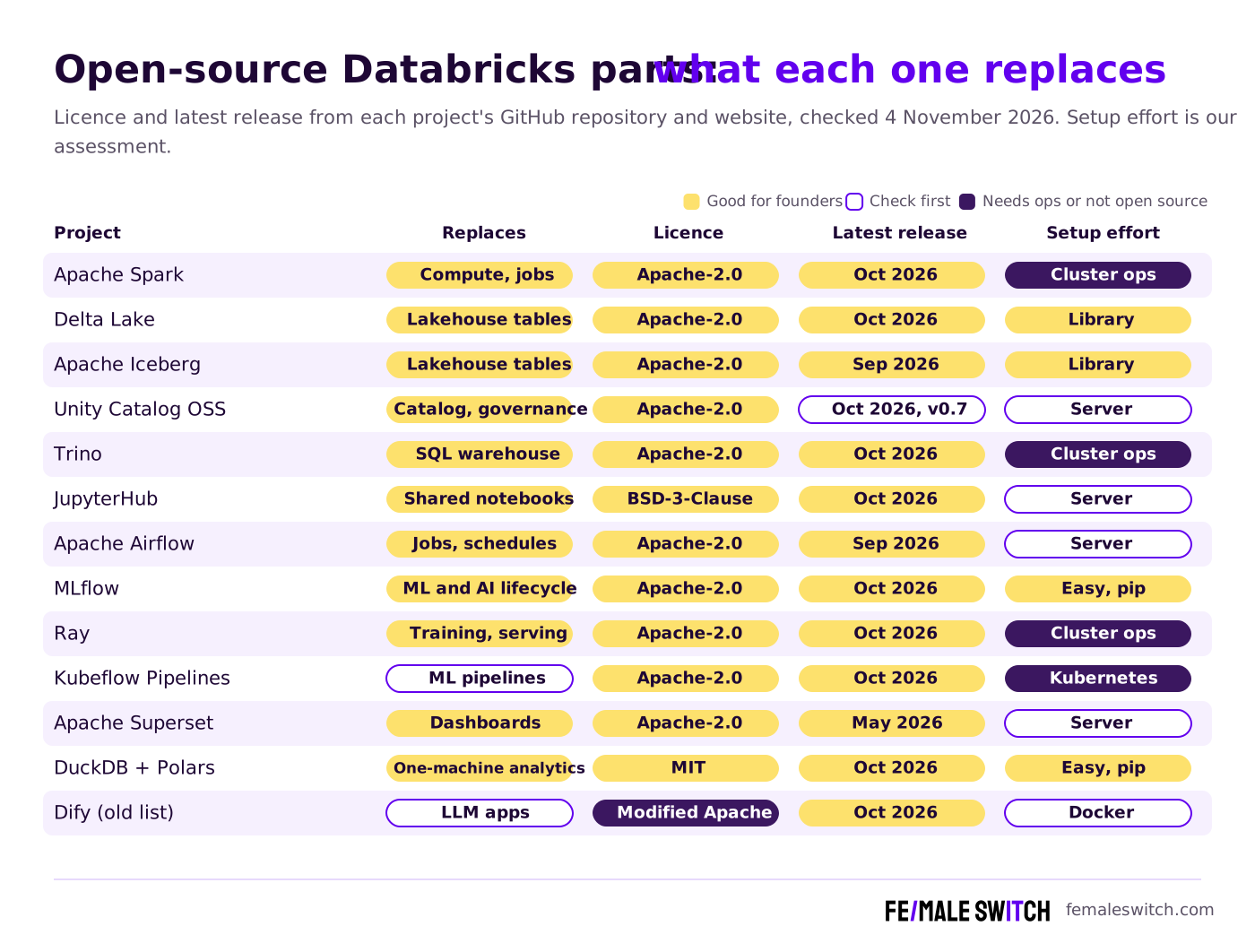
The Best Open-Source Databricks Alternatives in 2027
1. Apache Spark: run your Spark jobs without Databricks
Apache Spark is the engine Databricks is built around: one engine for data engineering, SQL, data science and machine learning, on a laptop or a cluster, in Python, SQL, Scala, Java or R. It is an Apache Software Foundation project under the Apache 2.0 licence, and Spark 4.3.0 was released on 30 October 2026. Most PySpark and Spark SQL code written for Databricks runs on plain Spark; what you lose are the Databricks-only extras such as its managed clusters, workspace and notebook features. You can run Spark on Kubernetes, on your own servers or through a cloud service such as Amazon EMR.
2. Delta Lake: the same table format Databricks uses
Delta Lake is the open-source storage framework behind Databricks tables. It adds ACID transactions, scalable metadata and time travel to Parquet files in S3, Azure, Google Cloud Storage or HDFS, and works with Spark, Flink, Trino, PrestoDB, Hive and other engines. Its UniForm feature lets Iceberg and Hudi clients read Delta tables. It is Apache 2.0 licensed, and version 4.4.1 came out in October 2026. If your data is already in Delta tables on Databricks, this is the easiest way out: the files stay where they are and other engines can read them.
3. Apache Iceberg: the open table format most engines support
Apache Iceberg is an open table format for huge analytic tables. It lets engines like Spark, Trino, Flink, Presto, Hive and Impala work with the same tables at the same time, with SQL merges, updates and deletes and schema changes that never rewrite your table. It is an Apache Software Foundation project under Apache 2.0, and version 1.12.0 came out in September 2026. Choose Iceberg over Delta Lake if you want the widest choice of engines and vendors; choose Delta if you are moving off Databricks and want the least migration work.
4. Unity Catalog OSS and Apache Polaris: the open catalog
Unity Catalog is the open-source version of the catalog that governs tables, files, models and AI tools in Databricks. Its website says it is Apache 2.0 licensed, including the OpenAPI specification, server and clients, and that it supports Delta Lake, Iceberg through UniForm, Parquet, CSV and JSON and implements the Iceberg REST Catalog APIs. Its GitHub README calls it a sandbox project of the LF AI and Data Foundation; version 0.7.0 came out in October 2026, so it is young and still pre-1.0. If your tables are Iceberg, Apache Polaris is the alternative: an Apache 2.0 catalog for Iceberg that implements the Iceberg REST API and works with Spark, Trino, Flink, Dremio OSS, StarRocks and Apache Doris. Polaris 1.8.0 came out in September 2026.
5. Trino: SQL over your lakehouse
Trino is a distributed SQL query engine that replaces Databricks SQL warehouses for analysts. It queries Delta Lake and Iceberg tables, object storage and many other databases in place, and works with BI tools such as Superset, Tableau and Power BI. It is Apache 2.0 licensed, and release 484 came out in October 2026. Like Spark, it needs someone to run the cluster.
6. JupyterHub and JupyterLab: shared notebooks for your team
JupyterHub is the multi-user version of Jupyter notebooks for companies, classrooms and research labs. It gives each person a workspace on shared servers, with pluggable login (for example OAuth or GitHub), and it runs in containers or on Kubernetes. Each user can open JupyterLab, the classic notebook or RStudio. Both are BSD-3-Clause licensed by Project Jupyter; JupyterHub 6.1.1 and JupyterLab 4.6.5 came out in October 2026. Connect a notebook to Spark, Trino or DuckDB and you have the core of the Databricks workspace.
7. Apache Airflow: jobs and schedules
Apache Airflow replaces Databricks jobs and Lakeflow schedules. Its homepage describes it as a platform created by the community to programmatically author, schedule and monitor workflows; pipelines are plain Python, and a web interface shows the status and logs of every run. It is Apache 2.0 licensed, and version 3.3.2 came out in September 2026. Use it to run Spark jobs, refresh tables and retrain models on a schedule.
Validate your startup idea with the unique borrowed authority approach: we publish articles about your product in our blog and you get traffic and testers for your MVP
- Prove Market Demand: See real organic traffic and waitlist conversions
- Unlock High-Potential Keywords: Receive a curated list of top-performing keywords directly from Google Search Console data.
- Estimate Customer Acquisition Cost (CAC): Gain financial foresight with an estimated CAC based on real keyword performance data.
🔗 Start validating your startup now
8. MLflow: experiments, models and AI agents
MLflow is the open-source version of the machine-learning tooling Databricks sells as Managed MLflow. For classic machine learning it covers experiment tracking, model evaluation, a model registry and deployment; for generative AI it adds tracing, evaluations, a prompt registry and an AI gateway to debug and monitor LLM applications and agents. It is Apache 2.0 licensed, installs with pip, and version 3.17.2 came out in October 2026. For most startups this is the first piece of the Databricks stack worth self-hosting.
9. Ray: distributed training, tuning and model serving
Ray scales Python and AI workloads from a laptop to a cluster of CPUs and GPUs. Its libraries cover data loading and preprocessing (Ray Data), training (Ray Train), hyperparameter tuning (Ray Tune), model serving (Ray Serve) and reinforcement learning (RLlib). It is Apache 2.0 licensed, and version 2.59.0 came out in October 2026. Use Ray instead of Spark when the heavy work is model training or inference rather than SQL. Anyscale, the company behind Ray, sells a managed version paid by usage, with a $100 credit to start.
10. Kubeflow Pipelines: ML pipelines on Kubernetes
Kubeflow was in the 2025 list and is still active: its website says it is now a graduated project of the Cloud Native Computing Foundation. Kubeflow Pipelines builds and runs reusable machine-learning workflows on Kubernetes; it is Apache 2.0 licensed, and version 2.18.0 came out in October 2026. Choose it only if your team already runs Kubernetes; otherwise Airflow with MLflow is simpler.
11. Apache Superset: dashboards and SQL exploration
Apache Superset replaces Databricks AI/BI dashboards. It is an open-source data exploration and visualization platform with a no-code chart builder and a SQL editor, and it connects to Trino and most SQL databases. It is Apache 2.0 licensed; version 6.1.0 came out in May 2026, and its repository was still receiving commits in November 2026. For more self-hosted dashboard tools, see our open-source Metabase alternatives and open-source Power BI alternatives.
12. DuckDB and Polars: when you do not need a cluster
Many startups have far less data than Databricks was built for. DuckDB is an MIT-licensed analytical database that runs inside your Python script or app and reads Parquet, CSV, JSON and Iceberg files, locally or from object storage; DuckDB 2.0.0 came out in October 2026. Polars is an MIT-licensed DataFrame library that describes itself as one of the fastest data processing tools on a single machine; version 2.1.0 came out in October 2026, and its paid Polars Cloud and on-premises services are optional. Both are a good replacement for Spark notebooks on small and medium data, and a better upgrade for the pandas code in the old version of this list.
Changed or Not Open Source: The Rest of the 2025 List
The 2025 version of this article mixed platforms with single libraries. Here is where its other picks stand in November 2026:
- Dify: not open source by the OSI definition. Its licence file is a modified Apache 2.0 that forbids running a multi-tenant service without permission and removing the logo from the frontend. It is a source-available LLM app builder, not a Databricks replacement. For open-source AI chat tools, see our open-source ChatGPT alternatives.
- H2O.ai: the company's platform is commercial, but H2O-3, its AutoML engine, is Apache 2.0 and still released (3.46.0.12 in August 2026). Use it for machine learning on your own servers next to the stack above.
- TensorFlow, pandas and LangChain: all still maintained and open source (Apache 2.0, BSD-3-Clause and MIT; TensorFlow 2.21.0 came out in March 2026, pandas 3.1.0 in October 2026 and langchain-core 1.7.4 on 2 November 2026), but they are libraries you run inside notebooks, not alternatives to a data platform.
- Taipy: still Apache 2.0, but development has slowed: its last release, 4.1.1, dates from February 2026. Check the repository before you build on it.
Which Open-Source Databricks Alternative Should You Choose?
- Your Databricks bill is too high and you want to keep your Spark code: Apache Spark on Kubernetes or EMR, with your existing Delta Lake tables.
- You want an open lakehouse that any engine can read: Iceberg tables with Apache Polaris, or Delta Lake with Unity Catalog OSS.
- Your analysts mostly write SQL: Trino plus Apache Superset.
- Your work is mostly model training, LLMs or AI agents: MLflow plus Ray, with JupyterHub for notebooks.
- You already run Kubernetes: Kubeflow Pipelines for ML workflows.
- Your data fits on one machine: DuckDB or Polars, and add the rest only when you need it.
- Nobody on the team wants to run servers: a managed platform is cheaper than your time; compare them in our Databricks alternatives list.
Comparing other data tools too? See our open-source Snowflake alternatives for self-hosted warehouses, free Looker alternatives for BI, and open-source Segment alternatives for collecting customer event data.
How Founders Use an Open-Source Data and AI Stack
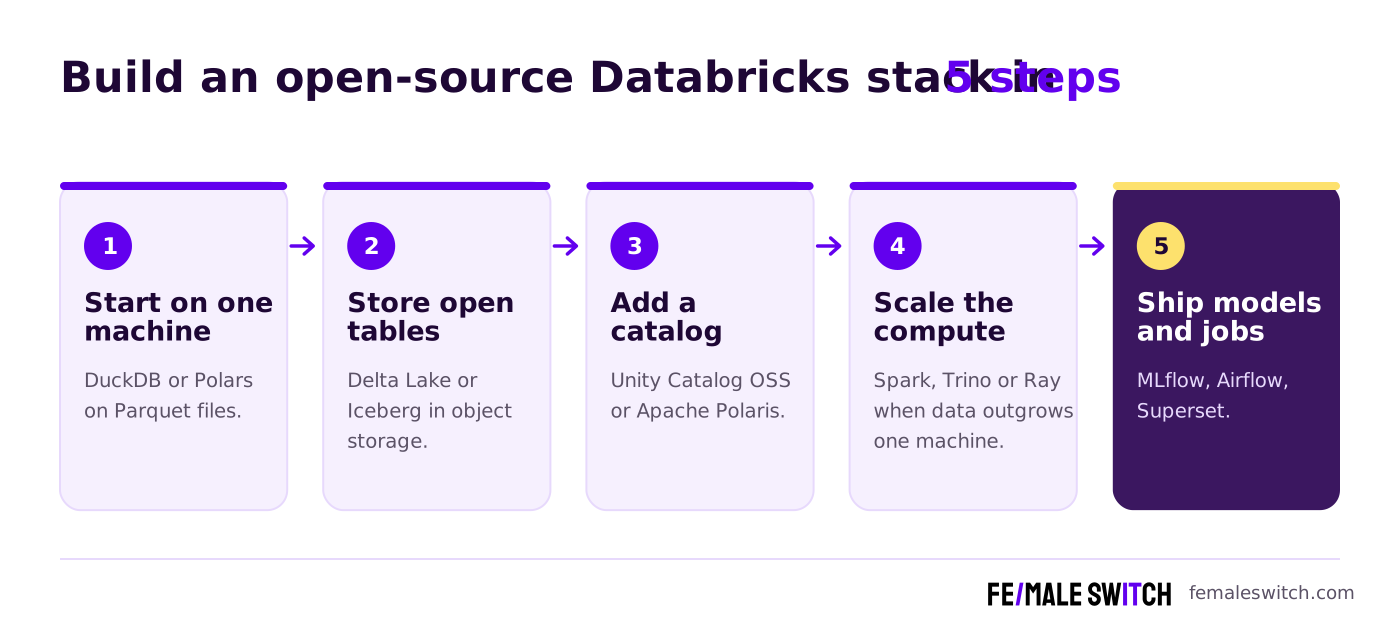
Most early-stage startups do not need a lakehouse on day one. Start with the questions you act on every week, keep raw data as Parquet files in cheap object storage, and query it with DuckDB from a notebook. Add Delta Lake or Iceberg when several people or tools write to the same tables, MLflow when you train or evaluate models more than once, and Spark, Trino or Ray only when one machine is no longer enough. Every open-source part you add is one more thing to patch, so add them one at a time.
The data stack is one layer of your product. Build internal tools on top with our open-source Retool alternatives, keep structured data and AI in a shared base with the open-source Airtable AI alternatives, connect your apps with the open-source Zapier alternatives, and code faster with the open-source GitHub Copilot alternatives. Before you build anything, validate your startup idea with real customers, and once your data tells a story, turn it into articles with the F/MS AI SEO Tool so customers find you in Google and AI assistants.
Join ElonaHunt (like ProductHunt but for women) and explore the coolest women-focused startups out there!
Discover your next big inspiration and connect with like-minded female entrepreneurs!
👉 Join the Hunt Here
FAQ About Open-Source Databricks Alternatives
Is there an open-source version of Databricks?
Not as one product. Databricks is built on open-source projects, including Apache Spark, Delta Lake, Unity Catalog and MLflow, which you can run yourself, but the managed workspace, clusters and many features around them are proprietary.
Can I run my Databricks Spark jobs without Databricks?
Usually yes. Most PySpark and Spark SQL code runs on open-source Apache Spark (version 4.3.0 came out on 30 October 2026), and Delta Lake tables stay readable. Databricks-only features such as its notebooks and managed jobs need replacements like JupyterHub and Airflow.
Is Unity Catalog open source?
Yes. Unity Catalog OSS is Apache 2.0 licensed, including its API specification, server and clients, and is a sandbox project of the LF AI and Data Foundation. It is still pre-1.0 (version 0.7.0 in October 2026), so the Databricks-hosted version has more features.
Is MLflow free?
Yes. MLflow is Apache 2.0 licensed and free to self-host. It tracks experiments, registers models, and traces and evaluates LLM applications and AI agents. Databricks also sells a managed MLflow.
Should I use Delta Lake or Apache Iceberg?
If your tables are already in Delta Lake on Databricks, keep Delta: it is Apache 2.0 and other engines can read it. For a new lakehouse that many engines and vendors should share, Iceberg has the widest support. Delta's UniForm feature lets Iceberg clients read Delta tables.
Is Databricks Free Edition enough for a startup?
No. Databricks says Free Edition is for personal use only and not for production or commercial use, with smaller compute and warehouse sizes. A startup needs a paid Databricks plan or an open-source stack.
Is Dify open source?
Not by the OSI definition. Dify uses a modified Apache 2.0 licence that forbids running a multi-tenant service without permission and removing its logo from the frontend, so it is source-available.
What is the cheapest open-source alternative to Databricks?
For small and medium data, DuckDB or Polars on a single machine: both are MIT-licensed and need no cluster. Add Spark, Trino or Ray only when your data or models outgrow one machine.
Which open-source tool replaces Databricks notebooks?
JupyterHub with JupyterLab gives every team member a notebook workspace on shared servers, with login through OAuth or GitHub. Both are BSD-3-Clause licensed.
Where can I get a backlink by writing about my startup?
You can publish a guest post in one of the Fe/male Switch startup blogs, which rank in Google and in AI tools. Get a quality backlink.
About the Author
Violetta Bonenkamp, also known as MeanCEO, is an experienced startup founder with an impressive educational background including an MBA and four other higher education degrees. She has over 20 years of work experience across multiple countries, including 5 years as a solopreneur and serial entrepreneur. Throughout her startup experience she has applied for multiple startup grants at the EU level, in the Netherlands and Malta, and her startups received quite a few of those. She’s been living, studying and working in many countries around the globe and her extensive multicultural experience has influenced her immensely.

