

Open-Source Segment Alternatives: Customer Data Platforms and Event Pipelines You Can Host and Change Yourself
Twilio Segment is the customer data platform (CDP) many startups install first: one tracking snippet collects events from your site and app, and Segment forwards them to analytics, email, ads and your data warehouse. It is easy to start, but the bill grows with your visitors, and your customer data passes through someone else's servers. An open-source CDP or event pipeline gives you the code, so you can host it, keep the data in your own database and customise every step. We checked each tool below on its official website, documentation and GitHub in November 2026: the exact licence, the latest release and what part of Segment it replaces. Several tools that are often called "open source" now use licences that are not, and we flag them clearly.
Quick answer: the closest open-source replacement for Segment's event collection is Jitsu (MIT, Segment-compatible API); if you also want product analytics in the same tool, use PostHog; for a classic customer profile server with segments, use Apache Unomi; to push warehouse data back into your business tools, add Multiwoven; and for messaging journeys on top of your events, use Dittofeed. RudderStack and Snowplow are popular Segment alternatives, but their core pipelines are not open source any more.
Boost Your SEO by Getting Featured in Our Blogs and get a backlink.
We publish content about startups, education, tech, funding, etc. that ranks well not only in Google but also in Perplexity, ChatGPT, Grok and other AI tools.
👉 Get featured now!
What Twilio Segment Costs in 2027
To know what you are replacing: the Segment Connections pricing page (checked November 2026, prices in US dollars) lists a Free plan at $0 with 1,000 visitors a month, 2 sources, 700+ integrations, 1 data warehouse destination and 500,000 reverse ETL records a month. The Team plan starts at $120 a month for 10,000 visitors, unlimited sources, 1,000,000 reverse ETL records and public API access. Business is priced on request. The full Segment customer data platform, with Unify (customer profiles) and Engage (audiences and journeys) on top of Connections, is sold through sales only. So the free plan is fine for a prototype, but a startup with real traffic hits the 1,000-visitor limit quickly. The tools below can be self-hosted for free; you pay for the server and your own time.
Open-Source Segment Alternatives Compared
Sources: each project's official website, pricing page, licence file and GitHub repository, checked 3 November 2026.
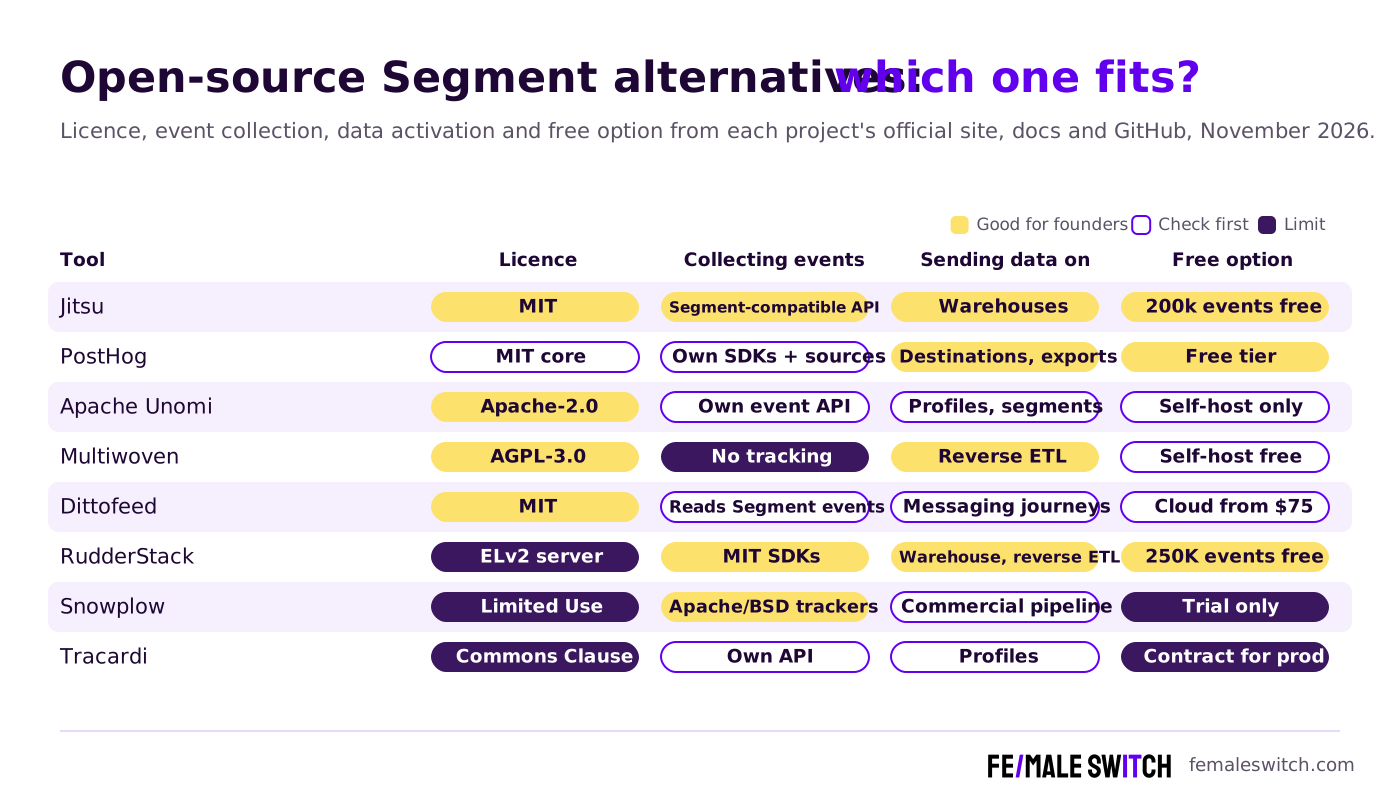
The Best Open-Source Segment Alternatives in 2027
1. Jitsu: the closest open-source match for Segment's event collection
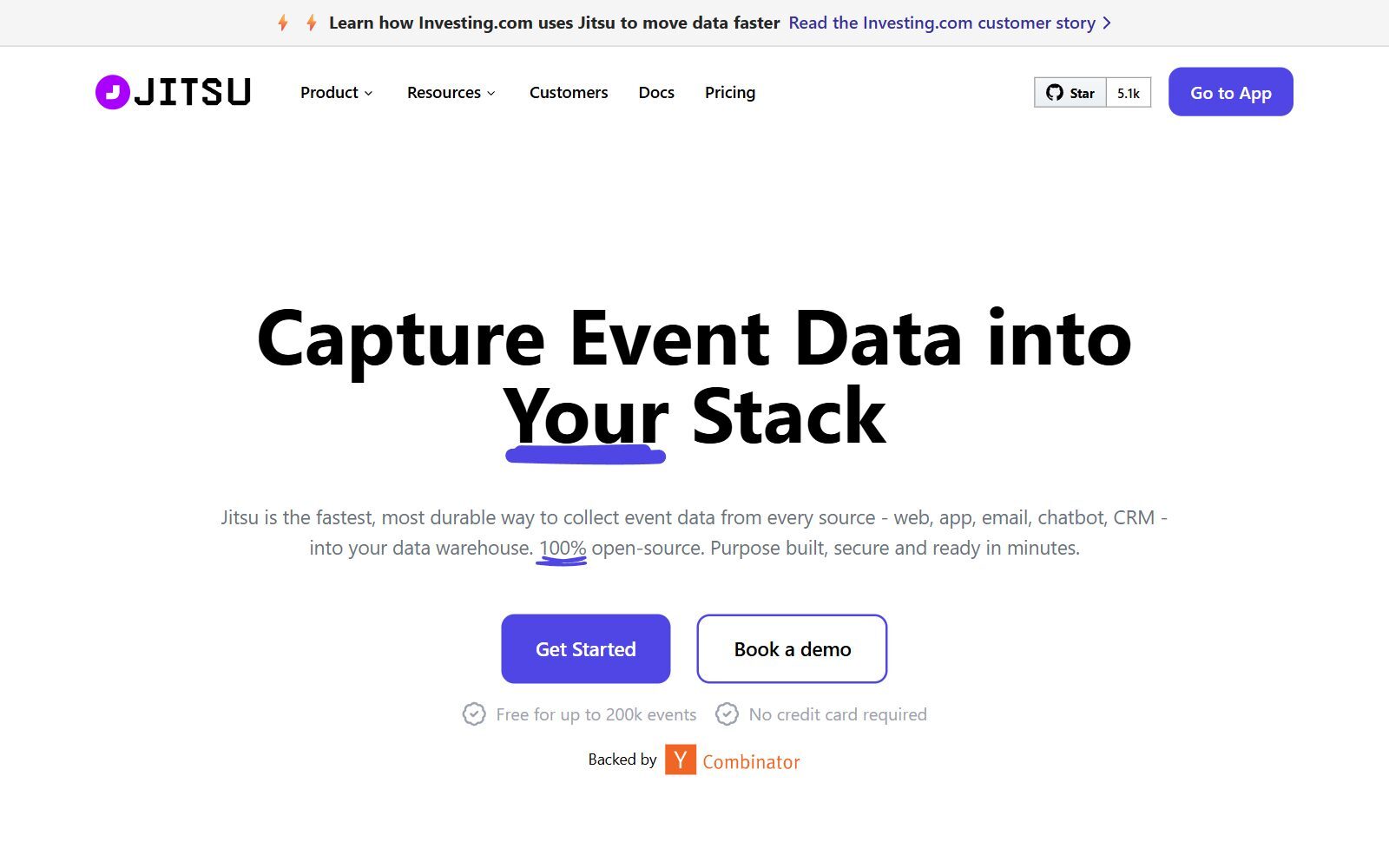
Jitsu collects events from your website, app and back end and streams them into your data warehouse. Its homepage calls it 100% open source, and the GitHub code is under the MIT licence. It ships with ClickHouse built in and also loads into Snowflake, BigQuery, Redshift, Postgres and MySQL; JavaScript functions can filter or enrich events before they are stored, and an identity graph stitches anonymous and known users together. For Segment users the key page is Jitsu's Segment compatibility: its browser library is based on analytics.js and is described as 100% compatible with the Segment API, and you can run Jitsu as a sidecar by sending a copy of your Segment data to it before you switch. Self-hosting is free with no usage limits and community support only; on Jitsu's pricing page the cloud Free plan covers 200k active events a month and Business costs $99 a month for 2M. New 2.15 builds were still being published in November 2026.
2. PostHog: event pipelines and product analytics in one open-source tool
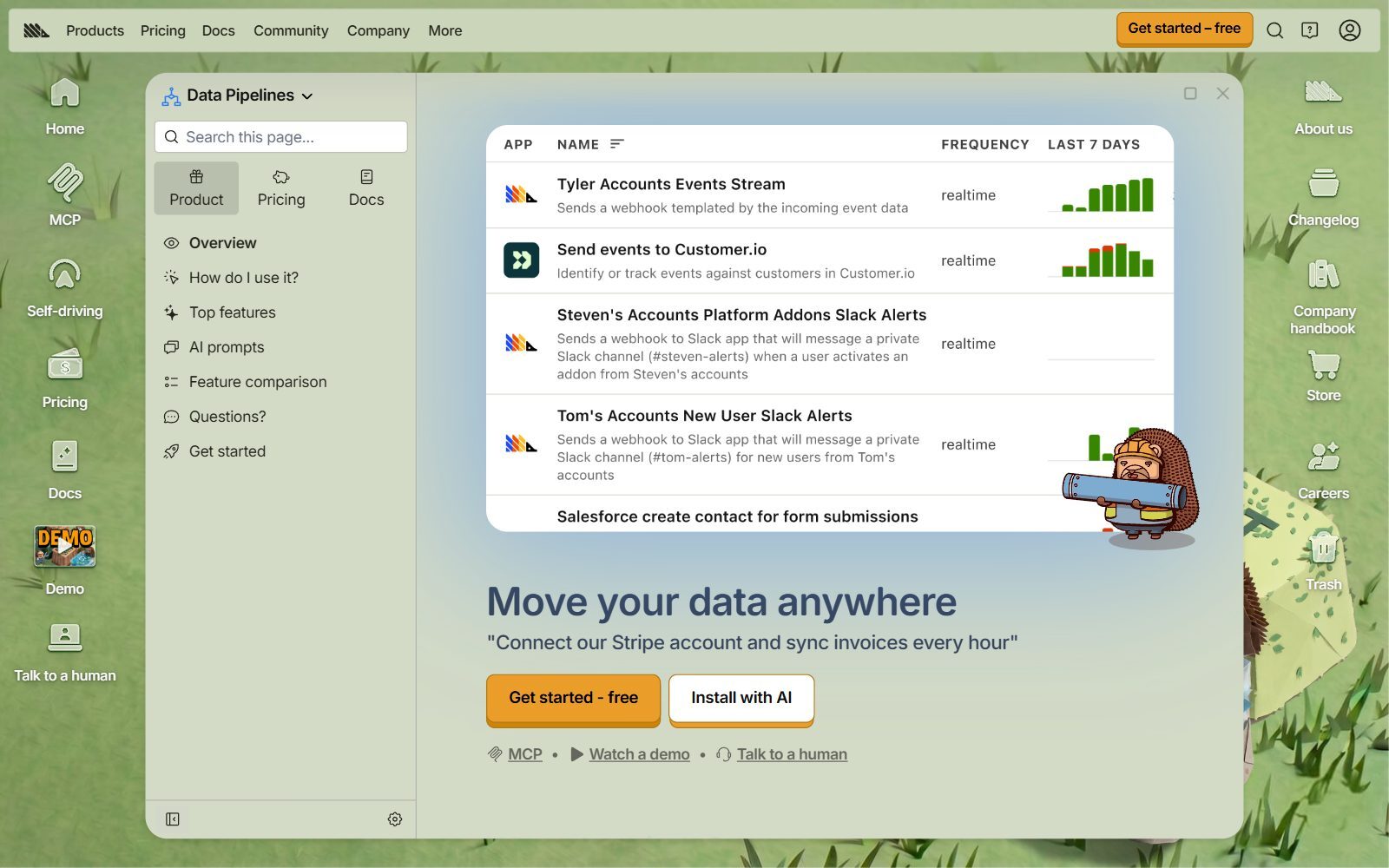
PostHog started as product analytics and now includes data pipelines that cover most of what startups use Segment for: sources that sync data from tools such as Stripe or HubSpot and from your own database, transformations that edit or drop event properties before they are stored, realtime destinations that send events to tools like Slack, HubSpot or Intercom, and batch exports to your warehouse. The main repository is MIT-licensed, except an ee/ folder with its own licence. The PostHog self-hosting guide offers a free Docker Compose "hobby" deployment under the MIT licence, but says self-hosted instances are officially unsupported, so most startups use PostHog Cloud and its free tier. Pick it if you want analytics, session replay and the data pipeline in one place instead of a separate CDP.
3. Apache Unomi: an open-source customer profile server
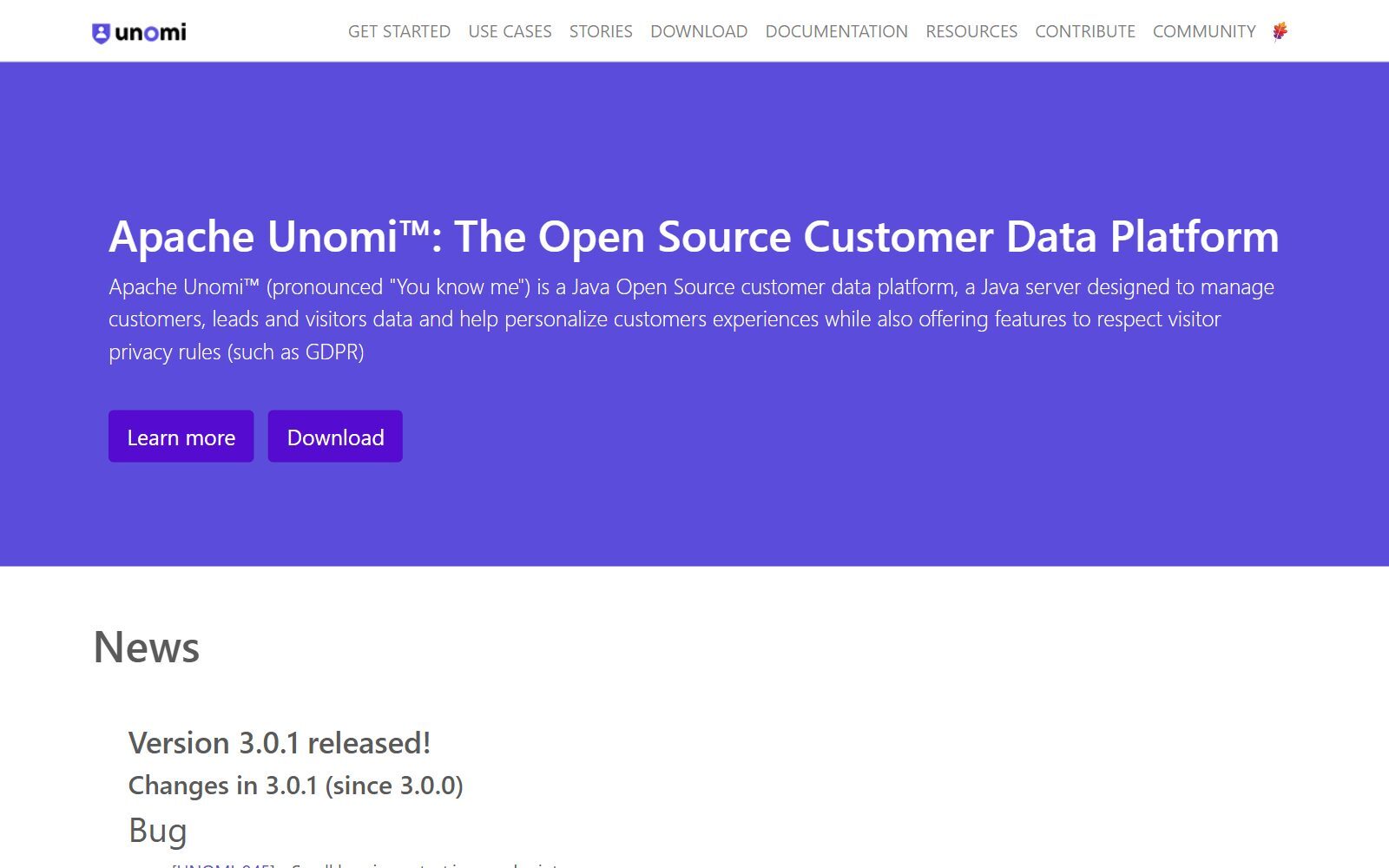
Apache Unomi is a Java customer data platform from the Apache Software Foundation, under the Apache 2.0 licence. It keeps persistent, consolidated profiles of your visitors, leads and customers, scores and segments them in real time, and has built-in features to respect privacy rules such as GDPR. Unomi is also the reference implementation of the upcoming OASIS Context Server CDP standard. This makes it closer to Segment Unify and its profiles than to Segment's tracking pipeline, and it suits teams that want a CDP inside their own Java stack and want to own the profile data. Version 3.0.1 was released on 20 July 2026, and a 4.0.0 release candidate was tagged on GitHub in October 2026. Expect developer work: there is no hosted version from the project.
4. Multiwoven: open-source reverse ETL for audiences and syncs
Multiwoven covers the other half of a CDP: it takes customer data and segments from your warehouse and syncs them into business tools such as your CRM, ad platforms and support tools, which Segment sells as reverse ETL. The code is under AGPL-3.0, it runs inside your own infrastructure, and the website promises free infrastructure with no caps on sources, destinations or data volume. Version 0.137.0 came out on 3 November 2026. Combine it with Jitsu or PostHog: one collects the events, Multiwoven sends the results back out.
Validate your startup idea with the unique borrowed authority approach: we publish articles about your product in our blog and you get traffic and testers for your MVP
- Prove Market Demand: See real organic traffic and waitlist conversions
- Unlock High-Potential Keywords: Receive a curated list of top-performing keywords directly from Google Search Console data.
- Estimate Customer Acquisition Cost (CAC): Gain financial foresight with an estimated CAC based on real keyword performance data.
🔗 Start validating your startup now
5. Dittofeed: open-source journeys on top of your Segment events
Dittofeed describes itself as an open-source customer engagement platform: it sends automated email, SMS and webhook messages (for push, Slack or WhatsApp) based on what users do. That is the job of Segment Engage or a tool like Customer.io. Its GitHub repository is MIT-licensed, self-hosting is free, and Twilio Segment is listed as a data source, so you can keep Segment for collection and replace only the engagement part, or feed it from another pipeline later. Dittofeed Cloud starts at $75 a month with a 14-day free trial. Its newest builds are still marked alpha (0.24.0, October 2026).
Popular Segment Alternatives That Are Not Open Source Any More
These three are on most "open-source Segment alternative" lists, including the 2025 version of this article. They are good products, but their licences now limit how you can use the code, so check them before you build on them:
RudderStack: Elastic License 2.0 for the server
RudderStack is a warehouse-native CDP and the best-known Segment alternative. Its rudder-server repository and the transformer service use the Elastic License 2.0, which lets you self-host but not offer the software to others as a hosted service; it is source-available, not open source. Its JavaScript SDK is MIT-licensed. The RudderStack pricing page lists a Free cloud plan with 250K events a month and Growth at $265 a month for 1 million events. Version 1.92.1 came out in October 2026. Choose it if you want a mature hosted pipeline and the licence fits you.
Snowplow: open trackers, limited-use pipeline
Snowplow's licence page shows the split: its tracker SDKs are under Apache 2.0 (the JavaScript tracker under BSD 3-Clause), but the pipeline apps, including the collector, enrich and loaders, are under a Limited Use License that allows non-production use only. The page itself says these licences are not called open source. Production use goes through Snowplow's commercial cloud.
Tracardi: MIT with Commons Clause
Tracardi is an API-first CDP whose GitHub repository uses the MIT licence with the Commons Clause, which removes the right to sell the software and is not an open-source licence. Its website offers a free open-source version and a paid commercial version, and says that using the production version with all features needs a contract. Its last tagged release, 1.1.25, dates from March 2026.
Removed From the Old List
- Pimcore: a product and content data platform, not a CDP, and now under the Pimcore Open Core License, which is not an OSI open-source licence.
- Open CDP by REES46: the product page still says the source code will be published on GitHub, so there is no public code to self-host.
- Dropsolid Open CDP: the old page is gone; Dropsolid now sells its CDP as a commercial platform. Its earlier offering was built on Apache Unomi, which is covered above.
- Bloomreach and Acquia DXP: commercial, closed-source platforms, not open-source alternatives.
- Matomo: open source (GPL-3.0), but a web analytics tool rather than a CDP. See our open-source Google Analytics alternatives instead.
How to Move From Segment to an Open-Source Stack
Switching a CDP is mostly a tracking-plan project. Keep Segment running while you test, and move one source at a time:
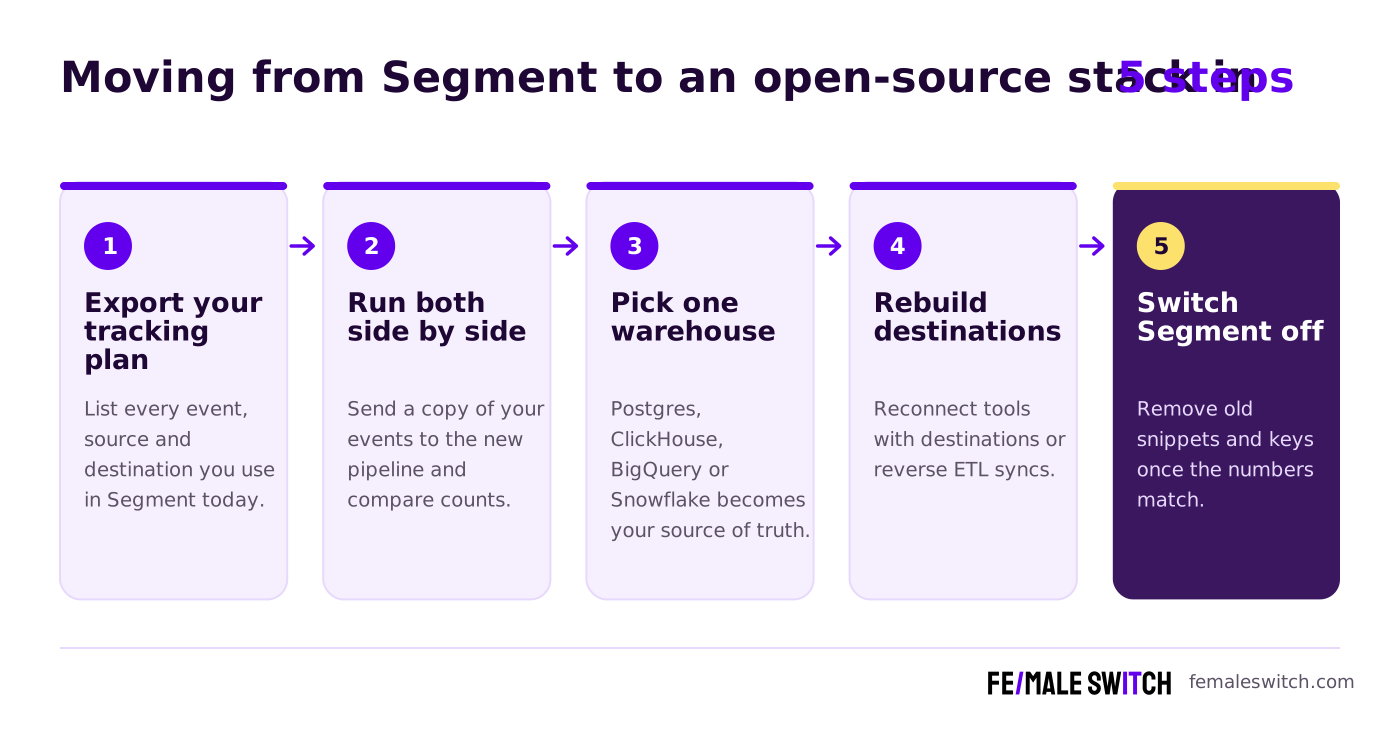
- Write down what Segment does for you today: every event name and property, each source, and each destination it feeds.
- Run both side by side: Jitsu documents a sidecar setup in which Segment sends a copy of your data to Jitsu through a webhook, so you can compare numbers before you remove anything.
- Make the warehouse your single source of truth: Postgres or ClickHouse is enough for most early-stage startups.
- Rebuild destinations and audiences: realtime destinations in Jitsu or PostHog, warehouse-to-tool syncs in Multiwoven, journeys in Dittofeed.
- Switch off Segment once event counts match, and remove the old snippet and write keys from your code.
Which Open-Source Segment Alternative Should You Choose?
- You want Segment's tracking without Segment: Jitsu, self-hosted or on its free cloud plan.
- You also need product analytics, funnels and session replay: PostHog.
- You need unified customer profiles and real-time segments in your own stack: Apache Unomi.
- Your data already sits in a warehouse and you need it in your CRM and ad tools: Multiwoven.
- You want automated emails and SMS triggered by user behaviour: Dittofeed.
- You prefer a hosted pipeline and the licence is not a concern: RudderStack, knowing its server is not open source.
Building the rest of your data stack too? See our open-source Snowflake alternatives for the warehouse, Databricks alternatives, open-source Metabase alternatives and free Looker alternatives for dashboards, and open-source Zapier alternatives for simple automations between tools.
Join ElonaHunt (like ProductHunt but for women) and explore the coolest women-focused startups out there!
Discover your next big inspiration and connect with like-minded female entrepreneurs!
👉 Join the Hunt Here
How Founders Use an Open-Source CDP
For an early-stage startup, a CDP is less about technology than about knowing your customers: which channel brought them, what they did first, and which behaviour comes before a purchase. Start small: track five to ten events that match your funnel, store them in one database and review them every week. Our guide on how to use Google Analytics as a startup covers the basics of reading that data, and our list of open-source social media analytics tools helps you add social channels. Once you have profiles, use them: send behaviour-based emails with one of our open-source Mailchimp alternatives, show better products with open-source product recommendation engines, and compare CRMs in HubSpot vs ActiveCampaign.
Customer data also powers support. If you are replacing your help desk bot too, read our open-source Zendesk AI alternatives and open-source Intercom alternatives. Before you build a data stack at all, validate your startup idea with real customers, and turn what you learn into articles with the F/MS AI SEO Tool so people find you in Google and AI assistants.
FAQ About Open-Source Segment Alternatives
What is the best open-source alternative to Segment?
Jitsu is the closest match for Segment's event collection: it is MIT-licensed, describes its browser library as 100% compatible with the Segment API and loads events into your own warehouse. PostHog is the better pick if you also want product analytics in the same tool.
Is Segment open source?
No. Twilio Segment is a commercial cloud service, and you cannot download and host the platform yourself. Its Free plan covers 1,000 visitors a month and 2 sources (checked November 2026).
Is RudderStack open source?
Not fully. RudderStack's server and transformer use the Elastic License 2.0, which is source-available rather than open source; its JavaScript SDK is MIT-licensed. Its pricing page says the self-hosted project is released under Elastic 2.0.
Is Snowplow still open source?
Only partly. Its trackers are under Apache 2.0 or BSD 3-Clause, but the pipeline apps (collector, enrich, loaders) are under a Limited Use License for non-production use only, and Snowplow does not call these licences open source.
What is the best open-source CDP for customization?
Apache Unomi gives you the most control over customer profiles, segments and scoring, under Apache 2.0. Jitsu lets you customise every event with JavaScript functions, and PostHog lets you write your own transformations and destinations.
How much does Twilio Segment cost in 2027?
When we checked in November 2026, the Segment Connections Free plan was $0 for 1,000 visitors a month, the Team plan started at $120 a month for 10,000 visitors, and Business was priced on request.
Can I keep using Segment's tracking code with an open-source tool?
With Jitsu, mostly yes: its browser library is based on analytics.js and it offers a Segment-compatible endpoint. You can also send a copy of your Segment data to Jitsu through a webhook while you test.
What is reverse ETL and do I need it?
Reverse ETL copies customer data and segments from your warehouse into tools such as your CRM or ad platforms. Multiwoven does this as open source. Most early-stage startups only need it once their warehouse holds data the sales or marketing team uses daily.
Is Tracardi open source?
Its GitHub repository uses the MIT licence with the Commons Clause, which is not an open-source licence, and its website says production use with all features needs a contract.
Where can I get a backlink by writing about my startup?
You can publish a guest post in one of the Fe/male Switch startup blogs, which rank in Google and in AI tools. Get a quality backlink.
About the Author
Violetta Bonenkamp, also known as MeanCEO, is an experienced startup founder with an impressive educational background including an MBA and four other higher education degrees. She has over 20 years of work experience across multiple countries, including 5 years as a solopreneur and serial entrepreneur. Throughout her startup experience she has applied for multiple startup grants at the EU level, in the Netherlands and Malta, and her startups received quite a few of those. She’s been living, studying and working in many countries around the globe and her extensive multicultural experience has influenced her immensely.

