

Open-Source Heap Alternatives for Product Analytics and Session Replay You Can Host Yourself
Heap made one idea popular: capture every click and page view automatically, then build funnels and retention charts later without asking a developer to add tracking. Heap is now part of Contentsquare, and beyond its free plan the price is a quote. If you want the same kind of product analytics on your own server, or at least with code you can read and run yourself, the tools below are real open-source projects. We checked each one in November 2026 on its official website and GitHub: the exact licence, the latest release, what the free self-hosted version includes, whether it has funnels, retention and session replay, and what the hosted cloud costs. This list is about understanding what users do inside your product. If you only need cookie-free website traffic stats, read our open-source Google Analytics alternatives instead.
Quick answer: the closest open-source match to Heap is PostHog, with autocapture, funnels, retention, user paths and session replay (use its free cloud tier, because self-hosting is officially unsupported). For session replay with funnels and journeys that you really host yourself, use OpenReplay. For Mixpanel-style events, funnels and cohorts with no event limits when self-hosted, use OpenPanel. For mobile and desktop apps, use Countly Lite, and if you want product analytics inside a full Google Analytics replacement, use Matomo with its paid plugins.
Boost Your SEO by Getting Featured in Our Blogs and get a backlink.
We publish content about startups, education, tech, funding, etc. that ranks well not only in Google but also in Perplexity, ChatGPT, Grok and other AI tools.
👉 Get featured now!
What Heap Offers in 2027, and Why Founders Look Elsewhere
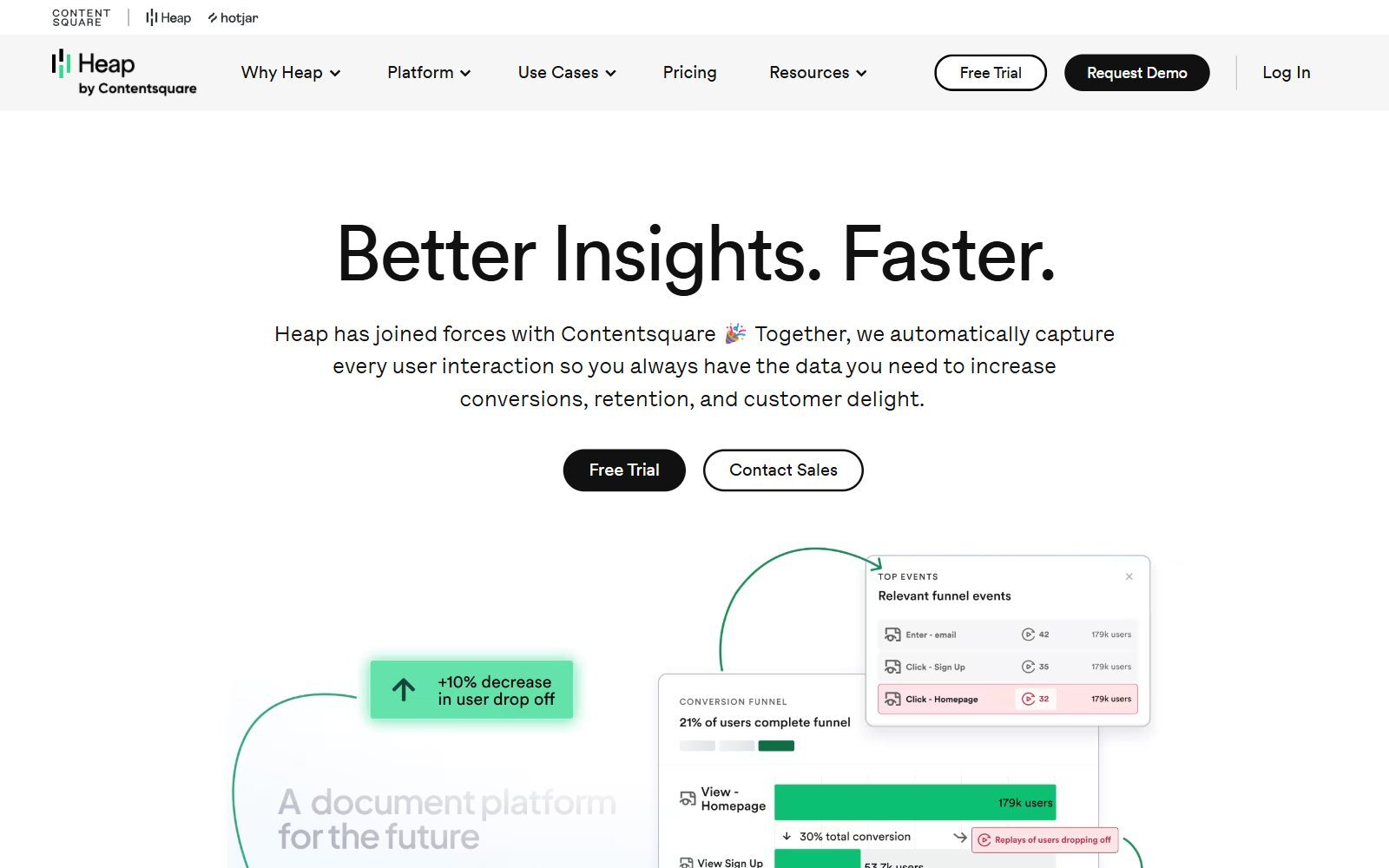
Heap's pricing page says Heap is part of the Contentsquare group, the company that also runs Hotjar. Heap's free plan covers up to 10k monthly sessions with core analytics charts and 6 months of data history, and funnels, journeys and retention are included on every plan. The Growth plan adds the Sense AI assistant, unlimited users and reports, CSV exports and 12 months of history; you get a price estimate only after you install the snippet. Pro and Premier have custom session pricing, and heatmaps, session replay and error analysis are paid add-ons on those two plans. Heap is closed source and runs only in its cloud. The open-source tools below let you keep raw event data on your own servers, choose how long to store it and pay for servers instead of sessions.
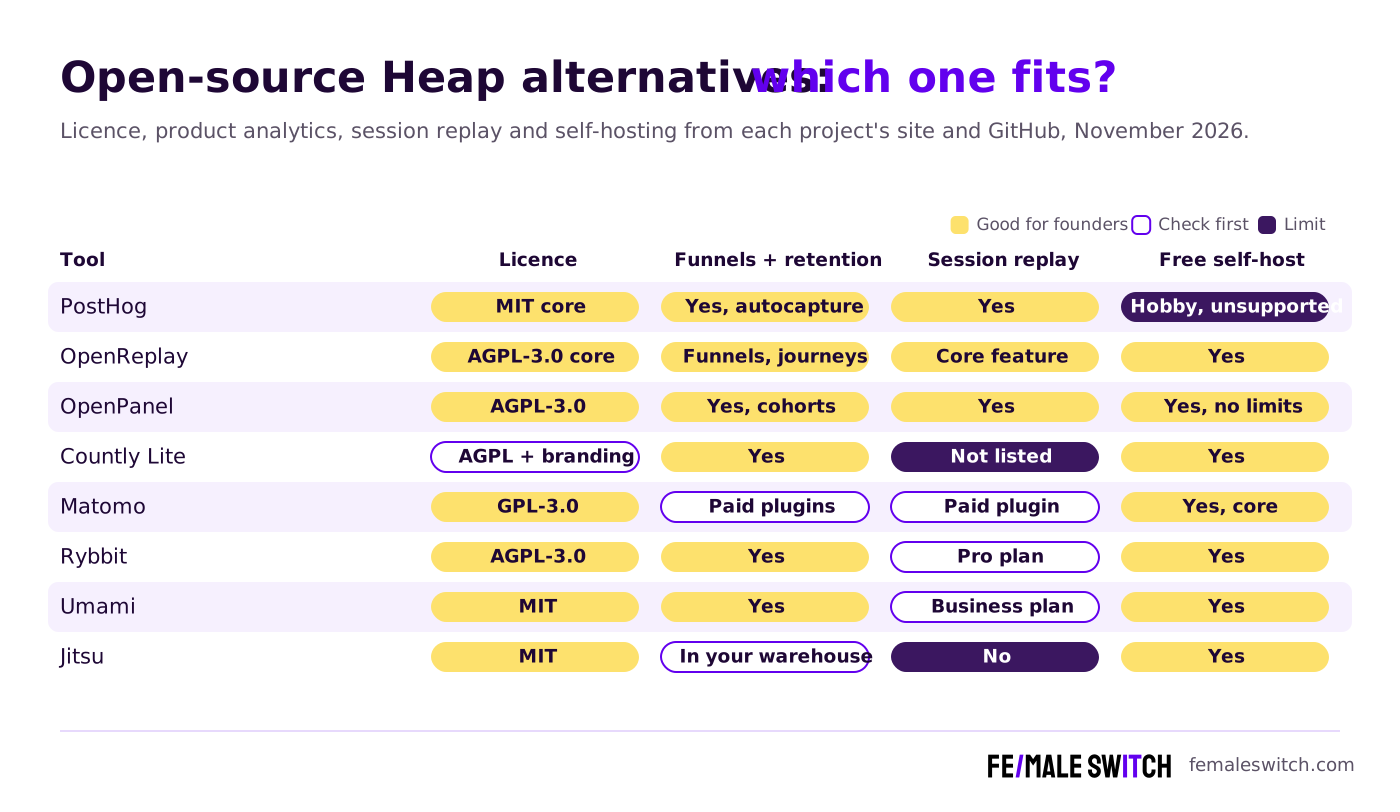
Open-Source Heap Alternatives Compared
Sources: each project's official website, pricing page and GitHub repository, checked 11 November 2026 (default view of each pricing page). Self-hosting is free, but you pay for the server and your own time.
The Best Open-Source Heap Alternatives in 2027
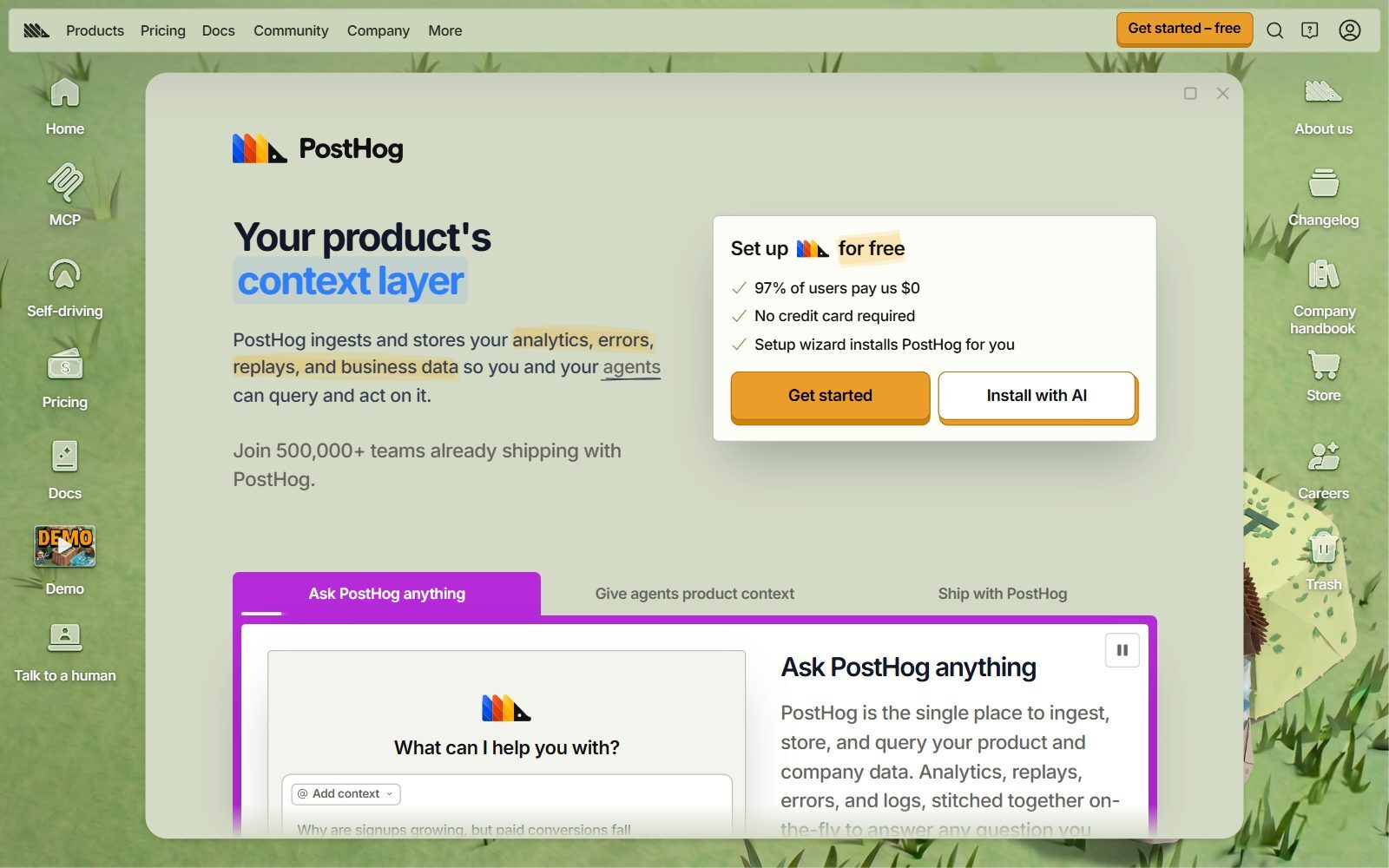
1. PostHog: the closest open-source match to Heap
PostHog works the way Heap users expect. Its JavaScript library autocaptures clicks, form changes and page views, and you can build trends, funnels, retention, user paths, stickiness and lifecycle charts on top, next to session replay, feature flags, experiments, surveys and error tracking. The code is MIT-licensed outside the ee folder. On PostHog's pricing page, the free plan gives 1 million events and 5,000 session recordings every month with no credit card, one project, 1-year data retention and recordings kept for 1 month; pay-as-you-go keeps events for 2 years. Be careful with self-hosting: the self-host docs say self-hosted deployments are officially unsupported, with no tagged releases and no support, paid features are cloud-only, and the free Docker Compose hobby deploy needs a server of roughly 4 vCPUs and 16GB of RAM.
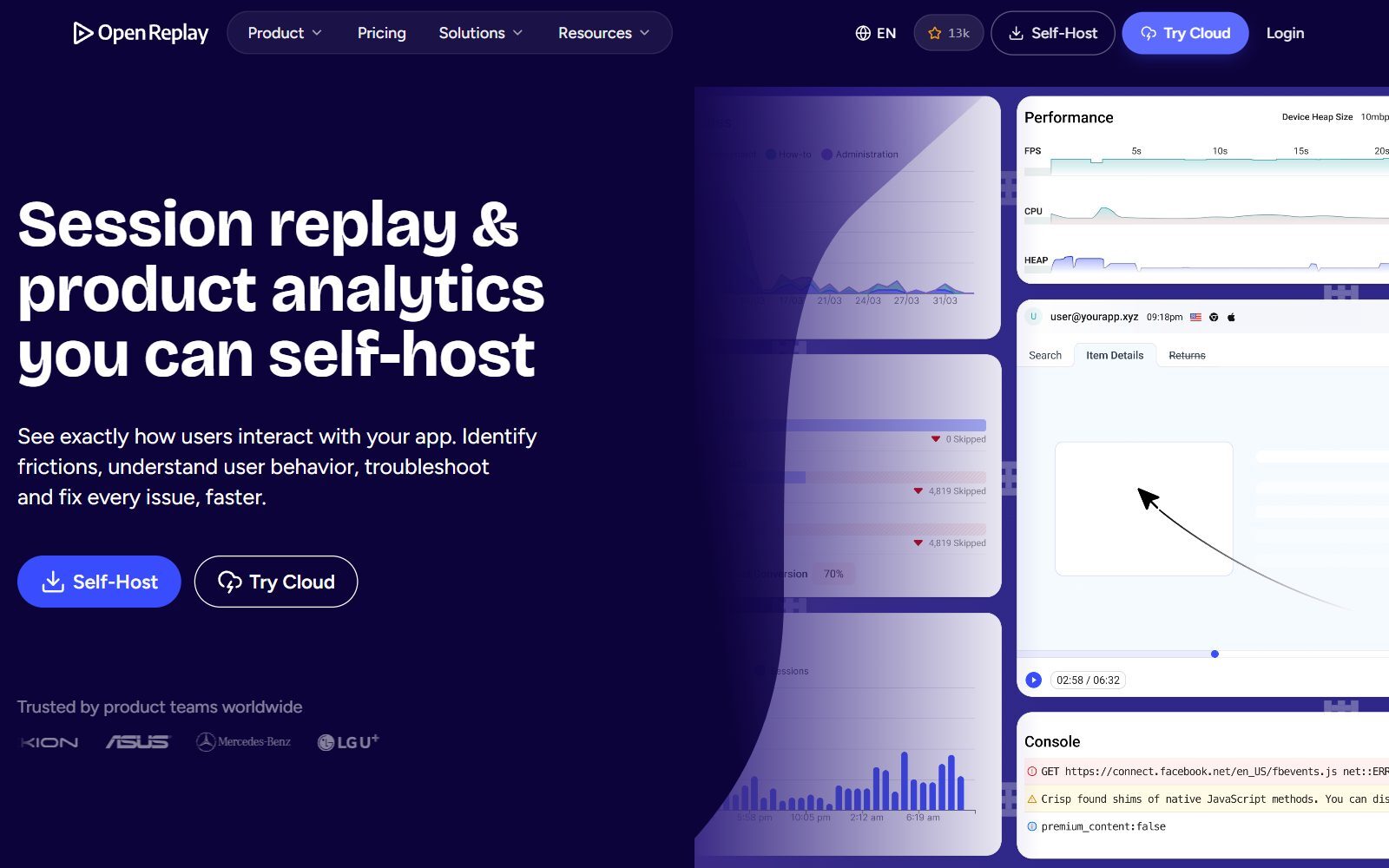
2. OpenReplay: session replay and product analytics you self-host
OpenReplay covers the part of Heap that most teams pay extra for: replays of real user sessions, with developer tools, network activity and performance data, plus funnels, user journeys, trends, heatmaps, web analytics, co-browsing and mobile support. Its licence file puts the code under AGPL-3.0 by default, with some folders under MIT and a separately licensed ee folder. On the OpenReplay pricing page, the Open-Source edition is free on your own infrastructure, the managed Dedicated plan starts at $199 a month billed hourly with a 7-day trial and no credit card, and Enterprise is self-hosted at scale on a custom contract. Version 1.28 came out on 10 November 2026. Recordings show what visitors type and click, so plan for consent and mask sensitive fields.
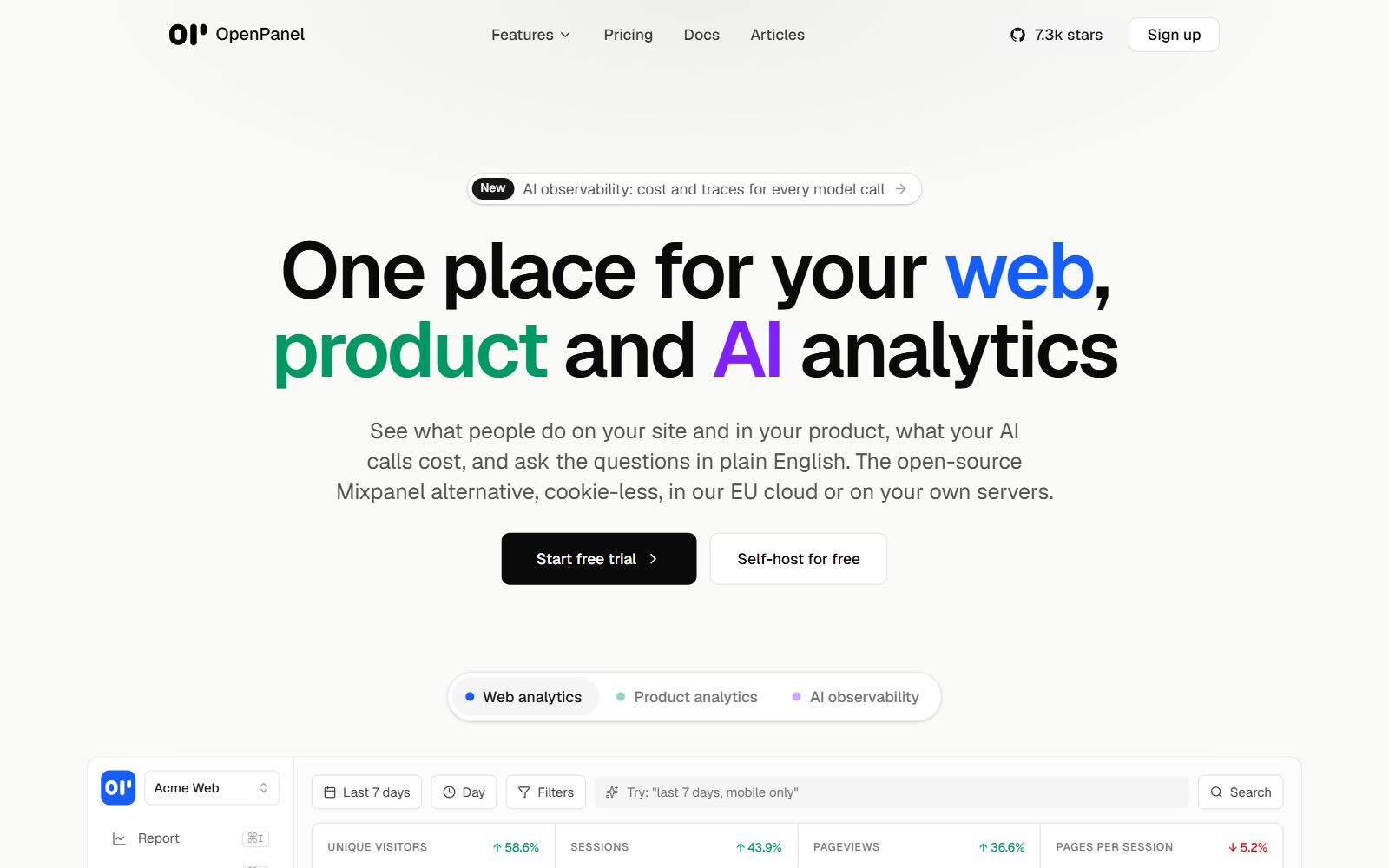
3. OpenPanel: Mixpanel-style events, funnels and cohorts
OpenPanel calls itself the open-source Mixpanel alternative, and it fits founders who track sign-ups, activation and payments as custom events. It has funnels, retention by sign-up week, cohorts, user profiles, session replay, revenue tracking, a realtime view and AI observability for model costs, with cookie-less tracking. The OpenPanel repository is AGPL-3.0, and the site says there is no enterprise edition hiding features; self-hosting with Docker Compose is free with no event limits. On the OpenPanel pricing page, every cloud plan has every feature and you pay only for events: $2.50 a month for 5K, $20 for 100K or $90 for 1M, with a 30-day trial and no card. Version 3.30.0 came out in November 2026.
4. Countly Lite: product analytics for mobile and desktop apps
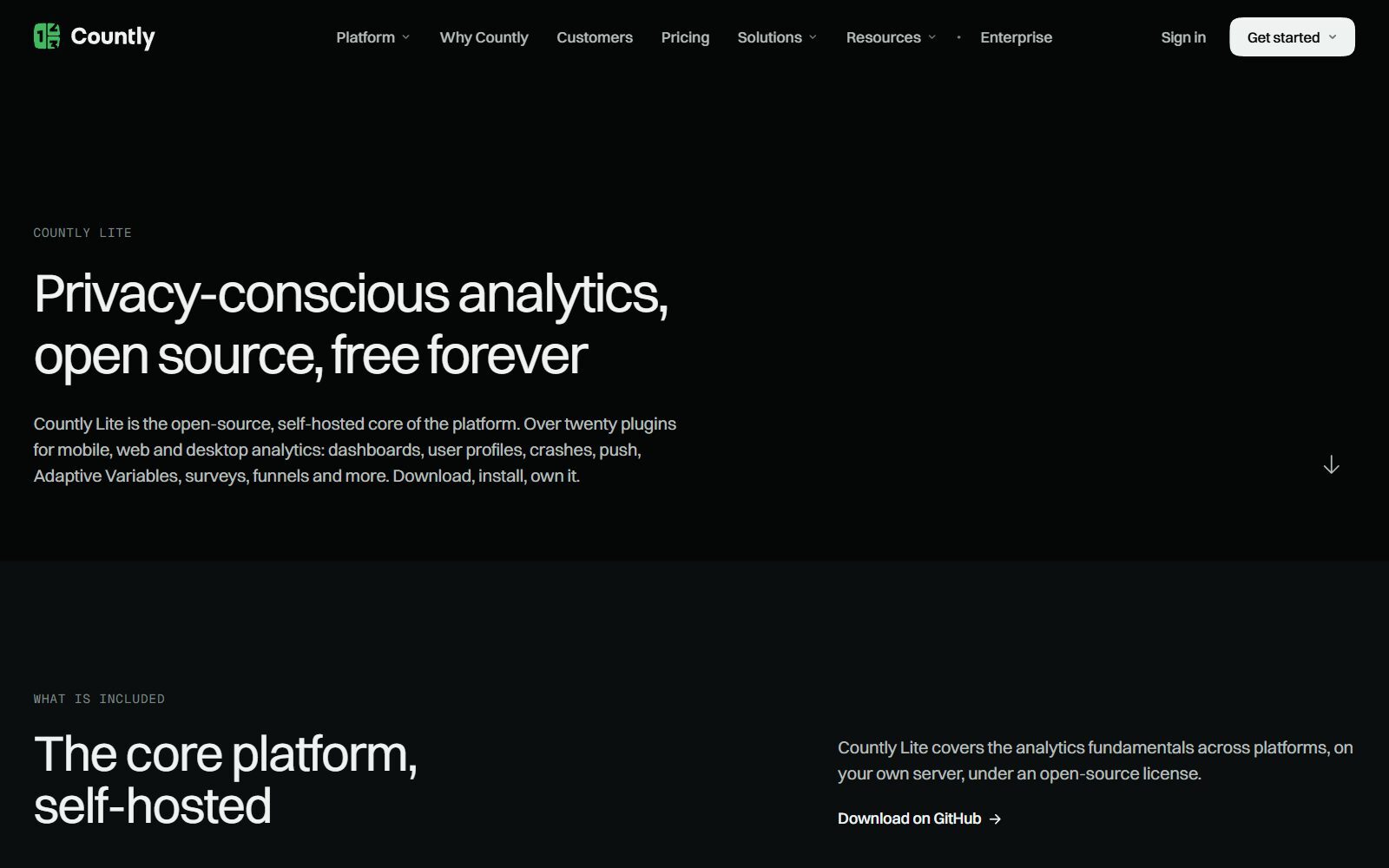
Countly Lite is the free, self-hosted core of Countly, with SDKs for iOS, Android, the web and macOS, Windows and Linux desktop apps. Its 20+ plugins include dashboards, user profiles, crash reports, push notifications, surveys, A/B testing, cohorts, funnels and retention. Journeys, Drill and the Cee AI agent are only in the paid platform: Flex, a dedicated private cloud from $175 a month, or Enterprise. The licence is AGPL-3.0 with a modified Section 7, so you may not remove Countly's name or logo from the interface. Release 25.03.58 came out in October 2026, and Lite gets community support only.
5. Matomo: web analytics with funnels, flows, heatmaps and recordings
Matomo is a GPL-3.0 analytics platform, and its On-Premise version is free to download. It becomes a Heap alternative with plugins: Funnels, Users Flow, Cohorts and Heatmap and Session Recording are paid On-Premise plugins, each with a 30-day free trial. Matomo Cloud includes them: on the Matomo pricing page, the Business plan at 50,000 hits a month costs 22 EUR a month (excluding tax), with 1,500 heatmap pageviews and 150 session recordings a month, 30 websites and 24 months of raw data. Version 5.14.2 came out in October 2026.
Validate your startup idea with the unique borrowed authority approach: we publish articles about your product in our blog and you get traffic and testers for your MVP
- Prove Market Demand: See real organic traffic and waitlist conversions
- Unlock High-Potential Keywords: Receive a curated list of top-performing keywords directly from Google Search Console data.
- Estimate Customer Acquisition Cost (CAC): Gain financial foresight with an estimated CAC based on real keyword performance data.
🔗 Start validating your startup now
6. Rybbit: cookieless analytics with funnels, retention and replay
Rybbit calls itself a Google Analytics replacement, but it also covers much of a product analytics tool: funnels, user journeys, retention, user profiles, goals, error tracking and web vitals, with no cookies required. The Rybbit code is AGPL-3.0, so you can run it yourself. On the Rybbit pricing page, the cloud starts at $13 a month billed annually for 100,000 pageviews, and session replays come with the $26 Pro plan, after a 7-day trial. Version 2.9.2 came out in October 2026.
7. Umami: light product analytics under the MIT licence
Umami is best known for simple traffic stats, but every plan, including the free one, lists funnel analysis, user retention, user journeys, goals, revenue and attribution reports. It is MIT-licensed, uses no cookies and is free to self-host. On Umami's pricing page, the Hobby cloud plan is free for 100K events a month on one website with 6 months of data, Pro costs $20 a month for 1 million events, and session replays and heatmaps come with the $200 Business plan. Email reports and the streaming API are cloud-only. Version 3.4.1 came out in October 2026.
8. Jitsu: open-source event collection into your own warehouse
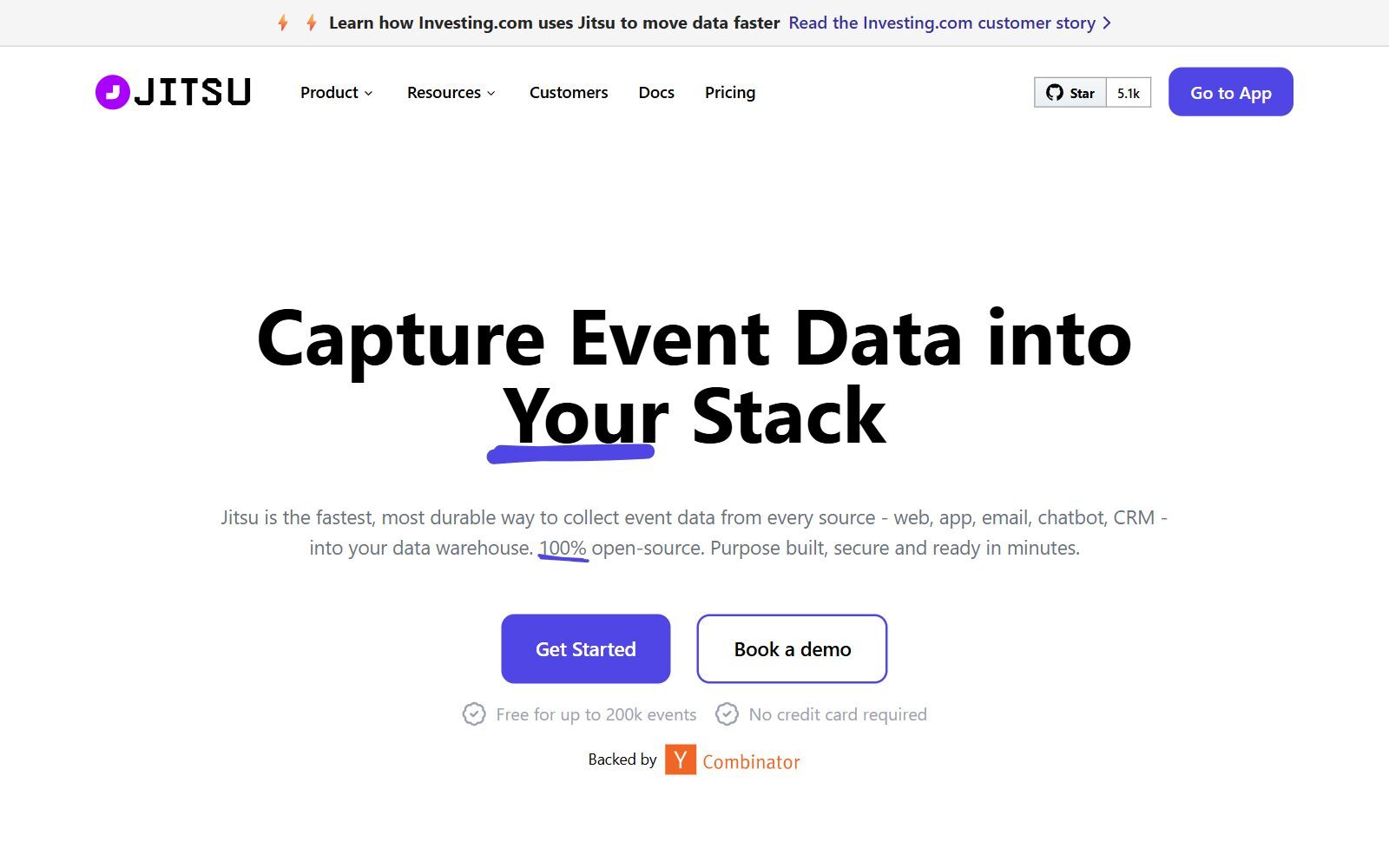
Jitsu is not a dashboard like Heap but the collection layer: one script captures events from your site and app and streams them into a data warehouse such as ClickHouse (included), where you query them with SQL or a BI tool. It is MIT-licensed and self-hostable, and the Jitsu pricing page shows a free cloud plan with 200k active events a month and a Business plan at $99 a month for 2M events. Pick it if you want to own raw behavioural data first and choose the analysis tool later; our open-source Segment alternatives compare it with other event pipelines.
Smaller open-source options: Swetrix (AGPL-3.0; funnels, session and user profiles and error tracking, with session replays on its Plus plan; cloud from €17 a month), Aptabase (AGPL-3.0 analytics for mobile and desktop apps, free up to 20,000 events a month; it tracks nothing automatically and has no user-level retention, by design) and rrweb (MIT, a JavaScript library to record and replay web sessions inside your own app; version 2.2.2 came out in November 2026).
Not Open Source, Changed, or Not a Heap Alternative
These names often appear in lists of open-source Heap alternatives, or were in the 2025 version of this article:
- RudderStack: its main server, rudder-server, is under the Elastic License 2.0, which is source-available, not an OSI open-source licence.
- Snowplow: since 8 January 2024, new versions of its core pipeline are released under the Snowplow Limited Use License Agreement, according to its GitHub README, so it is no longer open source.
- Highlight.io: the highlight.io website now redirects to LaunchDarkly, and the last tagged Docker release of the open-source project is from August 2025, so we left it out.
- Mixpanel and Amplitude: closed-source cloud products, like Heap. Our Google Analytics 4 alternatives list covers their free plans.
- Apache Superset, Metabase and Redash: open-source BI tools that chart data you already have; they do not capture user behaviour. See our open-source Metabase alternatives and open-source Tableau alternatives.
- Open Web Analytics and Plausible: still maintained, but they are website traffic tools without product funnels or user-level retention; they are covered in our open-source Google Analytics list.
Which Open-Source Heap Alternative Should You Choose?
- You want Heap-style autocapture and do not want to run servers: PostHog Cloud on its free tier.
- You must keep all data on your own servers and want to see what users do: OpenReplay, next to OpenPanel or Umami for the numbers.
- You track sign-ups, activation and payments as events: OpenPanel, self-hosted with no event limits or in its EU cloud.
- You have a mobile or desktop app: Countly Lite, keeping its branding in place, or Aptabase for anonymous app usage stats.
- You already use Matomo for your website: add the Funnels and Heatmap and Session Recording plugins, or move to Matomo Cloud.
- You have a data warehouse and an analyst: Jitsu to collect events, then a BI tool such as those in our open-source Looker alternatives.
Session replay and user-level tracking usually need consent in the EU and UK, even when a tool says it is cookie-free for basic stats. Mask form fields, keep replays behind your consent banner and read your data protection authority's guidance before you switch them on.
How Founders Use Open-Source Product Analytics
Start with one funnel that matters: visit, sign-up, first key action, payment. Track only the events behind those steps, check the drop-off every week and watch a few session replays of people who left at the worst step. Our guide to Google Analytics for startups explains which reports matter, and the same logic works in PostHog or OpenPanel. Report the metrics investors ask about from day one, tie them to your business model canvas metrics, and fix your first screen with a free landing page analyzer.
Product analytics is one part of an open-source startup stack. We have also checked free Google Analytics alternatives, open-source Power BI alternatives, open-source Snowflake alternatives for your warehouse, open-source social media analytics tools, open-source Intercom alternatives to talk to the users you see in your funnels and open-source Zapier alternatives to act on events. More and more visitors arrive from ChatGPT and other AI assistants, so also look at AI visibility tracking tools, and turn what you learn into articles with the F/MS AI SEO Tool. Before you build more features, validate your startup idea with real customers.
Join ElonaHunt (like ProductHunt but for women) and explore the coolest women-focused startups out there!
Discover your next big inspiration and connect with like-minded female entrepreneurs!
👉 Join the Hunt Here
FAQ About Open-Source Heap Alternatives
What is the best open-source alternative to Heap?
PostHog is the closest match: it autocaptures clicks and page views and adds funnels, retention, user paths and session replay, under the MIT licence outside its ee folder. Most startups use its free cloud tier, because self-hosting PostHog is officially unsupported.
Is Heap still available, and is it free?
Yes. Heap is now part of the Contentsquare group. Its free plan covers up to 10k monthly sessions with 6 months of data history, while Growth, Pro and Premier are priced by sessions on request, and session replay and heatmaps are add-ons on Pro and Premier.
Which open-source tool has autocapture like Heap?
PostHog's JavaScript library autocaptures clicks, form changes and page views by default, and you can limit it to certain pages or elements. Most other tools on this list need you to send custom events, and Aptabase tracks nothing automatically on purpose.
Can I self-host PostHog for free?
Yes, with the free Docker Compose hobby deploy under MIT, but PostHog's docs say self-hosted instances are officially unsupported, have no tagged releases or support, and only get the free-plan features. It needs a server of roughly 4 vCPUs and 16GB of RAM.
What is the best open-source session replay tool?
OpenReplay is built around session replay, with developer tools, funnels, journeys and heatmaps, and its Open-Source edition is free to self-host under AGPL-3.0. PostHog, OpenPanel and Rybbit also include replays, and rrweb is an MIT library if you want to build replay into your own app.
Is OpenPanel a good Mixpanel or Heap replacement?
For event-based product analytics, yes: it has funnels, retention, cohorts, user profiles and session replay, is AGPL-3.0, and self-hosting is free with no event limits. Its cloud starts at $2.50 a month for 5K events.
Which open-source analytics tool is best for mobile apps?
Countly Lite, with SDKs for iOS, Android and desktop apps, plus funnels, retention, cohorts, crash reports and push notifications. Its AGPL licence requires you to keep the Countly name and logo in the interface. Aptabase is a lighter option for anonymous app stats.
Is RudderStack open source?
Not fully. RudderStack's main server, rudder-server, is under the Elastic License 2.0, which is source-available rather than an OSI open-source licence. Jitsu is an MIT-licensed alternative for collecting events into your warehouse.
Are Metabase and Apache Superset Heap alternatives?
No. They are open-source BI tools that chart data you already have and do not capture what users do in your product. You can use them on top of Jitsu, PostHog or your own database.
Where can I get a backlink by writing about my startup?
You can publish a guest post in one of the Fe/male Switch startup blogs, which rank in Google and in AI tools. Get a quality backlink.
About the Author
Violetta Bonenkamp, also known as MeanCEO, is an experienced startup founder with an impressive educational background including an MBA and four other higher education degrees. She has over 20 years of work experience across multiple countries, including 5 years as a solopreneur and serial entrepreneur. Throughout her startup experience she has applied for multiple startup grants at the EU level, in the Netherlands and Malta, and her startups received quite a few of those. She’s been living, studying and working in many countries around the globe and her extensive multicultural experience has influenced her immensely.

