

Open-Source LottieFiles Alternatives: Create, Convert, Bundle and Play Lottie Animations Without a Subscription
LottieFiles is a paid platform built around Lottie, the small JSON animation format used for app onboarding, loaders, animated icons and website heroes. But Lottie itself is an open format, and every step of the pipeline has an open-source tool: an editor to draw the animation, a converter to move it between formats, a library to bundle it as a compact .lottie file, and a player to show it in your website or app. This guide covers only open-source software for that Lottie pipeline. We checked each project's licence, latest release and features on its official website and repository on 3 November 2026, and we list separately the old recommendations that are archived, abandoned or never made Lottie files. For paid and freemium editors such as Jitter, Lottielab or Cavalry, see our LottieFiles alternatives guide.
Quick answer: to create and edit Lottie files with open-source software, use Glaxnimate (it opens and saves Lottie and Telegram stickers) or Synfig Studio (Lottie export since version 1.4.0); to convert and script files, use python-lottie; to bundle animations into .lottie files, use dotlottie-js; and to play them, use the MIT-licensed dotLottie players for the web and apps, Airbnb's Lottie for iOS, Android and React Native, or the ThorVG and Skottie engines if you build your own renderer.
Boost Your SEO by Getting Featured in Our Blogs and get a backlink.
We publish content about startups, education, tech, funding, etc. that ranks well not only in Google but also in Perplexity, ChatGPT, Grok and other AI tools.
👉 Get featured now!
What LottieFiles Costs in 2027, and What Is Already Open
On the LottieFiles pricing page (default view, checked 3 November 2026) the Individual plan costs $19.99 per user per month and Team $24.99 per user per month, both billed annually. Individual includes one editor, 10 GB of CDN hosting, 2 GB of asset storage and 300 AI credits a month; Team has two or more editors, 50 GB of CDN, 5 GB of storage and 600 AI credits. Team+ and Enterprise prices are not listed. The FAQ says a free version gives new users unlimited preview, testing and sharing, the free animation library and basic edits.
What you pay for is the platform: the editor, hosting, the asset library and AI features. The format is not owned by LottieFiles. The Lottie Animation Community describes itself as a non-profit open-source project hosted by the Linux Foundation, working on a formal Lottie specification, and the Lottie specification repository tagged version 1.0.1 in April 2025. LottieFiles also publishes its players and its .lottie tooling under the MIT licence, so several tools below come from LottieFiles itself and are free to use without an account.
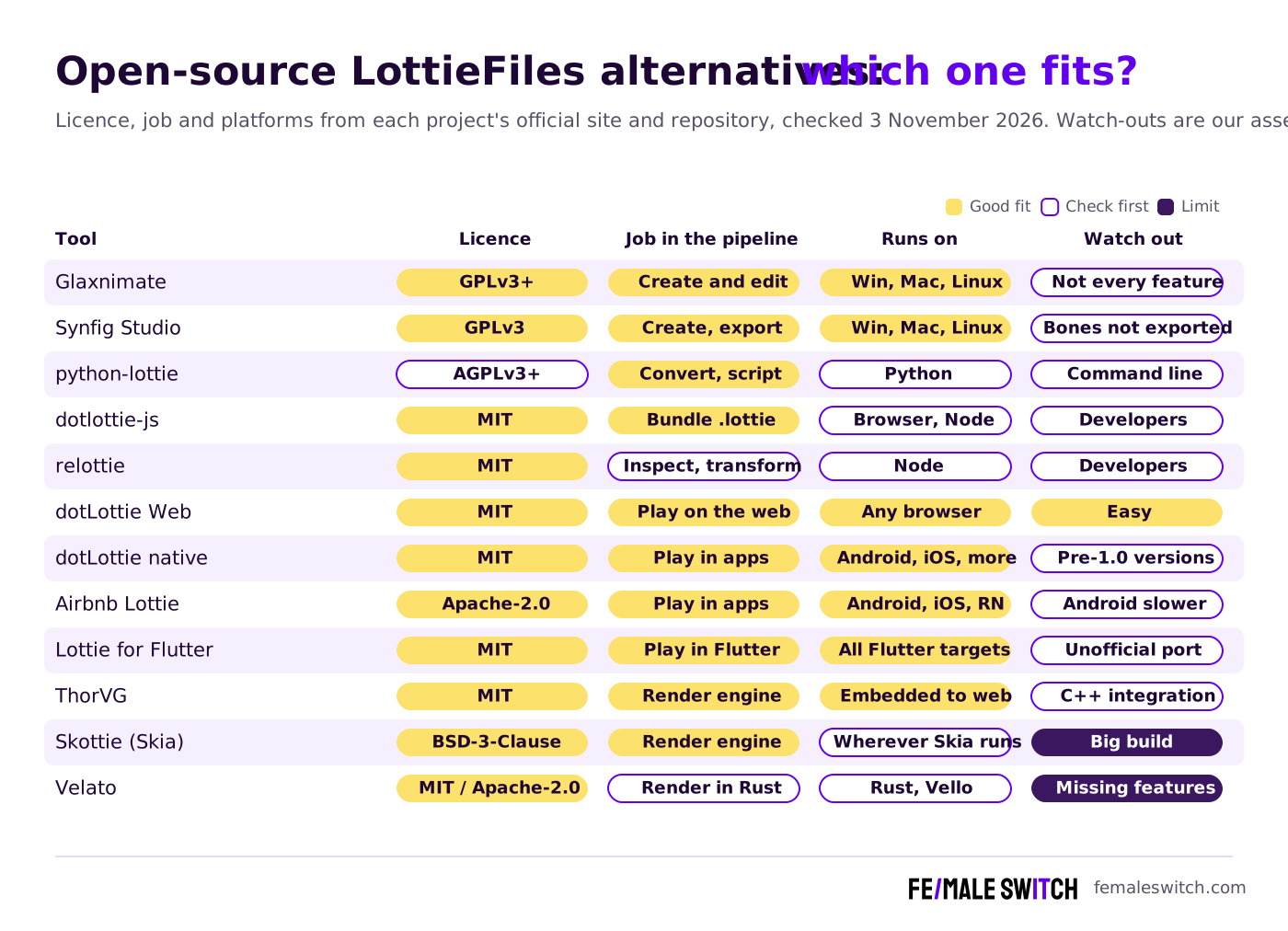
Open-Source LottieFiles Alternatives Compared
Sources: each project's official website, documentation and repository (licence file, releases, commits), checked 3 November 2026. Licences can differ between parts of a project, so read the licence file before you ship.
Open-Source Tools to Create and Edit Lottie Animations
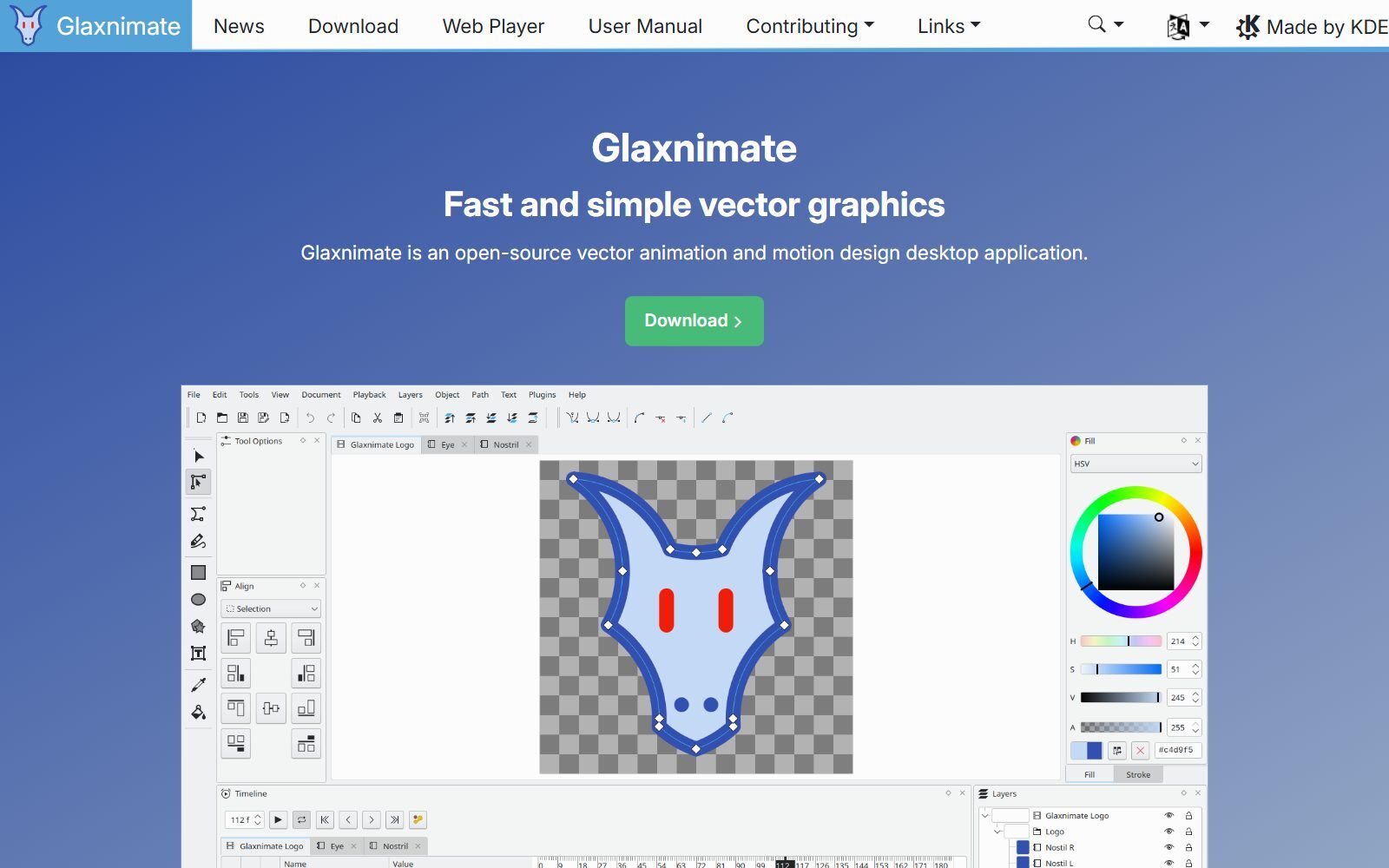
1. Glaxnimate: the open-source Lottie editor
Glaxnimate is an open-source vector animation and motion design app for Linux, Windows and macOS, now part of KDE. It is the closest open-source answer to Lottie Creator because it works with Lottie directly: according to its file format documentation, it can open and save Lottie JSON and Telegram animated stickers (TGS), runs Telegram's sticker restrictions check when you save a TGS file, and offers a Lottie web preview. That means you can download a Lottie file, change colours, timing or shapes, and save it again, which is what many teams use the LottieFiles editor for. It also handles animated SVG, GIF and WebP. The documentation warns that not every Lottie feature is implemented, so test complex files exported from After Effects. The Glaxnimate repository is GPLv3 or later, and version 0.6.0, the first stable release as part of KDE, came out on 3 March 2026.
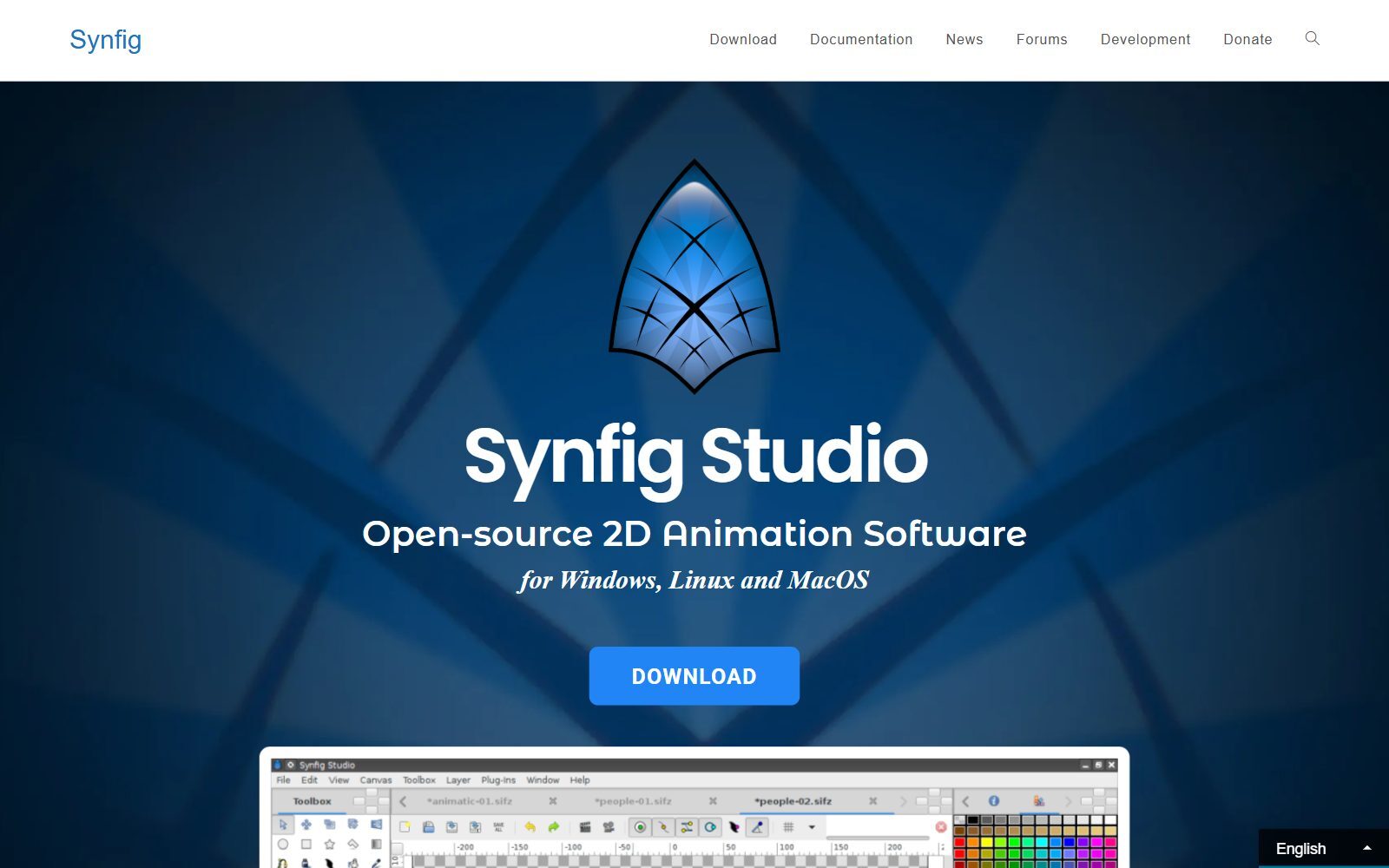
2. Synfig Studio: character animation exported to Lottie
Synfig Studio is a GPL v3 2D animation app for Windows, Linux and macOS that calculates the frames between your key positions, so you animate without drawing every frame. Its Lottie exporter, available since version 1.4.0 under Plugins, Export to Lottie, writes three files: the Lottie JSON for your page, an HTML file to preview it in a browser and a log that names any layer it could not convert. Know the limits before you plan a project around it: bone (skeleton) animation is not exported yet, and region, outline and polygon layers are exported frame by frame, which makes files heavier. Synfig 1.5.5 was released on 22 March 2026, and the code was still being updated in November 2026.
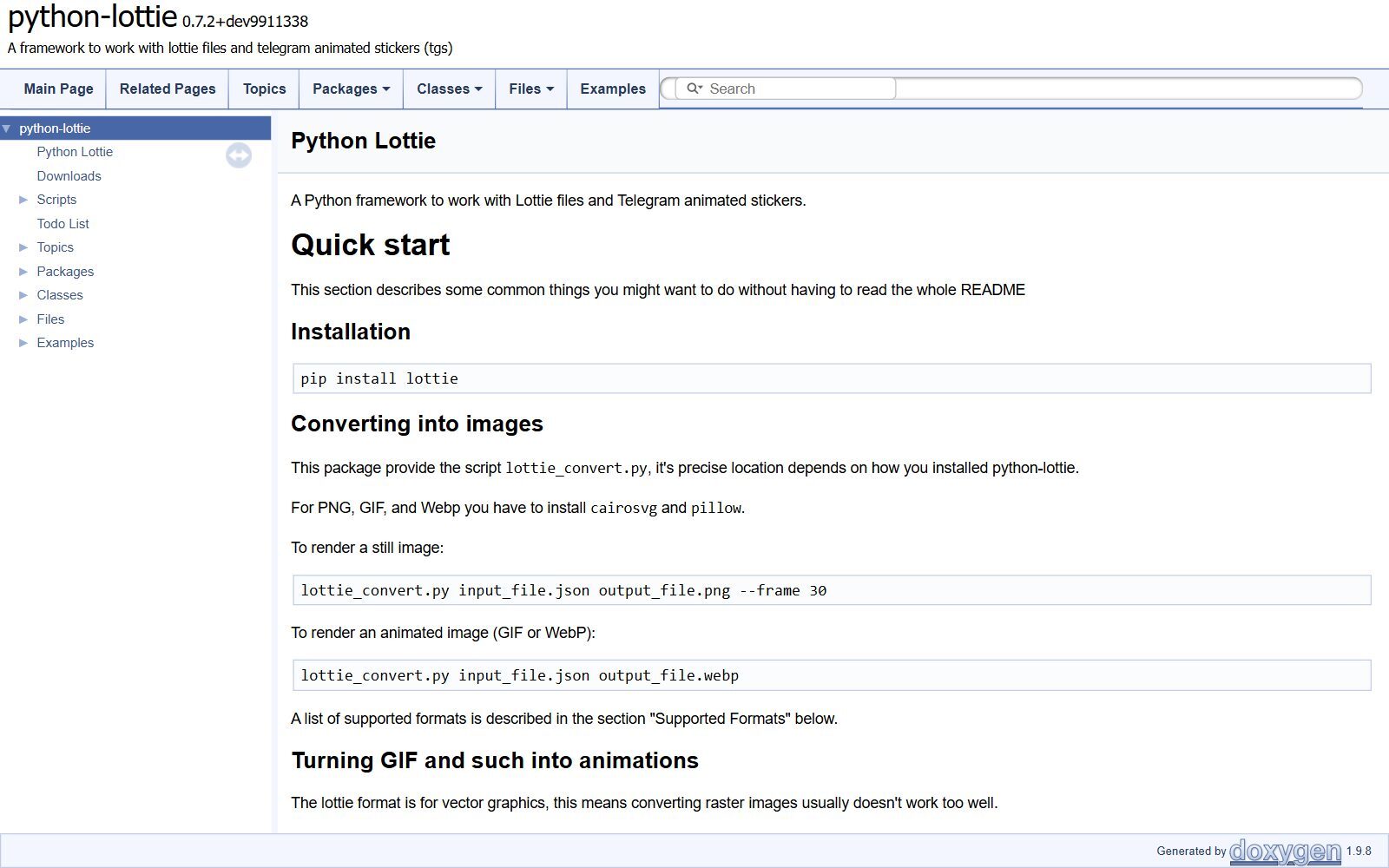
3. python-lottie: convert, inspect and script Lottie files
python-lottie is a Python framework for Lottie files and Telegram animated stickers, from the same author who started Glaxnimate. You install it with pip install lottie and use its lottie_convert.py script to move animations between formats: its documentation lists Lottie, TGS, SVG, dotLottie and Synfig in both directions, and export to GIF, WebP, MP4, WebM and HTML among others. It can also build animations from code, pretty-print and compare Lottie files, and check a TGS file for features Telegram does not support. That makes it useful for jobs LottieFiles does in the browser, such as turning a Lottie into a GIF for an email or a video for social media, but in a script you can run on hundreds of files. The licence is AGPLv3 or later; the last tagged release is 0.7.2 from May 2025, and the python-lottie repository was last updated in April 2026.
4. dotlottie-js: bundle and shrink animations as .lottie files
A .lottie file is a ZIP archive, compressed with Deflate, that holds one or more Lottie animations with their images, themes and state machines. Because it is compressed, it can be smaller than the same animation as plain JSON, which helps page speed. dotlottie-js is the MIT-licensed JavaScript library for creating and modifying .lottie files in the browser or in Node.js: you add your Lottie JSON animations, set loop and autoplay options and export one .lottie file, for example in your build process. Version 1.9.0 came out in October 2026.
5. relottie: read and change Lottie files with plugins
relottie is an MIT-licensed tool from LottieFiles that turns a Lottie file into a syntax tree, so plugins can inspect and change it, in the same way the unified ecosystem processes Markdown and HTML. Developers use this kind of tool to rename layers, swap brand colours, strip unused data or check files automatically before they ship. It is a developer library, not an app; its packages were last released in July 2026.
Validate your startup idea with the unique borrowed authority approach: we publish articles about your product in our blog and you get traffic and testers for your MVP
- Prove Market Demand: See real organic traffic and waitlist conversions
- Unlock High-Potential Keywords: Receive a curated list of top-performing keywords directly from Google Search Console data.
- Estimate Customer Acquisition Cost (CAC): Gain financial foresight with an estimated CAC based on real keyword performance data.
🔗 Start validating your startup now
Open-Source Lottie Players for Websites and Apps
6. dotLottie Web: the open-source web player
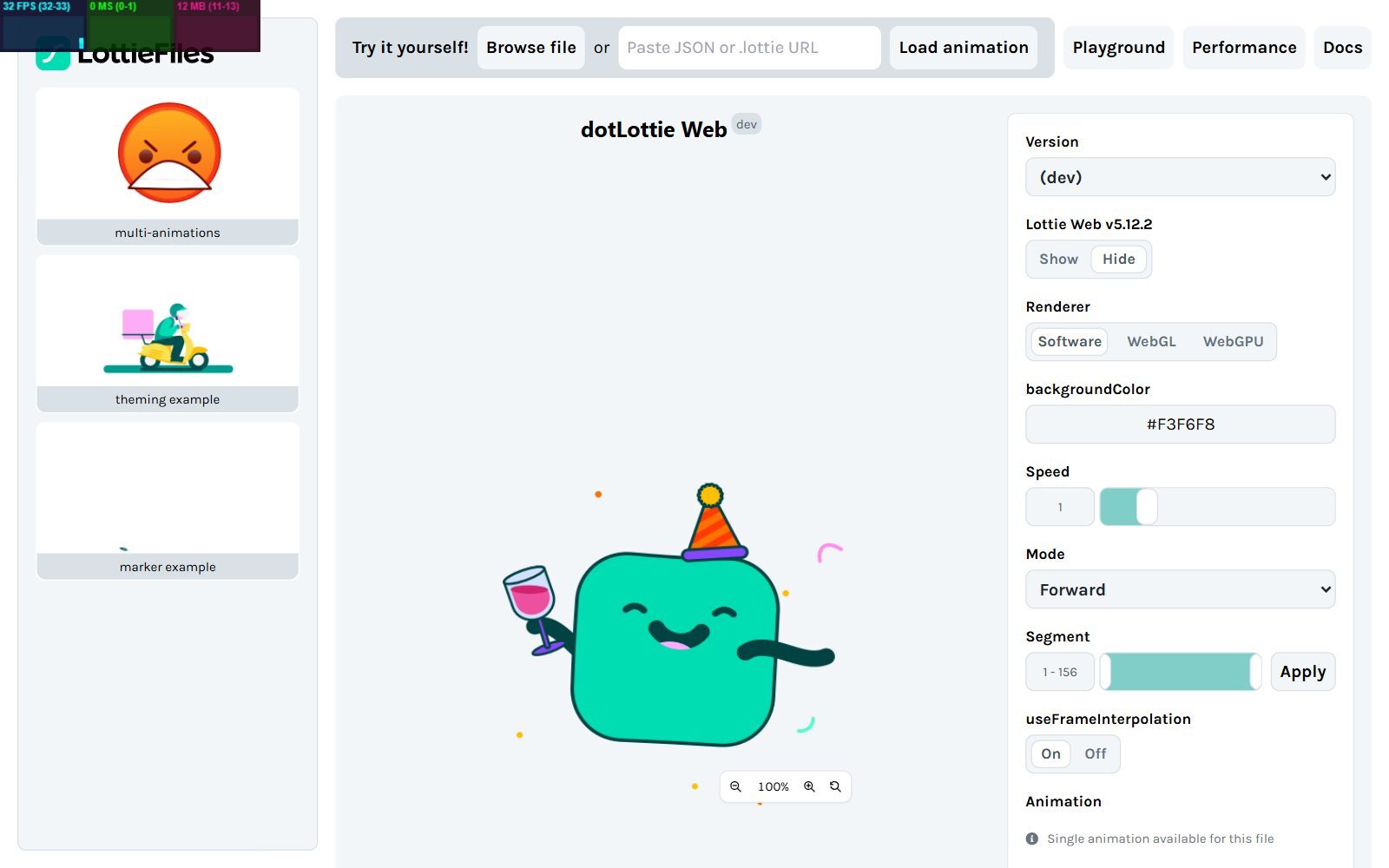
dotLottie Web is the official LottieFiles player for websites, and it is MIT-licensed, so you can use it without a LottieFiles plan. It plays both classic Lottie JSON and .lottie files, with a Rust and WebAssembly core built on the ThorVG renderer and a choice of Software, WebGL2 or experimental WebGPU rendering. A Web Worker mode moves rendering off the main thread, which keeps a page responsive when it shows many animations. There are ready packages for plain JavaScript, React, Vue, Svelte, Solid and a Web Component, plus runtime themes, colour and text slots, markers, segments and interactive state machines. Version 0.82.1 came out on 2 November 2026. You host the files yourself, on your own server or any CDN, so you do not need LottieFiles' hosting plan.
7. dotlottie-rs and the native dotLottie players
dotlottie-rs is the MIT-licensed Rust runtime behind every official dotLottie player. It exposes a C API for native platforms and WebAssembly bindings for the web, and powers the players for Android, iOS, Flutter and React Native, so an animation with themes, several animations in one file or a state machine behaves the same everywhere. dotlottie-rs 0.1.60 was released on 26 October 2026; the dotLottie Android player reached 0.17.0 in October 2026 and the dotLottie iOS player 0.16.9 in August 2026, both MIT. The version numbers are still below 1.0, so pin versions and test updates before release.
8. Lottie for iOS, Android and React Native (Airbnb)
The original Lottie libraries from Airbnb render Lottie animations natively in mobile apps, with documentation for Android, Jetpack Compose, iOS, React Native, the web and Windows. The mobile libraries are Apache-2.0: Lottie for iOS released 4.6.1 in June 2026, Lottie for Android released 6.7.1 in October 2025 and had code changes until February 2026, and Lottie React Native released 7.5.0 in August 2026. The latest React Native package needs React Native 0.84 or newer with the New Architecture; older apps can stay on version 7.3.x. Choose these if your app already uses Lottie JSON files and you do not need .lottie features.
9. Lottie for Flutter
Lottie for Flutter is an MIT-licensed, pure-Dart port of Lottie for Android. Its README calls it an unofficial conversion, and it runs on every Flutter target: Android, iOS, macOS, Linux, Windows and the web. Version 3.8.2 came out in November 2026. It is the simplest way to show a Lottie animation in a Flutter app; if you need .lottie theming or state machines, use the dotLottie Flutter player built on dotlottie-rs instead.
10. ThorVG: the lightweight engine behind many Lottie players
ThorVG is an MIT-licensed vector graphics engine for embedded systems, desktop apps and the web that renders SVG and Lottie. Its website names Blender, Godot, LottieFiles, LVGL, Espressif and Tizen OS among the projects that use it, and it is the renderer inside dotLottie. The ThorVG repository publishes a Lottie feature support list, can be built as a compact Lottie-only player, and offers a ThorVG Lottie player package on npm. Version 1.1.3 was released on 15 October 2026. Pick it if you build a device, a game or a native app and want Lottie without a browser.
11. Skottie: Skia's Lottie player
Skottie is the Lottie player inside Skia, the open-source 2D graphics library from Google, licensed under BSD-3-Clause. Skia describes it as a performant, secure native player for animations exported with Bodymovin, usable on any platform where you use Skia, including Android and iOS. On the web, the full build of Skia's CanvasKit includes Skottie, and the Skottie test server lets you check how a file renders. It suits teams that already use Skia; for a normal website, dotLottie Web is lighter to add.
12. Velato: a Lottie renderer for Rust
Velato from the Linebender community parses and renders Lottie animations in Rust, through the Vello GPU renderer or your own renderer. It is dual-licensed MIT or Apache-2.0, and version 0.12.0 came out in September 2026. Its README lists Lottie features it does not support yet, so it is for Rust developers who accept gaps, not for a marketing site.
Lottie Tools From Older Lists That Are Archived, Stalled or Not Lottie Tools
The 2025 version of this article listed general animation apps and code libraries. Here is what changed and why some are no longer on the list:
- lottie-web and the Bodymovin plugin: still the standard way to export Lottie from Adobe After Effects and play it on the web, and MIT-licensed, but the lottie-web repository has had no code change on its main branch since its last release, 5.13.0, in November 2024. Bodymovin also needs a paid After Effects plan. For playback, dotLottie Web is the maintained choice.
- LottieFiles lottie-player: the old Lottie web component is archived on GitHub; its last release, 2.0.1, is from June 2023. Use the dotLottie Web Component instead.
- rlottie (Samsung): its README now says the project is deprecated, will be archived and is no longer maintained. ThorVG is the active alternative for native apps.
- Enve: its code has not changed since September 2022. Its fork, Friction, is active but exports animated SVG and video, not Lottie; see our open-source Rive alternatives.
- Wick Editor: GPLv3, but its last release, 1.19, is from December 2020 and its code has not changed since January 2021.
- OpenToonz, Pencil2D, Krita and Blender: open source and actively developed, but they produce video and image sequences, not Lottie files. They are covered in the open-source Rive guide, our open-source Blender alternatives and open-source Krita alternatives.
- Motion and Magic UI: MIT-licensed code libraries for animating web interfaces in JavaScript and React. They can replace a Lottie in some interfaces, but they do not create or play Lottie files.
Which Open-Source LottieFiles Alternative Should You Choose?
- You want to edit a Lottie file you downloaded (colours, timing, shapes): Glaxnimate.
- You want to animate a character or explainer and ship it as Lottie: Synfig Studio, keeping its exporter limits in mind.
- You make Telegram stickers: Glaxnimate to draw them, python-lottie to convert and check them.
- You need GIFs or videos from Lottie files, in bulk: python-lottie.
- You want smaller files and several animations in one: dotlottie-js to build .lottie files.
- You show animations on a website: dotLottie Web, with files on your own hosting.
- You build a mobile app: the dotLottie players for .lottie features, or Airbnb's Lottie for iOS, Android and React Native for plain JSON; Lottie for Flutter in Flutter apps.
- You build a device, a game or a custom renderer: ThorVG, Skottie if you already use Skia, or Velato in Rust.
If you need a visual editor with templates, AI features and team libraries, no open-source project matches LottieFiles or its rivals yet; compare the free LottieFiles alternatives and the paid editors in our LottieFiles alternatives guide. If you want interactive animation beyond Lottie, read our Rive alternatives and free Rive alternatives.
How Founders Use Open-Source Lottie Tools
For an early-stage startup, one well-placed animation does more than ten: an onboarding step that shows how the product works, a loader that makes waiting feel shorter, or an animated hero on the landing page. An open-source Lottie pipeline keeps that cheap and keeps your files in an open format you own. A simple workflow: map the message first with the F/MS Lean Canvas tool, design the screens and static artwork with our open-source Figma alternatives, open-source Illustrator alternatives or open-source Inkscape alternatives, animate in Glaxnimate, bundle the result as a .lottie file and play it with dotLottie Web. Then test it on a slow phone and check whether sign-ups change.
For static social graphics, our free Canva Pro alternatives are faster than any animation tool, and for a quick launch page the free Carrd alternatives help. Once the page is live, the F/MS AI SEO Tool helps you write the articles that bring visitors to it.
Join ElonaHunt (like ProductHunt but for women) and explore the coolest women-focused startups out there!
Discover your next big inspiration and connect with like-minded female entrepreneurs!
👉 Join the Hunt Here
FAQ About Open-Source LottieFiles Alternatives
Is there an open-source alternative to LottieFiles?
Not as one platform, but every part of it has an open-source tool: Glaxnimate and Synfig Studio to create Lottie files, python-lottie to convert them, dotlottie-js to bundle them and the MIT-licensed dotLottie and Lottie players to show them in websites and apps.
Is Lottie open source?
Yes. Lottie is an open format, and the Lottie Animation Community, a non-profit project hosted by the Linux Foundation, works on its formal specification. The main players, from Airbnb and LottieFiles, are open source under the Apache-2.0 and MIT licences.
Can I edit a Lottie file without LottieFiles?
Yes. Glaxnimate can open a Lottie JSON or Telegram sticker file, let you change it and save it again. Not every Lottie feature is supported, so check complex files after saving.
Is the dotLottie player free to use?
Yes. dotLottie Web and the native dotLottie players for Android and iOS are MIT-licensed, so you can use them in commercial projects without a LottieFiles plan and host the files yourself.
What is the difference between Lottie JSON and .lottie?
A Lottie JSON file holds one animation as text. A .lottie file is a compressed ZIP archive that can hold several animations, their images, themes and interactive state machines, so it can be smaller and more flexible.
How do I convert a Lottie file to GIF or MP4 for free?
Use python-lottie: its lottie_convert.py script exports Lottie files to GIF, WebP, MP4, WebM and other formats, and you can run it on many files at once.
Can Synfig Studio export Lottie?
Yes, since version 1.4.0, through Plugins and Export to Lottie. Bone animation is not exported yet, and some layer types are exported frame by frame.
Is lottie-web still developed?
It still works and is MIT-licensed, but its last release, 5.13.0, is from November 2024 and its main branch has not changed since. LottieFiles' dotLottie Web player is updated regularly and plays both Lottie JSON and .lottie files.
How much does LottieFiles cost in 2027?
When we checked on 3 November 2026, the Individual plan cost $19.99 per user per month and Team $24.99 per user per month, both billed annually. A free version offers preview, testing, sharing and the free animation library.
Where can I get a backlink by writing about my startup?
You can publish a guest post in one of the Fe/male Switch startup blogs, which rank in Google and in AI tools. Get a quality backlink.
About the Author
Violetta Bonenkamp, also known as MeanCEO, is an experienced startup founder with an impressive educational background including an MBA and four other higher education degrees. She has over 20 years of work experience across multiple countries, including 5 years as a solopreneur and serial entrepreneur. Throughout her startup experience she has applied for multiple startup grants at the EU level, in the Netherlands and Malta, and her startups received quite a few of those. She’s been living, studying and working in many countries around the globe and her extensive multicultural experience has influenced her immensely.

