

Open-Source Voice Cloning Tools: Self-Hosted Voice Cloning and Text-to-Speech Models a Startup Can Actually Use
Voice cloning used to mean a paid API and a monthly bill per character. Today you can download open models that copy a voice from a few seconds of audio and run them on your own GPU, for voice agents, dubbing, audiobooks, games or accessibility features. The hard part is no longer quality: it is the licence. Many popular voice models publish their code under a permissive licence but their trained weights under a non-commercial one, so a demo that works on your laptop may not be allowed in your product. We checked every project below on GitHub and Hugging Face in October 2026: the licence of the code and of the model weights, the latest release, recent activity and whether the repository is archived.
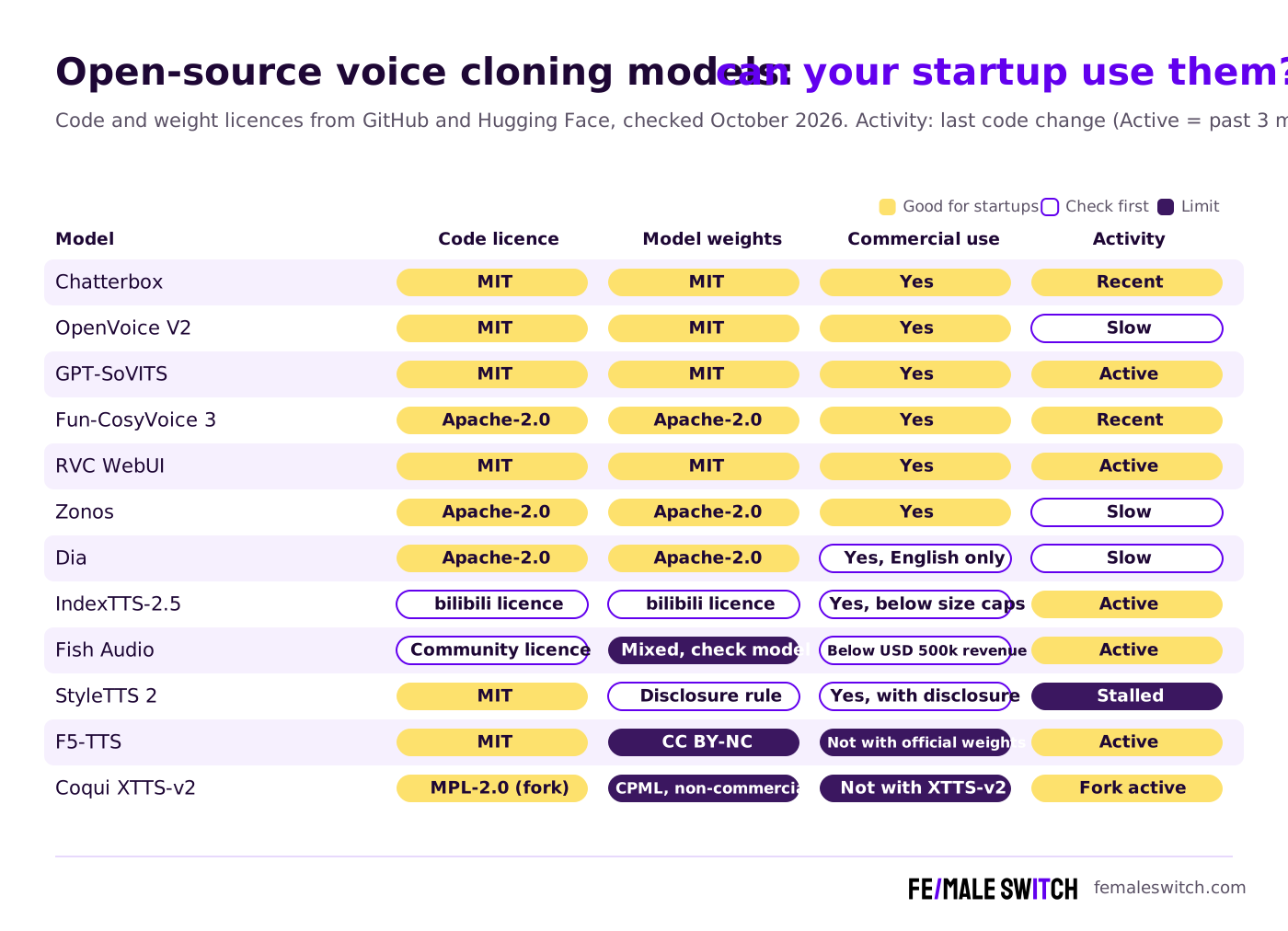
Quick answer: for a commercial product, start with Chatterbox (MIT code and weights, built-in watermark), GPT-SoVITS (MIT, strong few-shot cloning) or Fun-CosyVoice 3 (Apache-2.0, nine languages). OpenVoice V2, Zonos and Dia are also free for commercial use but see little development now. F5-TTS and Coqui's XTTS-v2 sound great, but their official weights are non-commercial. Whatever you pick, only clone voices whose owners have agreed.
Boost Your SEO by Getting Featured in Our Blogs and get a backlink.
We publish content about startups, education, tech, funding, etc. that ranks well not only in Google but also in Perplexity, ChatGPT, Grok and other AI tools.
👉 Get featured now!
Is “VoiceClone Lite” a Real Product?
The 2025 version of this article listed open-source alternatives to “VoiceClone Lite”. When we checked in October 2026, we could not verify that a product with this name exists: we found no official website, app listing or documentation for it. Search results only show similar names, such as a “Lite” cloning tier of the AnySpeech service and several mobile apps called “VoiceClone AI”. So instead of comparing tools with a product we cannot confirm, this guide covers what people searching for it usually want: free, open-source voice cloning and text-to-speech models you can self-host.
Open-Source Voice Cloning Models Compared
Sources: each project's GitHub repository (README, LICENSE file, releases, last commit) and Hugging Face model card, checked 28 October 2026. Self-hosting is free, but you pay for GPUs, storage and your own time.
The Best Open-Source Voice Cloning Tools in 2027
1. Chatterbox: the safest pick for commercial voice cloning
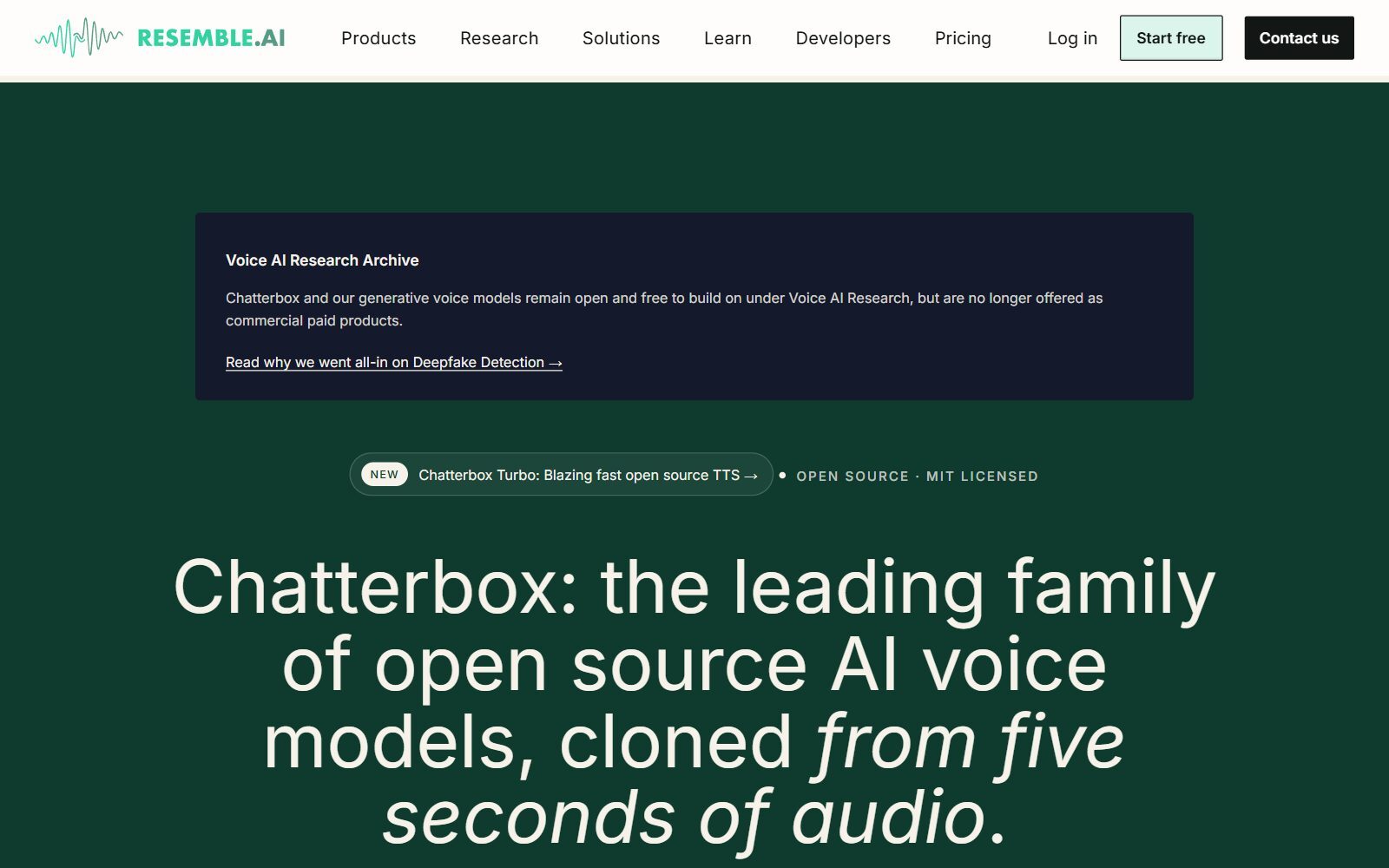
Chatterbox from Resemble AI is a family of open voice models whose code and weights are both MIT-licensed. Its README lists Chatterbox-Turbo (350 million parameters, English, built for low-latency voice agents, with tags such as [laugh] and [cough]), Chatterbox-Nano (110 million parameters, runs on a CPU at three times real time on eight cores) and Chatterbox Multilingual V3 (500 million parameters, 23+ languages, cross-language cloning). Every file it generates carries Resemble AI's imperceptible PerTh watermark, which you can detect with an open script: useful if you ever need to prove that a clip came from your system. One change to know: the Chatterbox page now says the models remain open and free to build on but are no longer offered as commercial paid products, as Resemble AI has moved to deepfake detection. So you get the open models, not a paid support contract. The code was last updated in July 2026.
2. OpenVoice V2: instant cloning, free for commercial use
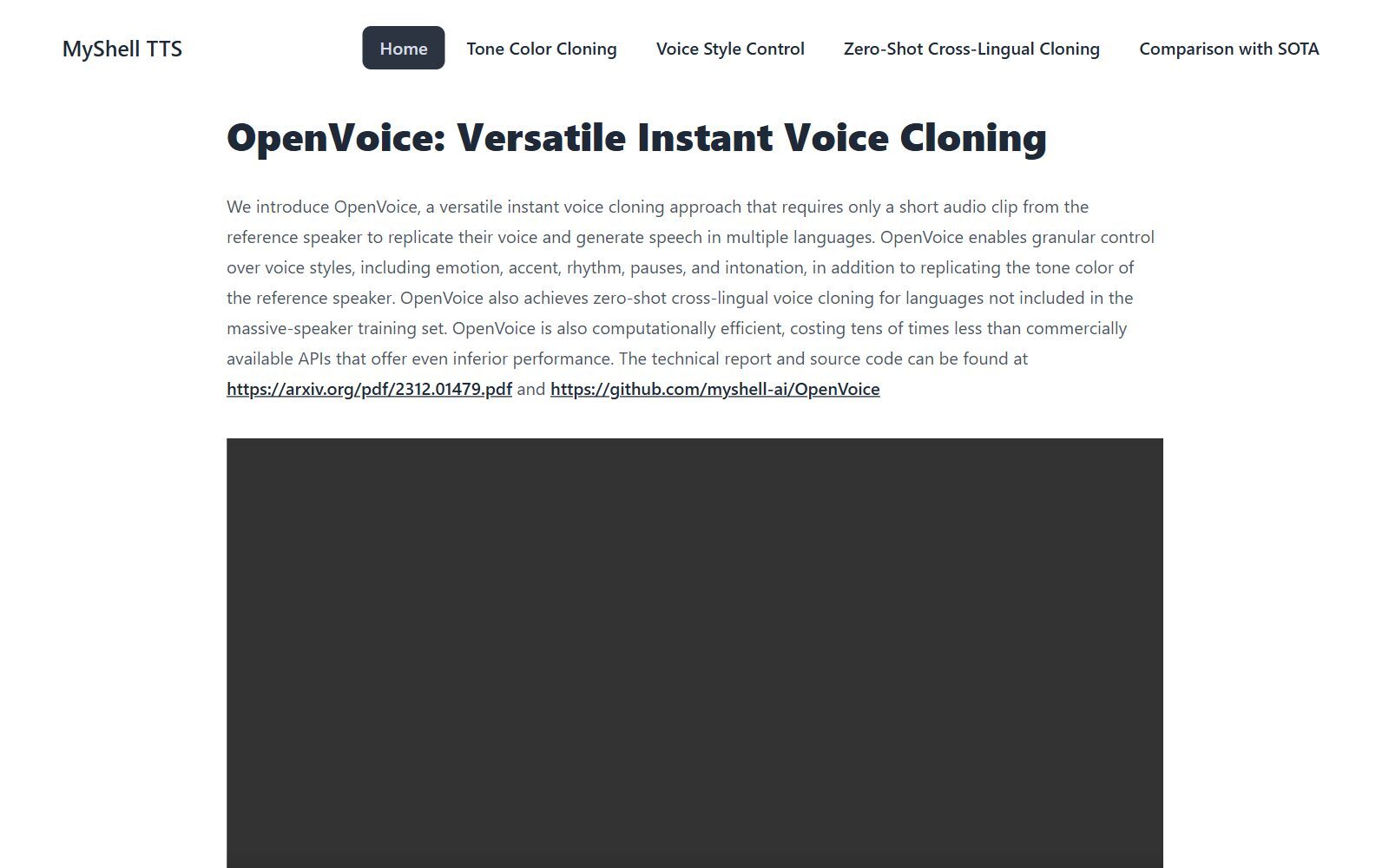
OpenVoice, developed by MyShell with researchers from MIT and Tsinghua University, clones the tone of a voice from a short clip and lets you control emotion, accent, rhythm, pauses and intonation. It can also clone across languages: the reference speaker and the output do not need to share a language. Version 2, released in April 2024, supports English, Spanish, French, Chinese, Japanese and Korean natively. Its GitHub README says that since April 2024 both V1 and V2 are MIT-licensed and free for commercial and research use. The catch is activity: the code has not changed since April 2025, so expect to fix dependencies yourself.
3. GPT-SoVITS: few-shot cloning with one minute of audio
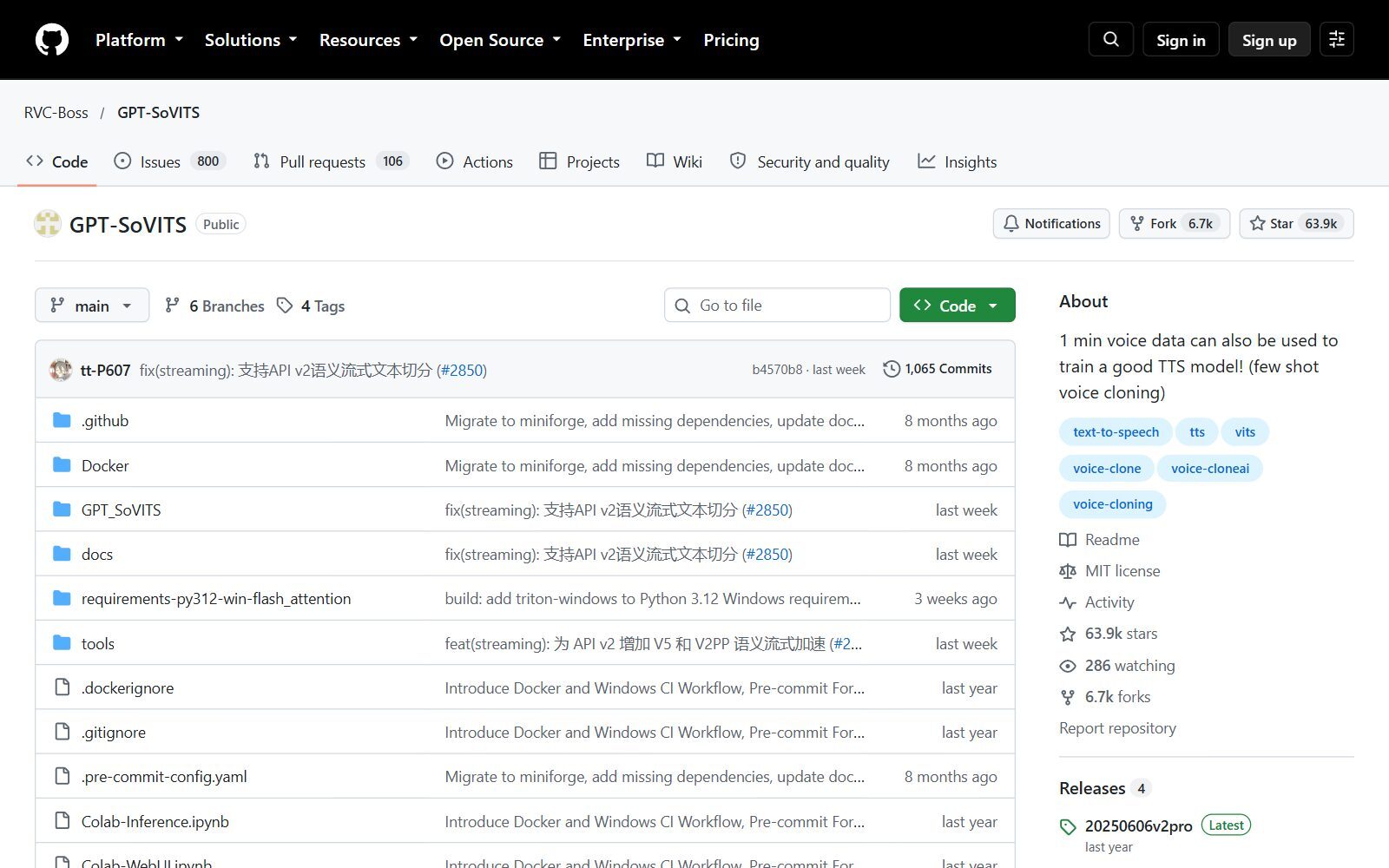
GPT-SoVITS is one of the most popular open voice cloning projects, with more than 60,000 stars on GitHub. It clones a voice zero-shot from a 5-second sample, and you can fine-tune it on about one minute of recordings for a closer match. It speaks English, Japanese, Korean, Cantonese and Chinese, and its web interface includes tools to separate vocals from music, cut training audio and transcribe it, which makes it friendly for non-researchers. Code and the pretrained models on Hugging Face are MIT-licensed. The last tagged release is from June 2025, but the code and the newer V5 models were still being updated in October 2026.
4. Fun-CosyVoice 3: multilingual cloning under Apache-2.0
Fun-CosyVoice 3, from Alibaba's FunAudioLLM team (the repository now sits under the QwenAudio organisation on GitHub), is a large-language-model-based TTS system for zero-shot multilingual speech. It covers nine languages (Chinese, English, Japanese, Korean, German, Spanish, French, Italian and Russian) plus 18+ Chinese dialects, and supports cross-lingual cloning and instructions for emotion, speed and volume. Both the code and the Fun-CosyVoice3-0.5B weights (released December 2025) are Apache-2.0, which allows commercial use. Note that the README's disclaimer calls its demo content “for academic purposes only”; that covers the examples, not the licence. The code was last updated in May 2026.
5. RVC WebUI: convert one voice into another
The Retrieval-based Voice Conversion WebUI (RVC) does speech-to-speech conversion: you speak or sing, and the output sounds like the target voice. According to its README you can train a good model with 10 minutes of voice data or less. Code and the pretrained models are MIT-licensed, and a new release came out in July 2026. It replaces the Mangio-RVC-Fork from the 2025 list, which has not been updated since September 2023. Because it can make anyone sound like a chosen voice, the consent rules below matter especially here.
Validate your startup idea with the unique borrowed authority approach: we publish articles about your product in our blog and you get traffic and testers for your MVP
- Prove Market Demand: See real organic traffic and waitlist conversions
- Unlock High-Potential Keywords: Receive a curated list of top-performing keywords directly from Google Search Console data.
- Estimate Customer Acquisition Cost (CAC): Gain financial foresight with an estimated CAC based on real keyword performance data.
🔗 Start validating your startup now
6. Zonos: expressive cloning at 44 kHz
Zonos v0.1 from Zyphra is an open-weight TTS model trained on more than 200,000 hours of multilingual speech. It clones a voice from a 10 to 30 second sample, outputs 44 kHz audio and lets you control speaking rate, pitch variation, audio quality and emotions such as happiness, fear, sadness and anger. Code and both model versions (transformer and hybrid) are Apache-2.0. Development has been quiet since March 2025.
7. Dia: realistic English dialogue in one pass
Dia is a 1.6-billion-parameter model from Nari Labs that generates dialogue between speakers, including non-verbal sounds, in one pass. You can clone a voice by giving it a 5 to 10 second audio prompt together with its transcript. Code and weights are Apache-2.0, but it only speaks English, and the code was last changed in November 2025. Good for podcast-style or conversational demos.
8. IndexTTS-2.5: controllable cloning from bilibili
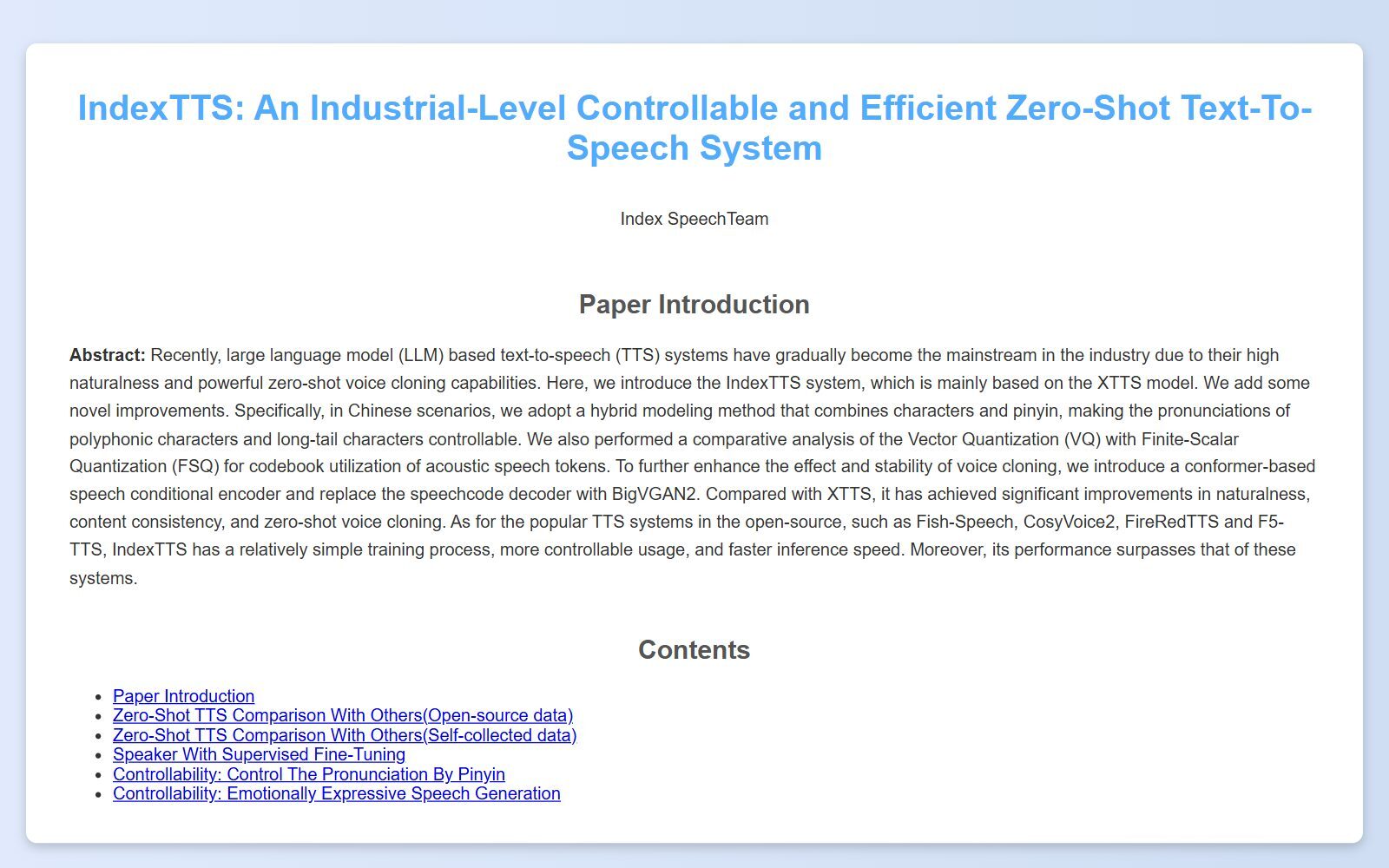
IndexTTS from the video platform bilibili is a zero-shot TTS system that separates timbre from emotion, so you can clone a voice and set the emotion separately. IndexTTS-2.5, released on 10 August 2026, supports Chinese, English, Japanese, Spanish and Arabic. It is not under a standard open-source licence: the bilibili Model Use License allows free use, including commercial use, but companies with more than 100 million monthly active users or more than RMB 1 billion in annual revenue need a separate licence, you may not use it to improve other AI models (except non-commercial ones), and you carry full responsibility for any infringement, including personality rights. Version 2.5.0 was released in August 2026.
9. Fish Audio (fish-speech): new community licence for small companies
The fish-speech repository from Fish Audio hosts its Drama 3 and S2-Pro voice models; S2-Pro covers about a hundred languages. Licensing changed on 13 October 2026: the new Fish Audio Community License allows free commercial use while your company's annual revenue is below USD 500,000, but never as a hosted text-to-speech or voice cloning service for others without a separate agreement. The README says the S2-Pro weights stay under the Fish Audio Research License, which is non-commercial, and the Drama 3 model card on Hugging Face still listed the research licence when we checked. Read the licence of the exact model you download, and ask Fish Audio if in doubt.
10. StyleTTS 2: high-quality English TTS with a disclosure rule
StyleTTS 2 produces very natural English speech using style diffusion and adversarial training. The code is MIT, but the pretrained models come with a condition: unless you have permission to use the voice you synthesise, you must tell listeners that the speech is synthesised. Its README also notes that inference depends on a GPL-licensed phonemizer package. The code has not changed since August 2024, so treat it as a research base.
11. F5-TTS: excellent quality, non-commercial weights
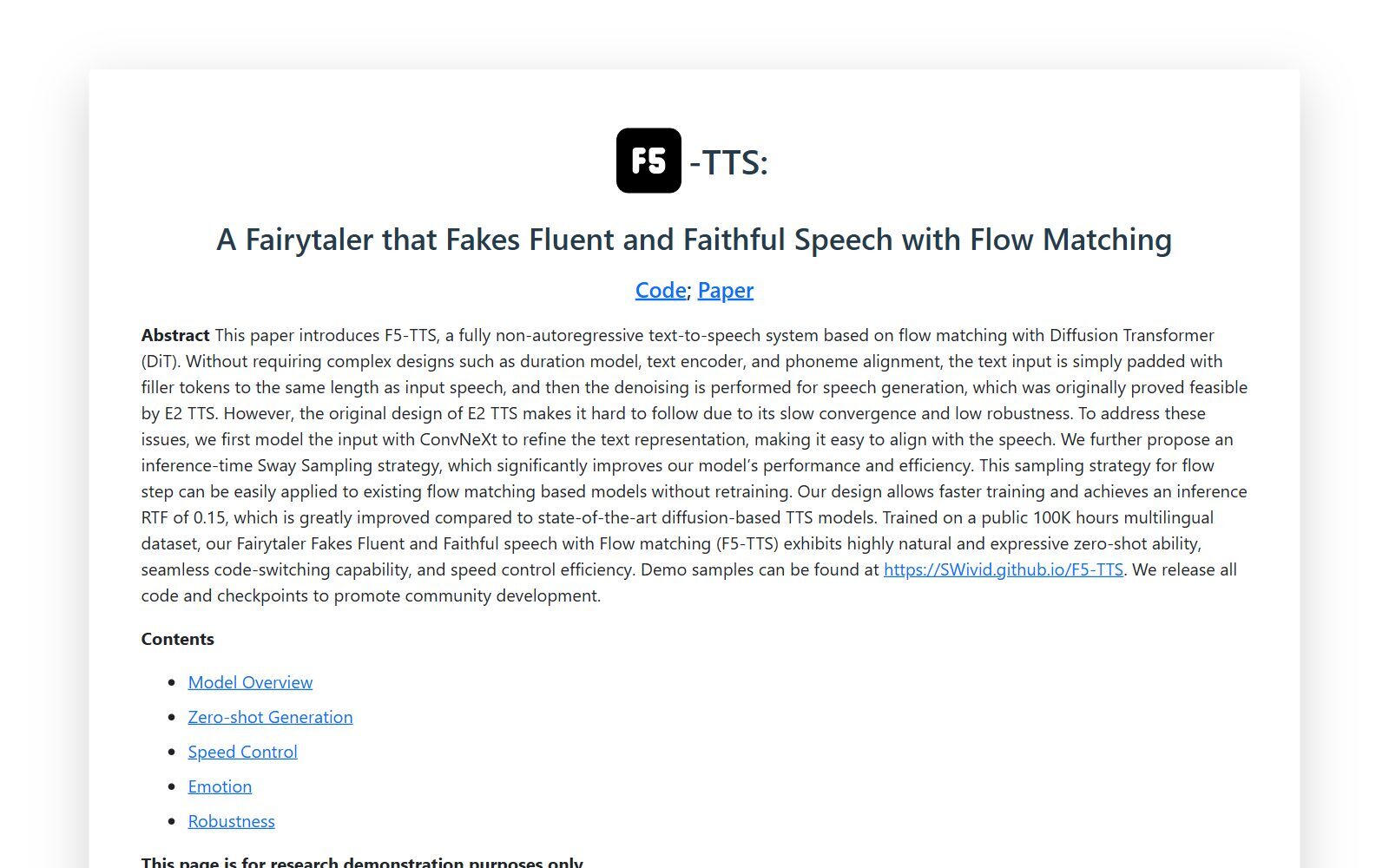
F5-TTS is a flow-matching TTS model trained on a 100,000-hour multilingual dataset, with zero-shot cloning and speed control. It is very actively maintained (version 1.1.22 in July 2026, code changes in October 2026). But the README is clear: the code is MIT, while the pretrained models are CC BY-NC because they were trained on the Emilia in-the-wild dataset. You can use the code commercially only with weights you train yourself on data you have rights to. The 2025 list linked to a repository that no longer exists; the official one is SWivid/F5-TTS.
12. Coqui TTS and XTTS-v2: the company closed, the code lives on
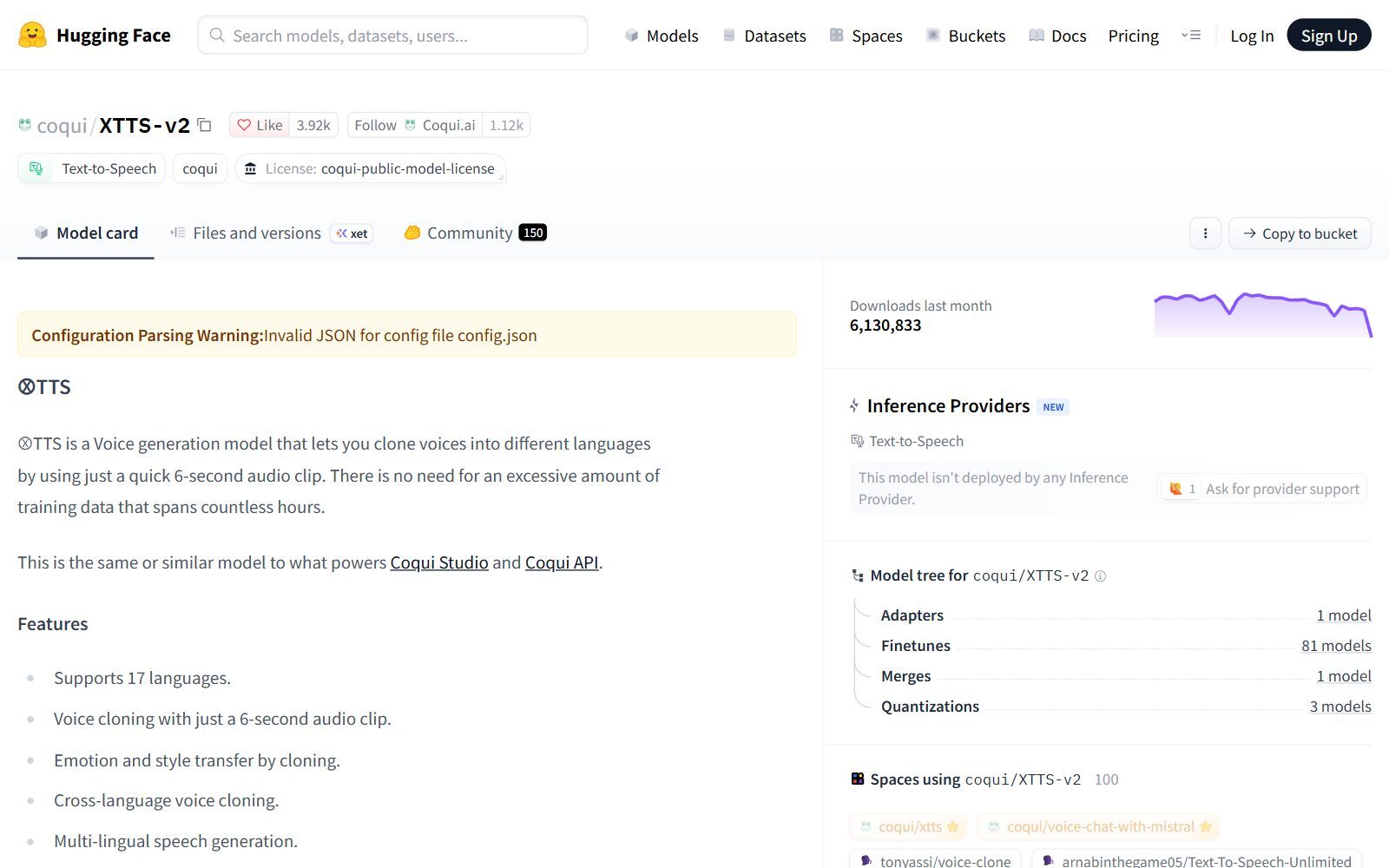
Coqui TTS was one of the best-known open TTS libraries, and its XTTS-v2 model clones a voice into 17 languages from a 6-second clip. The company behind it closed: according to Analytics India Magazine, Coqui ended its paid services in December 2023 and its co-founder announced the closure in January 2024 (sources give different dates). In October 2026, coqui.ai no longer loaded. The original repository's last release was v0.22.0 in December 2023, and the Idiap Research Institute now maintains a fork under MPL-2.0 (PyPI package coqui-tts, version 0.28.0 on 19 October 2026). The weights are the problem: XTTS-v2 on Hugging Face is under the Coqui Public Model License, which, as an Idiap maintainer put it, allows only non-commercial use. With Coqui gone, plan as if XTTS-v2 is for research and prototypes only; other Coqui models such as VITS each have their own licence.
Changed or Discontinued Since the 2025 List
- Real-Time-Voice-Cloning (CorentinJ): still online and MIT-licensed, but its author's README says it “has quickly gotten old” and points to Chatterbox for current quality. Fine for learning, not for products.
- Bark (Suno): MIT and free for commercial use, but its README says it does not support custom voice cloning, only speaker presets. The code was last changed in August 2024.
- Mozilla TTS: inactive; its last release (v0.0.9) is from January 2021. Use the maintained Coqui TTS fork instead.
- Mangio-RVC-Fork: described by its author as a very experimental fork and not updated since September 2023; replaced here by the main RVC WebUI.
- VALL-E-X (Plachtaa): the repository is archived (read-only) on GitHub.
- PaddleSpeech (Baidu): still Apache-2.0 and alive (release r1.5.0 in March 2025), but voice cloning is one example recipe in a large speech toolkit, not a ready cloning tool.
- Microsoft VibeVoice: on 5 September 2025 Microsoft removed the VibeVoice-TTS code from its repository after finding uses inconsistent with its intent. The remaining VibeVoice-Realtime-0.5B model ships only built-in voices to reduce deepfake risk, and Microsoft calls it research-only.
Consent and Legal Use: What to Check Before You Clone a Voice
A voice is personal. Open licences give you rights to the software, never to someone else's voice. A few verifiable points for founders:
- Get written consent from every person whose voice you clone, and say how and where the voice will be used. Several model licences make this explicit: StyleTTS 2 requires disclosure unless you have permission, and the bilibili licence puts all liability for personality rights on you.
- EU: the European Commission's AI Act page says deep fakes must be clearly labelled, providers of generative AI must make AI-generated content identifiable, and these transparency rules take effect in August 2026.
- US phone calls: in February 2024 the FCC ruled that AI-generated voices count as “artificial” voices under the Telephone Consumer Protection Act, so robocalls that use them need prior consent, according to law firm Cooley.
- Mark your output: Chatterbox watermarks every file by default. With other models, label synthetic audio in your product and keep logs of who generated what.
This is not legal advice; rules on voice and personality rights differ by country, so check with a lawyer before you launch a cloning feature.
Which Open-Source Voice Cloning Tool Should You Choose?
- You are building a commercial voice agent in English: Chatterbox-Turbo, or Chatterbox-Nano if you need CPU or on-device inference.
- You need many languages in a commercial product: Chatterbox Multilingual V3 or Fun-CosyVoice 3.
- You want the closest match to one specific voice and have a minute of clean audio: GPT-SoVITS with fine-tuning.
- You want to change a recorded voice into another voice: RVC WebUI.
- You are prototyping or doing research only: F5-TTS and XTTS-v2 are excellent, as long as nothing commercial ships on their weights.
- You are a small company and like Fish Audio's quality: check the Community License carefully (revenue cap, no hosted voice API) and the licence of the model you use.
How Founders Use Open-Source Voice Cloning
The most common startup uses are voice agents for support and sales, narrated product videos and courses, dubbing content into new languages and accessibility features. A voice model is usually one part of a bigger stack: a speech-to-text model, a language model and a TTS voice. If you are building a support bot, compare the open-source Intercom alternatives and open-source Zendesk alternatives for the help desk, and read ManyChat vs Chatfuel for chatbot builders. Our overview of AI agents for startup founders shows where a voice fits in an agent, and these audio AI tools for startups cover hosted options.
More open-source picks for your stack: open-source GitHub Copilot alternatives to write the code around your voice model, open-source StockAI alternatives for self-hosted image generation and open-source Zapier alternatives to connect it all. If you are raising money for a voice AI startup, see our list of VCs for AI startups. When your product is live, the F/MS AI SEO Tool helps you write the articles that bring users from Google and AI assistants.
Join ElonaHunt (like ProductHunt but for women) and explore the coolest women-focused startups out there!
Discover your next big inspiration and connect with like-minded female entrepreneurs!
👉 Join the Hunt Here
FAQ About Open-Source Voice Cloning Tools
Is VoiceClone Lite a real product?
We could not verify it. In October 2026 we found no official website, app listing or documentation for a product with that name, only similar names such as AnySpeech's “Lite” cloning tier and several “VoiceClone AI” apps.
What is the best open-source voice cloning model for commercial use?
Chatterbox, because both its code and its weights are MIT-licensed and every output is watermarked. GPT-SoVITS (MIT) and Fun-CosyVoice 3 (Apache-2.0) are strong alternatives.
Can I use F5-TTS commercially?
Only the code. F5-TTS's code is MIT, but its official pretrained models are CC BY-NC because of their training data, so commercial use needs weights you train yourself on data you have rights to.
Is Coqui XTTS-v2 free for commercial use?
No. XTTS-v2's weights are under the Coqui Public Model License, which allows only non-commercial use. The Coqui company has closed; the code lives on in the Idiap Research Institute's MPL-2.0 fork.
Is Coqui TTS still maintained?
The original coqui-ai/TTS repository is not; its last release was in December 2023. The Idiap fork, published on PyPI as coqui-tts, released version 0.28.0 on 19 October 2026.
How much audio do I need to clone a voice?
It depends on the model: Chatterbox and GPT-SoVITS work from about 5 seconds, XTTS-v2 from 6 seconds, Zonos from 10 to 30 seconds. GPT-SoVITS fine-tuning uses about one minute, and RVC training about 10 minutes.
Can Bark clone a voice?
No. Bark's README says it does not support custom voice cloning; it only offers speaker presets and random voices.
Is it legal to clone someone's voice?
Only with their consent, and rules differ by country. In the EU, the AI Act's transparency rules on labelling deep fakes take effect in August 2026, and in the US the FCC treats AI voices in robocalls as artificial voices that need prior consent. Ask a lawyer before launch.
Which open-source voice model runs without a GPU?
Chatterbox-Nano: its README says it runs three times faster than real time on eight CPU cores.
Where can I get a backlink by writing about my startup?
You can publish a guest post in one of the Fe/male Switch startup blogs, which rank in Google and in AI tools. Get a quality backlink.
About the Author
Violetta Bonenkamp, also known as MeanCEO, is an experienced startup founder with an impressive educational background including an MBA and four other higher education degrees. She has over 20 years of work experience across multiple countries, including 5 years as a solopreneur and serial entrepreneur. Throughout her startup experience she has applied for multiple startup grants at the EU level, in the Netherlands and Malta, and her startups received quite a few of those. She’s been living, studying and working in many countries around the globe and her extensive multicultural experience has influenced her immensely.

