

Kabul Startups to Watch in 2027: Verified Afghan Tech Companies, Support Programmes and Lessons for Founders
Kabul is one of the hardest places in the world to build a startup: international banking links are limited, the internet can be switched off, and girls and women are barred from secondary school and university. Yet a small group of Afghan tech companies keeps shipping products, mostly in payments, transport, e-commerce and business software. The 2026 version of this article named ten Kabul startups, from "DeliveryDrones Kabul" to "Kabul Ride-Hailer". We could not find any of them. For this 2027 edition we started again: in October 2026 we checked every company on its own website, its address and its app store listing, and kept only those that show a Kabul base and recent activity. Context facts come from named sources. The removed names are listed near the end.
Quick answer: the Kabul startups to watch in 2027 are HesabPay (a digital wallet that also works without a smartphone), Raftar (ride-hailing where the rider names the fare), 4Sough (an online marketplace with cash on delivery), Netlinks (business software and AI, in Kabul since 2005) and Jobs.af (jobs, freelance work and tenders). For support, look at the Digital Citizen Fund, Code to Inspire and SOLA, which train Afghan women and girls in tech, and at the Afghanistan chambers of commerce. None of the ten companies on the old list could be verified.
Are you getting customers from ChatGPT yet?
More and more traffic is coming from Perplexity, ChatGPT, Grok and other AI tools.
👉 Rank on ChatGPT
What Building a Startup in Kabul Looks Like in 2027
Kabul is a very small ecosystem by global standards. The StartupBlink 2026 ecosystem index ranks Kabul 1,529th in the world, 76 places lower than in its previous ranking, and 120th in South Asia, down 39 places since 2025. It lists only 9 startups in the city, 90% of those it lists for all of Afghanistan, and 4 of them work in software and data. Those numbers count companies that appear in StartupBlink's data, not every business in the city, but they show how thin the scene is.
Three facts shape every business model below:
- Money moves with difficulty. Part of Afghanistan's central bank reserves sits outside the country: the Fund for the Afghan People was set up in Geneva in September 2022 to hold USD 3.5 billion of those reserves, and its assets passed USD 3.9 billion by December 2024. That is why the companies in this list lean on cash on delivery, mobile wallets and phone-based payments instead of cards.
- Connectivity is not guaranteed. According to Pajhwok Afghan News, a nationwide internet and telecom shutdown lasted 48 hours before services were partly restored on 1 October 2025, and the government gave no official explanation. Products that also work over USSD or offline have an edge.
- Women are largely shut out of education. According to UNESCO, as reported by Al Jazeera in August 2026, about 2.4 million Afghan girls are denied secondary education and the ban on women at university remains in place. Much of the training for women now happens online or abroad.
There are also signs of activity. According to Xinhua, as published by The Express Tribune, the Ministry of Communications and Information Technology opened a five-day technology exhibition in Kabul on 26 July 2026 with the private sector, with more than 200 booths covering AI, cybersecurity, fintech, e-commerce and startups. Comparing other hard markets? See our guides to Beirut startups to watch and Mbabane startups to watch.
Kabul Startups to Watch in 2027 Compared
Sources: each company's official website and App Store listing, checked 30 October 2026. "None cited" means we found no funding announcement from the company or a primary source.
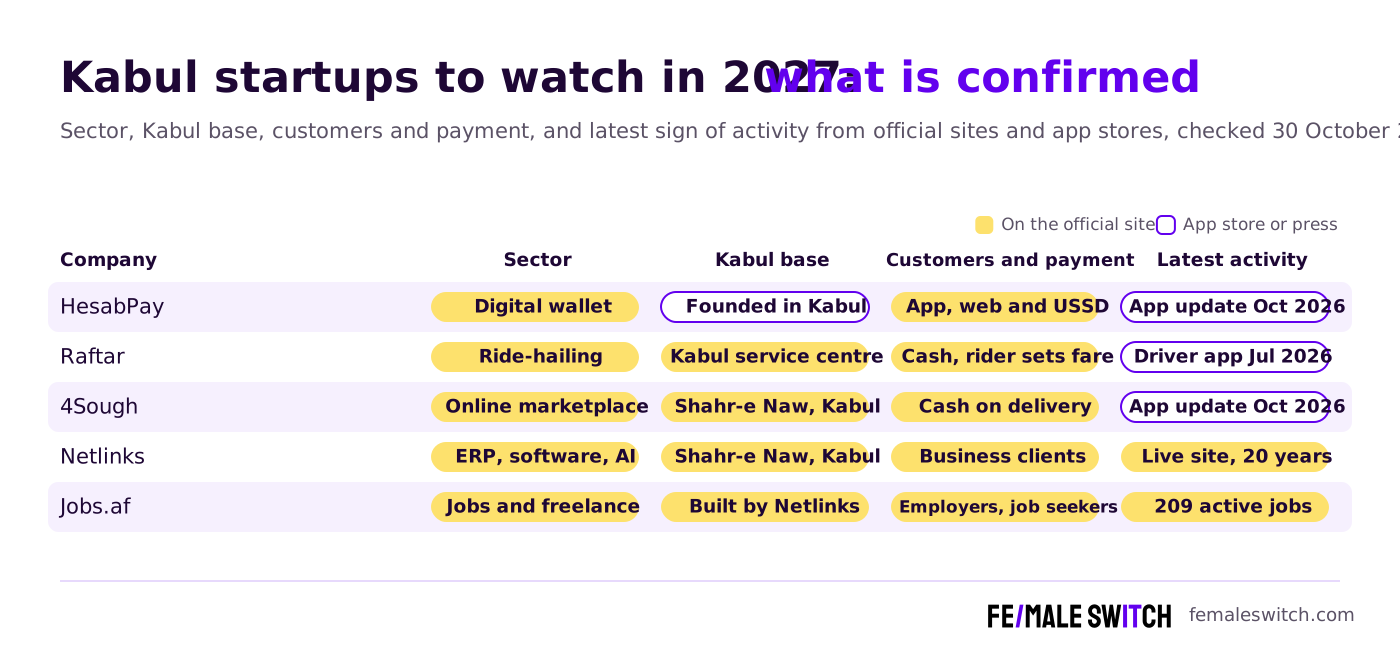
The Kabul Startups to Watch in 2027
1. HesabPay: a digital wallet that works on any phone
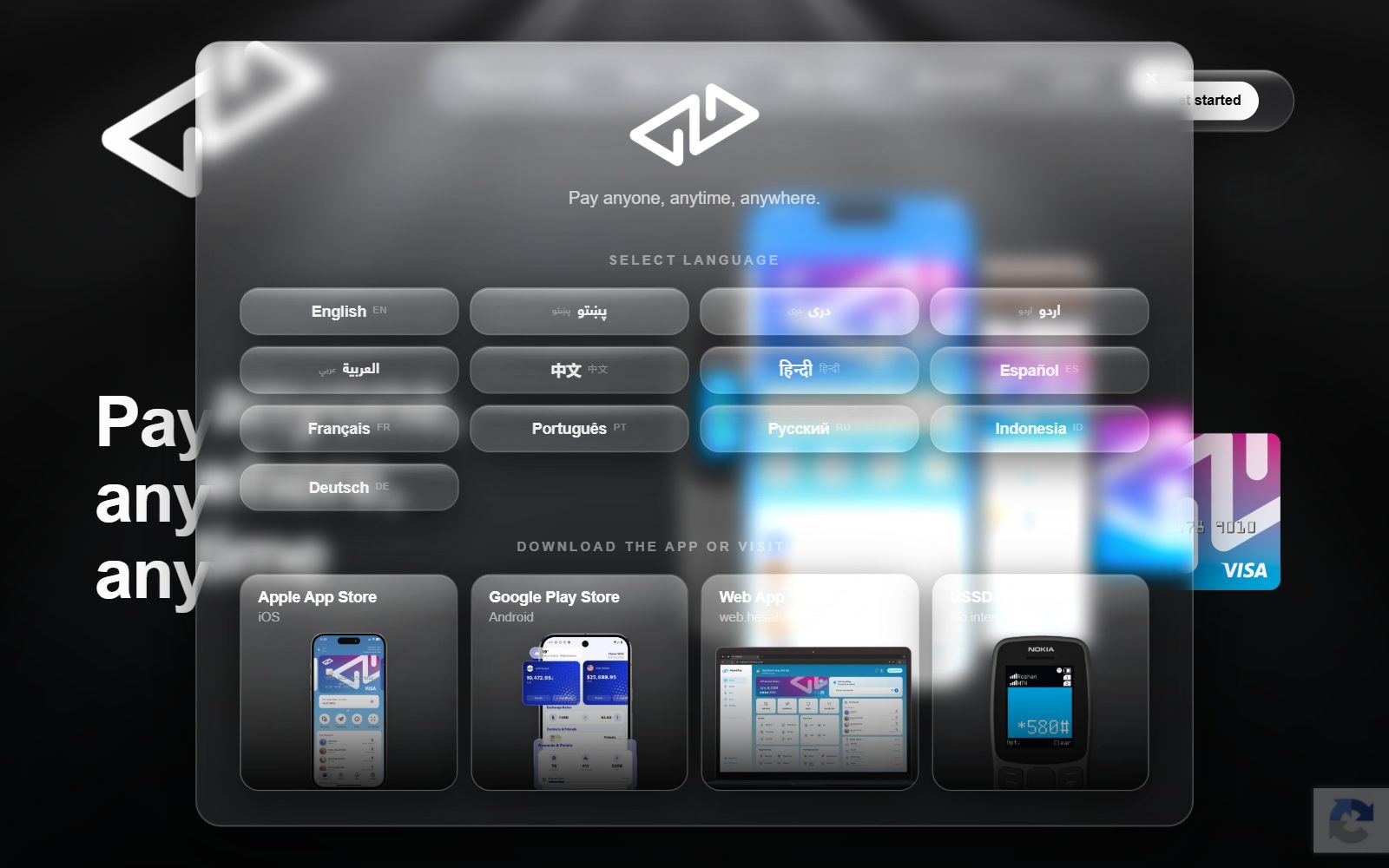
HesabPay is a digital wallet for sending money, paying electricity, internet and TV bills, mobile top-ups, government payments and bookings, with its own food service (Hesab Eats) and an eHawala transfer option. It works through a smartphone app, a web app and USSD (dialling *580#), so people without a smartphone can use it, and it offers a free virtual Visa card. According to an Algorand case study, HesabPay was founded in Kabul in 2016 by Sanzar Kakar, moved its settlement to the Algorand blockchain in 2022 and has about 1,700 active merchants. The World Food Programme says that since it began working with HesabPay in 2023, 49,000 people have opened digital accounts to receive aid, including 20,600 women in the World Bank-supported Mother and Child Benefit Programme, and that they can spend at 1,000 local merchants. A UNCDF story of April 2026 shows Afghan shopkeepers taking HesabPay payments by QR code and POS terminal under the Afghanistan Digital Prosperity Project run with UNDP. Its iPhone app was last updated on 1 October 2026. We found no funding round we could confirm on a primary source.
Lesson for founders: when banks and cards are hard to use, build on the channel everyone already has. USSD and a web app reach people a smartphone-only product never sees, and aid agencies can become your first large customers.
2. Raftar: ride-hailing where the rider names the fare
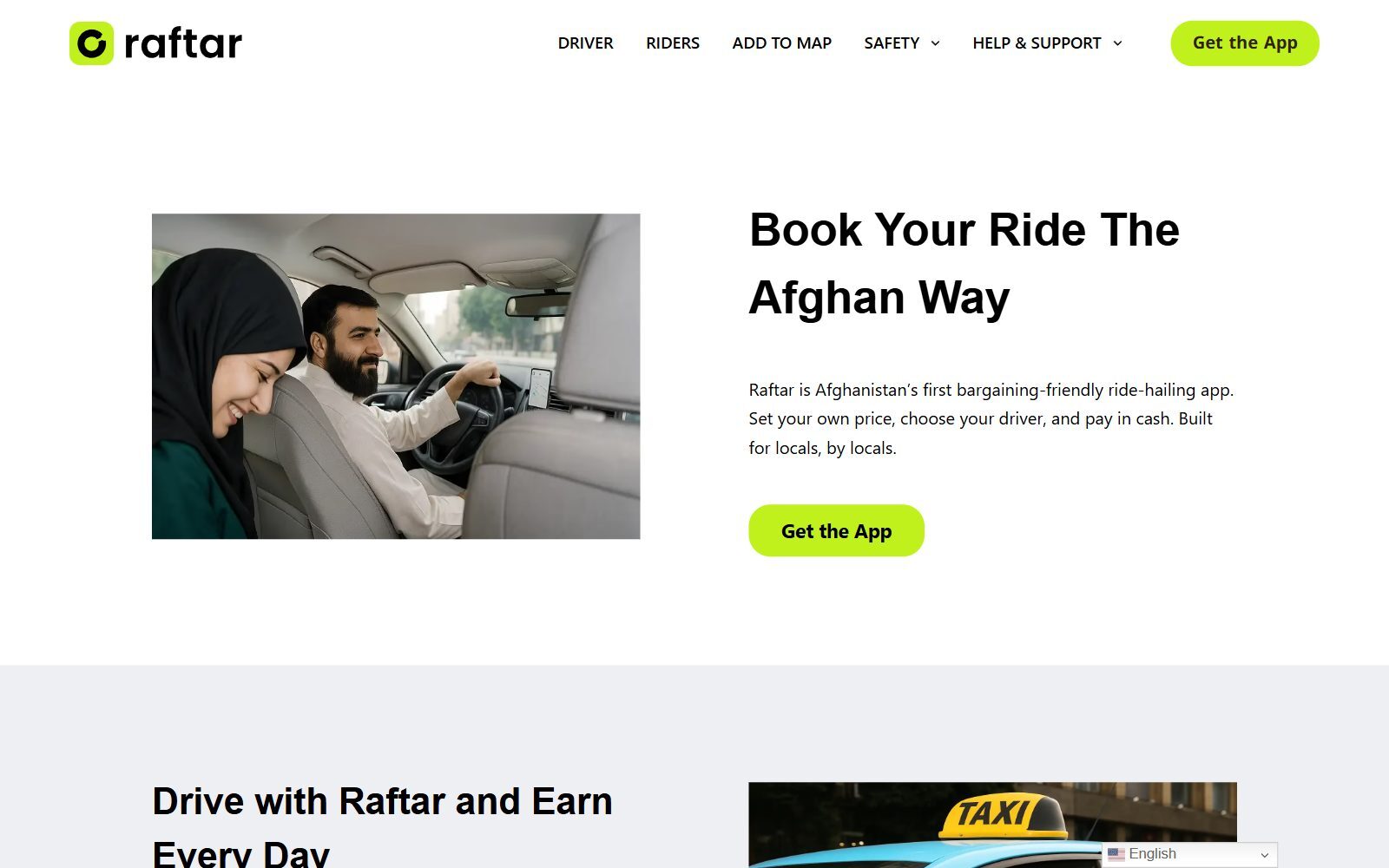
Raftar calls itself Afghanistan's first bargaining-friendly ride-hailing app. The rider proposes a fare, nearby drivers accept or counter, the rider picks a driver by price and rating, and pays the driver in cash. It offers Economy, Comfort (all cars with air conditioning) and Rickshaw rides, and a free service that registers local shops and offices on Google Maps. Its website gives the address of the Raftar Service Center in Kabul and the company name Raftar Technology Service Company. Its driver app first appeared in the App Store in September 2025 and was updated in July 2026.
Lesson for founders: copy the local habit, not the foreign app. Bargaining and cash are how Kabul taxis already work, so Raftar put them in the product instead of forcing fixed card fares.
Boost Your SEO by Getting Featured in Our Blogs and get a backlink.
We publish content about startups, education, tech, funding, etc. that ranks well not only in Google but also in Perplexity, ChatGPT, Grok and other AI tools.
👉 Get featured now!
3. 4Sough: an online marketplace with cash on delivery
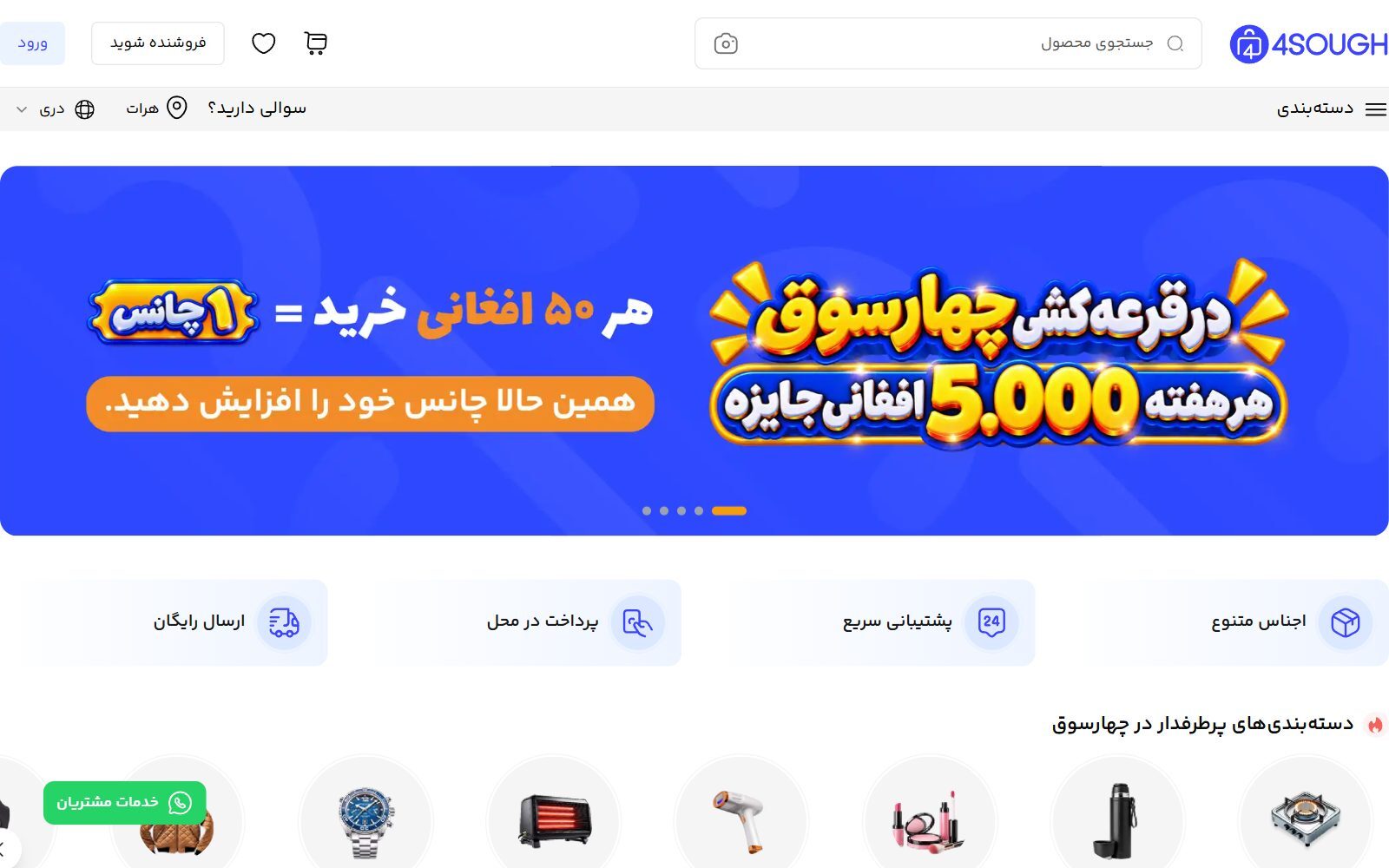
4Sough (Chaharsough) is an online marketplace in Dari that sells everything from groceries and clothes to electronics, home appliances and books from many sellers. Its homepage promises cash on delivery, free delivery and fast support, invites shops to sign up as sellers, and ran a weekly prize draw of 5,000 afghanis when we checked. The site footer gives an address in Shahr-e Naw, Kabul, and its listings show sellers in Kabul and Herat. The App Store lists the developer as 4Sough Electronic Online Service Company FZE, with a first release in September 2025 and an update on 19 October 2026.
Lesson for founders: in a cash economy, payment on delivery is not a weakness, it is the feature that wins trust. Recruit sellers first and the catalogue grows without you holding stock.
4. Netlinks: enterprise software built in Kabul
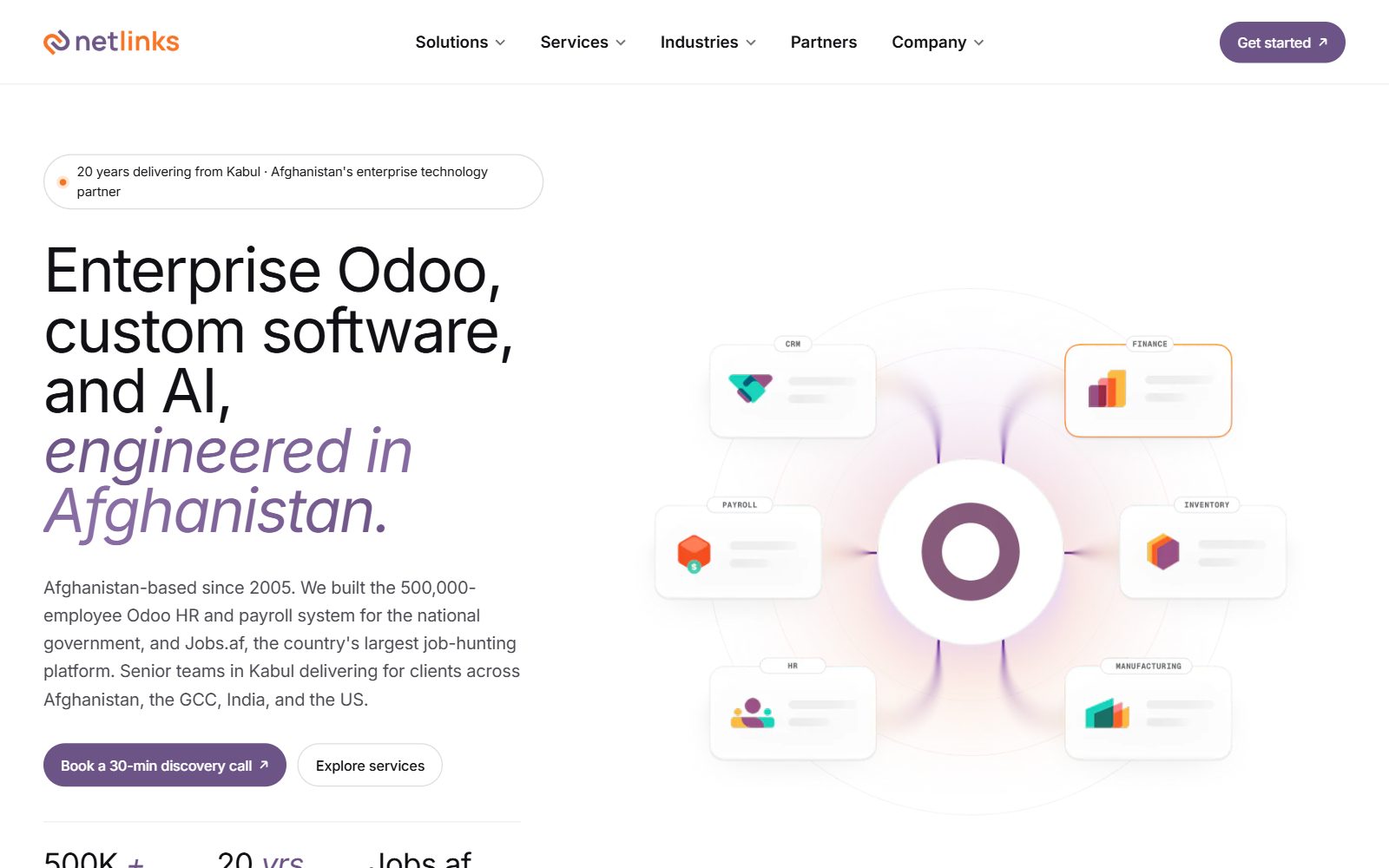
Netlinks sells Odoo ERP implementation, custom web and mobile software, AI and automation, and IT staff augmentation. Its about page says it was founded in 2005 as NETLINKS Ltd, was incorporated as NETLINKS Inc in Fairfax, Virginia, in 2019 with the same founders, and has delivery centres in Kabul (NETLINKS Plaza, Shahr-e Naw) and Gandhinagar, India, plus an office in Dubai. It says it built a 500,000-employee Odoo HR and payroll system for the national government and the Jobs.af platform, and names clients such as Siemens, Etisalat, the World Bank, IFC, UNDP, WHO, UNESCO and UN Women.
Lesson for founders: a US or Gulf legal entity with an engineering team in Kabul lets you sign foreign clients and get paid abroad, while you keep the team and the cost base at home. Many diaspora founders use the same model.
Boost Your SEO by Publishing Your Startup Press Release with us.
We publish content about startups, education, tech, funding, etc. that ranks well not only in Google but also in Perplexity, ChatGPT, Grok and other AI tools.
👉 Publish Press Release
5. Jobs.af: jobs, freelance projects and tenders
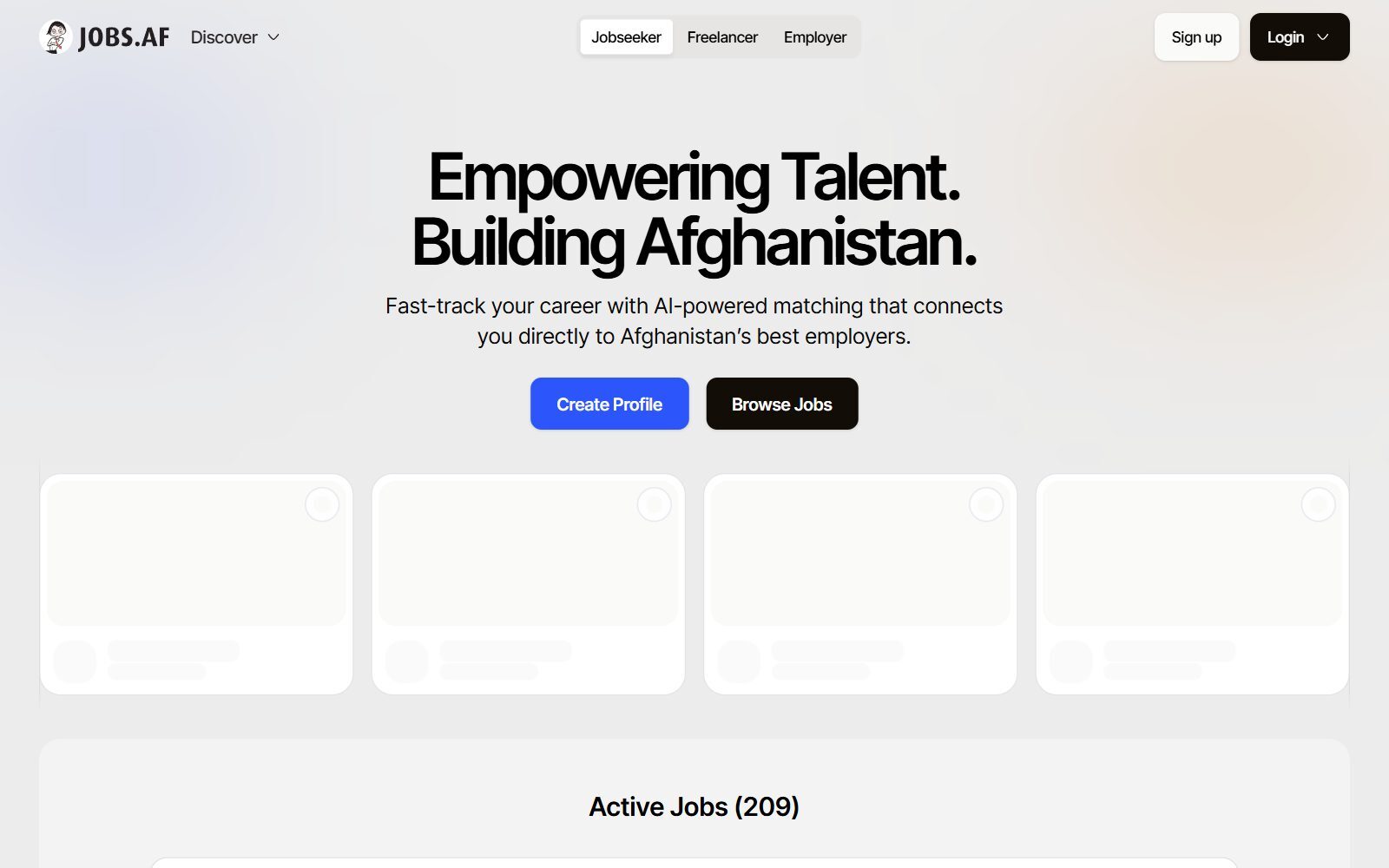
Jobs.af is a job platform for job seekers, freelancers and employers, with a separate section for tenders and what it describes as AI-powered matching. It showed 209 active jobs when we checked on 30 October 2026, many of them in Kabul and posted within the last day, and its footer runs from 2012 to 2026. Netlinks says it built Jobs.af and calls it the country's largest job-hunting platform; we could not check that ranking independently.
Lesson for founders: a marketplace that NGOs, companies and job seekers all use becomes basic infrastructure. Adding freelance projects and tenders keeps it useful when hiring slows down.
Support Programmes for Afghan Founders and Tech Talent
There are few accelerators in Kabul with public programmes we could verify. Most support for Afghan founders, and especially for women, now comes from non-profits that teach tech skills online, from the chambers of commerce, and from UN-backed projects.
Digital Citizen Fund
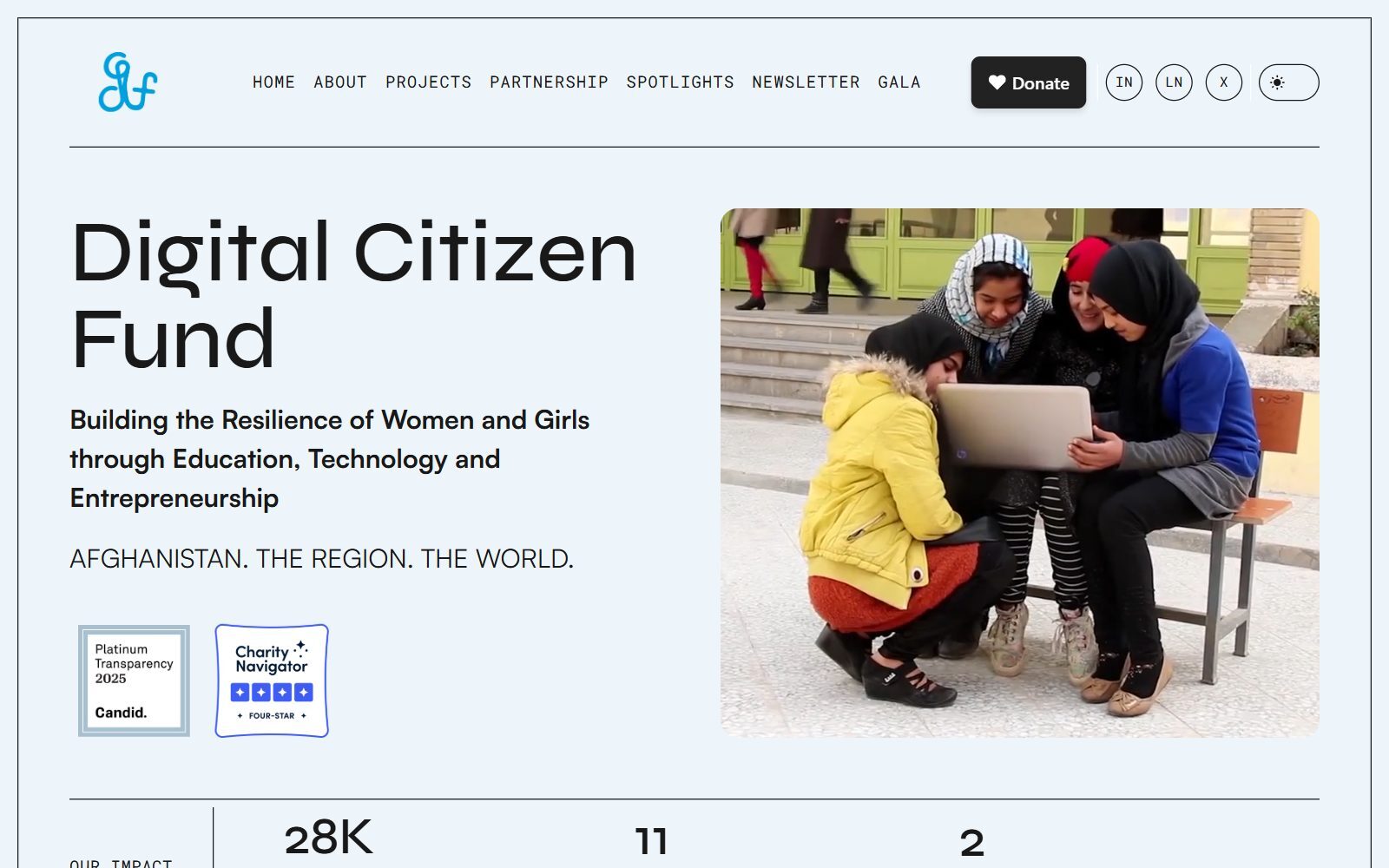
The Digital Citizen Fund was co-founded in 2013 by entrepreneur Roya Mahboob and teaches STEAM, digital literacy, financial literacy and entrepreneurship to Afghan girls and young women. Its homepage counts 28,000 students, 11 robotics labs and 2 innovation hubs, describes a free AI-enabled learning app, the Afghan Dreamers Academy, and it supports the Afghan Girls Robotics Team.
Code to Inspire
Code to Inspire was founded in 2015 by Fereshteh Forough as the first advanced coding school in Afghanistan and runs free coding and design programmes for Afghan girls and women. Its homepage reports 1,600 graduates, 300 scholarships, and $116,000 earned by students in paid projects, and it publishes apps and games built by its students.
SOLA and SOLAx
SOLA, the School of Leadership, Afghanistan, evacuated Kabul in 2021 and re-established its girls' boarding school in Rwanda. Its online academy, SOLAx, says it reaches tens of thousands of Afghan students, many of them girls who cannot attend school. It is a source of future founders, not a startup programme.
Chambers of commerce
The Afghanistan Chamber of Commerce and Investment publishes trade news, membership services, export support and business regulations in Dari and Pashto, with an English version. The Afghanistan Women's Chamber of Commerce and Industry (AWCCI) works with UN agencies on market access: according to UN Women, the two brought 40 women-owned businesses to an international exhibition in Kabul in March 2024.
Kabul Companies From the Old List That Changed or Could Not Be Verified
The 2026 version of this article listed ten companies with precise user numbers and funding, all linked to the same third-party list of business ideas. Here is what we found:
- DeliveryDrones Kabul, TeleMedic Afghanistan, SolarBright Energy Solutions, AgroGreen Kabul, EduTech Kabul, Artisan Online Marketplace (AOM), Kabul Ride-Hailer, FinServe Microloans, Urban Grow Kabul and SafeSpace Ideas Hub: we found no website, registration, app or press coverage for a company under any of these names, so we removed them and every figure attached to them.
- The "48% rise in investment in 2024": the old article gave no source and we found none, so it is gone.
- BBR (formerly Buber): this Kabul ride-hailing and delivery app still has a website that advertises taxi, food, parcel and shopping services in Kabul, but its footer dates from 2021, the app no longer appears in the App Store, and its Google Play page returned an error when we checked. We do not list it as active.
- Ehtesab: the Kabul safety-alert app founded by Sara Wahedi, which CBS News covered in 2021, no longer has a product online: its domain is listed for sale.
Which Kabul Startup Should You Learn From?
- You build fintech for cash economies: study HesabPay, its USSD channel and its aid-agency customers.
- You build a mobility or local-services app: study Raftar and how it turned bargaining into a feature.
- You build e-commerce: study 4Sough, which grows through sellers and cash on delivery.
- You run a software or AI agency: study Netlinks and its foreign entity with a Kabul engineering team.
- You build a marketplace for work: study Jobs.af, which mixes jobs, freelance projects and tenders.
- You train future founders: study the Digital Citizen Fund, Code to Inspire and SOLAx, which teach online when classrooms are closed.
How Founders Use Kabul's Startup Scene (and Where to Look Beyond It)
Some Afghan companies, like Netlinks, keep the team in Kabul and run a legal entity abroad to sign clients and get paid. If you are weighing where to base a new company, compare our guides to the best cities for early-stage startups, the best countries for early-stage startups and Abu Dhabi startups to watch. For money and mentors in the region, see early-stage VCs in Asia and startup incubators in Asia.
Women founders, including Afghan women building online from home or abroad, can add non-dilutive money from our lists of grants for women entrepreneurs in Asia, grants for female entrepreneurs and female founder grants, and meet investors at startup events for female entrepreneurs. Before you copy any of these business models, validate your startup idea with real customers. When you want to be found, list your startup in the F/MS marketing directories, publish your startup press release, and write about your product with the F/MS AI SEO Tool or the AI SEO Blog so customers and AI assistants can find you.
Is your startup on ChatGPT?
More and more traffic is coming from Perplexity, ChatGPT, Grok and other AI tools.
👉 Rank on ChatGPT
FAQ About Kabul Startups to Watch in 2027
Which Kabul startups should I watch in 2027?
Our verified list: HesabPay (digital wallet), Raftar (ride-hailing), 4Sough (online marketplace), Netlinks (business software and AI) and Jobs.af (jobs and tenders). Each shows a Kabul base and recent activity on its own website or app store listing, checked in October 2026.
Were DeliveryDrones Kabul and Kabul Ride-Hailer real startups?
We found no website, app, registration or press coverage for either name, or for the eight other companies on the old list, so all ten and their figures are removed.
How do people pay online in Afghanistan?
Mostly in cash and through mobile wallets. 4Sough and Raftar take cash, and HesabPay offers a wallet that works by app, web or USSD (*580#), plus a virtual Visa card.
How big is Kabul's startup ecosystem?
Small. StartupBlink's 2026 index ranks Kabul 1,529th in the world and 120th in South Asia, and lists 9 startups in the city, 90% of those it lists for Afghanistan.
Is the internet reliable for a Kabul startup?
Not fully. According to Pajhwok Afghan News, a nationwide internet and telecom shutdown lasted 48 hours before a partial restoration on 1 October 2025. Products that also work offline or over USSD are safer.
Where can Afghan women learn tech and business skills?
The Digital Citizen Fund, Code to Inspire and SOLA's online academy SOLAx all run free programmes for Afghan girls and women, mostly online. The Afghanistan Women's Chamber of Commerce and Industry works on market access.
Is there a startup event in Kabul?
According to Xinhua, as published by The Express Tribune, the Ministry of Communications and Information Technology opened a five-day technology exhibition in Kabul on 26 July 2026 with more than 200 booths, including fintech, e-commerce and startups.
What can founders learn from Kabul startups?
Build for the payment habits people already have, design for weak connectivity, and consider a foreign legal entity for clients and payments while the team stays at home.
Where can I get a backlink by writing about my startup?
You can publish a guest post in one of the Fe/male Switch startup blogs, which rank in Google and in AI tools. Get a quality backlink.
About the Author
Violetta Bonenkamp, also known as MeanCEO, is an experienced startup founder with an impressive educational background including an MBA and four other higher education degrees. She has over 20 years of work experience across multiple countries, including 5 years as a solopreneur and serial entrepreneur. Throughout her startup experience she has applied for multiple startup grants at the EU level, in the Netherlands and Malta, and her startups received quite a few of those. She’s been living, studying and working in many countries around the globe and her extensive multicultural experience has influenced her immensely.

