

Munich Startups to Watch in 2027: Verified Companies in Defence AI, Fusion, Space, Health Tech, Fintech and Climate Software
Munich has two of Germany's strongest universities, the Technical University of Munich (TUM) and LMU, Max Planck research institutes, and large companies such as Siemens, BMW and Allianz headquartered in the city. Its startups reflect that: many of them build hard technology for governments, hospitals and industry, and in 2026 several Munich companies announced very large funding rounds. The 2026 version of this article listed ten startups with funding figures we could not trace to any source and a few wrong descriptions. For this 2027 edition we checked every company again in November 2026: its legal notice (the German Impressum, which must give a real address), what it sells today and what it publishes about its funding. All ten old names are still in Munich, so they stay, with corrected facts, and we added three companies that raised major rounds or reached big milestones in 2026. Facts we found only in the press are named with their source.
Quick answer: the Munich startups to watch in 2027 are Helsing (defence AI, a $1.8 billion Series E in July 2026), Proxima Fusion (fusion power plants, a EUR 411 million round in July 2026), Isar Aerospace (rockets, reached orbit in September 2026), Avelios (hospital software backed by SAP, Fresenius and Sequoia), Scalable Capital, EGYM, Avi Medical, ottonova, ecoplanet, munevo, WorkerHero, Penzilla and Sizekick. Founders get support from UnternehmerTUM and its free accelerator, TUM Venture Labs, Munich Urban Colab, BayStartUP and LMU's entrepreneurship centre.
Are you getting customers from ChatGPT yet?
More and more traffic is coming from Perplexity, ChatGPT, Grok and other AI tools.
👉 Rank on ChatGPT
Why Munich Matters for Founders in 2027
Munich's startup scene has three strengths. The first is research: Proxima Fusion is a spin-out of the Max Planck Institute for Plasma Physics, and UnternehmerTUM, the entrepreneurship centre linked to TUM, says it works with more than 17,000 participants and more than 140 scalable startups a year. The second is customers: Avelios sells to hospitals, Penzilla to HR teams and ecoplanet to mid-sized manufacturers, all large markets in southern Germany. The third is capital for deep tech: in 2026 Helsing, Proxima Fusion and Avelios all announced money from global investors and strategic partners. For first-time founders, the easiest way in is usually a university programme or a shared space such as Munich Urban Colab.
For the wider picture, compare our guides to the best countries for startups in Europe, the best cities for AI startups in Europe and the deep tech cities in Europe.
Munich Startups to Watch in 2027 Compared
Sources: each company's official website, legal notice (Impressum) and own press releases, checked 4 November 2026; EGYM's round as reported by TechCrunch. Amounts are in the currency of the announcement.
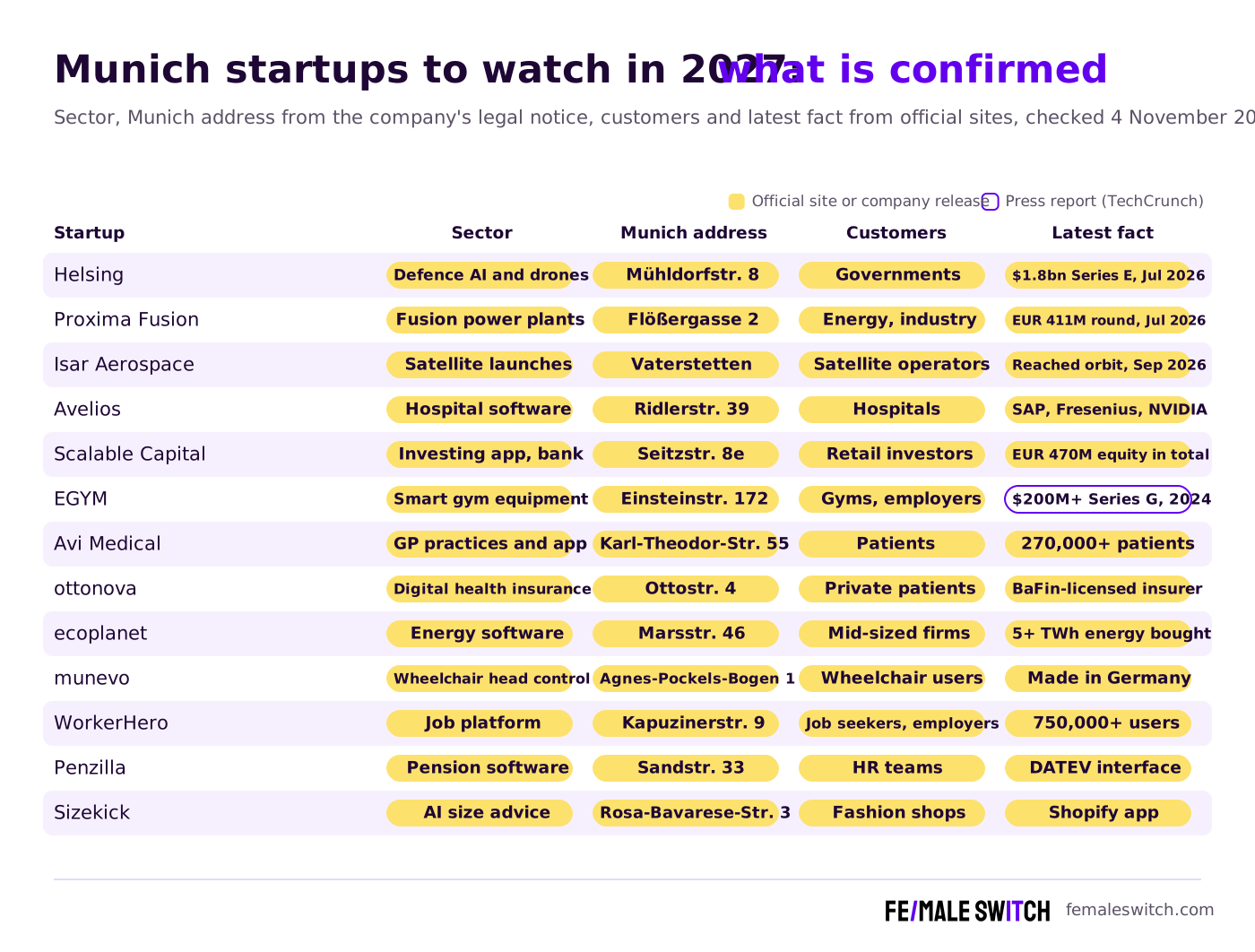
The Munich Startups to Watch in 2027
1. Helsing: Europe's biggest defence AI company
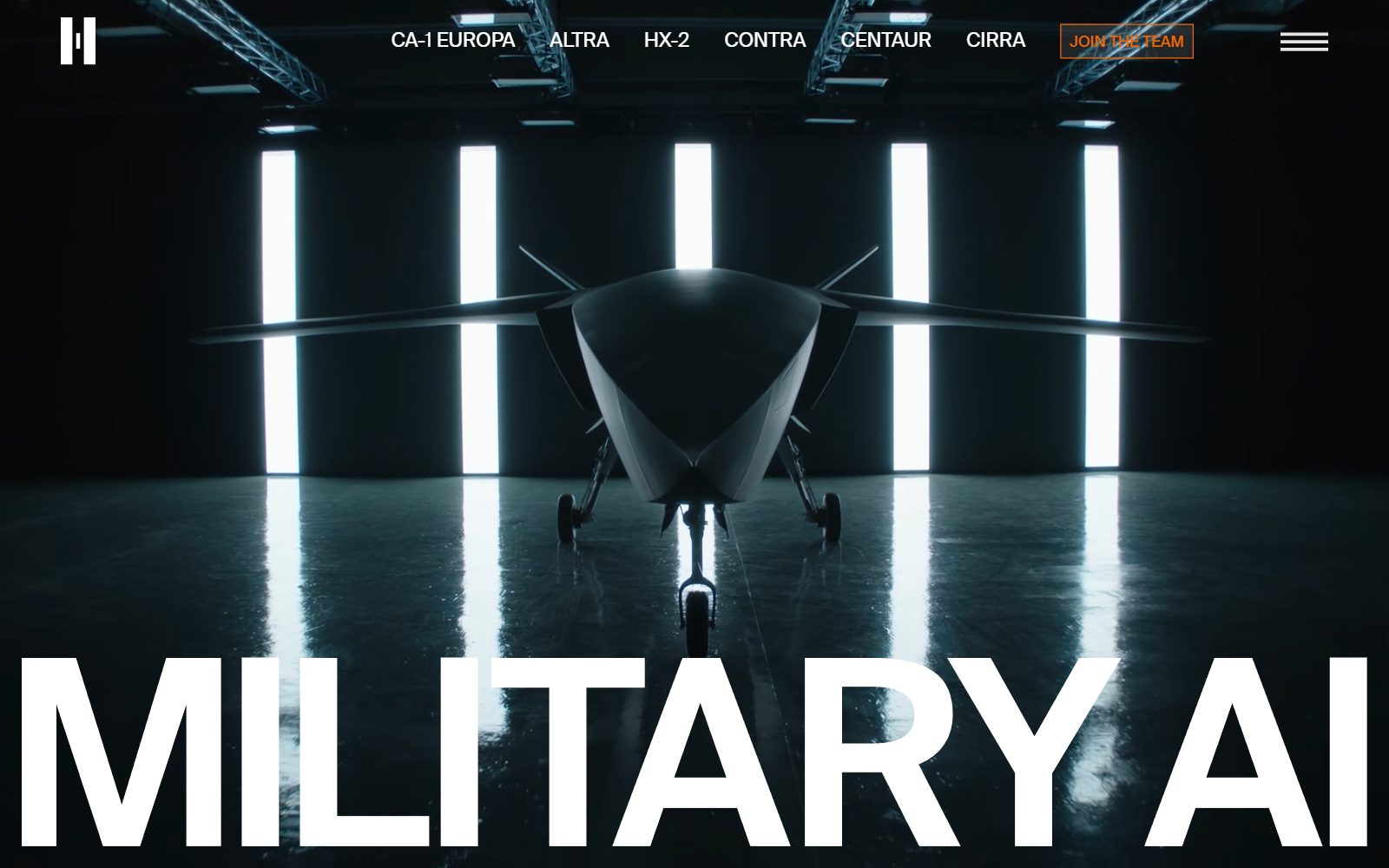
Helsing builds AI software and autonomous systems for defence: its site lists the CA-1 Europa autonomous aircraft, the HX-2 AI strike drone, the Contra air defence system, electronic warfare AI, underwater systems and what it calls Resilience Factories for mass production. On 13 July 2026 it announced a $1.8 billion Series E that valued it at $18 billion, with investors including Dragoneer, Lightspeed, General Catalyst, Plural and Goldman Sachs Alternatives, and said it remains predominantly European-owned. Its legal notice names Helsing SE at Mühldorfstraße 8 in Munich.
Lesson for founders: Helsing sells to the slowest, most demanding buyers there are, and still raised one of Europe's biggest rounds. A mission that buyers and investors already see as urgent can beat a long sales cycle.
2. Proxima Fusion: a power plant from a Max Planck lab
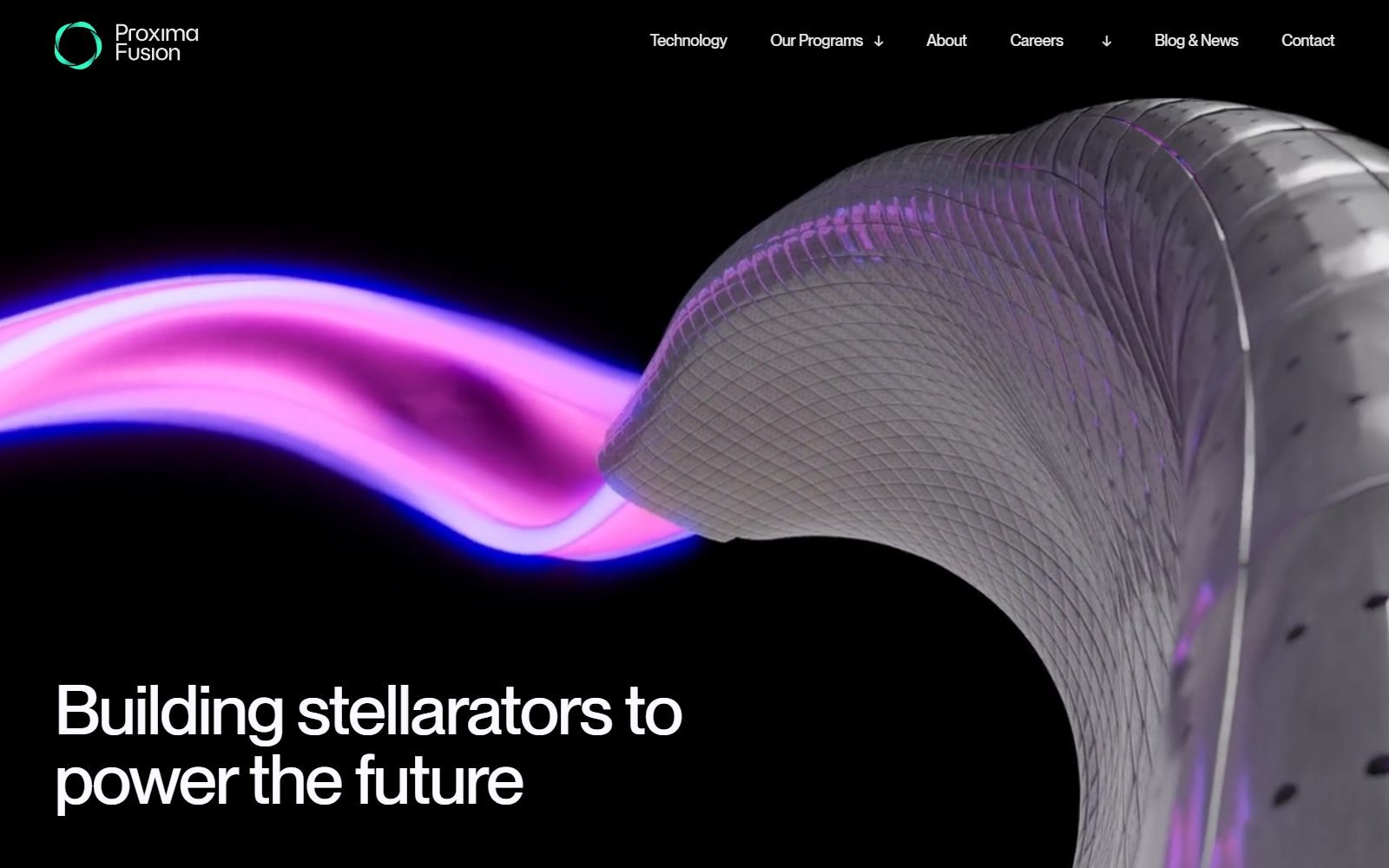
Proxima Fusion was spun out of the Max Planck Institute for Plasma Physics in 2023 to build stellarators, a type of fusion reactor. Its timeline aims for a demo machine called Alpha in the early 2030s and a power plant called Stellaris after that, and its team has more than 200 people. On 7 July 2026 it announced a EUR 411 million financing round at a EUR 2.4 billion valuation, led by XTX Ventures and East X Ventures, with RWE and Google as strategic investors and Bayern Kapital and the EIC Fund among returning investors. RWE also plans to build the first stellarator power plant with Proxima on a former nuclear plant site in Gundremmingen, Bavaria. Its imprint gives Flößergasse 2 in Munich.
Lesson for founders: Proxima turned decades of public research into a company with a clear industrial roadmap. Research spin-outs win investors when they show who will build, buy and host the product.
3. Isar Aerospace: rockets from the Munich suburbs
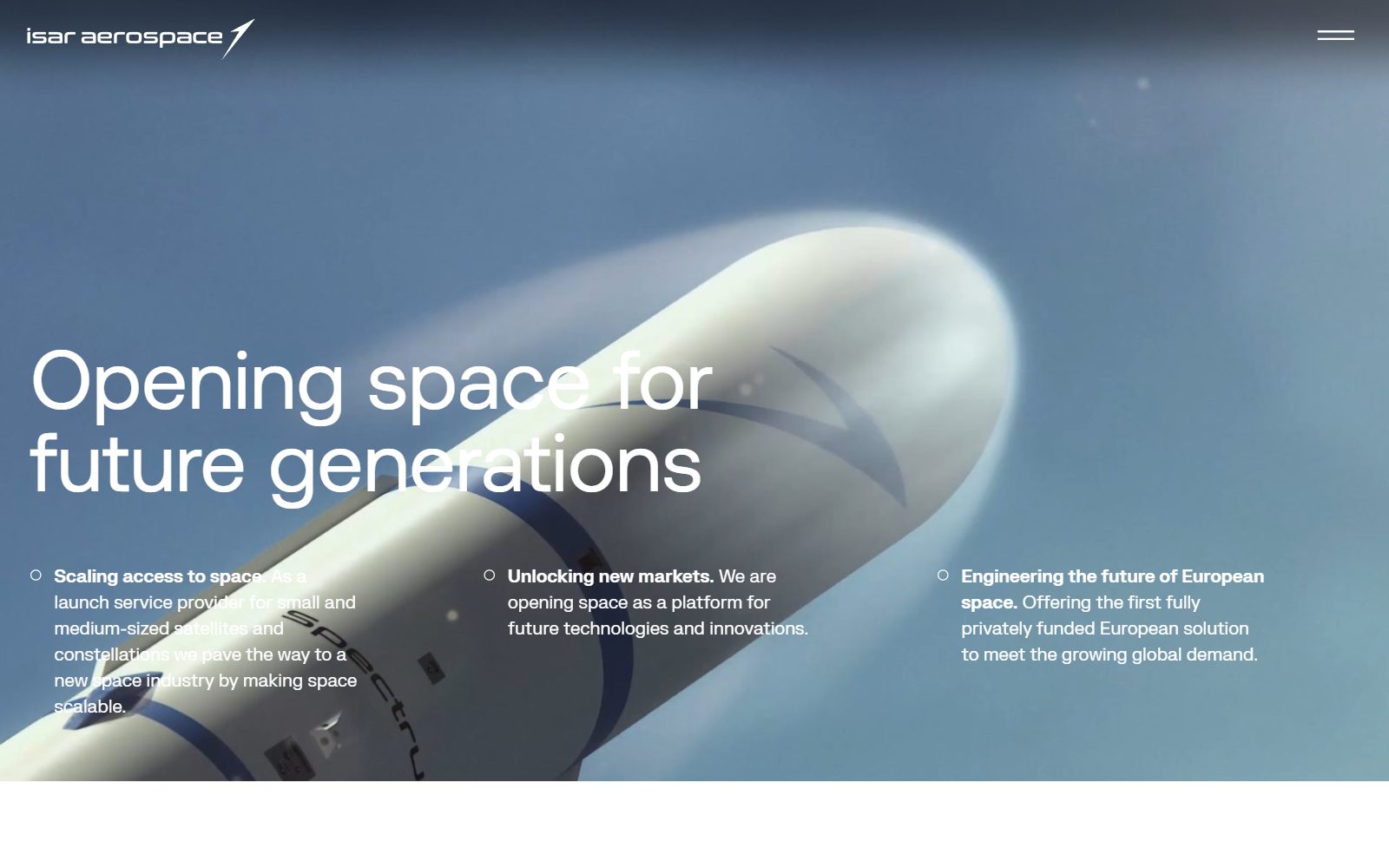
Isar Aerospace was founded in 2018 and launches small and medium-sized satellites and constellations with its Spectrum rocket. UnternehmerTUM lists Josef Fleischmann, Markus Brandl and Daniel Metzler as its founders. On 5 September 2026, on only its second flight, its rocket lifted off from Andøya in Norway and put satellites into orbit; the company called itself the first commercial space company from Europe to do so. Its legal notice gives Heimstettener Straße 20 in Vaterstetten-Parsdorf, in the Munich district just east of the city.
Lesson for founders: Isar Aerospace builds and tests its own rockets and reached orbit on only its second flight. In hardware, owning the whole production chain lets you learn and fix problems faster.
Boost Your SEO by Getting Featured in Our Blogs and get a backlink.
We publish content about startups, education, tech, funding, etc. that ranks well not only in Google but also in Perplexity, ChatGPT, Grok and other AI tools.
👉 Get featured now!
4. Avelios: hospital software that SAP backs
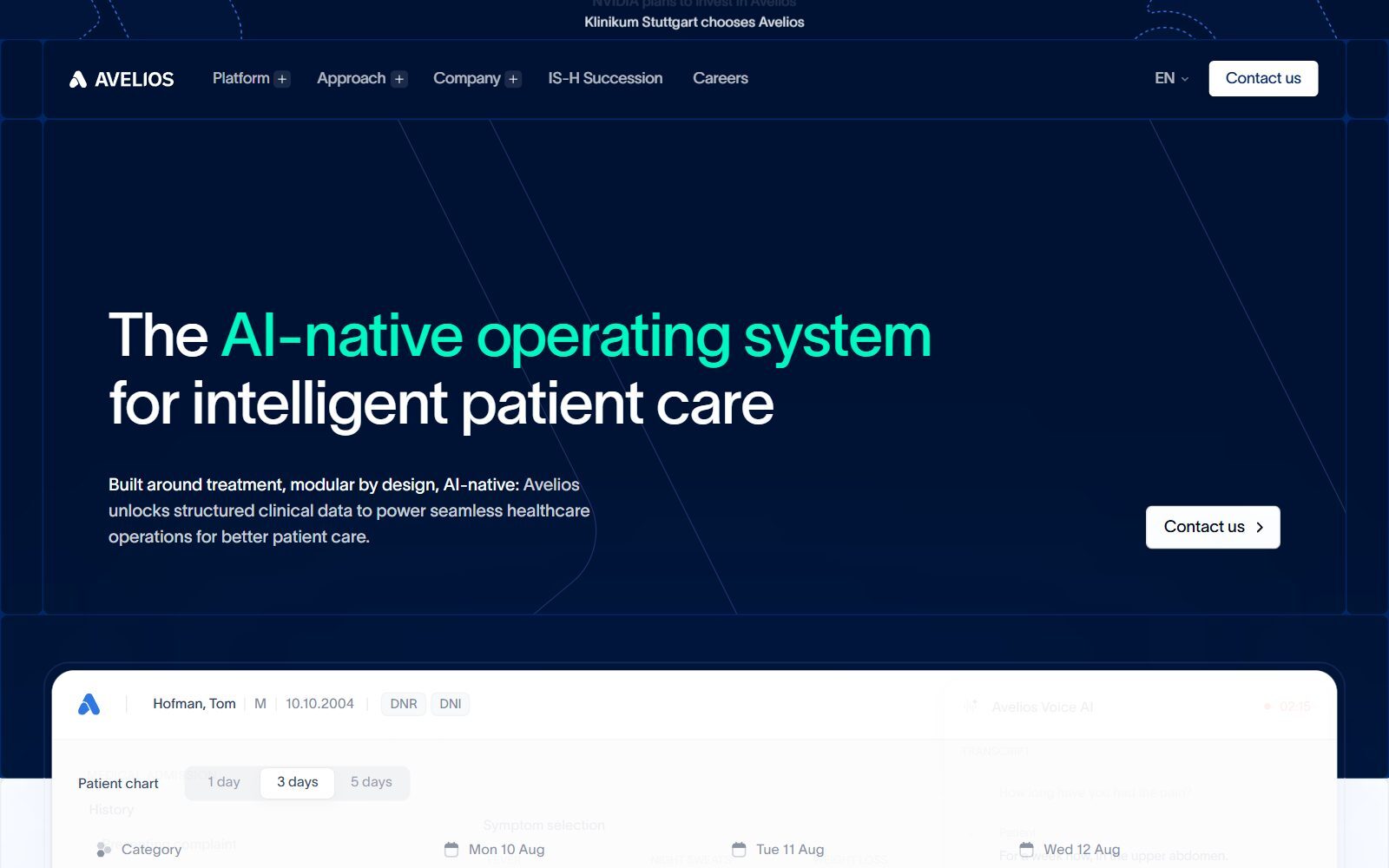
Avelios builds what it calls an AI-native operating system for hospitals: a modular hospital information system for treatment, administration, billing and data. Its homepage names Klinikum Stuttgart as a customer. In February 2026 SAP made a strategic investment, joining Sequoia Capital, as SAP ends support for its own hospital system IS-H in several markets; in May 2026 Fresenius, Europe's largest private hospital operator, invested; and on 19 October 2026 Avelios announced a planned investment from NVIDIA. Its imprint names Avelios Medical GmbH at Ridlerstraße 39 in Munich.
Lesson for founders: Avelios grew where an incumbent was leaving a market. When a big vendor ends a product, its customers need a new supplier fast, and the vendor may even back you.
5. Scalable Capital: from robo-adviser to bank
Scalable Capital was founded in 2014 by Erik Podzuweit, Florian Prucker, Adam French and Prof. Dr. Stefan Mittnik. It started with automated investing and now calls itself "the bank for everything": trading, savings plans, interest accounts, credit and a retirement account in one app, plus Agentic Investing, which lets customers connect AI assistants such as ChatGPT and Claude to their account. Its about page says it has received EUR 470 million in equity over five funding rounds and has teams in Munich, Berlin and London. Its legal notice names Scalable Capital Bank GmbH at Seitzstraße 8e in Munich.
Lesson for founders: Scalable kept adding products for the same customers until it became a full bank. Owning the customer relationship lets you sell more over time.
6. EGYM: smart machines for gyms
EGYM makes connected strength machines and software for gyms, health clubs and employers: Smart Strength, connected cardio, an AI trainer called Genius, and integrations with hardware and software from more than 200 brands. According to TechCrunch, it raised just over $200 million in a Series G in September 2024 from L Catterton and Meritech, at a valuation of more than $1.2 billion. Its legal notice names EGYM SE at Einsteinstraße 172 in Munich, with Philipp Roesch-Schlanderer among its managing directors.
Lesson for founders: EGYM sells to gyms, but its product keeps their members coming back. B2B products that help the customer's own customers are easier to justify.
7. Avi Medical: the family doctor, redesigned
Avi Medical runs general practitioner (GP) practices with online booking and its own app, which shows patients a personal prevention plan and their lab results. The old article called it an AI telemedicine company; in fact its site is about physical GP practices, free for patients of all health insurers, in Munich, Berlin, Hamburg, Stuttgart, Düsseldorf and Cologne. It says more than 270,000 patients have trusted it so far. Its legal notice names Avi Medical Operations GmbH at Karl-Theodor-Straße 55 in Munich.
Lesson for founders: Avi Medical did not try to replace doctors with an app; it rebuilt the practice around software. Sometimes the best digital business still has a physical front door.
Boost Your SEO by Publishing Your Startup Press Release with us.
We publish content about startups, education, tech, funding, etc. that ranks well not only in Google but also in Perplexity, ChatGPT, Grok and other AI tools.
👉 Publish Press Release
8. ottonova: private health insurance in an app
ottonova is a digital private health insurer for employees, the self-employed, students, civil servants and expats, with supplementary dental and hospital cover and company health plans. Its about page says it is licensed by BaFin, Germany's financial regulator, stores data in Germany, has 198 employees and a 4.8-star app store rating, and names Roman Rittweger, Sebastian Scheerer and Frank Birzle as founders. Its legal notice names ottonova Holding AG at Ottostraße 4 in Munich.
Lesson for founders: ottonova took the long road of getting a full insurance licence. In regulated markets, the licence itself can be your strongest moat.
9. ecoplanet: energy management for the Mittelstand
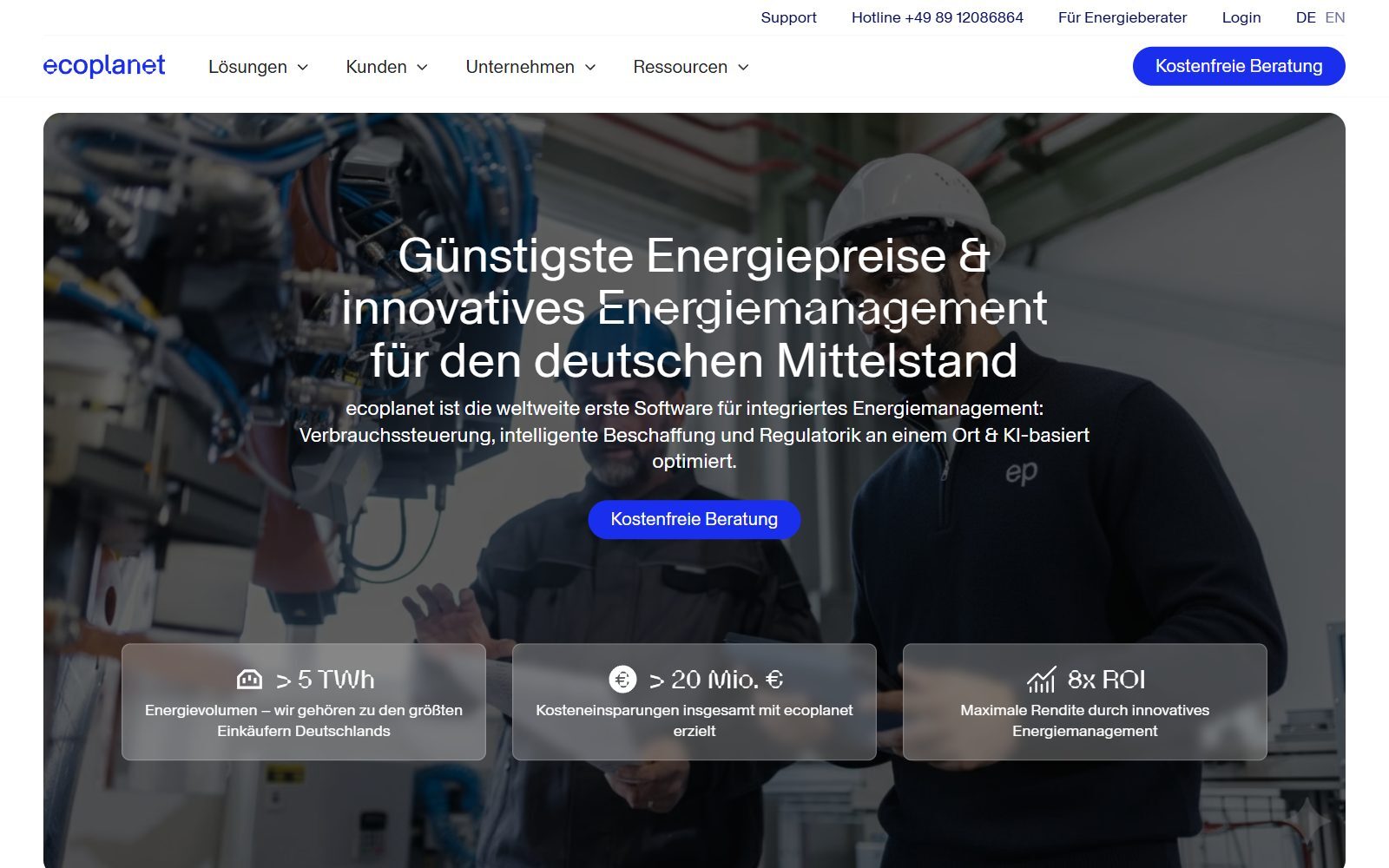
ecoplanet sells software that combines energy consumption monitoring, electricity and gas purchasing and ISO 50001 compliance for German mid-sized companies, the Mittelstand. It claims it buys more than 5 TWh of energy for its customers, has saved them more than EUR 20 million in total and can cut energy costs by up to 15%. Its customer list includes food, metal, plastics and automotive companies, and its legal notice names EcoPlanet Green Operations GmbH at Marsstraße 46 in Munich.
Lesson for founders: ecoplanet sells savings, not sustainability. Climate software is easier to buy when it pays for itself in the first year.
10. munevo: steering a wheelchair with a nod
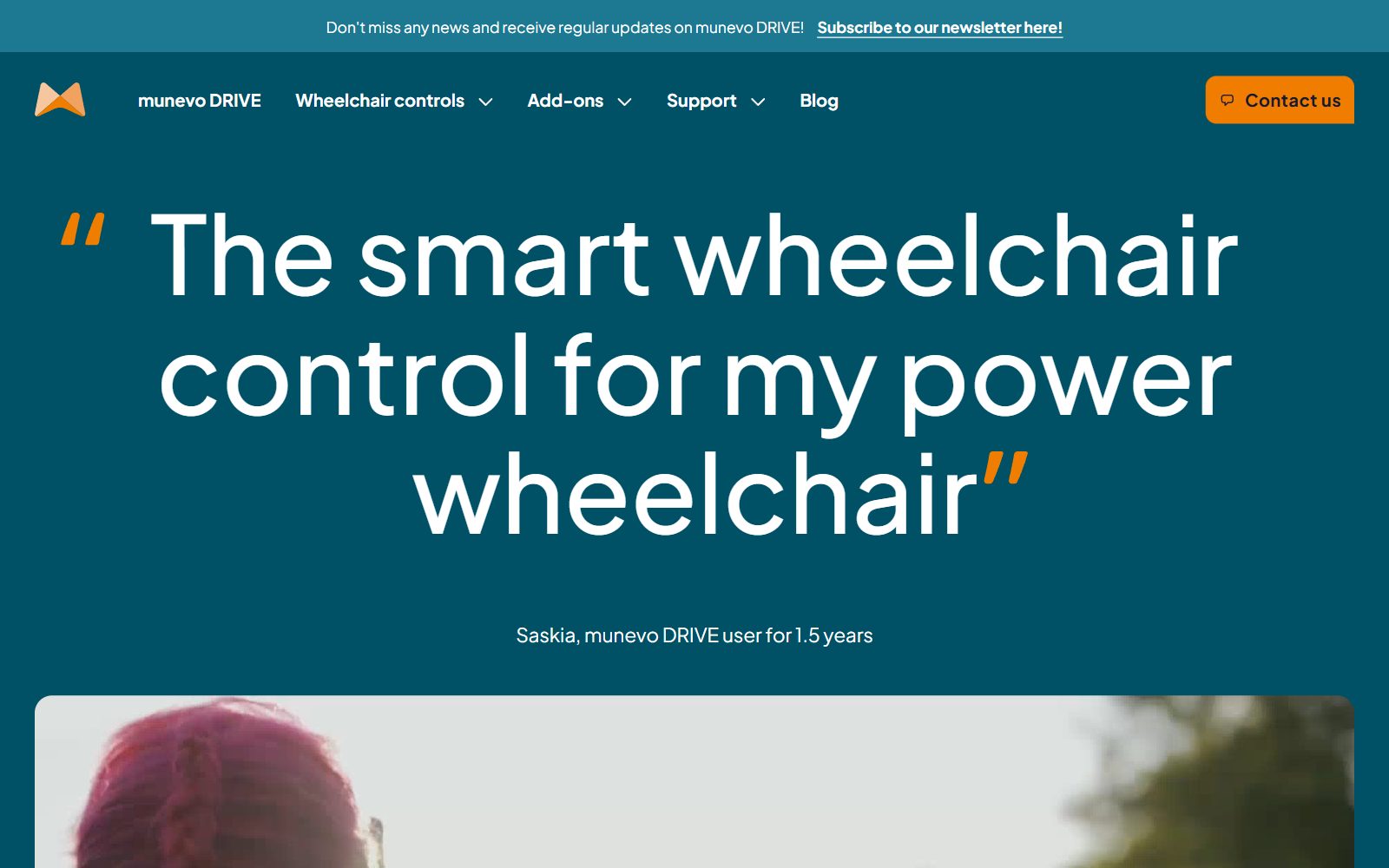
munevo makes munevo DRIVE, a head control for power wheelchairs: the user wears smartglasses and steers the wheelchair with head movements, as an alternative to chin control. Add-ons let users do more, for example operate a smartphone, and the company says the product is manufactured in Germany and comes with lifetime support. Its legal notice names Munevo GmbH at Agnes-Pockels-Bogen 1 in Munich.
Lesson for founders: munevo builds with its users, not only for them. In assistive technology, the people who use the product are your best product team.
11. WorkerHero: jobs without a CV
WorkerHero is a job platform for hands-on jobs in cities across Germany: candidates create one profile instead of writing applications and apply to employers in minutes. It says more than 750,000 people have signed up. The old article described it as an AI freelance marketplace, which its site does not support. Its legal notice names Simpmatch GmbH at Kapuzinerstraße 9 in Munich.
Lesson for founders: WorkerHero removed the step that stops many people from applying at all: the CV. Find the hardest step in your user's journey and delete it.
12. Penzilla: company pensions without paperwork
Penzilla makes software for company pension schemes (betriebliche Altersvorsorge), from advice to administration and payroll integration. According to its about page, founder Christoph Leser saw in his family's pension business how outdated software made company pensions a burden, and built Penzilla with his wife Catherine. Its legal notice gives Sandstraße 33 in Munich.
Lesson for founders: Penzilla came from inside the industry it digitises. Years in an old business can be the best market research there is.
13. Sizekick: fewer returns for online fashion
Sizekick is an AI size advisor for online fashion shops: it uses body measurements to recommend the right size, aiming to cut size-related returns and lift conversion. It offers a Shopify app and a workwear solution. Its legal notice names sizekick GmbH at Rosa-Bavarese-Straße 3 in Munich.
Lesson for founders: Returns are one of the biggest costs in online fashion. A product that fixes a cost your customer can measure is easy to sell.
Is your startup on ChatGPT?
More and more traffic is coming from Perplexity, ChatGPT, Grok and other AI tools.
👉 Rank on ChatGPT
Where Munich Startups Get Support
- UnternehmerTUM: the entrepreneurship centre linked to TUM, with training, startup support and investor contacts. It says it works with more than 17,000 participants and more than 140 scalable startups a year. Its Women Startup initiative runs workshops on pitching, negotiation and leadership, female founder talks and Female Founders Office Hours.
- UnternehmerTUM Accelerator: a free three-month programme for early-stage tech startups, with no equity taken and two batches a year starting in March and September. It says it has accelerated 359 startups since May 2017. Its new Physical AI Growth Lab with Microsoft, NVIDIA and Infineon had an application deadline set for 13 November 2026.
- TUM Venture Labs: innovation hubs run by TUM and UnternehmerTUM for tech startups at the interfaces of engineering, natural, life and data sciences.
- Munich Urban Colab: a building run by UnternehmerTUM and the City of Munich since 2021, with coworking, offices, event spaces and a makerspace, where startups work with companies, researchers and the city administration.
- BayStartUP: the central startup platform for Bavaria, with business plan competitions, startup workshops and a network of business angels and venture capital investors.
- LMU Innovation and Entrepreneurship Center: LMU's one-stop shop for innovation and entrepreneurship, with courses such as impACTup! for students and researchers.
Women founders can also look at the programmes in our lists of accelerators for female entrepreneurs in Europe and grants for female entrepreneurs in Europe, and read our guide to maternity pay for self-employed women in Germany.
What Changed Since the 2026 List
All ten companies from the old list still operate and still give a Munich address in their legal notice, so they all stay. But several facts were wrong or had no source, and some support programmes changed names:
- Avi Medical runs GP practices with an app; it is not an AI telemedicine service.
- WorkerHero is a job platform for hands-on jobs, not an AI freelance marketplace.
- Penzilla makes company pension software, not general HR automation.
- Funding figures removed: the old eGym "$184.5M", Scalable "EUR 300M", Avi Medical "EUR 88.5M" and Avelios "EUR 30M" had no source. We use only figures from the companies themselves or a named press report.
- Founding years removed where the company's own site does not give one.
- XPRENEURS: the old XPRENEURS incubator pages of UnternehmerTUM now lead to the UnternehmerTUM Accelerator.
- LMU Entrepreneurship Center: its old address now leads to the LMU Innovation and Entrepreneurship Center (IEC).
Which Munich Startup Should You Learn From?
- You build deep tech from research: study Proxima Fusion and how it turned a Max Planck experiment into an industrial plan.
- You sell to governments: study Helsing and its focus on a mission buyers see as urgent.
- You build hardware: study Isar Aerospace, which reached orbit on its second try.
- You sell to hospitals or large companies: study Avelios, which grew as an incumbent left the market.
- You work in a regulated market: study Scalable Capital and ottonova, which both hold their own licences.
- You build B2B software for SMEs: study ecoplanet and Penzilla, which sell savings and less paperwork.
- You build for consumers or patients: study Avi Medical, munevo and WorkerHero.
- You sell to online shops: study Sizekick and its focus on one measurable cost, returns.
How Founders Use Munich's Startup Scene
Look at who backs these companies: Proxima Fusion raised from XTX Ventures, RWE, Google and the Bavarian state fund Bayern Kapital; Avelios from Sequoia, SAP, Fresenius and NVIDIA. If you build technology, compare them with the funds in our guide to deep tech VCs in Europe, and look at the UnternehmerTUM Accelerator next to the programmes in our lists of startup incubators in Europe, deep tech accelerators in Europe and AI accelerators in Europe.
Meet the community at the startup events in Munich and the startup events in Germany, and read the European startup ecosystem country by country. Comparing cities? Munich's neighbours in our series are Innsbruck startups to watch, Zurich startups to watch and Aachen startups to watch; for Germany's other big scene, see Berlin startups to watch, and for the US, San Francisco startups to watch.
Before you copy any of these business models, test them with real customers. Deep tech and B2B founders often leave marketing until a funding round depends on it, so start early: list your startup in the F/MS marketing directories, publish your startup press release, and write about your product with the F/MS AI SEO Tool or the AI SEO Blog so customers, investors and AI assistants can find you.
FAQ About Munich Startups to Watch in 2027
Which Munich startups should I watch in 2027?
Our verified list: Helsing, Proxima Fusion, Isar Aerospace, Avelios, Scalable Capital, EGYM, Avi Medical, ottonova, ecoplanet, munevo, WorkerHero, Penzilla and Sizekick. Each still operates and gives a Munich-area address in its legal notice, checked in November 2026.
Which Munich startup raised the most money recently?
Helsing, which announced a $1.8 billion Series E at an $18 billion valuation on 13 July 2026. Proxima Fusion announced a EUR 411 million round at a EUR 2.4 billion valuation on 7 July 2026.
Is Isar Aerospace based in Munich?
It is based just outside the city: its legal notice gives Vaterstetten-Parsdorf in the Munich district. It was founded in 2018, and its rocket reached orbit on its second flight on 5 September 2026.
Which Munich startups work in health?
Avelios builds hospital software, Avi Medical runs GP practices with an app, ottonova is a digital private health insurer, and munevo makes a head control for power wheelchairs.
Which Munich startups work in climate and energy?
Proxima Fusion is developing fusion power plants, and ecoplanet sells energy management and purchasing software to mid-sized companies.
Why did the funding figures from the old list disappear?
The old article gave figures such as eGym's "$184.5M" and Avelios's "EUR 30M" with no source. We kept only figures that the companies publish themselves or that a named press outlet reported.
Where can startups get support in Munich?
UnternehmerTUM and its free UnternehmerTUM Accelerator, TUM Venture Labs, Munich Urban Colab, BayStartUP and the LMU Innovation and Entrepreneurship Center.
Is there support for women founders in Munich?
Yes. UnternehmerTUM's Women Startup initiative runs workshops, female founder talks and Female Founders Office Hours. The Fe/male Switch startup game is another way to practise building a startup.
What can founders learn from Munich startups?
Turn research into an industrial plan, sell to buyers with urgent needs, take on regulation when it becomes a moat, and fix a cost your customer can measure.
Where can I get a backlink by writing about my startup?
You can publish a guest post in one of the Fe/male Switch startup blogs, which rank in Google and in AI tools. Get a quality backlink.
About the Author
Violetta Bonenkamp, also known as MeanCEO, is an experienced startup founder with an impressive educational background including an MBA and four other higher education degrees. She has over 20 years of work experience across multiple countries, including 5 years as a solopreneur and serial entrepreneur. Throughout her startup experience she has applied for multiple startup grants at the EU level, in the Netherlands and Malta, and her startups received quite a few of those. She’s been living, studying and working in many countries around the globe and her extensive multicultural experience has influenced her immensely.

