

TL;DR: EIC Pathfinder is the European Innovation Council's grant for early, high-risk research that lays the scientific basis for a breakthrough technology, and yes, a startup can take part. The 2027 rules, adopted by the European Commission on 5 November 2026, give €166 million to Pathfinder Open and €82 million to three Pathfinder Challenges. Projects get up to €4 million each at a 100% funding rate. Pathfinder Open needs a consortium of at least three partners in three countries; the Challenges also accept a single startup or a pair of partners. Below: the 2027 calendar, a decision tree, a consortium budget example, a scored check and a copyable partner email.
Many deep-tech companies start as one partner in a research project that proves a new technology works in the lab. Every rule and date here comes from the adopted EIC Work Programme 2027 (Commission decision C(2026)7629); several pages ranking for this search still quote the earlier draft, with other budgets, page limits and Challenge deadlines.
What EIC Pathfinder funds
EIC Pathfinder funds research towards a radically new technology, starting from early technology readiness levels (TRL 1–2) and aiming at a proof of concept or a validation in the lab (TRL 3 or 4). It does not fund a product or a market launch: if your approach is incremental, or the technology is already validated in the lab, Pathfinder will not support you.
There are two calls:
- Pathfinder Open: any field of science or technology, no set topics. Only consortia can apply.
- Pathfinder Challenges: three set topics in 2027, each run by an EIC Programme Manager who builds a portfolio of projects that work together.
The grant is a Research and Innovation Action paid as a lump sum. It covers 100% of eligible costs, with no co-funding required from you. The EIC treats up to €4 million per project as appropriate and accepts larger requests if they are well justified. Funded teams also get access to the EIC's Business Acceleration Services.
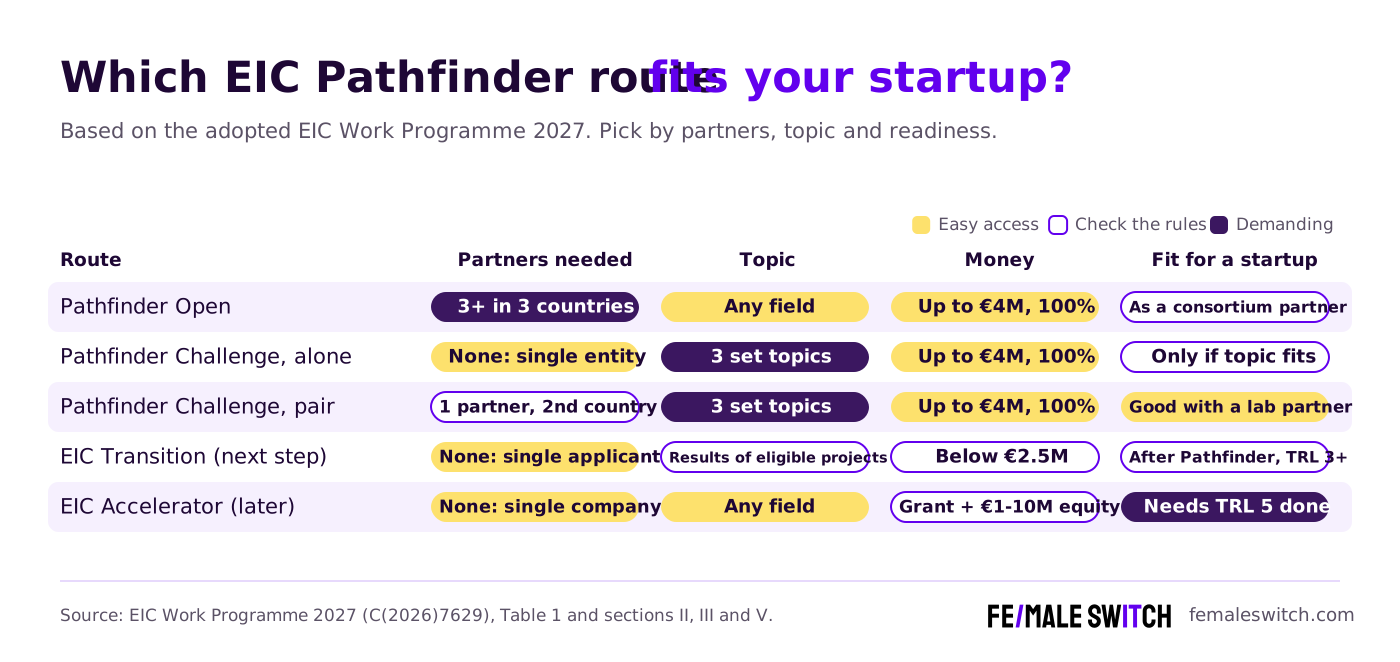
The 2027 budget and topics
Sources: EIC Work Programme 2027, Table 1 and sections II.1 and II.2.
The three 2027 Challenges are:
- Breakthroughs in advanced materials for electricity generation, storage and transmission: new materials, including nanomaterials, for future electricity grids, with no more than three projects per pillar.
- Safe and controlled continual learning in open world for reliable AI agents (CLOWAI): AI agents that keep learning safely after deployment, with a TRL 4 proof of concept and auditable model changes.
- Quantum energetics: the energy cost of quantum computing, communication and sensing, and a shared way to measure it.
Can a startup join? The eligibility rules
Yes. The work programme names startups, SMEs, universities, research organisations, industrial partners and even natural persons as possible partners, and it explicitly encourages consortia to include "promising high-tech SMEs, including start-ups".
Pathfinder Open needs at least three independent legal entities, each in a different country: at least one in an EU Member State, and two more in different Member States or Horizon Europe Associated Countries. A startup can be any of the three, including the coordinator.
Pathfinder Challenges are more flexible:
- A single legal entity in a Member State or Associated Country, such as one startup or SME. Mid-caps and large companies cannot apply alone.
- Two independent entities from two different Member States or Associated Countries.
- Three or more entities, under the same rules as Pathfinder Open.
One detail favours small companies. When Pathfinder Open proposals tie on the final score, the fourth tie-breaker is the number of SMEs in the consortium, after Excellence, Impact and gender balance among work package leaders.
Is your startup a good fit? Use this quick decision tree:
- Is your work still at TRL 1–3, with a scientific question nobody has answered yet? If no, skip Pathfinder and look at EIC Accelerator 2027 or EIC Transition.
- Does your technology fit one of the three 2027 Challenges? If yes, you can apply alone or with one partner by 29 September 2027.
- If not, can you find a university or research lab in another country, plus a third partner in a third country, by February? If yes, aim for Pathfinder Open Stage 1.
- If not, join someone else's consortium as the partner that brings use cases and exploitation, or start with cascade funding open calls, which fund single startups.
EIC Pathfinder 2027 calendar
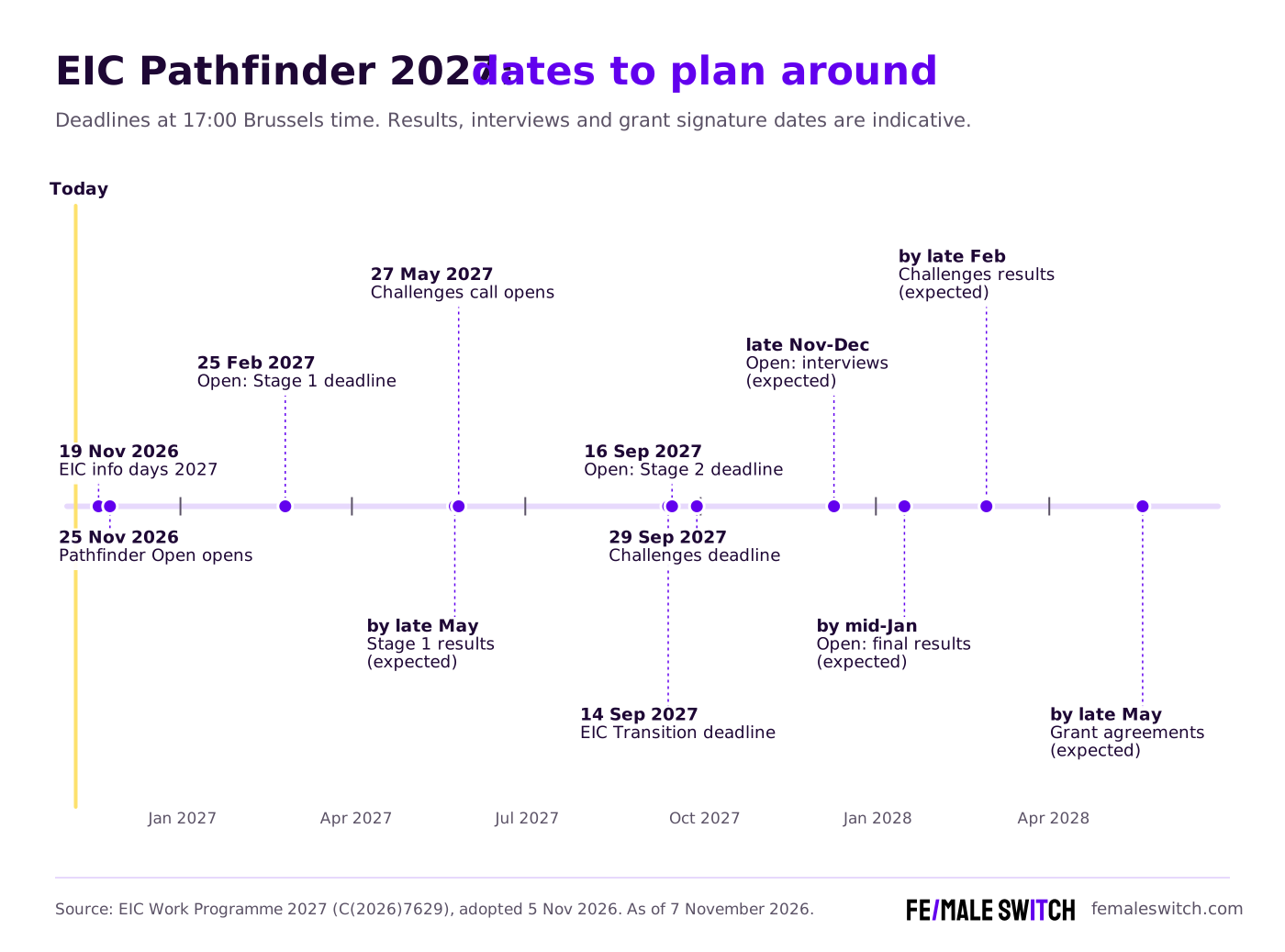
Opening dates can move by up to a month, and the Commission may delay any deadline by up to two months. Plan for a year between your first draft and the first payment. To fit Pathfinder around your other EU deadlines, see our EU grant calendar 2027.
How the two-stage Pathfinder Open works
2027 is the first year Pathfinder Open uses two stages and an interview.
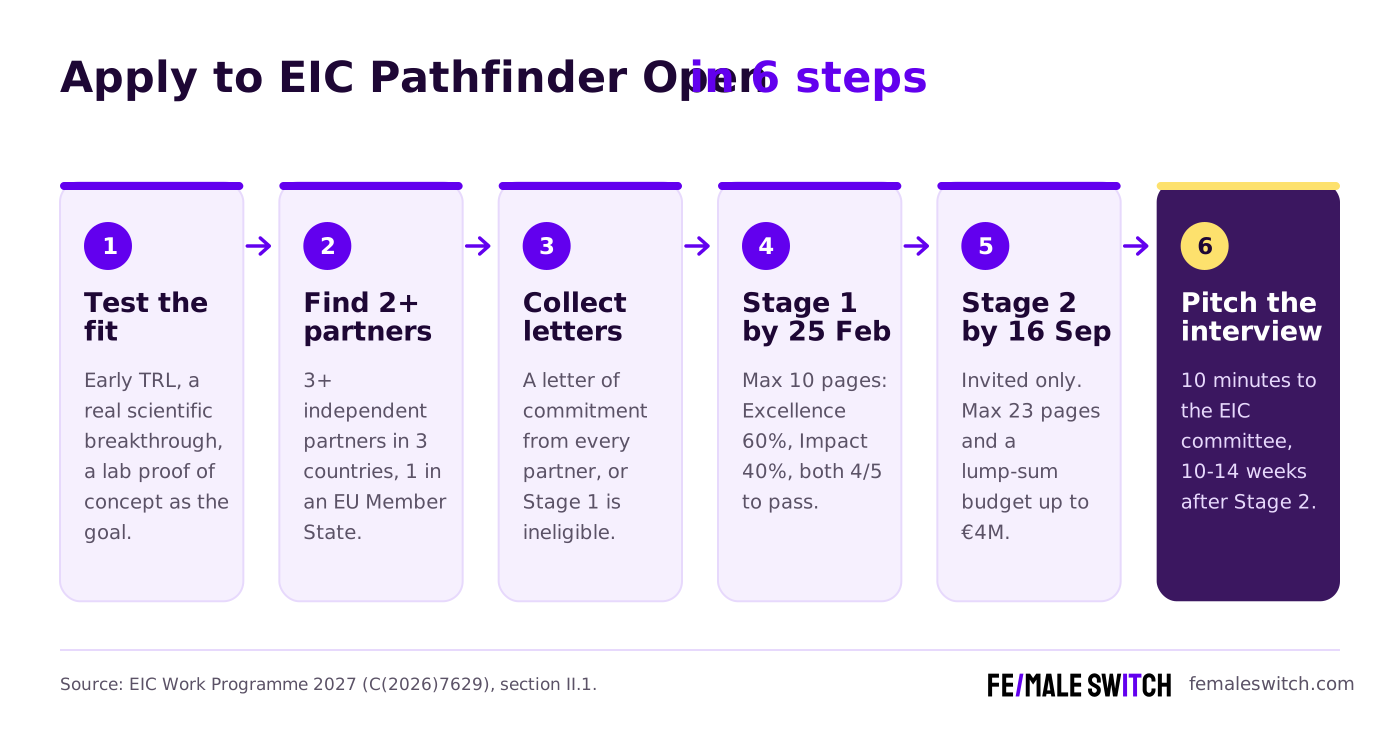
Stage 1: short proposal. Sections 1 and 2 of Part B (Excellence and Impact) fit in at most 10 A4 pages. Every partner must send a separate letter of commitment confirming it will take part; without them, the proposal is ineligible. At least three EIC evaluators score it:
- Excellence: threshold 4 out of 5, weight 60%.
- Impact: threshold 4 out of 5, weight 40%.
Proposals are ranked, and the best are invited to Stage 2 until their requested funding adds up to 2.5 times the call budget.
Stage 2: full proposal. Up to 23 pages, with the same consortium (changes only in exceptional cases). The criteria are Excellence (4/5, 50%), Impact (4/5, 30%) and Quality and efficiency of the implementation (3/5, 20%).
Interview. Every Stage 2 proposal above the thresholds is invited. A small group from the consortium pitches for up to 10 minutes, then answers the EIC Evaluation Committee's questions. The committee sets the final score.
The Challenges use one stage instead: a full proposal of up to 30 pages, scored on the same three criteria, then a "portfolio" step in which the committee picks projects that fit together. Plan a work package for portfolio activities of at least 10 person-months.
What a startup gets out of a Pathfinder consortium
The grant is only the start. Pathfinder projects can then apply for:
- Booster grants of up to €50,000 each, at most three per project, to test routes to market, such as preparing a spin-off or joining an incubator.
- EIC Transition, the next step from TRL 3–4 to TRL 5 and business readiness. In 2027 it is a single-applicant grant below €2.5 million, with €92 million and a deadline of 14 September 2027.
- EIC Accelerator through the Fast Track: Pathfinder projects are on the 2027 list of eligible feeder schemes, so a project review replaces the short proposal.
Every project must also protect its IP and plan exploitation. As a startup partner, settle IP ownership in the consortium agreement before you sign: a later spin-off, Accelerator application or VC round depends on it.
What the money looks like: a consortium example
A generic consortium of three partners asks for €3.6 million over four years for a new battery material:
With a lump sum you are paid for completed work packages, not receipts, but evaluators still check that the budget matches realistic costs. For the startup, €750,000 at 100% means paid R&D staff and lab time with no equity given away; the trade-off is shared research, published in open access.
Before you apply: a scored readiness check
Give yourself one point for each line you can back with a document:
- You can describe the long-term vision of a radically new technology in one paragraph.
- You can name the scientific breakthrough your project needs and why the current state of the art can't reach it.
- Your team, or your partners, include researchers who have published in this field.
- You have, or can get by January, two partners in two other countries (Open), or your topic fits a 2027 Challenge.
- Every partner has a PIC number on the EU Funding & Tenders Portal.
- You know what lab result will count as the proof of concept.
- You can explain the global problem the technology would help solve.
- You have an IP position: filings, or at least a plan for who owns what.
- Someone in the consortium has written a Horizon Europe proposal before.
- You can give the proposal around two months of part-time work.
8–10: apply for the 25 February Stage 1. 5–7: close the gaps now and target the 29 September Challenges or the 2028 call. 0–4: check the EU funding readiness checklist for earlier-stage options.
Copyable email to a research partner
Send it early: Stage 1 needs every letter of commitment on the day you submit. For proposal writing tips, read our guide on writing an EU grant proposal.
Who should apply and who can skip it
Apply if your startup was born from research, still has an open scientific question at its core, and can work with universities on a 3–4 year horizon. Pathfinder pays 100% of costs and takes no equity, which few other sources do at this stage.
Skip it if you need revenue or a product within a year, your innovation is a business model rather than a technical breakthrough, or you already have a working lab prototype. Then EIC Accelerator 2027, Eurostars or a national programme fit better. Unsure where to look next? Our guide on how to find open EU funding calls shows the search filters.
Related EU funding guides
- EU grants for startups: programme map, deadlines and decision tree
- EIC Accelerator 2027: cut-off dates, budget and how to apply
- Seal of Excellence: what the EU quality label is worth
- Call for evaluators: how to become a paid EU expert evaluator
- The EU funding labyrinth: a critical analysis for startups
- EIC Transition: turning a research result into a startup with EU money
For new EU calls every month, read Mean CEO's EU Funding News on blog.mean.ceo. To practise turning a research idea into a business, play the Fe/male Switch startup game.
FAQ
Can a startup apply to EIC Pathfinder?
Yes. Startups can join a Pathfinder Open consortium as a partner or coordinator. In the Pathfinder Challenges, a startup or SME can even apply alone, as a single legal entity in a Member State or Associated Country.
What is the EIC Pathfinder Open deadline in 2027?
Stage 1 closes on 25 February 2027 at 17:00 Brussels time. Invited proposals then submit the full Stage 2 proposal by 16 September 2027. The call opens on 25 November 2026.
How much funding does EIC Pathfinder give?
Up to €4 million per project, or more if well justified, at 100% of eligible costs as a lump sum. The 2027 budget is €166 million for Open and €82 million for the Challenges.
How many partners do I need for EIC Pathfinder?
For Pathfinder Open, at least three independent entities in three different countries, with at least one in an EU Member State. The Challenges also accept one or two entities.
What are the EIC Pathfinder Challenges 2027?
Advanced materials for electricity generation, storage and transmission; safe continual learning for reliable AI agents (CLOWAI); and quantum energetics. The deadline is 29 September 2027.
What is the difference between EIC Pathfinder and EIC Transition?
Pathfinder funds early research up to a lab proof of concept (TRL 3–4), mostly in a consortium. EIC Transition takes such results to TRL 5 and business readiness, with one applicant and a grant below €2.5 million.
About the Author
Violetta Bonenkamp, also known as MeanCEO, is an experienced startup founder with an impressive educational background including an MBA and four other higher education degrees. She has over 20 years of work experience across multiple countries, including 5 years as a solopreneur and serial entrepreneur. Throughout her startup experience she has applied for multiple startup grants at the EU level, in the Netherlands and Malta, and her startups received quite a few of those. She’s been living, studying and working in many countries around the globe and her extensive multicultural experience has influenced her immensely.

