

TL;DR: EIC Transition is the European Innovation Council's grant for taking a result from an earlier EU research project out of the lab and towards a business. In the 2027 work programme, adopted by the European Commission on 5 November 2026, it has €92 million, pays 100% of costs as a lump sum, and suits requests between €0.5 million and €2.5 million over one to three years. From 2027 only a single applicant can apply: a startup, an SME, a university or a research organisation. Your project must build on an eligible Pathfinder, ERC Proof of Concept or Horizon research project, and you need a letter of intent from a potential customer.
EIC Transition sits between a research grant and a company grant: it pays a team to prove a technology outside the lab and test a business model, so that an investor, a licensee or the EIC Accelerator can take it further. Every rule below comes from the adopted EIC Work Programme 2027 (Commission decision C(2026)7629) and the EIC's Transition page.
What EIC Transition funds in 2027
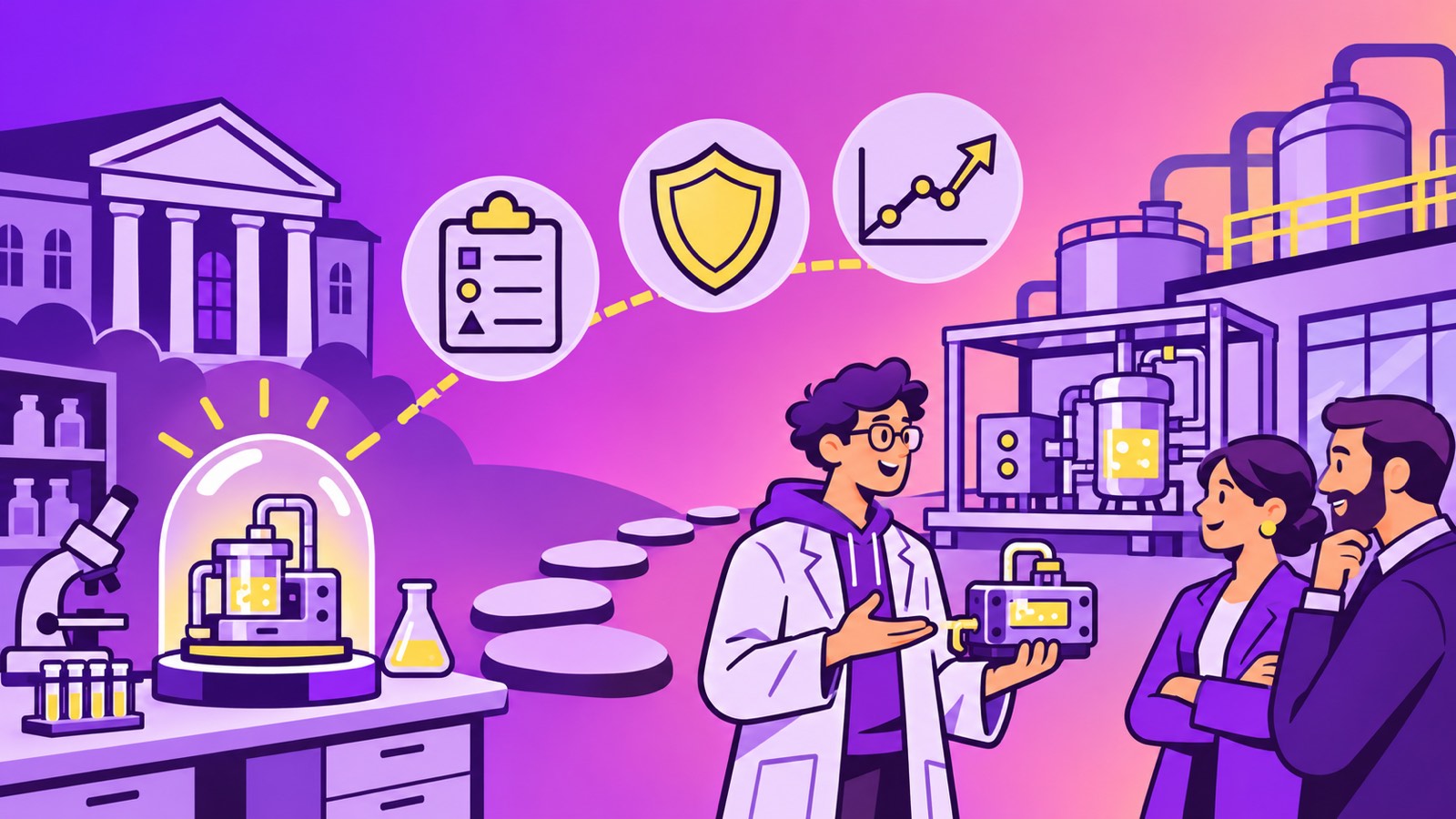
EIC Transition funds technologies that are past the experimental proof of concept (TRL 3) and in laboratory validation (TRL 4). The project must take them to TRL 5 or beyond, which means validation in an application-relevant environment through prototypes, modelling and user tests.
The work programme asks for two tracks that run in parallel from day one:
- Technology: mature and validate the innovation for a specific, high-potential application.
- Business: market research, a value proposition, a business plan and a business model tested on first customers, plus IP protection and any regulatory or certification work.
The work programme measures that second track in Business Readiness Levels (BRL 1 to 9) and expects your own team, not consultants, to do the customer work. Proposals for niche or very small markets are told not to apply.
There is one call, EIC Transition Open, with no set topics: any field of science, technology or application can apply.
What changed from 2026
- Single applicant only. The previous small-consortium format is gone. The grant agreement is signed with one beneficiary; affiliated entities and subcontractors are allowed where needed.
- Video pitch. Every proposal now includes a short video pitch (3–5 minutes).
- Revised feeder projects. The list of eligible base projects changed (see below).
- First-year checkpoint. Each project is reviewed after year one against its own KPIs and can be stopped.
Who can apply
You can apply as a single legal entity in an EU Member State or a Horizon Europe Associated Country if you are:
- a startup or SME;
- a university, research or technology organisation, including a research team, a principal investigator or an inventor who plans to form a spin-off.
Companies that are not SMEs cannot apply, but they can sign a letter of intent or act as subcontractors. Partners from the original project, such as a university's tech transfer office, can join as affiliated entities, associated partners or subcontractors, and a spin-off created during the project can take over the grant.
You don't need to have been part of the original project. New startups are explicitly welcome. If you were not a partner, you need a commitment letter from the owner of the results, agreeing to negotiate fair access to the results and IP for the whole project plus at least one year after it.
You must also name your route to market: own exploitation, a spin-off, a licence or another route.
Which results qualify: the feeder projects
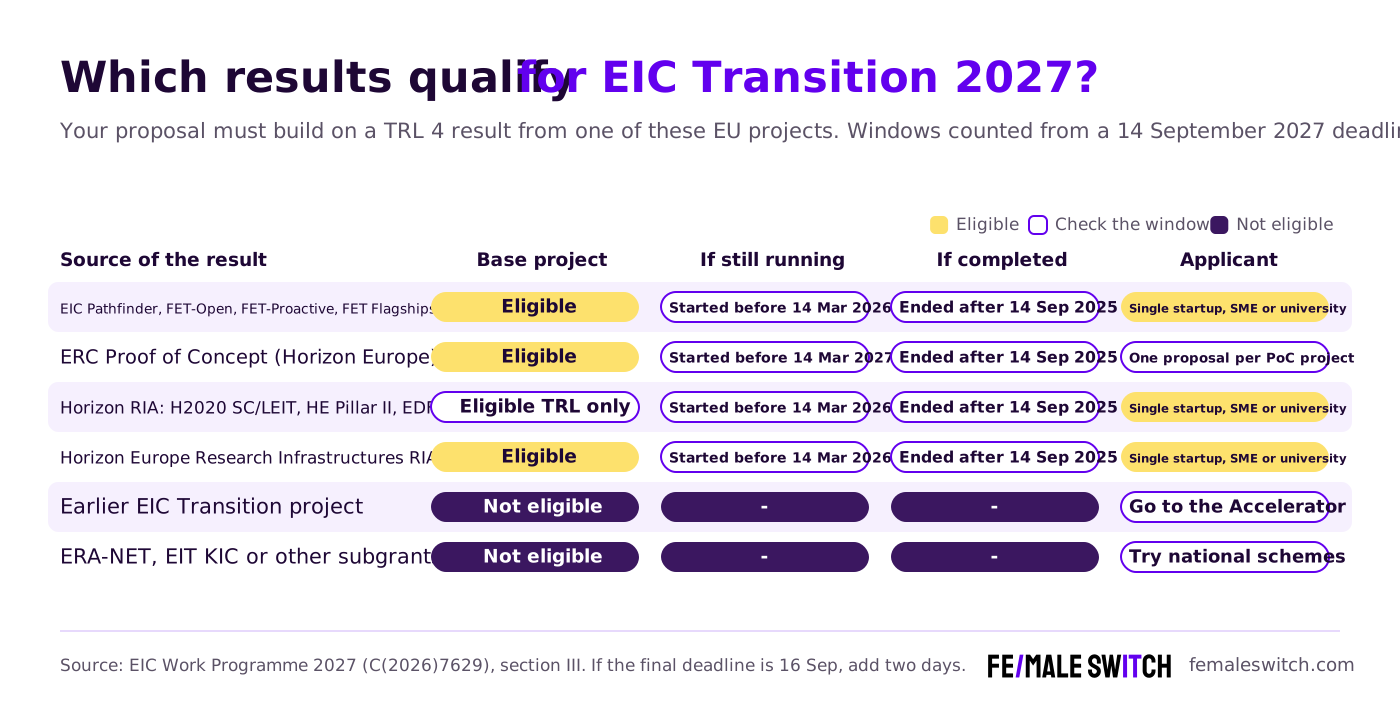
Your proposal must build on a result from one of these EU-funded projects:
- EIC Pathfinder projects, including Horizon 2020 EIC pilot Pathfinder, FET-Open, FET-Proactive and FET Flagships.
- ERC Proof of Concept projects funded under Horizon Europe.
- Research and Innovation Actions under Horizon 2020 Societal Challenges and Leadership in Industrial Technologies, Horizon Europe Pillar II and the European Defence Fund, at an eligible TRL.
- Research and Innovation Actions under the Horizon Europe Research Infrastructures part.
Not eligible: results already at TRL 5 or higher, results of an earlier Transition project, and results from subgrants such as ERA-NETs or EIT Knowledge and Innovation Communities. You must give the base project's grant number and acronym and where its result was reported (periodic report, Horizon Results Platform, the EIC Transition innovation discovery tool or CORDIS), or the application is incomplete. The EIC publishes an indicative list of eligible projects when the call opens.
Eligibility test: is your base project in the time window?
The work programme sets three time windows, counted back from the call deadline:
Then run the decision tree:
- Is the result from one of the four feeder project types? If no, look at Eurostars or a national programme.
- Is the base project inside the date window above? If no, you can't use it in 2027.
- Is the technology at TRL 4, not yet TRL 5? If it is further along, the Accelerator (TRL 6) fits better.
- Do you own the IP, or will the owner sign a commitment letter? If no, fix that first.
- Will a real potential customer sign a letter of intent? If yes, apply.
If you are still at TRL 1–3, start one step earlier with EIC Pathfinder.
EIC Transition 2027 calendar
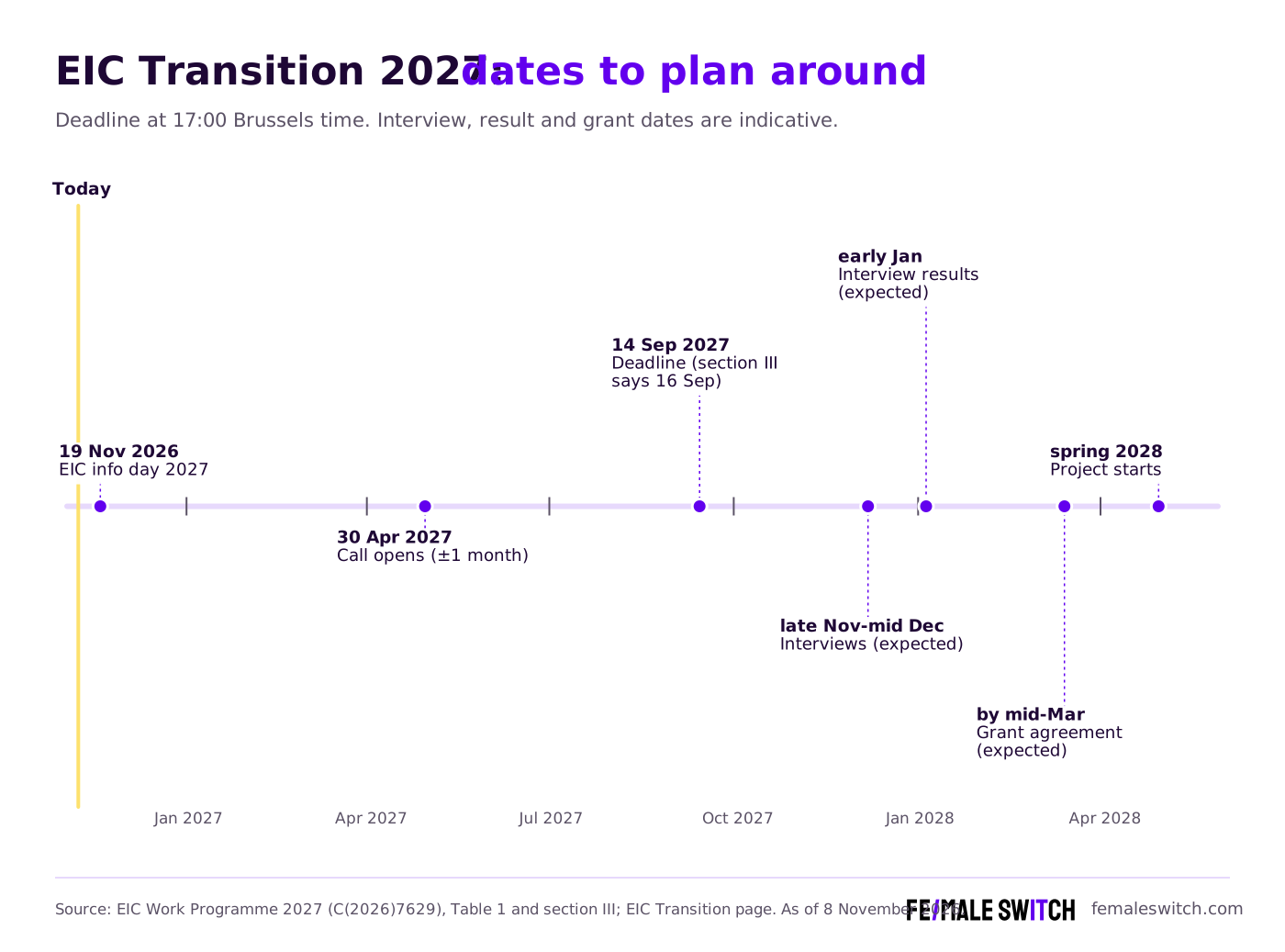
The work programme's call section says 16 September 2027, two days later than its summary table and the EIC page; plan for 14 September until the Portal topic page settles it. The Commission can also delay the deadline by up to two months. To fit Transition around your other deadlines, see our EU grant calendar 2027.
How the proposal is evaluated
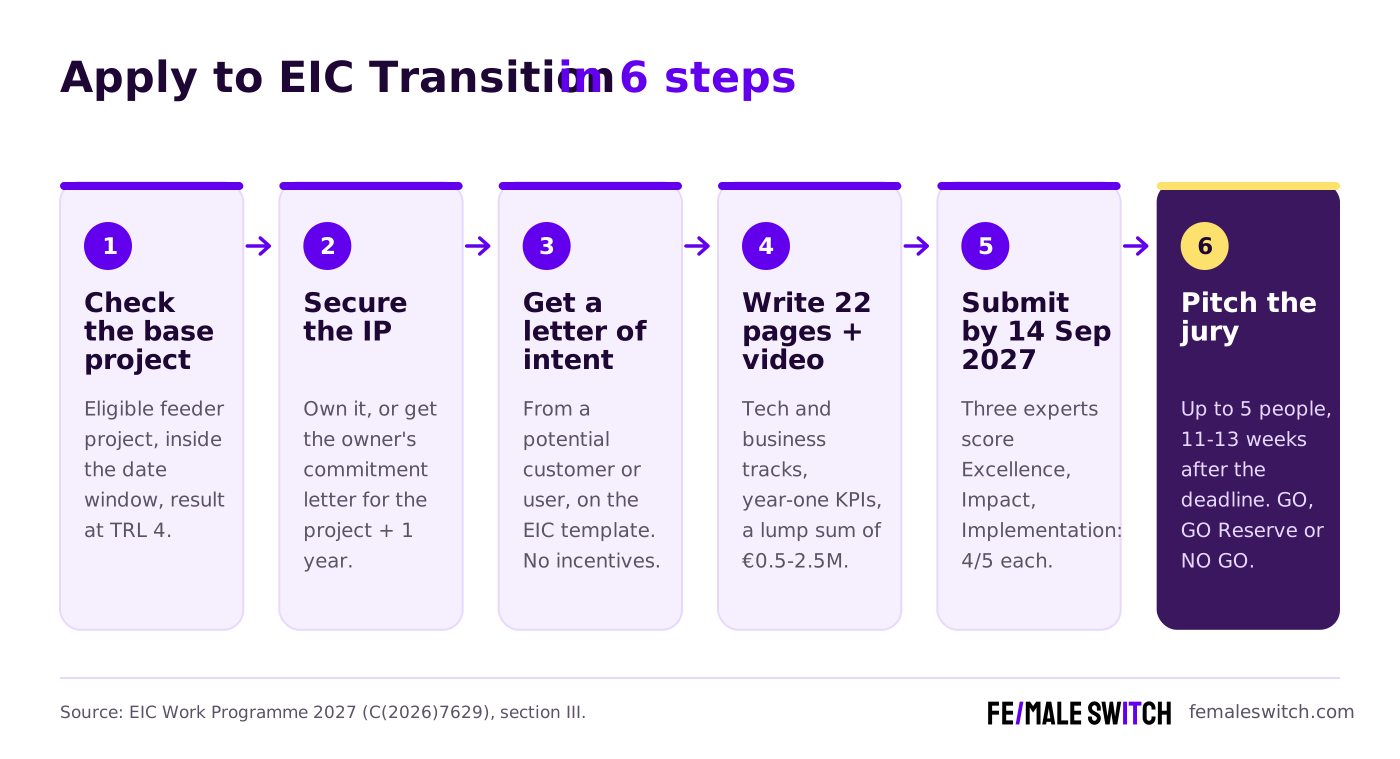
What you submit: Part B (sections 1–3 plus cover page, at most 22 A4 pages), the video pitch, and at least one letter of intent from a potential customer or user on the EIC template. The agency may check that letter at any time and ask for evidence such as a signed NDA.
Step 1, remote evaluation. At least three EIC expert evaluators score three criteria, each with a threshold of 4 out of 5:
- Excellence: the technological breakthrough and maturity, and clear first-year objectives, milestones and KPIs.
- Impact: credible use cases and paying customers, a realistic business plan, high commercial potential, and any contribution to reducing strategic dependencies.
- Implementation: the team's track record and commitment, and a workplan and lump sum backed by real evidence, not "automatically generated content".
The best-ranked proposals go to interview until they add up to 2.5 times the budget. If fewer than 30% of that pool are women-led, more women-led proposals that passed every threshold are invited until 30% is reached where possible. European Patent Office experts also review shortlisted proposals' novelty for the jury.
Step 2, interview. Up to five people from your team pitch to a jury of up to six members, sometimes with an EIC Programme Manager. The jury gives GO, GO Reserve or NO GO. If you pass every threshold in step 1 but are not funded, you get a Seal of Excellence, which some national programmes fund.
What the money looks like: a spin-off example
A generic university team with an ERC Proof of Concept result, a sensor that detects early crop disease, plans a 30-month project and a spin-off in month 6. The team asks for a €1.9 million lump sum:
Lump sums are paid for completed work packages, not receipts, but evaluators check the amount against realistic costs. For the founders it is a fully funded runway to TRL 5 with no equity given away, as long as they meet their first-year KPIs.
After Transition: what comes next
Funded projects also get:
- One Booster grant of up to €50,000 for activities such as freedom-to-operate checks, certification, piloting with customers or preparing a spin-off.
- The Fast Track to the EIC Accelerator: Transition projects are on the 2027 list of eligible feeders, so a project review replaces the Accelerator's short proposal.
- Business Acceleration Services: mandatory coaching, Tech2Market services and investor readiness training in year one.
Before you apply: a scored readiness check
Give yourself one point for each line you can back with a document:
- You can name the grant number of the base project and where its result was reported.
- The base project is inside the 2027 date window.
- You own the IP, or the owner will sign a commitment letter.
- The technology is at TRL 4 and you can show the lab data.
- You have spoken to at least ten potential customers or users.
- One of them will sign a letter of intent and is not a future supplier.
- Your team includes, or will hire, someone with business experience.
- You can set three measurable first-year KPIs you are confident of meeting.
- You know your route to market: own company, spin-off or licence.
- You can give the proposal around two months of part-time work before September.
8–10: apply on 14 September 2027. 5–7: close the gaps now; if your base project's window runs out, ask whether a newer eligible project could serve instead. 0–4: work through the EU funding readiness checklist first.
Copyable request for a letter of intent
Ask early: without the letter, the proposal is not evaluated. For writing tips, read our guide on writing an EU grant proposal.
Who should apply and who can skip it
Apply if you have a lab-validated result from an eligible EU project, a team that wants to build a company or license it, and customers willing to say so in writing.
Skip it if your idea did not come from an eligible EU project, your product already works in a relevant environment, or you only want to keep researching; then the Accelerator or cascade funding open calls fit better. Our guide on how to find open EU funding calls shows what is open now.
Related EU funding guides
- EU grants for startups: programme map, deadlines and decision tree
- EIC Accelerator 2027: cut-off dates, budget and how to apply
- EIC Pathfinder: can a startup join a deep tech research consortium?
- Seal of Excellence: what the EU quality label is worth
- Women TechEU: eligibility, timeline and how to apply
- The EU funding labyrinth: a critical analysis for startups
For new EU calls every month, read Mean CEO's EU Funding News on blog.mean.ceo. To practise turning a technology into a business, play the Fe/male Switch startup game.
FAQ
What is EIC Transition?
A European Innovation Council grant that takes a result of an earlier EU research project from TRL 4 to TRL 5 or beyond, while testing a business model with first customers.
What is the EIC Transition deadline in 2027?
14 September 2027 at 17:00 Brussels time (the work programme's call section says 16 September). The call opens on 30 April 2027.
How much funding does EIC Transition give?
Requests between €0.5 million and €2.5 million for one to three years, paid as a 100% lump sum. The 2027 budget is €92 million.
Can a startup apply to EIC Transition alone?
Yes. From 2027 only single applicants can apply: startups, SMEs, universities and research organisations in a Member State or Associated Country. Large companies can't apply.
Which projects are eligible for EIC Transition?
Results of EIC Pathfinder (including FET), ERC Proof of Concept and certain Research and Innovation Actions; the four feeder types are listed above.
What is the difference between EIC Transition and EIC Accelerator?
Transition takes a research result from TRL 4 to TRL 5 or beyond and is open to universities. The Accelerator needs TRL 6, funds companies with a 70% grant plus equity, and Transition projects can enter it through the Fast Track.
About the Author
Violetta Bonenkamp, also known as MeanCEO, is an experienced startup founder with an impressive educational background including an MBA and four other higher education degrees. She has over 20 years of work experience across multiple countries, including 5 years as a solopreneur and serial entrepreneur. Throughout her startup experience she has applied for multiple startup grants at the EU level, in the Netherlands and Malta, and her startups received quite a few of those. She’s been living, studying and working in many countries around the globe and her extensive multicultural experience has influenced her immensely.

