

TL;DR: EP PerMed, the European Partnership for Personalised Medicine, funds startups in two ways: as one partner in a transnational research consortium (the yearly Joint Transnational Call, worth about €33 million in 2027) or alone, through the Fast Track Validation Programme (up to €80,000 for a six-month validation study). No call is open on 25 October 2026, but JTC2027 on cell and gene therapy is pre-announced to publish on 4 November 2026, with pre-proposals due 20 January 2027. Below: a call status board, a decision tree, a worked Fast Track budget, a consortium outreach template and a plan to the January deadline.
EP PerMed is the EU-backed partnership that pools national research funding for personalised medicine projects across Europe. For a health-tech or biotech founder the money is large, but almost none of it goes to a company alone: you join a consortium with hospitals and universities, and your national funder pays your share under its own rules.
This guide replaces our old post on the 2025 Fast Track call. Facts come from the EP PerMed website, its call texts and webinar slides, and the French National Research Agency (ANR), which hosts the Joint Call Secretariat. Pre-announced dates are indicative until the call text is out.
What EP PerMed is and why startups should care

EP PerMed runs from 2023 to 2033: seven years of calls plus a three-year transition phase. According to the partnership's own figures, it brings together 61 partners from more than 28 countries and 11 regions and plans to invest about €375 million in personalised medicine research, innovation and implementation, of which about €100 million comes from the EU budget under Horizon Europe and about €275 million from the partners.
"Personalised medicine" means care fitted to a person's biology, lifestyle and environment: diagnostics, data and AI tools, pharmacogenomics, new therapies and the studies that prove them. Four call types matter to founders:
- Joint Transnational Calls (JTC): one large research call a year on a set theme; SMEs are an eligible partner type.
- Research, Innovation and Technology Calls (RITC): smaller innovation calls where at least one enterprise is mandatory.
- Fast Track Validation Programme: run with EIT Health, it pays one startup or team to validate a solution.
- Venture Creator: free mentoring for early teams, no grant.
Education, twinning and networking calls target healthcare organisations and researchers, not companies.
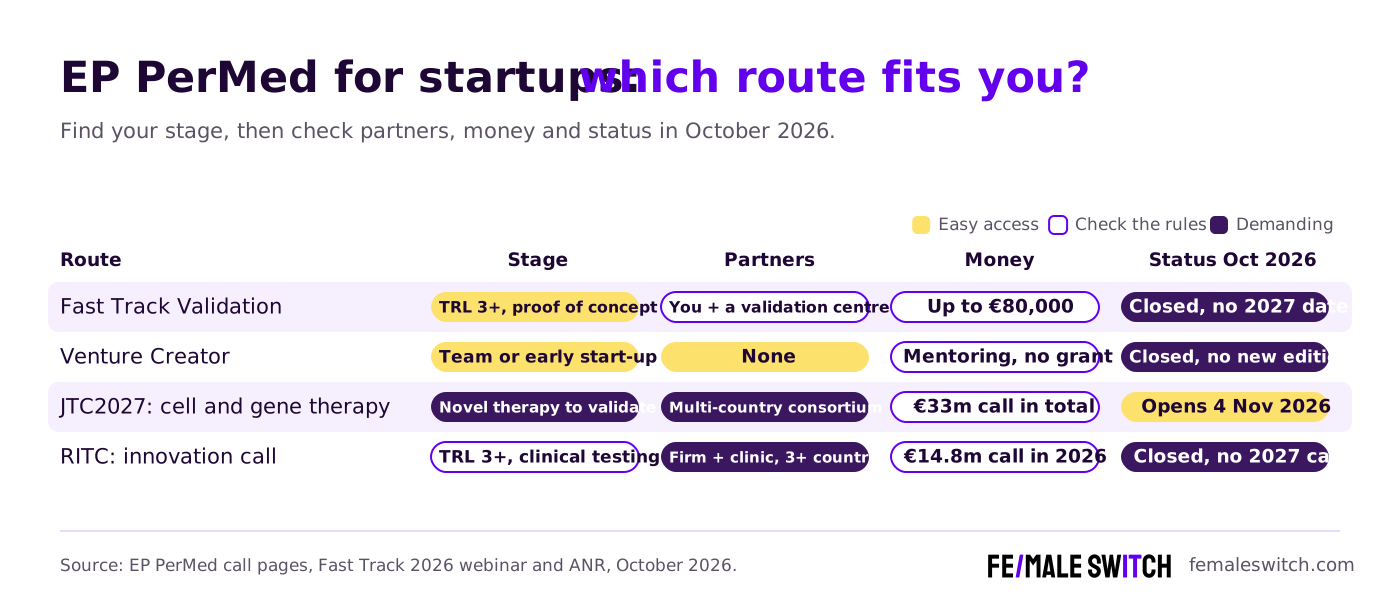
EP PerMed call status board (October 2026)
Sources: EP PerMed call pages and ANR, October 2026.
JTC2027: the next EP PerMed call, explained
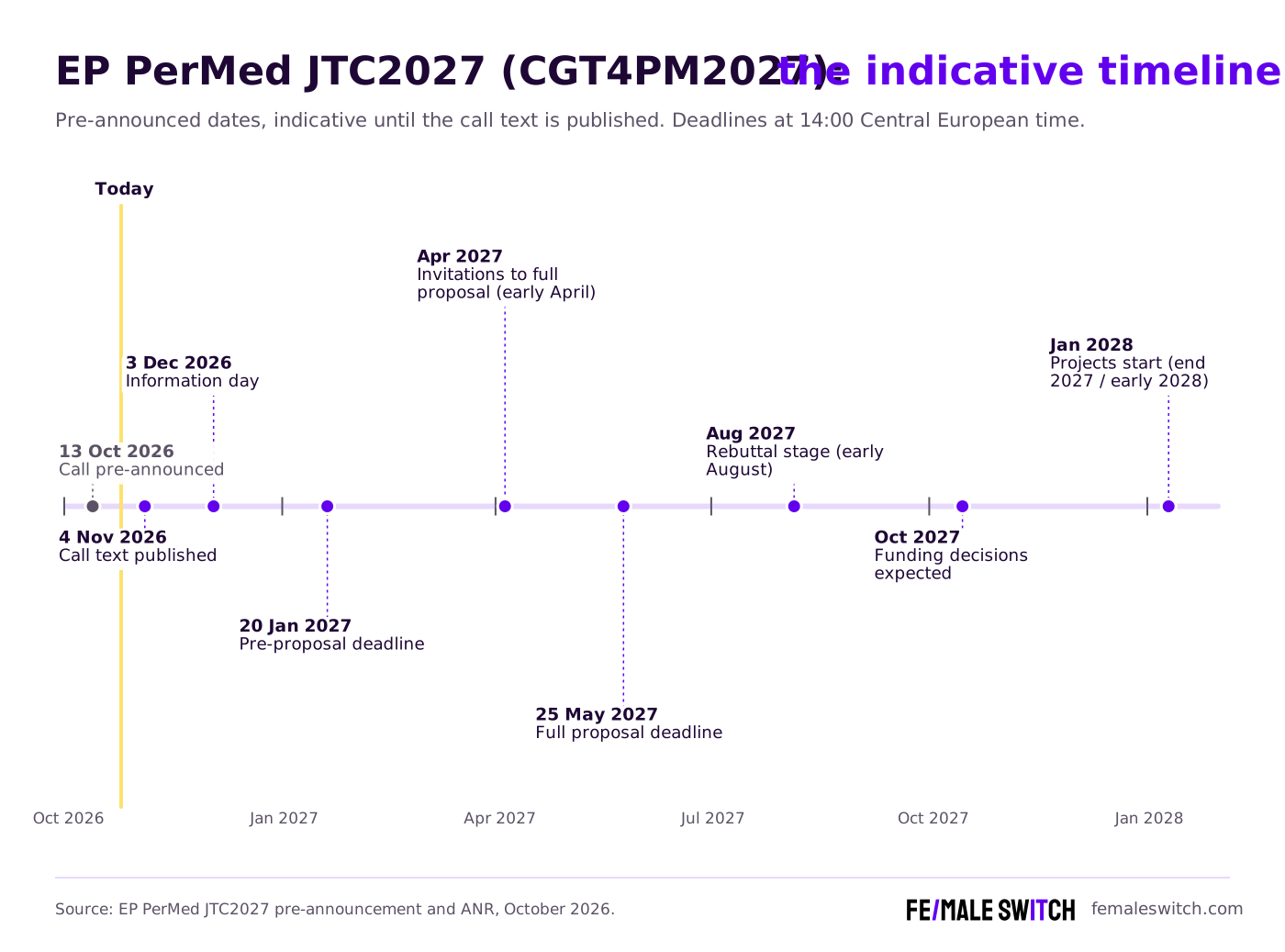
The 2027 Joint Transnational Call, "Cell and Gene Therapy for Personalised Medicine" (CGT4PM2027), was pre-announced on 13 October 2026. Projects must develop and validate an innovative somatic cell, gene or combined therapy, or a novel biological product such as mRNA or extracellular vesicles used to deliver genes. All disease areas are welcome.
Who funds it. Funders from 25 countries and 10 regions, several still marked "participation pending". Each partner is paid by its own national or regional funder under that funder's rules, so a company in one country may be fully eligible while one in another gets nothing. This is the most important fact for a startup.
Who can apply. Academia and research institutes, the clinical and public health sector, private for-profit partners including SMEs, and private non-profits such as foundations and patient groups. Cross-sector teams with SMEs and industry are encouraged.
Not published yet: consortium rules, project length and caps. For orientation, CARMEN2026 required at least three partners from three EU Member States or Associated Countries, allowed up to six at pre-proposal stage, let no more than two partners ask the same funder for money, and capped projects at three years.
The process. A pre-proposal, then a full proposal for invited consortia and a rebuttal step, all on the PT-Outline platform. The coordinator cannot change between stages.
The Fast Track Validation Programme: the startup's own path
Fast Track is the one EP PerMed instrument where a startup applies alone. It ran in 2025 (eight projects selected) and in 2026. The 2026 rules, from the call page and the January 2026 webinar:
- Applicant: an incorporated startup, or a team at an academic or healthcare research organisation, registered in an EU Member State or Horizon Europe associated country. No private individuals.
- Maturity: at least Technology Readiness Level (TRL) 3, a proof of concept, fitting the call's definition of personalised medicine.
- Money: up to €80,000 lump sum per project, for up to five projects. At least 70% goes to validation services.
- Validation centre: a biobank, health data registry or imaging facility you pick in Stage 2, legally and financially independent of you. The programme team can suggest centres.
- Contract: a three-party Financial Support Agreement between EIT Health as funder, the validation centre and you.
- Payment: 50% at the start, 50% after the final activity report is approved.
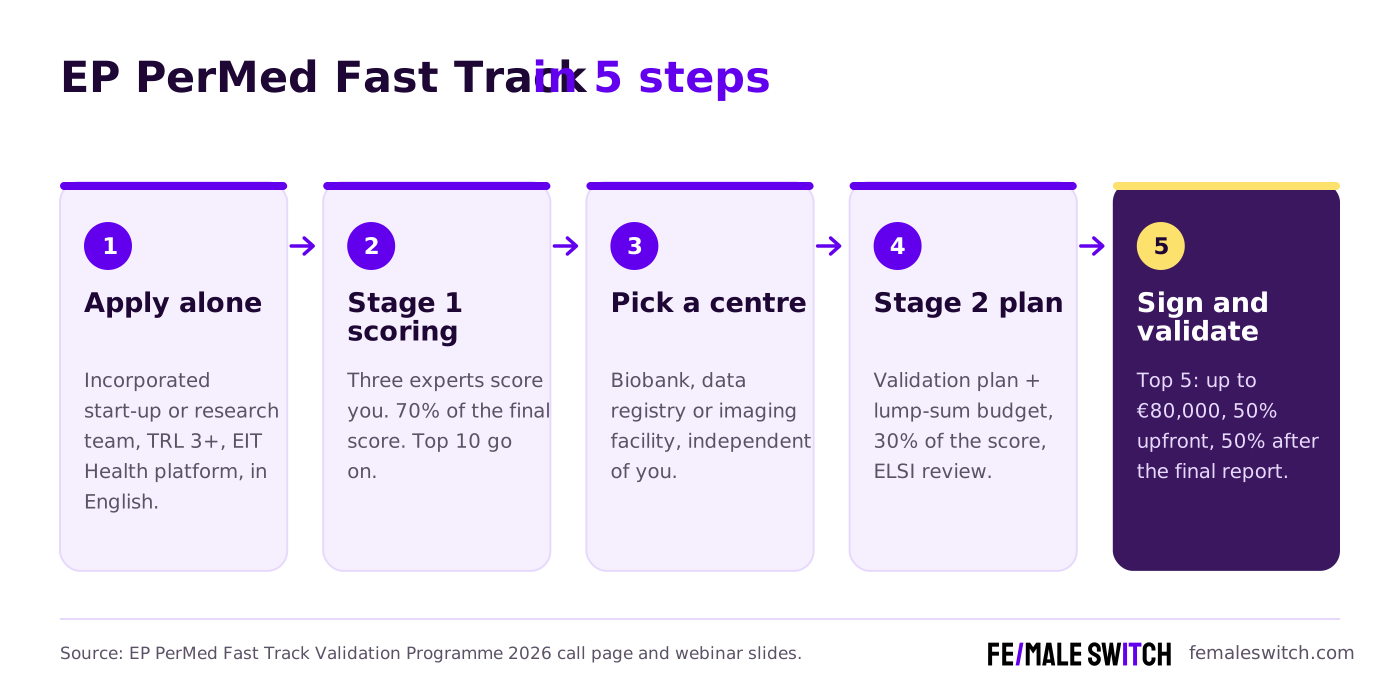
Stage 1, scored by three external experts, counts for 70% of the final score and the top ten go on. Stage 2, the validation plan and budget written with your centre, counts for 30%, plus an ethics, legal and social issues (ELSI) review. No 2027 Fast Track round has been announced yet.
Decision tree: which EP PerMed path fits you?
Answer in order and stop at the first "yes".
- Do you have a proof of concept (TRL 3+) that needs real-world evidence, and no consortium? Watch for the next Fast Track round. It is the fastest money EP PerMed offers.
- Still testing a business model? Venture Creator, if it returns, gives mentoring, not cash. Woman-led deep tech startups should also check Women TechEU.
- Cell or gene therapy, with partners in other countries? Prepare for JTC2027 now: pre-proposals are due in under three months.
- A data, AI or remote-monitoring tool that needs clinical testing? Watch for the next RITC-type call, which requires an enterprise in every consortium.
- None of the above? Start elsewhere. Cascade funding open calls and our map of European funds for startups cover money you can win without partners.
Worked founder example: a Fast Track budget
In this made-up example, a three-person startup has an algorithm that predicts drug response from a patient's genetic profile, built on data from one country. To prove it works in a second population, it partners with a biobank abroad that holds ready-to-use genetic and e-health data with consent for commercial use.
Two lessons. Ask for ready-to-use data, not new samples: six months leaves no time to collect them, as the programme's own webinar warns. And file for ethical approval during Stage 2, because it must be in place before the study starts.
Copyable outreach template for consortium partners
A startup rarely leads a JTC consortium; you get invited or you ask. Use this message to approach a clinical or academic coordinator before the pre-proposal deadline.
Readiness checklist: score yourself before 20 January 2027
A plan from now to the JTC2027 pre-proposal deadline
The call text is due on 4 November 2026 and the information day is on 3 December 2026. That leaves about eleven weeks.
If you are invited to the full stage (expected at the start of April 2027), you have until 25 May 2027. Funding decisions are expected in October 2027, with projects starting at the end of 2027 or early 2028. For writing help, see our guide on how to write an EU grant application. For monthly news on new calls, read Mean CEO's EU Funding News on blog.mean.ceo.
Who should apply and who can skip it
Apply if you build a diagnostic, therapy, data or AI tool for personalised medicine, you have results at TRL 3 or above, and you are happy to work inside a consortium with hospitals and universities. Cell and gene therapy companies should look at JTC2027 now.
Skip it for now if you need money within six months, your national funder does not fund companies in these calls, or your product is a wellness app with no clinical evidence path. Still choosing your funding mix? Read startup funding in Europe and the EU funding readiness checklist.
Related EU funding guides
Not sure your idea is a business yet? The Fe/male Switch startup game lets you build one step by step with an AI co-founder before you approach any funder.
FAQ
What is EP PerMed?
The European Partnership for Personalised Medicine, a Horizon Europe partnership running from 2023 to 2033 that pools about €375 million of national and EU money for personalised medicine calls.
Is there an open EP PerMed call now?
Not on 25 October 2026. JTC2027 on cell and gene therapy is pre-announced for 4 November 2026, with pre-proposals due 20 January 2027 at 14:00 CET (indicative dates).
Can a startup apply to EP PerMed alone?
Only through the Fast Track Validation Programme, which funds one startup or research team with up to €80,000 for a validation study. Joint Transnational Calls need a consortium; in 2026 that meant at least three partners from three countries.
How much funding does EP PerMed give a company?
In a JTC, your national or regional funder sets your share and cap; the whole JTC2027 budget is about €33 million. Fast Track pays up to €80,000 per project, at least 70% of it to the validation centre.
What is the EP PerMed Fast Track call?
A two-stage programme run with EIT Health: the top ten applicants write a validation plan with a validation centre, and the top five get up to €80,000 for a study of up to six months. The 2026 round closed on 10 March 2026.
About the Author
Violetta Bonenkamp, also known as MeanCEO, is an experienced startup founder with an impressive educational background including an MBA and four other higher education degrees. She has over 20 years of work experience across multiple countries, including 5 years as a solopreneur and serial entrepreneur. Throughout her startup experience she has applied for multiple startup grants at the EU level, in the Netherlands and Malta, and her startups received quite a few of those. She’s been living, studying and working in many countries around the globe and her extensive multicultural experience has influenced her immensely.

