

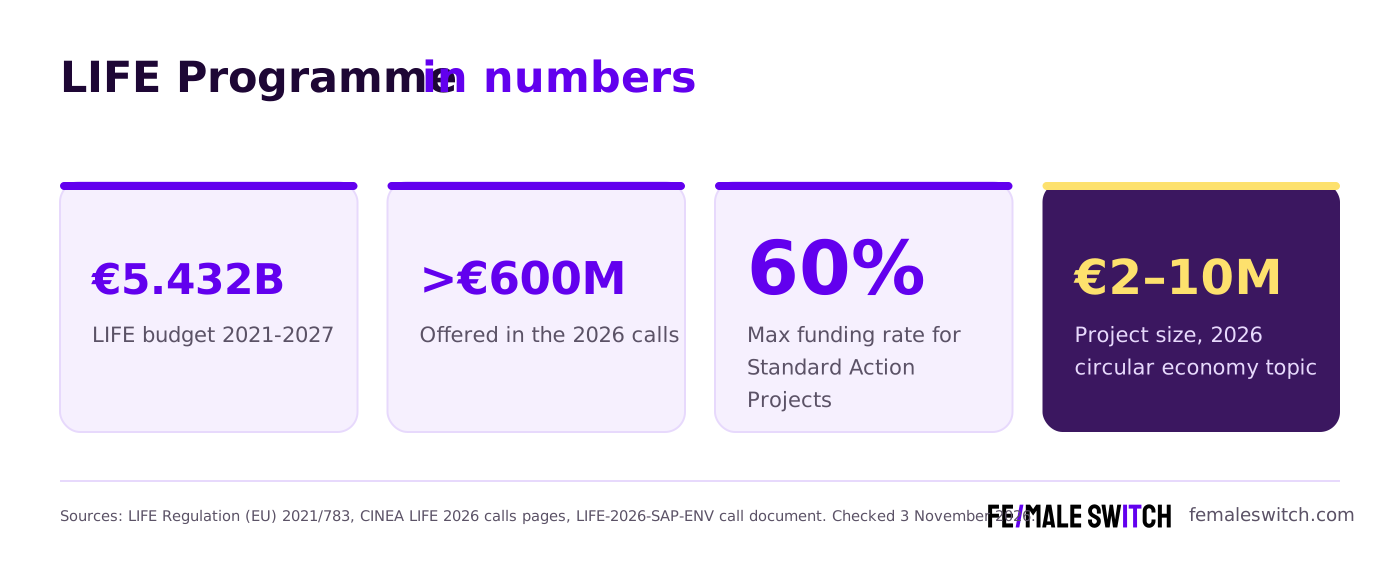
TL;DR: LIFE Programme grants are the EU's money for environment and climate projects: €5.432 billion for 2021-2027, run by the European Climate, Infrastructure and Environment Executive Agency (CINEA). A startup or SME can apply alone for a Standard Action Project and get up to 60% of its costs, but only for a demonstration or close-to-market project with a clear environmental benefit, not for research or general growth. The 2026 calls closed in September 2026, with results due in February/March 2027. The next round is expected to open around April 2027. Below: a deadline calendar, a decision tree, a budget worked example, a scored readiness worksheet and a copyable one-page project outline.
Most founders hear "EU green grant" and picture a cheque for their cleantech startup. LIFE is not that. It co-funds projects that show a solution working in real conditions and prove its effect on nature, pollution, waste or emissions. Done right, a LIFE project can pay for 60% of a full-scale pilot. Done wrong, it eats a year of your team's time.
This guide shows which LIFE routes fit a startup or SME, what they pay, and the dates that matter until 2028. All facts come from the LIFE Regulation (EU) 2021/783, CINEA's LIFE pages, the 2026 LIFE call documents published on the EU Funding & Tenders Portal, and CINEA's Clean Energy Transition FAQ. We checked them on 3 November 2026.
What the LIFE Programme is
LIFE is the only EU funding programme dedicated entirely to the environment and climate action. The LIFE Regulation sets its 2021-2027 budget at €5.432 billion, split into four sub-programmes:
On 19 October 2026 CINEA announced 135 new LIFE projects with €390 million in EU funding, about two-thirds of their €579 million total investment. LIFE money is regular, but every euro needs your own co-financing. See where LIFE sits on our map of EU grants for startups.
Which LIFE projects a startup can apply for
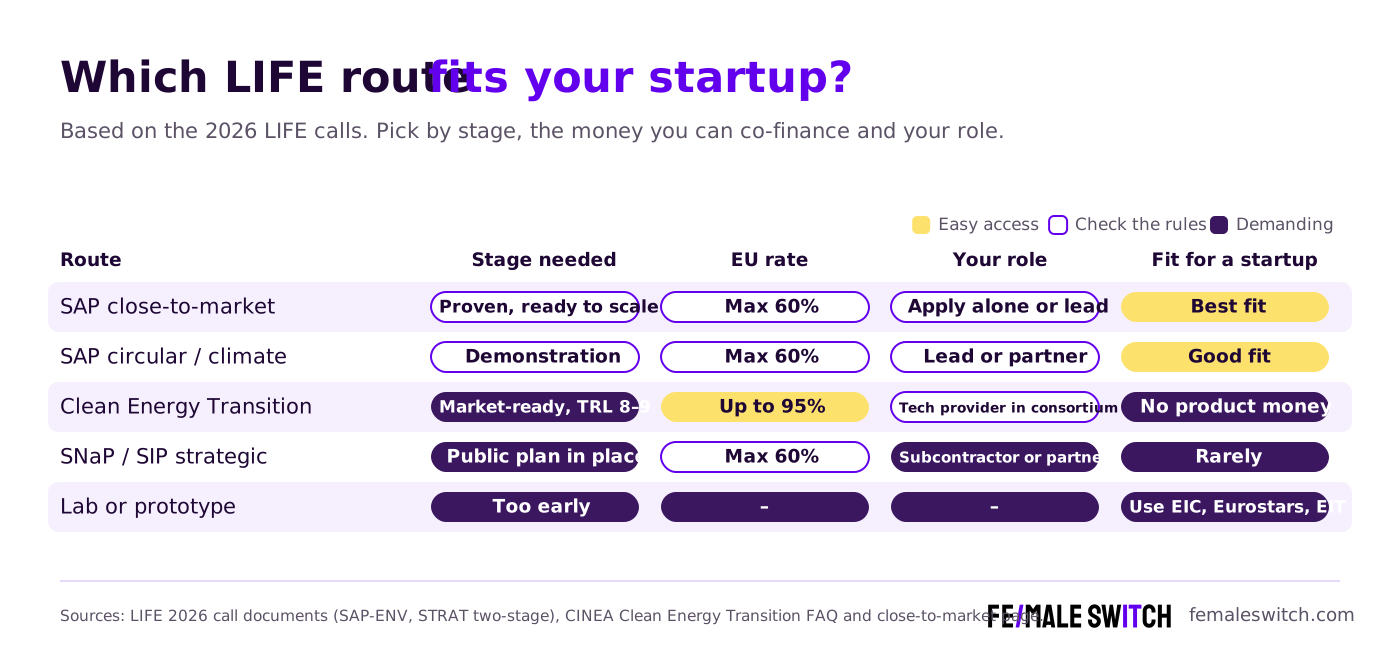
Standard Action Projects (SAPs). These are the main door. In the 2026 Circular Economy and Quality of Life call, the "consortium composition" rule was "n/a", so a single company can apply. Private legal entities established in an EU member state (including overseas countries and territories), a listed EEA country or a country associated to LIFE are eligible. Natural persons are not, except sole traders. The funding rate is a maximum of 60%. Projects run from 24 to 120 months.
Close-to-market projects. These are SAPs with a business angle rather than a separate call. CINEA describes them as projects that "launch innovative, demonstrative solutions that offer clear environmental and/or climate benefits", with a high level of technical and business readiness. The solution should be usable at industrial or commercial scale during the project or shortly after it ends. Every close-to-market project must produce a business plan. CINEA offers these projects business plan advice, coaching, expert connections, including on intellectual property, and help finding loans or guarantees.
Clean Energy Transition (CET) actions. These pay up to 95% of eligible costs, but they fund coordination and support work: policy, skills, finance and market uptake. CINEA's FAQ for the 2026 CET industry topic says proposals should use technologies "ready for market deployment", typically TRL 8 or 9, and that "demonstration activities are not in the scope". A startup with a market-ready energy product can join such a consortium as a technology provider. It won't get money to develop the product.
Strategic Nature and Integrated Projects (SNaP/SIP). These are large plans led by national or regional authorities, worth tens of millions of euros. Startups only take part as subcontractors or partners.
What LIFE does not fund: basic research, a company's general running costs, or a project already funded by another EU grant. The 2026 SAP call document also states that grants "may NOT produce a profit": a for-profit beneficiary must declare its project revenues, and any surplus is deducted from the final grant.
What a LIFE grant pays: rates, sizes and scoring
Three rules from the 2026 SAP call document catch first-time applicants:
- It reimburses real costs. The grant is a "budget-based mixed actual cost grant". You get back a share of costs you actually incurred, not your budget.
- Cash comes in stages. After signing, you normally receive a prefinancing of about 30% of the maximum grant. The rest follows later reports. You need cash to bridge the gap.
- Your finances are checked. Coordinators face a financial capacity check unless the grant is €60,000 or less, which no SAP is. A weak balance sheet can lead to instalments, a guarantee or no prefinancing at all.
Evaluators score four criteria from 0 to 20: relevance, impact, quality and resources. Each needs at least 10 points, and impact is weighted 1.5. A proposal needs 55 of 90 weighted points to pass, plus up to 10 bonus points, such as for building on earlier EU-funded results or for "exceptional catalytic potential". The Part B narrative is capped at 120 pages, and your project acronym must contain the word LIFE.
Worked founder example: a water-reuse startup
A nine-person startup has a membrane system that lets food factories reuse process water. It runs one paying pilot and has €1.5 million of seed funding.
It applies alone under Circular Economy and Zero Pollution, with the two factories as associated partners. Because impact weighs 1.5 times, the proposal promises measured litres of water saved and a replication plan. Pilot revenue goes in the budget, since LIFE pays no profit.
LIFE deadline calendar 2026-2028
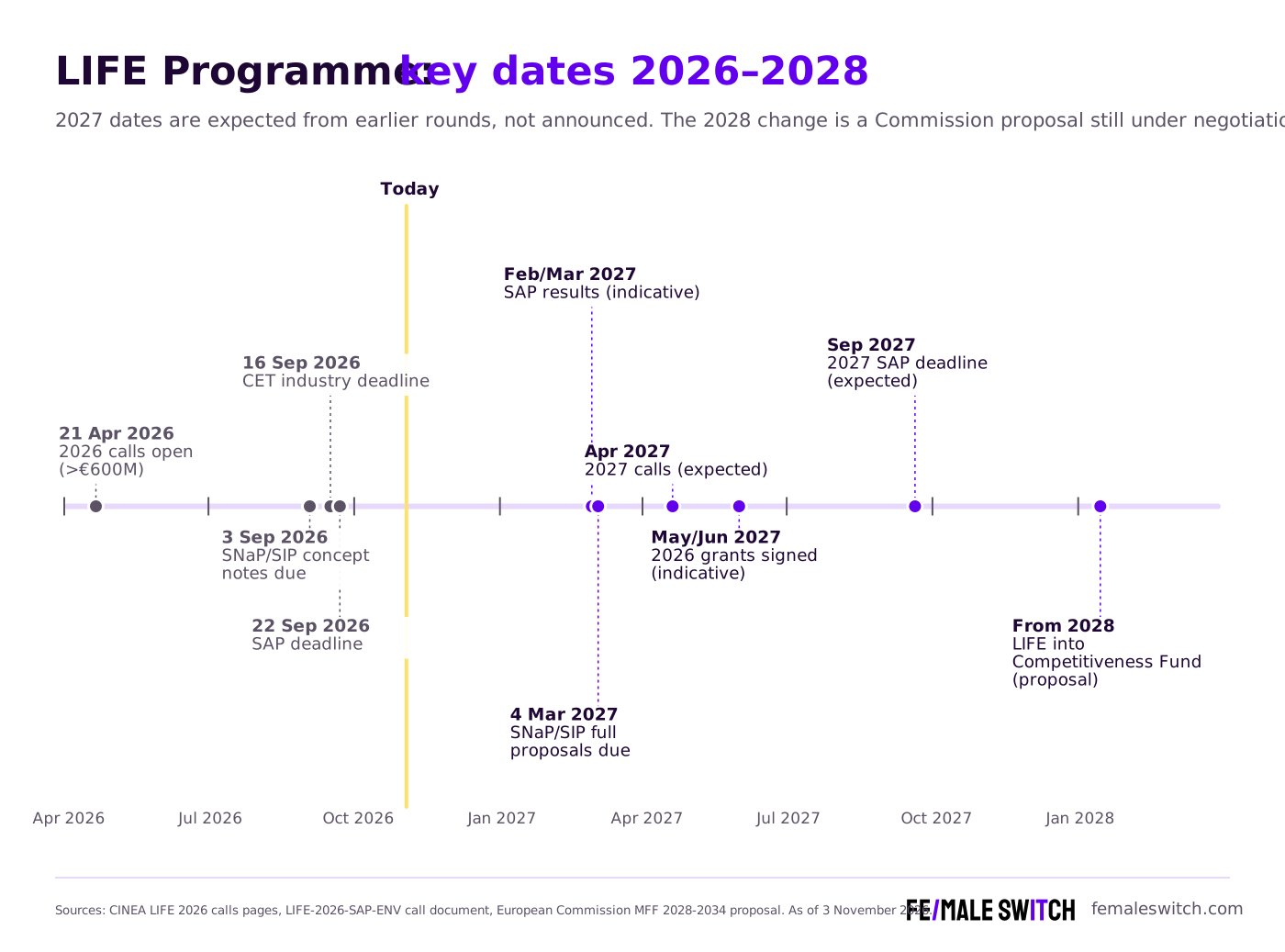
That last line matters. The Commission's proposal for the 2028-2034 EU budget would end LIFE as a stand-alone programme and continue its main activities inside a new European Competitiveness Fund. Parliament and the Council haven't agreed on it yet. Either way, the 2027 call is the last one under the current LIFE rules, so if your project fits, aim for it.
Track every date in our EU grant calendar 2027 and set alerts with our guide to finding open EU funding calls.
Decision tree: is LIFE the right grant for you?
- Does your solution have a measurable benefit for nature, pollution, waste, water, air or the climate? No: LIFE is not for you. Look at EU grants for small businesses.
- Is it still in the lab or at prototype stage? Yes: LIFE comes too early. Try the EIC Accelerator, Eurostars or green cascade funding calls.
- Can you demonstrate it at real scale, with a site, a customer or a public partner, within two to three years? No: build that partnership first.
- Can you co-finance 40% and wait 8–9 months from deadline to signature? No: raise equity or a loan first. Our guide to startup funding in Europe shows the order.
- Is your product an energy technology already on the market (TRL 8–9)? Then also look for a Clean Energy Transition consortium that needs a technology provider, and at InnoEnergy for equity.
- All yes? Prepare a close-to-market Standard Action Project for the 2027 call.
LIFE readiness worksheet: score yourself
Give each line 0 (no), 1 (partly) or 2 (yes).
13–16: apply in 2027. 8–12: start partnerships now and decide by February 2027. 0–7: LIFE is too early for you; start with a smaller grant. Our EU funding readiness checklist covers the general basics.
One-page LIFE project outline template
Use this before you write a 120-page proposal. If you can't fill it in, you aren't ready.
Who should apply and who can skip it
Apply to LIFE if you have a working green solution, a demonstration site, measurable results and cash to co-finance 40%. Circular economy, water, pollution and climate-adaptation startups fit best.
Skip it if you need money within six months, are still at prototype stage, or your environmental benefit is a side effect of your product. Early-stage green founders do better with the EIT Food or EIT RawMaterials programmes, national grants and angel money first. If you do apply, read our guide to writing an EU grant proposal before you start.
Related EU funding guides
For new LIFE and other EU calls every month, read Mean CEO's EU Funding News on blog.mean.ceo. And to test your business model before you put it in a business plan for CINEA, play the Fe/male Switch startup game.
FAQ
What is the LIFE Programme?
LIFE is the EU's funding programme for the environment and climate action. It has €5.432 billion for 2021-2027, split into Nature and Biodiversity, Circular Economy and Quality of Life, Climate Change Mitigation and Adaptation, and Clean Energy Transition. CINEA runs the calls.
Can a startup apply for a LIFE grant alone?
Yes, for Standard Action Projects. The 2026 Circular Economy and Quality of Life call had no minimum consortium, so a single private company established in an eligible country could apply. Partners and associated partners can make the proposal stronger.
What is the LIFE Programme funding rate?
Standard Action Projects and strategic projects get a maximum of 60% of eligible costs. Clean Energy Transition coordination and support actions get up to 95%. The grant reimburses costs actually incurred and may not produce a profit.
When is the next LIFE call for proposals?
The 2026 calls closed in September 2026. The 2027 calls have not been announced yet. The 2025 and 2026 calls opened in late April with deadlines in September, so expect a similar timetable in 2027 and check the EU Funding & Tenders Portal from April.
Does LIFE fund research or product development?
No. LIFE funds demonstration, close-to-market, best-practice and governance projects with a measurable environmental or climate benefit. Research and early product development belong to Horizon Europe and the EIC.
How much can a company get from LIFE?
In the 2026 Circular Economy and Zero Pollution topic, total project budgets were expected to be €2–10 million, so the EU share at 60% would be €1.2–6 million. Governance projects were smaller, at €0.7–2 million.
About the Author
Violetta Bonenkamp, also known as MeanCEO, is an experienced startup founder with an impressive educational background including an MBA and four other higher education degrees. She has over 20 years of work experience across multiple countries, including 5 years as a solopreneur and serial entrepreneur. Throughout her startup experience she has applied for multiple startup grants at the EU level, in the Netherlands and Malta, and her startups received quite a few of those. She’s been living, studying and working in many countries around the globe and her extensive multicultural experience has influenced her immensely.

