
TL;DR: how do you find a good business idea?
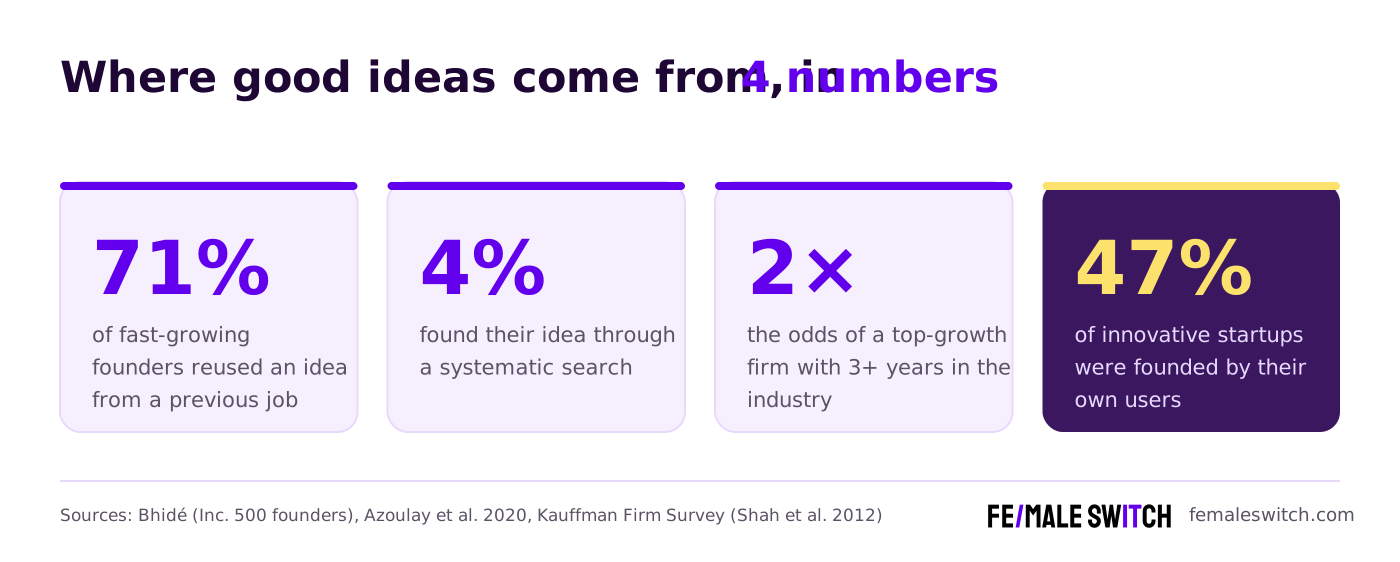
Start with what you already know. 71% of founders of fast-growing US companies built on an idea from a previous job, and only 4% found theirs through a systematic search. List the problems people in your industry or community pay to solve, look for recent changes that open new markets, use AI to widen your options, then test the best ones with real buyers before you spend money. Below are 100 business ideas sorted by budget, place and whether you can start alone, each linked to an in-depth guide.
👉 Get ideas matched to your skills with the free Business Ideas Generator
There is no shortage of business ideas. There is a shortage of ideas that fit the person who will run them. The same café that thrives for a former barista in a busy town can sink a first-time founder with no food experience, and the same AI consultancy that suits a former IT manager would struggle in other hands. If you would rather skip the list, answer five questions in our business suggestions finder to get three ideas that fit you.
This guide does two things. First, it shows what research says about where good business ideas come from and turns it into a five-step method. Second, it gives you 100 business ideas across ten categories, tagged by budget, where you work and whether you can start alone, with a link to the deeper guide for each one. If your best idea might be your hobby, our sister site covers business ideas from your hobby with real prices and tax rules.
Updated October 2026.
Where do good business ideas come from?
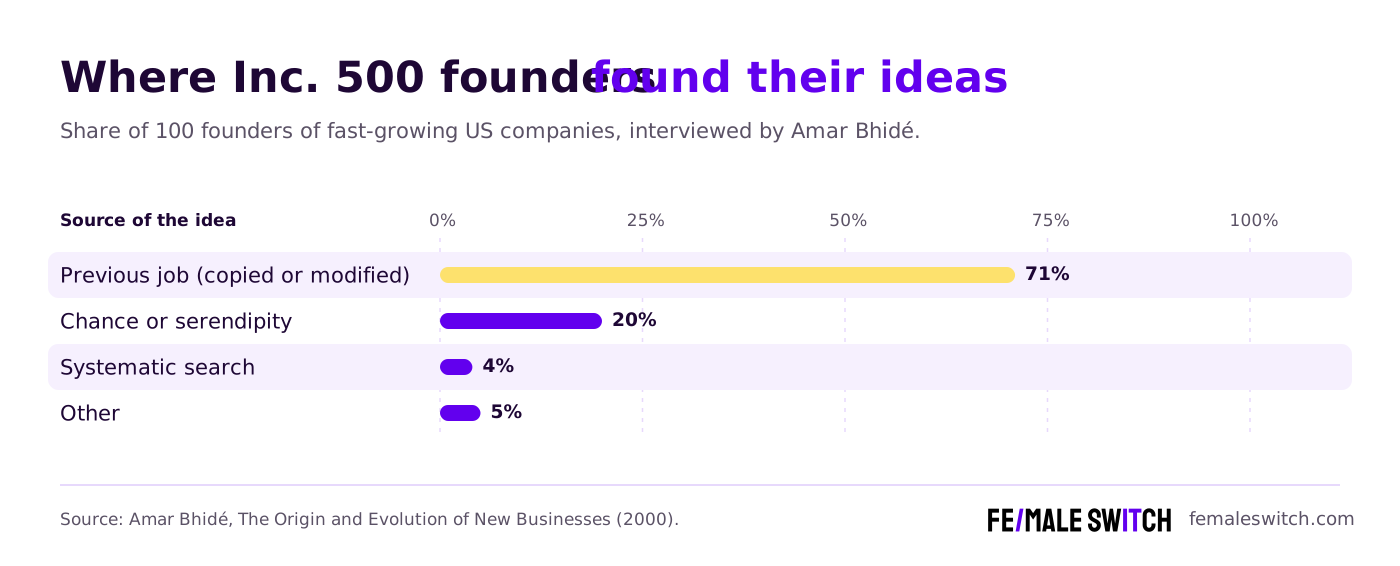
Not from brainstorming lists. When Amar Bhidé interviewed 100 founders of the fastest-growing US private companies for The Origin and Evolution of New Businesses, 71% had copied or modified an idea they met in a previous job, 20% stumbled on it by chance and only 4% found it through a systematic search. Only 6% claimed to have started with a unique product.
- Experience beats youth. In a study of 2.7 million US founders, Azoulay, Jones, Kim and Miranda found that founders with three or more years in the same industry were about twice as likely to build a top-0.1% growth company, and the average age of those founders was 45.
- Ideas grow out of experience. In the US Panel Study of Entrepreneurial Dynamics, 55.9% of new founders credited their idea to experience in a particular industry or market, only a third searched for it deliberately, and most said the opportunity unfolded over time.
- Your own problems count. In the Kauffman Firm Survey, people who first built a product for their own use founded 47% of innovative startups; half of them had met the need at work, the rest in their personal life or hobbies.
- Knowledge shapes what you see. Scott Shane showed that eight teams given the same MIT invention found eight different markets, each one tied to what its founders already knew.
- Testing beats certainty. In a randomised trial with 116 Italian startups, Camuffo and colleagues found that founders taught to treat ideas as hypotheses and test them earned more revenue, reached first sales faster and were quicker to drop weak ideas.
Many people stop at the idea stage. In the UK, 14.8% of adults intended to start a business within three years in 2024, but only 6.7% were actively setting one up, according to the Global Entrepreneurship Monitor. A clear method closes that gap.
Want to see these patterns in real companies? Our guide to great business ideas follows 20 founders who started small, from Spanx and Vinted to Gymshark and Mumsnet, and shows what each one started with and how they found their first customers.
How to find the right business idea for you in 5 steps
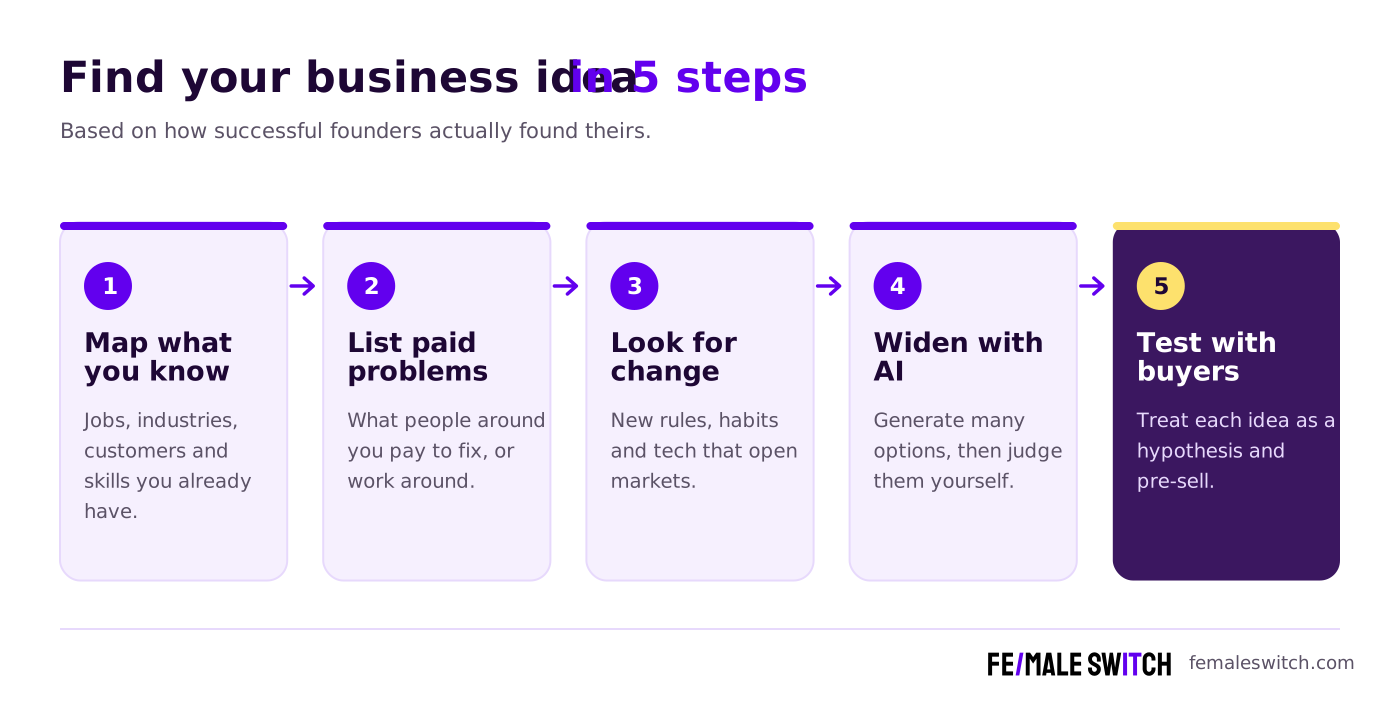
- Map what you know. Write down every industry you have worked in, the customers you served and the skills people already pay you for. This is your unfair advantage.
- List problems people pay to solve. Note the workarounds, complaints and slow, expensive processes you see at work and around you. A problem with a budget attached beats a clever idea.
- Look for change. New rules, habits and technologies open markets before big companies arrive. Our guide to new business ideas lists 25 openings with their deadlines.
- Widen your options with AI. Ask an AI tool for dozens of variations on your best problem, then judge them yourself (see below).
- Test with buyers. Treat each idea as a hypothesis: talk to ten potential customers, quote a price and ask for a deposit. Score the result with the Idea Validator.
Which kind of business fits you?
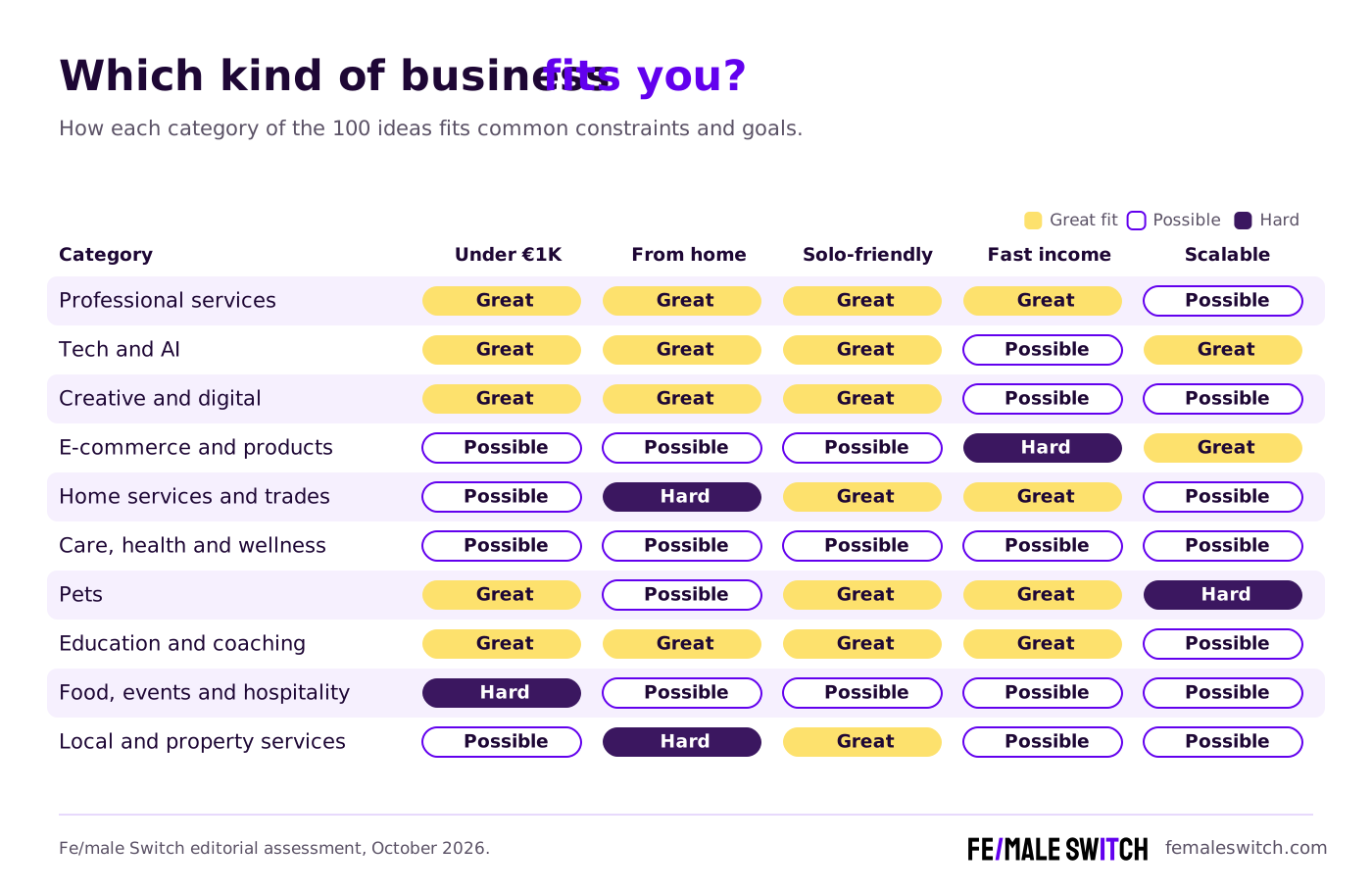
- Little money: professional services, tech, creative work, pets and coaching can start for under €1,000. See the best low cost business to start.
- Can't afford to lose: choose recurring services with low fixed costs. Compare survival rates in our guide to low risk business ideas.
- Working from home: desk-based services and digital products fit best; check zoning, lease and insurance in small business ideas from home.
- Fast income: local services and professional services earn from the first customer; products take longer.
- Scale: tech, products and team-based services can grow beyond your own hours; read how to start a startup.
100 business ideas, by category
Each idea is tagged by typical startup budget, where you work, and whether you can start alone. The last column names the guide where we cover it in depth; all guides are linked at the end of this section.
Professional services business ideas
Tech and AI business ideas
Creative and digital products business ideas
E-commerce and products business ideas
Home services and trades business ideas
Care, health and wellness business ideas
Pets business ideas
Education and coaching business ideas
Food, events and hospitality business ideas
Local and property services business ideas
Go deeper: our ranking of the best business ideas scores 30 of them on earnings, growth, survival and AI risk; small business ideas gives the money math for 25 local businesses; business ideas for women shows where women-owned firms earn most.
Business ideas in Europe: what is different?
The same ideas work across Europe, but three things change the choice. Many trades and professions are regulated (master craftsman rules in Germany, licensed estate agents in France), registration and social security costs vary widely, and new EU rules on repair, packaging, accessibility and AI are opening markets that barely exist in the US. Europe is also busy: about 10.5% of EU enterprises were new in 2023, against 8.5% that closed, according to Eurostat.
Compare start-up costs in MeanCEO's guide to bootstrapping costs by country, and follow the monthly startup ideas for European entrepreneurs series for fresh examples.
Can AI give you a good business idea?
Yes, but not on its own. In a Wharton experiment, GPT-4 generated 35 of the 40 best-rated product ideas out of 400, at about 40 times the speed of a person. But the human ideas were more novel, and a 2024 study in Science Advances found that AI help made individual ideas better while making everyone's ideas more similar. A 2025 meta-analysis of 28 studies confirmed the pattern: people working with AI produce better ideas, but much less varied ones.
- Feed it your context: your industry, skills, customers and budget. Generic prompts return generic ideas everyone else also gets.
- Ask for many, then filter: generate 50 variations, then judge them against what you know about the market.
- Mix sources: use more than one AI tool and add your own ideas; research shows that pooling models and prompts restores variety.
- Never skip customers: AI can't tell you whether people near you will pay.
Try it with the free Business Ideas Generator or brainstorm with our AI co-founder.
How do you know if a business idea is good?
Map your customer with the User Persona Generator and size the opportunity with the Market Size Calculator.
Turn your idea into a business with an AI co-founder
The Fe/male Switch startup game takes you from idea to first customers step by step, with Elona Musk as your AI co-founder and 6,000+ founders learning alongside you.
👉 Start building your first business
Conclusion: the best business idea is close to what you already know
Research on successful founders points the same way: good business ideas come from experience, from problems people already pay to solve and from recent changes in a market, and they get better when you test them with real customers. Use the 100 ideas above as a map, start from the categories that fit your budget and life, and let customers, not lists, make the final choice.
Your next step: write down three problems from your work or community, match them to ideas in the directory and talk to five potential customers this week. For structured lessons, join the free startup school.
Methodology
Budget bands are typical startup costs for a lean start (under €1,000, €1,000–10,000, over €10,000). Place, team and category fit are Fe/male Switch editorial assessments, October 2026, based on the research behind our in-depth guides.
FAQ: business ideas
How do I come up with a business idea?
Start from your experience: list the industries, customers and skills you know, then the problems people pay to solve. Research on fast-growing companies shows most founders built on an idea from a previous job. Use AI to generate variations and test the best with real buyers.
What is a good business idea for a beginner?
A service that uses a skill you already have and needs little money: consulting in your field, tutoring, pet care, cleaning, social media management or bookkeeping. They let you earn from the first customer and learn selling before taking bigger risks.
What are the best online business ideas?
Professional services delivered online (consulting, bookkeeping, marketing, web design), AI implementation for small firms, online teaching and coaching, digital templates and paid newsletters all need little capital and no premises.
What business can I start with little money?
59 of the 100 ideas in this guide typically start for under €1,000, including consulting, virtual assistance, tutoring, dog walking, cleaning and digital products. See our guide to the best low cost businesses for detailed costs.
What is the most profitable business idea?
Skills-based professional services keep the largest share of revenue as profit, while food and retail keep the least. Our ranking of the best business ideas scores 30 ideas on earnings, growth, survival and AI risk.
Can AI come up with business ideas?
Yes. In a Wharton study, GPT-4 generated most of the best-rated ideas, faster and cheaper than people. But AI ideas tend to be similar to each other, so combine them with your own knowledge and always test them with customers.
How do I know if my business idea is good?
A good idea solves a problem people already pay to fix, for a group you can reach, with an edge you have. The strongest evidence is a stranger paying a deposit or pre-ordering before you build.
What are the main sources of business ideas?
The most common sources are your previous jobs and industry, problems you or people around you face, hobbies and personal needs, changes in rules, technology or habits, ideas that work in another country or market, and customer complaints about existing products. Research shows work experience is by far the most productive source.
Is $5,000 enough to start a business?
Yes, for most service businesses and many online ones. 86 of the 100 ideas in this guide typically start for under €10,000, and 59 for under €1,000. Keep part of the budget for insurance, marketing and a few months of costs.
Should I keep my business idea secret?
Usually not. Ideas are rarely the bottleneck; execution is. Talking to potential customers early gives you the feedback you need, and almost 60% of fast-growing founders in Bhidé's study faced identical or close competitors anyway.
About the Author
Violetta Bonenkamp, also known as MeanCEO, is an experienced startup founder with an impressive educational background including an MBA and four other higher education degrees. She has over 20 years of work experience across multiple countries, including 5 years as a solopreneur and serial entrepreneur. Throughout her startup experience she has applied for multiple startup grants at the EU level, in the Netherlands and Malta, and her startups received quite a few of those. She’s been living, studying and working in many countries around the globe and her extensive multicultural experience has influenced her immensely.

