
Grants for Early-Stage Startups in South America in 2027: Start-Up Chile, CORFO, ANII, FAPESP, Centelha, Startup Perú and More
Early-stage founders in South America can get non-dilutive money from public agencies in almost every country, but each programme has its own rules on residence, company age and how much you add yourself. This guide lists the main grants and seed-grant programmes for idea-stage and young startups in 2027, country by country: Chile, Uruguay, Brazil, Peru, Colombia, Argentina, Paraguay and Ecuador, plus IDB Lab as a regional investor. Amounts are in local currency, as the official pages state them, and each status was checked in November 2026. For science-based companies, our guide to deep tech grants in South America goes deeper into ANID, FINEP and EMBRAPII. The 2025 version of this article listed 15 items, most of them grants for NGOs or partnerships rather than startups; what happened to them is at the end.
Quick answer: the best-known grant is Start-Up Chile, which gives founders of any nationality CLP 15 million (Build) or CLP 30 million (Ignite) equity-free; its BIG 13 call was set to close on 24 November 2026. In Chile, residents can also apply for CORFO Semilla Inicia (up to CLP 15 million, CLP 17 million for women). Uruguay's ANII pays up to UYU 3,000,000 to innovative new companies through an open window, Brazil has FAPESP PIPE in São Paulo and the state-by-state Centelha calls, and Peru's Startup Perú pays up to S/ 67,000 or S/ 150,000 when its calls are open.
Write FREE SEO-optimized Blog Articles! Our Article Writer ensures your blog is loved by both Google and your readers, turning those clicks into customers.
👉 Write your article here
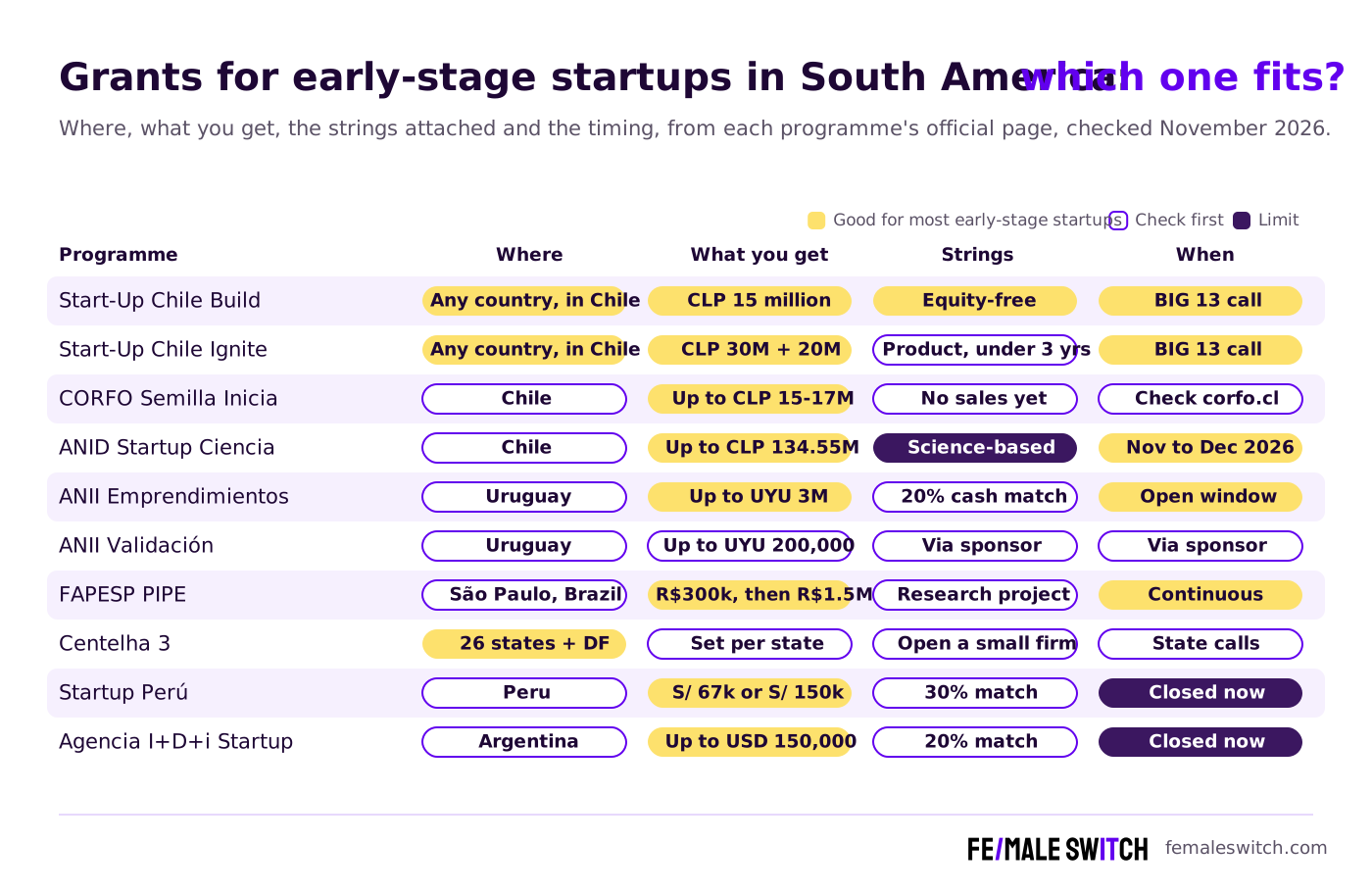
Grants for Early-Stage Startups in South America Compared
Sources: each programme's official page, checked on 9 November 2026 (ANID Startup Ciencia amount and FAPESP eligibility on 30 October 2026). Amounts and rules change with each call, so read the bases before you apply.
Chile
1. Start-Up Chile: CLP 15 million or CLP 30 million, equity-free
Start-Up Chile, CORFO's startup programme, gives equity-free funding to founders from any country who build their startup in Chile. Build is a four-month pre-acceleration for teams going from a validated idea to an MVP, with CLP 15 million; it runs two generations a year of up to 50 startups, at least half of them led by women. Ignite is a four-month acceleration for startups with a working product and less than three years of development, from any industry and country, with CLP 30 million and a possible CLP 20 million extension; teams with women leaders can get up to 90% financing. Applications for the BIG 13 generation were set to close on 24 November 2026 at 13:00 (GMT-3). See also AI accelerators in South America.
2. CORFO Semilla Inicia: up to CLP 17 million for women founders
CORFO's Semilla Inicia co-finances up to 75% of a project, capped at CLP 15,000,000, to validate a prototype or a quick-to-launch idea technically and commercially; women, or companies led by women, can get up to CLP 17,000,000 covering 85%. Individuals must be 18 or older and live in Chile; companies must be set up in Chile with less than 18 months of activity and no sales. The goal is a validated product and first sales during the project. Calls open and close on CORFO's site, so check which ones are open before you prepare.
3. ANID Startup Ciencia: for science-based startups
If your startup is built on research, ANID's Startup Ciencia 2027 call is scheduled to open in November 2026, close in December 2026 and announce results in April 2027. The 2026 edition paid up to CLP 134.55 million to micro and small firms under 10 years old; check the 2027 bases when they are published. More science-based options are in our guide to deep tech grants in South America.
Boost Your SEO by listing your startup and get a FREE backlink.
Create a profile in the F/MS Startup Game, add the link to your website and submit.
👉 List your startup now!
Uruguay
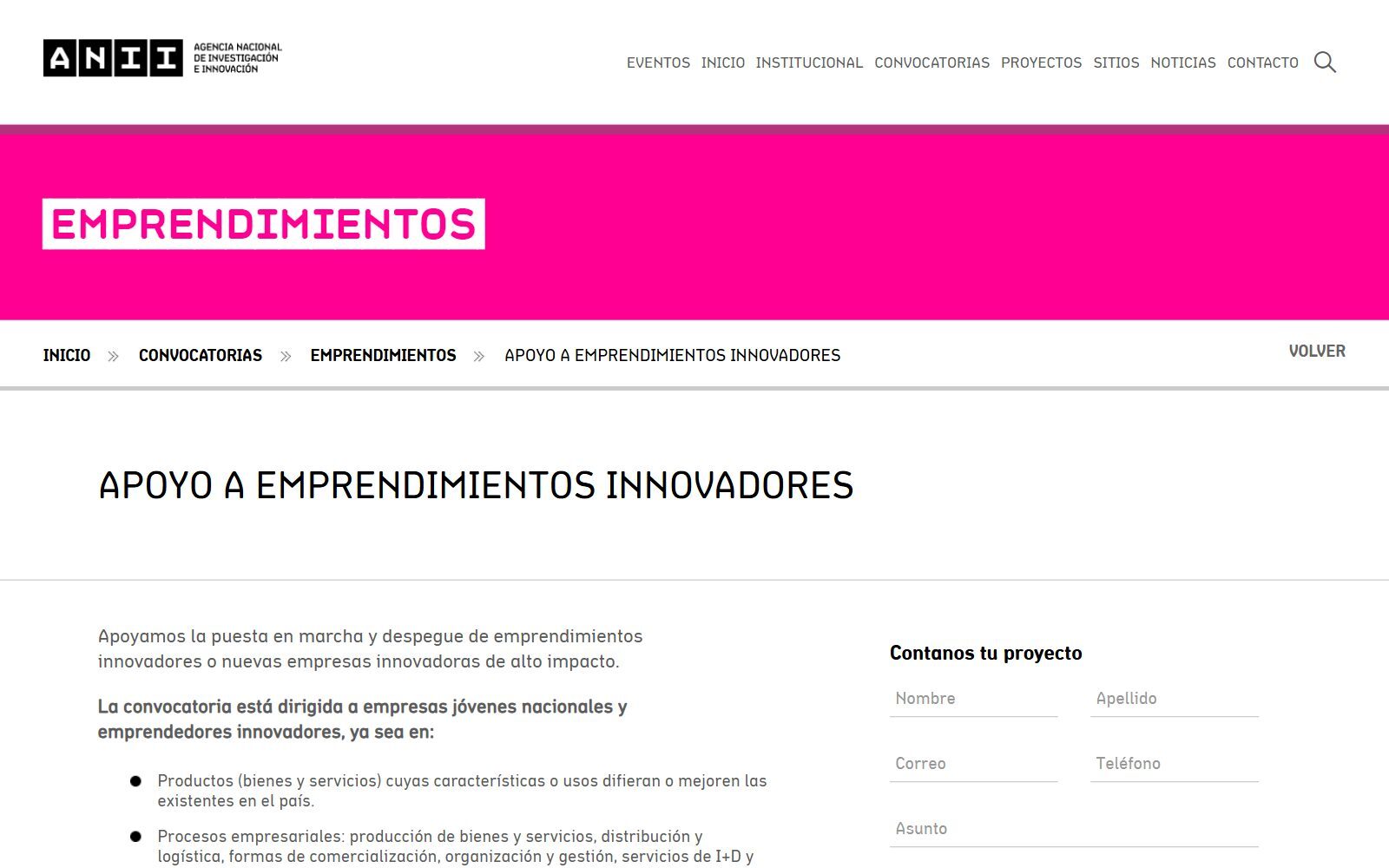
4. ANII Apoyo a Emprendimientos Innovadores: up to UYU 3,000,000
Uruguay's research and innovation agency ANII runs Apoyo a Emprendimientos Innovadores for young national companies and innovative entrepreneurs. It pays non-refundable funding of up to 80% of the project, capped at UYU 3,000,000, and the founders add at least 20% in cash. If the project is led by a woman (women partners hold the largest stake) or is linked to climate change, ANII covers up to 90%. Projects can last up to 24 months. The call works as an open window that closes when funds run out, and you can apply with a sponsoring institution. Uruguay's startup scene: Montevideo startups to watch.
5. ANII Validación de Ideas de Negocios: up to UYU 200,000
For the very first step, ANII and the national development agency ANDE fund Validación de Ideas de Negocios: up to UYU 200,000 non-refundable to run validation experiments and test a minimum viable product in your target market. You apply through a sponsoring institution (IPE VIN), which helps you write the project and follows its execution, and an expert advises you on the validation plan.
Brazil
6. FAPESP PIPE (São Paulo): up to R$1.5 million
The São Paulo Research Foundation's PIPE programme funds research for innovation in small companies. Phase 1 pays up to R$300,000 over nine months to test technical and scientific feasibility; Phase 2 pays up to R$1,500,000 over up to 24 months to develop the innovation, and can include first steps towards the market. Companies need up to 250 employees and a base or research unit in São Paulo state, and proposals are accepted in continuous flow. It suits technology startups more than service businesses.
7. Programa Centelha: the first push in 26 states
The federal Programa Centelha is the most common first grant for Brazilian founders outside São Paulo. Its third edition, launched in 2025, plans R$155 million across 26 states and the Federal District, run mostly by each state's research foundation. You can apply as an individual, and open a micro or small company in that state if you win, or with a small company set up within 12 months before the call; winners get non-refundable economic subsidy, technical support grants and training. Each state publishes its own call and amounts: in Minas Gerais, for example, the Centelha 3 call offered up to R$96,000 in subsidy plus up to R$50,000 in grants. In November 2026 the site listed Alagoas as open. Brazilian ecosystem: Brasília startups to watch.
Boost Your SEO with 1,500+ Free Business Directories: increase your DA, get backlinks and traffic.
We've compiled an exclusive list of directories and websites where you can submit your business and start building high-quality backlinks to boost your website traffic and get your SEO snowball rolling.
👉 Submit your startup now!
Peru, Colombia, Argentina and Paraguay
8. Startup Perú (ProInnóvate): S/ 67,000 or S/ 150,000
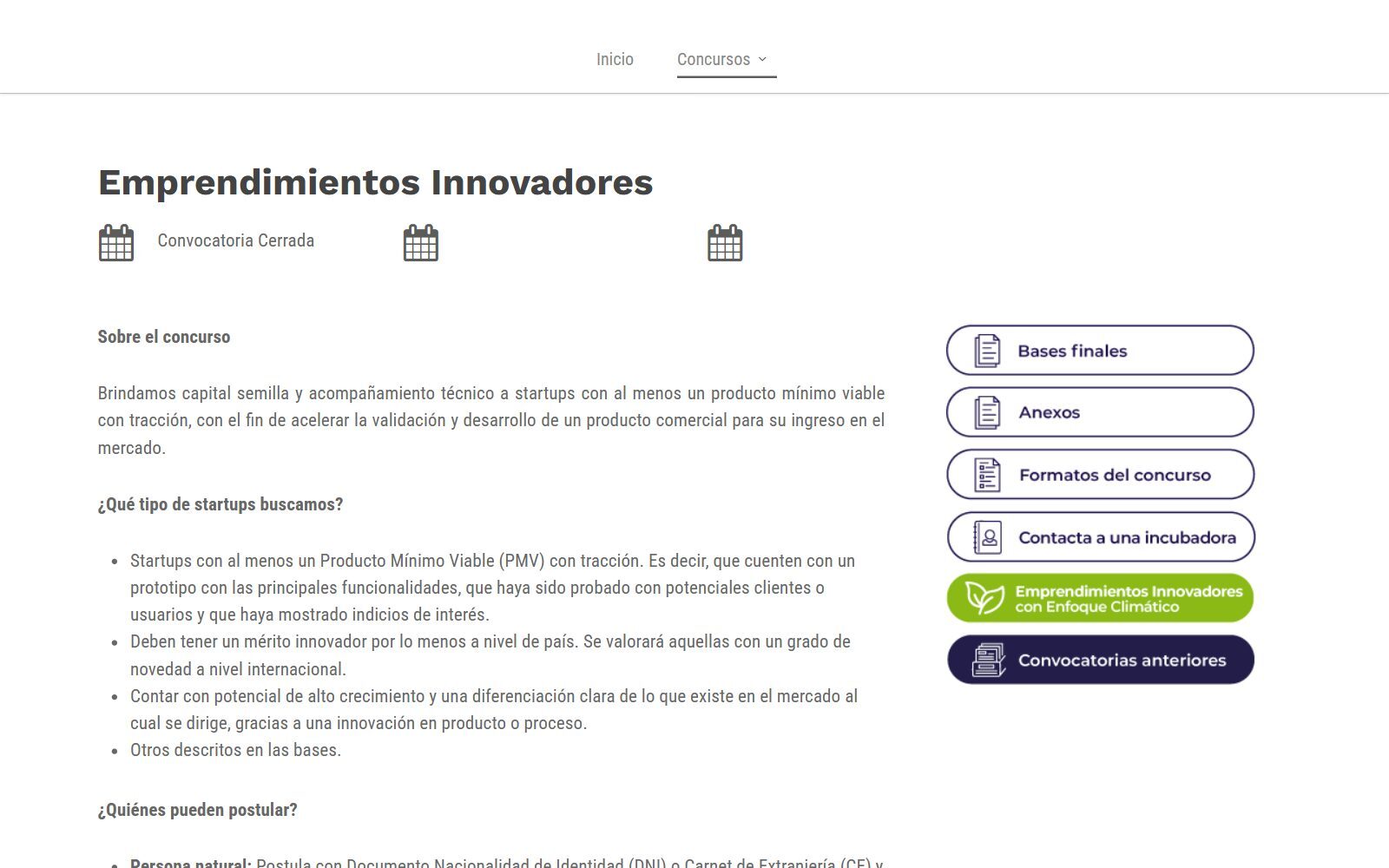
Peru's ProInnóvate runs Startup Perú seed-capital contests. Emprendimientos Innovadores gives up to S/ 67,000 (S/ 60,000 seed capital plus S/ 7,000 for an incubator) to startups with an MVP and early traction, either a team of individuals or a company up to 18 months old with annual sales up to S/ 120,000. Emprendimientos Dinámicos gives up to S/ 150,000 to companies one to five years old with sales of S/ 120,000 to S/ 1,200,000. Both cover up to 70% of the project over eight months, need a team of two to four with at least half Peruvians or residents, and were marked "Convocatoria Cerrada" in November 2026. ProInnóvate publishes a yearly contest calendar. Peru's scene: Lima startups to watch.
9. Colombia: iNNpulsa and SENA Fondo Emprender
Colombia's business growth agency iNNpulsa runs programmes such as ALDEA, which gives specialised support to entrepreneurs by maturity; in November 2026 its homepage listed ALDEA+ and iNNpulsa Mujeres among the open calls, so check each call for any cash component. SENA's Fondo Emprender funds business plans through national and regional calls; the national calls on its homepage had a deadline of 30 April 2026, so watch for new ones.
10. Argentina: Agencia I+D+i Startup lines
Argentina's research agency (Agencia I+D+i) ran three Startup 2025 lines by technology readiness level. Startup 2025 TRL 3-4 paid up to the peso equivalent of USD 150,000 in non-reimbursable funding, 80% from the agency and 20% from the startup, for proof of concept and lab validation, to startups up to seven years old. The higher-TRL lines were repayable loans. All three were closed in November 2026, and no new line was listed. Argentina's scene: Buenos Aires startups to watch.
11. Paraguay: CONACYT PROINNOVA
Paraguay's science council CONACYT has two startup instruments in its PROINNOVA programme: validation of entrepreneurial proposals (I.3-1) and the creation and start-up of technology-based companies (I.3-2). No startup call was listed as open on its homepage in November 2026; check its calls page for the next round.
12. Ecuador: FonQuito seed capital (Quito)
Ecuador's best-known startup seed grant is local: the City of Quito's FonQuito seed capital, run by the economic promotion agency ConQuito, for ventures that use emerging technologies or meet sustainable development goals. The 2026 call paid USD 10,000 to 15,000 to individuals and USD 10,000 to 25,000 to companies at the start-up stage, and USD 25,000 to 40,000 to companies at the consolidation stage. It took applications from 2 March to 7 April 2026, so it is closed; the bases of each call are published on ConQuito's site.
13. IDB Lab: an investor, not a grant
IDB Lab, the innovation arm of the Inter-American Development Bank, invests in early-stage, high-impact companies across Latin America and the Caribbean: equity or quasi-equity of US$200,000 to US$500,000 at seed and US$1 million to US$3 million at Series A or B. It also invests in venture funds, with emphasis on emerging ecosystems such as Ecuador, Paraguay, Bolivia and Uruguay. It is investment money, so treat it like a round; compare angel investors in South America.
Boost Your SEO by Getting Featured in Our Blogs and get a backlink.
We publish content about startups, education, tech, funding, etc. that ranks well not only in Google but also in Perplexity, ChatGPT, Grok and other AI tools.
👉 Get featured now!
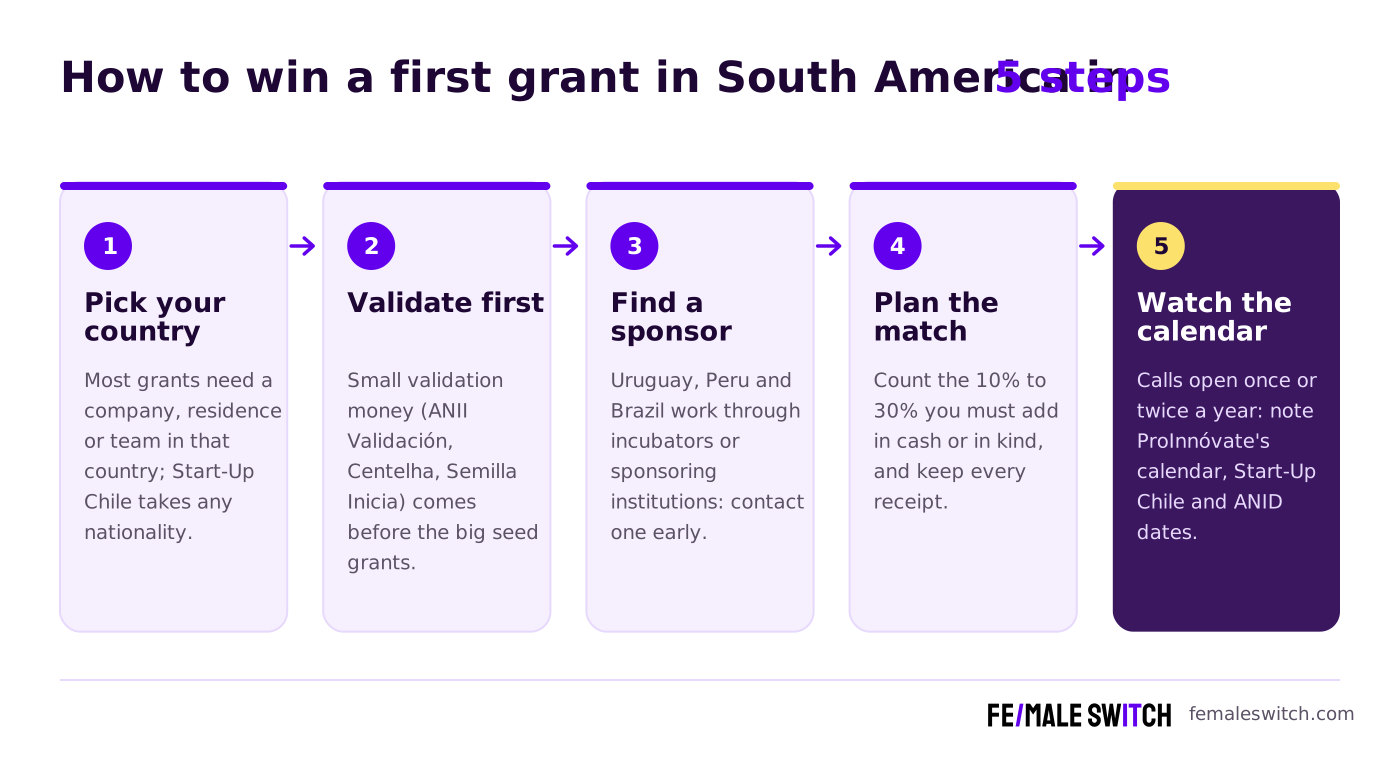
How to Win a First Grant in South America
Programmes Closed, Changed or Removed
The 2025 versions of this article listed many items that are not startup grants or that we could not find on an official page:
- "Startup Chile, up to $80,000 USD" and the "Start-Up Chile Seed Program": the same programme; its current tracks and amounts in Chilean pesos are above.
- Tinker Foundation, U.S. Embassy small grants and the Canada Fund for Local Initiatives: grants for charities, NGOs and community organisations, not startups; the old 2025 deadlines have passed.
- OCEAN Partnership Grants, Biosecurity AI Research Fund, Media Grants for Marine Conservation and P4G Partnerships: grants for partnerships, researchers and newsrooms listed on a third-party site, with 2025 deadlines.
- "Innovation Fund for Sustainable Development" and "Grassroots Grants Program": no official programme page found, so removed.
- GrantWatch, LegalZoom, HerSuiteSpot and WomensNet grants: mostly US grant directories and programmes, not South American startup grants.
- CAF and IDB grants: development-bank loans and projects with governments and institutions; IDB Lab, which invests in startups, is listed instead.
- Argentina's Startup 2025 lines and Peru's Startup Perú contests: closed in November 2026; watch for new calls.
- SENA Fondo Emprender national calls: the calls on its homepage closed on 30 April 2026; new calls are published there.
Which Grant Should You Apply For?
- Founder from anywhere willing to move to Chile: Start-Up Chile Build (idea to MVP) or Ignite (working product).
- Chilean resident with a prototype and no sales: CORFO Semilla Inicia; science-based teams: ANID Startup Ciencia.
- Uruguayan team: ANII Validación de Ideas de Negocios first, then Apoyo a Emprendimientos Innovadores.
- Technology startup in São Paulo: FAPESP PIPE Phase 1.
- Founder elsewhere in Brazil: your state's Centelha call.
- Peruvian team with an MVP: prepare for the next Startup Perú contest.
- Ready to raise equity: IDB Lab and local angel networks.
How Founders Use Grants With Other Support in South America
A grant rarely covers everything, so founders combine it with programmes and investors: see angel investors for edtech in South America, edtech VCs in South America and accelerators for early-stage startups. If you are choosing where to build, read about edtech countries in South America and AI startup cities in South America. For grants outside the region, compare grants for early-stage startups worldwide, grants for early-stage startups in Europe, grants for deep tech startups, edtech startup grants and grants for female entrepreneurs. Women founders can also look at accelerators for female entrepreneurs.
Join F/MS: Startup Facilitator & Incubator and unlock your startup dreams today! Get your first customers, register you company in the Netherlands and get startup visas for the team.
FAQ About Grants for Early-Stage Startups in South America
Which South American grant accepts foreign founders?
Start-Up Chile. Build and Ignite accept startups from any country, as long as you develop the startup in Chile during the programme. Most other grants need residence or a company in the country.
How much does Start-Up Chile give?
CLP 15 million equity-free for Build and CLP 30 million for Ignite, with a possible CLP 20 million extension for Ignite. The BIG 13 call was set to close on 24 November 2026.
Do these grants take equity?
No. Start-Up Chile, CORFO, ANII, FAPESP, Centelha and Startup Perú are non-dilutive. IDB Lab is different: it invests for equity or quasi-equity.
Do I have to add my own money?
Usually yes. ANII asks for at least 20% in cash, Startup Perú covers up to 70%, Argentina's Startup line covered 80% and CORFO Semilla Inicia up to 75% (85% for women).
Are there grants for women founders in South America?
Several programmes give women more: CORFO Semilla Inicia raises the cap to CLP 17 million and 85%, ANII covers up to 90% for women-led projects, and Start-Up Chile's Ignite finances teams with women leaders at up to 90%.
Can I apply before I set up a company?
Often yes. Semilla Inicia, Centelha, Startup Perú (as a team of individuals) and ANII Validación accept individuals; you usually need to set up a company if you win.
What grants exist in Brazil for early-stage startups?
FAPESP PIPE in São Paulo (up to R$300,000 in Phase 1) and the Centelha calls in 26 states and the Federal District. Our deep tech grants guide also covers FINEP and EMBRAPII.
Are Argentina's and Peru's startup grants open now?
No. Argentina's Startup 2025 lines and Peru's Startup Perú contests were closed in November 2026. Watch the Agencia I+D+i calls page and ProInnóvate's yearly calendar.
Is IDB Lab a grant?
No. IDB Lab invests in startups with equity or quasi-equity of US$200,000 to US$500,000 at seed, and in venture funds.
Where can I get a backlink by writing about my startup?
You can publish a guest post in one of the Fe/male Switch startup blogs, which rank in Google and in AI tools. Get a quality backlink.
About the Author
Violetta Bonenkamp, also known as MeanCEO, is an experienced startup founder with an impressive educational background including an MBA and four other higher education degrees. She has over 20 years of work experience across multiple countries, including 5 years as a solopreneur and serial entrepreneur. Throughout her startup experience she has applied for multiple startup grants at the EU level, in the Netherlands and Malta, and her startups received quite a few of those. She’s been living, studying and working in many countries around the globe and her extensive multicultural experience has influenced her immensely.
