

Grants for Deep Tech Startups in 2027: Non-Dilutive Funding Worldwide, From the EIC and ARIA to SPRIND, SBIR and Tnufa
Deep tech startups build on new science: quantum, advanced materials, biotech, fusion, robotics, semiconductors or space. They need years of R&D before revenue, which is why public grants matter more to them than to software startups. This guide lists the main non-dilutive programmes for deep tech founders worldwide in 2027: the EU's European Innovation Council, the UK's ARIA and Innovate UK, Germany's SPRIND, Austria, France, the US, Canada, Israel, Singapore, India and Australia, each with the amount, who can apply and the next date from its official page, checked in November 2026. For regional deep dives, see our guides to deep tech grants in North America and deep tech grants in South America. The 2025 version of this article listed 25 items, many of them funds, networks or programmes we could not find; what happened to them is at the end.
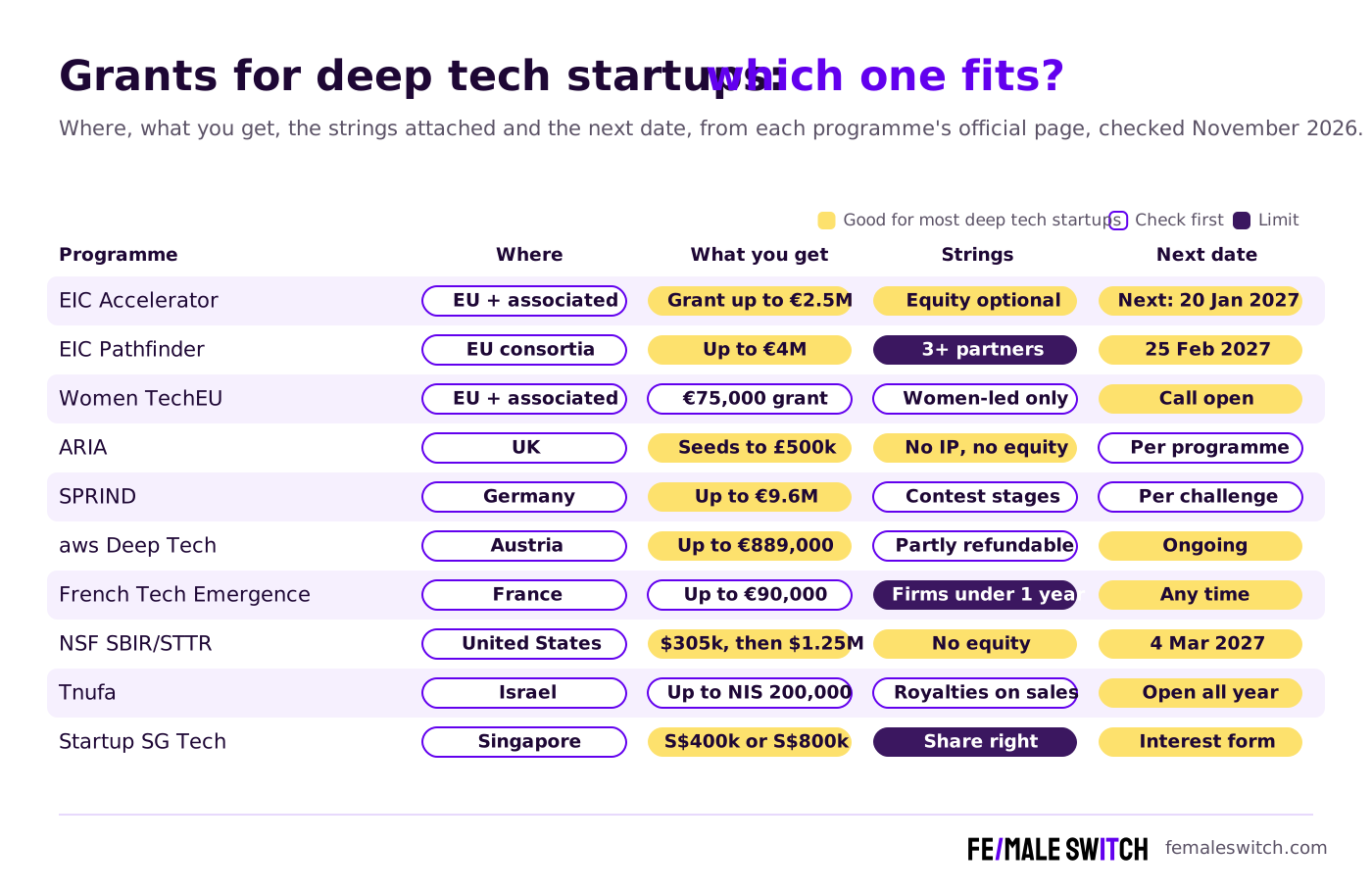
Quick answer: in Europe, the largest grant a single deep tech startup can win is the EIC Accelerator (up to €2.5 million, next batching date 20 January 2027), with EIC Pathfinder (up to €4 million for research consortia) and EIC Transition (up to €2.5 million) earlier in the pipeline. Women-led deep tech startups can add a Women TechEU grant of €75,000. In the UK, ARIA funds breakthrough research without taking IP or equity; in Germany, SPRIND challenges pay teams up to several million euros. In the US, NSF SBIR/STTR pays up to $305,000 in Phase I and $1,250,000 in Phase II, with the next deadline on 4 March 2027.
Write FREE SEO-optimized Blog Articles! Our Article Writer ensures your blog is loved by both Google and your readers, turning those clicks into customers.
👉 Write your article here
Grants, Contracts, Prizes and Equity: Know What You Are Applying For
- Grants pay for a project and take no equity: EIC Pathfinder and Transition, Women TechEU, Bourse French Tech Emergence, NSF SBIR/STTR.
- Conditional grants are repaid in part if you succeed: Israel's Tnufa through royalties on sales, Austria's aws Seedfinancing as a "conditionally refundable grant". Singapore's Startup SG Tech gives the government a right to subscribe for shares.
- Contracts and challenges pay teams to reach a technical goal in stages: SPRIND challenges, ARIA programmes and DARPA programmes. The money can be larger than a grant, but only the best teams go on to the next stage.
- Prizes and competitions pay winners with light paperwork; see deep tech startup competitions.
- Equity programmes invest for shares: the EIC Fund (the investment part of the EIC Accelerator), EIC STEP Scale Up, Israel's Startup Fund, venture funds and accelerators. They are not grants; compare deep tech VCs and deep tech accelerators.
Grants for Deep Tech Startups Compared
Sources: each programme's official page, checked on 9 November 2026. Amounts and rules change between rounds, so check the official page again before you apply.
EU Grants for Deep Tech Startups
1. EIC Accelerator: up to €2.5 million, plus optional equity
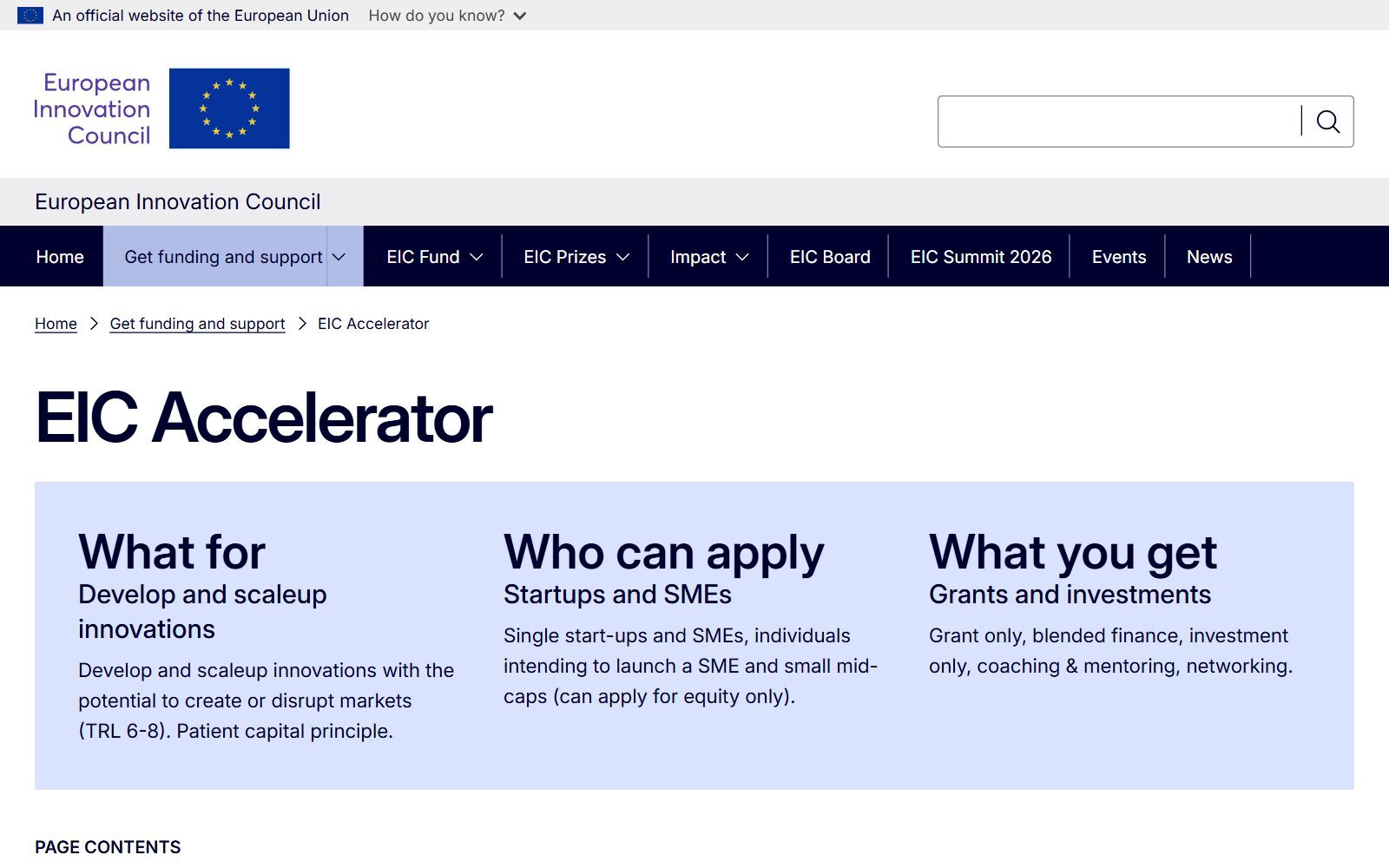
The European Innovation Council's EIC Accelerator is the largest grant a single deep tech startup can win in Europe. Startups and SMEs in EU member states and associated countries, and individuals planning to set up a company, can get a grant component of up to €2.5 million for innovation work at technology readiness levels 6 to 8, and an equity investment of €1 million to €10 million for scale-up. Short proposals can be sent at any time; if one passes, you submit a full proposal to a batching date (20 January, 17 March, 1 September and 4 November 2027) and pitch to a jury. The EIC Work Programme 2027, published on 5 November 2026, gives Accelerator Open €428 million for any technology and the Accelerator Challenges €150 million for four topics: ocean observation, climate-neutral and smart cities, fusion power plants, and carbon removal and utilisation. Our sister site has a step-by-step EIC Accelerator guide.
2. EIC Pathfinder and EIC Transition: from lab to prototype
EIC Pathfinder funds the earliest, high-risk research behind breakthrough technologies (TRL 1 to 4) with grants of up to €4 million, plus €50,000 booster grants. Pathfinder Open needs a consortium of at least three independent partners from different countries; its 2027 budget is €166 million and stage 1 proposals are due on 25 February 2027. The Pathfinder Challenges (€82 million, deadline 29 September 2027) also accept single applicants and cover advanced materials for electricity, reliable AI agents and quantum energetics. EIC Transition gives up to €2.5 million to single startups, SMEs or research organisations to take results from earlier EU-funded research from TRL 4 to TRL 5 or 6 and build a business case; its 2027 budget is €92 million and the deadline is 14 September 2027. University spin-offs use these two more than young companies without a research history.
3. EIC Pre-Accelerator: €500,000 to €1 million in widening countries
Deep tech startups in the EU's "widening" countries (such as Bulgaria, Croatia, Cyprus, Czechia, Estonia, Greece and Hungary) have their own route: the EIC Pre-Accelerator. The 2027 call pays lump sums of €500,000 to €1 million, covering 70% of the project for up to two years, to SMEs with technology validated in the lab (at least TRL 4). It opens on 5 May 2027 and closes on 18 November 2027, and winners get a Fast Track to the EIC Accelerator. Track all EU dates in our EU grant calendar for 2027.
Boost Your SEO by listing your startup and get a FREE backlink.
Create a profile in the F/MS Startup Game, add the link to your website and submit.
👉 List your startup now!
4. Women TechEU: €75,000 for women-led deep tech startups
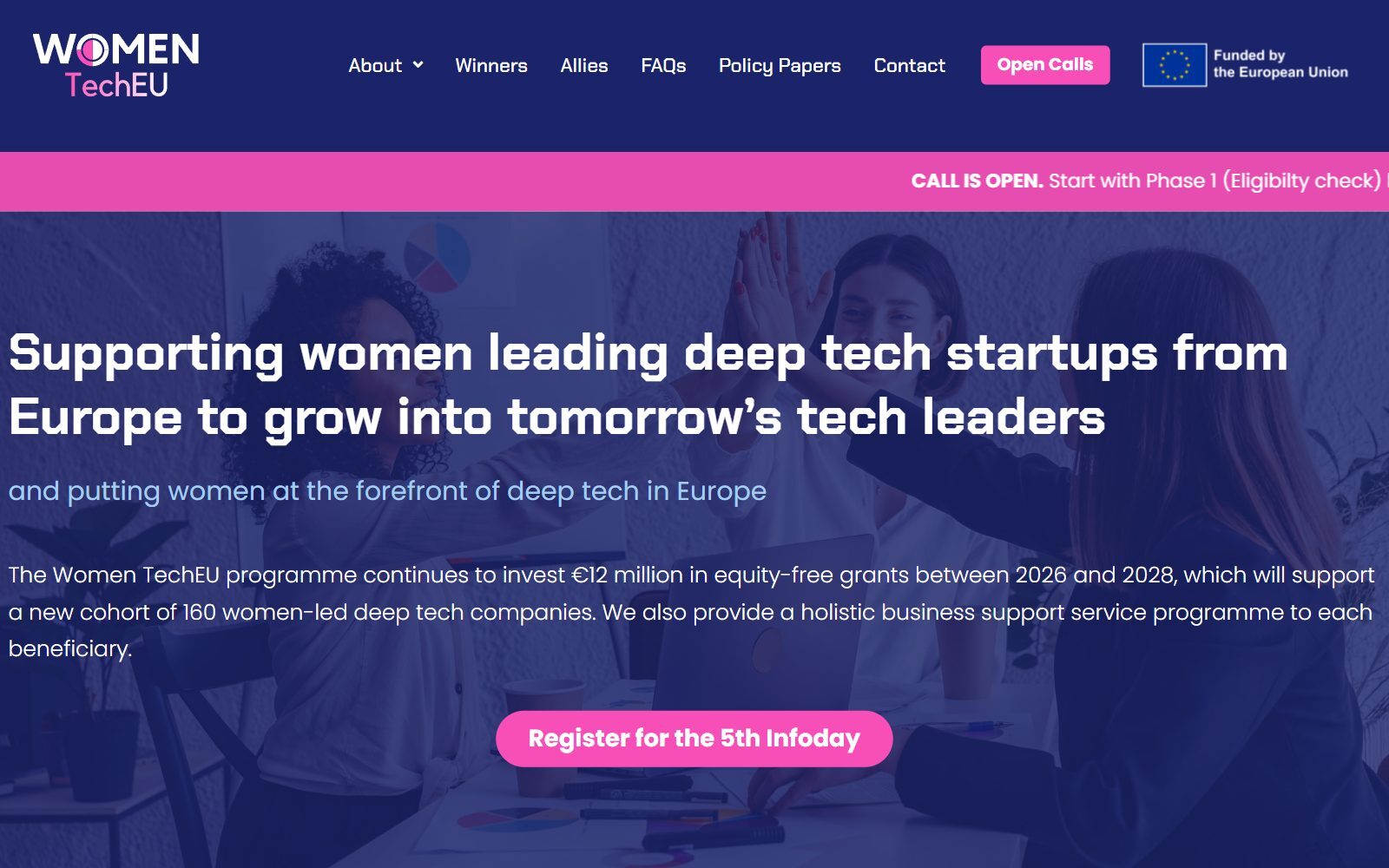
Women TechEU, funded by the EU, invests €12 million in equity-free grants between 2026 and 2028 in a new cohort of 160 women-led deep tech companies. Each one gets a €75,000 grant plus mentoring, training and help to reach other EIC funding. The company must be registered in an EU member state or associated country for at least six months and at most five years. The call runs continuously with four cut-off dates, and its site said the call was open in November 2026. More options: grants for female entrepreneurs in Europe.
UK and European National Programmes
5. Innovate UK Investor Partnerships (UK): Smart grants closed
Innovate UK's open Smart grants are closed to new applications while funding is aligned to its new strategy. For deep tech SMEs, the closest route now is Investor Partnerships: grant funding alongside private investment from selected partner investors, in sectors such as materials, batteries and engineering biology. The National Materials Innovation Programme round (£5 million in total) closes on 19 January 2027, but you can only apply if one of the partner investors invites you. The battery round was set to close on 25 November 2026 and the engineering biology round (up to £8 million) on 2 December 2026.
6. ARIA (UK): breakthrough research with no IP or equity taken
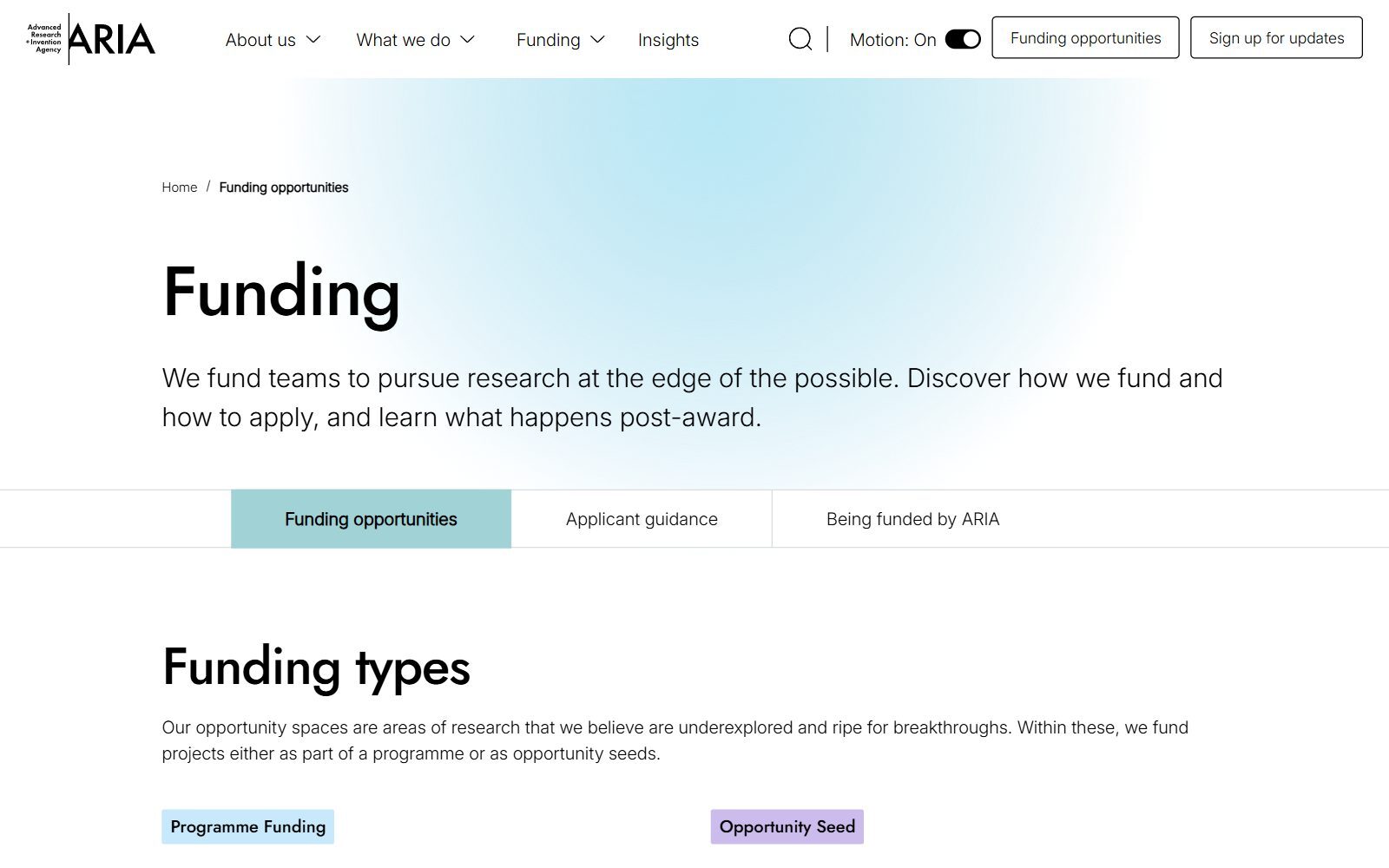
The Advanced Research + Invention Agency (ARIA) funds research at the edge of the possible inside its opportunity spaces, such as nature-inspired computation, abundant manufacturing, adaptive machines and scalable neural interfaces. It funds programmes of £10 million to £100 million made up of many projects, and opportunity seeds of up to £500,000 per project. Startups, companies of any size, universities and individuals can apply, usually with a concept paper of no more than three pages. ARIA says it does not keep IP rights, takes no equity and generally does not require match funding. Calls open and close per programme: in November 2026 the Robot Locomotion concept papers were due by 4 December 2026.
7. SPRIND challenges (Germany): staged money for breakthrough teams
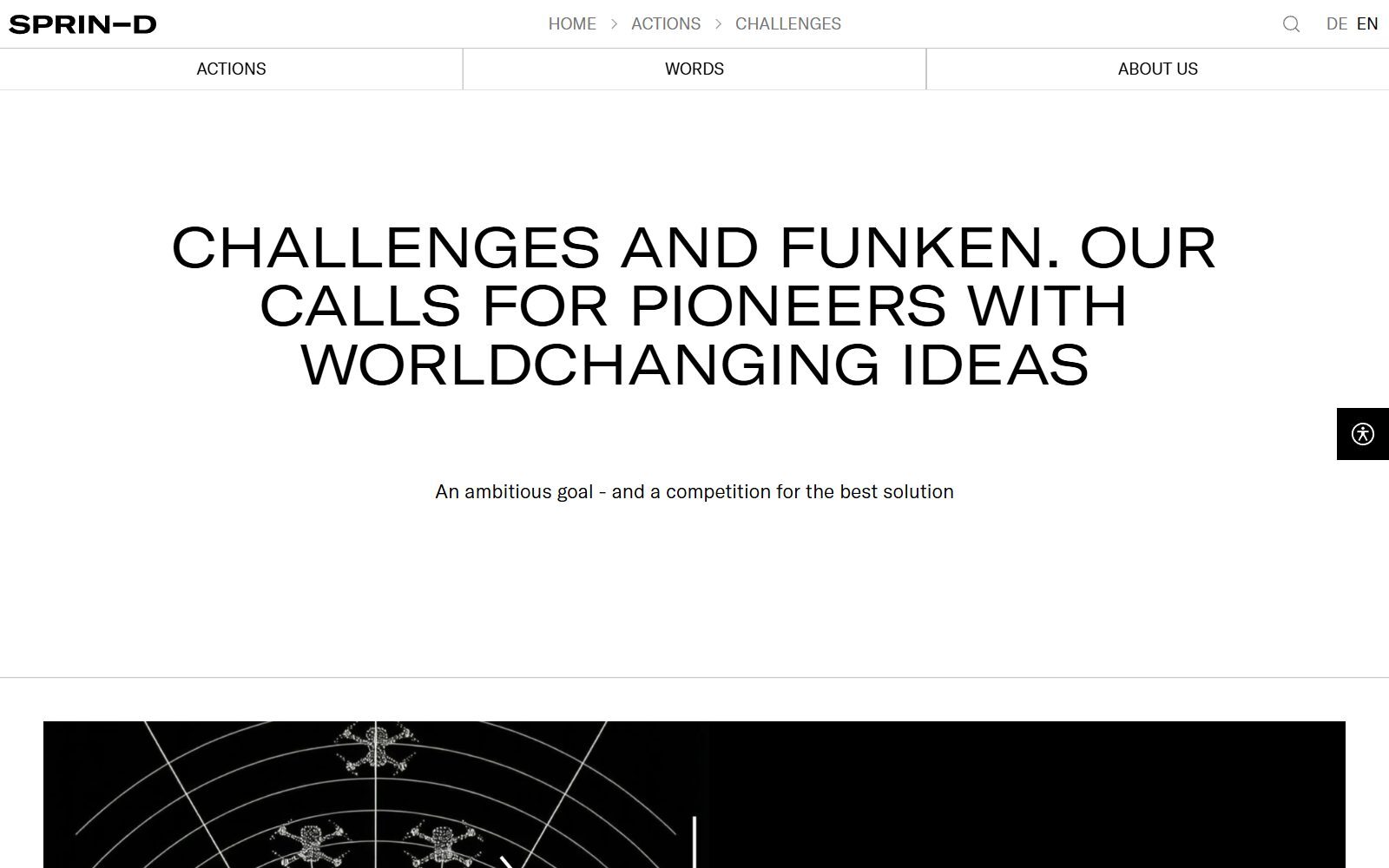
Germany's Federal Agency for Breakthrough Innovation runs SPRIND Challenges and Funken: competitions with a clear technical goal in which the best teams get paid to build and move on to the next stage. The AI-Native Chip Design challenge, run with the Dutch innovation agency NADI, offers up to €9.6 million per team over 20 months (up to €2.6 million in stage 1 and €7.0 million in stage 2) through fixed-price contracts; applications were set to close on 30 November 2026. The Engineering Microbial Consortia challenge was set to close on 16 November 2026. Other challenges cover quantum sensing, robotics, medicine and women's health. Money comes as contracts per stage, not a grant for your company, and only teams that reach the goal go on.
8. aws Seedfinancing Deep Tech (Austria): up to €889,000
Austria Wirtschaftsservice's aws Seedfinancing Deep Tech is one of the few national grants defined for deep tech. It is a conditionally refundable grant of up to €889,000, covering 80% of eligible costs, for small companies with fewer than 50 employees that apply within 54 months of starting; projects are usually at TRL 6 and must be a real technology leap. If women will own more than 25% of the shares, a gender bonus raises it to 90% of costs and up to €1 million. Applications are ongoing, with several decision dates a year.
9. Bourse French Tech Emergence (France): up to €90,000
Bpifrance's Bourse French Tech Emergence helps very young deeptech companies start: a grant of up to €90,000 for small companies registered in France for less than one year, with a project that meets Bpifrance's deeptech criteria. It covers up to 50% of eligible costs (up to 70% depending on the company), for 12 months or up to 18 under conditions, and costs incurred before you apply do not count. French founders also look at Bpifrance's later innovation aid and the EIC; see grants for early-stage startups in Europe.
Boost Your SEO with 1,500+ Free Business Directories: increase your DA, get backlinks and traffic.
We've compiled an exclusive list of directories and websites where you can submit your business and start building high-quality backlinks to boost your website traffic and get your SEO snowball rolling.
👉 Submit your startup now!
Deep Tech Grants Outside Europe
10. NSF SBIR/STTR and other US agencies
The National Science Foundation's America's Seed Fund says it funds startups to build deep technologies, based on discoveries in fundamental science and engineering, with up to $2 million and zero equity. Under the current NSF 26-510 solicitation, Phase I pays up to $305,000 and Phase II up to $1,250,000. You need a US small business with fewer than 500 employees, at least 50% owned by US citizens or permanent residents. You start with a Project Pitch; the 4 November 2026 deadline has passed, and the next ones are 4 March and 7 July 2027. SBIR and STTR were reauthorized on 13 April 2026 through fiscal year 2031. DOE, NASA, NIH and the Department of War also run SBIR/STTR topics; DARPA says its opportunities are open to start-ups and it manages its own SBIR/STTR topics, and ARPA-E posts calls on DOE's consolidated eXCHANGE portal. Agency by agency: deep tech grants in North America.
11. NRC IRAP (Canada): support set with an advisor
Canadian deep tech startups usually start with the National Research Council's Industrial Research Assistance Program (IRAP). According to NRC, you need an incorporated, for-profit business in Canada with no more than 500 full-time employees; there is no call, and an industrial technology advisor agrees the project and funding with you. Canada's SR&ED tax credits then return part of your R&D spending each year.
12. Tnufa and the Startup Fund (Israel)
The Israel Innovation Authority's Ideation (Tnufa) Incentive Program gives entrepreneurs and new Israeli startups a conditional grant of up to NIS 200,000 over 12 months, covering 80% of the approved budget, to prove the concept. It is open all year and repaid through royalties on sales. Later, the Authority's Startup Fund invests alongside private investors; from 15 July 2026 its maximum for approved deep tech companies is NIS 2 million at pre-seed and NIS 6 million at seed. That part is an investment, not a grant.
13. Startup SG Tech (Singapore): up to S$800,000, with a share right
Startup SG Tech from Enterprise Singapore funds the commercialisation of proprietary technology: up to S$400,000 for a proof of concept and S$800,000 for a proof of value, paid by milestone. The company must be registered in Singapore within the last 10 years, have at least 30% local equity and do its core R&D in Singapore. The grant carries an equity component: Enterprise Singapore has the right to exercise a share subscription. You apply with a Registration of Interest form.
14. BIRAC BIG (India): up to INR 50 lakh for biotech
For biotech and medtech, India's Biotechnology Ignition Grant (BIG) from BIRAC is the flagship grant for young startups and researchers: up to INR 50 lakh as grant-in-aid for up to 18 months to reach a proof of concept. Calls are announced twice a year, on 1 January and 1 July, and usually stay open for about 45 days, so the next call is expected on 1 January 2027. Eight BIG Partners mentor and monitor the grantees.
15. Industry Growth Program and R&D Tax Incentive (Australia)
Australia's Industry Growth Program supports startups and SMEs commercialising innovative products in the National Reconstruction Fund's priority areas, such as value-add in resources, agriculture and defence capability. You first apply for an advisory service; after the adviser's report you may apply for matched grants of $50,000 to $250,000 for early-stage commercialisation or $100,000 to $5 million for commercialisation and growth. Combined annual turnover must be under $20 million. The R&D Tax Incentive then refunds part of R&D spending to companies with turnover under A$20 million: their corporate tax rate plus an 18.5% premium.
Boost Your SEO by Getting Featured in Our Blogs and get a backlink.
We publish content about startups, education, tech, funding, etc. that ranks well not only in Google but also in Perplexity, ChatGPT, Grok and other AI tools.
👉 Get featured now!
How Deep Tech Founders Stack Grants
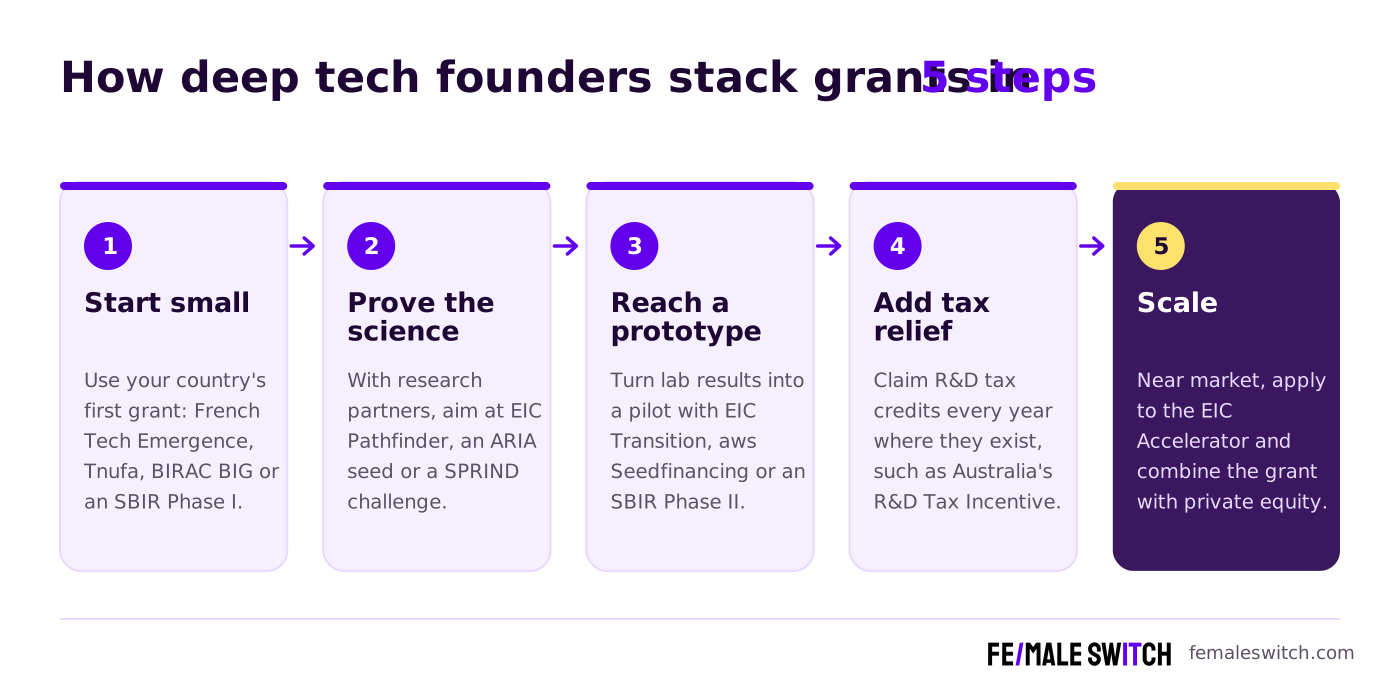
Deep tech companies rarely live on one grant. A typical order, from first idea to scale-up:
Programmes Closed, Changed or Removed
The 2025 versions of this article (25 and 20 grants) listed many items that are not deep tech startup grants or that we could not find on an official page:
- EIC 2025 budget (€1.4 billion), EIC Accelerator Open 2025 and EIC Challenges 2025: replaced by the EIC Work Programme 2027 (€1.8 billion), covered above.
- EIC Fund, EIC STEP Scale Up and the EIC Scaling Club: equity investment and a network for scale-ups, not grants.
- Innovate UK Smart grants and "UK Government Grants for Innovators": Smart is closed to new applications; Investor Partnerships and ARIA are listed instead.
- EIT Health Deep Tech Venture Builder: the 2025 call for medtech and digital health research teams is over, and we found no newer call on an official page.
- "Deep Tech Grant Initiative" (India) and Transfiere 2025: a policy proposal for a DARPA-style grant model and a 2025 event's open call, not grants.
- Startup SG Founder, Enterprise Development Grant and SGInnovate: a general first-time founder grant, a company upgrading grant and an investor; Startup SG Tech is the deep tech route.
- InvestEU, KIC InnoEnergy and the Startup India fund: financing through banks, funds and investors rather than direct startup grants; BIRAC BIG is listed for India.
- FFG General Programme and Innovation Fund Denmark: national R&D funders we did not re-check for this guide; Austria's aws Seedfinancing Deep Tech is listed instead.
- AWS Activate, Techstars and Y Combinator: cloud credits and accelerators that invest for equity; see grants for AI startups for credits and deep tech accelerators in Europe.
- "Deeptech Fund", "Energy Innovation Fund", "Climate Innovation Grants", "Technology Development Fund", "Artificial Intelligence Grant Program", "Accelerator Programmes (various)", EPA grants, NIST's Advanced Technology Program, Startup Global Initiative, Creative Catalyst Fund, Global Innovation Fund, Norrsken and The Impact Fund: unnamed or generic entries, impact investors and programmes with no current deep tech startup grant on an official page, so removed.
Which Deep Tech Grant Should You Apply For?
- EU startup with a product close to market: an EIC Accelerator short proposal, aiming at the 20 January or 17 March 2027 batching date.
- University spin-off or research consortium: EIC Pathfinder Open (25 February 2027) or EIC Transition if you build on an earlier EU project.
- Startup in a widening country: prepare for the EIC Pre-Accelerator call that opens on 5 May 2027.
- Women-led deep tech startup in Europe: Women TechEU, then the EIC Accelerator.
- UK team with a radical idea: watch ARIA's calls; if you have investor interest, ask about Innovate UK Investor Partnerships.
- Austrian or French startup in its first years: aws Seedfinancing Deep Tech or Bourse French Tech Emergence.
- US company: an NSF SBIR/STTR Project Pitch for the 4 March 2027 deadline.
- Israel, Singapore, India, Canada or Australia: Tnufa, Startup SG Tech, BIRAC BIG, NRC IRAP or the Industry Growth Program.
How Founders Combine Grants With Other Deep Tech Funding
Grants are slow and rarely cover a whole company, so deep tech founders also raise private money: compare deep tech VCs in Europe, deep tech VCs in North America and deep tech angel investors in Europe. Many join a programme first: see deep tech incubators in Europe and deep tech startup competitions in North America. If you are choosing where to build, read about the best countries for deep tech, deep tech countries in Europe, deep tech cities and deep tech cities in Europe. For grants beyond deep tech, see grants for early-stage startups, AI startup grants in Europe, grants for early-stage startups in South America and grants for female entrepreneurs. EU applicants should learn how to find open EU funding calls.
Join F/MS: Startup Facilitator & Incubator and unlock your startup dreams today! Get your first customers, register you company in the Netherlands and get startup visas for the team.
FAQ About Grants for Deep Tech Startups
What is the largest grant for a deep tech startup?
In Europe, the EIC Accelerator grant of up to €2.5 million for one company, with optional equity of €1 to €10 million. Research consortia can get up to €4 million from EIC Pathfinder. In the US, NSF SBIR/STTR pays up to $305,000 in Phase I and $1,250,000 in Phase II.
When is the next EIC Accelerator deadline?
Short proposals can be sent at any time. Full proposals are batched on 20 January, 17 March, 1 September and 4 November 2027.
Do deep tech grants take equity?
Most do not. Check the exceptions: the EIC Accelerator's investment part is equity if you ask for it, Singapore's Startup SG Tech gives Enterprise Singapore a share subscription right, and Tnufa and aws Seedfinancing are repaid in part if you succeed.
Are there deep tech grants for women founders?
Yes. Women TechEU gives €75,000 grants to 160 women-led deep tech startups between 2026 and 2028, and Austria's aws Seedfinancing Deep Tech raises its grant to €1 million when women own more than 25% of the shares.
Can a UK startup still get Innovate UK Smart grants?
No. Smart grants are closed to new applications. UK deep tech startups can look at ARIA calls, Innovate UK Investor Partnerships (by invitation of a partner investor) and the EIC Accelerator.
What is the difference between ARIA, SPRIND and a normal grant?
ARIA and SPRIND fund ambitious technical goals through programmes, challenges and contracts, often in stages, rather than a fixed grant to your company. ARIA says it keeps no IP and takes no equity.
Is SBIR running in 2027?
Yes. SBIR and STTR were reauthorized on 13 April 2026 through fiscal year 2031. NSF's next deadlines are 4 March and 7 July 2027.
Do I need a company before I apply?
Not always. The EIC Accelerator accepts individuals planning to set up a company and Tnufa accepts entrepreneurs. SBIR, Bourse French Tech Emergence, aws Seedfinancing and Startup SG Tech need a registered company.
Where can I find deep tech grants in North and South America?
Read our guides to deep tech grants in North America and deep tech grants in South America, which list programmes country by country.
Where can I get a backlink by writing about my deep tech startup?
You can publish a guest post in one of the Fe/male Switch startup blogs, which rank in Google and in AI tools. Get a quality backlink.
About the Author
Violetta Bonenkamp, also known as MeanCEO, is an experienced startup founder with an impressive educational background including an MBA and four other higher education degrees. She has over 20 years of work experience across multiple countries, including 5 years as a solopreneur and serial entrepreneur. Throughout her startup experience she has applied for multiple startup grants at the EU level, in the Netherlands and Malta, and her startups received quite a few of those. She’s been living, studying and working in many countries around the globe and her extensive multicultural experience has influenced her immensely.
