

Open-Source DeepBrain AI Alternatives: Self-Hosted AI Avatar, Lip-Sync and Text-to-Video Models for Startups
DeepBrain AI's AI Studios turns a script into a video with a talking AI presenter. It is quick, but you pay per seat and per credit, and your avatars live on someone else's servers. Open models can now do much of the same job on your own GPU: animate a photo so it speaks, sync lips to a new voice track, generate the voice itself and create B-roll from a text prompt. The catch is licensing. Many “open” avatar projects publish their code under MIT or Apache-2.0 but their trained weights, or a face detector they depend on, under a non-commercial licence. We checked every project below on GitHub and Hugging Face on 10 November 2026: the code licence, the model weight licence, the last code change and the hardware the README asks for.
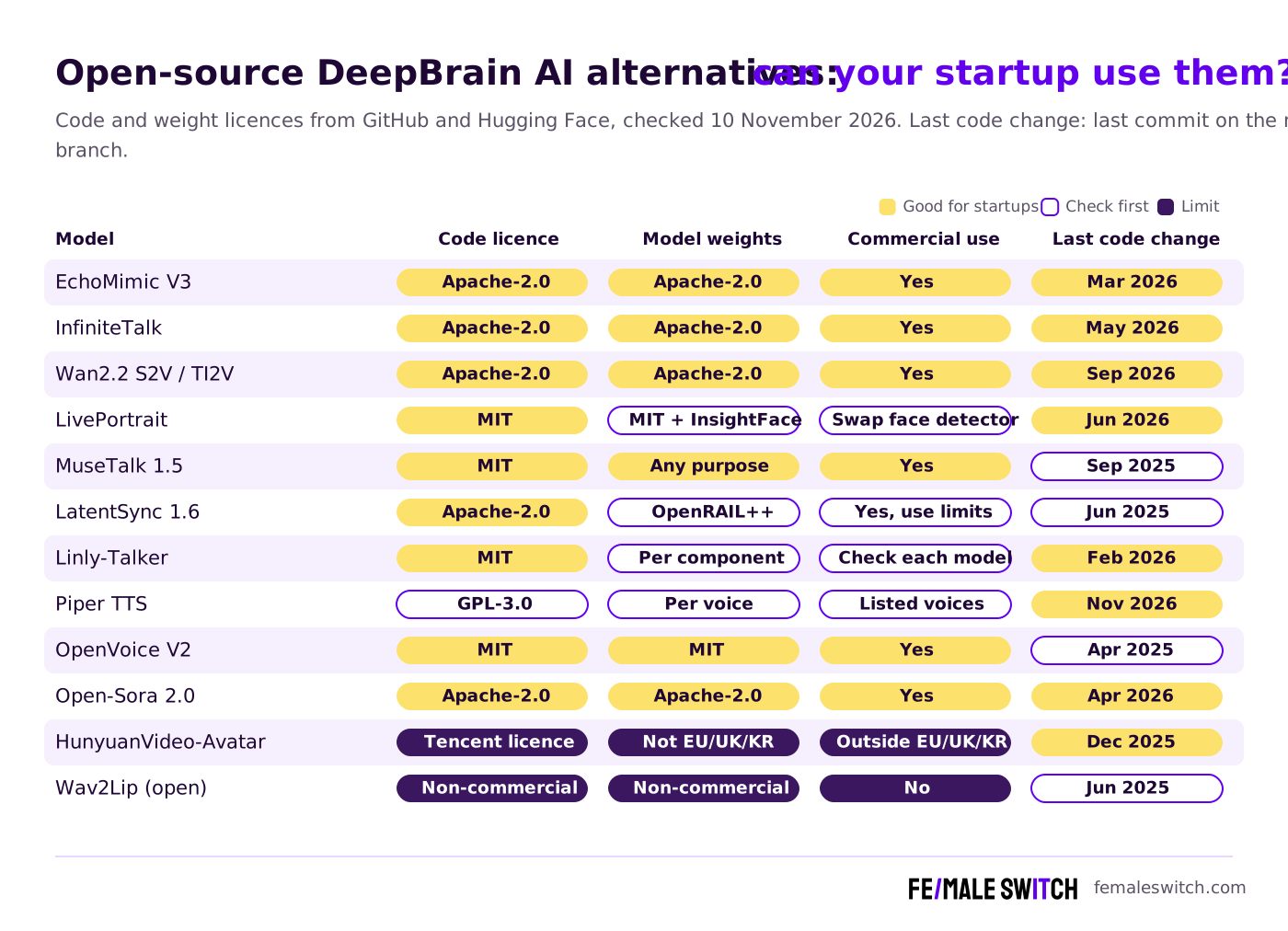
Quick answer: for a commercial talking-head video, start with EchoMimic V3 (Apache-2.0 code and weights, runs in 12 GB of VRAM), MuseTalk 1.5 (MIT, real-time lip-sync) or InfiniteTalk (Apache-2.0, long dubbed videos). Wan2.2 adds speech-to-video and text-to-video under Apache-2.0, and Piper or OpenVoice V2 give you the voice. LivePortrait is excellent but needs its InsightFace face detector replaced before commercial use, and the open Wav2Lip model is non-commercial. Only animate faces and voices whose owners agreed.
Boost Your SEO by Getting Featured in Our Blogs and get a backlink.
We publish content about startups, education, tech, funding, etc. that ranks well not only in Google but also in Perplexity, ChatGPT, Grok and other AI tools.
👉 Get featured now!
What DeepBrain AI Offers Today
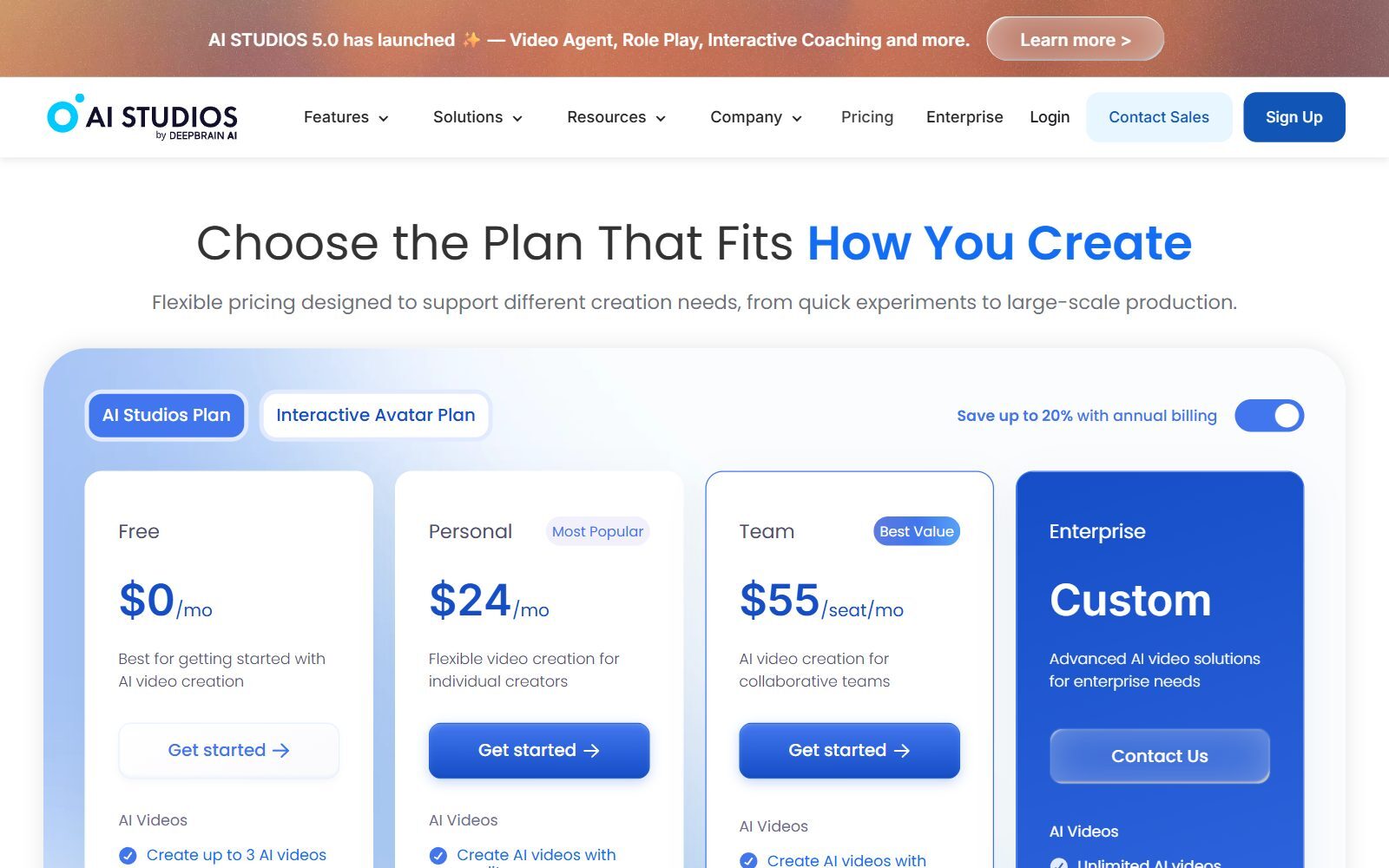
DeepBrain AI's product is now sold as AI Studios: deepbrain.io redirects to aistudios.com, and the site announces AI Studios 5.0 with a video agent, role play and interactive coaching. Its menu lists 2,000+ realistic AI avatars, AI dubbing in 70+ languages with voice cloning, interactive avatars and a deepfake detector. The pricing page (default view, annual billing switched on, checked 10 November 2026) shows:
- Free, $0: up to 3 AI videos of up to 1 minute, 1 avatar slot, 720p export and 12 one-time credits.
- Personal, $24 a month: billed once a year ($288 a year), videos up to 30 minutes, 3 avatar slots, 1080p export and 700 credits a month.
- Team, $55 per seat a month: from 2 seats, videos up to 60 minutes, 4K export and 1,000 shared credits per seat a month.
- Enterprise: custom pricing. A separate Interactive Avatar plan starts free with 2 credits; its Standard tier costs $99 a month.
None of this is open source. If you want to own the pipeline, keep avatar data in-house or avoid per-minute credits, the models below are the realistic alternatives. They are research-grade tools, not a drag-and-drop editor: expect Python, a CUDA GPU and some setup.
Open-Source AI Avatar and Video Models Compared
Sources: each project's GitHub repository (README, LICENSE, last commit) and Hugging Face model card, checked 10 November 2026. Self-hosting is free, but you pay for GPUs, storage and engineering time.
The Best Open-Source DeepBrain AI Alternatives in 2027
1. EchoMimic V3: the safest talking-avatar model for commercial use
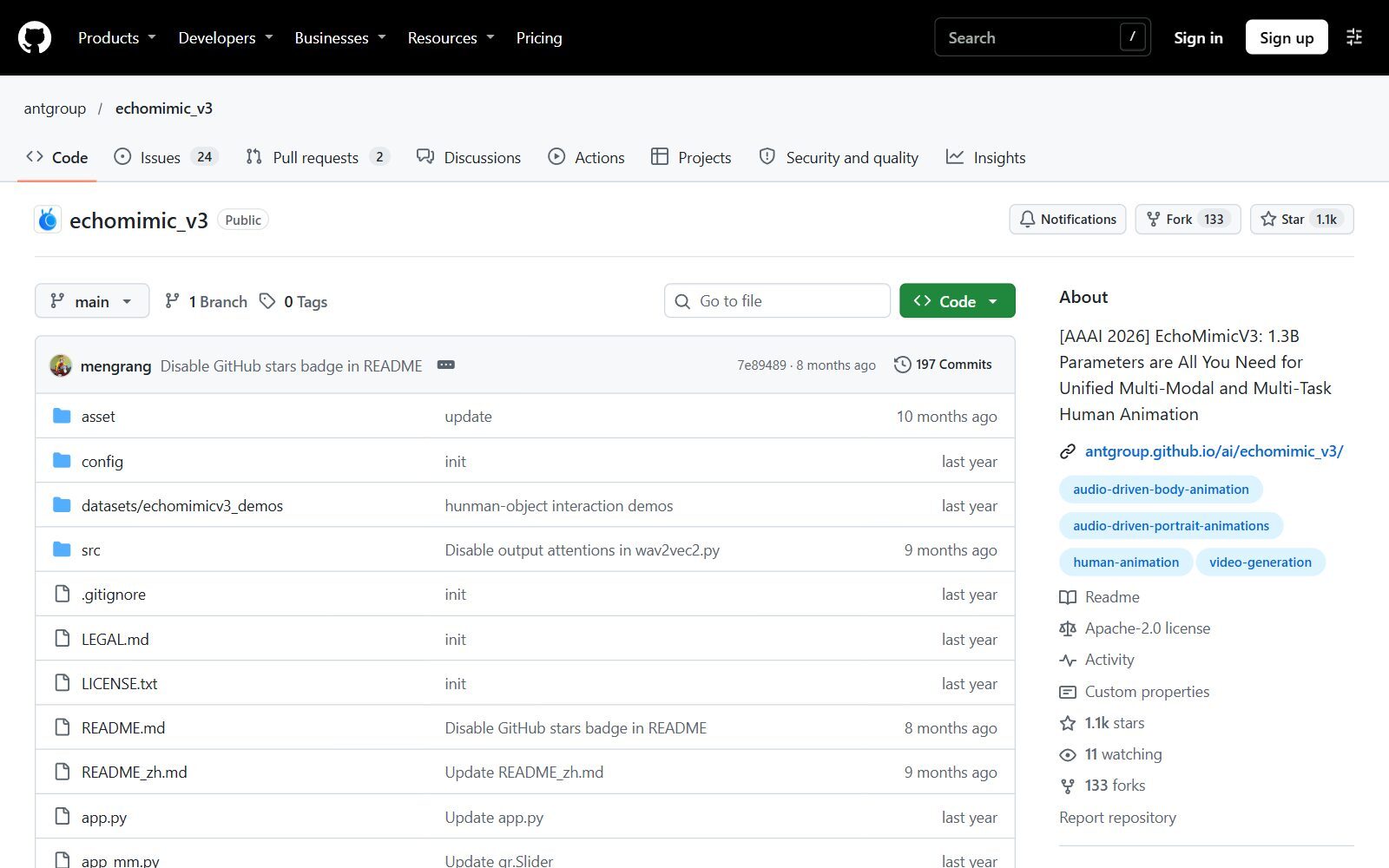
EchoMimic V3 from Ant Group's Alipay team animates a portrait or half-body image from an audio track, so a still photo becomes a speaking presenter. It has 1.3 billion parameters and was accepted at AAAI 2026. The EchoMimicV3-Flash version, published on 22 January 2026, generates in 8 steps, needs no face mask, supports up to 768×768 pixels and, according to the README, runs in 12 GB of VRAM. The repository and the weights on Hugging Face are both Apache-2.0, which allows commercial use. Pick V3 over EchoMimic V2 from the 2025 list: the V2 README says it is intended for academic research and its model card names no licence. The code was last changed in March 2026.
2. InfiniteTalk and LongCat-Video-Avatar: long talking videos and dubbing
InfiniteTalk from Meituan's MeiGen team generates talking videos of unlimited length. Give it a photo and audio, or an existing video and a new audio track, and it syncs the lips while also adjusting head movement, posture and facial expressions. That makes it a close match for AI Studios' dubbing feature. It is built on the Wan2.1 image-to-video model, works at 480P and 720P and has a low-VRAM mode. Code and weights are Apache-2.0. The same team released LongCat-Video-Avatar 1.5 on 21 May 2026, with Whisper-based lip-sync and 8-step generation; its code and weights are MIT.
3. Wan2.2: speech-to-video and text-to-video under Apache-2.0
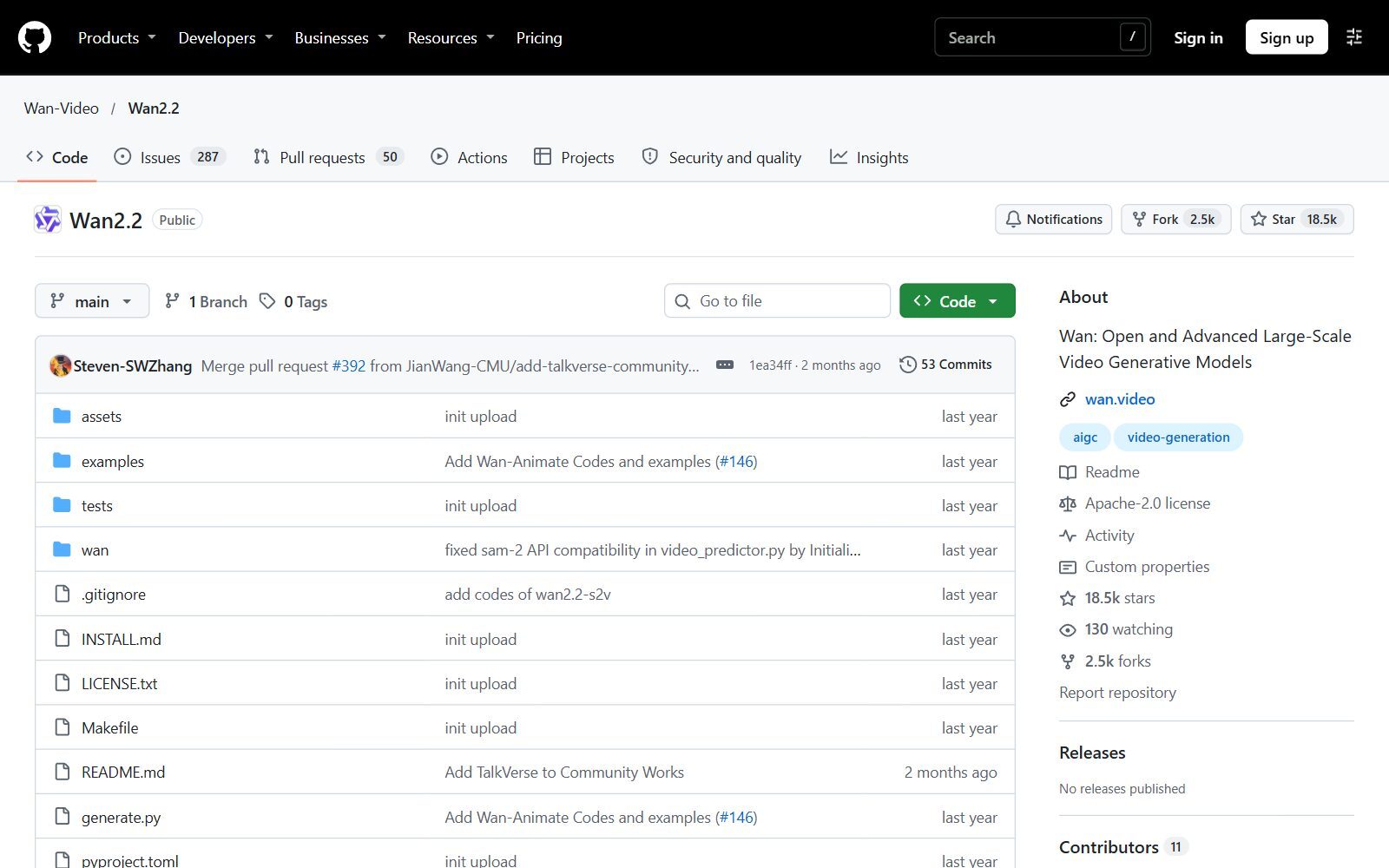
Wan2.2 is Alibaba's open video model family, and the whole repository and its weights are Apache-2.0. Three parts matter for a DeepBrain AI replacement: S2V-14B (August 2025) turns an image plus speech into a talking video at 480P or 720P and can generate the speech with CosyVoice; Animate-14B (September 2025) animates or replaces a character using a reference video; and TI2V-5B makes 720P text-to-video or image-to-video at 24 frames per second on a 24 GB card such as an RTX 4090, useful for B-roll. The README's single-GPU commands for the 14B models ask for at least 80 GB of VRAM, so plan on a rented cloud GPU. The code was last updated in September 2026.
Validate your startup idea with the unique borrowed authority approach: we publish articles about your product in our blog and you get traffic and testers for your MVP
- Prove Market Demand: See real organic traffic and waitlist conversions
- Unlock High-Potential Keywords: Receive a curated list of top-performing keywords directly from Google Search Console data.
- Estimate Customer Acquisition Cost (CAC): Gain financial foresight with an estimated CAC based on real keyword performance data.
🔗 Start validating your startup now
4. LivePortrait: expressive portrait animation, with one licence catch
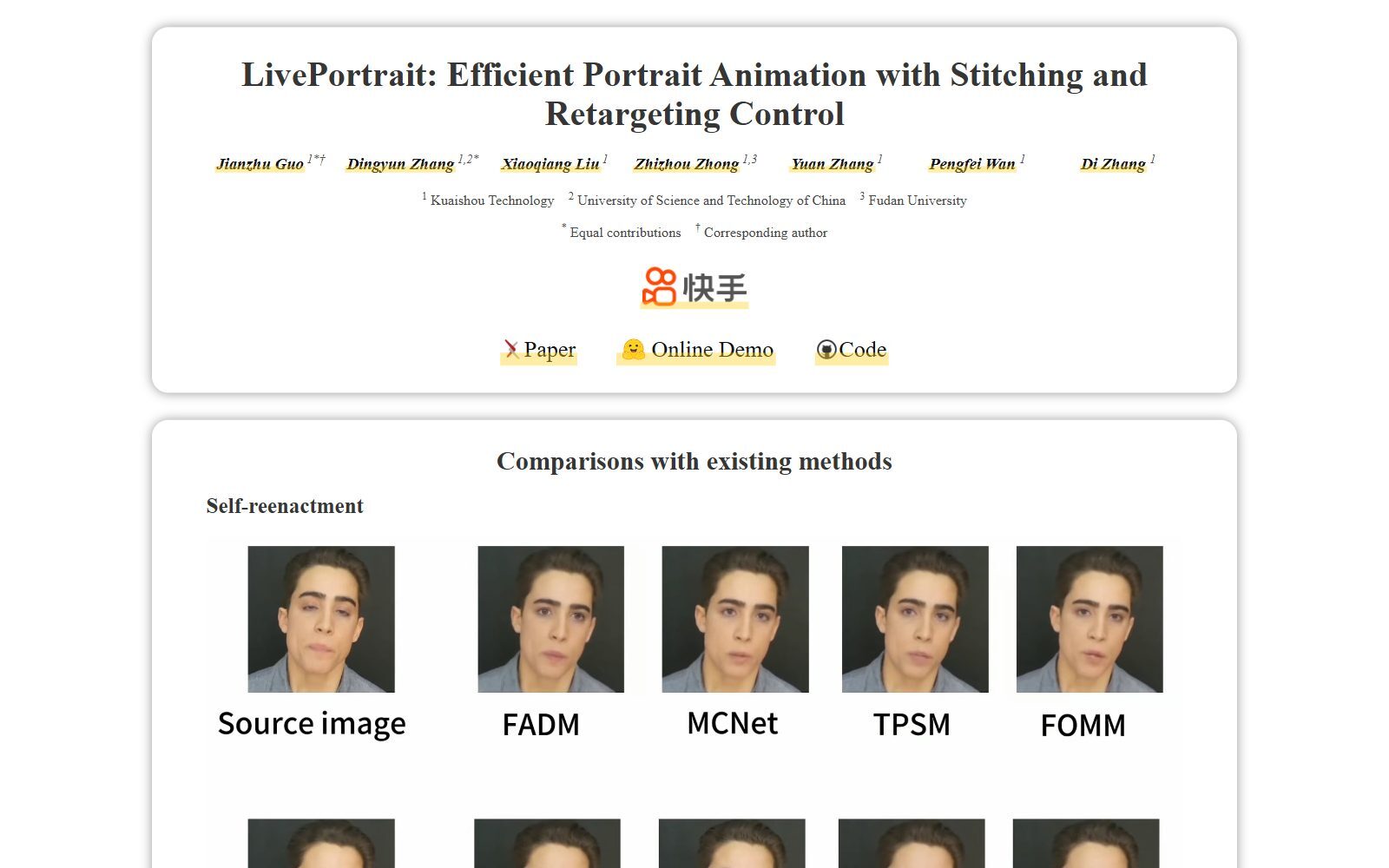
LivePortrait from Kuaishou animates a portrait using a driving video, so your avatar copies the expressions and head movements of a recording. It handles humans, cats and dogs, edits existing portrait videos, runs on macOS with Apple Silicon and has a Windows one-click installer. The code and the LivePortrait weights are MIT. But its LICENSE adds that the InsightFace face-detection models it uses are for non-commercial research only, and that you should remove and replace them for commercial use. It is driven by video, not audio, so pair it with a lip-sync model for speech. The code was last updated in June 2026.
5. MuseTalk 1.5: real-time lip-sync for existing footage
MuseTalk from Lyra Lab at Tencent Music Entertainment changes the mouth area of a face in a video to match new audio. Its README says it runs at 30+ frames per second on an NVIDIA Tesla V100, works on a 256×256 face region and supports Chinese, English and Japanese audio. Version 1.5 (March 2025) improved clarity and identity consistency. The code is MIT and the README says the trained model is available for any purpose, even commercially; only its test data is non-commercial. Development has been quiet since September 2025, but it is the easiest commercial-friendly lip-sync model to start with.
6. LatentSync 1.6: sharper lip-sync from ByteDance
LatentSync is an end-to-end lip-sync method based on latent diffusion. Version 1.6, released in June 2025, was trained on 512×512 videos to reduce blurriness. The README gives a minimum of 8 GB of VRAM for inference with version 1.5 and 18 GB with version 1.6, and training code is included. The code is Apache-2.0, while the 1.6 weights are under OpenRAIL++, a licence that allows commercial use but forbids listed harmful uses. No code changes since June 2025.
7. Linly-Talker: an open interactive digital human
AI Studios also sells interactive avatars that answer questions live. Linly-Talker is the closest open-source project: it chains a large language model, speech recognition (such as FunASR or Whisper), text-to-speech (Edge TTS, PaddleTTS, XTTS or CosyVoice) and a talking-head model (SadTalker, Wav2Lip, ER-NeRF or MuseTalk) behind one web interface. Linly-Talker itself is MIT, but its README asks you to follow the licence of every model you plug in, and some options are non-commercial (Wav2Lip, XTTS). Choose MuseTalk plus a commercial-friendly voice to keep a product clean. The code was last updated in February 2026.
8. Piper: fast local text-to-speech for the avatar's voice
Every avatar needs a voice. Piper is a fast neural text-to-speech engine that runs locally, even on a CPU, and installs with pip. Development moved from the archived rhasspy/piper repository (MIT) to OHF-Voice/piper1-gpl under the Open Home Foundation, and the engine is now GPL-3.0. Voices are the tricky part: the project's licensing page says it grants no licence over voice models, and each voice's model card only names the licence of its own dataset. Its commercial-use page lists the voices whose whole training chain allows commercial use, and warns that many were retrained in late 2026, so older downloads of the same voice do not qualify. The project is also looking for maintainers. The code was last updated on 9 November 2026.
9. OpenVoice V2: instant voice cloning under MIT
To give your avatar your own voice, OpenVoice from MyShell clones the tone of a voice from a short clip and lets you control emotion, accent, rhythm and pauses. Version 2 supports English, Spanish, French, Chinese, Japanese and Korean natively, and the README says V1 and V2 have been MIT-licensed and free for commercial use since April 2024. The code has not changed since April 2025, so expect some dependency fixing. For more voice options see our open-source voice cloning tools and open-source ElevenLabs alternatives.
10. Open-Sora 2.0: open text-to-video for B-roll
Open-Sora from HPC-AI Tech replaces the “OpenSora” entry of the 2025 list. Open-Sora 2.0, released in March 2025, is an 11-billion-parameter model that does text-to-video and image-to-video in one model at 256px and 768px. Code and weights are Apache-2.0, and the training code is published too. It needs a large GPU. Use it, or Wan2.2's TI2V-5B, for scenes around your presenter rather than for the presenter itself. The code was last updated in April 2026.
Popular “Open” Avatar Models That Are Not Open Source
- HunyuanVideo-Avatar (Tencent): strong multi-character, emotion-controllable avatar videos, and the README says it runs in 10 GB of VRAM through Wan2GP. But it uses the Tencent Hunyuan Community License, which does not apply in the European Union, the United Kingdom or South Korea, and companies above 100 million monthly active users need a separate licence.
- Duix-Avatar (Duix.com): under the DUIX.COM Community License; the README allows free commercial use, but enterprises with more than 100,000 users or more than USD 10 million in annual revenue must sign a commercial licence.
- LTX-2 (Lightricks): the successor of LTX Video from the 2025 list. The code is Apache-2.0, but the models are under the LTX-2 Community License, which the README says applies whenever you use them.
- CogVideoX (Zhipu AI, now zai-org): the code and CogVideoX-2B are Apache-2.0, but CogVideoX-5B uses its own CogVideoX licence.
- Wav2Lip: its README says the open-source model may only be used for personal, research or non-commercial purposes because it was trained on the LRS2 dataset; commercial lip-sync is offered by Sync Labs.
Changed or Removed Since the 2025 List
- SadTalker: now Apache-2.0 (its README says the non-commercial restriction was removed), but the code has not changed since October 2023. If you searched for a SadTalker alternative, EchoMimic V3 and MuseTalk are the maintained, commercial-friendly picks.
- EchoMimic V2: replaced by EchoMimic V3 (see above).
- Coqui TTS: the company closed (paid services ended in December 2023 and the closure was announced in January 2024, according to Analytics India Magazine), and coqui.ai no longer loads. The Idiap Research Institute maintains an MPL-2.0 fork, but XTTS-v2's weights are under the non-commercial Coqui Public Model License.
- Hallo, Hallo2 and Hallo3 (Fudan University): MIT code, but no code changes since early 2025, and Hallo3 is a derivative of CogVideoX-5B, so that model's licence applies.
- InstantID: an image tool for identity-preserving pictures, not video avatars; no code changes since July 2024.
- LTX Video, OpenSora and CogVideoX 5B: moved to LTX-2, Open-Sora 2.0 and zai-org/CogVideo; see the notes above.
- TensorFlow: removed. It is a general machine-learning framework, not an avatar or video tool.
Responsible Use: Consent for Faces and Voices
An open licence covers the software, never a person's face or voice. Before you animate anyone:
- Get written consent from every person whose photo, video or voice you use, and say where the avatar will appear. Use your own team, hired actors with a release, or synthetic faces.
- Label AI video. The European Commission's AI Act page says deep fakes must be clearly and visibly labelled, providers of generative AI must make AI-generated content identifiable, and dates these transparency rules to August 2026.
- Keep records of who generated which video and with which source material, so you can answer complaints quickly.
- Never impersonate real public figures, customers or employees without permission, and check rules on personality rights in each country you sell to. This is not legal advice.
Which Open-Source DeepBrain AI Alternative Should You Choose?
- A presenter video from one photo and a voiceover, for a commercial product: EchoMimic V3, or Wan2.2 S2V if you have a large GPU.
- Dubbing an existing video into another language: InfiniteTalk for long videos, MuseTalk or LatentSync for a quick lip-sync pass.
- Copying a real performance onto an avatar: LivePortrait, with the face detector replaced for commercial use.
- An interactive avatar that talks back: Linly-Talker with MuseTalk and a commercial-friendly voice.
- The voice: Piper for fast local TTS, OpenVoice V2 to clone your own voice.
- B-roll and scenes: Wan2.2 TI2V-5B on a 24 GB card, or Open-Sora 2.0.
- No GPU and no engineer: stay with a hosted tool such as AI Studios' free plan; self-hosting will cost you more time than money.
How Founders Use Open-Source AI Avatars
The most common startup uses are product explainers, onboarding and training videos, localised ads and support avatars. Before you build a pipeline, read our guide to AI avatars for marketing videos, see how to create faceless videos with AI and compare hosted video models in our Wan 2.7 video API guide. For the voice track, compare free ElevenLabs alternatives, paid ElevenLabs alternatives and these audio AI tools for startups.
More open-source pieces for your stack: open-source ChatGPT alternatives for the avatar's brain, open-source DALL-E alternatives and open-source StockAI alternatives for images, open-source Canva AI alternatives for thumbnails and open-source Zapier alternatives to automate publishing. Our overview of AI agents for startup founders shows where an avatar fits in an agent.
Building an AI video startup yourself? See the accelerators for AI startups, grants for AI startups and VCs for AI startups. When your product is live, the F/MS AI SEO Tool helps you write the articles that bring users from Google and AI assistants.
Join ElonaHunt (like ProductHunt but for women) and explore the coolest women-focused startups out there!
Discover your next big inspiration and connect with like-minded female entrepreneurs!
👉 Join the Hunt Here
FAQ About Open-Source DeepBrain AI Alternatives
Is DeepBrain AI the same as AI Studios?
Yes. DeepBrain AI sells its avatar video product as AI Studios; deepbrain.io redirects to aistudios.com. In November 2026 it had a free plan (3 videos up to 1 minute, 720p) and a Personal plan at $24 a month billed yearly.
Is there an open-source version of DeepBrain AI?
No. AI Studios is a closed, hosted product. Open models such as EchoMimic V3, InfiniteTalk, MuseTalk and Wan2.2 cover its main jobs (talking avatars, lip-synced dubbing and video generation) if you can run them on your own GPU.
Which open-source talking avatar model can I use commercially?
EchoMimic V3, InfiniteTalk and Wan2.2 are Apache-2.0 for code and weights, and MuseTalk's README allows commercial use of its model. Always check every extra model a pipeline downloads.
What is the best SadTalker alternative?
SadTalker is now Apache-2.0 but has not changed since October 2023. For a maintained, commercial-friendly replacement, try EchoMimic V3 for photo-to-video avatars or MuseTalk for lip-sync.
Can I use LivePortrait commercially?
The LivePortrait code and weights are MIT, but its LICENSE says the bundled InsightFace face-detection models are for non-commercial research only, so you need to replace them before commercial use.
Is Wav2Lip free for commercial use?
No. Its README limits the open-source model to personal, research and non-commercial use because of its training data. Commercial lip-sync is offered separately by Sync Labs.
Is HunyuanVideo-Avatar open source?
Not under an OSI licence. Its Tencent Hunyuan Community License does not apply in the EU, the UK or South Korea, so startups there cannot use it under that licence.
How much GPU memory do I need?
It depends on the model: EchoMimic V3 Flash about 12 GB, LatentSync 1.6 about 18 GB, Wan2.2 TI2V-5B 24 GB, and the 14B Wan2.2 models at least 80 GB on a single GPU, according to their READMEs. Piper TTS runs on a CPU.
Do I need consent to make an AI avatar of someone?
Yes. Get written consent from anyone whose face or voice you use, and label AI video: the EU AI Act requires deep fakes to be clearly labelled, with transparency rules dated to August 2026.
Where can I get a backlink by writing about my startup?
You can publish a guest post in one of the Fe/male Switch startup blogs, which rank in Google and in AI tools. Get a quality backlink.
About the Author
Violetta Bonenkamp, also known as MeanCEO, is an experienced startup founder with an impressive educational background including an MBA and four other higher education degrees. She has over 20 years of work experience across multiple countries, including 5 years as a solopreneur and serial entrepreneur. Throughout her startup experience she has applied for multiple startup grants at the EU level, in the Netherlands and Malta, and her startups received quite a few of those. She’s been living, studying and working in many countries around the globe and her extensive multicultural experience has influenced her immensely.

