

Open-Source ElevenLabs Alternatives: A Self-Hosted Replacement for Each ElevenLabs Product
ElevenLabs is no longer just a text-to-speech app. It now sells a whole audio stack: voices, transcription, voice agents, dubbing, sound effects, music and audiobook tools, all paid per character, per minute or per hour. The open-source world has an answer for almost every one of those jobs, but not one single tool that does them all. So instead of another list of TTS engines, this guide takes the ElevenLabs product line apart and names the best open-source replacement for each piece. We checked every project on GitHub and Hugging Face in October 2026, looking at two licences, not one: the licence of the code and the licence of the trained model weights, because many audio models publish free code but weights you may not use commercially.
Quick answer: for text to speech use Kokoro (Apache-2.0) or Piper on a CPU; for transcription instead of Scribe use Whisper through faster-whisper (MIT); for voice agents instead of ElevenAgents use Pipecat or LiveKit Agents; for dubbing use pyVideoTrans; and for music use ACE-Step 1.5 (MIT). Sound effects are the weak spot: the best open models have non-commercial or revenue-capped licences. For voice cloning, see our separate guide to open-source voice cloning tools.
Boost Your SEO by Getting Featured in Our Blogs and get a backlink.
We publish content about startups, education, tech, funding, etc. that ranks well not only in Google but also in Perplexity, ChatGPT, Grok and other AI tools.
👉 Get featured now!
What ElevenLabs Sells in 2027, and What Each Job Costs
The ElevenLabs website now groups its products into ElevenCreative (speech, music, sound effects, voices, video), ElevenAgents (voice and chat agents) and ElevenAPI for developers. Its models include Eleven v3 and the newer Eleven v4 for expressive speech, Flash for low-latency speech, Scribe v2 and Scribe v2 Realtime for transcription, Eleven Music and Dubbing v2. On the ElevenAPI pricing page (checked October 2026), text to speech costs $0.08 per 1,000 characters on the multilingual models and $0.04 on Flash and Turbo; Scribe transcription costs $0.22 per hour ($0.39 for realtime); music $0.15 per minute; sound effects, Voice Changer and Voice Isolator $0.12 per minute; and dubbing $0.33 to $0.50 per minute. Voice agents are billed at $0.08 per call minute plus the language model, according to the ElevenAgents pricing page. In the apps, the Free plan gives 10,000 credits a month, and the commercial licence and Instant Voice Cloning start on Starter at $6 a month. Every open-source tool below can run on your own hardware with no per-use fee; you pay for servers, GPUs and your own time instead. If you only want free hosted plans, our list of free ElevenLabs alternatives covers those.
ElevenLabs Products and Their Open-Source Replacements
Sources: ElevenLabs pricing pages and each project's GitHub repository (README, LICENSE, releases) and Hugging Face model card, checked 30 October 2026. Self-hosting has no per-use fee, but you pay for hardware and your own time.
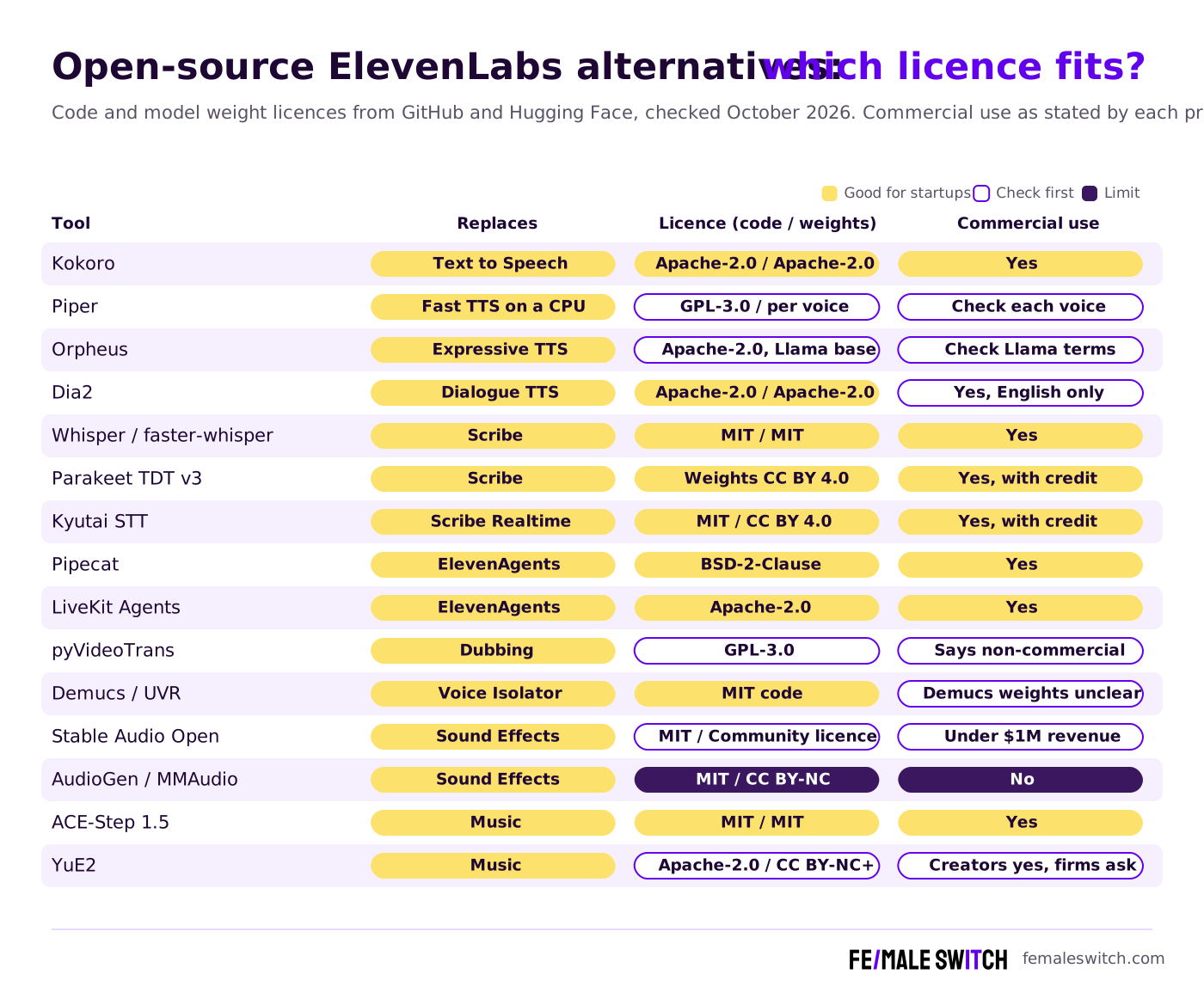
The Best Open-Source ElevenLabs Alternatives in 2027, Job by Job
1. Text to speech: Kokoro, Piper, Orpheus and Dia2 instead of Eleven v3 and Flash
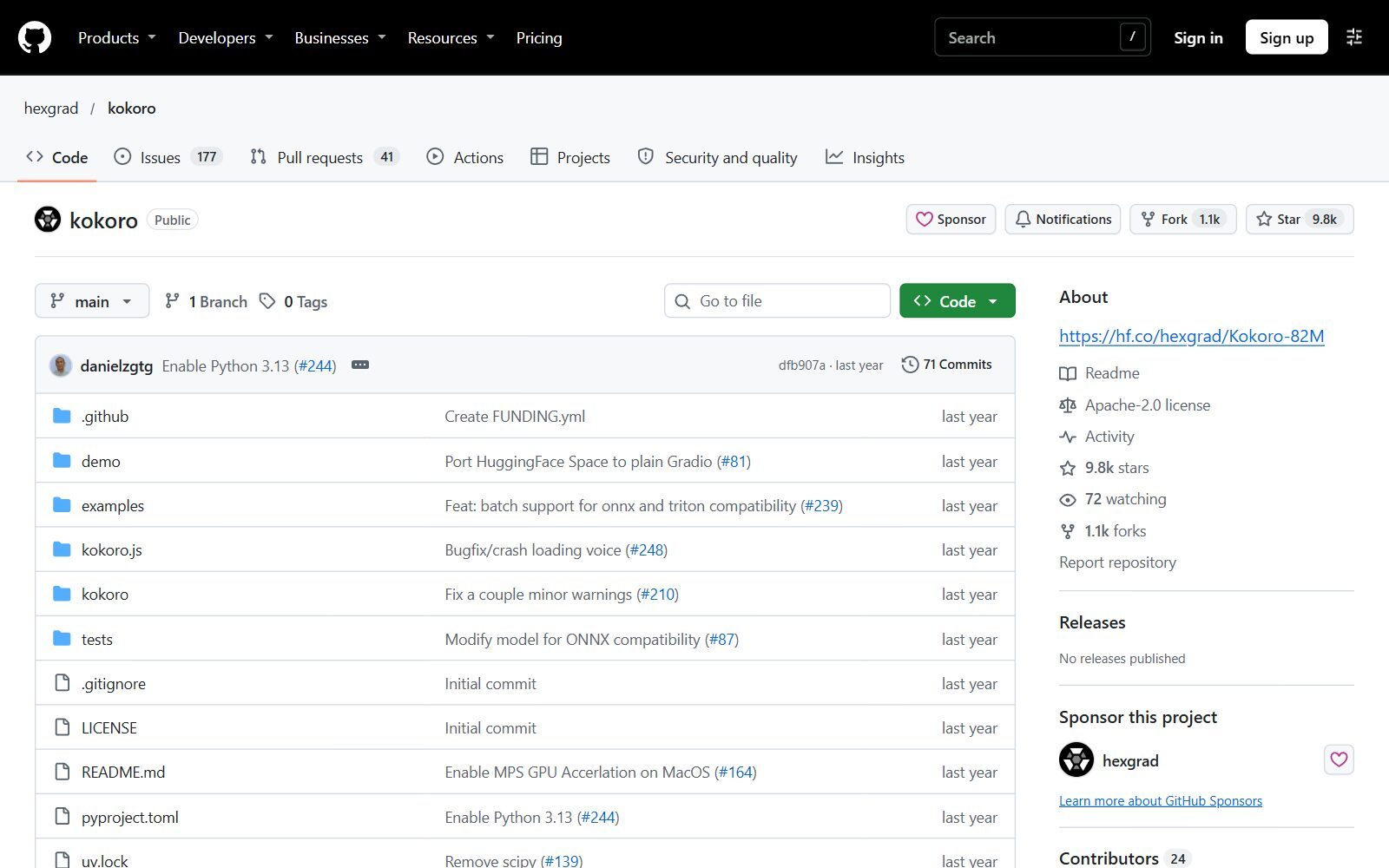
Kokoro is the default pick for a commercial product. It is an open-weight model with 82 million parameters and Apache-licensed weights, and its README says it matches larger models in quality while being much faster and cheaper to run. It installs with one pip command and covers American and British English, Spanish, French, Hindi, Italian, Japanese, Brazilian Portuguese and Mandarin. It ships with built-in voices and does not clone voices. The code was last changed in August 2025, so treat it as finished rather than fast-moving.
Piper is the closest thing to Eleven Flash you can run on cheap hardware: a fast, local neural TTS engine that runs well without a GPU and is used by Home Assistant and the NVDA screen reader. It now lives at the Open Home Foundation under GPL-3.0 (the original repository was archived in October 2025) and released version 1.8.0 in September 2026. Each voice has its own model card and licence, so check the one you ship, and note that the README says the project is looking for maintainers.
Orpheus TTS from Canopy Labs is the open model closest to Eleven v3's emotional delivery: it uses a Llama 3B backbone, controls emotion with simple tags, can clone voices zero-shot and streams with about 200 milliseconds of latency. The code is Apache-2.0 and Hugging Face lists the fine-tuned English model as Apache-2.0, but you must accept conditions to download it and its model tree names Meta's Llama 3.2 3B Instruct as the base, so read Meta's licence too. Multilingual models are a research preview.
Dia2 from Nari Labs generates dialogue between two speakers, with laughs and other non-verbal sounds, like Eleven v3's multi-speaker mode. Released in November 2025 in 1B and 2B sizes, it streams audio as the first words arrive and generates up to two minutes of English; code and weights are Apache-2.0. Its predecessor Dia (1.6B, also Apache-2.0) is still available.
2. Speech to text: Whisper and its faster cousins instead of Scribe
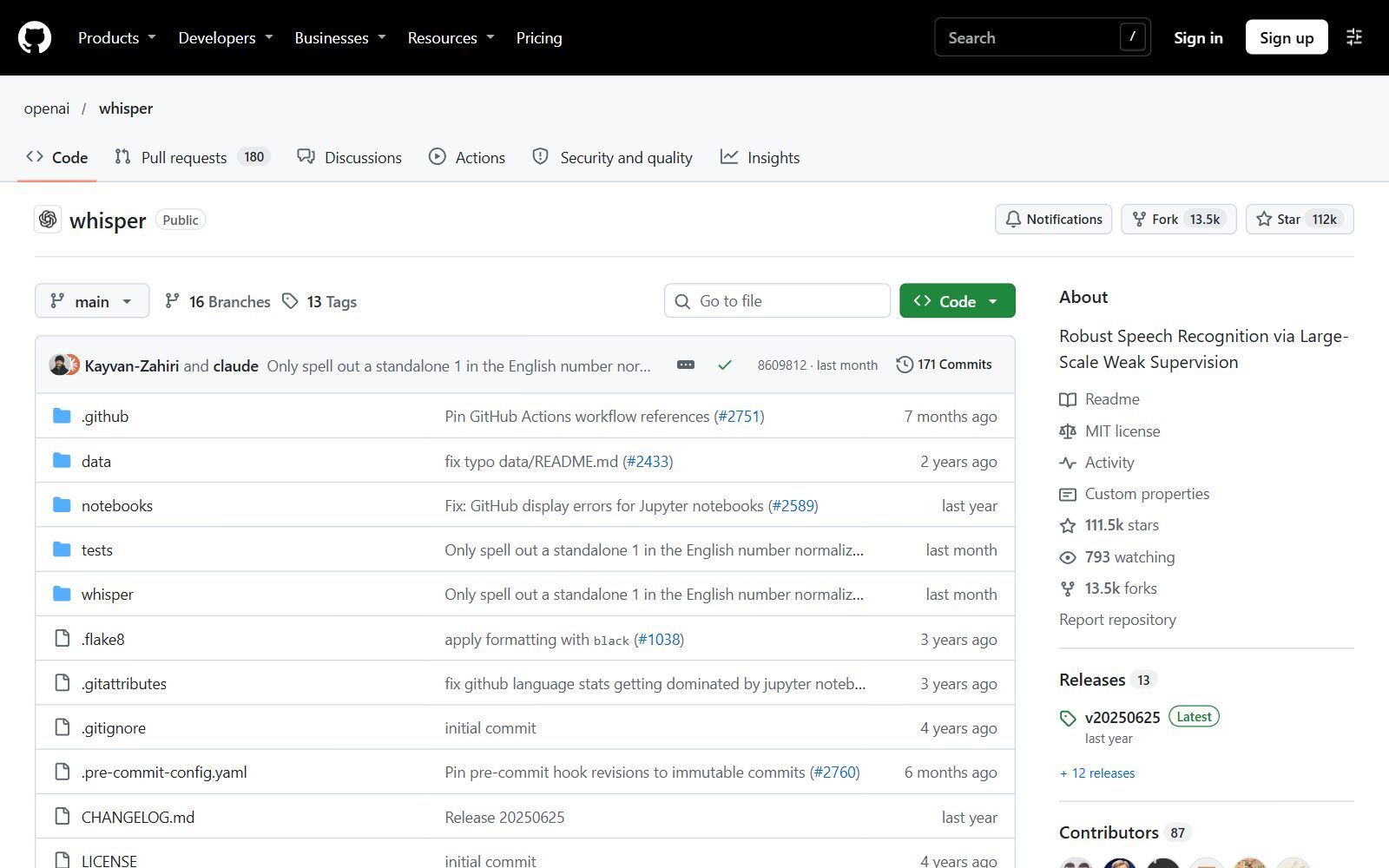
Whisper from OpenAI is still the base of most open transcription: a multilingual speech recognition model whose code and weights are both MIT-licensed. Its turbo model needs about 6 GB of video memory and runs roughly eight times faster than the large model; use the large or medium models if you also need translation into English, because turbo is not trained for it. The latest tagged release is from June 2025, and the code was last updated in August 2026.
In production, most teams run Whisper through faster-whisper (MIT), which its README says is up to four times faster than the original at the same accuracy and uses less memory, or whisper.cpp (MIT), a plain C/C++ port that runs on a CPU, Apple Silicon, iPhone, Android, Raspberry Pi and even in the browser.
Two newer models are worth testing against Whisper. NVIDIA's Parakeet TDT 0.6B v3 transcribes 25 European languages with word-level timestamps, detects the language automatically and is released under CC BY 4.0, which allows commercial use with attribution. Mistral's Voxtral Mini (Apache-2.0) transcribes up to 30 minutes of audio, answers questions about it and writes summaries, which replaces a separate transcription and summary step.
For live captions or agents, which Scribe v2 Realtime covers at ElevenLabs, Kyutai STT streams text with word timestamps. Its English and French model has a 0.5-second delay and built-in voice activity detection that tells an agent when the user has finished speaking; the code is MIT and Apache-2.0, the weights CC BY 4.0.
3. Voice agents: Pipecat and LiveKit Agents instead of ElevenAgents
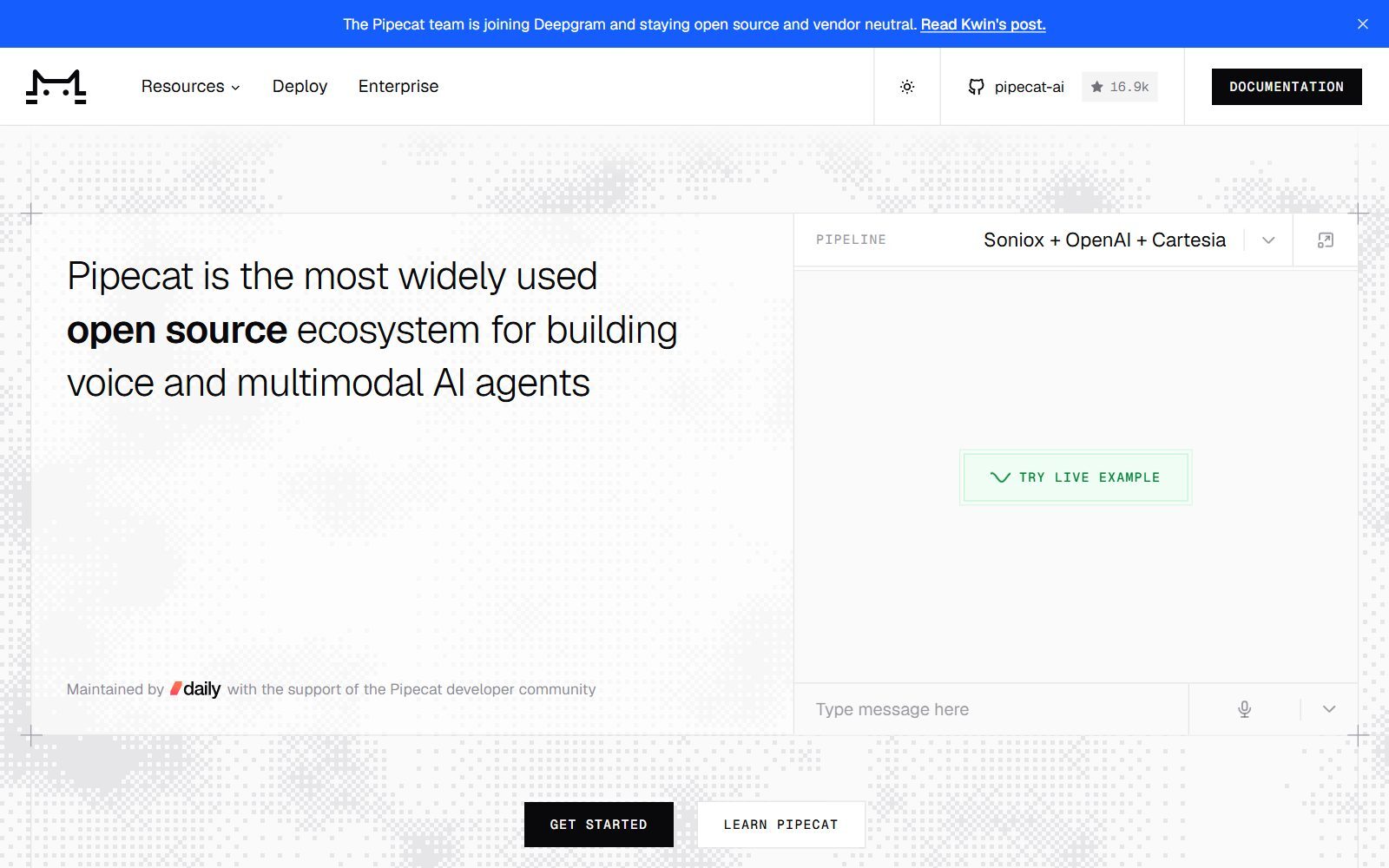
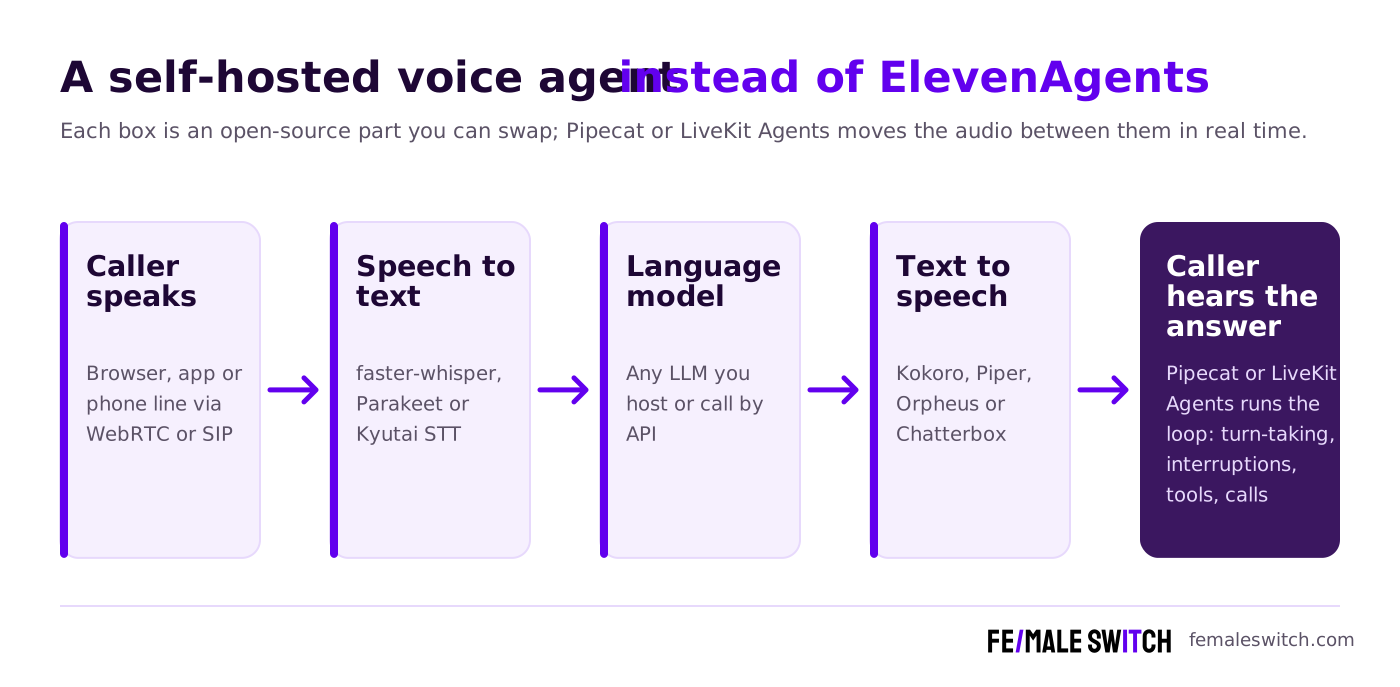
ElevenAgents bundles speech recognition, a language model, a voice and phone calls into one hosted product. Open-source frameworks give you the same pipeline, and you choose each part. Pipecat is a Python framework for real-time voice and multimodal agents under the BSD-2-Clause licence, with client SDKs for the web, iOS, Android and more, and Pipecat Flows for structured conversations. It was maintained by Daily; in October 2026 its website announced that the Pipecat team is joining Deepgram and that the project stays open source and vendor neutral. A new release came out on 29 October 2026.
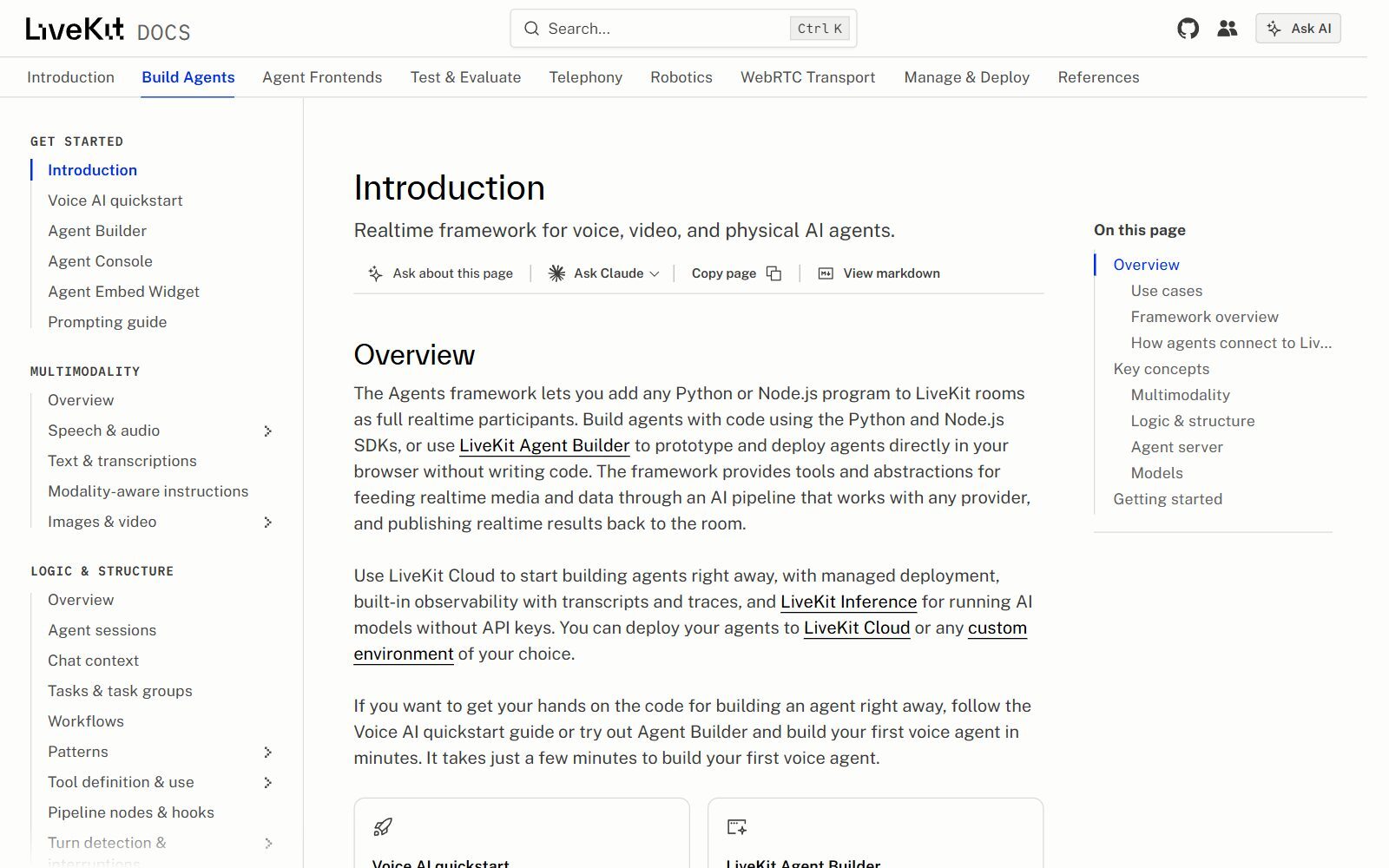
LiveKit Agents (Apache-2.0) adds agents as real-time participants to LiveKit rooms, with phone calls through LiveKit's telephony stack, MCP tools, a built-in test framework and semantic turn detection. You can run the whole stack on your own servers, including the open-source LiveKit media server; only the turn-detection models use a separate LiveKit Model License. New versions were released in late October 2026.
Validate your startup idea with the unique borrowed authority approach: we publish articles about your product in our blog and you get traffic and testers for your MVP
- Prove Market Demand: See real organic traffic and waitlist conversions
- Unlock High-Potential Keywords: Receive a curated list of top-performing keywords directly from Google Search Console data.
- Estimate Customer Acquisition Cost (CAC): Gain financial foresight with an estimated CAC based on real keyword performance data.
🔗 Start validating your startup now
4. Voice cloning and voice changing: keep it short, and get consent
ElevenLabs keeps Instant Voice Cloning for paid plans. The safest open option for products is Chatterbox from Resemble AI, with MIT-licensed code and weights, an English Turbo model, a Multilingual model for 23+ languages and an invisible watermark in every file. For Voice Changer-style speech-to-speech conversion, RVC WebUI (MIT) trains a voice model on 10 minutes of audio or less. Licences, consent rules and ten more models are in our voice cloning comparison. Only clone voices whose owners have agreed in writing.
5. Dubbing: pyVideoTrans and open-dubbing instead of ElevenLabs Dubbing
pyVideoTrans is the most complete open dubbing tool: one click runs speech recognition, subtitle translation, AI dubbing with a different voice per speaker and the final video. It can use faster-whisper and local language models through Ollama, clone voices with F5-TTS, CosyVoice or GPT-SoVITS, and ships a Windows app that needs no Python. The code is GPL-3.0, but its README calls it a free, non-commercial project and makes users responsible for the APIs and content they use, so check terms before you sell dubbing to clients. A new release came out in October 2026.
Softcatalà's open-dubbing (Apache-2.0) is a simpler command-line pipeline built on Whisper, Meta's NLLB translation and several TTS engines, with speaker gender detection. Its author calls it experimental, and the code was last changed in July 2025, so it is better for learning than for client work.
6. Voice isolation and noise removal: Demucs, UVR and DeepFilterNet
To separate a voice from music, Demucs splits a track into vocals, drums, bass and other stems. The original Meta repository is archived; its author keeps an officially maintained fork but says he is not actively developing it. Its code is MIT, but the README says the licence of the weights is not clear because some training data was research-only, so ask a lawyer before you sell separated audio. Ultimate Vocal Remover (MIT) wraps Demucs and its own models in a desktop app and posted a development update in October 2026. To clean background noise from speech recordings, DeepFilterNet is MIT or Apache-2.0 at your choice, though its last release is from 2023.
7. Sound effects: the gap in open source
This is where open models trail ElevenLabs, mainly because of licences. Stable Audio Open 1.0 generates stereo sound effects and samples of up to 47 seconds at 44.1 kHz from a text prompt; its code (stable-audio-tools) is MIT, but the weights use the Stability AI Community License, which according to Stability AI's licence page is free for organisations with less than $1 million in annual revenue and needs an Enterprise licence above that. Meta's AudioGen (in the MIT-licensed AudioCraft library) and MMAudio, which generates sound to match a video, both publish their weights under CC BY-NC 4.0: fine for prototypes, not for a paid product.
8. Music: ACE-Step 1.5 instead of Eleven Music
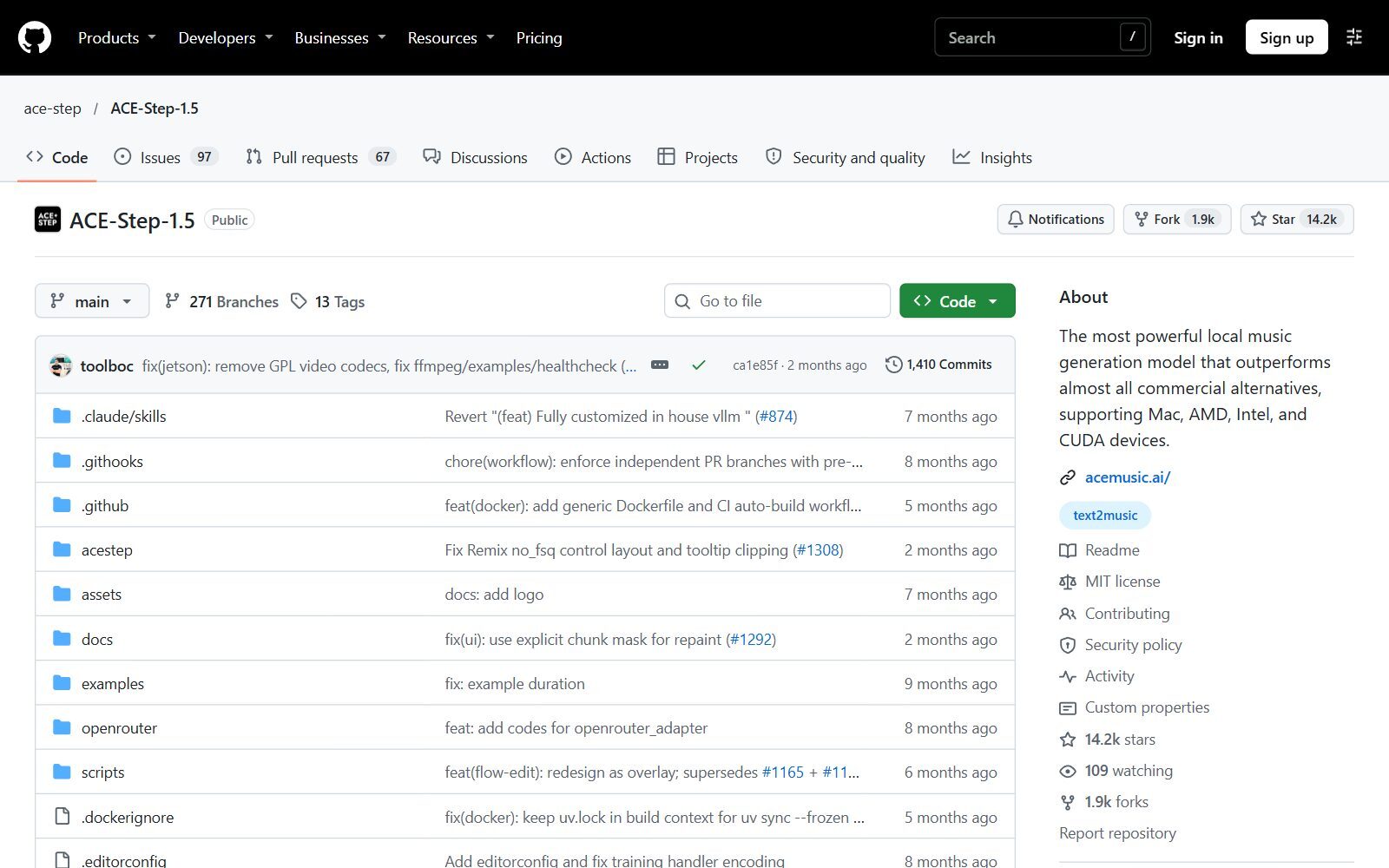
ACE-Step 1.5 is the strongest open music model for commercial use: code and weights are MIT. Its README says it runs locally with less than 4 GB of video memory, generates songs from 10 seconds to 10 minutes with lyrics in 50+ languages, and can make covers, repaint parts of a track and add accompaniment to a vocal. You can train a LoRA on a few songs to capture a style. Version 1.5 was released in May 2026 and the code was updated in August 2026.
YuE2 is a newer music model with Apache-2.0 code, but its weights are CC BY-NC 4.0 with an extra creator permission: individual creators and musicians may use it and earn from the songs, while companies must ask for a commercial licence. If you are building a music product, start with ACE-Step.
9. Audiobooks and long-form narration instead of Studio
ebook2audiobook (Apache-2.0) turns e-books into audiobooks with chapters and metadata, on a CPU or GPU, with a choice of TTS engines and voice cloning; its README limits use to e-books without DRM that you acquired legally. audiblez (MIT) is simpler: it converts an EPUB into an M4B audiobook with Kokoro, and its author reports about five minutes for a 160,000-character book on a cloud T4 GPU, or about an hour on a MacBook CPU.
Tools from the 2025 List That Are Gone, Stalled or Not a Fit
The 2025 version of this article listed ten TTS engines. Here is what happened to them:
- Coqui XTTS-v2: the Coqui company has closed. The code lives on in a maintained fork, but the XTTS-v2 weights use the Coqui Public Model License, which allows only non-commercial use.
- TortoiseTTS: Apache-2.0 and still online, but its last release is from May 2022 and its last code change from November 2024.
- Mozilla TTS: inactive; the code has not changed since February 2021. Its work continued in Coqui TTS.
- Mimic 3: its README says it is no longer maintained and calls Piper its spiritual successor.
- MaryTTS: a Java TTS server under LGPL-3.0 whose last release dates from May 2022; fine for research, not for modern-sounding voices.
- eSpeak NG: still maintained and tiny, but it is a classic rule-based synthesizer, not a neural voice. Piper uses it under the hood for pronunciation.
- OpenVoice: MIT and free for commercial use, but a voice cloning tool with no code changes since April 2025; covered in our cloning guide.
- Ultravox: not a TTS model at all. It takes speech in and returns text from a language model, so it fits inside a voice agent, not in place of a voice.
- StyleTTS 2 and VITS: both MIT, but research code with no changes since 2024 and 2021; use Kokoro or Piper for products.
- Also left out: Higgs Audio v3 (its weights are research and non-commercial only) and Seed-VC, whose GitHub repository has been archived.
Which Open-Source ElevenLabs Alternative Should You Choose?
- You need a voice in your app today and must ship commercially: Kokoro; Piper if it has to run on a CPU or a small device.
- You want emotional, character-style voices: Orpheus or Dia2, after checking their licences for your use.
- You transcribe meetings, calls or podcasts: faster-whisper; Parakeet v3 for European languages; Voxtral Mini if you also want summaries.
- You are building a voice agent for support or sales: Pipecat or LiveKit Agents with Kyutai STT or faster-whisper, your language model and Kokoro.
- You localise videos: pyVideoTrans, with a human check before anything goes to a client.
- You need music or jingles: ACE-Step 1.5.
- You need sound effects for a commercial product: Stable Audio Open if your revenue is under $1 million; otherwise ElevenLabs or another paid service is still the simpler legal route.
- You are a funded startup that would rather not self-host: ElevenLabs runs a Startup Grants Program; its agents pricing page offers 12 months free with 33 million characters to build and test.
How Founders Use Open-Source Voice AI
Most startups do not need the whole stack. A typical first use is a narrated demo video or onboarding voice (Kokoro), then transcription of customer calls for research (faster-whisper), and only later a voice agent. If that agent answers customers, the help desk behind it matters as much as the voice: compare the open-source Intercom alternatives and open-source Zendesk alternatives, and see where a voice fits in our overview of AI agents for startup founders. For hosted tools, these audio AI tools for startups and AI music creation sites are quicker to start with, and we wrote about ElevenLabs' AI music generator and how to use it well.
More open-source picks for the rest of your stack: open-source DALL-E alternatives and open-source StockAI alternatives for images, open-source GitHub Copilot alternatives to write the code around your models and open-source Zapier alternatives to connect everything. Raising money for a voice AI startup? See our list of VCs for AI startups. And once your product is live, the F/MS AI SEO Tool helps you write the articles that bring users from Google and AI assistants.
Join ElonaHunt (like ProductHunt but for women) and explore the coolest women-focused startups out there!
Discover your next big inspiration and connect with like-minded female entrepreneurs!
👉 Join the Hunt Here
FAQ About Open-Source ElevenLabs Alternatives
Is there an open-source version of ElevenLabs?
Not as one product. ElevenLabs covers text to speech, transcription, voice agents, dubbing, sound effects and music, and open source has separate tools for each: for example Kokoro for speech, Whisper for transcription, Pipecat for agents, pyVideoTrans for dubbing and ACE-Step 1.5 for music.
What is the best open-source alternative to ElevenLabs text to speech?
Kokoro, because its code and weights are Apache-2.0 and it runs fast on modest hardware. Piper is best on a CPU, and Orpheus or Dia2 are more expressive but need a GPU and a licence check.
What is the open-source alternative to ElevenLabs Scribe?
OpenAI's Whisper, whose code and weights are MIT-licensed, usually run through faster-whisper or whisper.cpp. NVIDIA's Parakeet TDT 0.6B v3 (CC BY 4.0) and Mistral's Voxtral Mini (Apache-2.0) are strong newer options.
Can I build an ElevenLabs-style voice agent with open source?
Yes. Pipecat (BSD-2-Clause) or LiveKit Agents (Apache-2.0) connect a speech-to-text model, a language model and a TTS voice in real time, including phone calls. You host and pay for each part yourself.
Which open-source voice models can I use commercially?
Kokoro, Dia2, Chatterbox, Whisper and ACE-Step 1.5 have permissive licences for both code and weights. Parakeet and Kyutai STT weights are CC BY 4.0 (credit required). Coqui XTTS-v2, F5-TTS, AudioGen and MMAudio weights are non-commercial.
Is Coqui TTS still available?
The Coqui company has closed. A maintained fork of its code exists, but the popular XTTS-v2 weights are licensed for non-commercial use only, so do not build a paid product on them.
Is there an open-source alternative to ElevenLabs Music?
ACE-Step 1.5, with MIT-licensed code and weights. Its README says it runs with less than 4 GB of video memory and writes songs of up to 10 minutes with lyrics in 50+ languages.
How much does ElevenLabs cost compared with self-hosting?
In October 2026 the ElevenAPI listed text to speech at $0.08 per 1,000 characters ($0.04 on Flash), transcription at $0.22 per hour and voice agents at $0.08 per minute plus the language model. Self-hosted tools have no per-use fee, but you pay for servers and maintenance.
Is Ultravox a text-to-speech model?
No. Ultravox takes speech in and produces text, so it replaces the transcription and language model steps of a voice agent. You still need a TTS model such as Kokoro to speak the answer.
Where can I get a backlink by writing about my startup?
You can publish a guest post in one of the Fe/male Switch startup blogs, which rank in Google and in AI tools. Get a quality backlink.
About the Author
Violetta Bonenkamp, also known as MeanCEO, is an experienced startup founder with an impressive educational background including an MBA and four other higher education degrees. She has over 20 years of work experience across multiple countries, including 5 years as a solopreneur and serial entrepreneur. Throughout her startup experience she has applied for multiple startup grants at the EU level, in the Netherlands and Malta, and her startups received quite a few of those. She’s been living, studying and working in many countries around the globe and her extensive multicultural experience has influenced her immensely.

