

Grants for AI Startups in 2027: Non-Dilutive Funding Worldwide, From the EIC and SBIR to Startup SG Tech and Free Compute
Grants for AI startups exist on every continent, but most of them are general innovation grants that AI companies can win, not money reserved for AI. What is AI-specific is usually something else: free supercomputer time, cloud credits and the occasional AI prize. This guide puts the main options side by side for 2027: government grants in the EU, the US, Canada, the UK, Singapore, Israel, Australia and Germany, then the compute and credit programmes, each with the amount, who can apply and the current status from its official page, checked in November 2026. For deeper regional lists, see our guides to AI startup grants in Europe and AI startup grants in North America. The 2025 version of this article listed 20 items, seven of them accelerators that take equity; what happened to those is at the end.
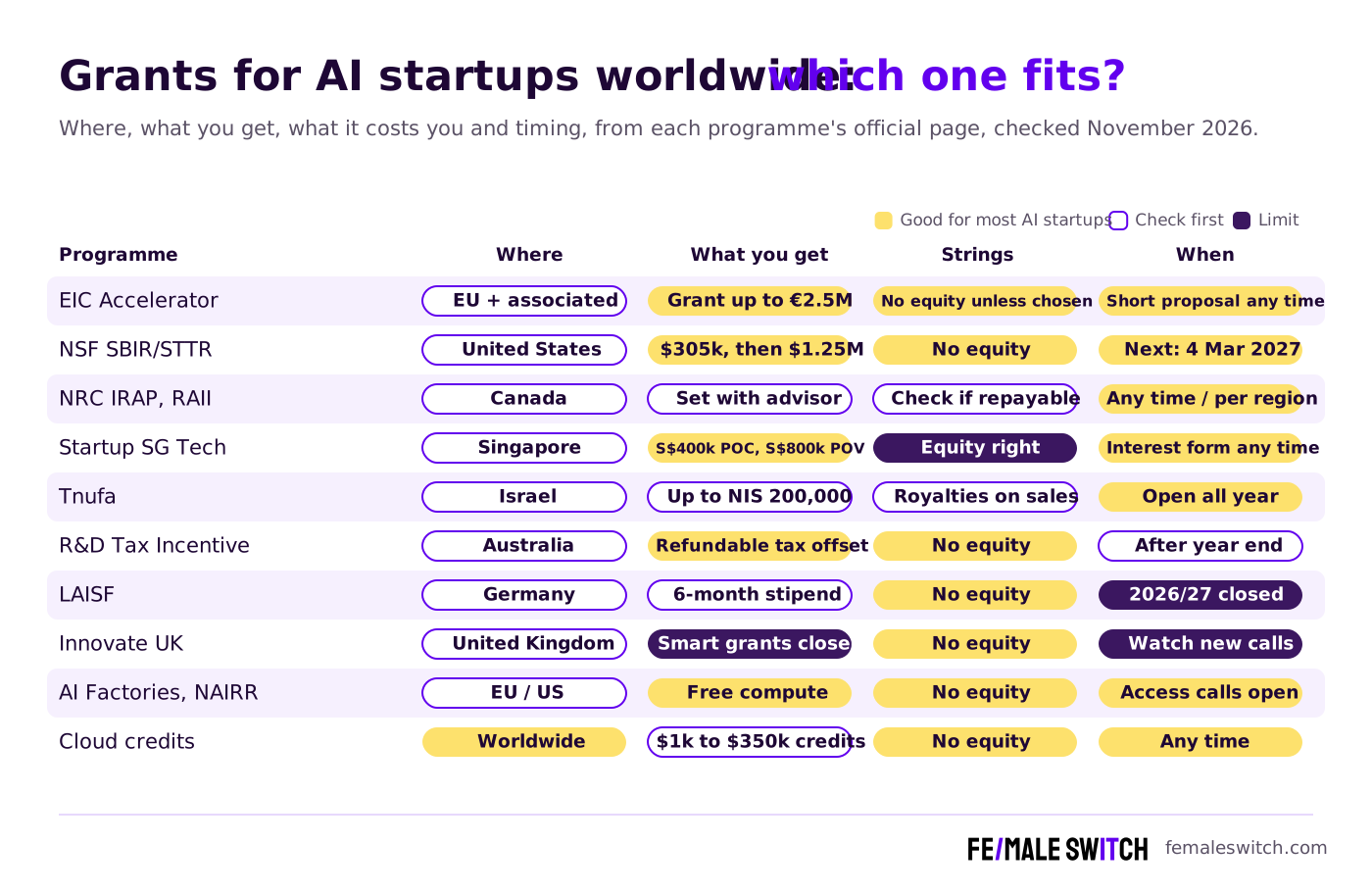
Quick answer: in Europe, the biggest grant open to AI startups is the EIC Accelerator (up to €2.5 million, short proposals at any time). In the US it is NSF SBIR/STTR, with an Artificial Intelligence topic, up to $305,000 in Phase I and $1,250,000 in Phase II and a next deadline on 4 March 2027. Canadian AI startups start with an NRC IRAP advisor, Singapore has Startup SG Tech (up to S$400,000 or S$800,000), Israel has the Tnufa ideation grant (up to NIS 200,000) and Australia refunds R&D costs through the R&D Tax Incentive. Whatever the country, also apply for cloud credits (up to $350,000 from Google Cloud for AI startups), but remember that credits are not grants.
Write FREE SEO-optimized Blog Articles! Our Article Writer ensures your blog is loved by both Google and your readers, turning those clicks into customers.
👉 Write your article here
Grants, Credits, Prizes and Equity: Know What You Are Applying For
- Grants are cash for a project, with no equity: you report on how you spend it. Some are "conditional": Israel's Tnufa is repaid through royalties if you sell, and Singapore's Startup SG Tech gives the government a right to subscribe for shares.
- Tax credits (Australia's R&D Tax Incentive, Canada's SR&ED, the Dutch WBSO) lower your tax or refund part of your R&D costs after you spend them: real money, but it arrives late.
- Credits and free compute (Google, AWS, Microsoft, NVIDIA Inception, EU AI Factories, the NAIRR Pilot) pay for computing only. They are often worth more than a small grant to an AI company, but they cannot pay salaries.
- Prizes and challenges pay winners of a competition, with light paperwork, and run in rounds.
- Accelerators and venture funds invest for equity. They are not grants, even when a list calls them that; see our guides to accelerators for AI startups and equity-free AI accelerators.
Grants for AI Startups Compared
Sources: each programme's official page, checked on 8 and 9 November 2026 (EU AI Factories on 1 November 2026). Amounts and rules change between rounds, so check the official page again before you apply.
Government Grants for AI Startups
1. EIC Accelerator (EU): up to €2.5 million, open to AI in any field
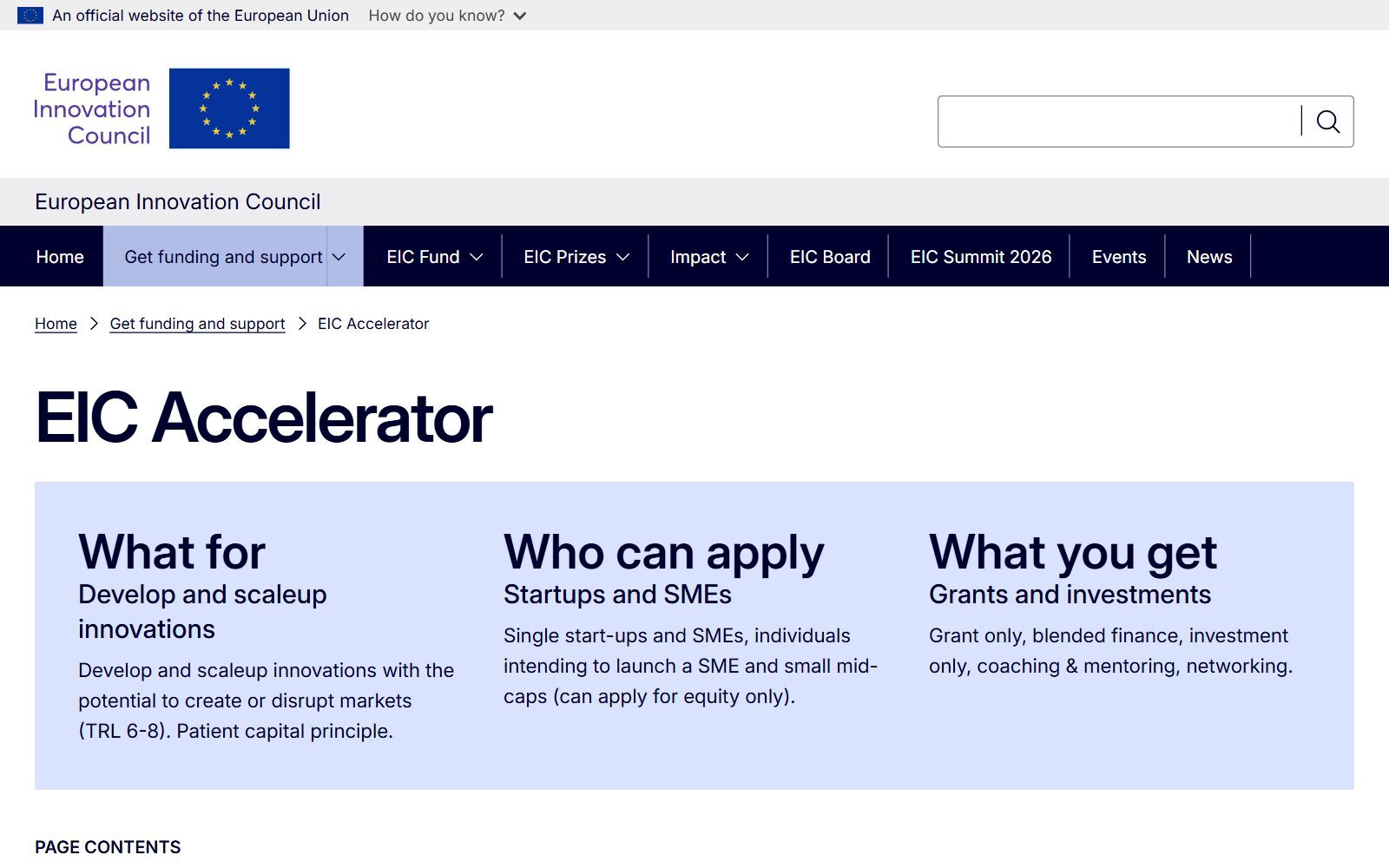
The European Innovation Council's EIC Accelerator is the largest grant a single AI startup can win in Europe. Startups and SMEs in EU member states and associated countries get a grant component of up to €2.5 million for innovation work at technology readiness levels 6 to 8, and can add an equity investment of €1 million to €10 million. You start with a short proposal, which can be sent at any time and gets feedback in about four to six weeks; if it passes, you submit a full proposal to a batching date and pitch to a jury. The EIC Work Programme 2027, published on 5 November 2026, gives Accelerator Open €428 million for 2027. AI startups apply through Open: none of the four 2027 Accelerator Challenges (ocean observation, climate-neutral cities, fusion and carbon removal) is about AI. Our sister site has a step-by-step EIC Accelerator guide.
2. Horizon Europe AI calls: GenAI4EU, EIC Pathfinder and EIC Transition
AI-specific EU money mostly comes as Horizon Europe calls for consortia. GenAI4EU funds generative AI in sectors such as health, robotics and public administration; the Commission says its first calls opened in 2025 and most are closed, so watch the 2027 work programmes. EIC Pathfinder gives up to €4 million to early, high-risk research, mostly to consortia of three or more partners, and EIC Transition gives up to €2.5 million to turn results of earlier EU-funded research into products. These suit AI spin-offs from universities more than young companies with no research history. Track dates in our EU grant calendar for 2027.
Boost Your SEO by listing your startup and get a FREE backlink.
Create a profile in the F/MS Startup Game, add the link to your website and submit.
👉 List your startup now!
3. NSF SBIR/STTR (US): the AI topic of America's Seed Fund
In the US, the main grant for AI startups is the National Science Foundation's SBIR/STTR programme, which has its own Artificial Intelligence topic. Under the current NSF 26-510 solicitation, Phase I pays up to $305,000 for 6 to 18 months and Phase II up to $1,250,000; NSF says it invests up to $2 million per company and takes zero equity. Your company needs fewer than 500 employees, at least 50% ownership by US citizens or permanent residents, work done in the US, and must not be majority-owned by several venture capital or private equity firms. SBIR and STTR were reauthorized on 13 April 2026 through fiscal year 2031. You begin with a short Project Pitch; the 4 November 2026 deadline has passed, and the next ones are 4 March 2027 and 7 July 2027. Other agencies (DOE, NIH, DoD) also fund AI topics; see deep tech grants in North America.
4. NRC IRAP and the Regional AI Initiative (Canada)
Canadian AI startups usually start with the National Research Council's Industrial Research Assistance Program (IRAP). According to NRC, you need an incorporated, for-profit business in Canada with no more than 500 full-time employees; there is no call, and an industrial technology advisor agrees the support with you. IRAP's AI Assist, according to NRC, helps SMEs develop and adapt generative AI and deep learning solutions. The Regional Artificial Intelligence Initiative adds money for AI adoption, commercialization and scale-up through Canada's regional development agencies, each with its own intake dates; ask whether the contribution is repayable.
5. Innovate UK and BridgeAI (UK): Smart grants closed
Innovate UK's open Smart grants, which many lists still show, are closed to new applications while funding is aligned to Innovate UK's new strategy. BridgeAI, delivered by Innovate UK and partners, offers support and funding to help businesses in sectors such as agriculture and food processing, construction, creative industries and transport and logistics adopt AI, and connects them with AI developers. It is aimed more at AI buyers than AI builders, and we found no open cash call for AI startups on its page in November 2026. UK startups can still apply for the EIC Accelerator, as grant only.
6. Startup SG Tech (Singapore): up to S$800,000, with a string
Startup SG Tech from Enterprise Singapore funds the commercialisation of proprietary technology, and information and communication technology is one of its areas. Since 2 January 2025 the cap is S$400,000 for a proof of concept and S$800,000 for a proof of value, paid by milestone. The company must be registered in Singapore within the last 10 years, have at least 30% local equity, do its core R&D in Singapore and show paid-up capital of at least 10% (POC) or 20% (POV) of the grant. Read the small print: the grant carries an equity component, as Enterprise Singapore has the right to exercise a share subscription. You apply with a Registration of Interest form. Integrating off-the-shelf models does not count as proprietary technology.
7. Tnufa ideation grant (Israel): up to NIS 200,000
The Israel Innovation Authority's Ideation (Tnufa) Incentive Program gives entrepreneurs and new Israeli startups a conditional grant of up to NIS 200,000 over 12 months, covering 80% of the approved budget, to build a first prototype and validate the idea. It is open all year. The Authority takes no equity, but you repay the grant through royalties on product sales. Later, its Startup Fund invests alongside private investors; from 15 July 2026 its maximum for approved deep tech companies rose to NIS 2 million at pre-seed and NIS 6 million at seed. That is an investment, not a grant.
8. R&D Tax Incentive (Australia): a refundable offset
Australia's main support for AI R&D is the R&D Tax Incentive, open to companies in any sector. Companies with aggregated turnover under A$20 million get a refundable offset equal to their corporate tax rate plus an 18.5% premium, so a loss-making startup gets cash back. You register your R&D activities within 10 months of the end of the income year. The government announced changes in the 2026–27 Budget that start on 1 July 2028; until then the current rules apply.
9. Lean AI Startup Funding, LAISF (Germany): a stipend for AI teams
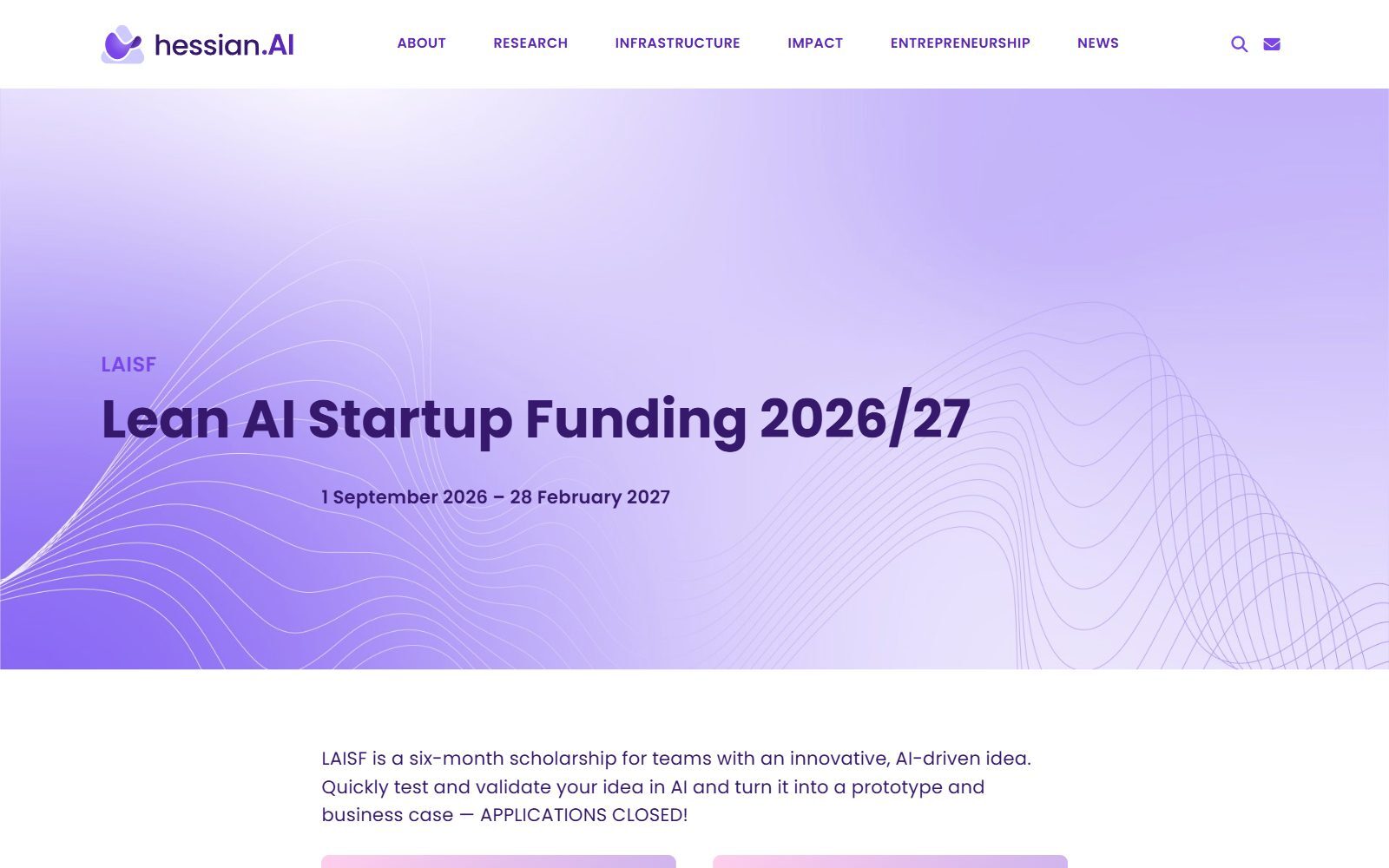
hessian.AI's Lean AI Startup Funding is one of the few grants made only for AI founders. It is a six-month scholarship for up to two people full-time (or three part-time) with an AI-driven idea, plus €5,000 for material costs and up to €30,000 to win at the mid-term presentation. You must not have incorporated your company yet or have other funding for the project, and funded team members need a residence in Germany, but not in Hesse. The 2026/27 round runs from 1 September 2026 to 28 February 2027; its deadline was 10 August 2026, so applications are closed. In other German regions, the federal exist stipend is the usual route; see grants for early-stage startups in Europe.
Boost Your SEO with 1,500+ Free Business Directories: increase your DA, get backlinks and traffic.
We've compiled an exclusive list of directories and websites where you can submit your business and start building high-quality backlinks to boost your website traffic and get your SEO snowball rolling.
👉 Submit your startup now!
Free Compute and Cloud Credits for AI Startups (Not Grants)
10. EU AI Factories and the US NAIRR Pilot: free public compute
Public supercomputers now open part of their capacity to AI startups. The EuroHPC AI Factories offer Playground, Fast Lane (up to 50,000 GPU hours) and Large Scale access, free of charge to AI SMEs and startups for innovation. In the US, the NAIRR Pilot accepts resource requests on a rolling basis from US researchers and from startups and small businesses with federal grants, so an SBIR award opens the door. Neither pays cash, but both replace a GPU bill.
11. Google for Startups Cloud Program: up to $350,000 for AI startups
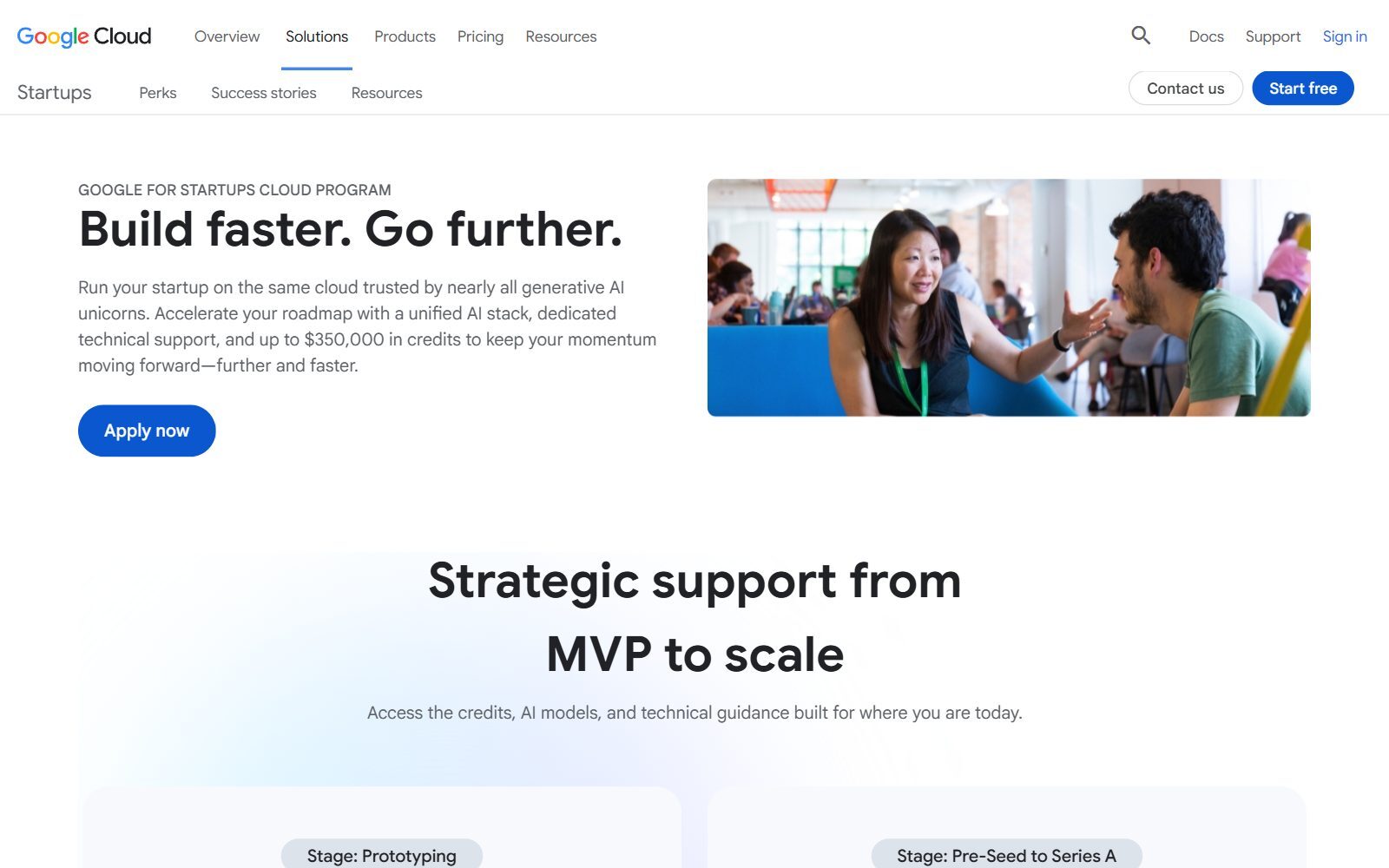
The Google for Startups Cloud Program has a separate tier for AI startups: 100% of Google Cloud usage up to $250,000 in the first year and 20% up to another $100,000 in the second, so up to $350,000. Other startups get up to $100,000 in year one. It is open worldwide to pre-seed to Series A startups, and Google asks for a working website that describes your business, team and product.
12. AWS Activate and Microsoft for Startups
AWS Activate starts self-funded founders at $1,000 in credits (some get up to $5,000); the Portfolio tier gives up to $200,000 to pre-Series B startups referred by an Activate Provider such as an accelerator or VC firm, and AWS says extra credits are available for AI startups ready to scale. Microsoft for Startups advertises up to $150,000 in Azure startup credits, unlocked step by step as you build.
13. NVIDIA Inception: free membership, credits through partners
NVIDIA Inception is a free programme for AI startups at any funding stage, with no application fees, deadlines or cohorts. Members get developer tools and training, preferred pricing on NVIDIA hardware and software, free cloud credits from NVIDIA and partners, and, depending on eligibility, introductions to investors through Inception Capital Connect. It gives no cash, and NVIDIA takes no equity for membership.
Boost Your SEO by Getting Featured in Our Blogs and get a backlink.
We publish content about startups, education, tech, funding, etc. that ranks well not only in Google but also in Perplexity, ChatGPT, Grok and other AI tools.
👉 Get featured now!
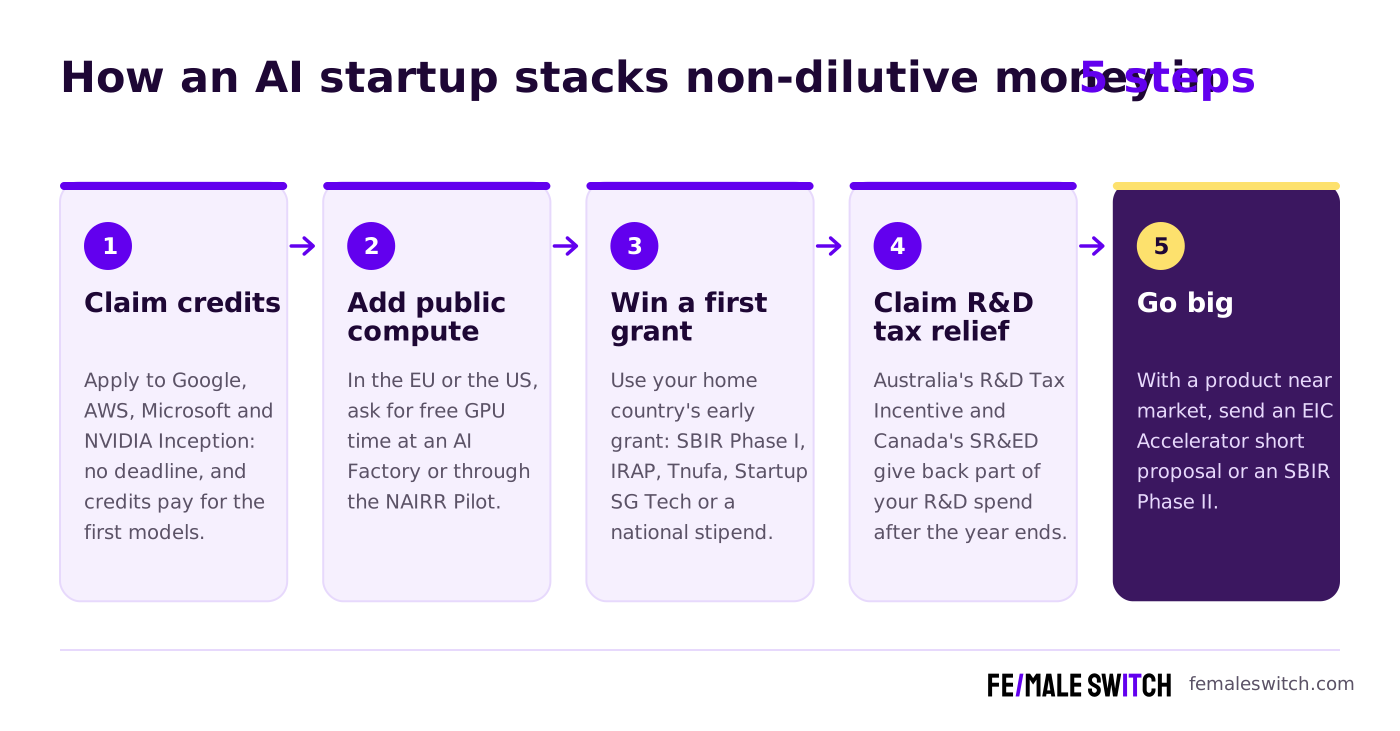
How AI Founders Stack Non-Dilutive Money
No single grant funds an AI startup, so founders combine them. A typical order:
Programmes Closed, Changed or Removed
The 2025 versions of this article (20, 15 and 25 grants) listed many items that are not startup grants or no longer exist:
- EIC Challenges 2025 (generative AI): closed. The 2027 Accelerator Challenges cover ocean observation, cities, fusion and carbon removal, not AI.
- EIC STEP Scale-Up: equity for scale-ups, not a grant.
- EIT Urban Mobility and the Innovation Fund: mobility and climate programmes, not AI startup grants.
- Innovate UK Smart grants and the UKRI Technology Missions Fund: Smart is closed to new applications; the old £7 million item referred to BridgeAI, covered above.
- Techstars, Y Combinator, 500 Global, Plug and Play, AI2 Incubator, StartX and Betaworks: accelerators that invest for equity; see AI accelerators in North America and AI accelerators in Europe. Andreessen Horowitz is a venture capital firm.
- Cooperative AI Foundation, Johns Hopkins, Princeton, University of Virginia, NordForsk, the AI Safety Fund and CyberASAP: research funding for universities, researchers or academics, not startups.
- EIT Digital Challenge: EIT Digital became 28DIGITAL in October 2025; no current startup grant found.
- AI Climate Accelerator, Microsoft AI for Earth and the US federal AI budget: a programme listed only on a third-party site, a grant scheme with no current call and a 2024 government budget item, not startup grants.
- "AI for Healthcare Program", "AI in Transportation Initiative", "Women in AI Fund", "Green AI Initiative", "AIM Partnership Grants", "Startup Boost AI Grants", "Black Innovation Fund", "Global AI Impact Challenge" and similar entries: no official programme page found, so removed.
- Funding trend items (India AI funding, venture capital trends): news, not grants.
Which Grant Should Your AI Startup Apply For?
- EU company with a product close to market: EIC Accelerator, starting with a short proposal.
- US company: an NSF SBIR/STTR Project Pitch for the 4 March 2027 deadline, then the NAIRR Pilot for compute once you hold an award.
- Canadian company: call NRC IRAP and ask about AI Assist and your region's RAII intake.
- Singapore company with proprietary tech: Startup SG Tech, if you accept the share subscription right.
- Israeli founders at idea stage: Tnufa, open all year.
- Australian company: register your R&D for the R&D Tax Incentive every year.
- Any AI startup training or serving models: Google Cloud, AWS, Microsoft and NVIDIA Inception credits, and free EU AI Factories compute if you are in Europe.
How Founders Combine Grants With Other AI Funding
Grants are slow, so most AI founders also raise private money: compare VCs for AI startups, AI VCs in North America, AI VCs in Europe and angel investors for AI startups. If you are choosing where to build, read about the best countries for AI startups, in Europe and Asia. For grants beyond AI, see grants for early-stage startups, deep tech grants in South America and edtech startup grants. Women founders can add grants for female entrepreneurs, and EU applicants should learn how to find open EU funding calls.
Join F/MS: Startup Facilitator & Incubator and unlock your startup dreams today! Get your first customers, register you company in the Netherlands and get startup visas for the team.
FAQ About Grants for AI Startups
Are there grants only for AI startups?
A few, such as hessian.AI's LAISF stipend in Germany and the AI topic of NSF SBIR/STTR in the US. Most AI startups win general innovation grants such as the EIC Accelerator, IRAP or Startup SG Tech, plus AI-specific compute and credits.
What is the largest grant an AI startup can get?
In Europe, the EIC Accelerator grant of up to €2.5 million, with optional equity of €1 to €10 million. In the US, NSF SBIR/STTR pays up to $305,000 in Phase I and up to $1,250,000 in Phase II.
Are cloud credits the same as grants?
No. Credits from Google, AWS, Microsoft or NVIDIA partners pay only for computing on one platform and expire. They are still valuable for AI startups: Google Cloud offers AI startups up to $350,000.
Do AI startup grants take equity?
Most do not. Exceptions to check: Singapore's Startup SG Tech gives Enterprise Singapore a share subscription right, Israel's Tnufa is repaid through royalties, and the EIC Accelerator's investment part is equity if you ask for it.
Is SBIR still running in 2027?
Yes. SBIR and STTR were reauthorized on 13 April 2026 through fiscal year 2031. NSF's next deadlines are 4 March 2027 and 7 July 2027.
Can a non-US startup apply for SBIR?
No. NSF requires a US small business with fewer than 500 employees, at least 50% owned by US citizens or permanent residents, doing the work in the US.
Are Innovate UK Smart grants open?
No. Smart grants are closed to new applications while Innovate UK aligns funding to its new strategy. UK startups can still apply for the EIC Accelerator grant.
How do I get free GPU time for my AI startup?
In the EU, apply for Playground or Fast Lane access at a EuroHPC AI Factory. In the US, the NAIRR Pilot accepts startups that hold a federal grant such as SBIR.
Do I need a company before I apply?
Not always. LAISF requires that you have not incorporated yet, Tnufa accepts entrepreneurs, and the EIC Accelerator accepts individuals planning to set up a company. SBIR, IRAP and Startup SG Tech need a registered company.
Where can I get a backlink by writing about my AI startup?
You can publish a guest post in one of the Fe/male Switch startup blogs, which rank in Google and in AI tools. Get a quality backlink.
About the Author
Violetta Bonenkamp, also known as MeanCEO, is an experienced startup founder with an impressive educational background including an MBA and four other higher education degrees. She has over 20 years of work experience across multiple countries, including 5 years as a solopreneur and serial entrepreneur. Throughout her startup experience she has applied for multiple startup grants at the EU level, in the Netherlands and Malta, and her startups received quite a few of those. She’s been living, studying and working in many countries around the globe and her extensive multicultural experience has influenced her immensely.
