

AI Startup Grants in North America: SBIR/STTR, Free AI Compute, Cloud Credits and Canadian AI Funding Checked for 2027
AI startups burn money on two things before they have revenue: people and compute. Non-dilutive money that pays for either one is worth chasing, but most lists of "AI grants" mix real grants with accelerators, loans, investors and news items. This guide was rebuilt in November 2026 from official pages only. It covers what an AI startup in the United States or Canada can actually apply for: federal research grants, free compute through the National AI Research Resource pilot, cloud credits, and Canada's AI programmes. Programmes from the 2025 list that are closed, not grants or not North American are listed at the end. For the European side, read our guide to AI startup grants in Europe. For programmes outside North America too, see our worldwide guide to grants for AI startups.
Quick answer: in the US, the biggest AI grant is still NSF SBIR/STTR, which has an Artificial Intelligence topic and pays up to $305,000 in Phase I and $1.25 million in Phase II, with no equity; the programmes were reauthorized on 13 April 2026 and run through fiscal year 2031. The next NSF deadline is 4 March 2027. For compute, AI startups can get up to $350,000 in Google Cloud credits or up to $200,000 in AWS Activate credits, and SBIR winners can request free resources from the NAIRR Pilot. In Canada, start with an NRC IRAP advisor (which also runs AI Assist), check your region's RAII intake and claim SR&ED. Canada's AI Compute Access Fund is closed, with no new call announced.
Write FREE SEO-optimized Blog Articles! Our Article Writer ensures your blog is loved by both Google and your readers, turning those clicks into customers.
👉 Write your article here
AI Startup Grants in North America Compared
Sources: each programme's official page, checked 8 November 2026 (SR&ED and Mitacs in late October and early November 2026). Amounts are maximums in US or Canadian dollars; read the current call before you apply.
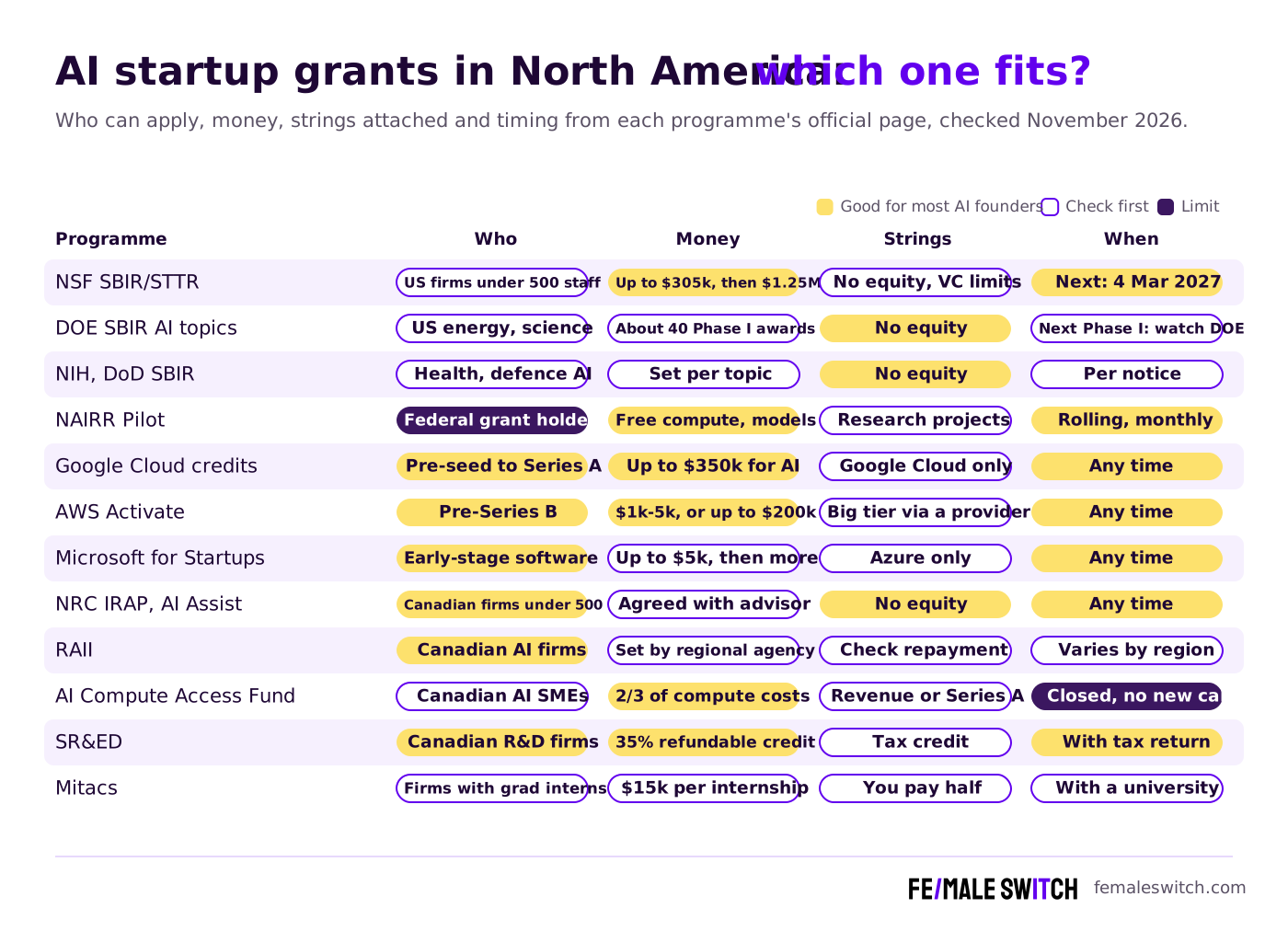
United States: Federal Grants for AI Startups
1. NSF SBIR/STTR (America's Seed Fund): the main AI grant
SBIR and STTR are the largest source of early non-dilutive money for US tech startups, and AI is one of NSF's named topics. Their legal authority lapsed on 30 September 2025 and new calls were paused; on 13 April 2026 the President signed S. 3971, and the White House statement says it authorizes SBIR through fiscal year 2031. As of 8 November 2026 the agencies are running their calls again.
NSF's Artificial Intelligence topic covers two areas: AI systems that are safe, reliable, fair, robust, private and resource-efficient, and AI hardware, such as chips and architectures for sustainable AI or edge devices. Under the current solicitation, NSF 26-510, Phase I pays up to $305,000 for 6 to 18 months and Phase II up to $1,250,000, usually over 24 months; NSF says it invests up to $2 million per company and takes zero equity. The rules matter for AI startups: your company needs fewer than 500 employees, must be at least 50% owned by US citizens or permanent residents, must do the work in the US, and cannot be majority-owned by several venture capital or private equity firms. You start with a short Project Pitch; only invited teams submit a full proposal. The 4 November 2026 deadline has passed; the next ones are 4 March 2027 and 7 July 2027.
2. DOE, NIH and DoD SBIR/STTR: AI inside other agencies' topics
Ten other federal agencies run SBIR or STTR, and several write AI into their topics. The Department of Energy's programmes are now managed by its Office of Technology Commercialization, and its SBIR/STTR page confirms the reauthorization took effect on 13 April 2026. On 22 July 2026 DOE opened a $10 million Phase I call for about 40 awards, with two AI topics: "AI for Quantum Computing and Networking" and "Achieving AI-Driven Autonomous Laboratories". That call closed on 10 September, and DOE said another Phase I opportunity would open in the fall. NIH funds health AI (diagnostics, imaging, clinical software) through its institutes, and the Department of Defense funds dual-use AI through monthly SBIR/STTR releases. Award sizes and dates for every agency are in our guide to deep tech grants in North America.
Boost Your SEO by listing your startup and get a FREE backlink.
Create a profile in the F/MS Startup Game, add the link to your website and submit.
👉 List your startup now!
3. NAIRR Pilot: free AI compute for startups with a federal grant
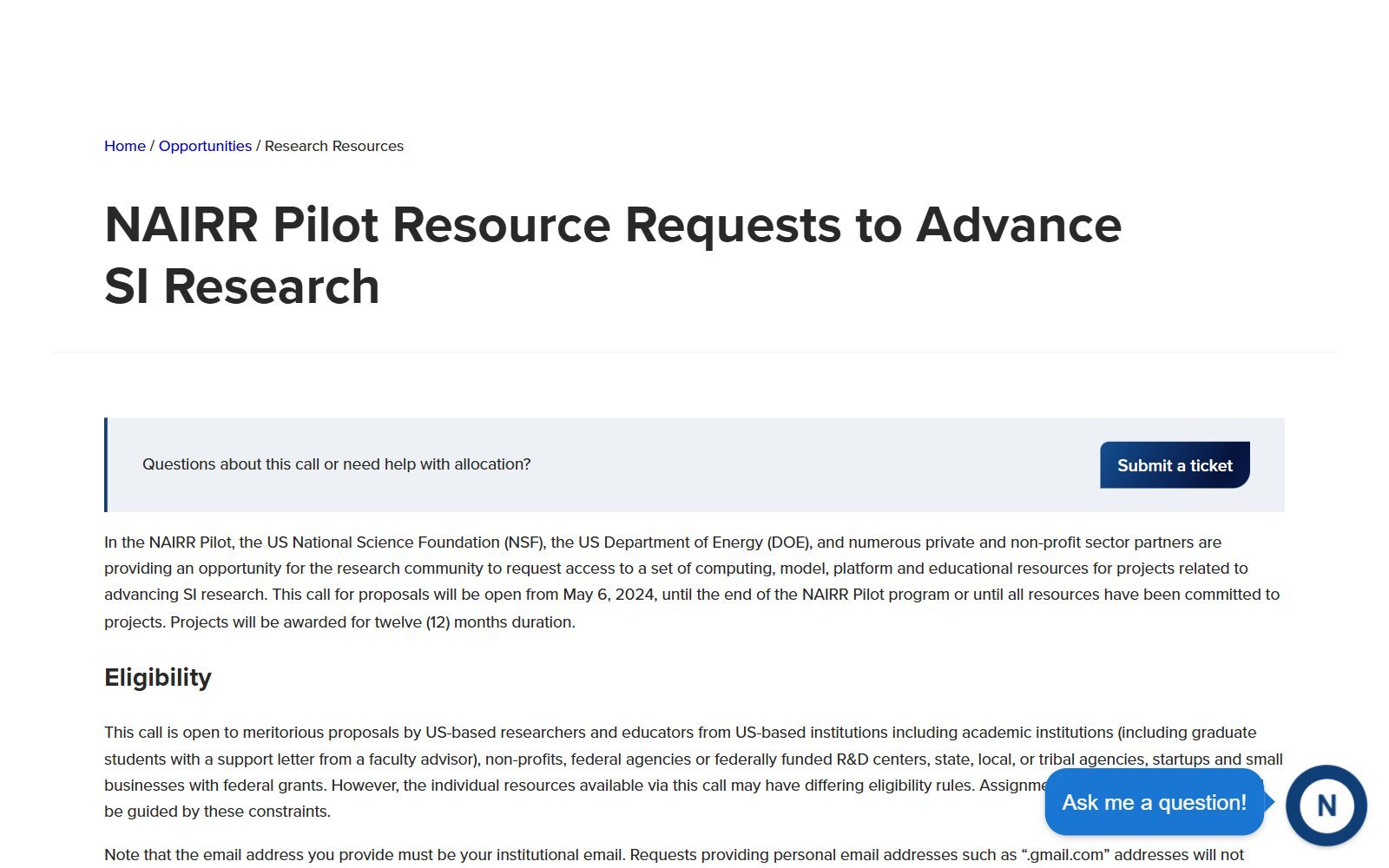
The National AI Research Resource (NAIRR) Pilot, led by NSF with DOE and private partners, gives free access to computing, models, platforms and training resources. Its resource request call is open to US-based researchers and educators, and it names "startups and small businesses with federal grants" as eligible, so an SBIR or STTR award is your ticket in. The call has run on a rolling basis since May 2024 and stays open until the pilot ends or the resources are committed. Requests sent by the 15th of a month are usually decided by the end of the next month, and awards last 12 months. Two catches: you must apply with an institutional email address, and individual resources can have their own rules. Some models, datasets and platforms in the catalogue can be used without a proposal.
Cloud Credits for AI Startups (US and Canada)
Cloud credits are not grants: they only pay for one provider's services and expire. But for an AI startup that trains or serves models, they are often worth more than a small cash grant, and you can apply at any time from the US or Canada.
4. Google for Startups Cloud Program: up to $350,000 for AI startups
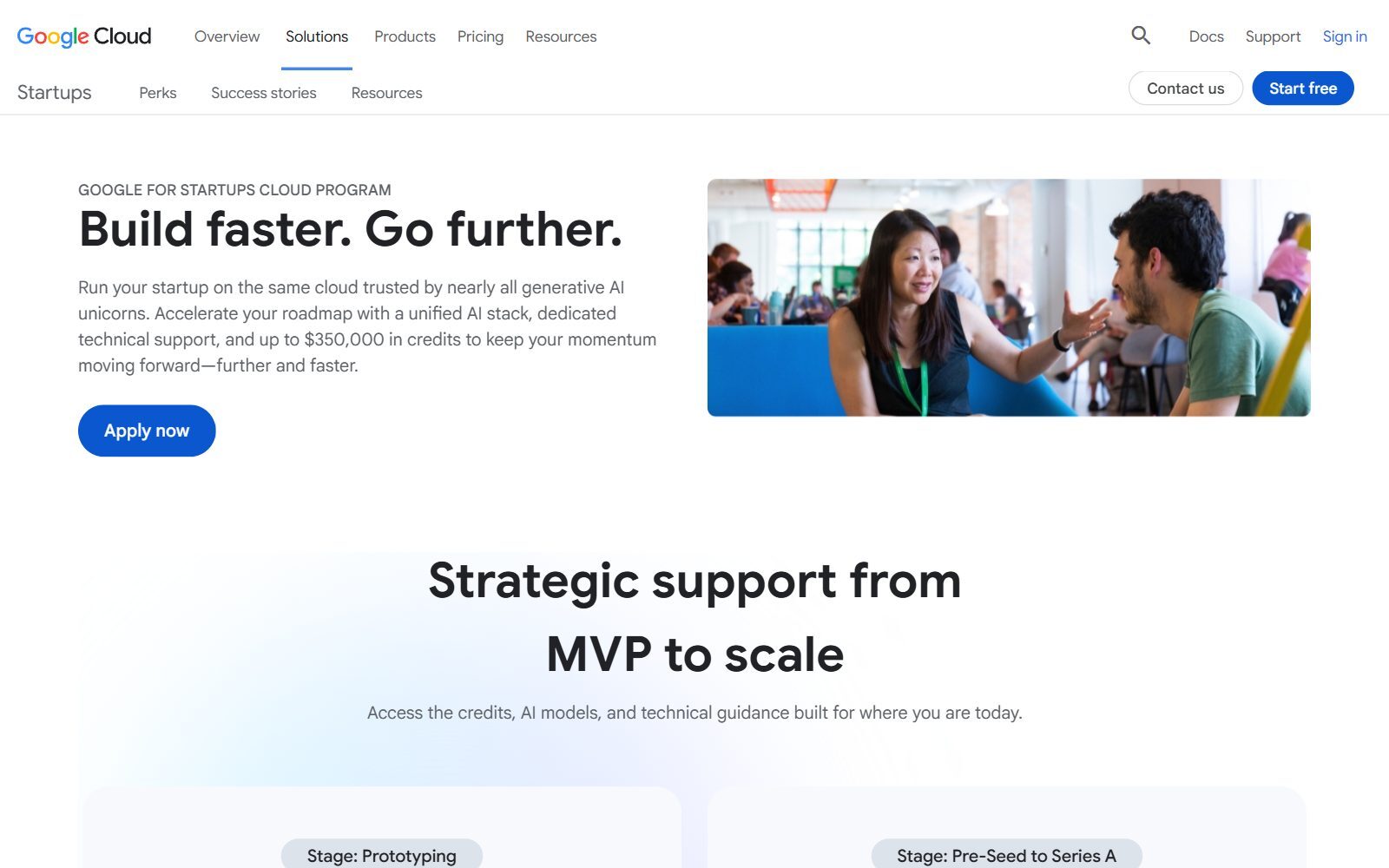
The Google for Startups Cloud Program gives AI startups 100% of Google Cloud usage up to $250,000 in year one and 20% up to another $100,000 in year two, so up to $350,000 in total; other startups get up to $100,000 in year one. The credits also cover Google's own models such as Gemini and Gemma, but not third-party models, which are billed directly. The tier is for startups with pre-seed to Series A funding founded in the last 3 to 5 years, and Google asks for a working website about your business, team and product. Pre-funded builders start with free access to Google AI Studio instead.
5. AWS Activate: up to $200,000, more for AI startups by invitation
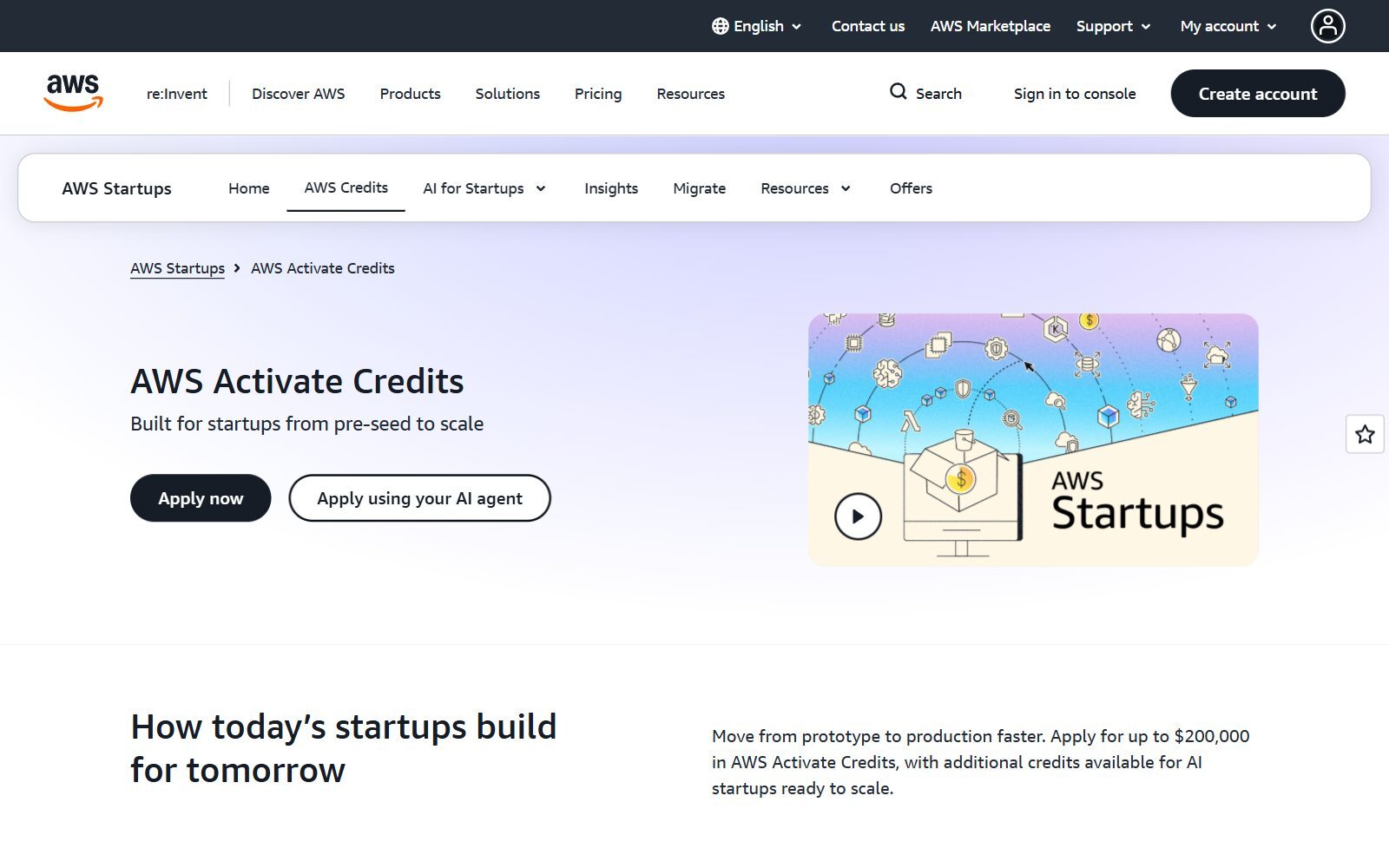
AWS Activate has two tiers. Activate Founders is for self-funded startups: you start with $1,000 in credits, and some get up to $5,000. Activate Portfolio gives up to $200,000, but you need an Organization ID from an Activate Provider, such as your accelerator, angel group or VC firm. AWS also offers $200,000 or more in credits for AI startups ready to scale, by invitation only. Eligibility: pre-Series B, founded in the last 10 years, with an AWS account on a paid plan.
6. Microsoft for Startups: Azure credits that grow with you
Microsoft for Startups is for early-stage startups building software products, including AI applications. According to its page, you unlock up to $5,000 in Azure credits once your business is verified, and the credits can grow to up to $150,000 over time as you build on Azure. NVIDIA Inception, IBM and the Google for Startups Accelerator give discounts, mentoring and investor access rather than money; compare them in our guide to AI accelerators in North America.
Boost Your SEO with 1,500+ Free Business Directories: increase your DA, get backlinks and traffic.
We've compiled an exclusive list of directories and websites where you can submit your business and start building high-quality backlinks to boost your website traffic and get your SEO snowball rolling.
👉 Submit your startup now!
Canada: AI Grants and Funding
7. NRC IRAP and AI Assist: start with an advisor
The National Research Council's Industrial Research Assistance Program (IRAP) is the main source of R&D money for small Canadian tech companies. According to NRC, your business must be incorporated, for-profit, operating in Canada and have no more than 500 full-time equivalent employees. There is no call: you contact IRAP, and an industrial technology advisor works out the support with you. For AI, IRAP runs AI Assist, which according to NRC helps SMEs develop and adapt generative AI and deep learning solutions and links them to computing resources. Access goes through your IRAP advisor, so ask about AI Assist in your first call.
8. Regional Artificial Intelligence Initiative (RAII)
The Regional Artificial Intelligence Initiative pays for AI adoption, commercialization and scale-up in Canadian businesses, and for incubators and accelerators that support them. According to ISED's page, last updated 13 October 2026, a $500 million expansion over five years brought total federal funding to $700 million. Seven regional development agencies deliver it (ACOA, CED Quebec, CanNor, FedNor, FedDev Ontario, PrairiesCan and PacifiCan), and each sets its own intake dates and terms. PrairiesCan takes applications on a continuous basis until 31 December 2030, or until its money is committed, and projects must be finished by 31 March 2031. FedDev Ontario's first productization and commercialization intake ran from October to December 2024 and is closed. Ask your agency whether the contribution is repayable before you apply.
9. AI Compute Access Fund: closed, watch for a second call
Under Canada's Sovereign AI Compute Strategy, the AI Compute Access Fund pays two-thirds of eligible costs for Canadian cloud AI compute (half for non-Canadian compute), for projects with $100,000 to $5 million in compute costs over up to three years. It is for Canadian for-profit AI companies with fewer than 500 employees that have revenue or at least Series A financing. The call closed on 31 July 2025, and ISED lists the fund as closed with no new call announced. On 12 May 2026 the government announced $66 million for 44 companies from the $300 million fund and said more offers would follow as assessments finish.
Boost Your SEO by Getting Featured in Our Blogs and get a backlink.
We publish content about startups, education, tech, funding, etc. that ranks well not only in Google but also in Perplexity, ChatGPT, Grok and other AI tools.
👉 Get featured now!
10. SR&ED: a refundable tax credit for AI R&D
Model development with real technical uncertainty can count as R&D under the Scientific Research and Experimental Development programme. You claim it with your corporate tax return. According to the Canada Revenue Agency's SR&ED investment tax credit page, most Canadian-controlled private corporations earn a 35% credit on qualified spending up to $6 million a year (for tax years beginning after 15 December 2024), and 15% above it. The 35% credit on current expenditures is fully refundable, so a startup without profits gets cash back.
11. Mitacs: AI research interns paid half by the programme
Mitacs Accelerate pairs your company with graduate students or postdocs from a Canadian university, which suits AI startups that need machine learning researchers. In the standard model you contribute from $7,500 per four- or six-month internship and Mitacs adds funding for a $15,000 research award, of which the intern gets at least $10,000.
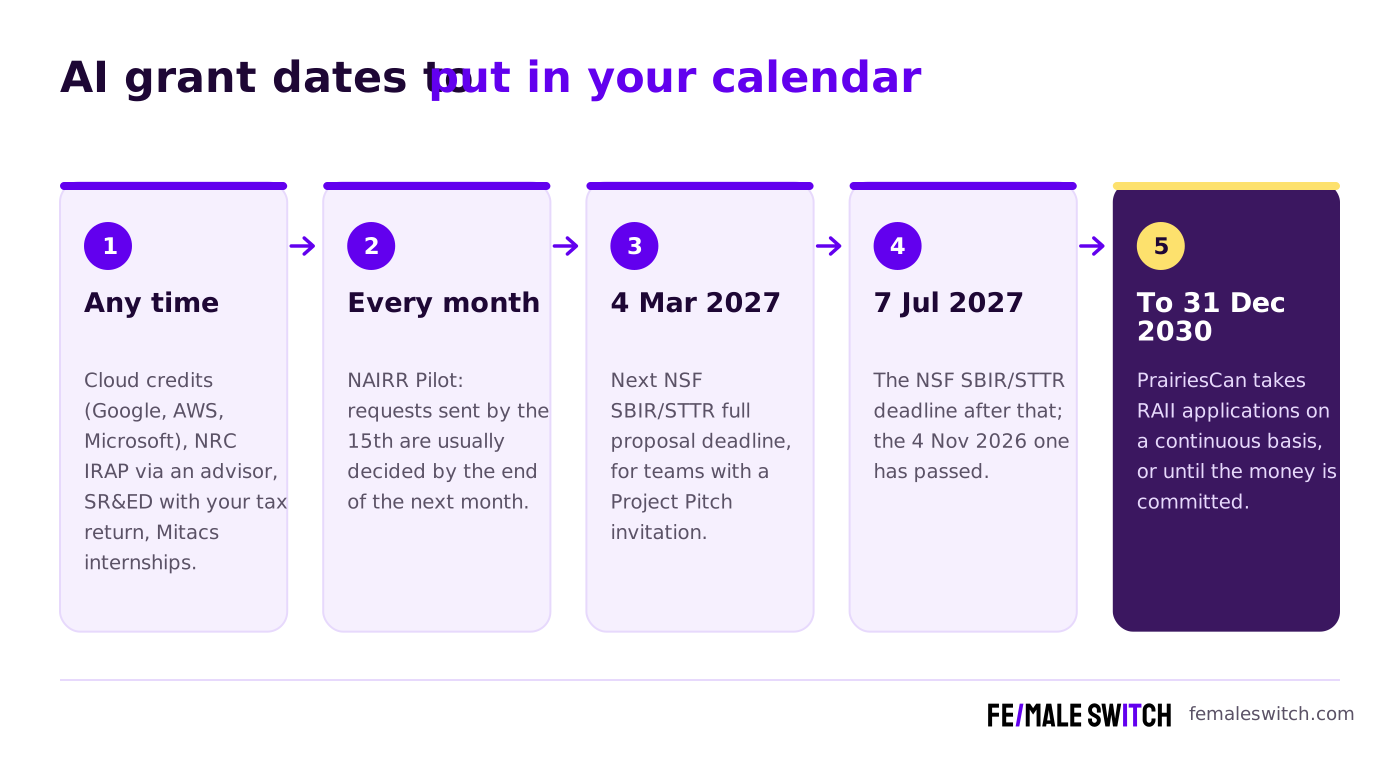
Grant Dates for Your Calendar
Most of the money above has no deadline. These are the fixed dates and the programmes you can use at any time.
Programmes Removed or Changed
The 2025 versions of this list (20 entries here, plus 25 and 10 in two similar posts that now point to this one) mixed grants with other things. What we removed and why:
- Closed or paused: Canada's AI Compute Access Fund (closed 31 July 2025). Scale AI, Canada's AI cluster, says its project funding is "on pause until further notice" and its startup Acceleration programme takes no new applications. DIGITAL (the former Digital Supercluster) funds collaborative projects as co-investment, not grants, and its AI calls are marked closed.
- Lenovo Evolve Small: a general small-business grant, not for AI startups. In May 2026 Lenovo said the programme is moving to a new global model; no new North American round was announced.
- Accelerators, not grants: Google for Startups Accelerator (AI First and Cloud), NVIDIA Inception, IBM for Startups, Plug and Play, Blackstone LaunchPad and Fintech71. See equity-free AI accelerators and accelerators for AI startups.
- Loans and investors: the SBA 7(a) loan programme, "Angel Investors Network", In-Q-Tel, the CIT GAP Funds (seed equity, renamed Virginia Venture Partners in 2021 according to VIPC) and the venture capital "trend" entries. For investors, see VCs for AI startups and angel investors for AI startups in North America.
- For universities and researchers, not startups: NEH grants for humanities AI centres, CIFAR, Johns Hopkins seed grants, Cooperative AI Foundation research grants and the EDA Tech Hubs (regional consortia).
- Not North American: the Hessian.AI startup competition (Germany) and the AI Festival competition in Milan, both covered by our European guide; the UN Tourism AI challenge was a global 2025 competition.
- Passed events and news items: the Army xTechLive pitch at CES 2025 (the Army's xTech competitions open in November 2026 are not AI-specific), Microsoft and Aligned Data Centers infrastructure investments, a private seed round and the federal AI budget.
- No current official programme found: Microsoft AI for Earth grants, Google.org's generative AI accelerator (for non-profits), "Industry Canada Innovation Program", Startup Israel's AI fund, Element AI Startup Grant, Anaplan Innovator Hub and Autodesk AI Impact Residency. The general "DOE grants" entry is replaced by DOE's SBIR/STTR AI topics above.
Which One Should You Apply For?
- US AI startup with a technical innovation: send an NSF Project Pitch now to aim for the 4 March 2027 deadline; if your work fits an energy, health or defence topic, also watch DOE, NIH or DoD (never for the same work twice).
- You just won an SBIR or STTR award: request free compute from the NAIRR Pilot.
- You need GPUs this month: apply for Google Cloud, AWS Activate or Microsoft for Startups credits; ask your accelerator or investor for an AWS Activate Provider ID to reach the $200,000 tier.
- Canadian AI startup: call NRC IRAP and ask about AI Assist, check your regional agency's RAII intake, claim SR&ED every year and hire ML interns through Mitacs.
- Canadian startup with big compute bills: subscribe to ISED updates for a second AI Compute Access Fund call; until then, use cloud credits.
- Raising equity anyway: grants take months; combine them with an AI accelerator or a pre-seed round.
How Founders Combine AI Grants With Other Funding
Grants pay for R&D and compute, not for sales, so most AI founders stack them with investors and programmes. When you are ready to raise, compare early-stage VCs in North America and deep tech VCs in North America. If you are still choosing where to build, read about the best cities for AI startups in North America, startup cities in North America and the best countries for AI startups. To save time on the application itself, many founders use AI agents for startup founders for research and first drafts, then rewrite the technical parts themselves.
For more non-dilutive money, see our lists of grants for early-stage startups, grants for female entrepreneurs in North America, EdTech grants in North America and deep tech grants in South America. Grant-grants.com, our sister site, explains non-dilutive funding, how to write a grant budget justification and what to do when you reapply after a rejection.
Join F/MS: Startup Facilitator & Incubator and unlock your startup dreams today! Get your first customers, register you company in the Netherlands and get startup visas for the team.
FAQ About AI Startup Grants in North America
Are there grants specifically for AI startups in the US?
Yes. The largest is NSF SBIR/STTR, which has an Artificial Intelligence topic for AI systems and AI hardware: up to $305,000 in Phase I and $1,250,000 in Phase II, with no equity. DOE, NIH and DoD also fund AI work through their own SBIR/STTR topics.
Are SBIR and STTR still running in 2027?
Yes. Their authority lapsed on 30 September 2025, but S. 3971 was signed on 13 April 2026 and authorizes SBIR through fiscal year 2031. Agencies restarted their calls after the reauthorization.
When is the next NSF SBIR deadline for AI startups?
The 4 November 2026 deadline has passed. The next full proposal deadlines are 4 March 2027 and 7 July 2027, and you need an invitation from a Project Pitch first.
Can a VC-backed AI startup get NSF SBIR?
Only if it meets the ownership rules. NSF says the company must be at least 50% owned by US citizens or permanent residents and must not be majority-owned by multiple venture capital, private equity or hedge fund firms.
How can an AI startup get free GPU compute in the US?
Through cloud credits (up to $350,000 from Google Cloud for AI startups, up to $200,000 from AWS Activate) or, if you hold a federal grant such as an SBIR award, through the NAIRR Pilot, which gives free compute and models for 12 months.
Is the Canadian AI Compute Access Fund open?
No. Its call closed on 31 July 2025 and ISED lists it as closed with no new call announced. In May 2026 Canada announced $66 million for 44 companies from the fund.
What is IRAP AI Assist?
According to NRC, AI Assist is part of the Industrial Research Assistance Program and helps Canadian SMEs develop and adapt generative AI and deep learning solutions. You reach it through an IRAP industrial technology advisor.
Are Google for Startups and NVIDIA Inception grants?
No. They are accelerators or partner programmes that give credits, discounts, mentoring and investor access. Google's separate Cloud Program gives credits, not cash.
Can a Canadian AI startup apply for SBIR?
Not as a Canadian company: SBIR and STTR are for US small businesses. Canadian founders usually combine NRC IRAP, RAII, SR&ED and Mitacs, or set up a qualifying US company.
Where can I get a backlink by writing about my AI startup?
You can publish a guest post in one of the Fe/male Switch startup blogs, which rank in Google and in AI tools. Get a quality backlink.
About the Author
Violetta Bonenkamp, also known as MeanCEO, is an experienced startup founder with an impressive educational background including an MBA and four other higher education degrees. She has over 20 years of work experience across multiple countries, including 5 years as a solopreneur and serial entrepreneur. Throughout her startup experience she has applied for multiple startup grants at the EU level, in the Netherlands and Malta, and her startups received quite a few of those. She’s been living, studying and working in many countries around the globe and her extensive multicultural experience has influenced her immensely.
