
Startup Incubators in South America: 15 Incubators for Early-Stage Founders, Country by Country
An incubator is not an accelerator. Accelerators pick a cohort, invest and push for growth in a few months; incubators give early founders a home for a year or more: space, labs, mentors, help with grants and a university or city network behind them. In South America most real incubators sit inside universities, science parks and city agencies, and many earlier "top incubator" lists mixed them up with venture funds and corporate programmes. This guide lists 15 incubators in Brazil, Chile, Argentina, Colombia, Peru, Uruguay and Ecuador that run now. We checked each on its own website on 16 November 2026 and give costs, money and intake only where the page states them. Public programmes, accelerators and names from older lists that changed are in separate sections.
Quick answer: in Brazil, the Cietec incubator at USP/IPEN in São Paulo takes applications from researchers and startups across the country until 20 January 2027, and ParqTec in São Carlos selects all year. In Uruguay, Ingenio at the LATU Technology Park offers 12 months of incubation; in Ecuador, i3lab ESPOL runs a 15-week IdeaCamp for US$250 per team. University founders should start with their own university's incubator (Gênesis at PUC-Rio, Incamp at Unicamp, PREINC-UBA in Buenos Aires, Startup UNI in Lima), and women founders in Peru can apply to Femlab by UTEC Ventures. If you want cash and a demo day instead, compare our startup accelerators in South America.
Write FREE SEO-optimized Blog Articles! Our Article Writer ensures your blog is loved by both Google and your readers, turning those clicks into customers.
👉 Write your article here
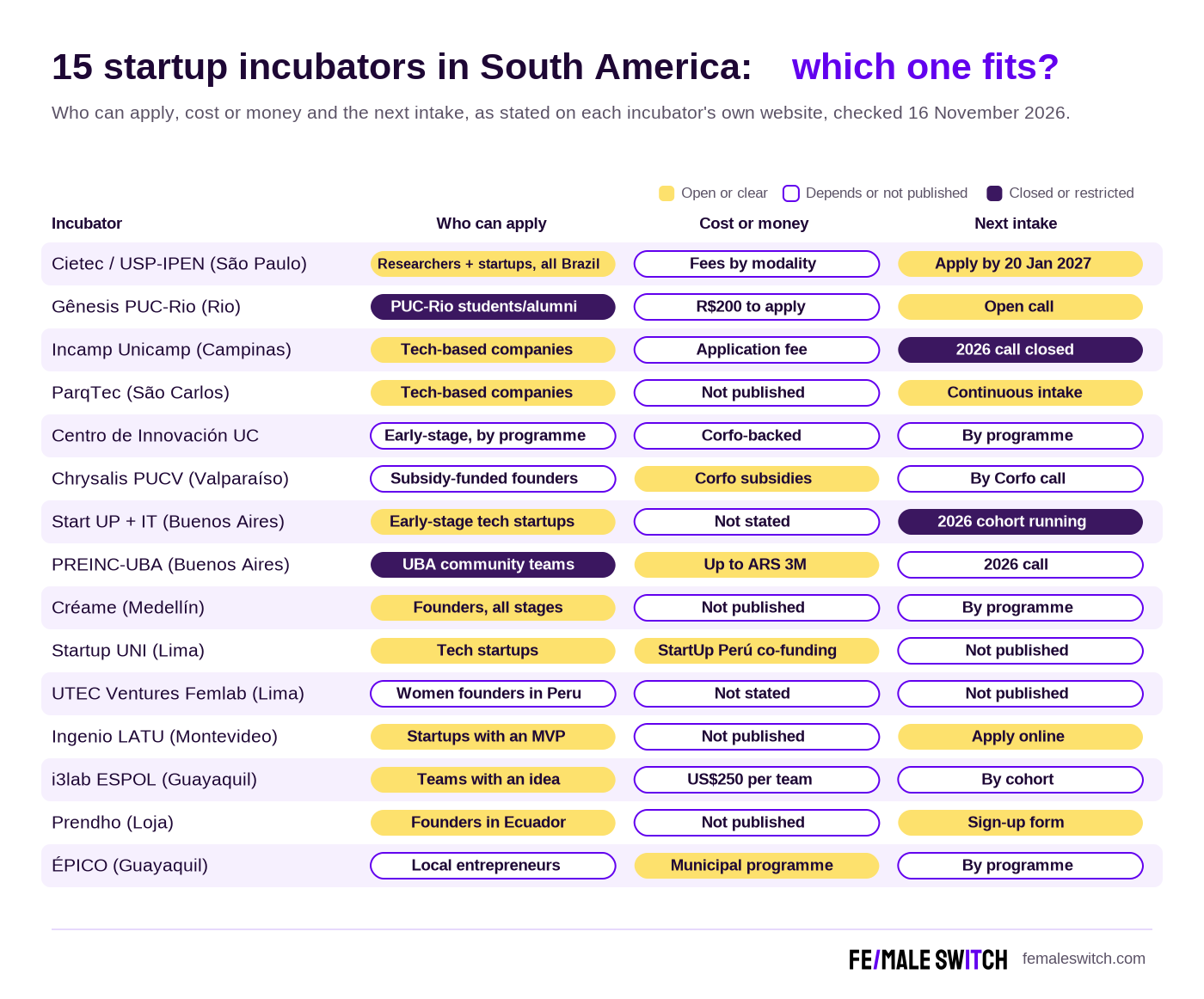
South America's Startup Incubators Compared
Sources: each incubator's own website, checked 16 November 2026. "Not published" means the page gives no figure.
The 15 Startup Incubators in South America for 2027
Grouped by country. For each one: who runs it, who can apply, what you get and what the page says about the next intake.
Brazil
1. Cietec: Incubadora USP/IPEN (São Paulo)
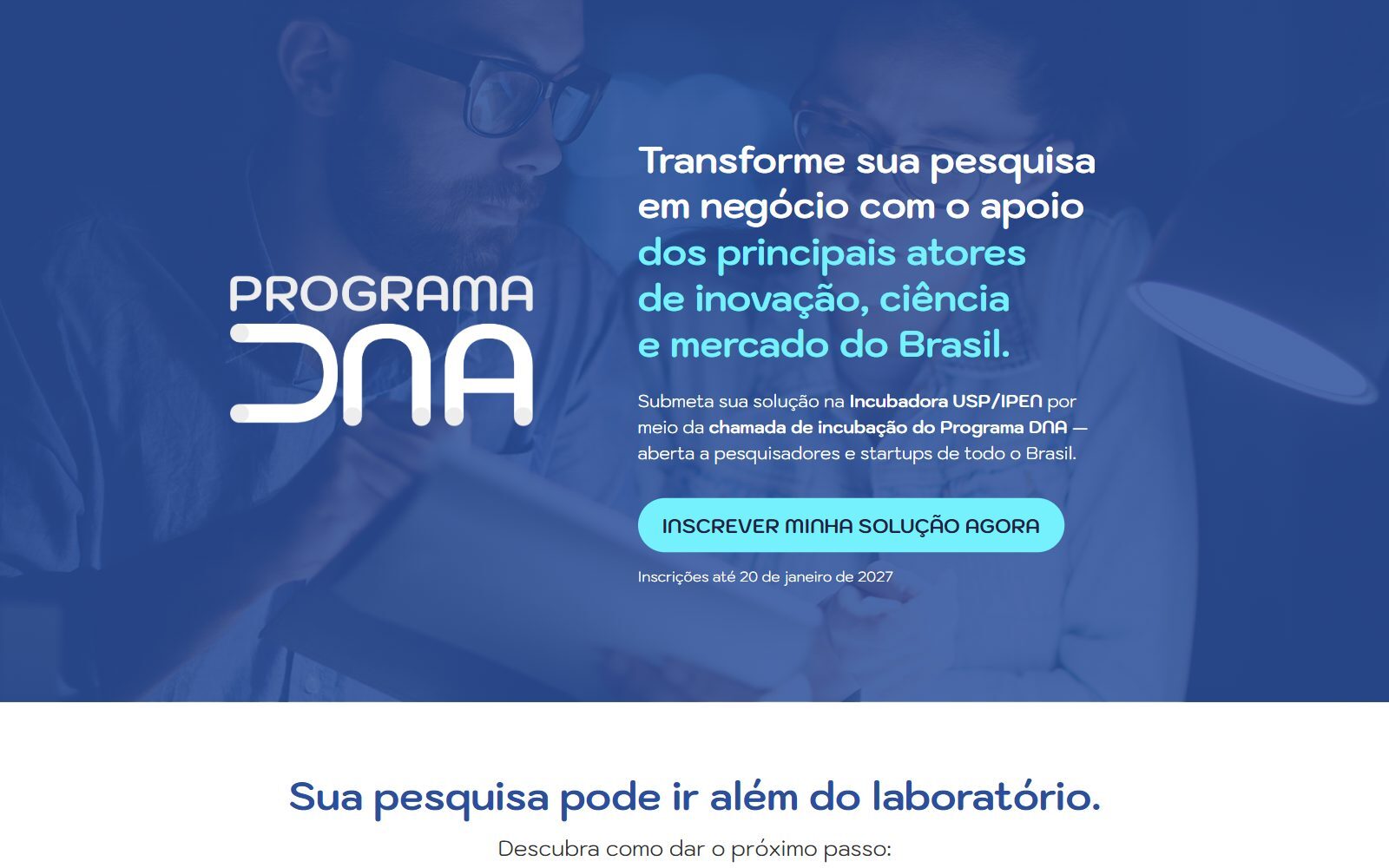
Cietec runs the São Paulo technology incubator on the IPEN campus at the University of São Paulo, on about 25,000 m² of land. It says more than 1,000 startups have passed through its portfolio, and it holds Cerne 4, the top certification of Anprotec, Brazil's association of innovation environments. Its Programa DNA incubation call is open to researchers and startups from all over Brazil until 20 January 2027. The journey has three cycles (discovery, business and acceleration) with a training track, mentors and consultants, links to USP, IPEN and FIESP, and shared spaces or labs depending on the modality you sign up for. It suits science-based teams that need lab access.
2. Instituto Gênesis, PUC-Rio (Rio de Janeiro)
Instituto Gênesis is the incubator of the Pontifical Catholic University of Rio de Janeiro, active for more than 25 years and also Cerne 4 certified. Its call is only for startups that have PUC-Rio students or alumni among their partners. You apply online, pay a R$200 application fee and every partner fills in an entrepreneur profile; startups then join as virtual or resident companies, according to how it works.

3. Incamp, Unicamp (Campinas)
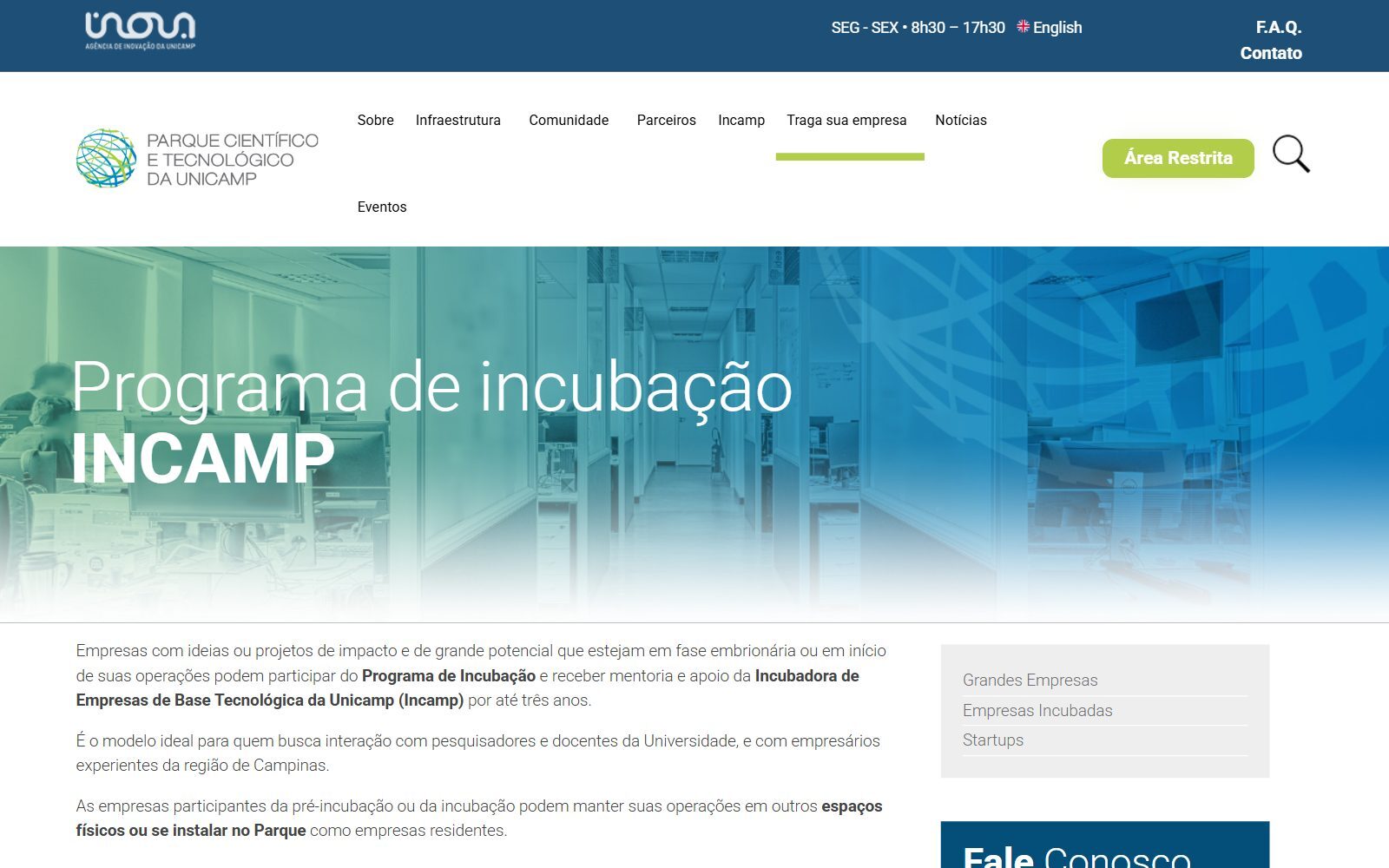
The Incamp incubation programme is the technology-based incubator of the University of Campinas, inside the Unicamp Science and Technology Park. Companies with an idea or in early operation get mentoring and support for up to three years, after an optional pre-incubation stage, and can stay virtual or rent a shared room, an own room or a lab room in the park. Proposals follow a yearly selection call with an application fee. The 2026 call is closed and its panel results were published in October 2026, so watch the page for the next call.
4. ParqTec (São Carlos)
ParqTec in São Carlos says its CINET incubator started on 2 January 1985 with Opto Eletrônica, which it calls the first incubated company in Latin America; a second incubator runs in Leme. Its selection is continuous: you send a business plan, then an interview checks your commitment and plans. There are three stages, pre-incubation with coworking, incubation and post-incubation support with funding applications and investors. It suits technology teams that want an incubator they can join at any time of year.
Boost Your SEO by listing your startup and get a FREE backlink.
Create a profile in the F/MS Startup Game, add the link to your website and submit.
👉 List your startup now!
Chile
5. Centro de Innovación UC (Santiago)
The Centro de Innovación UC of the Pontificia Universidad Católica de Chile runs pre-incubation and incubation for dynamic early-stage ventures. Its current incubation programmes include Volcanes, run with Ketrawalab and supported by Corfo for founders with early-stage projects, and Energía de Mujer, an 8-month programme for women entrepreneurs in the Renca district. Its science-based acceleration tracks are covered in our accelerator guide; for the city's companies, see Santiago startups to watch.
6. Chrysalis, PUCV (Valparaíso)
Chrysalis is the business incubator of the Pontificia Universidad Católica de Valparaíso, based in its innovation directorate. It gives technical and financial support to entrepreneurs who have won public subsidies, mainly from Corfo, with training, strategy work and follow-up tailored to each venture, and it runs programmes for companies and institutions too. Its intake follows the subsidy calls; its homepage news lists the latest Corfo call.
Argentina
7. Start UP + IT, Universidad de Palermo and Polo IT (Buenos Aires)
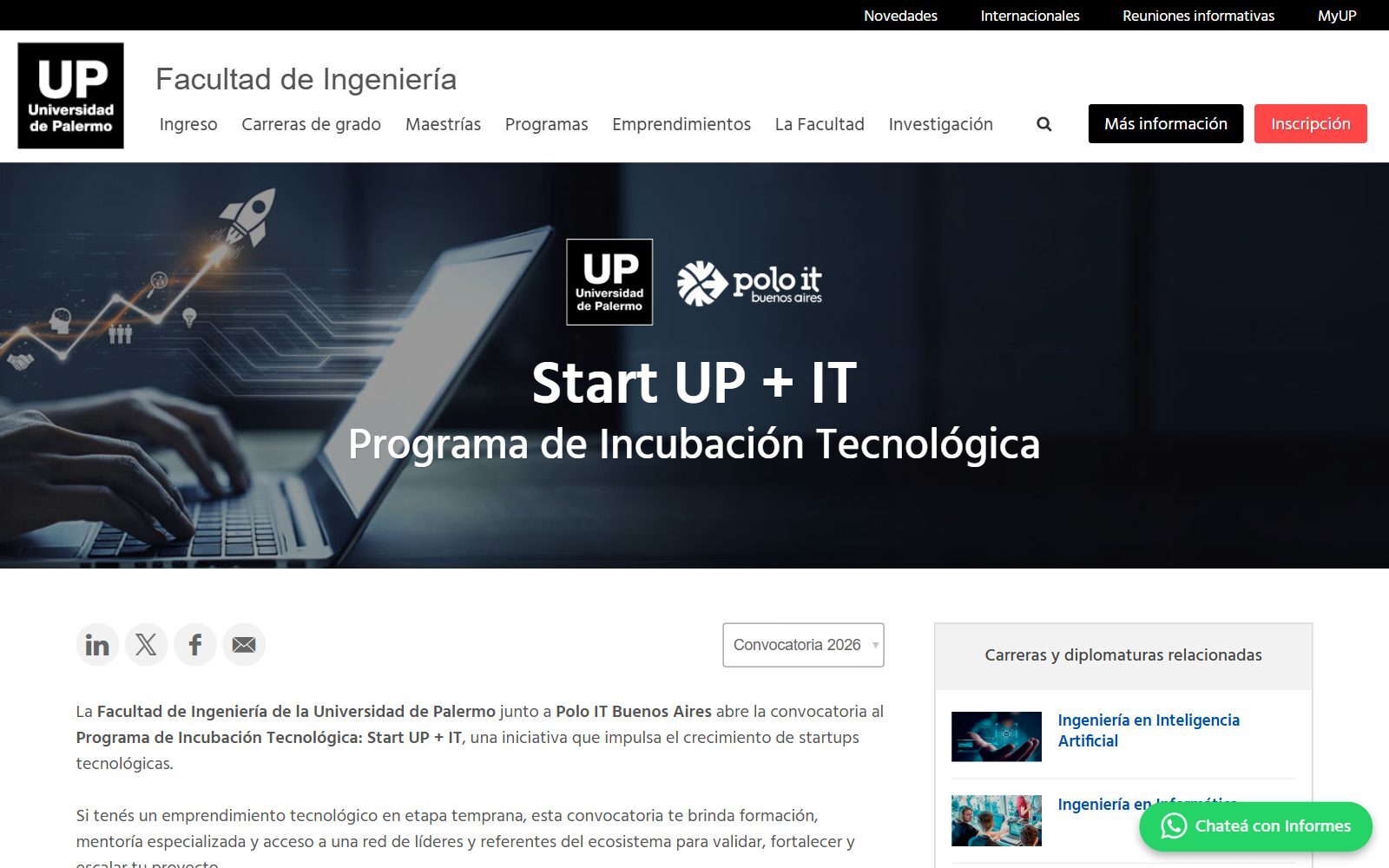
Start UP + IT is a technology incubation programme of the Universidad de Palermo's engineering faculty and Polo IT Buenos Aires, the city's IT cluster. Up to 40 early-stage tech startups are selected for each cohort. The 2026 call closed on 31 July 2026; modules and a demo day ran from August to October, and mentoring and follow-up run in November and December 2026. Participants also get a discounted Polo IT entrepreneur membership. The 2027 call is not announced yet. See also Buenos Aires startups to watch.
8. PREINC-UBA, University of Buenos Aires
The University of Buenos Aires runs PREINC-UBA, a pre-incubation call for technology-based projects from its own community. According to the 2026 rules, teams need at least three members of the UBA community (projects across two or more faculties score higher), and each project can receive up to ARS 3,000,000 over 12 months of pre-incubation, ending with a presentation day for companies and investors. It is only for UBA students, graduates and staff; other founders in Buenos Aires should look at Start UP + IT above.
Boost Your SEO with 1,500+ Free Business Directories: increase your DA, get backlinks and traffic.
We've compiled an exclusive list of directories and websites where you can submit your business and start building high-quality backlinks to boost your website traffic and get your SEO snowball rolling.
👉 Submit your startup now!
Colombia
9. Créame (Medellín)
Créame has supported entrepreneurs in Medellín for 30 years. It pre-incubates, incubates and accelerates companies, and says that together with the Distrito de Medellín it has supported more than 700 companies at every stage, from idea to consolidation; it also runs regional programmes, for example with Ecopetrol. Calls appear on its opportunities page. For Medellín's companies and support, see our Medellín startups to watch guide.
Peru
10. Startup UNI (Lima)
Startup UNI is the business incubator of the Universidad Nacional de Ingeniería in Lima. In May 2026, ProInnóvate reported that startups incubated by Startup UNI had developed AI, sustainability, automation and mobility products with co-funding from the national StartUp Perú contest (generations 11G and 12G) and technical support from the incubator. That is the typical Peruvian route: an incubator helps you apply to StartUp Perú and then supports the funded project. See also Lima startups to watch.
11. Femlab by UTEC Ventures (Lima, women founders)
Femlab is the incubation programme of UTEC Ventures for women founders. Over 9 weeks, participants work on pitch training, leadership, product development and startup finance. You must be a woman on the founding team of an early-stage startup, Peruvian or resident in Peru, and able to give 10 hours a week. The page gives no date for the next intake.
Boost Your SEO by Getting Featured in Our Blogs and get a backlink.
We publish content about startups, education, tech, funding, etc. that ranks well not only in Google but also in Perplexity, ChatGPT, Grok and other AI tools.
👉 Get featured now!
Uruguay
12. Ingenio, LATU Technology Park (Montevideo)
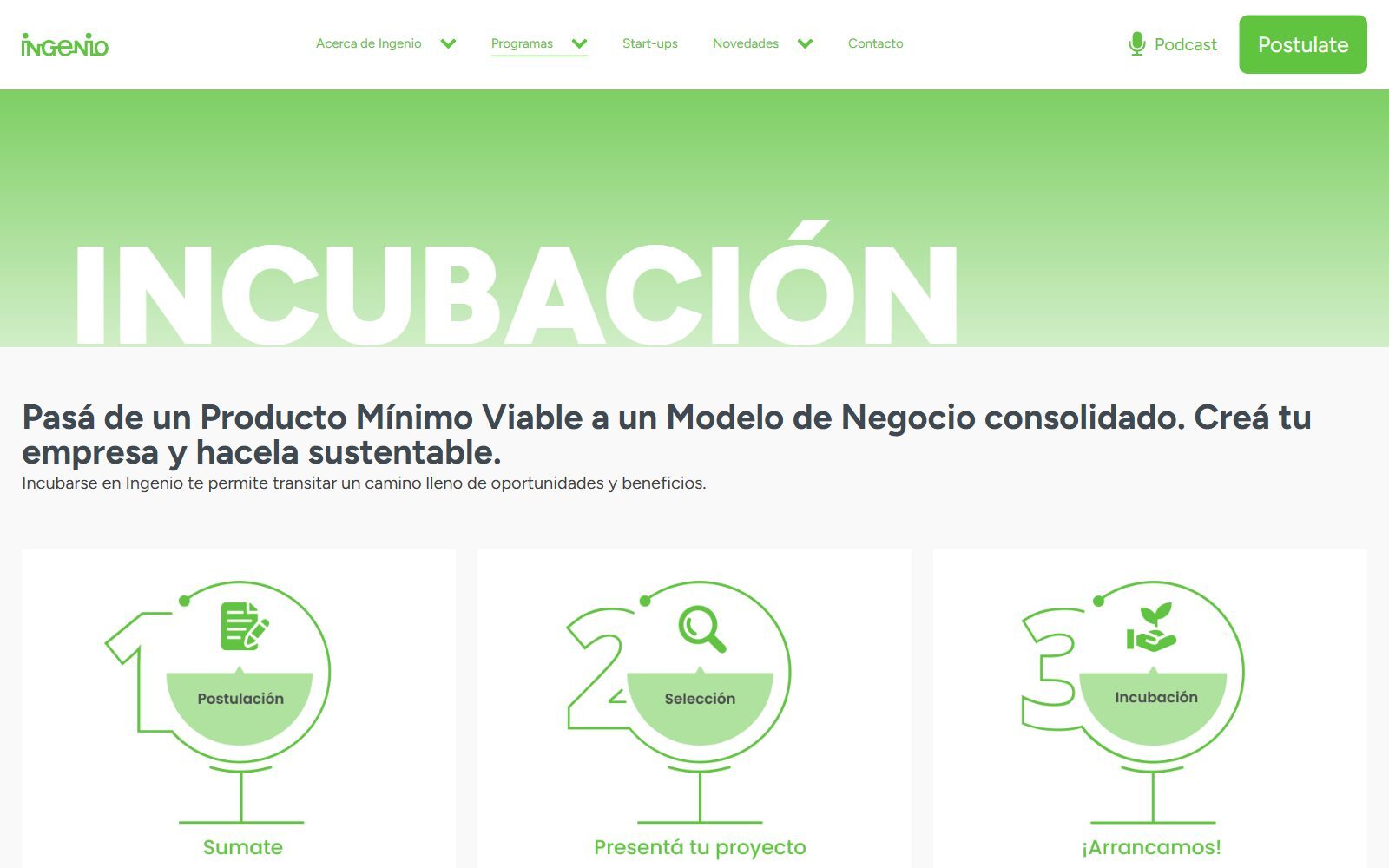
Ingenio is the business incubator at the LATU Technology Park in Montevideo. Once its selection committee approves a project and the contract is signed, 12 months of incubation start: a diagnosis and incubation plan, consultants and mentors, offices, coworking and an electronics lab for prototypes, and help preparing for investors and funding agencies. It is aimed at teams moving from a minimum viable product to a consolidated business, and it also runs acceleration and soft-landing programmes for startups growing into Latin America from Uruguay. You apply through the form on its site.
Ecuador
13. i3lab ESPOL (Guayaquil)
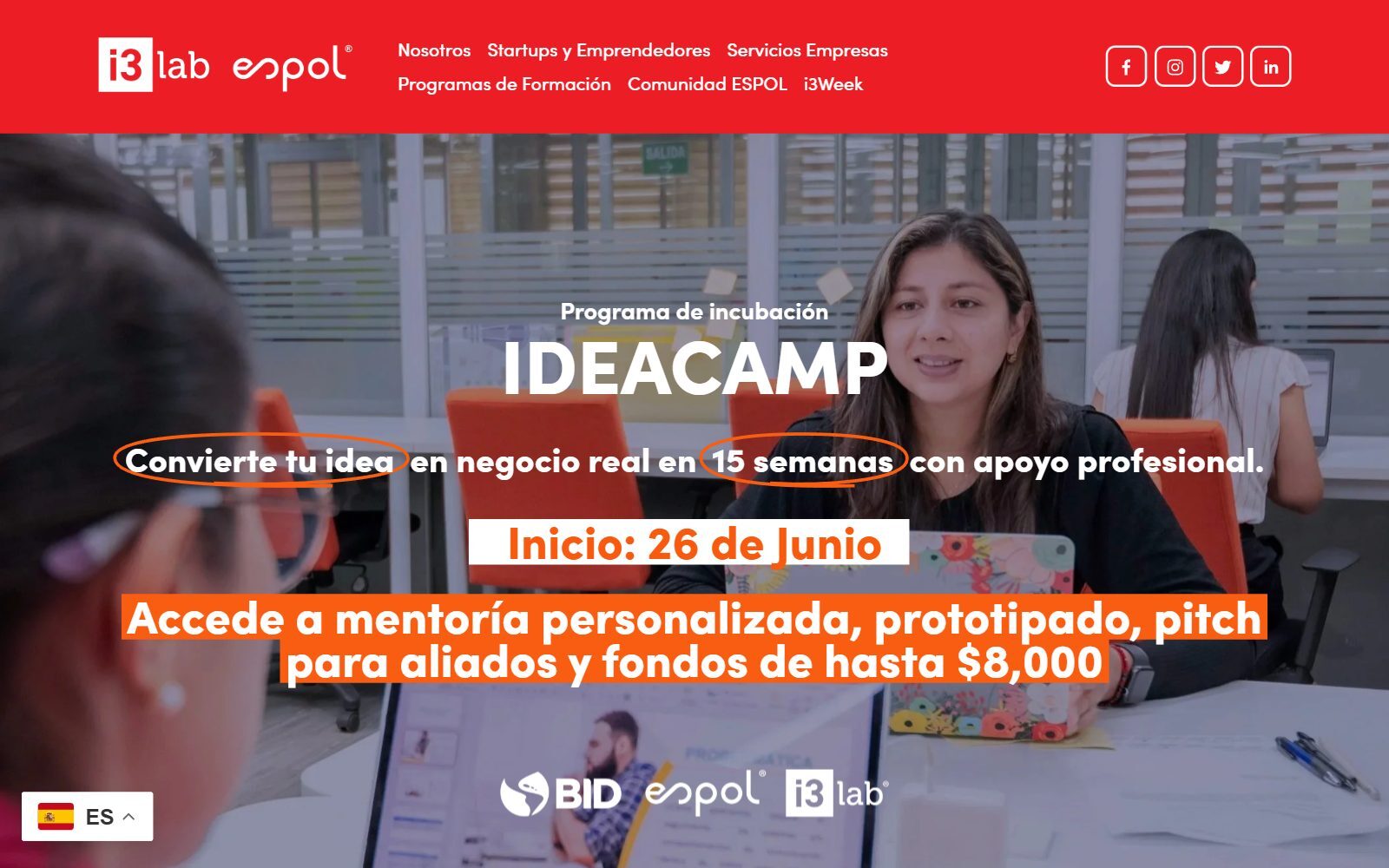
The i3lab is the entrepreneurship and innovation centre of ESPOL, the Escuela Superior Politécnica del Litoral. Its IdeaCamp incubation programme turns an idea into a business in 15 weeks, with mentoring, prototyping and coaching on value propositions; places are limited and teams are selected. The in-person programme costs US$250 per team, and the page advertises access to funds of up to $8,000. For startups that already sell, i3lab's BoostCamp acceleration programme started its 2026 cohort on 14 August 2026, ending with a demo day for investors.
14. Prendho (Loja)
Prendho is an incubator in Loja accredited by Ecuador's Undersecretariat for Research, Innovation and Technology Transfer. Its Incubiti programme takes founders from idea to business, and it also runs an incubator for creative and cultural industries, an accelerator, product prototyping and an agro-industrial plant that rents machinery at preferential rates. It has transferred its Incubiti model to other Ecuadorian universities (UTC, PUCESI, ESPOCH and UNESUM). Sign-up for its programmes is through a form on the homepage.
15. ÉPICO (Guayaquil)
ÉPICO is Guayaquil's municipal agency for economic development and innovation. It runs a business incubation centre with programmes that help entrepreneurs turn ideas into companies, plus sales training and digital-talent programmes; 250 entrepreneurs completed its Ruta ÉPICA programme in 2026. It is a good first stop for local, non-tech small businesses as well as startups.
Public Programmes and Accelerators That Are Not Incubators
These names often appear in incubator lists. They are useful, but they are a national programme, a funder or an accelerator, not an incubator:
- Start-Up Chile (government accelerator): the Chilean public accelerator is equity-free; applications for its BIG 13 generation were set to close on 24 November 2026 at 13:00 (GMT-3), according to Start-Up Chile.
- InovAtiva Brasil (public programme): Brazil's free national acceleration programme. It and Cubo Itaú, Antler, WOW and Google for Startups are covered in our accelerators in South America guide.
- StartUp Perú (funding contest): ProInnóvate's StartUp Perú contests co-finance startups, incubators and accelerators; Peruvian incubators such as Startup UNI help teams apply.
- ANII (Uruguay, funding agency): the national research and innovation agency funds innovative ventures and co-invests with investors; ANII lists its current calls on its homepage.
- Corfo (Chile, funding agency): it backs incubation work such as Chrysalis's subsidy programmes and the Volcanes programme at Centro de Innovación UC.
- iNNpulsa Colombia: its ALDEA+ 25 call closed on 17 February 2026, and the call names the agency "INNPULSA COLOMBIA EN LIQUIDACIÓN" (in liquidation), so check before you plan on it.
For money without giving up equity, see our grants for early-stage startups in South America and deep tech grants in South America.
Incubators From the 2025 Lists That Closed, Changed or Are Not Incubators
Our older top-10, top-15, top-20 and top-25 lists took most names and figures from third-party lists. We checked each name again:
- Accelerators, funds and corporate programmes: 500 Global, Start-Up Chile, Google for Startups, Founder Institute, Antler, Rockstart, Cubo Itaú, Wayra (now Telefónica's corporate venture capital arm), NXTP Labs (now a venture fund) and Techstars are not incubators. The ones still running in the region are in our accelerator guide.
- Gone or not confirmed: ACE Startups, Startup Farm, BootUp360, The Yield Lab Latin America and BoostLAB could not be confirmed as running programmes on an official page in our checks, so they were removed.
- Not in South America: MassChallenge and Startup Mexico (Mexico is in North America) and Harvard Innovation Labs (Boston).
- Not incubators: Seedstars now presents itself as an emerging-markets seed fund with Seedspace coworking (including Lima), Liga Ventures and The Bakery are innovation consultancies, Karma Ventures is a venture fund, and the C40 Cities Finance Facility helps cities finance climate projects.
- Ruta N and HubBOG: Ruta N is Medellín's innovation agency (its Gen N 2026 is an innovation contest, not incubation); HubBOG in Bogotá offers acceleration and coworking. Plug and Play and Box180 were not verified.
- Could not be checked: the websites of Raiar (PUCRS, Porto Alegre), Emprende UP (Universidad del Pacífico) and StartUPC (UPC) blocked or did not answer our checks, so we left them out rather than guess.
We also removed every figure that came only from third-party lists, such as "$60,000 for 16 weeks", acceptance rates and "startups accelerated" counts.
Which Incubator in South America Should You Choose?
- You are a researcher with a lab-based idea in Brazil: Cietec at USP/IPEN (apply by 20 January 2027) or Incamp at Unicamp.
- You studied at a university with its own incubator: start there (Gênesis for PUC-Rio, PREINC-UBA for UBA, Startup UNI for UNI, i3lab for ESPOL): it is usually cheaper and easier to enter.
- You need an incubator any time of year: ParqTec in São Carlos selects continuously; Ingenio and Prendho take applications online.
- You need public money first: in Chile look at Chrysalis or Centro de Innovación UC with Corfo calls, in Peru at Startup UNI and StartUp Perú, and in Uruguay at ANII's calls alongside Ingenio's incubation.
- You are a woman founder: Femlab in Lima, Energía de Mujer in Santiago, and our incubators for female entrepreneurs in Europe if you plan to expand.
- You already have traction and want investment: skip the incubator and look at our startup accelerators in South America or AI accelerators in South America.
Join F/MS: Startup Facilitator & Incubator and unlock your startup dreams today! Get your first customers, register you company in the Netherlands and get startup visas for the team.
How Founders Use an Incubator in South America
Founders get the most from an incubator when they treat it as a base for applications: many incubators help you prepare grant and contest applications, and public funds often work through them (Corfo subsidies at Chrysalis, StartUp Perú co-funding with Startup UNI). Once you have a product and early customers, move on to investors: our angel investors in South America, EdTech VCs in South America and EdTech angel investors in South America guides list who is active. To pick a city, compare AI startup cities in South America and EdTech countries in South America. If you are expanding abroad, see the same guide for startup incubators in Europe and startup incubators in Asia, the deep tech incubators list and our worldwide accelerators for early-stage startups.
FAQ About Startup Incubators in South America
What is the difference between an incubator and an accelerator?
An incubator supports very early founders for a longer time (often 12 months or more) with space, labs, mentors and help with grants, and usually takes no equity. An accelerator runs a short, intensive cohort, often invests for equity and ends with a demo day.
Which incubator in Brazil is open now?
Cietec's Programa DNA call for the USP/IPEN incubator in São Paulo takes applications from researchers and startups across Brazil until 20 January 2027, and ParqTec in São Carlos selects all year round. Unicamp's Incamp call for 2026 is closed.
Do incubators in South America take equity?
None of the 15 incubators in this list says on its page that it takes equity. Some charge fees instead: Gênesis at PUC-Rio charges R$200 to apply, Incamp charges an application fee and i3lab ESPOL's IdeaCamp costs US$250 per team.
Can foreigners join an incubator in South America?
Some programmes are national: Cietec's call is for Brazil, Femlab is for Peruvians and residents of Peru, and PREINC-UBA is only for the UBA community. Ingenio in Uruguay runs soft-landing programmes for companies coming to Latin America, and Start-Up Chile accepts founders from any country.
Is Start-Up Chile an incubator?
No. Start-Up Chile is Chile's equity-free government accelerator. Its BIG 13 applications were set to close on 24 November 2026. It is covered in our accelerator guide.
Which incubators are good for women founders?
Femlab by UTEC Ventures in Lima is a 9-week incubation programme for women founders, and Centro de Innovación UC runs Energía de Mujer, an 8-month programme for women entrepreneurs in Renca, Santiago.
Are there incubators in Argentina?
Yes. Start UP + IT of the Universidad de Palermo and Polo IT Buenos Aires selected up to 40 tech startups in 2026, and the University of Buenos Aires funds pre-incubation projects of up to ARS 3,000,000 for its own community through PREINC-UBA.
Is iNNpulsa Colombia still running programmes?
Its ALDEA+ 25 call closed on 17 February 2026, and the call itself names the agency as in liquidation. In Medellín, Créame still pre-incubates, incubates and accelerates companies.
How do I get public funding through an incubator?
In Chile, Chrysalis supports entrepreneurs who won Corfo and other subsidies; in Peru, incubators like Startup UNI support teams co-funded by StartUp Perú; in Uruguay, ANII runs its own calls for innovative ventures, and Ingenio helps incubated teams prepare for funding agencies.
What happened to ACE Startups and Startup Farm?
We could not confirm a running programme for either on an official page, so both were removed. Other names from older lists, like Wayra and NXTP, are now venture investors rather than incubators.
About the Author
Violetta Bonenkamp, also known as MeanCEO, is an experienced startup founder with an impressive educational background including an MBA and four other higher education degrees. She has over 20 years of work experience across multiple countries, including 5 years as a solopreneur and serial entrepreneur. Throughout her startup experience she has applied for multiple startup grants at the EU level, in the Netherlands and Malta, and her startups received quite a few of those. She’s been living, studying and working in many countries around the globe and her extensive multicultural experience has influenced her immensely.
