

Deep Tech Grants in Asia in 2027: Non-Dilutive Funding From Singapore, Japan, Korea, Taiwan, Hong Kong, India, Malaysia and Vietnam
Deep tech startups in Asia, working on semiconductors, robotics, biotech, quantum, advanced materials or climate technology, need years of R&D before they sell anything. Asian governments fund that stage with grants that are often larger than in Europe, but each one has its own strings: matched investment, local shareholding, a university link or a share right for the state. This guide lists the main non-dilutive programmes for deep tech startups in Asia in 2027, each with the amount in local currency, who can apply, the status and the next date from its official page, checked in November 2026. For programmes in other regions, see our worldwide guide to grants for deep tech startups and the regional guides to deep tech grants in North America and deep tech grants in South America. The 2025 version of this article listed 15 items, many of them EU programmes, events, investors or names we could not find; what happened to them is at the end.
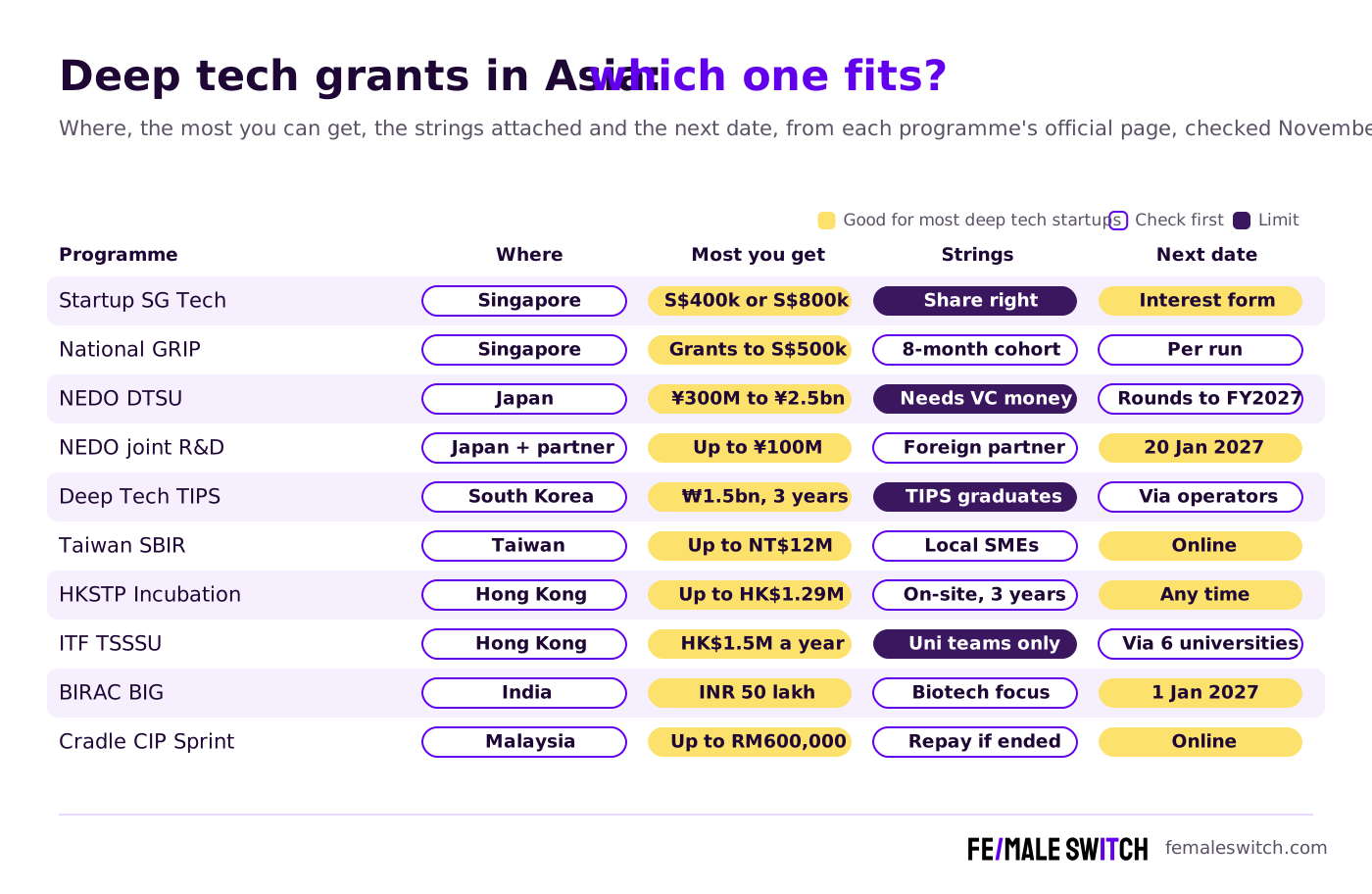
Quick answer: the largest deep tech grants in Asia are Japan's NEDO Deep-Tech Startups Support Program (DTSU), up to ¥2.5 billion per project once venture capital has invested, and Korea's Deep Tech TIPS, KRW 1.5 billion over three years for TIPS graduates. Singapore's Startup SG Tech pays up to S$400,000 for a proof of concept and S$800,000 for a proof of value, with a share subscription right for the state. Hong Kong's HKSTP Incubation Programme gives up to HK$1.29 million, India's BIRAC BIG INR 50 lakh to biotech startups (next call expected on 1 January 2027), and Malaysia's Cradle CIP Sprint up to RM600,000.
Write FREE SEO-optimized Blog Articles! Our Article Writer ensures your blog is loved by both Google and your readers, turning those clicks into customers.
👉 Write your article here
Grants, Matched Grants and Equity: What You Are Applying For
- Plain grants pay for a project and take no equity: BIRAC BIG, NIDHI-PRAYAS, Taiwan SBIR, Hong Kong's TSSSU.
- Investment-linked grants pay only after private investors have put money in: Japan's DTSU needs venture capital equal to at least a third of the costs, and Korea's TIPS starts when an accredited operator invests.
- Grants with strings: Startup SG Tech gives Enterprise Singapore a right to subscribe for shares, and Cradle's CIP grants are conditional and must be paid back if the agreement is terminated.
- Incubation with funding: HKSTP and Singapore's National GRIP combine money with a programme you must follow, usually on site.
- Equity, not grants: Singapore's Startup SG Equity, SGInnovate and most university funds invest for shares; compare deep tech VCs and early-stage VCs in Asia.
Deep Tech Grants in Asia Compared
Sources: each programme's official page, checked on 10 November 2026. Amounts and rules change between rounds, so check the official page again before you apply.
Singapore
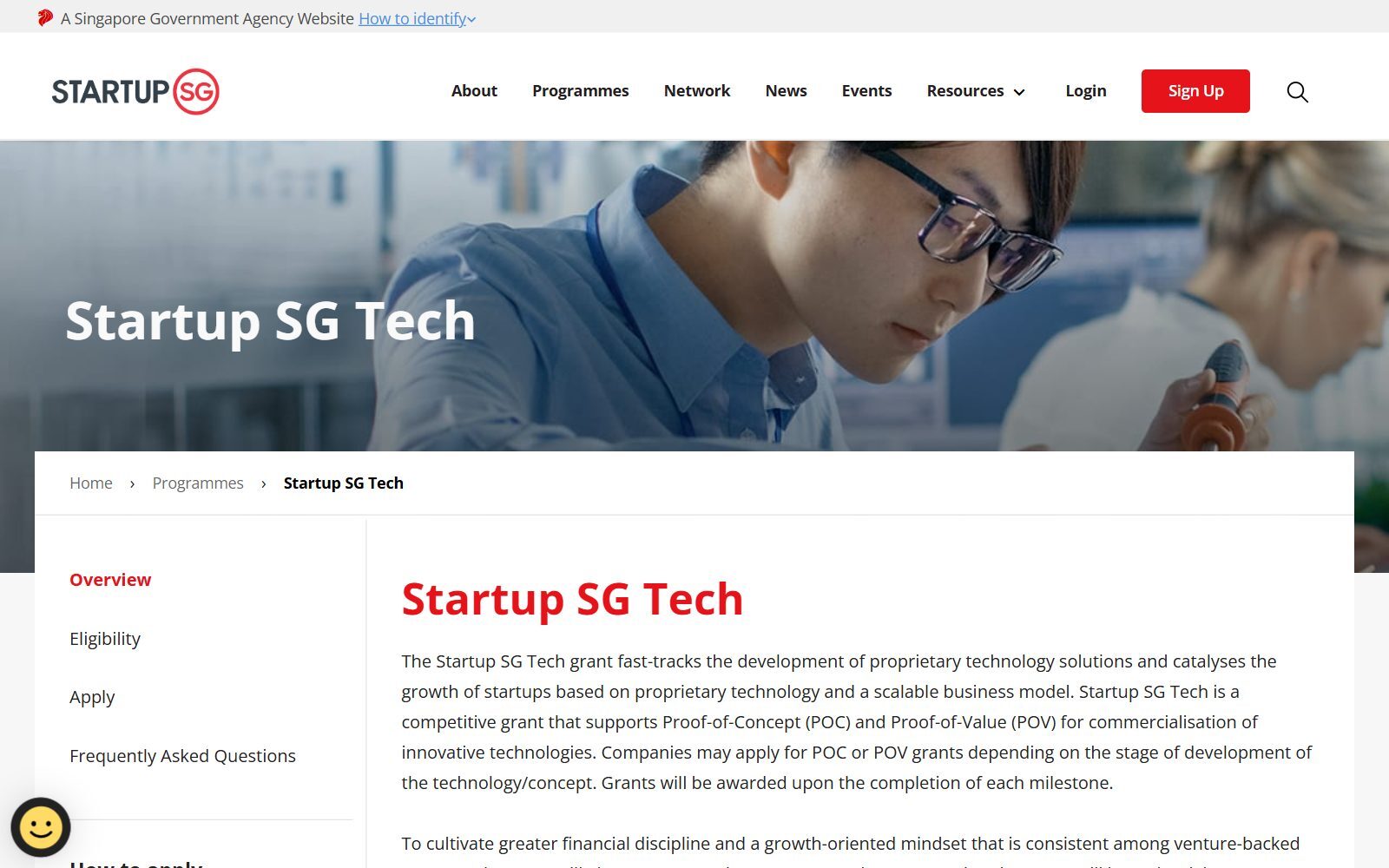
1. Startup SG Tech: up to S$800,000, with a share right
Enterprise Singapore's Startup SG Tech is Singapore's main grant for deep tech commercialisation. It funds a proof of concept (POC) of up to S$400,000 or a proof of value (POV) of up to S$800,000; these caps apply to formal applications made since 2 January 2025, and the money is paid as you reach milestones. The technology must be proprietary and a real breakthrough: integrating off-the-shelf parts does not count. The company must be a private limited company registered in Singapore within the last 10 years, with at least 30% local shareholding, group turnover of no more than S$100 million or no more than 200 workers, and its core R&D in Singapore. Researchers from public research institutes can apply for the POC stage. The string: Enterprise Singapore has the right to exercise a share subscription. You start with a Registration of Interest form.
2. National GRIP (NUS and NTU): a free venture-building programme with grants
The National Graduate Research Innovation Programme (National GRIP), run by NUS and NTU with the National Research Foundation, turns university research into deep tech startups. NTU's page says programme fees of S$90,000 per team are fully subsidised and that teams can reach early-stage funding during the programme: a Proof-of-Concept grant of up to S$250,000 and a Proof-of-Value grant of up to S$500,000 (eligibility criteria apply), plus 8 months of incubation. Individuals can join an existing team or form one around university technology. It runs in cohorts: Run 3 of Phase 1 began on 16 January 2026, so watch the page for the next run. For other programmes in the region, see startup incubators in Asia.
Boost Your SEO by listing your startup and get a FREE backlink.
Create a profile in the F/MS Startup Game, add the link to your website and submit.
👉 List your startup now!
Japan
3. NEDO Deep-Tech Startups Support Program (DTSU): up to ¥2.5 billion
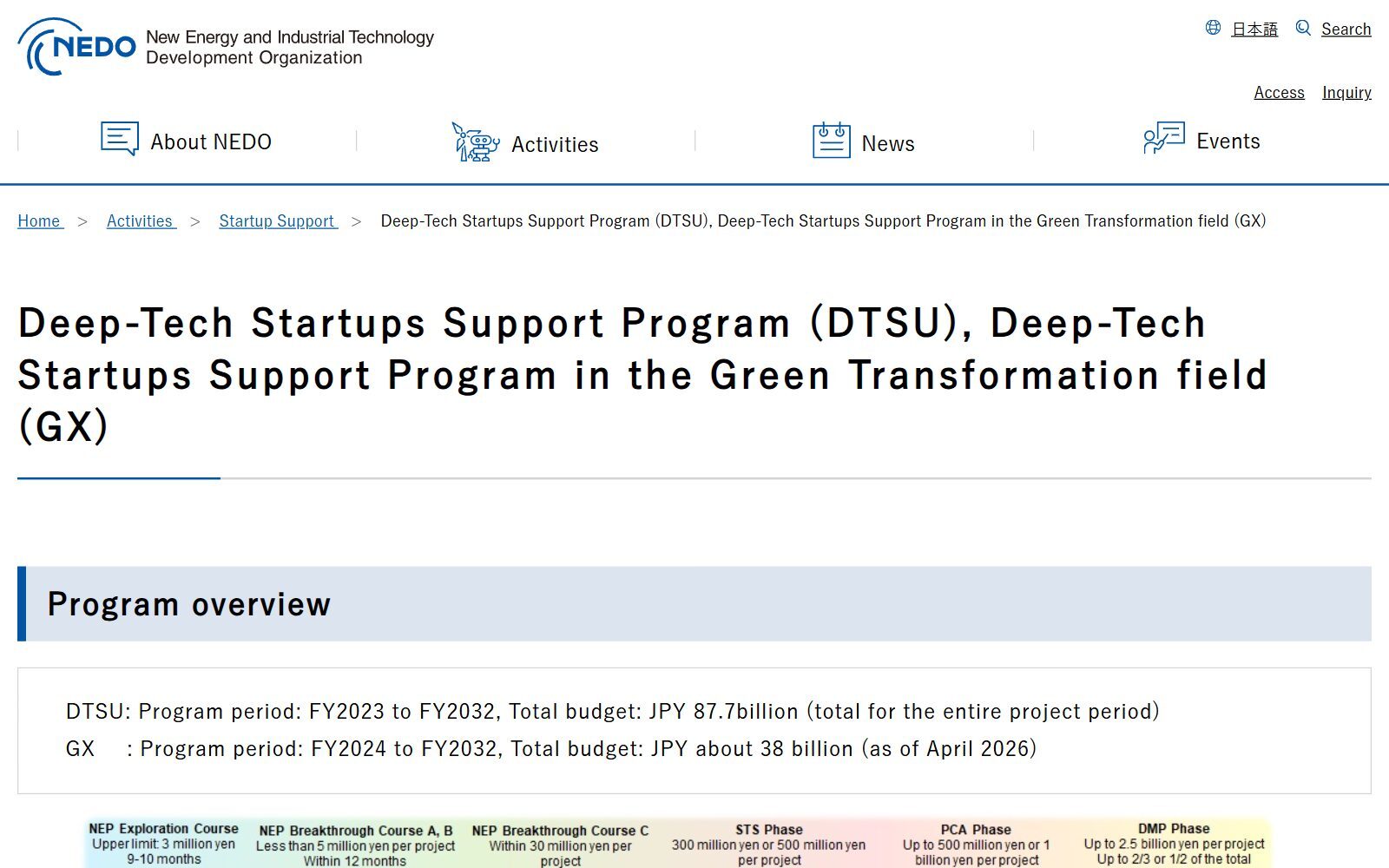
Japan's New Energy and Industrial Technology Development Organization runs the Deep-Tech Startups Support Program (DTSU), with ¥87.7 billion from fiscal 2023 to fiscal 2032, plus a green transformation (GX) track. It pays in three phases: up to ¥300 million or ¥500 million in the STS phase (research and prototypes), ¥500 million or ¥1 billion in the PCA phase (product and first markets) and ¥2.5 billion in the DMP phase (mass-production demonstration), covering up to two-thirds of eligible costs. The big condition: venture capital, corporate VC or operating companies must invest at least one-third of the eligible costs. NEDO says calls run until fiscal 2027; the companies chosen in the ninth DTSU round were announced on 1 June 2026. NEDO also runs smaller exploration courses for teams before they raise money.
4. NEDO International Joint R&D: up to ¥100 million with a foreign partner
NEDO's Deep-Tech Startups Support Fund for international joint R&D pays Japanese deep tech startups to develop technology with a company in another country, while the partner's own agency funds the partner. The subsidy is up to ¥100 million per project and two-thirds of the cost, for about two to three years; applicants should usually be companies set up within the past ten years. Partner countries in the 2026 Globalstars call include South Korea and Singapore as well as Austria, Canada, France, Germany, Israel, the UK and others. The 2026 call runs from 7 October 2026 to 20 January 2027.
South Korea and Taiwan
5. TIPS and Deep Tech TIPS (South Korea): up to KRW 1.5 billion
Korea's TIPS programme, run by the Ministry of SMEs and Startups, matches private investment with government R&D money. An accredited operator (an accelerator or VC) invests first, at least KRW 200 million (KRW 100 million outside the capital region), and recommends the startup; applications are rolling, through the operators. According to the ministry's 2026 plan (26 January 2026), the general track now pays up to KRW 800 million over two years, up from KRW 500 million, and about 800 companies get R&D money in 2026. The deep tech track has changed: it is now a follow-on for startups that have finished the general track, with KRW 1.5 billion of R&D over three years and at least KRW 500 million of follow-on investment.
6. Taiwan SBIR: up to NT$12 million
Taiwan's Small Business Innovation Research programme (SBIR), from the Ministry of Economic Affairs' Small and Medium Enterprise and Startup Administration, funds R&D at registered Taiwanese SMEs in any industry. Phase 1 (early research) pays up to NT$1.5 million for six months, Phase 2 (development) NT$6 million for one year or NT$12 million for two, and Phase 2+ (added-value application) NT$6 million for one year. The company must not have mainland Chinese capital, and you apply online. It is not limited to deep tech, but it is the usual first grant for Taiwanese hardware and semiconductor startups.
Hong Kong
7. HKSTP Incubation Programme: up to HK$1.29 million
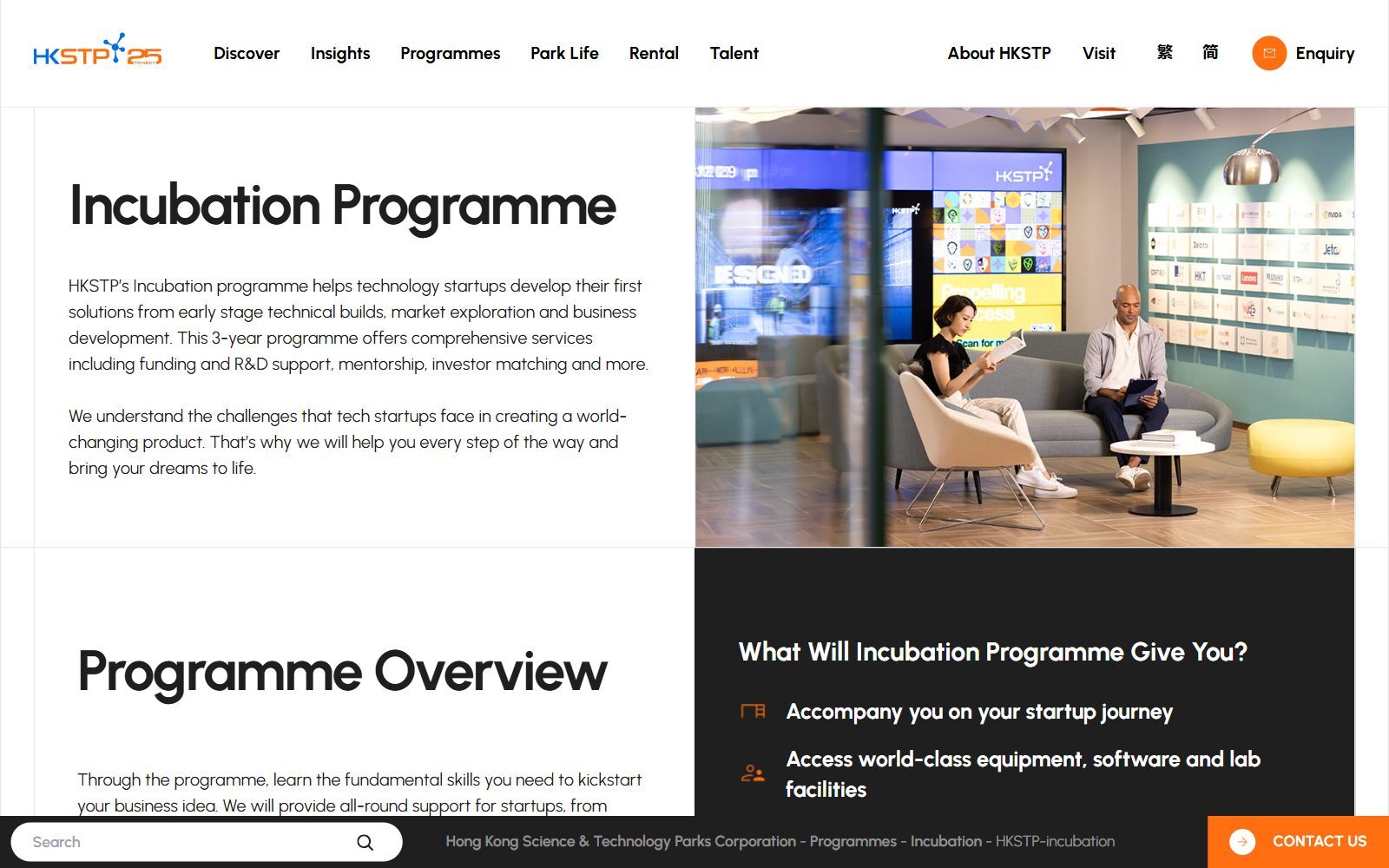
Hong Kong Science and Technology Parks' Incubation Programme is a three-year programme for technology startups with funding support of up to HK$1.29 million for technology and business development, a rental subsidy, labs and equipment, mentors and investor matching. It is an on-site programme at the Science Park. HKSTP says you can apply at any time, that overseas companies are welcome, and that rejected applicants can apply again three months after the panel result.
8. ITF TSSSU and RAISe+: grants for university spin-offs
Hong Kong's Innovation and Technology Fund pays for university spin-offs through the Technology Start-up Support Scheme for Universities (TSSSU): each funded start-up can get up to HK$1.5 million a year for up to three years, for staff, R&D, premises and marketing. The start-up must be registered in Hong Kong for no more than two years (TSSSU-O) or seven years (TSSSU+, which needs matching private investment), with students, alumni or staff of one of six local universities; you apply through the university. For larger projects, RAISe+ gives university teams up to HK$100 million per project on a matching basis; only UGC-funded universities can apply, and its fourth round closed on 30 October 2026.
Boost Your SEO with 1,500+ Free Business Directories: increase your DA, get backlinks and traffic.
We've compiled an exclusive list of directories and websites where you can submit your business and start building high-quality backlinks to boost your website traffic and get your SEO snowball rolling.
👉 Submit your startup now!
India, Malaysia and Vietnam
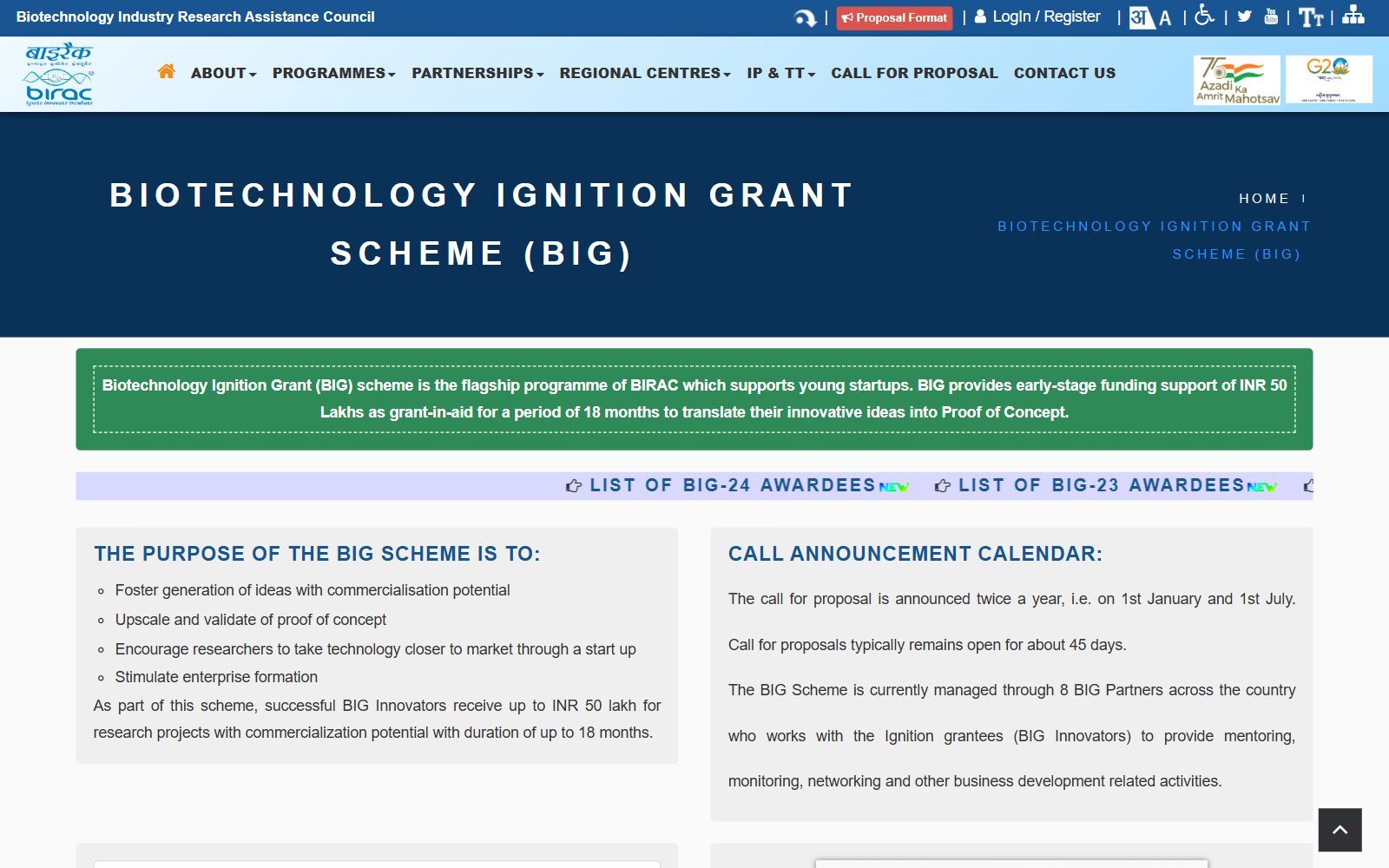
9. BIRAC BIG (India): up to INR 50 lakh for biotech
For biotech, medtech and agritech, India's Biotechnology Ignition Grant (BIG) from BIRAC is the flagship grant for young startups and researchers: up to INR 50 lakh as grant-in-aid for up to 18 months to reach a proof of concept. Calls open twice a year, on 1 January and 1 July, and usually stay open for about 45 days, so the next call is expected on 1 January 2027. Eight BIG Partners across India mentor and monitor the grantees.
10. NIDHI-PRAYAS (India): up to INR 10 lakh for a prototype
The Department of Science and Technology's NIDHI-PRAYAS helps young innovators turn an idea into a working prototype: up to INR 10 lakh per innovator or startup, plus access to the host incubator's facilities and mentors. It is sector-agnostic and runs through PRAYAS centres at technology business incubators, so you apply to a centre near you. The Startup India Seed Fund Scheme also funded early startups through incubators, but we could not confirm on an official page whether it takes new applications in 2027.
11. Cradle CIP Spark and CIP Sprint (Malaysia): up to RM600,000
Malaysia's Cradle Fund offers two conditional grants for technology startups. CIP Spark gives up to RM150,000 over 18 months for development and pre-commercialisation; teams of at least two (one Malaysian) or companies under five years old with revenue under RM3 million can apply. CIP Sprint gives up to RM600,000 over 18 months for commercialisation to Sdn Bhd companies under seven years old with accumulated revenue under RM5 million. Both need IP rights, and both are conditional: the money must be paid back if the funding agreement is terminated.

12. NATIF (Vietnam): technology innovation grants, wider support from 2027
Vietnam's National Technology Innovation Fund (NATIF), under the Ministry of Science and Technology, is the closest thing to a national innovation grant. According to Viet Nam News (30 September 2026), its 2026 call funded up to 15 AI projects with up to VND 3 billion each, with proposals due by 10 October 2026, and from 2027 NATIF plans to widen support to other technology innovation, including innovative start-ups. We could not reach NATIF's own website to confirm the 2027 rules, so check it before you apply.
Boost Your SEO by Getting Featured in Our Blogs and get a backlink.
We publish content about startups, education, tech, funding, etc. that ranks well not only in Google but also in Perplexity, ChatGPT, Grok and other AI tools.
👉 Get featured now!
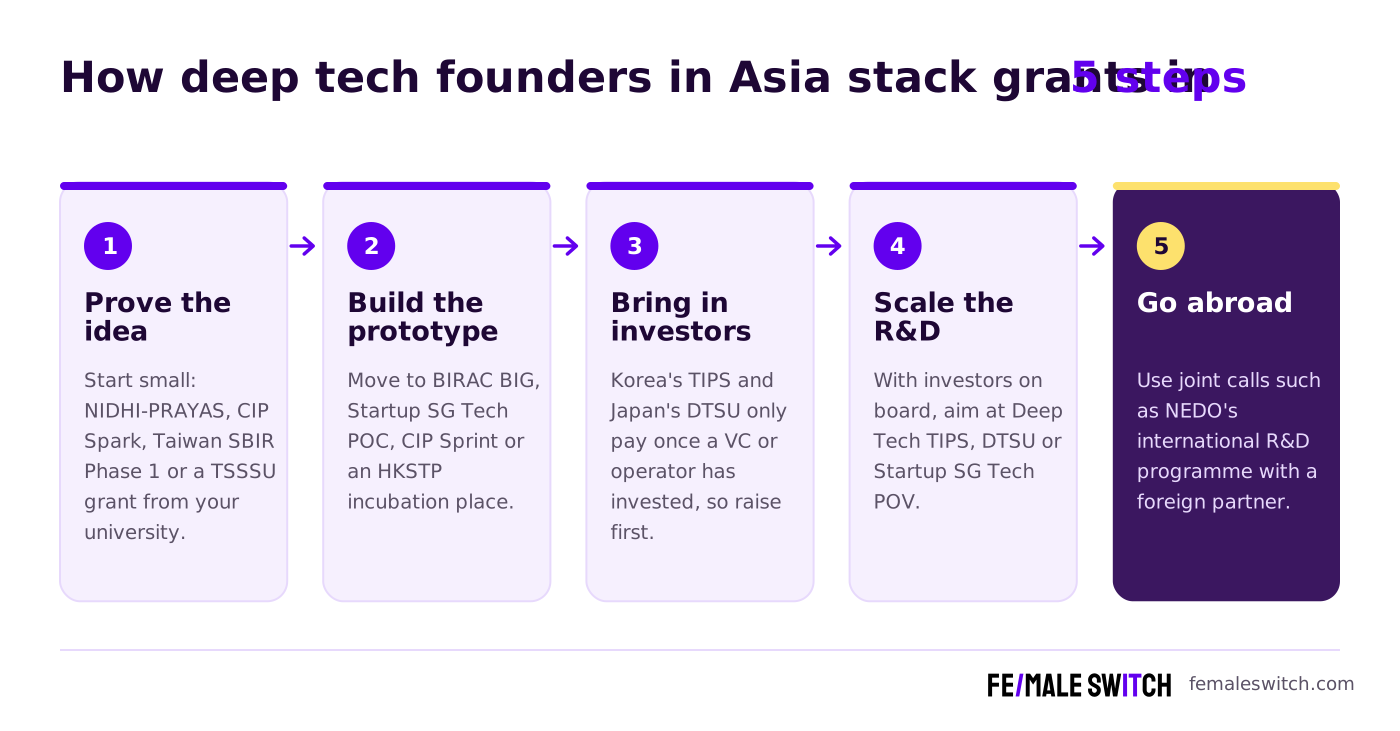
How Deep Tech Founders in Asia Stack Grants
Most deep tech startups combine several programmes as the technology matures:
Programmes Closed, Changed or Removed
The 2025 versions of this article (15 and 20 grants) listed many items that are not grants for deep tech startups in Asia or that we could not find on an official page:
- Startup SG Equity, SGInnovate and Singapore Climate Ventures: equity investors and a venture platform, not grants.
- Startup SG Founder and the Enterprise Development Grant (Singapore): a general first-time founder grant and a company upgrading grant; Startup SG Tech is the deep tech route.
- EIC Accelerator, EIC STEP Scale-Up and Horizon Europe: EU programmes for companies in the EU and associated countries; see our worldwide guide to deep tech grants.
- Startup Mahakumbh (India): a startup event, not a grant.
- Smart Nation and Digital Government Office: a government office, with no startup grant call on an official page.
- "APAC Deep Tech Initiative", "Asia Innovation Challenge", "China Innovation Challenge", "ASEAN Smart Cities Network Grant", "ASEAN Innovation Fund" and "2025 India Startup Challenge": we found no such grant programme for startups on an official page, so removed.
- China's 863 Program, Japan's Green Innovation Fund and "NEDO Global Ventures Fund": a past national research programme, a large climate R&D fund and a name we could not find; none is an open grant call for startups on an official page, so NEDO's DTSU is listed instead.
- K-Startup Grand Challenge, Startup Thailand, the Asian Cultural Council, the DBS Foundation grant, the Philippines' Start-Up Venture Fund and Vietnam's NIC: an accelerator for foreign founders, a national brand, arts fellowships, a social-enterprise grant, an investment fund and an innovation centre; none is a current deep tech grant we could confirm.
- "Startup funding landscape", "deep tech investment trends" and "Stage One platform" sections: general commentary with no grant behind it, removed along with their unsourced figures.
Which Deep Tech Grant in Asia Should You Apply For?
- Singapore company with proprietary technology: Startup SG Tech, if you accept the share subscription right; National GRIP if you start from NUS or NTU research.
- Japanese startup that has raised venture capital: NEDO DTSU; with a foreign partner, the international joint R&D call before 20 January 2027.
- Korean startup: find a TIPS operator who will invest; Deep Tech TIPS comes after the general track.
- Taiwanese SME: an SBIR Phase 1 or Phase 2 application.
- Hong Kong: the HKSTP Incubation Programme, or TSSSU if you come from one of the six universities.
- Indian biotech or hardware team: BIRAC BIG from 1 January 2027, or NIDHI-PRAYAS for a first prototype.
- Malaysian tech startup with IP: CIP Spark, then CIP Sprint.
How Founders Combine Grants With Other Funding in Asia
Grants rarely cover a whole company, so deep tech founders in Asia also raise private money and join programmes. Compare deep tech accelerators, startup competitions in Asia and deep tech startup competitions. If you are choosing where to build, read about the best countries for deep tech, deep tech cities, startup cities in Asia and the best countries for AI startups in Asia. Women founders should also check grants for women entrepreneurs in Asia and the best countries for female entrepreneurs in Asia. Related guides: grants for AI startups, grants for early-stage startups, edtech accelerators in Asia, and, for teams also looking at Europe, deep tech incubators in Europe and deep tech VCs in Europe.
Join F/MS: Startup Facilitator & Incubator and unlock your startup dreams today! Get your first customers, register you company in the Netherlands and get startup visas for the team.
FAQ About Deep Tech Grants in Asia
What is the largest deep tech grant in Asia?
Japan's NEDO DTSU pays up to ¥2.5 billion per project in its mass-production phase, covering up to two-thirds of costs, but only after venture capital has invested at least a third. Korea's Deep Tech TIPS pays KRW 1.5 billion over three years to TIPS graduates.
How much is Startup SG Tech?
Up to S$400,000 for a proof of concept and S$800,000 for a proof of value, paid by milestone. Enterprise Singapore has the right to exercise a share subscription.
Can foreign founders apply for these grants?
Mostly only through a local company. Startup SG Tech needs a Singapore company with 30% local equity, TIPS a Korean company, Taiwan SBIR a Taiwanese SME and Cradle at least one Malaysian. HKSTP says overseas companies are welcome to apply to its incubation programme.
Do deep tech grants in Asia take equity?
Most do not. Exceptions: Startup SG Tech gives Enterprise Singapore a share subscription right, and Cradle's CIP grants must be repaid if the agreement is terminated. TIPS and DTSU require private investors to take equity first.
When is the next BIRAC BIG call?
BIRAC announces BIG calls on 1 January and 1 July, and each stays open for about 45 days, so the next call is expected on 1 January 2027.
How do I apply for Korea's TIPS?
Through a TIPS operator: an accelerator or VC invests in your startup and recommends it. Applications are rolling. The deep tech track is a follow-on for startups that complete the general track.
Are there grants for university spin-offs in Asia?
Yes. Hong Kong's TSSSU pays up to HK$1.5 million a year for up to three years, Singapore's National GRIP offers grants of up to S$500,000, and Startup SG Tech accepts researchers from public research institutes at the POC stage.
Is the Startup India Seed Fund Scheme still open?
We could not confirm on an official page whether it takes new applications in 2027. For deep tech, BIRAC BIG and NIDHI-PRAYAS are the main Indian grants.
Where can I find deep tech grants in Europe and the Americas?
Read our worldwide guide to grants for deep tech startups and the regional guides to deep tech grants in North America and South America.
Where can I get a backlink by writing about my deep tech startup?
You can publish a guest post in one of the Fe/male Switch startup blogs, which rank in Google and in AI tools. Get a quality backlink.
About the Author
Violetta Bonenkamp, also known as MeanCEO, is an experienced startup founder with an impressive educational background including an MBA and four other higher education degrees. She has over 20 years of work experience across multiple countries, including 5 years as a solopreneur and serial entrepreneur. Throughout her startup experience she has applied for multiple startup grants at the EU level, in the Netherlands and Malta, and her startups received quite a few of those. She’s been living, studying and working in many countries around the globe and her extensive multicultural experience has influenced her immensely.
