

The Best Countries in Asia for AI Startups: Money, AI Laws, Compute and Visas
Where you register an AI startup in Asia decides four practical things: how much AI investment is nearby, which national AI plan or law you work under, whether the state helps you pay for GPUs, and whether a foreign founder can get a visa. This guide compares 15 Asian countries and territories on exactly those points. Investment figures come from Stanford's AI Index Report 2026, which counts private AI investment and newly funded AI companies in 2025; laws, programmes and visas come from government pages we checked in October and November 2026. We include Israel, Saudi Arabia and the UAE as West Asia, and Hong Kong as a Special Administrative Region of China. For the worldwide picture, see our guide to the best countries for AI startups.
Quick answer: Singapore is the best all-round base for a foreign AI founder in Asia: an updated national AI strategy (May 2026), more than S$1 billion of public AI research money to 2030, the second-highest share of AI talent in the world and the EntrePass for founders. China has the most AI money in Asia ($12.4 billion of private AI investment in 2025), but we found no founder route for foreigners. India is the place for cheap GPUs (IndiaAI Compute), Israel for AI talent and a national supercomputer, and South Korea, Japan, Taiwan and Vietnam now have national AI laws. Hong Kong pays up to 70% of AI supercomputer costs for local AI startups, and the UAE has Hub71+ AI and a Golden Visa.
Write FREE SEO-optimized Blog Articles! Our Article Writer ensures your blog is loved by both Google and your readers, turning those clicks into customers.
👉 Write your article here
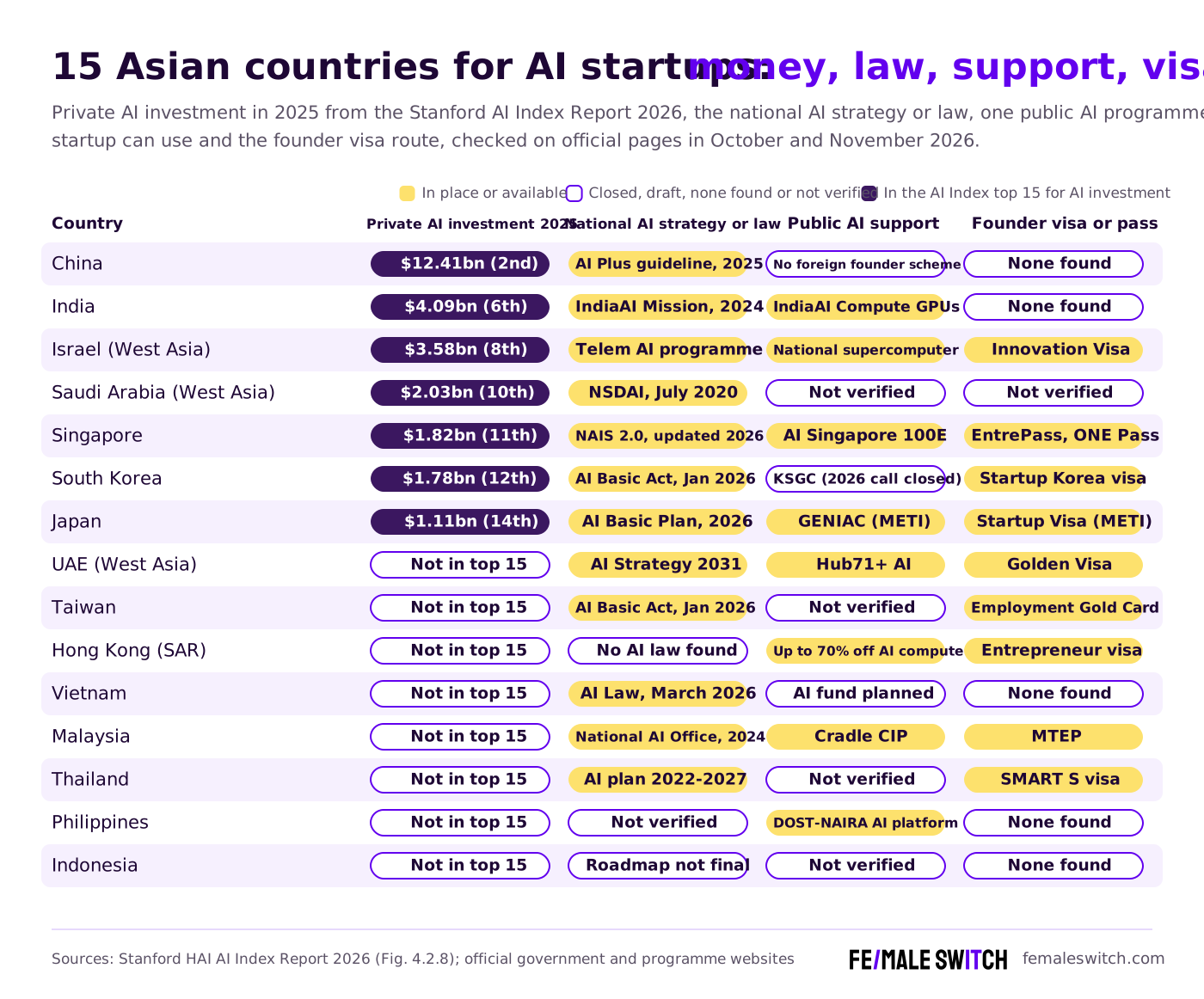
Asian Countries for AI Startups at a Glance
Sources: investment and newly funded AI companies from the Stanford HAI AI Index Report 2026, figures 4.2.8 and 4.2.9 (2025 data; "not in top 15" means the country is not shown in that chart); laws, programmes and visas from the official pages linked below, checked October and November 2026.
How We Chose and Ordered the Countries
The first seven countries are the Asian ones in the AI Index Report 2026 top 15 for private AI investment, in that order. The other eight follow by how many of our four founder checks (strategy or law, public AI support, founder visa) we could confirm on an official page. We gave no invented scores. The same report measures AI talent on LinkedIn: Israel had the highest share of AI talent in 2025 (2.1%) and Singapore the second highest (1.8%); the UAE had the second-highest net inflow of AI talent, and generative AI use was highest in the UAE (64%) and Singapore (61%). Bangladesh, Sri Lanka, Kazakhstan and Uzbekistan from the old list are not ranked this time, because we could not confirm founder-relevant AI facts on their official pages.
The 15 Best Countries in Asia for AI Startups in 2027
1. China
China is second in the world for private AI investment ($12.41 billion in 2025) and third for newly funded AI companies (161). The State Council's AI Plus guideline of August 2025 wants intelligent terminals and AI agents to pass 70% penetration in six key sectors by 2027 and 90% by 2030, with work on models, data, computing power and open-source ecosystems. The AI Index notes that private figures likely understate China's total AI spending because of government guidance funds. It suits founders who are already in China; we found no national founder visa or AI startup scheme for foreigners. See our China startups to watch.
2. India
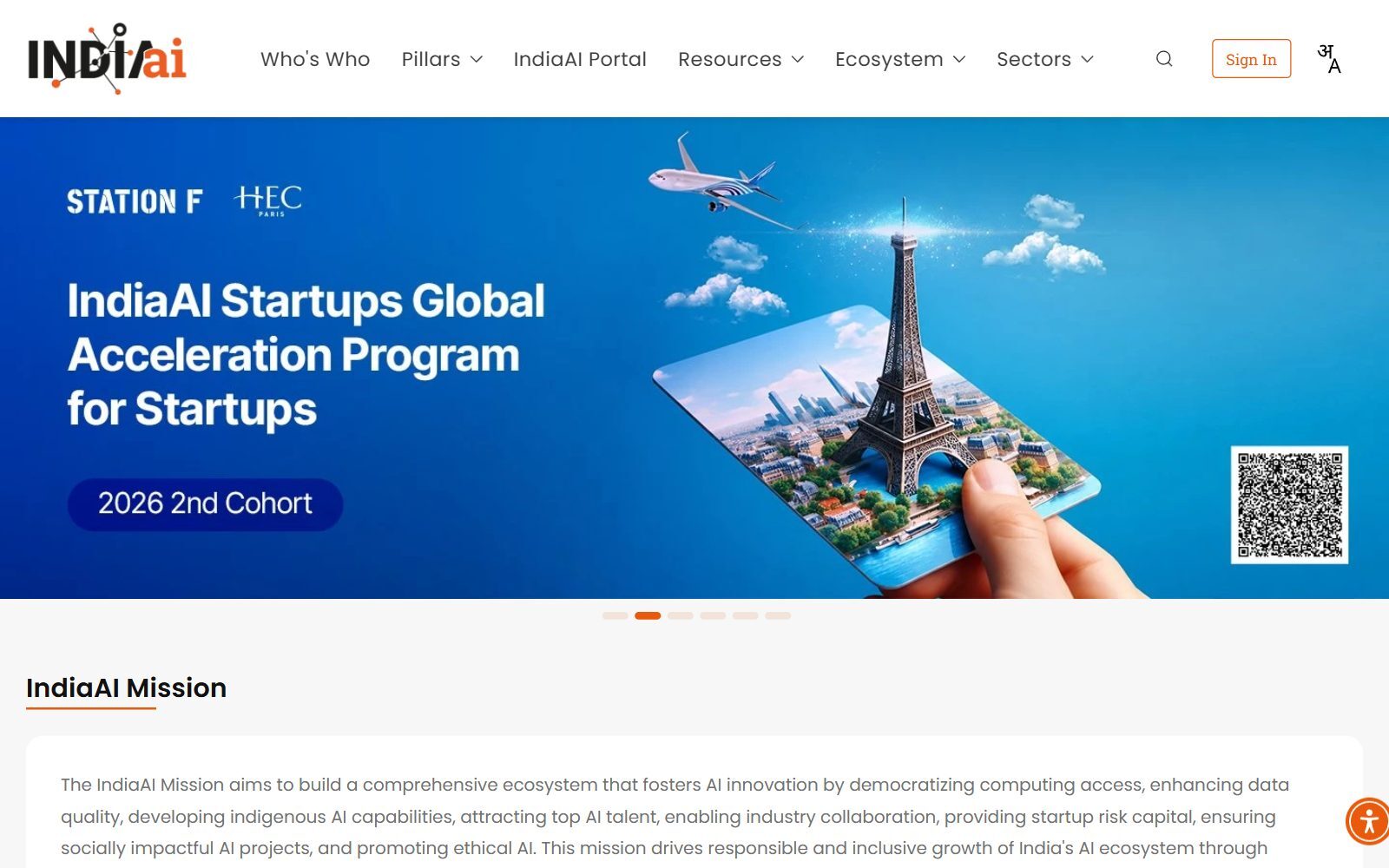
India had $4.09 billion of private AI investment in 2025 and 108 newly funded AI companies, fourth in the world. The cabinet approved the IndiaAI Mission with a budget of Rs 10,371.92 crore; its pillars include public AI compute, datasets and IndiaAI Startup Financing for deep-tech AI startups. The IndiaAI Compute portal rents GPUs to startups and MSMEs with DPIIT recognition, and requests under 5,000 GPU hours are approved automatically; a government backgrounder of August 2026 puts the shared pool at 45,000+ GPUs. The IndiaAI site also runs the IndiaAI Startups Global Acceleration Program with Station F and HEC Paris (a second 2026 cohort). India has no founder visa for foreigners; Startup India recognition lets local companies under 10 years old apply for a 3-year tax holiday.
3. Israel (West Asia)
Israel had $3.58 billion of private AI investment in 2025, 64 newly funded AI companies and the highest AI talent share of any country in the AI Index. Under its Telem national programme for AI R&D infrastructure, the Israel Innovation Authority opened access to the national supercomputer, run by Nebius: 1,000 Nvidia B200 accelerators over the coming years at below-market prices, 70% of them for companies training AI models, with a minimum of 16 accelerators for 1 to 6 months. Foreign founders can ask for the Innovation Visa, a B/2 stay permit approved in 2024, through a supporting framework that backs the founder, for up to two years. See our Tel Aviv startup events guide.
4. Saudi Arabia (West Asia)
Saudi Arabia had $2.03 billion of private AI investment in 2025, tenth in the world, and its AI talent concentration more than doubled between 2019 and 2025, one of the fastest rises in the AI Index. The National Strategy for Data and AI, run by the data and AI authority SDAIA, was approved on 17 July 2020 and serves Saudi Vision 2030. We did not re-check a founder residency route or an AI startup scheme for this update, so we leave them out.
Boost Your SEO by listing your startup and get a FREE backlink.
Create a profile in the F/MS Startup Game, add the link to your website and submit.
👉 List your startup now!
5. Singapore
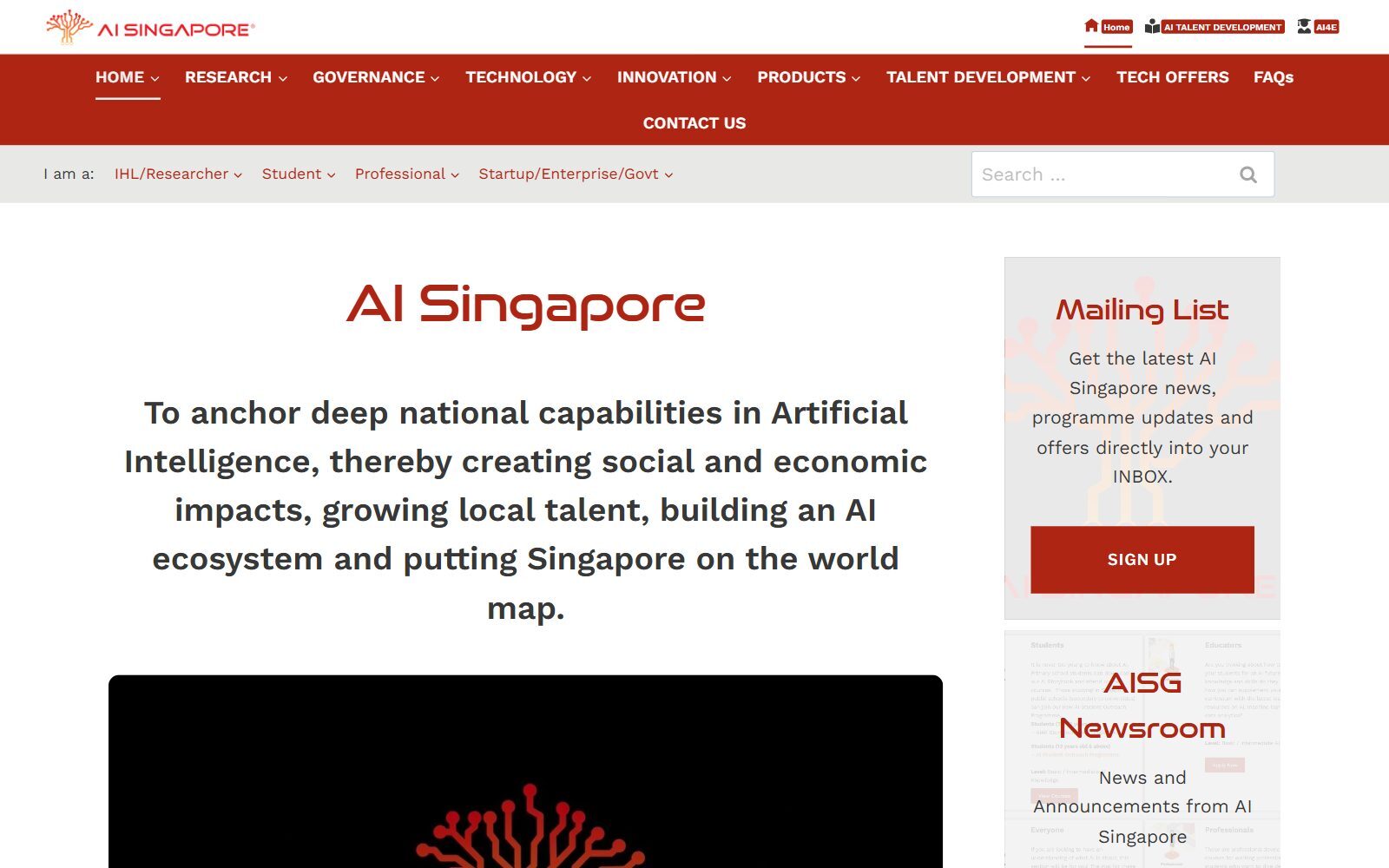
Singapore had $1.82 billion of private AI investment in 2025 and 49 newly funded AI companies. On 20 May 2026 it published an update to its National AI Strategy (NAIS 2.0 dates from December 2023): a National AI Council chaired by the Prime Minister since February 2026, national AI Missions in advanced manufacturing, financial services, connectivity and healthcare, more than S$1 billion for public AI research and talent from 2025 to 2030, and a new Kampong AI community at one-north. AI Singapore runs 100 Experiments to help companies build their first AI products, the AI Apprenticeship Programme and the SEA-LION language models. Foreign founders use the EntrePass for a venture-backed or innovative-technology business, and from 28 January 2027 the ONE Pass adds an AI and Tech track for founders and leaders earning at least S$22,500 a month (startups need at least US$30 million raised).
6. South Korea
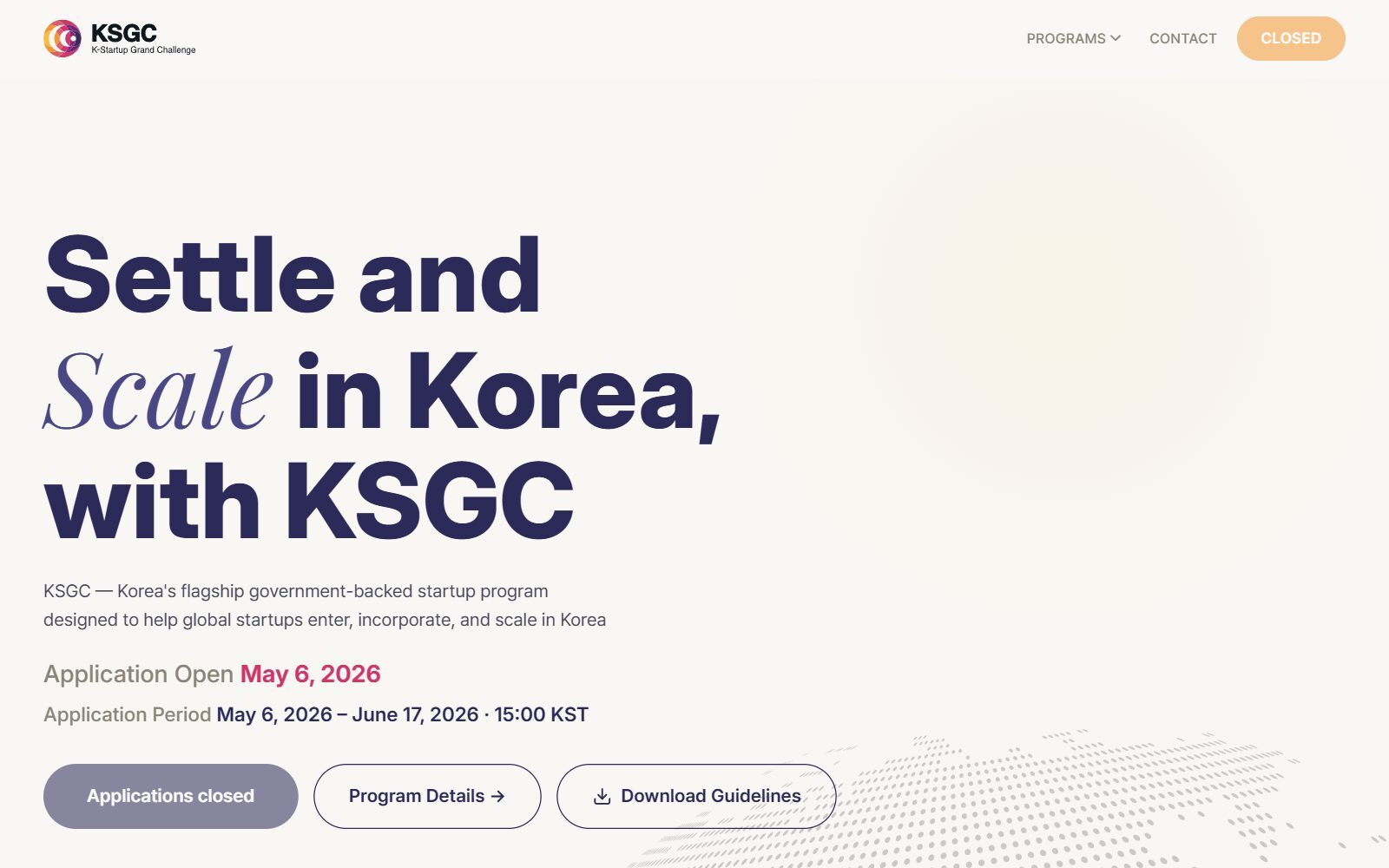
South Korea had $1.78 billion of private AI investment in 2025 and 59 newly funded AI companies. Its AI Basic Act came into force on 22 January 2026 with a grace period of at least one year before investigations and fines, and an AI Basic Act Support Desk gives companies confidential advice. Foreign founders can enter through the K-Startup Grand Challenge, the government-backed programme that helps global startups incorporate in Korea: its 2026 call closed on 17 June 2026, and the third phase runs until June 2027 with visa support. The Ministry of SMEs and Startups also recommends founders for the Startup Korea Special Visa on a rolling basis. See our Seoul startups to watch.
7. Japan
Japan had $1.11 billion of private AI investment in 2025 and 56 newly funded AI companies. The cabinet adopted Japan's first AI Basic Plan on 23 December 2025 and a revised one on 14 July 2026, under the AI Promotion Act. METI's GENIAC (Generative AI Accelerator Challenge) supports companies that build generative AI with compute and data, and lists more than 90 selected businesses. Foreign founders can use Japan's Startup Visa: a local government or private operator certified by METI checks your startup plan, and the immigration office then grants a "Specified Activities" status to prepare the company. See our Fukuoka startups to watch and the Tokyo startup events guide.
Boost Your SEO with 1,500+ Free Business Directories: increase your DA, get backlinks and traffic.
We've compiled an exclusive list of directories and websites where you can submit your business and start building high-quality backlinks to boost your website traffic and get your SEO snowball rolling.
👉 Submit your startup now!
8. United Arab Emirates (West Asia)
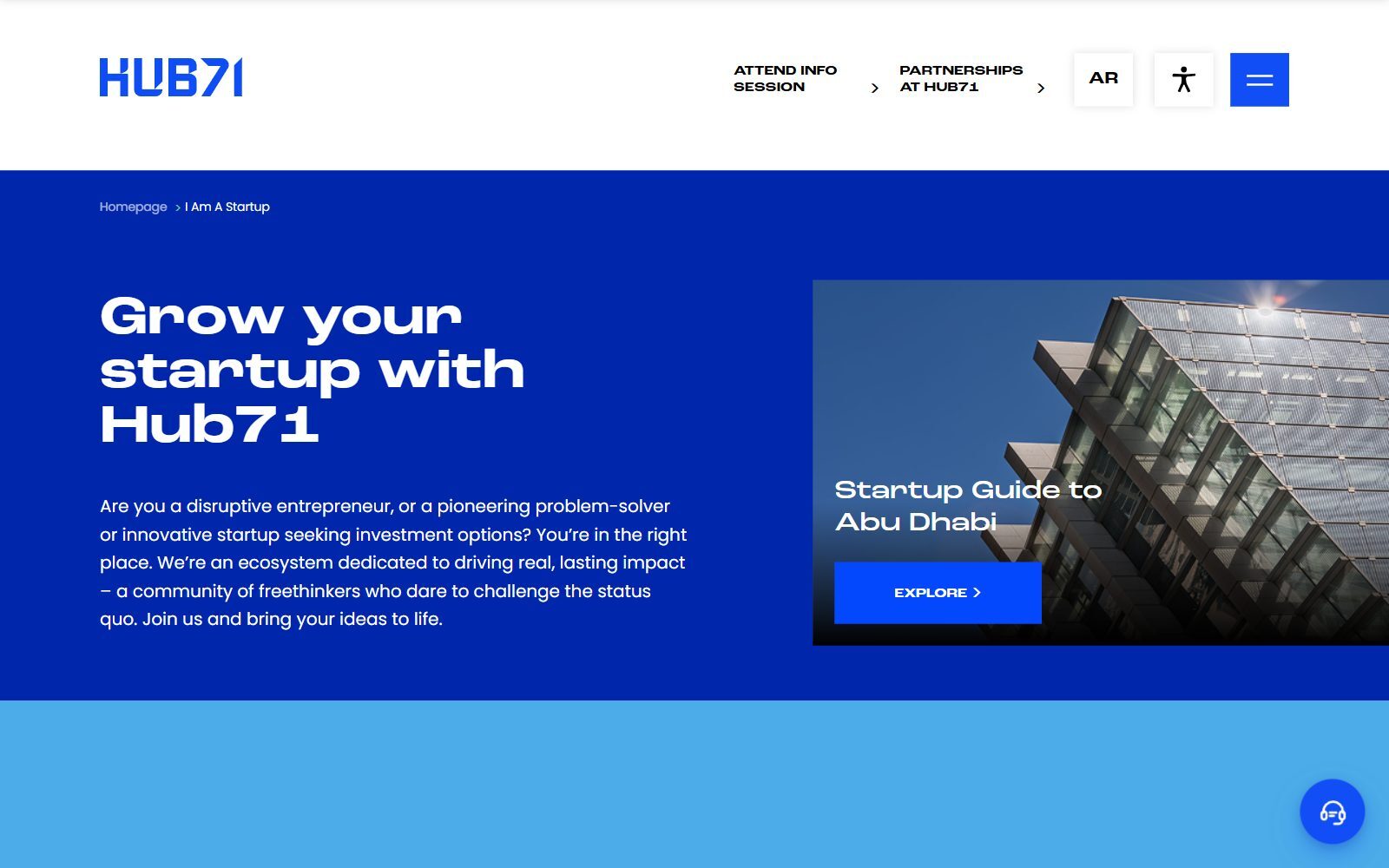
The UAE is not in the AI Index top 15 for investment, but it leads the world for generative AI use (64%) and has the second-highest net inflow of AI talent. The UAE Council for AI works to implement the UAE Strategy for Artificial Intelligence and make the UAE a world leader in AI by 2031. Hub71 in Abu Dhabi runs Hub71+ AI, a cross-programme ecosystem for startups building with AI, and its programmes offer free housing and office space. Founders can apply for the Golden Visa for entrepreneurs. See our Abu Dhabi startups to watch.
9. Taiwan
Taiwan's Artificial Intelligence Basic Act was promulgated on 14 January 2026 and took effect the same day. The National Science and Technology Council is the central authority; article 6 tells the government to fund AI research, applications and infrastructure through subsidies, investment and tax or financial incentives, and agencies must adjust their rules within two years. Foreign founders and specialists can move with the Taiwan Employment Gold Card, which combines visa, residence and an open work permit for up to 3 years. We did not find a public AI compute scheme for startups.
10. Hong Kong (Special Administrative Region of China)
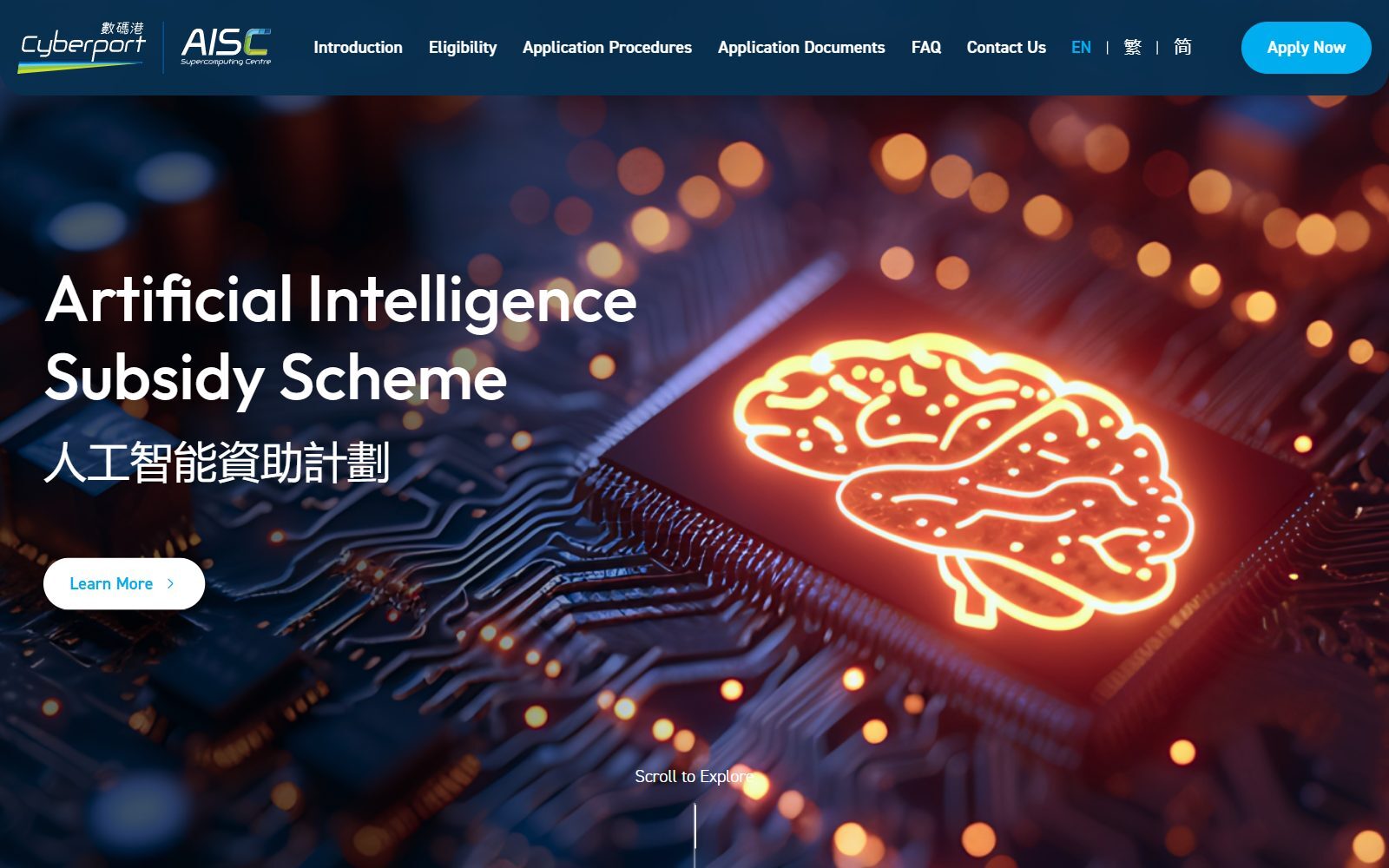
Hong Kong's 2024-25 Budget set aside HK$3 billion for a three-year Artificial Intelligence Subsidy Scheme that pays for computing power at Cyberport's AI Supercomputing Centre. AI start-ups qualify if they were incorporated in the last seven years, have their head office, main operation or leadership in Hong Kong and fewer than 250 staff; approved users normally get up to 70% of the list price covered, and applications are open all year. The HKSTP Incubation Programme adds up to HK$1.29 million for technology and business development. Foreign founders apply through the Immigration Department's Investment as Entrepreneurs route with a three-year business plan. See our Hong Kong tech startups.
11. Vietnam
Vietnam's Law on Artificial Intelligence (35 articles) has been in effect since 1 March 2026, one of the first standalone AI laws in Southeast Asia. According to the Ministry of Science and Technology, AI enterprises get the highest level of incentives, better access to infrastructure, datasets and regulatory sandboxes, and SMEs get help with funding, training and market access. Decision 367/QD-TTg of 3 March 2026 set the implementation plan: in 2026 and 2027 the ministry is to create a national AI development fund and AI innovation clusters at high-tech parks. Ho Chi Minh City's SIHUB connects startups with incubators and investors. We found no founder visa.
12. Malaysia
Malaysia's National AI Office (NAIO), approved by the cabinet on 28 August 2024, was launched by the Prime Minister on 12 December 2024 under the Ministry of Digital to lead AI research, adoption and commercialisation. Cradle supports technology entrepreneurs through its Cradle Investment Programme, and MDEC's Malaysia Tech Entrepreneur Programme (MTEP) is the route for foreign founders who want to start up in Malaysia.
Boost Your SEO by Getting Featured in Our Blogs and get a backlink.
We publish content about startups, education, tech, funding, etc. that ranks well not only in Google but also in Perplexity, ChatGPT, Grok and other AI tools.
👉 Get featured now!
13. Thailand
Thailand's national AI strategy and action plan for 2022 to 2027 was approved by the cabinet on 26 July 2022, with five strategies: ethics and law, infrastructure, talent and education, AI technology and innovation, and AI use in the public and private sectors. Its site also lists ThaiLLM projects and a 2026 AI readiness assessment. The Board of Investment's SMART S visa is for technology startup founders in targeted industries: you need a deposit of at least 600,000 baht held for 3 months and must be a director or hold 25% of a company set up in Thailand. See our Bangkok startups to watch.
14. Philippines
The Department of Science and Technology launched the National Artificial Intelligence Center for Research and Innovation (NAICRI) on 26 February 2026 as the country's anchor for AI research and advanced computing. Its DOST-NAIRA platform offers AI as a service on the COARE high-performance computer, with shared models, datasets and drag-and-drop tools, and AIgnite MSMEs helps small firms adopt AI. QBO Innovation in Manila runs startup acceleration and incubation programmes. We found no founder visa. See our Cebu startups to watch.
15. Indonesia
Indonesia's digital ministry Komdigi said on 16 March 2026 that it is preparing a Presidential Regulation on AI as the national governance framework and finalising a National AI Roadmap with principles such as transparency, accountability and data protection; we found no signed version. For money, Antler runs its Indonesia programme in Jakarta and can invest $85,000 for 10% after six weeks. We found no founder visa or public AI compute scheme for startups.
What Changed Since the Last Version
- Removed figures: the old post's shares and counts (India "41.7% of AI fintech firms", China "24 of the top 50" and "$71 million per startup", Singapore "44% of GenAI startups" and "$8.1 billion", Israel "9.6%", Vietnam "27%", Indonesia "13%", Malaysia's innovation rank) had no working source. We replaced them with the Stanford AI Index and official pages.
- Removed links: ten FAQ links to a placeholder website and homepage-only links to news and government sites that said nothing about AI startups.
- New laws: South Korea's AI Basic Act (January 2026), Taiwan's AI Basic Act (January 2026) and Vietnam's Law on AI (March 2026); Japan adopted AI Basic Plans in December 2025 and July 2026.
- New support: Singapore's strategy update and ONE Pass AI track, Israel's national supercomputer, Hong Kong's AI Subsidy Scheme, India's GPU portal and the Philippines' NAICRI.
- Added: Saudi Arabia, the UAE, Taiwan and Hong Kong. Not ranked this time: Bangladesh, Sri Lanka, Kazakhstan and Uzbekistan (see our Dhaka startups to watch for Bangladesh).
Which Asian Country Should You Choose for Your AI Startup?
- You are a foreign founder who wants one easy base: Singapore (EntrePass, AI Singapore), then Hong Kong or the UAE.
- You need cheap GPUs: India (IndiaAI Compute), Hong Kong (up to 70% of AI supercomputer costs), Israel (national supercomputer) or Japan (GENIAC).
- You need AI engineers: Israel and Singapore have the highest AI talent shares in the world.
- You want clear AI rules: South Korea, Taiwan and Vietnam have national AI laws with published dates; Japan has an AI Basic Plan.
- You sell into a big home market: China or India, if you are already based there.
- You build in Southeast Asia on a small budget: Malaysia (MTEP, Cradle), Thailand (SMART S visa) or Vietnam (AI incentives under the new law).
Join F/MS: Startup Facilitator & Incubator and unlock your startup dreams today! Get your first customers, register you company in the Netherlands and get startup visas for the team.
How Founders Use This List
Shortlist two or three countries that fit your passport, your data and your first customers, then go one level down. Our guides to startup cities in Asia, startup incubators in Asia and startup competitions in Asia name the programmes in each city. For money, see early-stage VCs in Asia, VCs for AI startups, angel investors for AI startups and accelerators for AI startups. Women founders can compare the best countries for female entrepreneurs in Asia and grants for women entrepreneurs in Asia. If you are choosing between continents, read the best countries for AI startups in Europe, and meet investors at events in Singapore, Seoul, Bangalore, Hong Kong or Dubai. Before you move anywhere, validate your startup idea with real customers.
FAQ About the Best Countries for AI Startups in Asia
Which Asian country is best for AI startups in 2027?
For a foreign founder, Singapore: an updated national AI strategy, more than S$1 billion of public AI research money to 2030, the EntrePass and the second-highest AI talent share in the world. China has more AI money ($12.41 billion in 2025) but no founder route for foreigners that we could find.
Which Asian country has the most AI investment?
China, with $12.41 billion of private AI investment in 2025 according to the Stanford AI Index Report 2026, followed by India ($4.09 billion) and Israel ($3.58 billion).
Where can an AI startup get cheap GPU compute in Asia?
India's IndiaAI Compute portal rents subsidised GPUs to recognised startups, Hong Kong's AI Subsidy Scheme covers up to 70% of the list price at Cyberport's supercomputer, and Israel's national supercomputer offers Nvidia B200s below market prices.
Which Asian countries have a national AI law?
South Korea (AI Basic Act, in force 22 January 2026), Taiwan (AI Basic Act, 14 January 2026) and Vietnam (Law on AI, in effect 1 March 2026). Japan has an AI Promotion Act with an AI Basic Plan.
Can a foreign founder get a startup visa in Asia?
Yes: Singapore's EntrePass, Korea's Startup Korea Special Visa, Japan's Startup Visa, Israel's Innovation Visa, Taiwan's Employment Gold Card, Hong Kong's Investment as Entrepreneurs route, Thailand's SMART S visa, Malaysia's MTEP and the UAE Golden Visa.
Is the K-Startup Grand Challenge open?
Not now. The 2026 call ran from 6 May to 17 June 2026 and has closed; the selected teams stay in the programme until June 2027. Watch ksgc.global for the next call.
Are Israel, Saudi Arabia and the UAE in Asia?
Geographically they are in West Asia, so we include them and mark them as such. Our guide to the global best countries for AI startups covers them too.
Is Hong Kong a separate country?
No. Hong Kong is a Special Administrative Region of China with its own immigration rules, companies law and support schemes, so we list it separately.
Why did you remove the old statistics?
They had no working source, and the old FAQ linked to a placeholder website. We replaced them with the Stanford AI Index Report 2026 and official government pages.
Can you feature my AI startup?
Yes. We publish articles about startups, funding and tech; see how to get featured and get a backlink in the callouts above, or read our guide to startup cities for AI.
About the Author
Violetta Bonenkamp, also known as MeanCEO, is an experienced startup founder with an impressive educational background including an MBA and four other higher education degrees. She has over 20 years of work experience across multiple countries, including 5 years as a solopreneur and serial entrepreneur. Throughout her startup experience she has applied for multiple startup grants at the EU level, in the Netherlands and Malta, and her startups received quite a few of those. She’s been living, studying and working in many countries around the globe and her extensive multicultural experience has influenced her immensely.
