

TL;DR: European Defence Fund grants come from the EU's defence research and development programme, worth nearly €7.3 billion for 2021–2027. Startups rarely get them alone: the doors that fit are two yearly SME calls (up to €5–6 million per project, at least three SMEs from three countries), the EUDIS Business Accelerator (a €120,000 voucher, no equity taken), hackathons, and the new €115 million AGILE programme. The 2026 SME calls closed on 29 September 2026 with 333 proposals; 2027 calls are not published yet.
The European Defence Fund (EDF) has a reputation as a club for large defence primes, yet the Commission wants it to reach SMEs, startups and "non-traditional players", mostly through its innovation scheme, EUDIS. This guide maps the routes in for a ten-person dual-use company.
Facts come from the Commission's EDF page, the 2026 call documents and Info Days slides, the EUDIS site and the Commission's AGILE announcement, checked on 16 November 2026.
What the European Defence Fund is, in founder terms

Member States set the priorities and the Commission runs annual calls for collaborative defence research and development. It pays grants (no equity) only to consortia: partners from at least three Member States or associated countries (Norway, and Ukraine once its association agreement is in force), or two for disruptive technology calls.
The Commission puts the fund at "nearly €7.3 billion" for 2021–2027, though its page still shows an older €8 billion split (€2.7 billion research, €5.3 billion capability development).
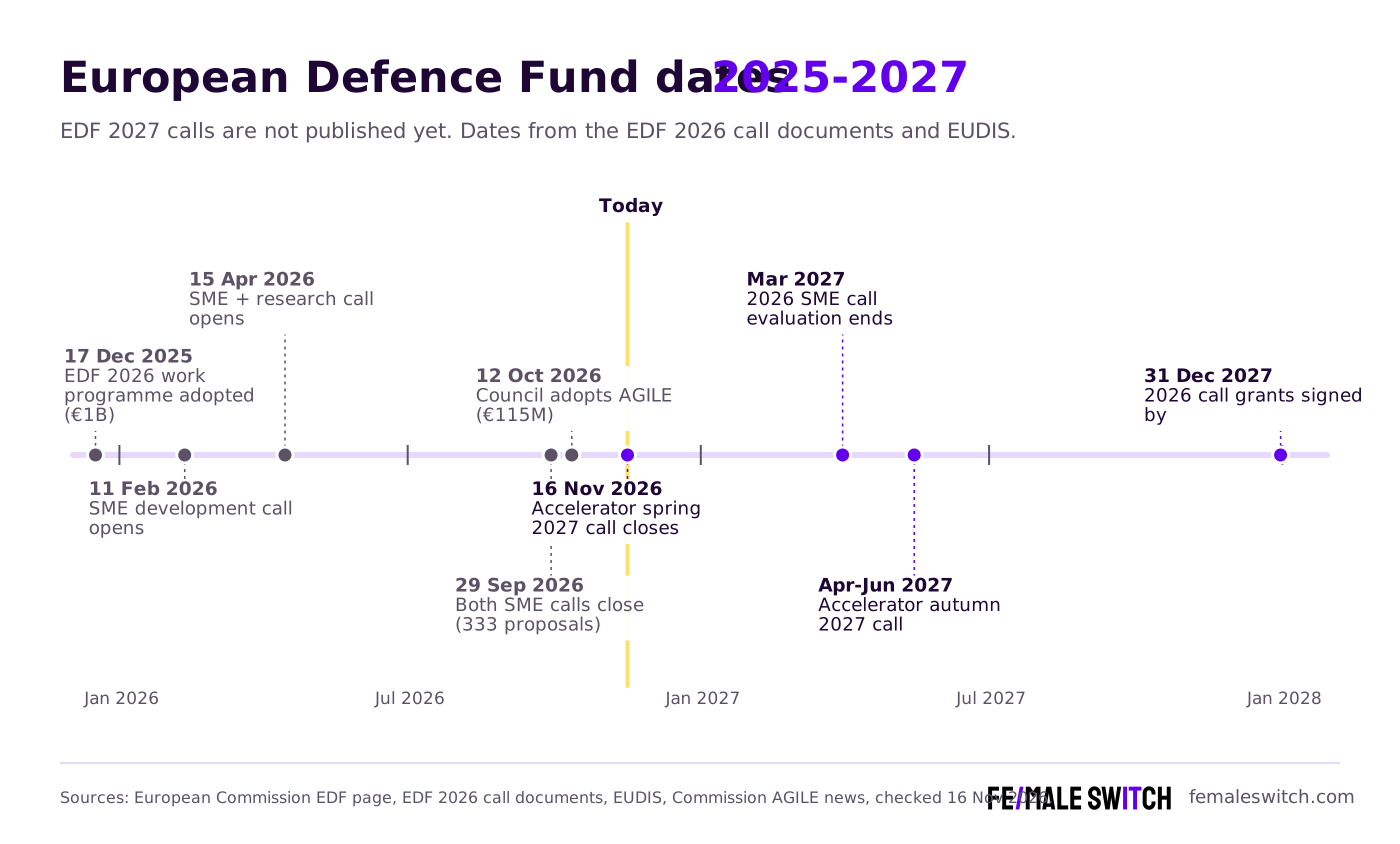
The 2026 work programme, adopted on 17 December 2025, holds about €1 billion and 31 call topics. Half goes to major capabilities, a quarter to critical technologies and a quarter to EUDIS, including around €60 million for disruptive technologies and €60 million for SME calls.
Source: European Commission EDF page and EDF 2026 Info Days presentation.
The SME calls, rule by rule
EUDIS says that "every year there are two open and non-thematic SME R&D calls". You pick the topic, in any area of defence interest, including civilian solutions adapted for defence: the dual-use door.
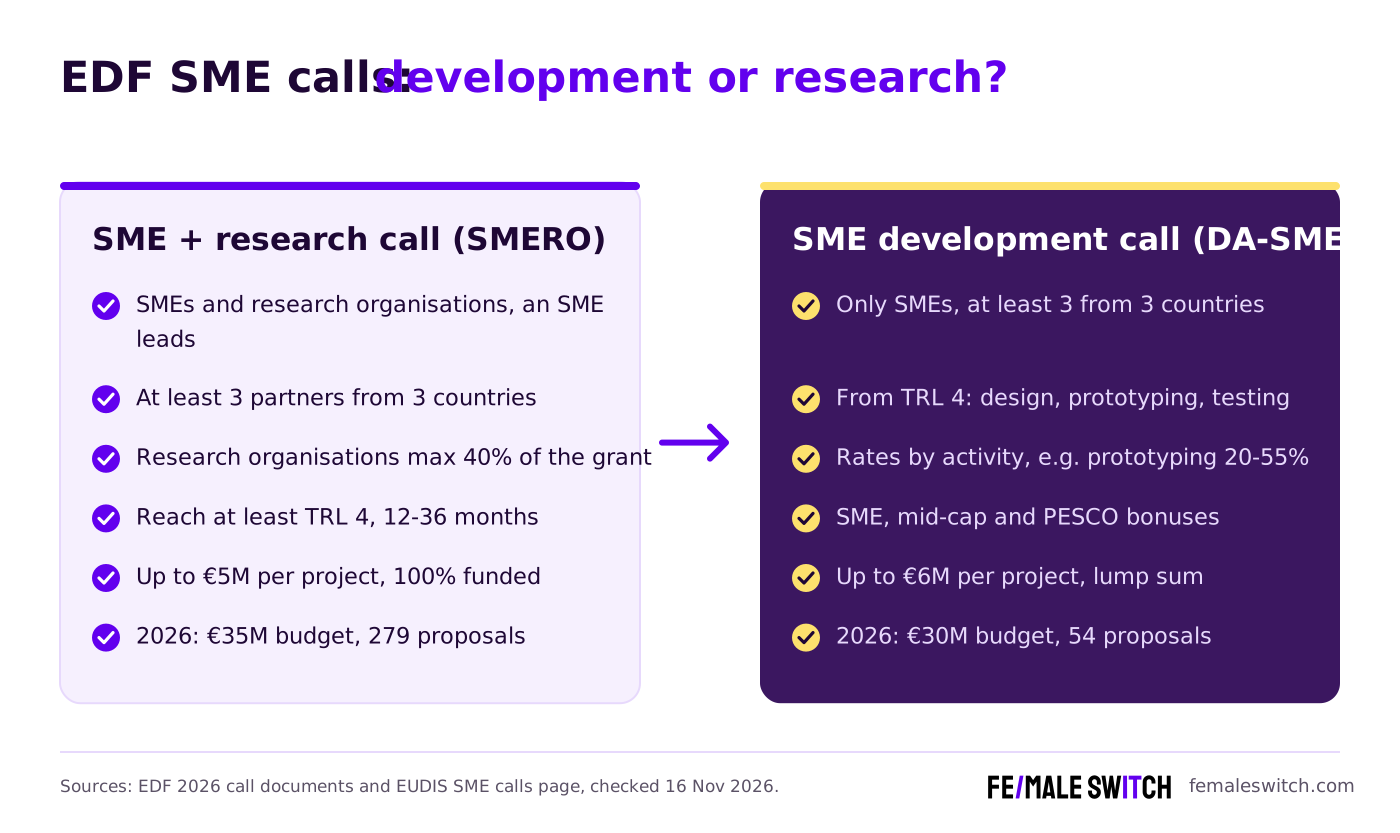
Development call (EDF-2026-LS-DA-SME). Only SMEs may be beneficiaries, at least three independent ones from three eligible countries. Work starts from TRL 4 and covers design, prototyping, testing and certification. Grants are lump sums of up to €6 million. Baseline/maximum funding rates vary by activity: 65%/100% for design, 20%/55% for prototyping and 45%/80% for testing. Bonuses for SMEs, mid-caps and PESCO projects lift the baseline.
Research call (EDF-2026-LS-DIS-RA-SMERO). SMEs and research organisations, at least three from three countries, with an SME as coordinator. Research organisations may take at most 40% of the grant. Projects run 12 to 36 months, must reach at least TRL 4, are funded at 100% and are capped at €5 million.
Rules that knock out startups:
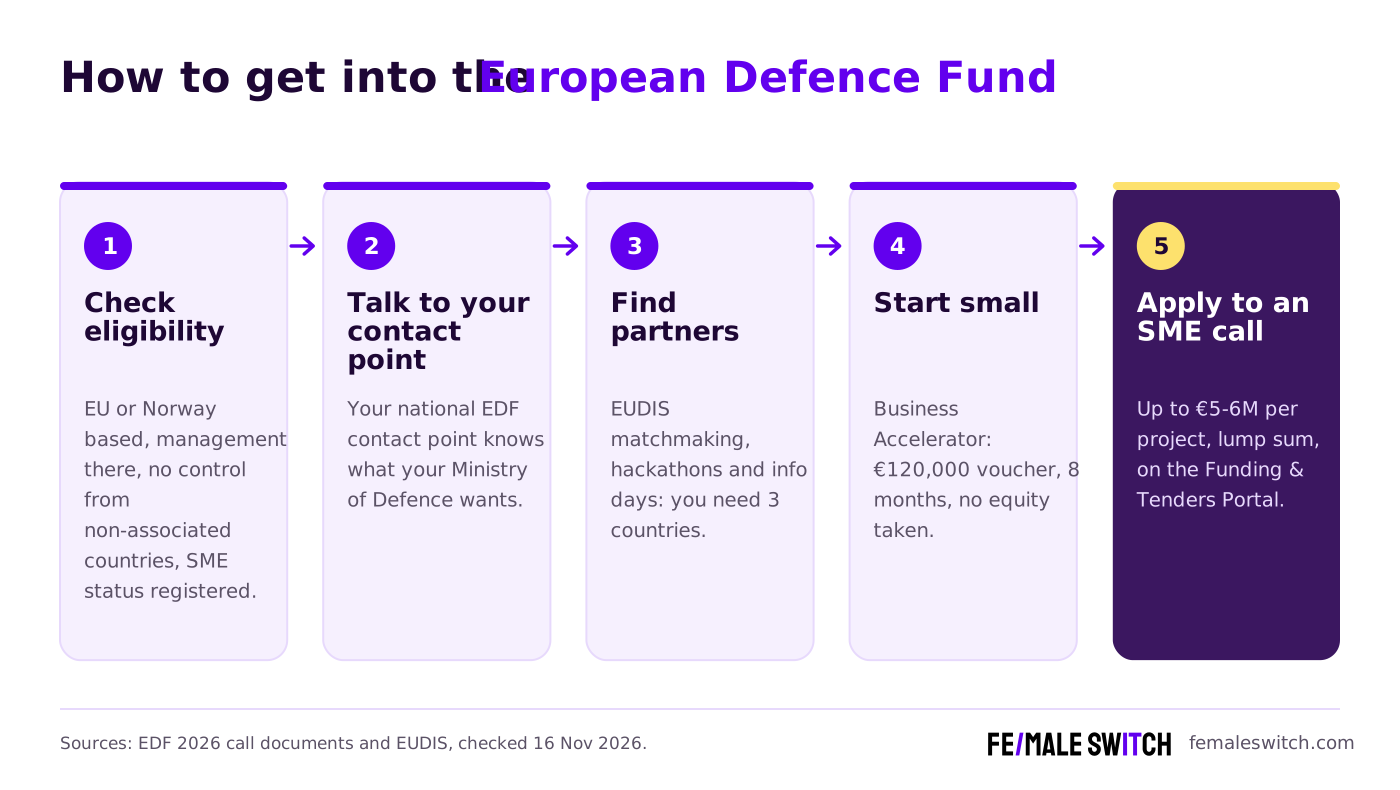
- Every applicant must be established and managed in the EU or an associated country, free of control by a non-associated third country. A US or UK investor with control can make you ineligible unless your Member State approves guarantees.
- SME status is self-declared in the Participant Register by the deadline, on accounts no older than 31 December 2024.
- Classified work can require security clearances.
The 2026 research call drew 279 proposals and the development call 54. At maximum grant sizes, the two budgets fund about 12 projects. EUDIS lists 17 SME proposals selected in 2023, 19 in 2024 and 16 in 2025.
EUDIS: the startup side of the fund
EUDIS, the EU Defence Innovation Scheme, is how the EDF reaches newcomers. It has €1.46 billion from the EDF plus €400–500 million leveraged from other public and private sources; for 2026 that is €231 million. Its tracks:
- Business Accelerator. Eight months of coaching and bootcamps for 20 companies per cohort, two cohorts a year, ending in a showcase to defence end-users. Each company gets a €120,000 seed voucher and the top three get another €50,000. The Commission "will not ask for any equity or ownership of IPRs". Open to companies from EU Member States and Norway; Ukrainian entities can join the matchmaking. Three cohorts (60 companies) ran in 2025 and 2026.
- Defence hackathons. Twice a year in eight countries, open to adults from EU Member States, Norway or Ukraine. Teams keep their IP.
- Matchmaking. Events and an online platform to meet primes, investors and partners.
- Business coaching. Up to 15 days for SMEs that already have an EDF grant.
- Defence Equity Facility. EUDIS "does not provide direct equity financing"; it backs private funds through the European Investment Fund (seven so far), and a €1 billion "Defence Equity Facility 2.0" fund-of-funds with the EIB Group was due to deploy from 2026.
Other EU routes for defence and dual-use startups
- AGILE. The Council gave its final approval on 12 October 2026 to a €115 million programme for SMEs, startups and scale-ups with emerging and disruptive defence products. The Commission promises a time-to-grant of about four months, against more than a year for EDF grants. No call is published yet.
- EIC STEP Scale Up Defence. The adopted EIC Work Programme 2027 sets aside €100 million for equity of up to €30 million in defence tech scaleups. Batch dates: EIC Accelerator 2027 guide.
- EIC Transition. Results of EDF research actions count as eligible starting points; see EIC Transition.
- Cascade funding. From 2026, every EDF project may pass grants on to third parties, so watch consortia for small open calls (how cascade funding works).
Decision tree: which door fits your company?
Readiness worksheet: score yourself
Give each line 0, 1 or 2 points.
11–14 points: build a consortium now for the 2027 SME calls. 6–10: apply to the Business Accelerator or a hackathon and use matchmaking to find partners. Under 6: start with civilian funding such as EU grants for small businesses and come back with a dual-use version.
How to get into the European Defence Fund, step by step
- Check eligibility: ownership, management location, SME status.
- Talk to your national contact point for the EDF.
- Find partners at EUDIS matchmaking events and info days.
- Read the call document, not summaries.
- Write the proposal and lump sum budget table.
- Submit on the EU Funding & Tenders Portal by 17:00 Brussels time.
Copyable template: pitch to a consortium partner
Worked example: a dual-use drone sensor company
A made-up example: a twelve-person Estonian company sells thermal sensors for agricultural drones and sees demand from border guards.
- Score: 10 points. Fully EU-owned, TRL 5 prototype, an informal talk with its Ministry of Defence, no partners yet.
- Steps: EUDIS matchmaking brings a Portuguese AI startup and a Czech drone maker; the company joins the Business Accelerator for the €120,000 voucher and end-user feedback; the three SMEs prepare a €4 million development call proposal for the 2027 round.
- Cash plan: on the 2026 rhythm (September deadline, evaluation until March, grants signed by the end of the next year), civilian revenue and a seed round cover the gap.
European Defence Fund dates 2025–2027
No 2027 deadline is confirmed yet. For new EU calls, follow Mean CEO's EU Funding News on blog.mean.ceo, use our EU grant calendar 2027 and see how to find open EU funding calls.
Who should apply and who can skip it
Apply if you have a defence or dual-use technology, EU or Norway ownership and management, partners in two other countries and a year of runway.
Skip it if you need fast cash, are controlled by investors from outside the EU, or do not want to deal with security rules. Start with the EU funding readiness checklist instead. Defence experts can work as paid EU evaluators. For the proposal, use our guide to writing an EU funding application.
Related EU funding guides
Practise building a team and pitching in the Fe/male Switch startup game.
FAQ
What is the European Defence Fund?
The EU programme for collaborative defence research and development: nearly €7.3 billion for 2021–2027, with about €1 billion in the 2026 work programme.
Can a startup get money from the European Defence Fund?
Yes, almost always inside a consortium of at least three SMEs (or SMEs and research organisations) from three countries. Alone, a startup can join the EUDIS Business Accelerator for a €120,000 voucher.
How much does the EDF SME call pay?
In 2026, lump sums of up to €6 million per development project and up to €5 million at 100% in the SME and research organisation call.
When is the European Defence Fund 2027 deadline?
Not published yet; EUDIS expects 2027 call information in the coming months. In 2026 the SME calls opened in February and April and closed on 29 September.
What is EUDIS?
The EU Defence Innovation Scheme, the EDF's door for SMEs, startups and new players: SME calls, the Business Accelerator, hackathons, matchmaking and the Defence Equity Facility.
Can dual-use startups apply to the European Defence Fund?
Yes. The SME calls welcome civilian solutions adapted for defence that meet a defence need and the ownership rules.
About the Author
Violetta Bonenkamp, also known as MeanCEO, is an experienced startup founder with an impressive educational background including an MBA and four other higher education degrees. She has over 20 years of work experience across multiple countries, including 5 years as a solopreneur and serial entrepreneur. Throughout her startup experience she has applied for multiple startup grants at the EU level, in the Netherlands and Malta, and her startups received quite a few of those. She’s been living, studying and working in many countries around the globe and her extensive multicultural experience has influenced her immensely.

