

Semrush vs Google Keyword Planner: Paid All-in-One SEO Suite or Free Google Ads Keyword Tool?
Semrush and Google Keyword Planner both tell you what people search for, but they are built for different people and cost very different amounts. Semrush, an Adobe company since April 2026, is a paid all-in-one SEO and AI-search suite: keyword research with difficulty scores, competitor analysis, rank tracking, site audits and tracking of how your brand shows up in AI answers. Google Keyword Planner is a free tool inside Google Ads, built for advertisers: it gives you keyword ideas, Google's own search volumes, ad competition, bid ranges and forecasts for a campaign. Whether you search for Semrush vs Keyword Planner or Keyword Planner vs Semrush, this guide compares what each one does today, what it costs and when a startup should pay for Semrush. We checked both official websites on 11 November 2026.
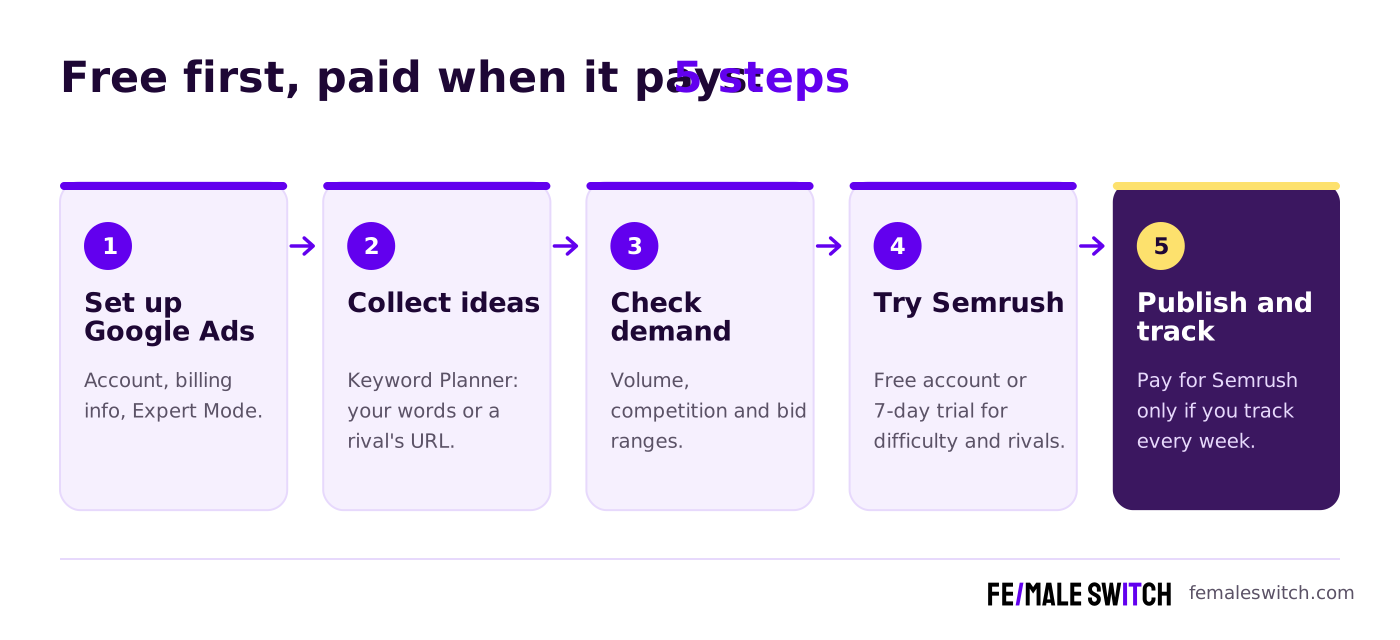
Quick answer: start with Google Keyword Planner. It is free once your Google Ads account is set up with billing information, and its numbers come from Google itself, which makes it the right tool for checking demand and planning ads. Pay for Semrush when you need SEO work that Keyword Planner does not do: keyword difficulty, your competitors' organic keywords, daily rank tracking for 500 keywords and site audits (AI-search tracking starts on the Starter plan). The SEO plan costs €134 a month, or €112.52 a month billed annually, as shown to our European visitor, with a free account and a 7-day trial.
Are you getting customers from ChatGPT yet?
More and more traffic is coming from Perplexity, ChatGPT, Grok and other AI tools.
👉 Rank on ChatGPT
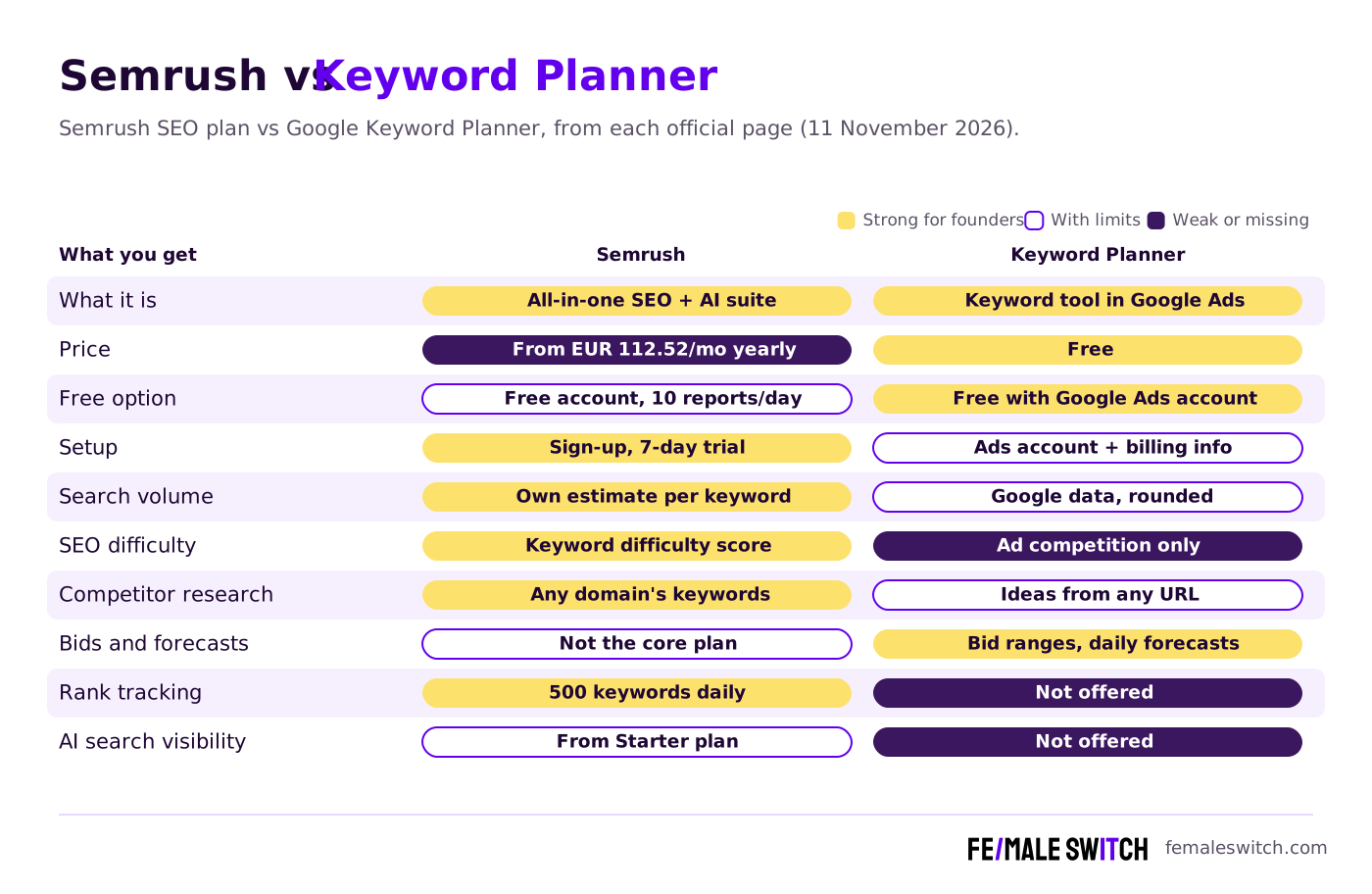
Semrush vs Keyword Planner at a Glance
Sources: semrush.com (homepage, pricing, keyword research page, Adobe FAQ) and Google Ads Help plus Google's Keyword Planner page, checked 11 November 2026. Semrush showed prices in euros to our European visitor, on its default annual view.
Semrush and Keyword Planner in 2027: What Each One Does
Semrush: the paid all-in-one SEO and AI-search suite
Semrush now calls itself a platform to grow and measure brand visibility "everywhere search happens": in Google and in AI answers. For keywords, its keyword research tools include the Keyword Magic Tool for ideas, the Keyword Strategy Builder for grouping topics, keyword gaps against competitors, a personal keyword difficulty score for your own site and Position Tracking for the keywords you pick. Around that it adds competitor analysis, backlinks, site audits, content tools, AI visibility tracking across ChatGPT, Gemini and Google, and an MCP connection that brings Semrush data into AI assistants. Semrush says its database holds 29 billion keywords, 43 trillion backlinks and 808 million domain profiles across 142 geographic databases. Semrush is now part of Adobe: its customer FAQ of 28 April 2026 says Adobe has officially acquired Semrush.
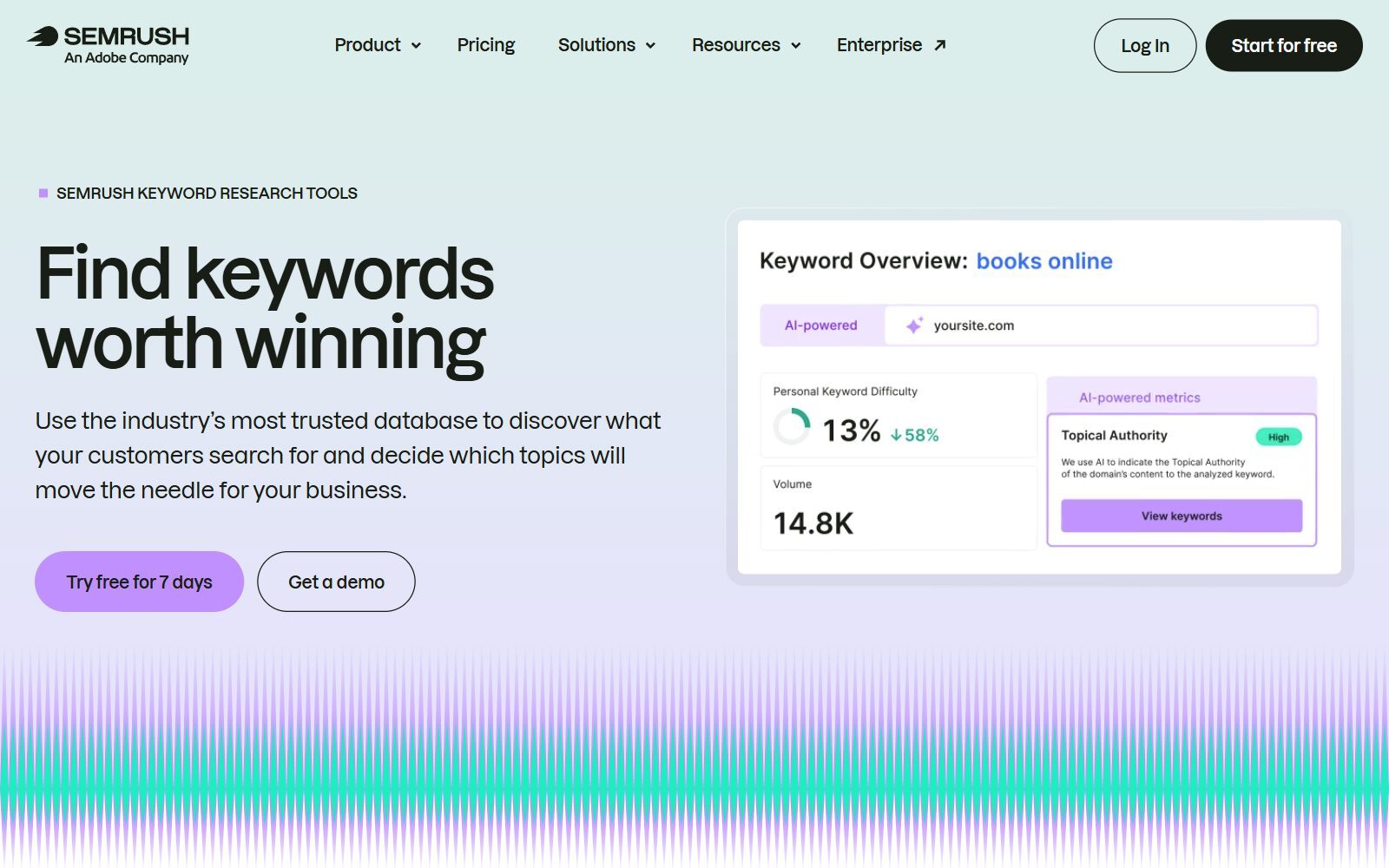
The Semrush pricing page now sells toolkits. The SEO + AI Search plans, on the default annual view in euros:
- SEO, €112.52 a month billed annually (€134 month to month): 5 websites, 500 keywords tracked daily, basic keyword research and competitor analysis, Position Tracking and Site Audit. Aimed at freelancers and small businesses; the AI-search features shown on the card are not included in this plan.
- Starter, €158.40 billed annually (€190 monthly): the full keyword research and competitor tools, MCP access, 50 AI prompts tracked daily and 300 AI visibility reports a day.
- Pro+, €238 billed annually (€286 monthly): 15 websites, 1,500 keywords tracked daily, historical SEO data, content optimisation, keyword cannibalisation analysis, multi-location and device tracking and 100 prompts.
- Advanced, custom price: 40+ websites, 5,000+ keywords, share of voice, API, team users and unlimited prompts.
- Free account, $0: 1 demo project and 10 reports a day across the main tools, with no credit card (AI Visibility features not included). Paid plans come with a 7-day free trial, and you can cancel, downgrade or upgrade at any time. Extra users start at €43 a month.
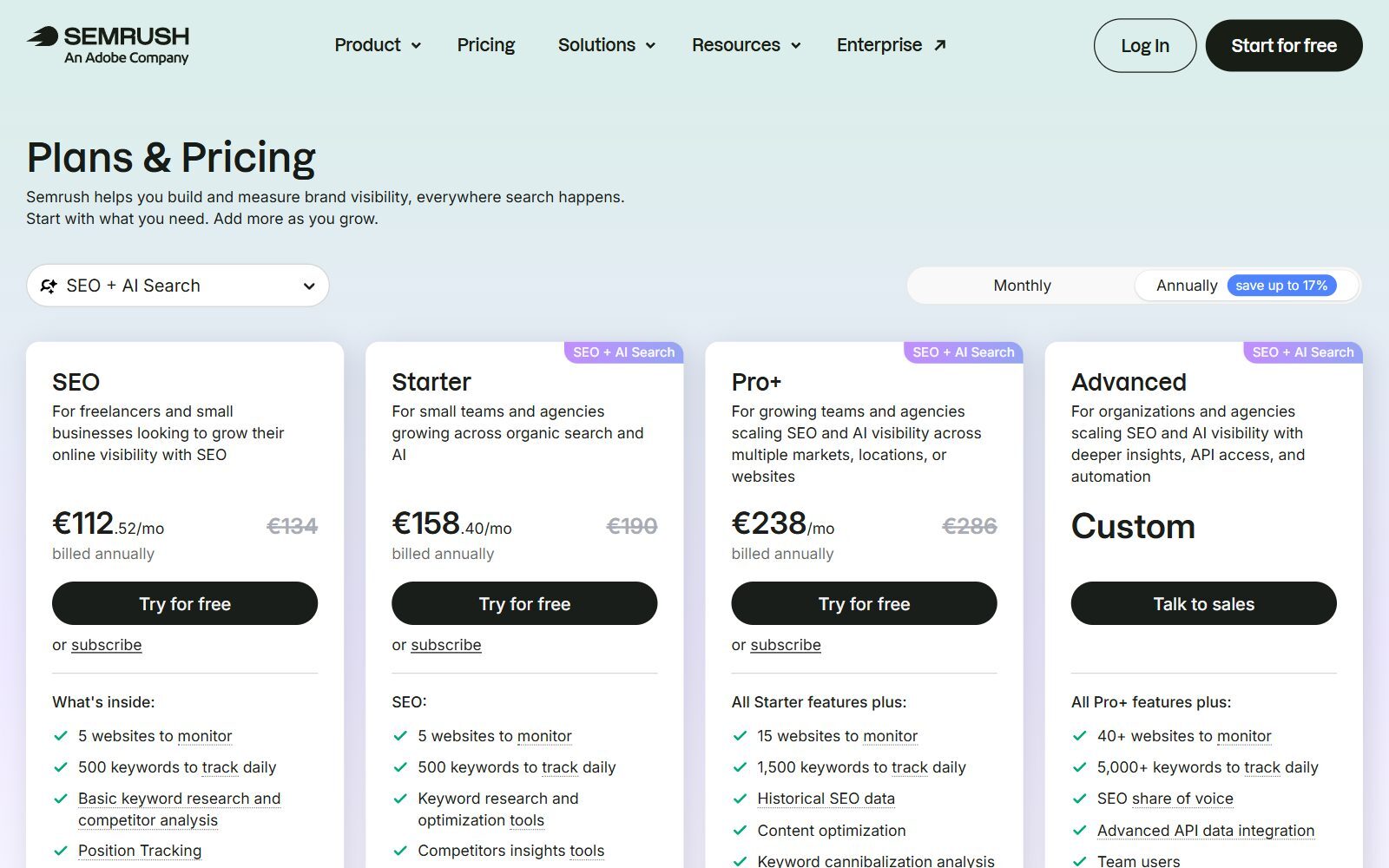
Best for: founders and small teams who publish content every week and need keyword difficulty, competitor data and rank tracking in one place.
Is your startup on ChatGPT?
More and more traffic is coming from Perplexity, ChatGPT, Grok and other AI tools.
👉 Rank on ChatGPT
Google Keyword Planner: Google's own numbers, free inside Google Ads
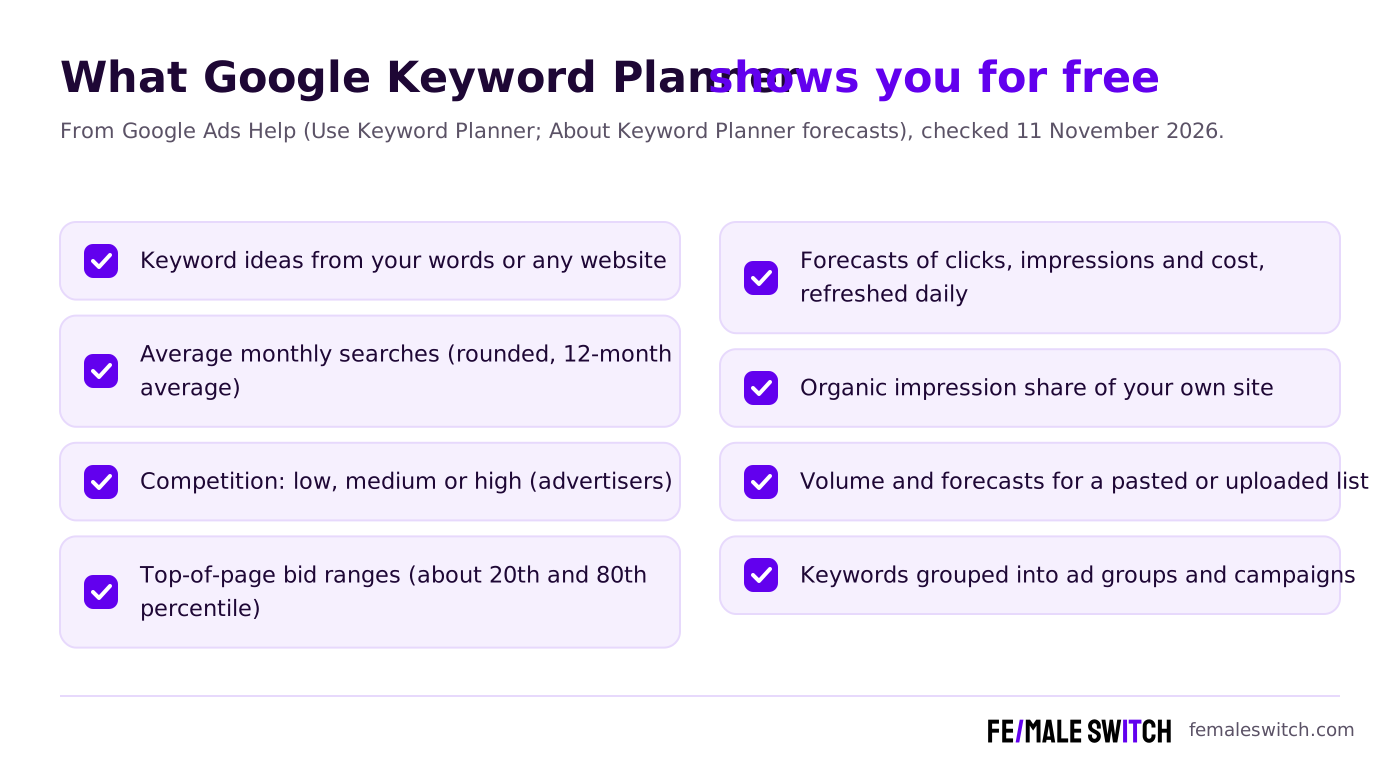
Google Keyword Planner is a free part of Google Ads. You enter words about your business, or any website, and it suggests related keywords with their average monthly searches and the cost to target them; you can also paste or upload your own list to get search volume and forecasts. Google's own Keyword Planner page calls it a free resource to help advertisers build keyword lists for search campaigns.
- Access: you need a Google Ads account. Google says you must complete the account setup, including billing information, to use "Get ideas for new keywords", and its FAQ adds that you create a campaign and switch from Smart Mode to Expert Mode. Then open Tools, Planning, Keyword Planner. There is no separate account.
- Search volume: average monthly searches for the keyword and its close variants, averaged over 12 months by default, for exact match only. Google's forecasts help page says the volumes are rounded. Some accounts see broad ranges instead of one number; the Google help pages we read do not explain when that happens.
- Competition and bids: competition (low, medium or high) counts advertisers, not SEO difficulty. Top-of-page bid ranges show roughly the 20th and 80th percentile of what advertisers paid in the last 30 days.
- Forecasts: expected clicks, impressions, cost, CTR and average CPC for your keywords at a given bid, refreshed daily from the last 7 to 10 days with seasonality.
- Limits: very low-volume and sensitive keywords cannot be found or forecast, health and finance terms often return nothing, and each keyword can have at most 80 characters or 10 words.
Best for: founders who want to check demand for free, and anyone planning a Google Ads campaign.
Boost Your SEO by Getting Featured in Our Blogs and get a backlink.
We publish content about startups, education, tech, funding, etc. that ranks well not only in Google but also in Perplexity, ChatGPT, Grok and other AI tools.
👉 Get featured now!
Semrush vs Keyword Planner: Feature by Feature
Search volume: Google's own numbers vs an estimate
Keyword Planner's averages come straight from Google, so they are the reference point for Google Search, with two caveats: they are rounded, and some accounts see broad ranges. Semrush shows its own estimate for each keyword in each of 142 regional databases, which is easier to compare across many keywords and countries but is still an estimate. Many founders check the final shortlist in Keyword Planner.
Ranking difficulty and competitors
This is where Semrush earns its price. Keyword Planner's "competition" only tells you how many advertisers bid on a keyword; it says nothing about how hard it is to rank organically. Semrush gives a keyword difficulty score (and a personal one for your site), the keywords any competitor ranks for and the gaps between you and them.
Ads and budgets
Keyword Planner wins for Google Ads: bid ranges, click and cost forecasts and a plan you can turn straight into a campaign. Semrush sells advertising research as a separate toolkit, so the SEO plan is not the tool for planning a first ad budget.
Tracking and AI search
Keyword Planner plans; it does not track. Semrush's SEO plan tracks 500 keywords a day across 5 websites and audits your site. Tracking how your brand appears in AI answers starts on the Starter plan, with 50 prompts a day, 100 on Pro+ and unlimited on Advanced.
What Changed Since the Old Version of This Comparison
- New Semrush plans: the 2026 version quoted "$139.95 a month" and old plan names. Today the SEO + AI Search plans are SEO, Starter, Pro+ and Advanced, shown in euros to European visitors, with other toolkits (Traffic and Market, Local, Content, Social, Advertising) sold separately.
- Semrush is part of Adobe: Adobe completed the acquisition, per Semrush's FAQ of 28 April 2026.
- Free account wording: the free plan now gives 1 demo project and 10 reports a day across the main tools.
- Keyword Planner access: Google's help pages now say billing information must be entered before you can get keyword ideas.
- Removed: an unsourced "74% of startups" survey figure, an unsourced "3 to 6 months" SEO timeline, claims about unnamed AI features, links to third-party blogs and a generic mistakes section.
Which One Should You Choose?
- You have no budget yet: Keyword Planner, plus Semrush's free account for 10 reports a day.
- You plan your first Google Ads campaign: Keyword Planner, for bid ranges and forecasts.
- You publish content every week and want to rank: Semrush SEO, for keyword difficulty, competitors and daily rank tracking. Test it with the 7-day trial first.
- You care about ChatGPT and AI answers: Semrush Starter or higher, which tracks AI prompts every day.
- You want a cheaper paid tool: see Semrush alternatives, free Ahrefs alternatives and Ahrefs vs Semrush.
More match-ups for Keyword Planner: Keyword Tool vs Keyword Planner, SpyFu vs Keyword Planner, Similarweb vs Keyword Planner, KWFinder vs Keyword Planner, Wincher vs Keyword Planner and Keyword Revealer vs Keyword Planner. More match-ups for Semrush: Semrush vs Similarweb, Semrush vs BrightEdge, Semrush vs Majestic and Semrush vs Long Tail Pro.
How Founders Use Semrush, Keyword Planner and Other Keyword Tools
- Start with Google's free data. Our Google Ads Keyword Planner guide walks through the setup, and the list of Google Ads keyword tools shows what else works with it.
- Study your competitors. The Semrush competitor analysis guide shows the method; for ad history, see SpyFu vs Rank Tracker.
- Compare more research tools. Our overview of SEO keyword research tools for startups and the guide to keyword research for startups cover cheaper and free options.
- Build links to the pages you publish. Submit your startup to the F/MS marketing directories and pitch guest posts to blogs that cover your niche.
- Track and refine. Watch the pages you publish weekly and check whether AI chatbots cite you; the competitor analysis tools list helps you see who outranks you.
Research only pays off when you publish: the F/MS AI SEO Tool turns your keywords into articles built to rank on Google and to be cited by ChatGPT and Perplexity, with human editors checking the result, and the AI SEO blog explains the method.
Boost Your SEO by Publishing Your Startup Press Release with us.
We publish content about startups, education, tech, funding, etc. that ranks well not only in Google but also in Perplexity, ChatGPT, Grok and other AI tools.
👉 Publish Press Release
FAQ: Semrush vs Google Keyword Planner
What is the main difference between Semrush and Google Keyword Planner?
Semrush is a paid all-in-one SEO and AI-search suite with keyword difficulty, competitor research, rank tracking and site audits. Google Keyword Planner is a free tool inside Google Ads that shows Google's own search volumes, ad competition, bid ranges and forecasts for advertisers.
Is Google Keyword Planner free?
Yes. Google calls it a free resource for advertisers. To use it you need a Google Ads account with the setup completed, including billing information, and Google's FAQ says you also create a campaign and switch to Expert Mode. The tool itself costs nothing.
How much does Semrush cost?
On 11 November 2026 the default annual view showed SEO at €112.52 a month billed annually (€134 month to month), Starter at €158.40 (€190), Pro+ at €238 (€286) and Advanced on request, in euros for our European visitor.
Does Semrush have a free plan or trial?
Yes. The free account gives 1 demo project and 10 reports a day across the main tools with no credit card, and paid plans have a 7-day free trial.
Which is more accurate for search volume?
Keyword Planner's numbers come from Google, but Google says they are rounded, and some accounts see ranges. Semrush shows its own estimates. Use Keyword Planner as the reference for Google and Semrush to compare many keywords and countries quickly.
Does Keyword Planner show keyword difficulty?
No. Its competition column shows how many advertisers bid on a keyword, not how hard it is to rank organically. Semrush gives a keyword difficulty score and a personal one for your site.
Which tool is better for Google Ads?
Keyword Planner. It gives top-of-page bid ranges, click and cost forecasts and plans you can turn into campaigns. Semrush sells its advertising research as a separate toolkit.
Can I use Semrush and Keyword Planner together?
Yes. A common setup is Keyword Planner for free ideas, Google's volumes and bids, and Semrush (free account, trial or SEO plan) for difficulty, competitors and rank tracking.
Where can I submit a guest post about my startup?
You can publish a guest post in one of the Fe/male Switch startup blogs, which rank in Google and in AI tools like ChatGPT and Perplexity. Get a quality backlink.
Who owns Semrush now?
Adobe. Semrush's customer FAQ of 28 April 2026 says Adobe has officially acquired Semrush, and the Semrush logo now reads "An Adobe Company".
About the Author
Violetta Bonenkamp, also known as MeanCEO, is an experienced startup founder with an impressive educational background including an MBA and four other higher education degrees. She has over 20 years of work experience across multiple countries, including 5 years as a solopreneur and serial entrepreneur. Throughout her startup experience she has applied for multiple startup grants at the EU level, in the Netherlands and Malta, and her startups received quite a few of those. She’s been living, studying and working in many countries around the globe and her extensive multicultural experience has influenced her immensely.

