

SpyFu vs Google Keyword Planner: Spy on Competitors or Use Google's Own Data in 2027?
SpyFu and Google Keyword Planner both give you keyword lists, but they start from opposite ends. SpyFu starts from your competitors: type in a domain and it shows the keywords that site ranks for on Google, the keywords it buys on Google Ads, every ad it has tested and how all of that changed over the years. Google Keyword Planner starts from your own ideas: it is Google's free planning tool for advertisers, with average monthly searches, competition, bid ranges and forecasts for the keywords you enter. Whether you search for Keyword Planner vs SpyFu or SpyFu vs Keyword Planner, this guide shows what each one gives a startup. We checked SpyFu's site and Google's own help pages on 8 November 2026.
Quick answer: start with Google Keyword Planner, which costs nothing once your Google Ads account is set up with billing details and a campaign, for search volume, competition and bid estimates. Add SpyFu when you need to know what already works for your competitors in search and in Google Ads: its free version shows limited results with no time limit, and paid plans start at $39 a month, or $29 a month billed annually, with a 30-day money-back guarantee. For a startup about to spend on Google Ads, the two together are a cheap way to avoid guessing.
Are you getting customers from ChatGPT yet?
More and more traffic is coming from Perplexity, ChatGPT, Grok and other AI tools.
👉 Rank on ChatGPT
SpyFu vs Keyword Planner at a Glance
Sources: spyfu.com (home, pricing, help centre), Google Ads Help (Use Keyword Planner; About Keyword Planner forecasts) and Google's Keyword Planner page, checked 8 November 2026. SpyFu shows prices in US dollars.
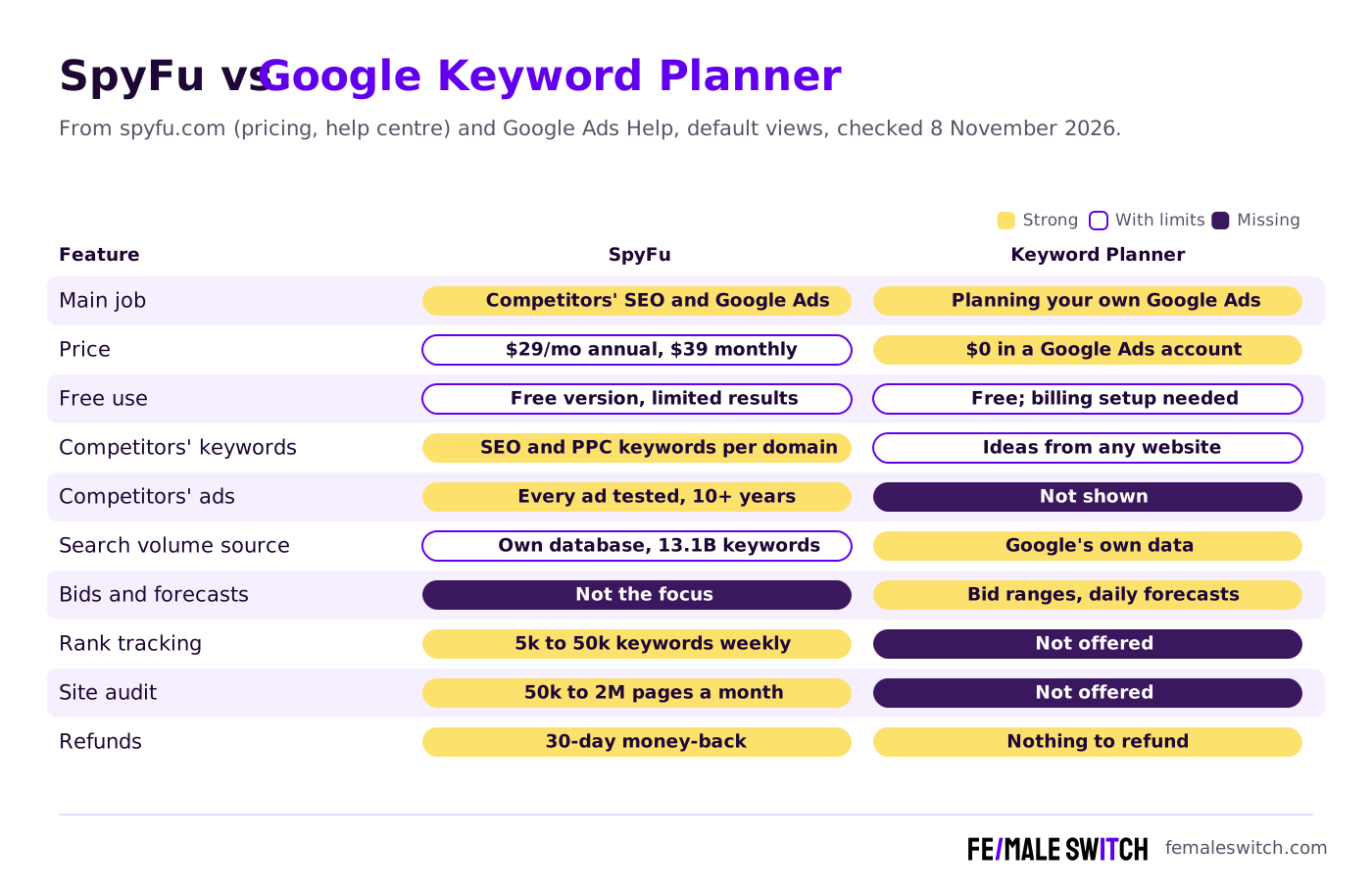
The Two Tools in 2027
SpyFu: what already works for your competitors
SpyFu is built around one question: what is working for other sites on Google? Its homepage promises the SEO and PPC keywords your competitors "buy and rank for, every ad they've tested, and how your own site stacks up". SpyFu says its data covers 38 countries, 13.1 billion keywords and 152 million websites, with 18+ years of history on the homepage (the pricing page says 10+ years); these are the company's own figures.
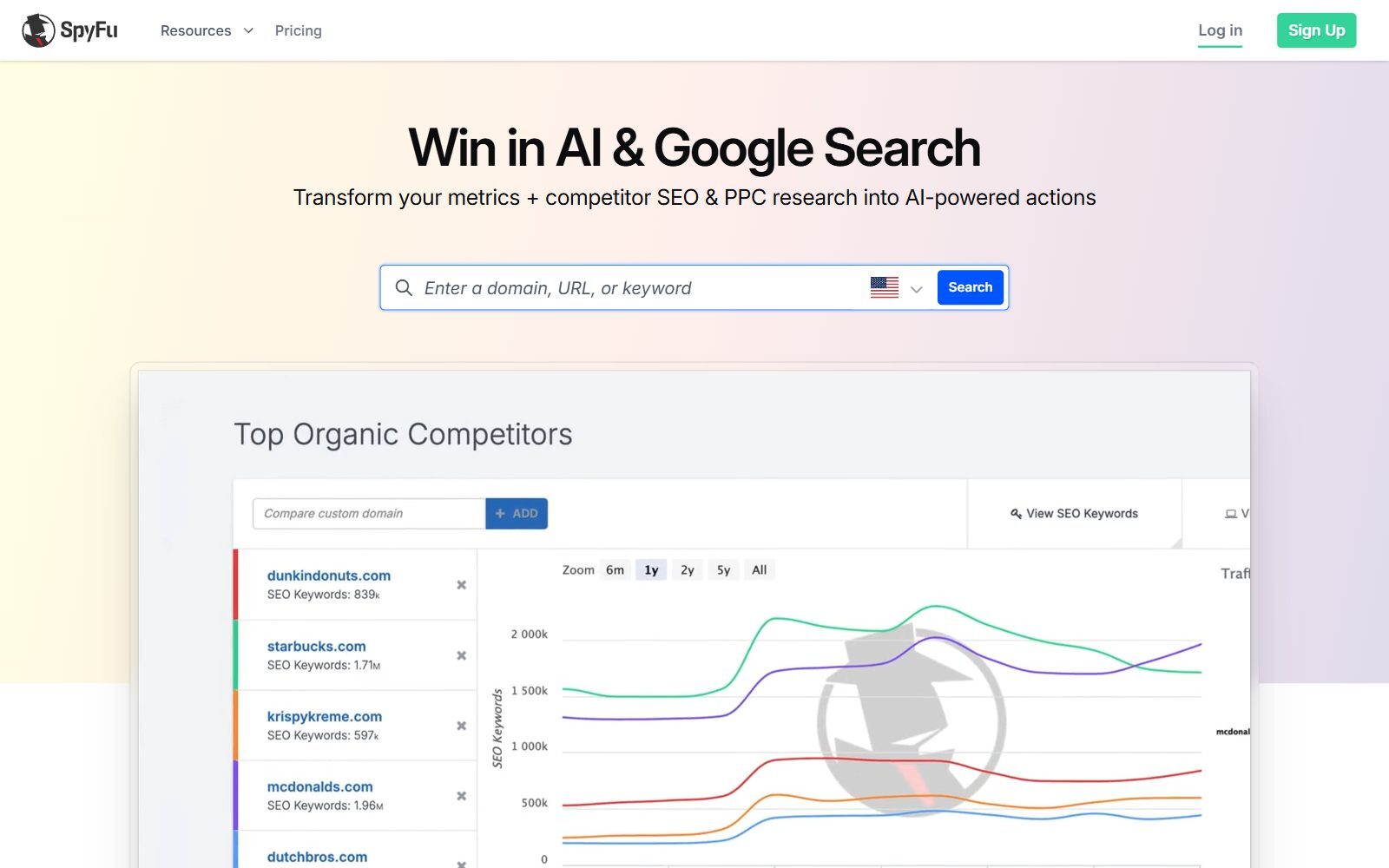
- Competitor SEO: the keywords a domain ranks for, its organic ranking history and the organic competitors it shares keywords with; Kombat compares several domains at once.
- Competitor Google Ads: every keyword a competitor has bought on Google and every ad variation it has tested, which shows which ad copy survived.
- Your own site: weekly rank tracking (5,000 keywords on Basic), automated reports, Google Search Console integration and an AI-powered site audit that checks 100+ issues and writes fixes you can publish to a connected site.
- AI tools: a ChatGPT integration that brings SpyFu data into ChatGPT (3 chats on Basic), AI Brand Monitoring and RivalFlow, which suggests page improvements (from Pro + AI).
What SpyFu costs
The SpyFu pricing page shows a monthly and an annual price on each plan, in US dollars:
- Basic, $39 a month or $29 a month billed annually: 10,000-row search results and exports, 1 site tracking project, 5,000 weekly tracked rankings, 50,000 audited pages a month, 1,000 AI fixes, 1 user.
- Pro + AI, $59 for the first month, then $119 a month, or $89 a month billed annually: unlimited results and exports, 10 projects, 15,000 tracked rankings, 500,000 audited pages, API credits worth $40 a month, 1 user ($30 per extra user).
- Team / Agency, $249 a month or $187 a month billed annually: unlimited projects, 50,000 tracked rankings, 2 million audited pages, $100 of API credits, 5 users.
- Risk: a 30-day money-back guarantee, and you can cancel any time by email, live chat or phone.
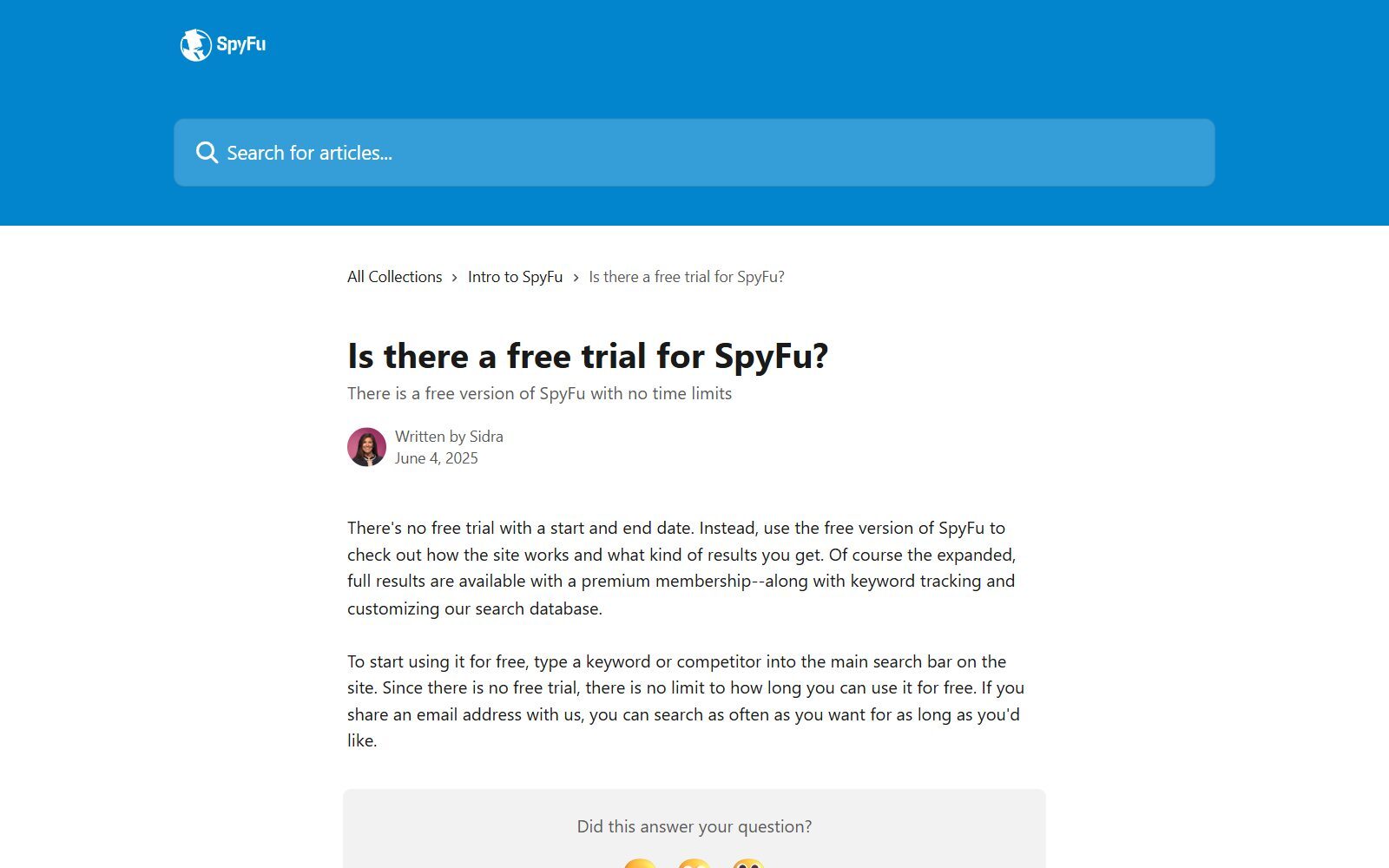
Free version: SpyFu's help centre says there is no free trial with a start and end date. Instead, the free version shows limited results for as long as you like, and the full results need a paid plan.
Is your startup on ChatGPT?
More and more traffic is coming from Perplexity, ChatGPT, Grok and other AI tools.
👉 Rank on ChatGPT
Google Keyword Planner: Google's own numbers for your keywords
Google describes Keyword Planner on its Google Ads site as "a free resource to help advertisers build keyword lists for search campaigns". According to the Use Keyword Planner help page, you can discover new keywords from words or from a website, see estimates of how often they are searched and what it costs to target them, and build a forecast for a campaign. There is no separate sign-up: it sits in a Google Ads account under Tools, Planning, Keyword Planner.
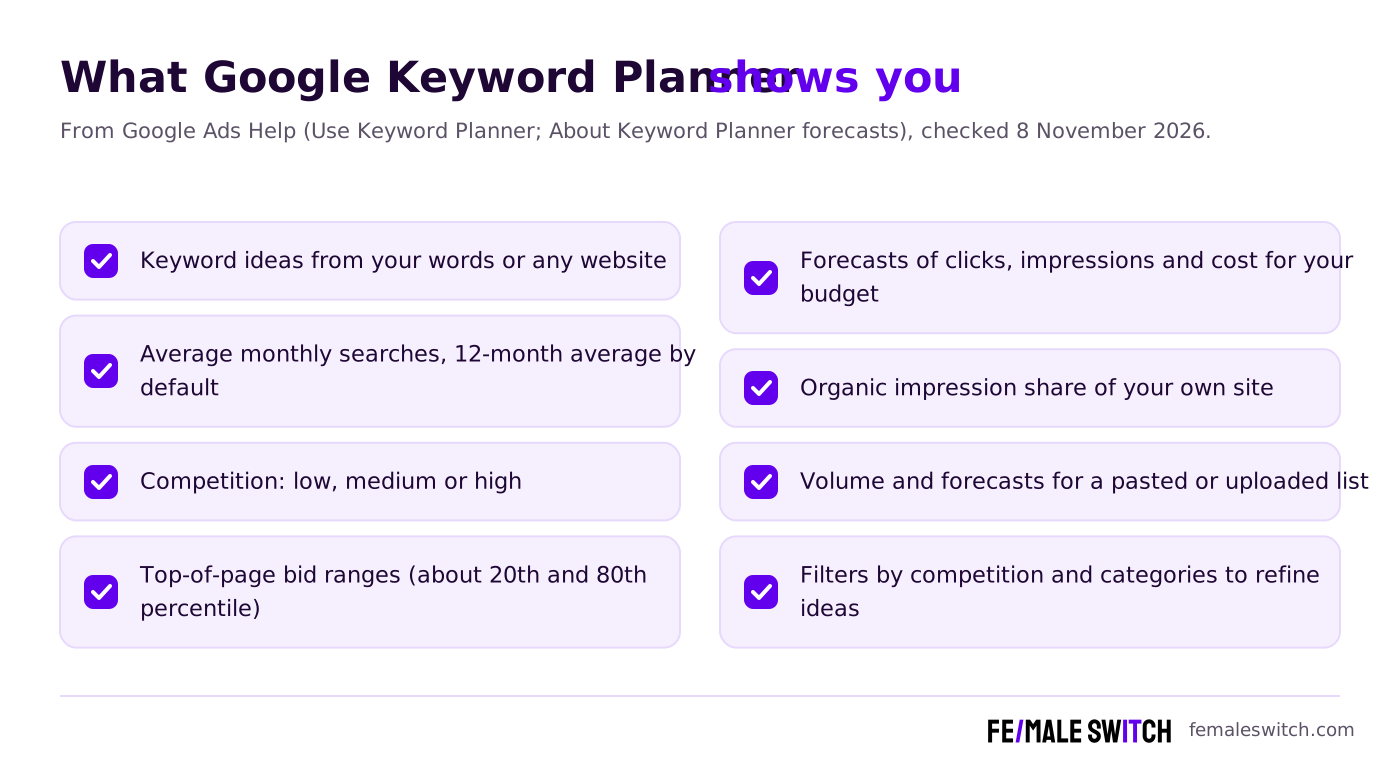
- Average monthly searches: searches for the keyword and its close variants, averaged over 12 months by default, for the location and network you choose. Google notes these historical stats are shown only for exact matches (About Keyword Planner forecasts).
- Competition: low, medium or high, based on how many advertisers showed ads on the keyword compared with all keywords on Google.
- Top-of-page bid ranges: the low end is roughly the 20th percentile and the high end roughly the 80th percentile of what advertisers have historically paid.
- Forecasts: clicks, impressions, conversions and cost for your budget, refreshed daily from the last 7 to 10 days and adjusted for seasonality.
- Organic impression share: how often your own site appeared in web searches for a keyword idea.
The limits: to use "Get ideas for new keywords" you must enter billing information and finish the account setup, and Google's Keyword Planner page says you need to create a campaign and switch from Smart Mode to Expert Mode. Keywords with very low search volume, or in sensitive categories such as health or finance, often show no results. Keywords can be at most 80 characters or 10 words. Some accounts see search volume as broad ranges (for example 1K to 10K) rather than one number; the Google help pages we read do not explain when that happens, so treat ranges as rough buckets. And it only covers Google: there is no competitor ad history, no rank tracking and no site audit.
Boost Your SEO by Getting Featured in Our Blogs and get a backlink.
We publish content about startups, education, tech, funding, etc. that ranks well not only in Google but also in Perplexity, ChatGPT, Grok and other AI tools.
👉 Get featured now!
Keyword Planner vs SpyFu: Feature by Feature
Finding keywords
Keyword Planner gives you ideas around your own words, or around any website you paste in, straight from Google's data. SpyFu gives you the keywords that a competitor already ranks for or pays for, which is often faster for a startup: you see which topics have already proven themselves in your market.
Search volume
Keyword Planner's averages come from Google itself, so they are the reference point, with the range caveat above. SpyFu's volumes are its own estimates from search, clickstream and AI data. Use Google's number when you budget an ad campaign; use SpyFu's to compare keywords quickly.
Google Ads
Both help, in different ways. Keyword Planner gives you bid ranges and a forecast for your budget. SpyFu shows what your competitors bid on and the ads they kept running, which tells you what probably converts. Startups that run ads usually want both before they spend the first euro.
Price
Keyword Planner costs nothing. SpyFu starts at $29 a month billed annually ($348 a year) or $39 month to month, and its free version is enough for a first look at a few competitors.
What Changed Since the Earlier Version of This Article
- SpyFu prices: the old text said plans start at $39 a month. That is still the monthly Basic price, but annual billing now brings it to $29 a month, and the middle plan is called Pro + AI.
- "Unlimited queries" corrected: Basic caps search results and exports at 10,000 rows; unlimited results start on Pro + AI.
- SpyFu added AI tools: an AI-powered site audit that writes fixes, a ChatGPT integration, AI Brand Monitoring and RivalFlow.
- Keyword Planner setup: Google now says billing information and a finished account setup are needed even for basic keyword ideas.
- Removed: claims about competitor ad spend that we could not find on SpyFu's pages, "voice assistant" filler, links to third-party review articles, and a generic "common mistakes" list.
SpyFu or Keyword Planner: Which Should You Choose?
- You have no budget: Keyword Planner for volumes and bids, plus SpyFu's free version for a first look at competitors.
- You plan your first Google Ads campaign: both. Competitors' keywords and ads from SpyFu, bid ranges and a forecast from Keyword Planner.
- You mainly do SEO: SpyFu, for competitors' ranking keywords, rank tracking and the site audit. Keyword Planner has none of these.
- You only need ideas and volumes: Keyword Planner, or a free idea tool; see Keyword Tool vs Keyword Planner and Keyword Tool vs Keyword Revealer.
- You need keyword difficulty or rank tracking next to Google's data: KWFinder vs Keyword Planner, Keyword Revealer vs Keyword Planner and Wincher vs Keyword Planner.
- You want traffic estimates for whole websites: Similarweb vs Keyword Planner.
More SpyFu match-ups: SpyFu vs Keyword Insights (competitor research vs keyword clustering) and SpyFu vs SE Ranking (research tool vs all-in-one suite). For two budget tools from one company, see the sibling Ubersuggest vs AnswerThePublic, and for bigger suites, Ahrefs vs Semrush, our Semrush alternatives and free Ahrefs alternatives.
How Founders Use SpyFu and Keyword Planner Together
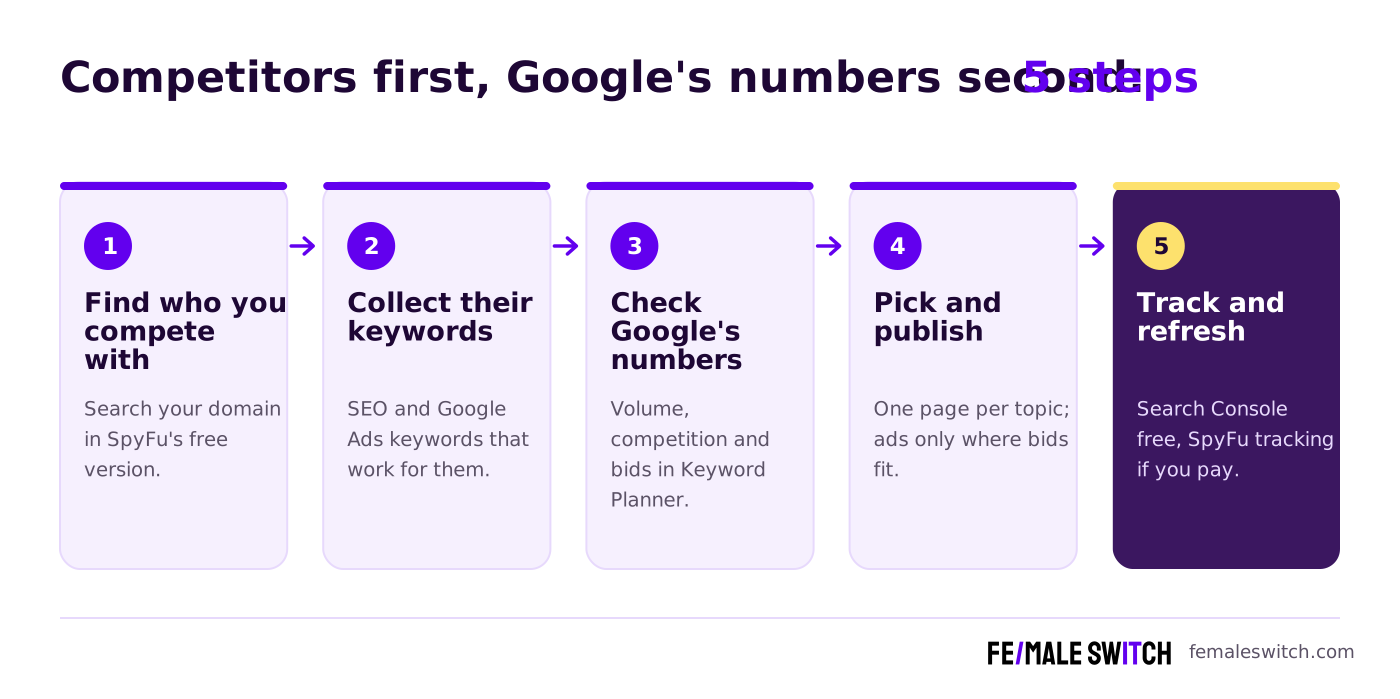
- Find who you compete with. Search your own domain, or a competitor's, in SpyFu's free version and note the sites that share your keywords. Our guide to checking competitor keywords explains what to look for.
- Collect their keywords. Save the SEO keywords they rank for and the Google Ads keywords they keep paying for.
- Check Google's numbers. Paste the list into Keyword Planner's "Get search volume and forecasts" for average monthly searches, competition and bid ranges. See how to use Google Keyword Planner and these Keyword Planner tips.
- Pick and publish. Write one page per topic for the keywords you can realistically rank for, and advertise only where the bid ranges fit your budget.
- Track and refresh. Watch your clicks in Google Search Console, which is free, or track rankings weekly in SpyFu if you pay for it, and update pages that slip.
On a $0 budget, also read how startups can do keyword research on a $0 budget and the guide to SEO keyword research tools for startups.
Keywords only pay off once you publish. The F/MS AI SEO Tool turns a keyword into a full article written to rank on Google and to be cited by AI assistants such as ChatGPT and Perplexity, with human editors checking the result. For early links to a new site, F/MS Marketing Directories lists places where you can submit your startup, and F/MS Marketing Services offers done-for-you features and backlinks.
Boost Your SEO by Publishing Your Startup Press Release with us.
We publish content about startups, education, tech, funding, etc. that ranks well not only in Google but also in Perplexity, ChatGPT, Grok and other AI tools.
👉 Publish Press Release
FAQ: SpyFu vs Google Keyword Planner
What is the main difference between SpyFu and Google Keyword Planner?
SpyFu shows what your competitors rank for and buy on Google, with their ad history. Keyword Planner shows Google's own search volume, competition, bid ranges and forecasts for the keywords you choose.
Is Google Keyword Planner free?
Yes. Google calls it a free resource for advertisers. You need a Google Ads account with billing information and a finished setup; Google's Keyword Planner page also says to create a campaign and use Expert Mode.
How much does SpyFu cost?
Basic costs $39 a month, or $29 a month billed annually. Pro + AI costs $59 for the first month and then $119 a month, or $89 a month annually. Team / Agency is $249 a month or $187 annually. There is a 30-day money-back guarantee.
Does SpyFu have a free trial?
Not a time-limited one. SpyFu's help centre says there is a free version with limited results and no time limit; full results need a paid plan.
Where can I submit a guest post about my startup?
You can publish a guest post in one of the Fe/male Switch startup blogs, which rank in Google and in AI tools like ChatGPT and Perplexity. Get a quality backlink.
Why does Keyword Planner show ranges instead of exact numbers?
Some accounts see search volume as broad ranges. Google's help pages we read do not explain when that happens. Treat ranges as rough buckets, and compare them with another source such as SpyFu.
Which tool is better for Google Ads?
Use both. Keyword Planner gives bid ranges and forecasts for your budget; SpyFu shows the keywords and ads your competitors kept paying for.
Which tool is better for SEO?
SpyFu. It shows competitors' ranking keywords and adds rank tracking and a site audit. Keyword Planner is built for ads and has no rank tracking.
Can Keyword Planner show my competitors' keywords?
Partly. You can paste any website and Google suggests keywords related to its content, but it does not show what that site ranks for or which ads it ran.
Can I use AI to write SEO articles from my keywords?
Yes. The F/MS AI SEO Tool writes articles from your keywords that are built to rank on Google and in AI assistants, with human editors reviewing them.
About the Author
Violetta Bonenkamp, also known as MeanCEO, is an experienced startup founder with an impressive educational background including an MBA and four other higher education degrees. She has over 20 years of work experience across multiple countries, including 5 years as a solopreneur and serial entrepreneur. Throughout her startup experience she has applied for multiple startup grants at the EU level, in the Netherlands and Malta, and her startups received quite a few of those. She’s been living, studying and working in many countries around the globe and her extensive multicultural experience has influenced her immensely.

