
Best Countries in Asia for Early-Stage Startups: Visas, Programmes and Rankings You Can Check
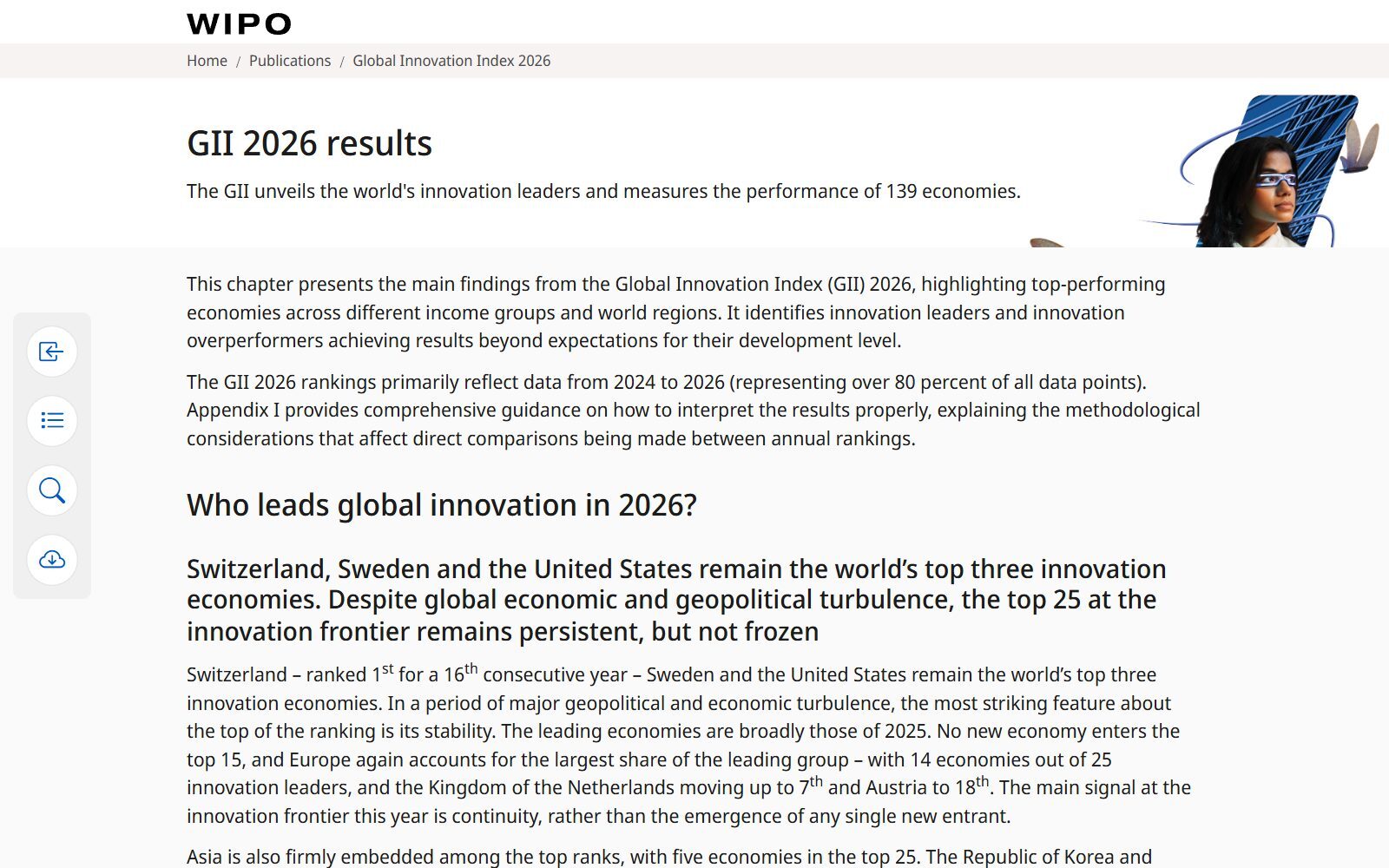
Choosing where to start up in Asia comes down to three practical questions: can you get a visa to run your own company there, is there public money or a programme for very young startups, and how strong is the innovation system around you. This guide answers those questions for 12 Asian economies: South Korea, Singapore, China, Japan, Hong Kong, Taiwan, Malaysia, India, Vietnam, Thailand, the Philippines and Indonesia. Every visa and programme was checked on an official government or programme page on 12 November 2026, and the only ranking we use is WIPO's Global Innovation Index (GII) 2026, which covers 139 economies.
Quick answer: for a foreign founder with an early-stage startup, Singapore (EntrePass plus the Startup SG Founder grant), South Korea (startup visas, the K-Startup Grand Challenge and GII 4th place) and Taiwan (Entrepreneur Visa and the Employment Gold Card) have the clearest routes. Japan lets you prepare for up to 2 years on its Startup Visa, but its regular Business Manager visa now needs JPY 30 million of capital. Malaysia (MTEP pass and Cradle grants) and Thailand (SMART S visa) are cheaper Southeast Asian bases. India, Vietnam, Indonesia and China suit founders who are already there or have a local co-founder: we found no startup visa on their official pages.
Write FREE SEO-optimized Blog Articles! Our Article Writer ensures your blog is loved by both Google and your readers, turning those clicks into customers.
👉 Write your article here
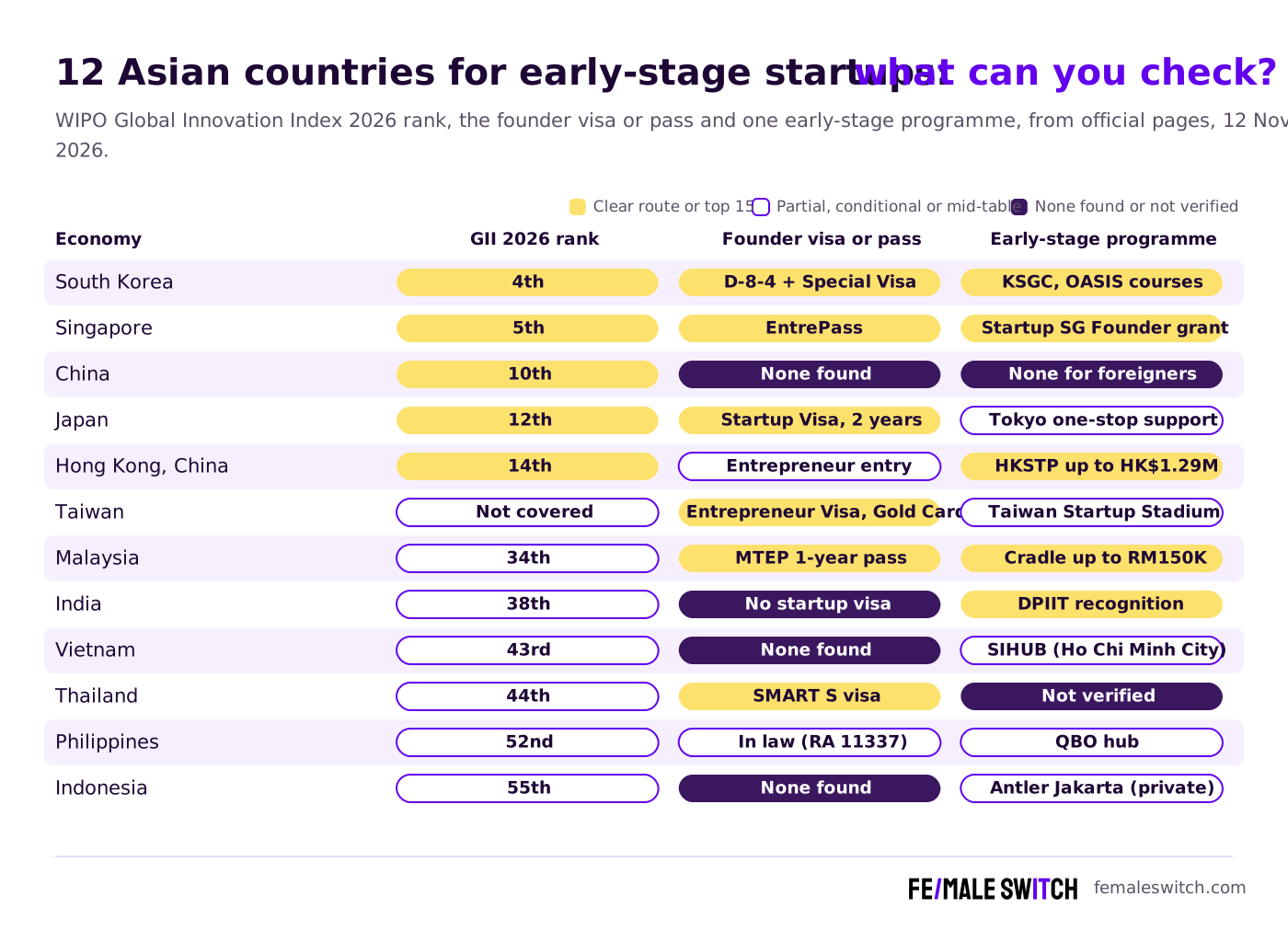
Asian Countries for Early-Stage Startups Compared
Sources: WIPO Global Innovation Index 2026 and each government or programme page, checked 12 November 2026. The GII does not rank Taiwan. Rules change, so read the official page again before you apply.
How We Chose and Ordered the Countries
We kept the ten countries of the 2025 version and added Japan and Taiwan, which have some of Asia's clearest founder routes. A country stays on the list even when we could not find a startup visa, because many founders start where they already live; in that case we say so. The countries are ordered by their rank in WIPO's Global Innovation Index 2026, which measures innovation inputs and outputs, not how easy it is to start a company. Treat the order as a reading aid, and use the visa and programme facts to decide. We removed every figure from the old article that had no source, including ecosystem values, "Silicon Valley of Asia" labels and links to an AI search tool.
The 12 Best Countries in Asia for Early-Stage Startups in 2027
1. South Korea (GII 4th)
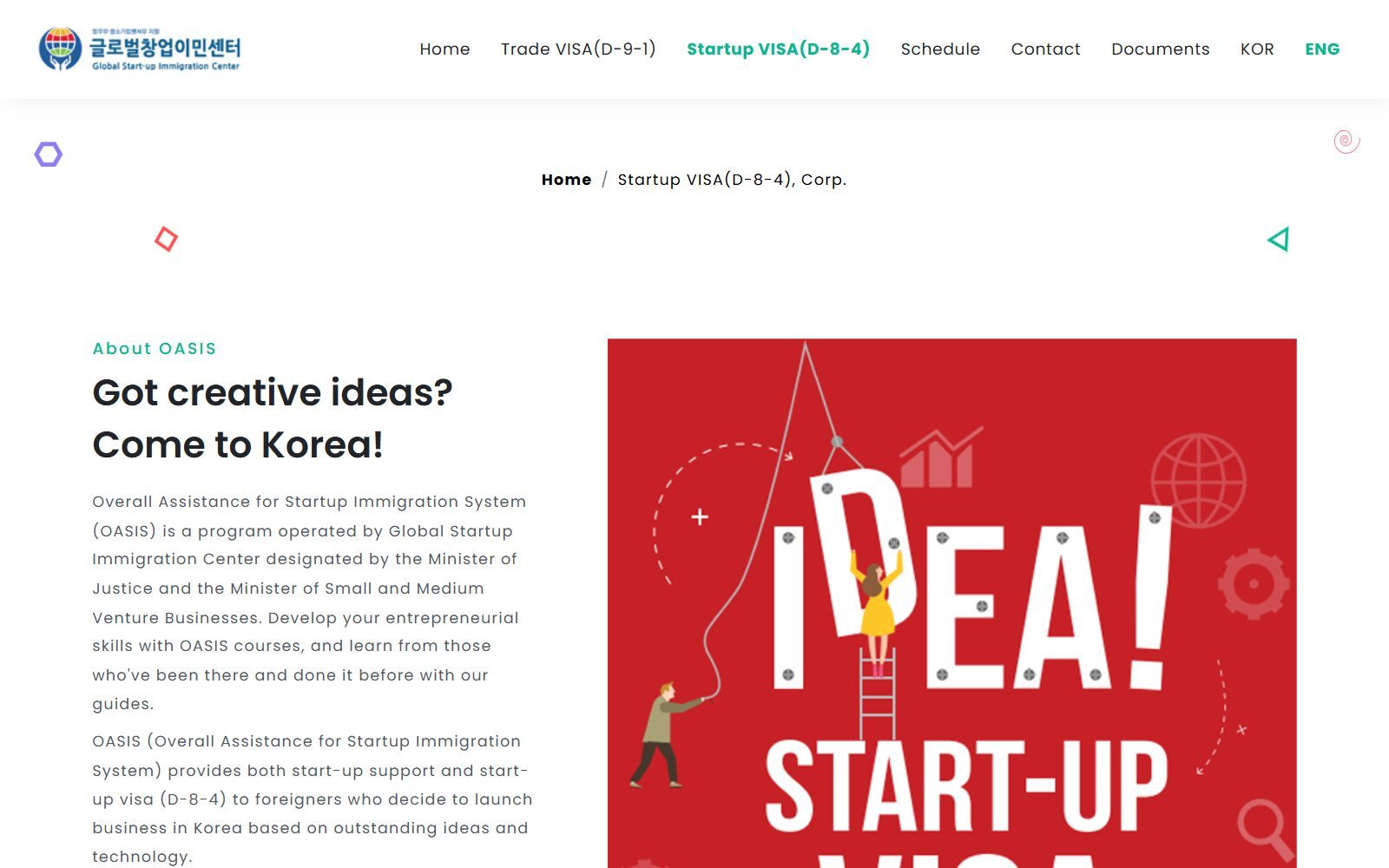
WIPO places the Republic of Korea 4th in the GII 2026 and 1st in the world for business-performed R&D, with Seoul the 5th-largest innovation cluster. For founders the routes are well documented. The OASIS programme of the Global Startup Immigration Center, designated by Korea's Ministers of Justice and SMEs, leads to the D-8-4 startup visa: you need a bachelor's degree, at least 60 OASIS points (including one prerequisite item such as intellectual property) and a company set up in Korea; its courses and coaching earn points. The Ministry of SMEs and Startups also recommends founders for the Startup Korea Special Visa: representatives of a (prospective) startup who are not Korean nationals apply on a rolling basis, and the call is listed until 30 December 2026. The government-backed K-Startup Grand Challenge helps foreign startups incorporate in Korea and supports the D-10-2 and D-8 visas; its 2026 call closed on 17 June 2026. See our Seoul startups to watch and the startup events in Seoul.
2. Singapore (GII 5th)
Singapore is 5th in the GII 2026 and, according to WIPO, still the strongest economy in the world for innovation inputs. The Ministry of Manpower's EntrePass is for foreign founders of a private limited company registered with ACRA that is venture-backed or owns innovative technology; you must hold at least 30% of it and meet one criterion, such as raising at least SGD 100,000 in a single round, being supported by a government-recognised or internationally renowned incubator or accelerator, or having founded and sold a tech business. For first-time founders, Startup SG Founder gives a startup grant of S$20,000 to S$50,000 with mentoring; Enterprise Singapore matches it 1:1, so you put in the same amount as paid-up capital, and you need a letter of recommendation from an Accredited Mentor Partner. Compare the accelerators there in our startup accelerators in Asia and see the startup events in Singapore.
3. China (GII 10th)
China stays 10th in the GII 2026 and is the only middle-income economy among the innovation leaders; WIPO also names Shenzhen-Hong Kong-Guangzhou the world's top innovation cluster for the second year running. For a foreign founder, though, we found no national startup visa or early-stage programme for foreigners on an official page, so China mostly suits founders who already live and work there. Many foreign founders test the market from Hong Kong (number 5) instead. See our China startups to watch.
4. Japan (GII 12th)
Japan holds 12th place in the GII 2026, and WIPO ranks Tokyo-Yokohama the world's second innovation cluster. Its Startup Visa runs through local governments and private operators certified by the Ministry of Economy, Trade and Industry (Fukuoka City was the first, in January 2019): once your plan is confirmed, the Immigration Services Agency lets you spend up to 2 years preparing your business. That matters because the regular Business Manager status has been much harder to get since its new rules took effect on 16 October 2025: you now need capital of JPY 30 million or more, at least one full-time employee who is Japanese or holds a qualifying residence status, and a considerable level of Japanese. Tokyo's support site for foreign founders lists the Tokyo Startup Visa, the Business Development Center Tokyo and a one-stop business establishment centre. See our Fukuoka startups to watch, Nagoya startups to watch and the startup events in Tokyo.
Boost Your SEO with 1,500+ Free Business Directories: increase your DA, get backlinks and traffic.
We've compiled an exclusive list of directories and websites where you can submit your business and start building high-quality backlinks to boost your website traffic and get your SEO snowball rolling.
👉 Submit your startup now!
5. Hong Kong, China (GII 14th)
Hong Kong, a Special Administrative Region of China, climbs to 14th in the GII 2026. Its Immigration Department's Investment as Entrepreneurs route asks for a three-year business plan, but it also has a clause for start-ups: an application may be considered favourably if the start-up is supported by a government-backed programme with rigorous selection, such as InvestHK's StartmeupHK Venture Programme, the HKSTP Incu-App, Incu-Bio and Incu-Tech programmes or the Cyberport Incubation Programme. The HKSTP Incubation Programme runs for 3 years and gives up to HKD 1.29 million for technology and business development to startups with an MVP or prototype in ICT, electronics, green technology or precision engineering. See our Hong Kong tech startups and the startup events in Hong Kong.
6. Taiwan (not covered by the GII)
WIPO's index does not rank Taiwan, so it has no GII place here, but its founder routes are clear. The Entrepreneur resident visa is applied for online through the Foreign Professionals Online Application Platform and reviewed by the Investment Commission of the Ministry of Economic Affairs. The Taiwan Employment Gold Card combines an open work permit, residence permit and visa for up to 3 years, so you can work for your own startup or any other company. Taiwan Startup Stadium, founded in 2015, has worked with 230+ Taiwanese startups, 120+ mentors and 500+ investors to take local startups abroad. See our Taipei startups to watch.
7. Malaysia (GII 34th)
Malaysia is 34th in the GII 2026; WIPO notes that Malaysia and India remain in the top 40 among middle-income economies. The Malaysia Digital Economy Corporation's Malaysia Tech Entrepreneur Programme (MTEP) is a pass for tech founders, experienced entrepreneurs and CTOs, with two tracks: a 1-year pass for tech entrepreneurs entering the ecosystem and a 5-year pass for established entrepreneurs and investors, including dependants, which can be approved before you land. For money, Cradle's CIP Spark is a conditional grant of up to RM150,000 for up to 18 months for development and pre-commercialisation; teams need at least two people with at least one Malaysian, and companies must be under 5 years old with accumulated revenue under RM3 million.
8. India (GII 38th)
India is 38th in the GII 2026, leads Central and Southern Asia and is, with Viet Nam, the longest-standing innovation overperformer for its income level, according to WIPO. It has no dedicated startup visa, so it suits Indian founders and foreign founders with an Indian co-founder. The key step is DPIIT startup recognition: it covers private limited companies, partnerships and LLPs up to 10 years old (20 for deep tech) with turnover under INR 200 crore (INR 300 crore for deep tech), and opens the 80-IAC income tax exemption and the angel tax exemption. The Startup India Seed Fund Scheme, paid through incubators, closed to startups on 31 May 2026, so check its site for any new round. See the startup events in Bangalore and our Visakhapatnam startups to watch.
9. Vietnam (GII 43rd)
Viet Nam rises to 43rd in the GII 2026; WIPO notes that it leads in high-tech exports and creative goods exports and has overperformed for its income level for 16 years. We found no startup visa for foreign founders on an official page, so Vietnam mostly suits local founders and teams with a Vietnamese co-founder. In Ho Chi Minh City, the city's startup and innovation centre SIHUB offers training, consulting, investment connections and startup space (site in Vietnamese). Antler also invests in Vietnam from Ho Chi Minh City.
Boost Your SEO by Getting Featured in Our Blogs and get a backlink.
We publish content about startups, education, tech, funding, etc. that ranks well not only in Google but also in Perplexity, ChatGPT, Grok and other AI tools.
👉 Get featured now!
10. Thailand (GII 44th)
Thailand moves up to 44th in the GII 2026, and WIPO says it is gaining ground among upper middle-income economies. Its Board of Investment runs the SMART Visa: the SMART S category is for technology startup founders in targeted industries, who need a deposit of at least 600,000 baht held for at least 3 months, health insurance, and must be a director or hold 25% of a company already set up in Thailand. We could not verify a current national grant for early-stage startups on an official page, so plan to fund the first months yourself. See our Bangkok startups to watch.
11. Philippines (GII 52nd)
The Philippines is 52nd in the GII 2026. Its Innovative Startup Act (Republic Act 11337) of 2019 tells the Department of Foreign Affairs to create startup owner, employee and investor visas, valid for 5 years and renewable for 3, plus free 6 to 12-month interim visas, all with an endorsement from a host agency. We could not find an official page that shows how to apply for them today, so ask a Philippine embassy first. On the ground, QBO Innovation Hub, a division of Ideaspace, has worked with government, universities and companies on the Philippine startup ecosystem since 2016. See our Cebu startups to watch.
12. Indonesia (GII 55th)
Indonesia is 55th in the GII 2026, and WIPO describes it as having stabilised around that rank. We found no startup visa for foreign founders on an official page; the golden visa we saw described in the press is aimed at large investors, and its figures could not be checked on the immigration site. The easiest first cheque for a local team is private: Antler Indonesia invests $85,000 after a six-week residency in Jakarta and pre-commits up to $250,000 more for your next round.
What Changed Since the 2025 List
- Added: Japan and Taiwan, which have some of Asia's clearest founder routes (Japan's Startup Visa, Taiwan's Entrepreneur Visa and Gold Card).
- Rankings: the old "frequently recognised" and "high rankings in global reports" lines had no source; we replaced them with the WIPO GII 2026 rank of each economy.
- Removed figures: Singapore's "US$144 billion in ecosystem value", the "Silicon Valley of Asia" label, Labuan tax claims and every funding-trend sentence without a source.
- Removed links: all 19 links in the old article pointed to an AI search redirect (vertexaisearch.cloud.google.com), not to a real source; each country now links to its own immigration or programme page.
- Japan: the Business Manager visa rules changed on 16 October 2025 (JPY 30 million of capital, a full-time employee and Japanese ability), which makes the Startup Visa the better first step.
- India: the Startup India Seed Fund Scheme closed to new startup applications on 31 May 2026.
Which Asian Country Should You Choose?
- You are a foreign founder with a tech product and some funding: Singapore (EntrePass) or South Korea (startup visas and KSGC).
- You are a first-time founder in Singapore: Startup SG Founder, with its 1:1 matched grant.
- You build hardware or deep tech: Taiwan, Hong Kong (HKSTP) or Korea; also read our deep tech cities in Asia and deep tech grants in Asia.
- You want a low-cost Southeast Asian base: Malaysia (MTEP and Cradle grants) or Thailand (SMART S, if you can fund yourself).
- You want the Japanese market: start on Japan's Startup Visa through a certified city such as Tokyo or Fukuoka.
- You are already in India, Vietnam, Indonesia or China: start where you are and use the local programmes: DPIIT recognition in India, SIHUB in Ho Chi Minh City, Antler in Jakarta.
- You build with AI: compare the AI laws, compute and investment in our best countries in Asia for AI startups.
Join F/MS: Startup Facilitator & Incubator and unlock your startup dreams today! Get your first customers, register you company in the Netherlands and get startup visas for the team.
How Founders Use This List
Shortlist two or three countries that fit your passport, your customers and your budget, then look at the support on the ground: our startup incubators in Asia and startup accelerators in Asia list programmes country by country, the grants for early-stage startups in Asia cover non-dilutive money and the early-stage VCs in Asia list who writes the first cheques. If you are choosing a city rather than a country, read our startup cities in Asia; women founders should also see the best countries for female entrepreneurs in Asia and the VCs for female entrepreneurs in Asia.
Comparing beyond Asia? See the worldwide best countries for early-stage startups and the best countries for startups in Europe. Before you move, validate your startup idea with real customers in your target market, follow our 30-day validation sprint and avoid the common pre-seed fundraising mistakes.
FAQ About the Best Countries in Asia for Early-Stage Startups
Which Asian country is best for early-stage startups?
For a foreign founder, Singapore and South Korea have the clearest mix of a founder visa, public programmes and a top-five innovation ranking (WIPO GII 2026: Korea 4th, Singapore 5th). Taiwan is a strong third for hardware founders, even though the GII does not rank it.
Which Asian countries have a startup visa?
Among the 12 we checked: South Korea (D-8-4 through OASIS, and the Startup Korea Special Visa), Singapore (EntrePass), Japan (Startup Visa through certified local governments), Taiwan (Entrepreneur Visa), Malaysia (MTEP pass), Thailand (SMART S) and Hong Kong (Investment as Entrepreneurs, with a start-up clause). The Philippines has startup visas in its 2019 Innovative Startup Act, but we found no official application page.
What is the Global Innovation Index?
It is WIPO's yearly ranking of how innovative economies are, built from innovation inputs and outputs. The 2026 edition covers 139 economies. It measures innovation, not how easy it is to start a company, so we use it only as background.
Does India have a startup visa?
We found no dedicated startup visa on an official page. India's main tool is DPIIT startup recognition, which opens tax exemptions for companies up to 10 years old (20 for deep tech) with turnover under INR 200 crore.
How much money do you need to start a company in Japan?
On the regular Business Manager status, the rules in force since 16 October 2025 require capital of JPY 30 million or more and a full-time employee. The Startup Visa lets you prepare for up to 2 years first, through a certified local government or operator.
Can a foreigner get a grant in Singapore?
Startup SG Founder gives first-time founders S$20,000 to S$50,000, matched 1:1 by their own paid-up capital, through an Accredited Mentor Partner. Check its eligibility rules for your company before you apply.
Is Malaysia good for early-stage startups?
Malaysia is 34th in the GII 2026 and offers the MTEP pass (1 year for new tech entrepreneurs, 5 years for established ones) and Cradle's CIP Spark grant of up to RM150,000 for teams with at least one Malaysian.
What does Thailand's SMART S visa require?
A deposit of at least 600,000 baht held for at least 3 months, health insurance, and being a director or 25% shareholder of a technology startup in a targeted industry that is already set up in Thailand.
Where can women founders find support in Asia?
Fe/male Switch runs a startup facilitator and incubator for women, and our guides to the best countries for female entrepreneurs in Asia and grants for women entrepreneurs in Asia list women-focused programmes.
How can I get my startup in front of more investors?
Get covered where investors and AI assistants look: you can publish a guest post in the Fe/male Switch startup blogs. Get featured and earn a backlink.
About the Author
Violetta Bonenkamp, also known as MeanCEO, is an experienced startup founder with an impressive educational background including an MBA and four other higher education degrees. She has over 20 years of work experience across multiple countries, including 5 years as a solopreneur and serial entrepreneur. Throughout her startup experience she has applied for multiple startup grants at the EU level, in the Netherlands and Malta, and her startups received quite a few of those. She’s been living, studying and working in many countries around the globe and her extensive multicultural experience has influenced her immensely.
